
Cochemiea
Known Species


What is Cochemiea and how was it expanded by the 2021 revision?
Cochemiea was originally a small genus of four or five zygomorphic-flowered cacti endemic to Baja California, first elevated to genus rank by Walton in 1899. For most of the twentieth century it remained a minor Baja curiosity with fewer than ten species. In 2021 Breslin, Wojciechowski and Majure published a molecular phylogenetic study of the entire mammilloid clade in the journal Taxon and showed that Mammillaria as broadly understood was non-monophyletic. Their resolution produced three monophyletic genera: Mammillaria sensu stricto, Cochemiea sensu lato, and Coryphantha. The expanded Cochemiea absorbed Mammillaria sect. Cochemiea, the genus Bartschella, and portions of Mammilloydia and Neomammillaria, bringing the total to approximately 36 accepted species. The result is a genus that now spans two very different growth forms: the original Baja sprawlers with scarlet zygomorphic flowers, and the former Mammillaria miniatures with large actinomorphic magenta flowers.
Where do Cochemiea species grow in the wild?
The genus covers a large arc of northwestern Mexico. The pre-revision Baja California species, including the type species C. poselgeri and C. setispina, are restricted to the Baja California peninsula and adjacent Gulf of California islands. C. albicans and C. blossfeldiana also grow on the Baja Pacific coast and island chain. The former Mammillaria species transferred in by the 2021 revision occupy a very different mainland range: C. guelzowiana grows in Durango, Coahuila, and Nuevo León; C. theresae is restricted to the Coneto Mountains of Durango at 2,150 to 2,300 m; C. saboae ranges from Chihuahua and Sonora into Durango at elevations above 2,100 m. The Baja core species are lowland and coastal, rarely exceeding 400 m elevation; the mainland miniatures are high-elevation species in the Sierra Madre transition zone.
How big do Cochemiea species get?
Size varies enormously across the genus, which is now one of its defining challenges for collectors unfamiliar with the post-revision circumscription. The type species, C. poselgeri, produces slender cylindrical stems up to 2 m long that drape off cliff faces and form colonies several metres across. C. setispina is smaller, its stems reaching around 30 cm in height. At the other extreme, C. theresae has an aerial stem of only 1 to 3 cm in diameter and up to 4 cm tall, with most of the plant mass as a buried tuberous taproot. C. guelzowiana stays between 4 and 10 cm in diameter. C. saboae is even smaller at 10 to 20 mm stem diameter. The Baja endemics C. albicans and C. blossfeldiana are compact globose to shortly cylindrical plants in the 5 to 15 cm range. There is no typical Cochemiea size; a collector needs to treat each species on its own terms.
What do Cochemiea flowers look like?
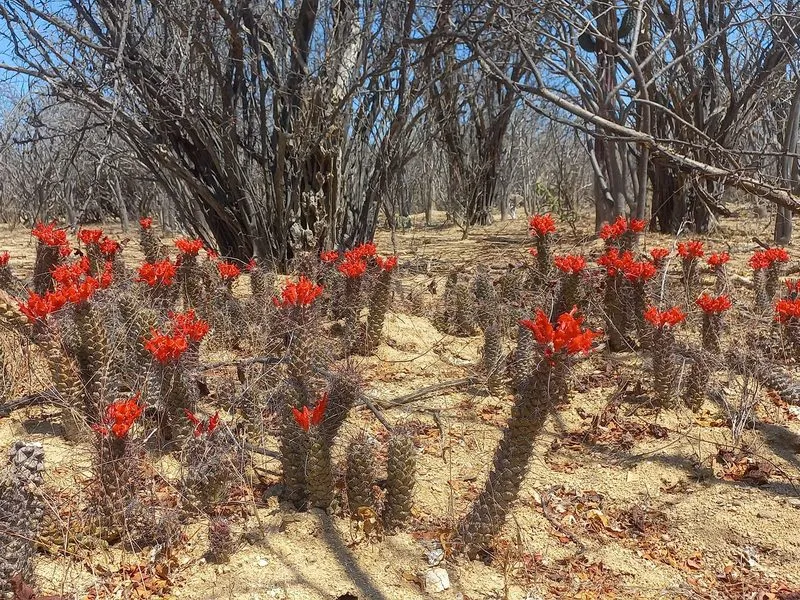
Flower form splits clearly along the pre- and post-revision lines. The Baja core species, including C. poselgeri and C. setispina, produce zygomorphic (bilaterally symmetrical) tubular flowers in deep scarlet red with protruding stamens and recurved petals, a classic hummingbird-pollination syndrome. This bilateral symmetry is unusual in Cactaceae and was the original defining character of the genus before the molecular revision. The former Mammillaria species produce actinomorphic (radially symmetrical) funnel-shaped flowers in saturated magenta to pink-purple. C. guelzowiana carries flowers up to 7 cm in diameter on a body only 4 to 10 cm across, a flower-to-body ratio essentially unmatched in the cactus family. C. theresae and C. saboae produce similarly oversized magenta blooms. C. blossfeldiana is a Baja Pacific outlier with distinctive bicoloured pink-and-white flowers and hooked central spines.
How cold-hardy is Cochemiea?
Cold tolerance is highly species-dependent and is the single most important variable for a grower placing a new acquisition. The lowland Baja California species, C. poselgeri and C. albicans, are maritime-climate plants experiencing very few hard frosts in nature; a safe cultivation minimum is 5°C, with brief dry excursions to −4°C reported. C. blossfeldiana occupies a similar maritime-coastal climate and has comparable cold tolerance. C. setispina, from the granite mountain interior of central Baja, experiences slightly colder winters; the safe minimum remains around 5°C. The mainland high-elevation species have more cold experience in nature: C. theresae at 2,150 to 2,300 m in the Coneto Mountains tolerates brief frost when fully dry, and C. guelzowiana survived the severe 1997 Mexican altiplano freeze that killed more than 95% of the wild population, meaning the surviving plants carry genuine cold-hardiness down to at least −5°C under dry conditions. None of the seven species covered here are suitable for unprotected outdoor cultivation in climates with sustained hard frosts.
What substrate does Cochemiea need in cultivation?
The site-wide 90/10 mineral-to-organic baseline applies, but Cochemiea has some of the widest within-genus substrate variation of any genus on this site. The Baja lowland species, C. poselgeri, C. albicans, and C. blossfeldiana, grow on mixed sandy and rocky substrates, and no cultivation source shows a lime requirement or a lime aversion for them; a neutral 90/10 mix of pumice, lava, zeolite, granite, silica grit, and worm castings suits them. C. guelzowiana and C. theresae grow on or over limestone rock in Durango. No cultivation source makes limestone a requirement for either; the house mix caps crushed limestone at 15 to 20% of the total as a house choice. C. setispina is a granite associate in the central Baja interior and the house mix leaves out limestone supplementation. Hard tap water already supplies calcium and bicarbonate, while rainwater and RO water supply neither. All seven species share two requirements: drainage that clears within 30 minutes of watering, and a completely dry substrate through the winter dormancy period. Shallow pots suit the species that are prone to crown rot in deep containers.
Is Cochemiea legal to own?
All Cactaceae are listed under CITES Appendix II as a blanket family, so cross-border movement of any Cochemiea plant or seed requires valid CITES documentation for commercial trade. No species in the genus carries an Appendix I listing. Within Mexico, C. guelzowiana is listed as amenazada (threatened) under NOM-059-SEMARNAT, and C. theresae is similarly protected under Mexican federal law. Nursery-propagated plants of documented origin are legal to buy, sell, and grow in the United States, Canada, the United Kingdom, the European Union, and Australia. Wild-collected specimens require full paperwork chains proving legal export from Mexico and CITES compliance at the border; the absence of such documentation on a plant is a red flag.
Which Cochemiea species are most endangered?
Cochemiea theresae and Cochemiea guelzowiana are both assessed as Critically Endangered by the IUCN. C. theresae is known from fewer than 250 mature individuals in a single population at the Coneto Mountains of Durango, with an extent of occurrence of just 99 km². Illegal collection is the primary documented threat, with trafficking seizures recorded in multiple countries. C. guelzowiana suffered a catastrophic population crash during the severe 1997 Mexican altiplano freeze, falling from an estimated 10,000 individuals to fewer than 500. Both species remain under intense collection pressure in the wild, which makes nursery-propagated seed grown stock the only defensible acquisition route for serious collectors. The other five species in this launch set carry Least Concern or unassessed IUCN status, though all have restricted ranges within Mexico and benefit from the CITES Appendix II family-level protection.
Trace any specimen to its wild origin in our Cochemiea field numbers database.