
Old Man Cactus
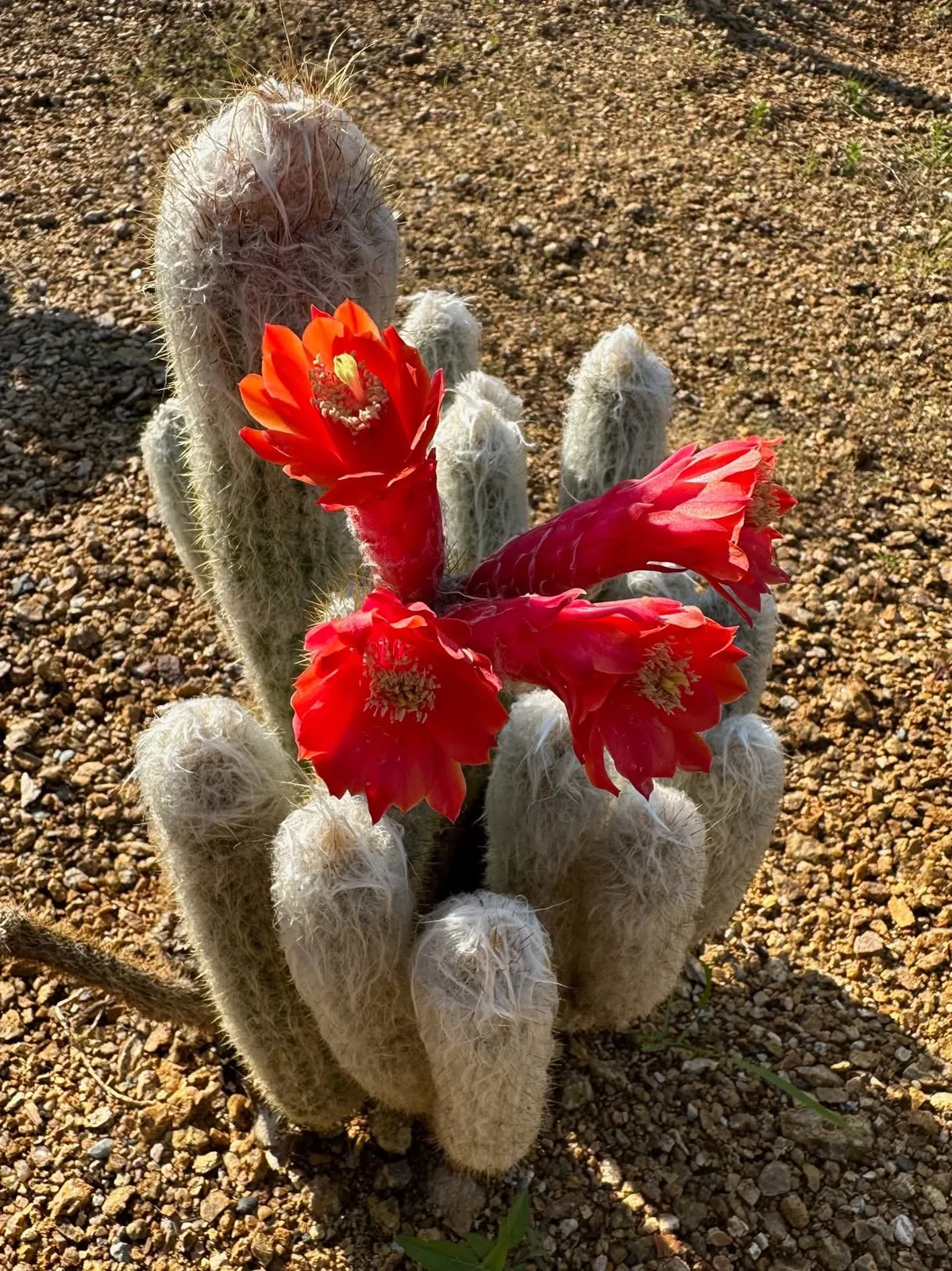
The old man cactus is instantly recognisable among columnar cacti in cultivation, identified at a glance by the mane of long, soft white hair that buries its green stem. That shaggy coat, more unkempt beard than tidy fur, is what gives the plant its common name and its Mexican nickname “viejito,” little old man.
Not every plant sold as “old man cactus” is the same species. The name is applied loosely to three unrelated columnar cacti: the Mexican Cephalocereus senilis covered on this page, the Peruvian Espostoa lanata, and the Andean Oreocereus celsianus. Range is the fastest way to sort them, and hair texture and bloom time settle the rest; the full comparison is in the Comparison section below.
The accepted botanical name is Cephalocereus senilis (Haw.) K.Schum., in family Cactaceae. The English botanist Adrian Hardy Haworth first described it in 1824 as Cactus senilis; the combination into Cephalocereus is credited to the German botanist Karl Moritz Schumann, known in botanical citations as K.Schum. Over the following century the plant was shuffled through several other segregate genera, turning up in older literature as Cereus senilis and Pilocereus senilis.
In the wild it grows only in Mexico, restricted to limestone canyon country in the states of Hidalgo and Veracruz, with its best-known population lining the walls of the Barranca de Metztitlán. In cultivation it could hardly be more different: this ranks among the most widely propagated columnar cacti in the international houseplant trade, raised by the million in nurseries and sold everywhere from specialist growers to supermarket garden sections. This entry is a reference page; rarecactus.com does not grow or offer this species.
Cephalocereus senilis quick reference
A slow columnar cactus from the limestone canyons of Hidalgo and Veracruz, grown worldwide as a compact container specimen. Values calibrated for cultivated container plants, drawn from habitat data and grower experience.
Taxonomy & nomenclature
The accepted name is Cephalocereus senilis (Haw.) K.Schum., in family Cactaceae. The basionym is Cactus senilis Haworth, published in 1824; the species was later recombined into Cephalocereus by the German botanist Karl Moritz Schumann, whose standard citation abbreviation is K.Schum. Over the nineteenth century the plant also passed through Cereus and Pilocereus, appearing in older literature as Cereus senilis and Pilocereus senilis.
Those older combinations still circulate on nursery labels and in older field guides, which is why a plant may be tagged with any of several names despite always being the same species. Kew’s Plants of the World Online keeps all of them in synonymy under the single accepted name used here.
The genus Cephalocereus groups a small number of columnar cacti native to Mexico and the Caribbean, several of which share the white-haired look that gives this species its common name. Cephalocereus senilis remains the genus’s best-known member and the one most widely grown outside its native range.
Historical synonyms (12)
- Cactus senilis Haw., 1824 basionym
- Cereus senilis (Haw.) Salm-Dyck ex DC., 1828 homotypic synonym
- Cephalophorus senilis (Haw.) Lem., 1838 homotypic synonym
- Echinocactus senilis (Haw.) Beaton, 1839 homotypic synonym
- Pilocereus senilis (Haw.) Lem., 1839 homotypic synonym
- Pilocereus senilis subsp. cristatus Mathsson, 1891 homotypic synonym
- Euporteria senilis (Phil.) Kreuz. & Buining, 1941 homotypic synonym
- Cephalocereus senilis f. cristatus (Mathsson) P.V.Heath, 1992 homotypic synonym
- Cephalocereus senilis f. fasciatus P.V.Heath, 1992 homotypic synonym
- Pilocereus senilis var. cristatus Mathsson, homotypic synonym
- Cactus bradypus Lehm., 1826 heterotypic synonym
- Cereus bradypus (Lehm.) Steud., 1840 heterotypic synonym
Sources: POWO (Kew) · IPNI · GBIF · Wikidata
Habitat
Cephalocereus senilis is confined in the wild to a narrow stretch of east-central Mexico, in the states of Hidalgo and Veracruz. Its signature population grows on the steep limestone walls of the Barranca de Metztitlán, a deep river canyon now protected as a UNESCO biosphere reserve, where the plant dominates the xerophilous scrub covering the canyon slopes.
Estimates of the extent of occurrence run to only around 2,170 square kilometres, a range small enough to weigh heavily in the species’s conservation assessment. Precise elevation figures are inconsistent across sources, but populations are commonly placed in a band roughly 1,000 to 2,000 metres.
The climate is markedly seasonal: a summer rainy season feeds the growing period, followed by a long, essentially dry winter, the same pattern that shapes cactus growth across highland central Mexico.
Morphology
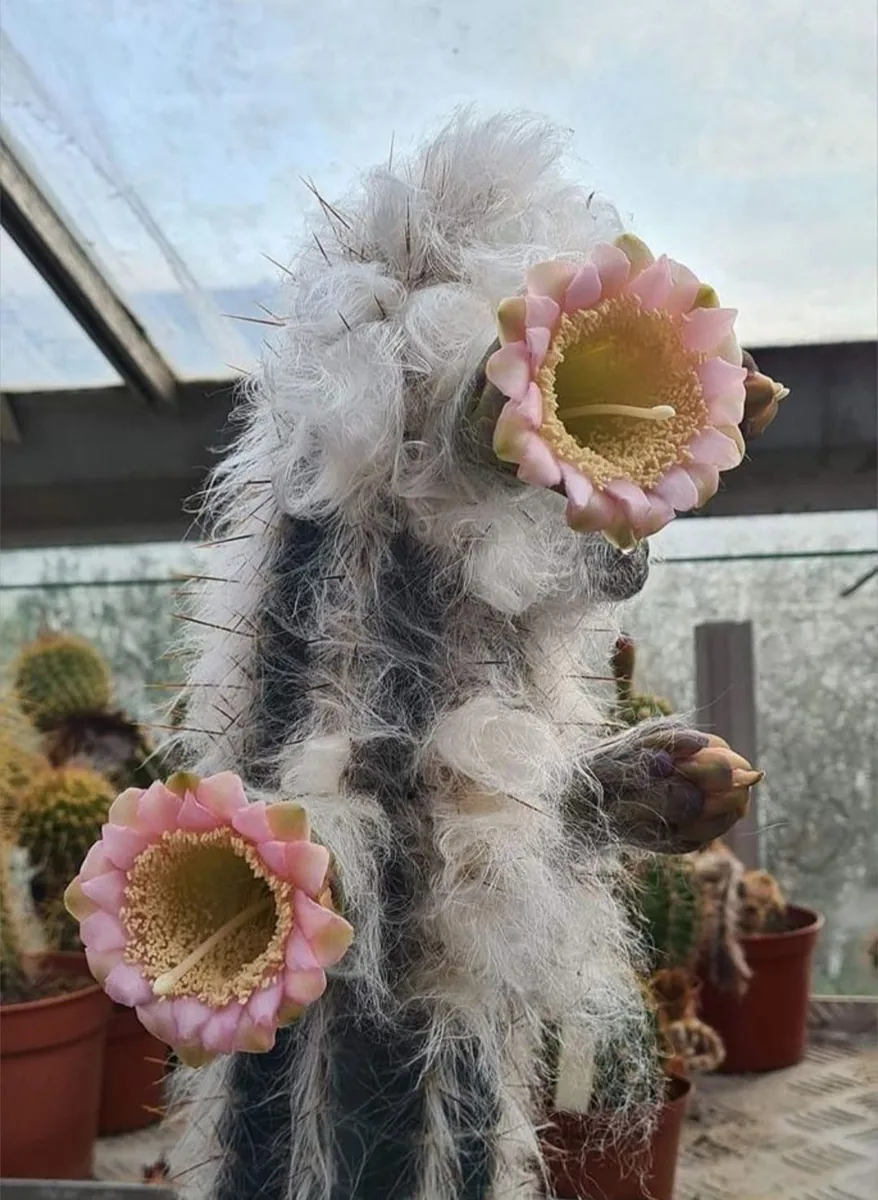
Wild plants grow as a solitary, unbranched column, occasionally producing basal branches with age or after injury, and can eventually reach 5 to 15 metres in height with a stem 30 to 45 centimetres across, carrying 20 to 30 low, gently notched ribs. Container-grown plants rarely approach that scale; most stay a modest few feet tall for decades.
The defining feature is the coat of long, soft, white to silvery hair-like bristles, technically modified radial spines rather than true hair, typically 6 to 14 centimetres long. The wool shields the stem from intense sun and buffers temperature swings; it grows densest and whitest on active new growth, while older, lower sections naturally dull and grey with age. Underneath, concealed from casual view, sit one to five stout yellow central spines, commonly three, up to about 5 centimetres long and sharp enough to draw blood despite the soft look of the plant from a distance.
On wild stems that reach roughly 6 metres or more, a lateral pseudocephalium, a dense zone of extra wool and bristles, develops and produces the plant’s nocturnal, funnel-shaped flowers, each about 8 to 9 centimetres long in shades reported from pale pink to whitish. Flowering this way typically does not begin until the plant is 10 to 20 years old, a threshold container specimens rarely reach.
Locality detail
The species is native only to Mexico, in the neighbouring states of Hidalgo and Veracruz, with its best-documented population on the limestone cliffs of the Barranca de Metztitlán. The map below marks that signature locality as a regional centroid; precise coordinates for a CITES-listed, historically over-collected species are withheld.
Because the plant grows on steep, largely inaccessible canyon walls, wild populations are difficult to survey, which is part of why range and population figures are not consistently published. Nearly every plant available commercially today, in contrast, was propagated in nurseries far from these canyons.
Cultivation
Two habitat facts shape care: the plant roots in bare, fast-draining limestone where water never pools, and its body is wrapped in a dense hair coat that holds moisture landing on it. Match both and the species is forgiving; ignore either and it rots from the crown with little warning.
Substrate
Pot it in a sharply draining, mineral-dominant mix of roughly 35 per cent pumice, 20 per cent decomposed granite, 15 per cent lava rock, 15 per cent crushed limestone, 5 per cent zeolite and 10 per cent low-nutrient organic base. The limestone chip is a house formulation choice, not something the species is known to need or avoid, and your water matters as much as the grit: hard tap water already supplies calcium and bicarbonate at every watering, while rainwater and RO water supply neither. The pumice and granite handle the fast drainage a cliff-rooted cactus needs.
As the only Cephalocereus species covered here, its mix follows the site’s standard mineral-forward Cactaceae baseline, plus the crushed limestone share explained above.
| Species | Pumice | Lava | Zeolite | Granite | Limestone | Silica | Organic |
|---|---|---|---|---|---|---|---|
| Cephalocereus senilis (this page) | 35% | 15% | 5% | 20% | 15% | 0% | 10% |
Watering and light
From spring through autumn, soak the mix thoroughly and then let it dry out completely before watering again, aiming water at the soil rather than over the plant. The dense hair traps droplets against the stem, and standing moisture in that coat is the most common route to rot. Cut watering back sharply for winter, mirroring the long dry season of its native canyons. Give it full sun outdoors, or bright light with several hours of direct sun through a south-facing window indoors; strong, consistent light is what keeps new hair dense and bright rather than sparse and dull. Keep it above roughly 5–10°C (41–50°F), and never let cold and wet coincide.
Growth is slow by any measure, commonly cited around 20 centimetres of new height a year under good conditions, and a container specimen can stay a modest size for many years. Nursery propagation from seed is the standard commercial route and is credited with supplying most of the plants now in the trade, easing demand on the wild populations described above.
Comparison
“Old man cactus” is not a name unique to one species. It is used, loosely and inconsistently, for three different columnar cacti native to two separate continents, and a plant carrying that label in a shop or a search result could be any of the three.
| Character | Cephalocereus senilis (this page) | Espostoa lanata | Oreocereus celsianus |
|---|---|---|---|
| Common name | Old man cactus, old man of Mexico | Peruvian old man cactus, snowball cactus | Old man of the Andes |
| Native range | Mexico only – Hidalgo and Veracruz | Andes – southern Ecuador to northern Peru | Andes – Peru, Bolivia, Argentina |
| Elevation | Mid-elevation semi-arid canyons | Andean slopes | High Andes, roughly 2,600–4,000 m |
| Hair & spines | Long, soft, sparse-looking white hair; sharp yellow spines mostly hidden beneath | Denser, neater woolly covering; bristly spines project through it | White hair plus conspicuous orange-yellow to brown spines showing through |
| Flowering structure | Lateral pseudocephalium on mature stems; night-blooming | True lateral cephalium; night-blooming | No cephalium, flowers direct from areoles; day-blooming |
| IUCN status | Endangered | Least Concern | Least Concern |
Range is the fastest way to sort them: a Mexican plant is Cephalocereus senilis, while an Andean plant is one of the other two. Between the Andean pair, Espostoa lanata carries a denser, more uniform wool with a true lateral cephalium and night-blooming flowers, while Oreocereus celsianus shows more spine through a looser hair coat, forms no cephalium, and flowers by day. Both South American species are rated Least Concern by the IUCN, in clear contrast to the Mexican species covered on this page.
Frequently asked questions
How do you care for an old man cactus?
Give it full sun or very bright light, a fast-draining mineral-heavy mix, and a thorough soak followed by a complete dry-out before the next watering. Cut back hard in winter and keep it above roughly 5–10°C (41–50°F); it has essentially no frost tolerance.
How fast does an old man cactus grow, and how tall does it get?
It is a slow grower, adding only a few centimetres of height a year under good conditions. In its native Mexican canyons it can eventually reach 5 to 15 metres over many decades, but as a container plant it typically stays a modest few feet tall for years.
How do you keep the white hair on an old man cactus looking full and white?
Strong, consistent direct light is the single biggest factor in dense, bright new growth. Avoid letting water pool in the wool when you water, and clear out trapped dust occasionally; some dulling and greying of the older, lower hair is a normal part of ageing rather than a care problem.
Is the old man cactus rare?
In the wild, yes: it survives only in a small stretch of limestone canyon country in Hidalgo and Veracruz, Mexico, and is legally protected there. In cultivation the picture flips entirely: it ranks among the most widely propagated columnar cacti in the international houseplant trade, which is exactly why choosing a nursery-grown plant over a wild-collected one matters for its future.
Why is it called “old man cactus,” and is every plant sold under that name the same species?
The name comes from the long, shaggy white spines that resemble an unkempt beard. But the label is also used for two unrelated South American cacti, Espostoa lanata and Oreocereus celsianus, so a plant tagged “old man cactus” could belong to any of three different genera. Only the Mexican Cephalocereus senilis covered on this page is the original, classic old man cactus; see the Comparison section above to identify which one you actually have.
Sources & further reading
Kew Plants of the World Online (POWO), Cephalocereus senilis (Haw.) K.Schum. · Haworth, A.H. 1824. Cactus senilis. Philosophical Magazine and Journal 63: 41 (basionym) · World Flora Online (WFO) and Wikispecies, Cephalocereus senilis (synonymy cross-reference) · IUCN Red List of Threatened Species, Cephalocereus senilis (Endangered) · CITES Cactaceae Checklist (Kew), family-wide Appendix II listing · Mexico NOM-059-SEMARNAT-2010, species-at-risk listing · Barranca de Metztitlán Biosphere Reserve materials, UNESCO Man and the Biosphere Programme · LLIFLE Encyclopedia of Cacti, Cephalocereus senilis (morphology, distribution, cultivation) · North Carolina State Extension Gardener Plant Toolbox, Cephalocereus senilis (USDA zones, care) · Wikipedia, Espostoa lanata and Oreocereus celsianus (comparative range, cephalium structure, IUCN status)