
Avonia herreana
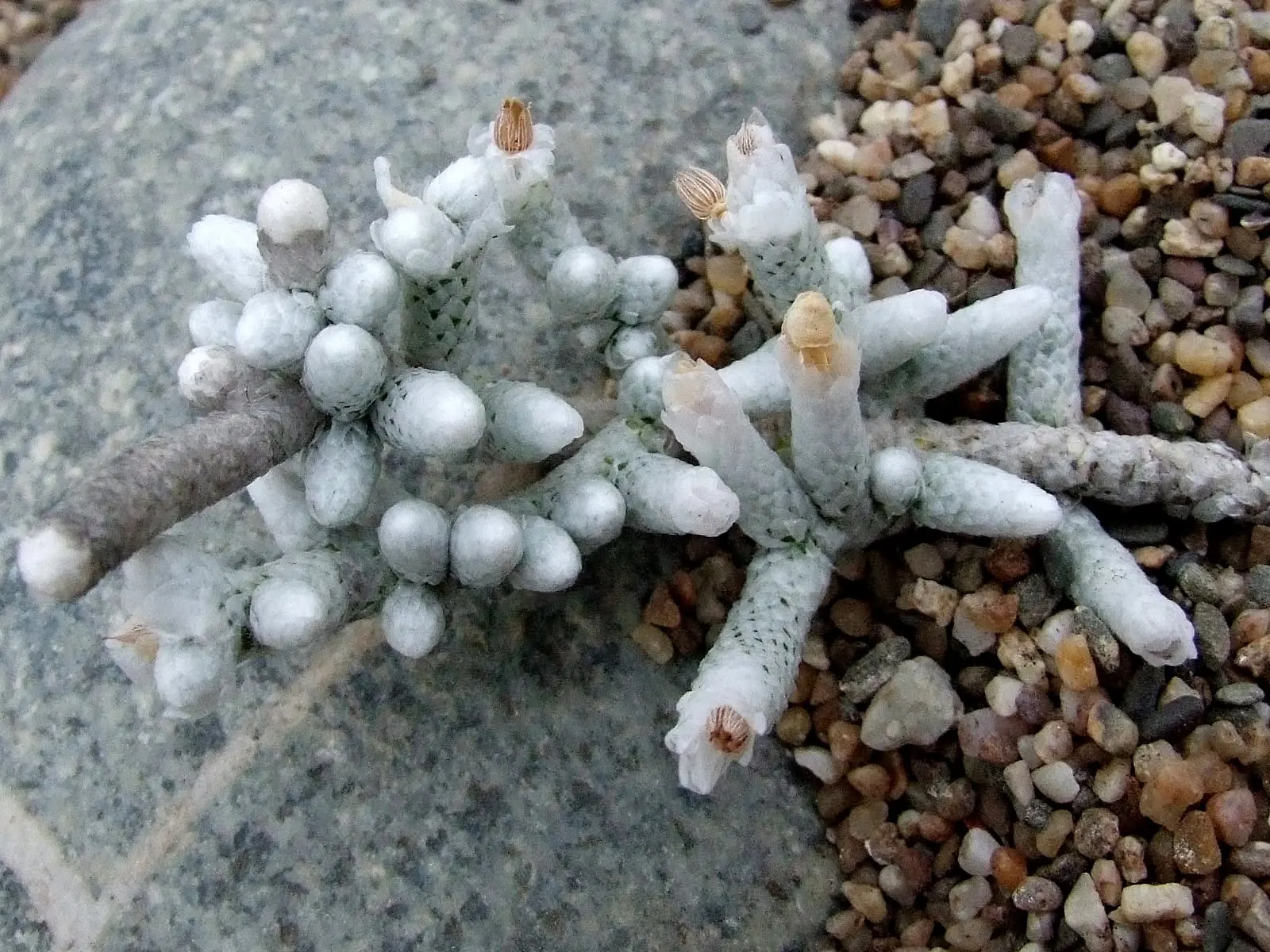
Avonia herreana hides its leaves the way the whole genus does, but it does the job badly, and that is how you know it. Slender branches, decumbent and divided, run to about 100 mm and are sheathed in papery stipular scales. On every sibling those scales clamp shut. Here they sit loosely enough that the green leaves stay partly visible between them, a shagginess you can read across a bench.
The plant is a dwarf tuberous perennial of the Central Richtersveld, and its range is small enough to state exactly: an extent of occurrence near 55 km², across three to four known locations, all of them in South Africa’s Northern Cape. It grows on quartz outcrops and quartz flats, and on west-facing shale ridges, where pale scaled branches on pale stone are close to invisible.
Karl von Poellnitz described it in 1930 as an Anacampseros. Gordon Rowley moved it to Avonia in 1994, and that is the name the plant is traded, photographed and searched under. Kew disagrees and keeps the plant in Anacampseros; both positions have current backing and neither has been withdrawn.
Flowers are white, solitary at the branch tips, with about ten stamens. They open in the southern summer, which is the dry half of this plant’s year, and the genus is known for blooms that last hours rather than days. Most growers never catch one.
Avonia herreana quick reference
A quartz and quartzite specialist from the Central Richtersveld, on west-facing ground that takes gentle winter rain and summer fog and little else. Values calibrated for seed grown plants in cultivation.
Taxonomy & nomenclature
The accepted name is Avonia herreana (Poelln.) G.D.Rowley, the combination Rowley made in Bradleya 12 in 1994 when he raised Avonia from a section of Anacampseros to a genus in its own right. The basionym is Anacampseros herreana Poelln., published in Repertorium Specierum Novarum Regni Vegetabilis 28: 30 in 1930. The epithet honours Hans Herre. Poellnitz is the sole basionym author here. Three of this plant’s siblings carry a live dispute over whether their basionym belongs to E.Mey. ex Fenzl or E.Mey. ex Sond., but that argument does not reach herreana.
Two major authorities disagree about whether Avonia exists. Kew’s Plants of the World Online sinks the genus into Anacampseros and accepts zero Avonia names; for this plant it accepts Anacampseros herreana Poelln. and files Avonia herreana as its single homotypic synonym. The GBIF backbone taxonomy accepts Avonia herreana and treats the Anacampseros name as the synonym. South Africa’s national Red List follows Kew. The CITES database follows Kew. This site follows GBIF and prints the Kew name alongside it, because the disagreement is real and unresolved. Kew itself records the point: its Publications tab for this species logs the Avonia treatment as an alternative taxonomy proposed by Govaerts in 1995.
The practical consequence is small. Both names refer to the same plant and the same type, so a permit, a label or a seed packet reading Anacampseros herreana is not a different species. Search behaviour has already voted: Google returns the Avonia name on these queries and largely ignores the Anacampseros one. The family is Anacampserotaceae under every current authority, and the older Portulacaceae placement survives only as a legacy field in some databases. Rowley circumscribed nine species; later authors added five more, giving the roughly fourteen that CITES itself publishes. Seven of them are covered here, among them Avonia quinaria and Avonia papyracea. No infraspecific name has ever been published under herreana, and no heterotypic synonym exists.
Historical synonym (1)
- Anacampseros herreana Poelln., 1930 basionym
Sources: GBIF
Habitat
Avonia herreana is a Central Richtersveld endemic. The national Red List gives its habitat as quartz outcrops and flats within the Western Gariep Hills Desert; the flora treatment gives quartzite outcrops; a Richtersveld National Park plant list places it among west-facing shale ridges. Those are three different rocks and two of them are silica, which is why the growing mix leads with silica grit rather than with pumice.
The climate is the part that matters most, and it splits this genus. The Richtersveld runs two rainfall regimes. The western and higher ground takes highly predictable, gentle winter rain plus fog, roughly 150 mm a year, with the fog peaking between April and August. The eastern sections sit in the mountains’ wind shadow, get almost no winter precipitation, and see occasional heavy summer thunderstorms instead. West-facing ridges put herreana on the winter-rain-and-fog side, not the summer-rainfall Bushmanland habitat most of the genus occupies, so its growing season runs opposite to theirs. Avonia mallei is the other winter-rainfall taxon on this hub.
Scarcity here is a habitat measurement, not an adjective. An extent of occurrence of 55 km² and three to four locations is the whole known world of this species, and the coordinates on public occurrence records are deliberately blurred to roughly 30 km because of collecting pressure. Nineteen occurrence records exist worldwide, spanning 1934 to 2014, with herbarium material at Pretoria and Kirstenbosch and living collections in Zürich and Edinburgh. The surrounding desert shrubland is dominated by stem-succulent chamaephytes on gypsum crusts and quartz fields; the park as a whole carries 1,077 indigenous taxa, with Aizoaceae the second-largest family, which is the company this plant keeps even though no named associate has been recorded growing alongside it.
Morphology
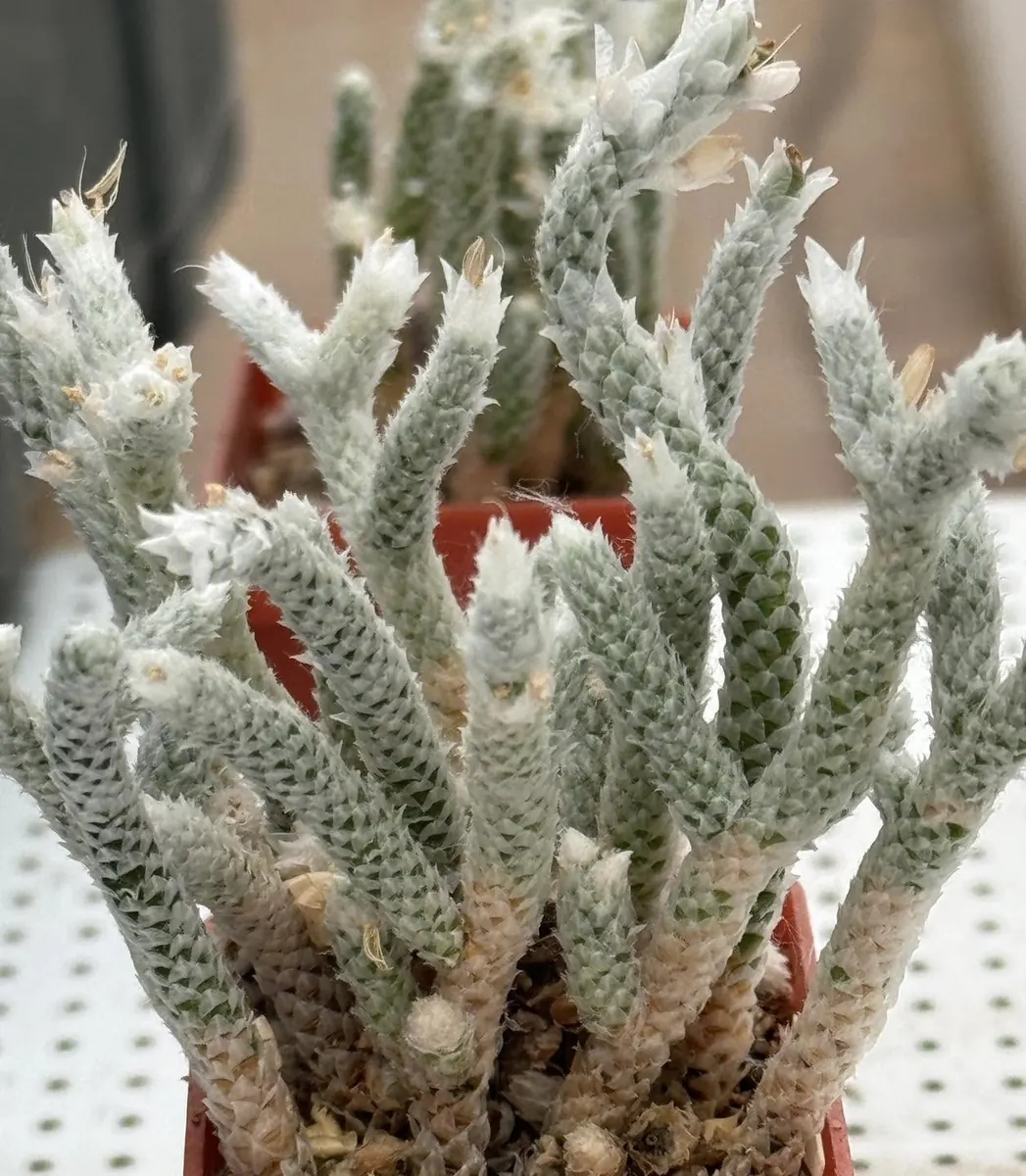
Avonia herreana is a dwarf tuberous perennial whose slender decumbent branches run to about 100 mm and whose papery stipular scales sit loosely enough to leave the green leaves partly exposed. One full botanical description of it exists, a flora treatment in the Extra Cape Flora, and it is short enough to exhaust in a paragraph: branches decumbent, divided, slender, up to 100 mm long. Leaves partly exposed by stipular scales, the scales broadly ovate to lanceolate, slightly hooded with a recurved tip, often carrying a darker midvein. Flowers solitary at the branch tips, subsessile, white, with about ten stamens. Summer.
The diagnostic is the first clause. Leaves partly exposed by stipular scales is an architectural statement, not an impression: the scale covers the leaf incompletely, at every size and every age. Every other Avonia on this hub buries its leaves outright. Trade descriptions reach for the same character in looser words, calling the scales loosely positioned or the plant shaggy, and they are describing the same thing less usefully.
Several dimensions have never been published for this species: no caudex diameter, no plant height, no flower diameter, no fruit and no seed description. The only measurement on record is that 100 mm branch length. Flower colour has been contested by a single retail listing claiming yellow, against a flora treatment and two further sources saying white or greenish-white, and photographs show white. A field-collected line from Kuboos has been described in the trade as having brown-edged scales, which is neither the darker midvein the flora describes nor a character any botanical source supports, so it is not a species trait.
Locality detail
Avonia herreana is endemic to the Central Richtersveld in the Northern Cape of South Africa. The map shows a regional centroid. Precise localities are not public: occurrence records are already obfuscated at source to roughly 30 km because the plant is collected illegally.
Kew’s summary line for this species reads Western Cape Province, while its own distribution block on the same page reads Cape Provinces, the wider region code covering Northern, Western and Eastern Cape. The national Red List, the flora treatment and the georeferenced occurrence cluster all agree on the Northern Cape and the Richtersveld, and exactly one Western Cape record exists: an herbarium sheet gathered in 1934 by the man the plant is named for. A single legacy label appears to be doing the damage. Anyone reading a Western Cape range for this plant is reading an artifact. A type sheet at Kew is separately labelled South West Africa, which cannot be right for a South African endemic, so the type locality remains unresolved.
Cultivation
Avonia herreana is an intermediate-level plant: full sun, a mix that runs 95 per cent mineral and leads with silica grit, a small shallow pot, and water through the cool half of the year rather than the warm one. The difficulty is the watering window, not the drought.
Two things frame it, and only one of them is the obvious one. The obvious one is that it comes from a hyper-arid quartz desert taking about 150 mm of rain a year. The other is that Avonia is not a keep-it-dry genus in the way that reads: too much water kills these plants immediately, and so does no water at all. The window is narrow at both edges, and most losses come from a grower who picked one edge and committed to it.
No cultivation literature exists for A. herreana specifically. Its habitat is well documented and species-specific.
Substrate
Mix 32 per cent silica grit, 28 per cent pumice, 15 per cent lava, 12 per cent granite grit, 8 per cent zeolite, 5 per cent organic matter, and no limestone. Silica, granite and lava are house-formulation figures here: no published source gives a mineral proportion for this species, so treat the split between them as a working convention rather than a reading of the rock this plant grows on. Pumice carries aeration and buffers the fog and dew moisture the plant is built to use; the roots are shallow, so the top third of the profile has to wet and dry fast. Lava adds drainage that will not break down plus thermal mass, which suits a plant that sits exposed rather than buried. Granite grit is inert ballast for a top-heavy branching plant in a shallow pot. Zeolite carries the cation exchange that a mix with only 5 per cent organic matter would otherwise lack entirely, and 5 per cent is the rot-class figure this genus runs on rather than a number specific to this species.
Limestone is left out at zero, and that zero is a genuine gap rather than a finding: no source in the cultivation literature for this genus, this species included, recommends lime for any Avonia, and none reports harm from it either. Calling the plant a calcifuge or a calcicole on that basis would be reading the number stronger than the evidence supports, so this page makes neither claim; zero is simply the honest default with no cultivation source addressing the question one way or the other. The widely syndicated advice for this genus recommends a commercial mix with 50 to 70 per cent grit and ingredients this site avoids; that mineral fraction sits far below the 95 per cent used here.
Organic and limestone are the two components with cultivation evidence behind them, and both are held to the same values across all seven Avonia: organic at 5 per cent, set by the rot-class evidence for arid caudiciform succulents, and limestone at 0 per cent, because no cultivation source in the literature recommends lime for any Avonia. The remaining columns (pumice, lava, zeolite, granite, silica) are house-formulation figures that set drainage and particle size in the pot; they vary from page to page as a growing convention, not because any source ties a percentage to a species’ own rock.
| Species | Pumice | Lava | Zeolite | Granite | Limestone | Silica | Organic |
|---|---|---|---|---|---|---|---|
| A. quinaria | 41% | 8% | 10% | 8% | 0% | 28% | 5% |
| A. papyracea | 37% | 18% | 10% | 10% | 0% | 20% | 5% |
| A. albissima | 30% | 15% | 8% | 15% | 0% | 27% | 5% |
| A. herreana (this page) | 28% | 15% | 8% | 12% | 0% | 32% | 5% |
| A. ustulata | 50% | 15% | 15% | 10% | 0% | 5% | 5% |
| A. dinteri | 35% | 20% | 10% | 20% | 0% | 10% | 5% |
| A. mallei | 30% | 20% | 12% | 20% | 0% | 13% | 5% |
Watering and light
Start from what the habitat does. Rain falls on this plant in the southern winter, gently and predictably, and fog carries it from April to August. Transposed to a northern bench, the wet half of its year is roughly October to March. Genus-level growing sheets run the opposite calendar, watering March to October and drying off in winter, and that advice is repeated widely enough to look like consensus even though it traces back to a small number of sources. It is a statement about how European and North American benches are run, not a phenology finding: no phenology study of this species exists. Water on the cool side of the year, hold back through the hottest weeks, and watch the plant rather than the calendar. Reports across the genus describe plants that shift seasons opportunistically, going flaccid under one regime and staying plump under another, which is a reason for nobody to be dogmatic here.
Full sun, and plenty of it. The white scales are a solar-reflectance structure that protects the leaves underneath them, and high light is what produces flowers and compact growth. Keep the scales themselves dry: water the soil, not the plant. Cold tolerance runs to about -5°C on the genus sheets, but only for a bone-dry plant, and the most experienced published grower of this genus declines to give a number at all and advises against frost exposure. The one species-tagged figure is more conservative, at about -1°C. Take the conservative end unless you have reason not to.
Propagation and provenance
Seed is the route. Sow at 15 to 21°C, which is a notably cool germination window that fits a cool-season grower, and expect germination in about two weeks. Keep the sowing moist until it germinates, then move deliberately toward the adult regime, because the seedling that tolerates constant moisture becomes the adult that dies of it. Most Avonia are self-fertile and set seed without help; A. quinaria is the known exception and needs two plants and a brush. No grafting practice is documented for this species or for any plant in the genus, so treat any grafted Avonia offered to you as an unexplained curiosity rather than a shortcut.
At rarecactus.com we build every page in this genus around seed-grown provenance, and A. herreana is the sharpest case for it anywhere in Avonia. The national Red List names illegal collection of mature wild plants as a driver of this species’s decline, with local declines already recorded. Meanwhile seed is exempt from CITES paperwork when it comes from artificially propagated plants, and it sells for a couple of dollars a packet when a vendor has it. The scarcity is in the habitat, not in the trade. That gap is the whole argument: a plant that is hard to find in the wild and cheap to raise from seed has no defensible reason to be dug up, and every wild-collected specimen on a shelf is a choice somebody made against an easier option.
On the legal side, the trade in this plant is regulated through the CITES listing of Anacampseros spp. on Appendix II, which has been in force since 1975 and carries an annotation reading “Includes Avonia spp.” There is no separate Avonia listing; the genus is covered by that annotation rather than in its own right. The current annotation exempting seed dates from 2010, not from the original listing. One member of the genus, A. quinaria, was transferred to Appendix I in March 2026 and is now a different legal proposition; herreana was not part of that transfer and remains on Appendix II. Whole plants need paperwork to cross a border. Seed of artificially propagated plants does not.
Comparison
Avonia herreana is most easily confused with Avonia albissima, and that is the real confusion risk rather than the superficial one. The two share the broadly ovate white scale architecture, share the flower formula down to the stamen count, and actually overlap in the Richtersveld. Better still, both are described by the same author in the same flora, so the differences between them are real character differences rather than two botanists using words differently.
Four characters separate them and all four hold at any growth stage. A. herreana leaves its leaves partly exposed; A. albissima hides them. A. herreana has scales broadly ovate to lanceolate; A. albissima is ovate and never lanceolate. A. herreana has a slightly hooded scale apex with a recurved tip; A. albissima is truncate. A. herreana often shows a darker midvein, a line; A. albissima sometimes shows a dark blotch at the tip, a spot. Different structures, not different intensities. The first character alone will do it.
Three things that look like discriminators are not. Range does not separate them inside the Richtersveld, where both occur, though any plant found outside it is albissima, which ranges from southern Angola through Namibia to Griqualand West. Habitat does not separate them either, because albissima’s is described too broadly to exclude quartz. And the published measurements do not, because 100 mm of branch length and 40 mm of height are measured on different axes and are not a numeric key. Elsewhere in the genus the separations are easier: Avonia ustulata wears a rusty brown scale apex and belongs to a different corner of the country, while A. quinaria carries a turnip caudex, scales ranked in fives, and flowers to 3 cm that nothing here approaches.
Frequently asked questions
How do you grow Avonia herreana?
Full sun, a mix that is 95 per cent mineral and led by silica grit, the smallest shallow pot that holds the plant, and water on the cool side of the year. It is an intermediate-level plant, and the difficulty is not drought tolerance but the narrowness of the watering window: too much water kills it immediately, and none at all kills it too. Keep the papery scales dry by watering the soil rather than the plant.
How do you propagate Avonia herreana?
From seed. Sow at 15 to 21°C and expect germination in about two weeks, keeping the sowing moist until it comes up and then moving steadily toward the lean adult regime. Most Avonia are self-fertile and set seed unaided, so a single plant can supply you. No grafting practice is documented for this species, and vegetative propagation of it has not been described.
When does Avonia herreana go dormant?
No phenology study of this plant exists. Rain reaches it in the southern winter, gently and predictably, with fog from April to August, and it grows on the west-facing ground that receives them. That puts its wet season in the northern-hemisphere autumn through spring and its rest in high summer, which is the opposite of the March-to-October calendar the genus sheets recommend. Those sheets describe how northern benches are run rather than what this species does at home. Water on the cool side and let the plant tell you the rest.
How often should Avonia herreana be watered?
Less often than a leafy succulent and more often than a hard-dry cactus, which is why this genus catches people out. Soak when the mix has dried through during the cool growing months, then let it dry completely before the next one. Through the hottest weeks reduce hard, but do not walk away for the season: plants in this genus die from being left dry as readily as from being overwatered. Water the soil, never the scales.
What is the common name for Avonia herreana?
It does not have one. No vernacular name for this species appears in any published source, and inventing one would help nobody find it. Search for Avonia herreana, which is the name the plant is traded and photographed under and the one Google returns. You will also meet it as Anacampseros herreana, the name Kew accepts, since Kew sinks Avonia into Anacampseros while the GBIF backbone keeps the two apart. Same plant, same type, two authorities that have not agreed.
Sources & further reading
Poellnitz, K. von. 1930. Zur Kenntnis der Gattung Anacampseros L. III. Repertorium Specierum Novarum Regni Vegetabilis 28(1–5): 27–32 (Anacampseros herreana at p. 30) · Rowley, G.D. 1994. Avonia. Bradleya 12(prepr.): 111–112 (Avonia herreana comb. nov. at p. 111) · IPNI, International Plant Names Index, urn:lsid:ipni.org:names:978181-1 and urn:lsid:ipni.org:names:698258-1 · Kew POWO, Anacampseros herreana Poelln., powo.science.kew.org/taxon/urn:lsid:ipni.org:names:698258-1 (accepted name; Avonia herreana listed as homotypic synonym; Govaerts 1995 logged as alternative taxonomy) · GBIF Secretariat, GBIF Backbone Taxonomy, Avonia herreana (accepted; key 5646654) and the occurrence dataset (19 records, Northern Cape) · Snijman, D.A. 2013. Anacampserotaceae. In: D.A. Snijman (ed.), Plants of the Greater Cape Floristic Region 2: The Extra Cape Flora, Strelitzia 30: 239–241. SANBI, Pretoria · von Staden, L. 2016. Anacampseros herreana Poelln. National Assessment: Red List of South African Plants version 2024.1 (Endangered B1ab(iii,v)+2ab(iii,v)) · Raimondo, D. et al. 2009. Red List of South African Plants. Strelitzia 25. SANBI, Pretoria (earlier assessment, under Avonia herreana) · UNEP-WCMC, Species+ / CITES Checklist, Anacampseros herreana (Appendix II via the Anacampseros spp. genus listing, annotation #4; EU Annex B) · van Wyk, P., Bezuidenhout, H. & Jürgens, N. 2024. A checklist of indigenous flora in the Richtersveld National Park. Koedoe 66(1): 1822 · Mucina, L. & Rutherford, M.C. 2006. The Vegetation of South Africa, Lesotho and Swaziland. Strelitzia 19. SANBI, Pretoria (Western Gariep Hills Desert) · Driskill, E. 2009. Avonia. Plant of the Month, October 2009. Henry Shaw Cactus and Succulent Society · Desmet, P.G. Namaqualand, South Africa: an overview of a unique winter-rainfall desert ecosystem. Plant Ecology · World of Succulents, How to Grow and Care for Avonia (genus-level cultivation, germination window, cold floor)