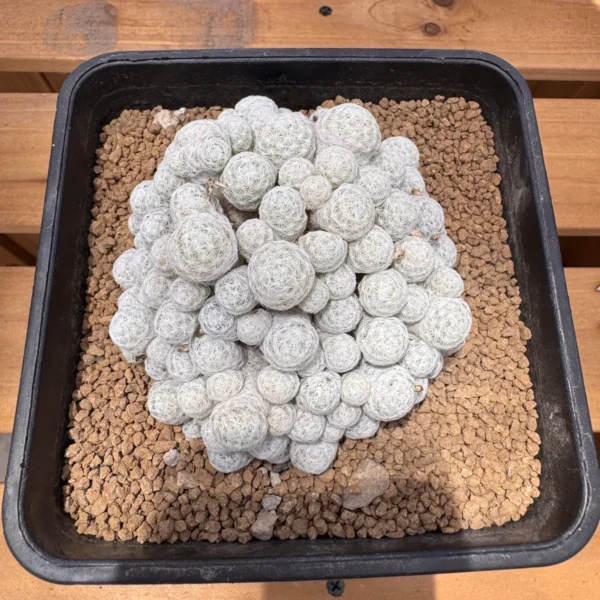
Mammillaria luethyi MZ 1753
Lot MAMM-LUET-01 22 available, sold individually
$84.00
- Plant: Mammillaria luethyi MZ 1753
- Cultivation: seed grown, with a strong root system
- Size: about 2 cm
- Field data: MZ 1753, Ciudad Acuña, Coahuila
- Listing: one plant from the batch pictured, sold individually
- Grown: cultivated in our greenhouse
22 in stock
This specimen is one of a kind. The photos show the exact plant you'll receive.
Description
Type: Seed grown · Size: about 2 cm · Field data: MZ 1753, Ciudad Acuña, Coahuila · 22 plants available
Mammillaria luethyi is the button-sized Coahuilan cactus that spent 44 years known only from photographs, and this is a rare chance to buy it seed grown with documented field data. The 22 plants for sale in this batch were all raised from seed in our greenhouse under the collection number MZ 1753, recorded at Ciudad Acuña in northern Coahuila. The photographs show representative plants from the batch; you will receive one plant of the same size and character, with the field data on its label.
What makes Mammillaria luethyi different
The whole visible plant is a green head about a centimetre and a half across, sitting on a carrot-like succulent taproot that keeps most of the body underground. Each tubercle carries up to 80 tiny spines fused into a soft, umbrella-tipped white cluster, a spine architecture recorded in no other cactus, so the surface reads as rows of white buttons rather than anything armed. In flower it throws violet-magenta blooms nearly as wide as the head itself, white at the throat with orange anthers.
The species is also cryptocarpic. The fruit ripens completely inside the stem instead of pushing out of it, leaving a hollow that holds up to 15 seeds, and those seeds often release only when the mother plant splits or dies. In habitat the head contracts into the ground through drought until only the spine crown sits flush with the limestone, which is a large part of how the species evaded botanists for so long.
Lost for 44 years
In 1952 the American botanist Norman Boke photographed flowering plants of an unknown cactus at Mrs Crosby’s hotel in Ciudad Acuña, brought in by a mining prospector. The material sent on to Missouri Botanical Garden died without identifiable seed, and for four decades the species existed only in those photographs while Backeberg, Buxbaum, and Glass and Foster argued over which genus they showed. The Swiss botanist Jonas Lüthy worked the old account against topographic maps of Coahuila until, in late 1995, he could put a finger on the probable ground. George S. Hinton walked it the following spring, found the plants, and published the species that autumn in Phytologia, naming it for the man who located it on paper. The accepted record lives at Kew: Mammillaria luethyi G.S.Hinton. Our Mammillaria luethyi specimen page tells the full story with habitat detail.
How we grow it
At rarecactus.com we grow every Mammillaria luethyi in this batch from seed in our own greenhouse, and none are grafted. That distinction matters more here than in most of the genus. Grafted stock of this species balloons into soft, oversized heads that offset heavily and lose the flat, half-buried habit that defines the plant in habitat. Seed grown plants keep the tight proportions, the dense white spine buttons, and the true taproot, and simply take longer to get there. A seed grown 2 cm plant with a strong taproot represents years of patient growing, not months. We keep them in a lean, fully mineral pumice mix with a limestone component, watered only when bone dry, in strong light with steady airflow. Our Mammillaria care guide covers the regime step by step.
Field data and provenance
MZ 1753 is a collection number of Milan Zachar, recorded at Ciudad Acuña, Coahuila, and you can look the number up yourself in our Field Number Database. Field data is what separates a plant from a documented plant: you know which population your plant’s seed line traces back to. The wild localities themselves remain unpublished by the discoverers to protect the species, and nothing we sell touches them. These plants are greenhouse raised from cultivated seed. Mammillaria sits on CITES Appendix II, and artificially propagated stock like this is the lawful, ethical way to own the species.
When your plant arrives
Your Mammillaria luethyi ships well rooted and packed dry for transit. Pot it straight up into a sharply draining mineral mix in a pot deep enough to respect the taproot, settle it in bright indirect light, and withhold water for about 14 days before the first cautious soak. After that, treat it as the slow, tough little limestone plant it is: strong light, sparse water, and a completely dry winter rest. Browse the rest of the genus on the Mammillaria encyclopedia hub.
Shipping & Returns
Shipping
Flat $12 shipping anywhere in the United States, for one plant or several. Orders ship within 1 to 3 business days and usually arrive 2 to 5 business days later. Every plant is packed by hand to travel safely.
Returns
Each specimen is a living, one of a kind plant, so all sales are final and we do not accept returns or exchanges. If a plant arrives dead, take clear photos of the plant and the packaging within a couple of days of delivery and email brian@rarecactus.com. If anything else about your order is not right, tell us and we will help where we can.