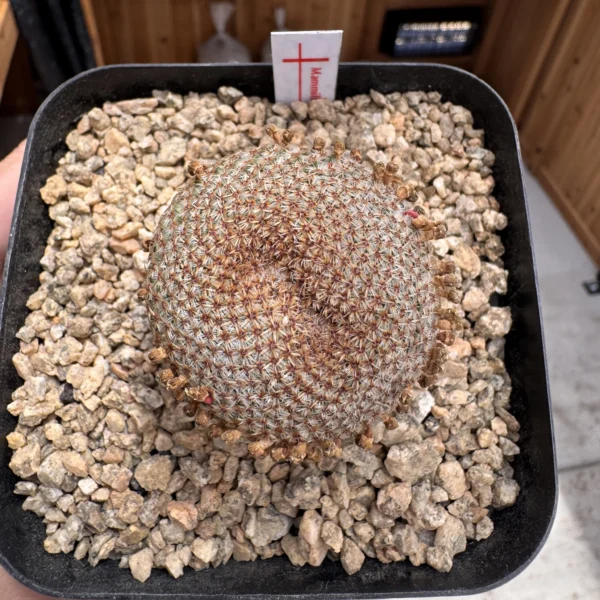
Mammillaria crucigera (Specimen B)
Lot MAMM-CRUC-02 1 of 1 the exact plant pictured
$142.00
- Plant: Mammillaria crucigera (Specimen B)
- Cultivation: seed grown, with a strong root system
- Size: about 4.6 cm (1.8 in) across
- Listing: one-of-a-kind, the exact plant in the photographs
- Grown: cultivated in our greenhouse
Hurry, only 1 item left in stock!
This specimen is one of a kind. The photos show the exact plant you'll receive.
Description
Type: Seed grown · Size: about 4.6 cm (1.8 in) across · One-of-a-kind specimen
This Mammillaria crucigera for sale is a mature, single-headed plant that has left the flat button stage behind and drawn itself up into the short cylindrical body the species takes on with age. It measures about 4.6 cm (1.8 in) across the spine net, and the plant in the photographs is the exact one that ships. At rarecactus.com we grow our Mammillaria in a mineral-dominant house mix of pumice, lava grit and decomposed granite with crushed limestone worked through it, in small pots that dry out fast, which is what holds the tubercles this tight and the spination this dense.
What makes this Mammillaria crucigera for sale different
The surface is the whole argument for the species. Every reddish-brown areole carries 22 to 30 glassy white radial spines barely 2 mm long, pressed flat and interlocking with those of its neighbours until the olive green body vanishes under a continuous net. Set over that net are four short, rigid, yellow-brown central spines arranged in a small cross, and it is the cross that the epithet crucigera records. Underneath, the tubercles are minute, firm and keeled, packed into many spiralling ranks with white wool filling every axil. Kew holds the accepted record for Mammillaria crucigera Mart., published in 1829, and our own Mammillaria crucigera specimen page sets out the botany, the habitat and the two recognised subspecies in full.
A plant with age on it
Young plants of this species sit flat and round. This one has moved past that stage. The head has risen into the short cylindrical, faintly barrel-shaped form that crucigera develops as it matures, and it is still solitary and undivided at close to full diameter for the species. Mature plants eventually fork dichotomously into low crowded clumps of two or several heads, so a single unbranched column like this one is a particular moment in the plant’s life rather than a fixed habit. Along the upper third of the body you can pick out the spent fruit still lodged in the axils, left behind by an earlier flowering. Growth is counted in millimetres a year, which is another way of saying that nothing about this plant happened quickly.
Where the species comes from
Mammillaria crucigera is a narrow endemic of the Tehuacán-Cuicatlán basin, the dry rain-shadow valley straddling the border of southern Puebla and northern Oaxaca, where it grows on eroding gypsum and limestone at roughly 700 to 1,020 m. It is recorded from about ten localities and nowhere else, and the IUCN assesses it as Endangered on that basis. The spine net is functional rather than ornamental: on pale exposed rock at low latitude it scatters fierce sunlight off the epidermis and blunts the swing between day and night temperatures. Within the genus the species belongs to series Supertextae alongside M. supertexta and M. haageana, a separate lineage from the soft-spined snowball group that holds M. humboldtii, however alike the white spination looks at a glance.
How we grow it
The plant sits in a sharply drained mineral mix in a small pot that dries out quickly, under bright light with a little shelter from the fiercest summer midday sun. It is watered only once the substrate has gone completely dry through the growing months, sparingly even then, and kept hard and dry through winter above roughly 8°C. That dense spine coat is slow to give up moisture, so rot is the one real hazard with this species, and restraint with the watering can matters more than anything else you do. Our Mammillaria care guide works through the substrate, the watering rhythm and the winter rest in detail.
Flowering
In late winter and early spring a settled plant opens a ring of small funnel-shaped flowers close to the crown, deep pink to carmine, sitting down in the spine net rather than standing above it. The effect is a coloured wreath set into the surface rather than a display. Small fruit follows and can sit in the axils long afterwards, as it has on this specimen. Strong light and a spare hand with the water are what keep the body compact, the new spines dense and the cross pattern crisp.
When your plant arrives
Your specimen ships well rooted and packed dry for transit. Pot it up into a sharply draining mineral mix in a small container, settle it somewhere bright but out of harsh direct sun, and withhold water for about 14 days while it acclimates before the first cautious soak. After that, water only on a soak-and-fully-dry cycle through the growing season and keep it dry and above 8°C in winter. Water the substrate rather than the crown, and never leave moisture standing in the wool overnight.
Potting and position
Use a small pot rather than a generous one. The root system is modest, and a large volume of slow-drying substrate sitting around the neck is what kills these plants, so a snug container, a grit top dressing and fast drainage matter far more than depth. Give it the brightest position you can short of scorching summer glass. A bright windowsill, a ventilated greenhouse shelf or a sheltered spot outdoors in the warm months all suit it well. In good light the body stays tight and the spines colour up; in shade it softens, pales and loses the geometry that makes it worth growing.
Provenance and legality
Every Mammillaria crucigera for sale from our greenhouse is raised from seed and never lifted from habitat. This particular plant carries no collector number and no locality data, and we are not going to invent any: the tag reads the species name and nothing more, so what we can tell you honestly is that it was grown here, slowly, on the regime described above. Mammillaria sits on CITES Appendix II through the family-wide listing of the Cactaceae, and nursery-propagated stock is the lawful way to own one. The rest of the genus is on our Mammillaria encyclopedia hub.
One plant, one set of photographs. The Mammillaria crucigera for sale on this page is the exact 4.6 cm specimen shown, well rooted and packed dry for safe travel.
Shipping & Returns
Shipping
Flat $12 shipping anywhere in the United States, for one plant or several. Orders ship within 1 to 3 business days and usually arrive 2 to 5 business days later. Every plant is packed by hand to travel safely.
Returns
Each specimen is a living, one of a kind plant, so all sales are final and we do not accept returns or exchanges. If a plant arrives dead, take clear photos of the plant and the packaging within a couple of days of delivery and email brian@rarecactus.com. If anything else about your order is not right, tell us and we will help where we can.