
Copiapoa cinerea subsp. cinerea
| Family | Cactaceae |
| Named by | Autonym (automatic) |
| Parent species | Copiapoa cinerea |
| Type locality | Hueso Parado, Quebrada Taltal |
| Native range | ~10 km N to ~20 km S of Taltal |
| Altitude | Near sea level to 950 m |
| Ribs | <30, wide, deep |
| Spines | Black, subulate, <10 total |
| Perianth | Red-tipped segments |
| IUCN status | LC (species level) |
| CITES | Appendix II |
This is the plant that started everything. When Rodolfo Amando Philippi climbed the hills above Taltal in the 1850s and collected the specimen that would become Echinocactus cinereus, he was looking at what we now call Copiapoa cinerea subsp. cinerea: the nominotypical form, the type population, the original. Every other named form within the species is defined by how it differs from this one.
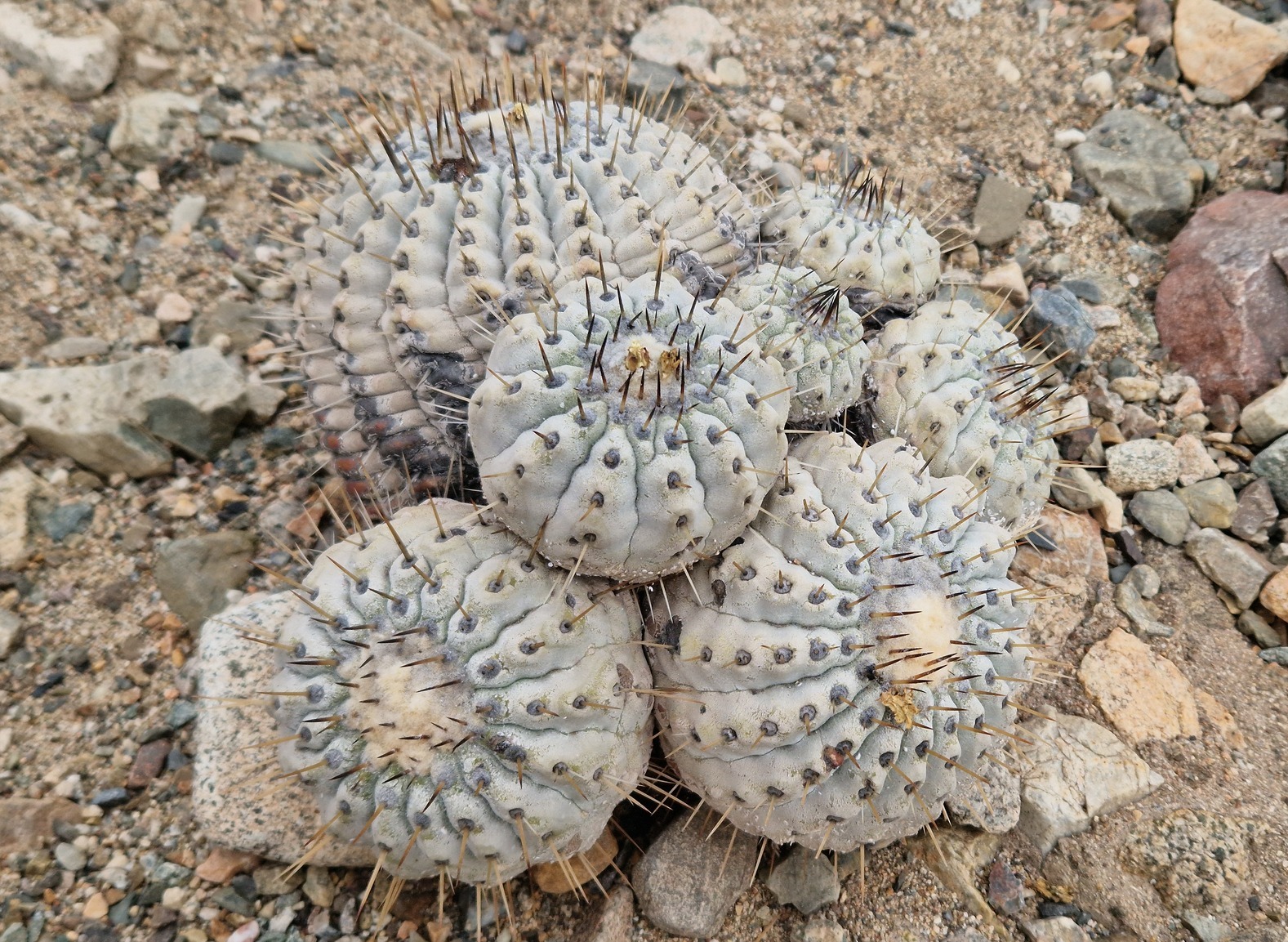
The Taltal form is what most collectors picture when they think of Copiapoa cinerea. A globose to short-cylindrical body coated in brilliant silver-white farina. Dark, almost black spines emerging from woolly areoles. A flat, densely woolly crown. The visual contrast between the pale body and the dark armature is the character that has made this subspecies so widely photographed among the world’s cacti, and so expensive.
In habitat, some populations near Taltal contain hundreds of thousands of individuals. The valley east of the town holds what Schulz (2006) described as one of the largest single populations in the genus. But abundance is misleading. This subspecies has the lowest seedling recruitment and the highest percentage of dead or senile individuals of any Copiapoa cinerea subspecies. The colonies persist because the plants live for centuries, but the next generation may not be replacing them at a sustainable rate.
In the collector market, seed grown specimens of subsp. cinerea with documented Taltal-area provenance sit at the top of the pricing hierarchy for the species. A well-developed seed grown plant of 15 to 20 years, with the full silver coating and mature spine character, can sell for $3,000 to $8,000. The most exceptional examples, plants approaching 30 years of age with the deep body character that only decades of slow, patient growing can produce, have changed hands for over $10,000 in private sales. This is not speculation or hype: it is a function of how long it takes to produce a plant of this quality and how few growers have the patience to do it.
Conservation status
Copiapoa cinerea is listed as Least Concern by the IUCN Red List (Guerrero et al., 2024). The species-level LC assessment is maintained because the southern subspecies columna-alba supports large, healthy populations. The situation for subsp. cinerea around Taltal is less reassuring: Schulz and Kapitany (1996) documented low seedling recruitment, elevated senescence, and the highest proportion of dead individuals among the three subspecies.
Contents
What the Repeated Name Means
The doubled epithet in Copiapoa cinerea subsp. cinerea is not a typo or a stutter. It is a formal consequence of how botanical nomenclature works. When a species is divided into subspecies, the International Code of Nomenclature requires that the subspecies containing the type specimen receive a name that repeats the species epithet. This “autonym” is not published by any individual taxonomist. It comes into existence automatically the moment another subspecies is formally described.
For Copiapoa cinerea, the trigger was Friedrich Ritter’s 1959 description of Copiapoa columna-alba, which was later transferred to subspecific rank as Copiapoa cinerea subsp. columna-alba. At that point, the original Taltal population, the one containing Philippi’s type specimen from Hueso Parado, automatically became subsp. cinerea. The same mechanism created the autonym when Copiapoa cinerea subsp. krainziana was recognized.
What the name tells a collector is specific and useful: this is the form from the type locality. It is the population Philippi collected. It is the morphological baseline against which the other subspecies are compared. If you are buying a plant labeled subsp. cinerea, you should expect the Taltal phenotype: wide ribs, dark spines, red-tipped perianth, and the classic silver body. A plant labeled only Copiapoa cinerea without a subspecific epithet could be any of the three forms.
Habitat & the Taltal Range
Subsp. cinerea is distributed from approximately 10 kilometers north of Taltal to roughly 20 kilometers south, growing primarily inland on rocky hillsides at elevations up to 950 meters. The highest confirmed populations are on Cerro Perales (Schulz 2006). Some plants also occur near sea level, though the densest concentrations are at mid-elevations where the camanchaca fog reaches most reliably.
The substrate is predominantly granitic, with plants rooting into cracks and fissures in rocky slopes. Rainfall is negligible: Taltal receives roughly 1 to 5 millimeters per year. Fog provides essentially all moisture. The ecology here mirrors what Copiapoa solaris experiences further north near El Cobre, though the cinerea populations occupy a broader altitudinal range and show more morphological variation across the landscape.
Road construction and urban expansion from Taltal are the primary habitat threats in this part of the range. The town sits directly within the subspecies’ distribution, and development pressure has been increasing. Unlike the southern subspecies columna-alba, which has some populations within Pan de Azúcar National Park, subsp. cinerea around Taltal has no formal in-situ protection.
Morphology
Subsp. cinerea branches laterally and basally, sometimes forming loose mounds of multiple heads. This branching habit distinguishes it from the typically solitary subsp. columna-alba. Individual stems are globose to elongated-cylindrical, reaching substantial size in old plants: stems up to one meter tall and 18 centimeters in diameter have been recorded, though most plants in habitat are smaller.
The ribs number fewer than 30, broad and deep, barely undulating. This wider rib structure is one of the key characters separating subsp. cinerea from subsp. columna-alba, which produces up to 50 narrow, flat, undulating ribs. The wider ribs of subsp. cinerea give the plant a bolder, more architectural profile when viewed from above.
Spines are few, typically fewer than 10 total, subulate, emerging black or very dark brown and weathering to grey over years. The contrast between fresh dark spines near the apex and weathered grey spines lower on the body creates a visual gradient that is one of the plant’s most attractive features. Spine length and thickness vary between populations: some Taltal forms produce robust, outward-pointing centrals, while others are nearly spineless.
The flowers carry the most useful taxonomic character for separating this subspecies from columna-alba. The interior perianth segments are tipped red, and the outer segments display a reddish mid-stripe. These red markings are absent in subsp. columna-alba, where the perianth is uniformly pale yellow. Flowers are funnel-shaped, 2.5 to 3.5 centimeters across, and emerge from the grey to white apical wool.
Population Health
The population dynamics of subsp. cinerea present a paradox. Some populations are enormous. The valley east of Taltal supports what may be hundreds of thousands of individuals, one of the largest single concentrations of any Copiapoa species anywhere. Numbers alone would suggest a secure population.
The age structure tells a different story. Schulz and Kapitany (1996) documented that subsp. cinerea has the lowest seedling recruitment of the three subspecies. Juvenile plants are scarce relative to the total population. At the same time, the proportion of dead or senile individuals is the highest of any Copiapoa cinerea subspecies. This pattern, many old plants, few young ones, suggests a population that is living on accumulated capital from past reproductive events but not replenishing itself at a rate that ensures long-term stability.
The contrast with subsp. columna-alba is instructive. In Pan de Azúcar National Park and other southern sites, columna-alba populations include abundant seedlings of all size classes, indicating active and ongoing recruitment. Whatever environmental or biological factor limits seedling establishment in the Taltal area does not appear to affect the southern populations to the same degree.
Whether this reflects a natural demographic pattern in a very long-lived species (centuries-old plants may produce reproductive pulses separated by decades) or a genuine decline driven by habitat degradation and changing fog patterns remains an open question. The 2024 Guerrero et al. reassessment flagged declining habitat quality and low recruitment as concerns across much of the genus.
Key Localities
The type locality is Hueso Parado in Quebrada Taltal, where Philippi collected the original material in 1854. The area remains the center of the subspecies’ distribution. Karel Kníže collected material under field number KK77 from the Taltal area at 300 to 600 meters elevation, producing short, stout black-spined plants that remain popular in the seed trade. Cerro Perales, at approximately 950 meters, represents the upper altitudinal limit and produces plants with somewhat different body proportions than lowland populations.
The populations north of Taltal transition gradually into the range of subsp. krainziana. Intermediate forms occur in this zone, showing spine characters that blend the subulate spines of subsp. cinerea with the filiform spines of krainziana. These transitional plants are of considerable interest to collectors and taxonomists alike, as they illustrate the gene flow that Larridon et al. (2018) confirmed with molecular data.
Copiapoa cinerea subsp. cinerea care and cultivation
Substrate and watering
The cultivation substrate mirrors Copiapoa cinerea at the species level: 33 per cent pumice, 12 per cent lava rock, 10 per cent zeolite, 25 per cent granite grit, 5 per cent limestone chip, 10 per cent coarse silica, and 5 per cent worm castings. Fast drainage matters more than any single ingredient; this nominate subspecies shares the genus-wide rot sensitivity that keeps organic capped at 5 per cent. The zeolite buffers pH and paces nutrients; the silica fraction is a structural aggregate, the same durable-grit role granite plays, with no chemistry claim attached. The farina coating that makes subsp. cinerea so distinctive develops under strong UV; the substrate choice influences that only indirectly by keeping the root collar dry and the epidermis stress-conditioned.
All ten Copiapoa species on this site share a genus-flat 95/5 mineral-organic cultivation mix. Limestone stays at the low end of an indeterminate carbonate band and organic at the class-prior 5 percent; neither figure is a per-species finding. The only value that varies by species is lava, sized to container depth: the tuberous-rooted trio (hypogaea, hypogaea var. barquitensis, laui) gets a deeper pot allowance than the rest of the genus.
| Species | Pumice | Lava | Zeolite | Granite | Limestone | Silica | Organic |
|---|---|---|---|---|---|---|---|
| C. laui | 27% | 18% | 10% | 25% | 5% | 10% | 5% |
| C. humilis | 33% | 12% | 10% | 25% | 5% | 10% | 5% |
| C. humilis subsp. tenuissima | 33% | 12% | 10% | 25% | 5% | 10% | 5% |
| C. solaris | 33% | 12% | 10% | 25% | 5% | 10% | 5% |
| C. cinerea | 33% | 12% | 10% | 25% | 5% | 10% | 5% |
| C. cinerea subsp. cinerea (this page) | 33% | 12% | 10% | 25% | 5% | 10% | 5% |
| C. cinerea subsp. krainziana | 33% | 12% | 10% | 25% | 5% | 10% | 5% |
| C. esmeraldana | 33% | 12% | 10% | 25% | 5% | 10% | 5% |
| C. hypogaea | 27% | 18% | 10% | 25% | 5% | 10% | 5% |
| C. hypogaea var. barquitensis | 27% | 18% | 10% | 25% | 5% | 10% | 5% |
Developing the farina
Collectors growing subsp. cinerea specifically for its silver-white appearance should prioritize high light from an early age. Plants that spend their first years in shade develop epidermis that never quite catches up to plants that were light-hardened early. The farina is an epicuticular wax, produced by the plant in response to UV stress. More light means more wax. This does not mean scorching the plant in direct summer sun without acclimatization; it means providing the strongest light the plant can tolerate without damage, increasing exposure gradually, and maintaining it consistently over years.
Growth rate and patience
Subsp. cinerea is slow, though not as extreme as Copiapoa solaris or Copiapoa laui. Expect a seed grown plant to reach a body diameter of 5 to 8 centimeters in about 10 years under good conditions. The transition from globose to cylindrical happens after 15 to 20 years. Full adult character, with the complete silver coating, weathered spines, and established branching habit, takes 25 to 30 years. These are rough benchmarks, not guarantees. Some growers report faster progress with optimal greenhouse conditions; others find their plants plateau for years before resuming visible growth.
Grafting accelerates early development but produces softer growth that lacks the tight, hard body of seed grown plants. Grafted seedlings are useful for building up size past the vulnerable early years, but for a plant intended as a long-term specimen, seed grown from the start produces the best result. Copiapoa humilis subsp. tenuissima grows faster and forgives more mistakes; it remains the recommended genus introduction for growers not yet confident with the cinerea complex.
Pricing & Provenance
Subsp. cinerea commands the highest prices among the three subspecies because it is the most iconic form and the most visually dramatic at maturity. Young seed grown plants under five years are accessible at $50 to $200. At 10 to 15 years, with developing farina and established spination, prices reach $1,000 to $3,000. Plants of 20 to 30 years, showing the full silver character, mature branching, and the deep body hardness that comes from decades of slow growth, sell for $5,000 to $10,000 or more.
Provenance drives significant premiums. A plant grown from seed sourced from a documented wild collection with a known field number (KK77 from Taltal is the classic example) is worth substantially more than a plant of equivalent age with unknown or unverifiable parentage. The field number links the cultivated plant to a specific wild population, which has genetic, scientific, and conservation value beyond the horticultural.
The market for mature Copiapoa cinerea subsp. cinerea is not speculative or driven by transient trends. It is built on a fundamental reality: these plants cannot be produced quickly. A collector who starts a seed grown plant today and grows it well for 25 years will have something that is, by definition, irreproducible on any shorter timeline. That mathematical certainty is what underpins the pricing structure.
How subsp. cinerea Differs from the Other Subspecies
Compared to subsp. krainziana, the differences are dramatic. Krainziana produces numerous filiform (thread-like) spines that cover the body in a shaggy mass, while subsp. cinerea has few, robust, subulate spines that stand individually. The two occupy adjacent ranges north of Taltal and hybridize where they meet, producing intermediates with spine characters between the two extremes. Krainziana is Critically Endangered with a single known population; subsp. cinerea is far more abundant but potentially less sustainable in the long term due to its poor recruitment.
Compared to subsp. columna-alba, the differences are subtler but consistent. Columna-alba produces up to 50 narrow, flat, undulating ribs compared to the fewer than 30 wide, deep ribs of subsp. cinerea. Columna-alba is typically solitary, while subsp. cinerea branches from the base. The flowers of columna-alba lack the red perianth tips that characterize subsp. cinerea. Geographically, columna-alba occupies sandy coastal valleys further south, while subsp. cinerea prefers rocky inland hillsides around Taltal.
Frequently asked questions
How difficult is Copiapoa cinerea subsp. cinerea to grow?
How is Copiapoa cinerea subsp. cinerea propagated from seed?
Is Copiapoa cinerea subsp. cinerea legal to own?
Where does Copiapoa cinerea subsp. cinerea grow in the wild?
When does Copiapoa cinerea subsp. cinerea flower?
Related Taxa in the Genus
Copiapoa solarisThe sun cactus of the Atacama. Restricted to two fog-dependent localities near El Cobre and Blanco Encalada. Slower than Aztekium from seed.Copiapoa humilis subsp. tenuissimaA compact, dark-bodied form from the Paposo coast. Faster growing and more forgiving than the cinerea complex, it is an excellent entry point for collectors new to the genus.Copiapoa humilisThe parent species of the humilis complex. Miniature clustering habit, highly variable across its range from Paposo to Chañaral.Copiapoa cinereaThe silver ghost of the Atacama. Three geographically segregated subspecies span the coast from Caleta Colorado to Chañaral. The most iconic species in the genus.Copiapoa cinerea subsp. krainzianaThe shaggy-spined showpiece from the quebradas north of Taltal. Hair-like white spines are unique in the cactus family. A single known population.Copiapoa lauiA miniature species from a single site near Esmeralda. Tiny, densely clustering heads with fine white spines. Rivals Copiapoa solaris for restricted range.Copiapoa esmeraldanaEsmeralda coast. Best habitat condition of any Copiapoa but range extremely narrow. Affinities to the cinerea complex.Copiapoa hypogaeaPartially subterranean. The most unusual growth form in the genus, with the stem largely buried below the soil surface.Copiapoa hypogaea var. barquitensisDistinct variety from Barquito. Flatter, more tuberculate stems. Sought by specialist collectors for its unusual surface texture.
Sources & References
Philippi, R.A. (1860). Flora Atacamensis, p. 23. · Britton, N.L. & Rose, J.N. (1922). The Cactaceae, vol. 3, p. 86. · Hutchison, P.C. (1953). Studies of South American Cactaceae 2. Cactus and Succulent Journal: 34–37. · Schulz, R. & Kapitany, A. (1996). Copiapoa in Their Environment: Chañaral to El Cobre. · Schulz, R. (2006). Copiapoa. · Hunt, D. (2013). The New Cactus Lexicon. · Larridon, I. et al. (2018). Investigating taxon boundaries in Copiapoa subsection Cinerei. Kew Bulletin 73: 55. · Guerrero, P.C. et al. (2024). Copiapoa cinerea. IUCN Red List 2024: e.T212479449A212480302. · Villalobo-López, A. et al. (2024). Effects of trade and poaching pressure on extinction risk. Conservation Biology 38: e14353. · Royal Botanic Gardens, Kew. Plants of the World Online. Retrieved 2026.