
Copiapoa hypogaea
| Family | Cactaceae |
| Named by | F.Ritter (1960) |
| Synonym | Neochilenia hypogaea |
| Native range | Chañaral area, Atacama, Chile |
| Altitude | Near sea level to ~400 m |
| EOO | <150 km² |
| Stem diameter | 3–6.5 cm |
| Habit | Subterranean, solitary to clumping |
| Root | Tuberous-napiform |
| Spines | Few, black, 2–4 mm |
| Flowers | Yellow, reddish outside, 1 day |
| IUCN status | Endangered |
| CITES | Appendix II |
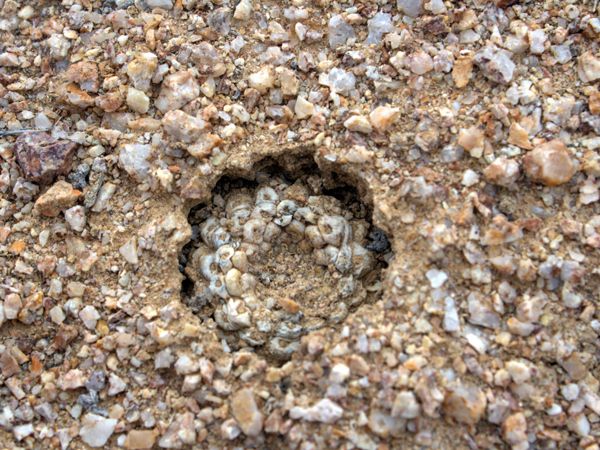
Most cacti grow up. Copiapoa hypogaea grows down. The species name tells you exactly what it does: hypogaea, from the Greek hypo (under) and gaia (earth). The stem is partially or wholly subterranean, with only the flat, wool-filled apex exposed at the soil surface. The rest of the body, connected to a swollen tuberous taproot, sits below ground. In habitat, you can walk directly over a population and miss it entirely. The exposed apex, a few centimeters of brownish disc flush with the desert pavement, is virtually invisible against the surrounding gravel.
Friedrich Ritter described the species in 1960 from material collected five kilometers north of Chañaral, on the coastal hills of the Atacama Region. It was the first partially geophytic Copiapoa to be recognized: a cactus that had solved the problem of extreme aridity not by growing tall and developing a thick waxy coating like Copiapoa cinerea, but by retreating underground and reducing its exposed surface to the absolute minimum. The strategy works. By burying the body and taproot, the plant minimizes direct solar exposure, reduces transpiration, and accesses deeper soil moisture that surface-dwelling species cannot reach.
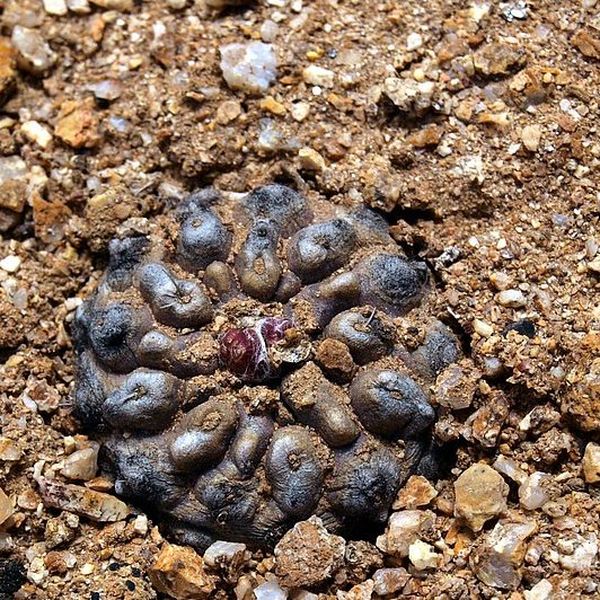
Two principal forms are recognized. The type form, from north of Chañaral, has a rugose (rough-textured) epidermis sometimes called “lizard skin” for its distinctively pebbled surface. The second form, Copiapoa hypogaea var. barquitensis, from the town of Barquito just south of Chañaral, has a smooth epidermis, slightly more prominent spines, and is the form most familiar in cultivation. A third infraspecific taxon, Copiapoa hypogaea subsp. cobrensis Doweld, has been described but is not widely accepted.
For collectors, Copiapoa hypogaea is a conversation piece. It looks like no other cactus in a collection. The flat disc of the apex, the hidden body, the tuberous root revealed only at repotting: everything about the plant challenges assumptions about what a cactus should look like. Mature seed grown specimens with well-developed character go well into the thousands from specialist dealers.
Conservation status
Copiapoa hypogaea is listed as Endangered by the IUCN Red List (Faundez, Guerrero, Saldivia, Walter & Avilés, 2013/2024). The species has an extent of occurrence under 150 square kilometers and an area of occupancy under 20 square kilometers, with severely fragmented distribution. The Barquito locality is urbanized and degraded by mining. Trade pressure is notable at 8.2% of the genus total. Some populations fall within Pan de Azúcar National Park.
Contents
Taxonomy & Nomenclature
Ritter published Copiapoa hypogaea in 1960 in Cactus (Paris), volume 15, number 66, page 19. The type material came from five kilometers north of Chañaral, collected under Ritter’s field number FR261. The species was immediately distinctive: nothing else in the genus grew underground. Curt Backeberg later transferred it to Neochilenia as Neochilenia hypogaea, a placement that reflected an older generic concept that has since been abandoned. The species is now firmly placed in Copiapoa.
The relationship between Copiapoa hypogaea and Copiapoa laui has been debated for decades. Some authors, including Graham Charles, have treated laui as a subspecies of hypogaea. Hoffmann and Walter published the combination Copiapoa hypogaea var. laui. The molecular phylogeny of Larridon et al. (2015) placed both in a basal, unnamed clade within the genus, confirming their close relationship. Most current treatments accept Copiapoa laui as a separate species based on its much smaller size, its restricted distribution near Esmeralda (well north of the hypogaea range), and its distinctive fine bristly spination.
Infraspecific taxonomy within Copiapoa hypogaea recognizes var. barquitensis F.Ritter, described from near the town of Barquito south of Chañaral, and subsp. cobrensis Doweld. The “Lizard Skin” form from north of Chañaral is sometimes listed as a cultivar (Copiapoa hypogaea cv. Lizard Skin) rather than a formal taxonomic entity, though it represents the type population’s most distinctive phenotype.
Historical synonyms (4)
- Neochilenia hypogaea Backeb., 1959 basionym
- Copiapoa hypogaea var. barquitensis F.Ritter, 1980 homotypic synonym
- Pilocopiapoa hypogaea (F.Ritter) Y.Itô, 1981 homotypic synonym
- Copiapoa hypogaea subsp. cobrensis Doweld, 2001 homotypic synonym
Sources: POWO (Kew) · IPNI · GBIF · Wikidata
Habitat & the Chañaral Coast
Copiapoa hypogaea is endemic to a small stretch of the Atacama coast centered on the town of Chañaral, in the Atacama Region (III Region) of Chile. The extent of occurrence is under 150 square kilometers. Two main population areas are known: north of Chañaral (the type locality, FR261) and near the town of Barquito, a few kilometers to the south.
The Barquito locality is problematic. The town itself is urbanized and surrounded by mining activity that has degraded the surrounding habitat. The copper industry that gives the Atacama coast its economic identity is also its primary ecological threat. Road construction, dust from mining operations, and urban expansion directly reduce available habitat. Unlike Copiapoa solaris at El Cobre, which faces mining pressure but occupies steep terrain that is difficult to develop, the flat coastal habitat of Copiapoa hypogaea is easy to build on.
Some populations are within Pan de Azúcar National Park, which provides formal legal protection. The species grows at low elevation, from near sea level to roughly 400 meters, in the fog belt where the camanchaca provides trace moisture. The substrate is sandy gravel, flat to gently sloping, and the plants are typically isolated rather than forming dense colonies.
Morphology
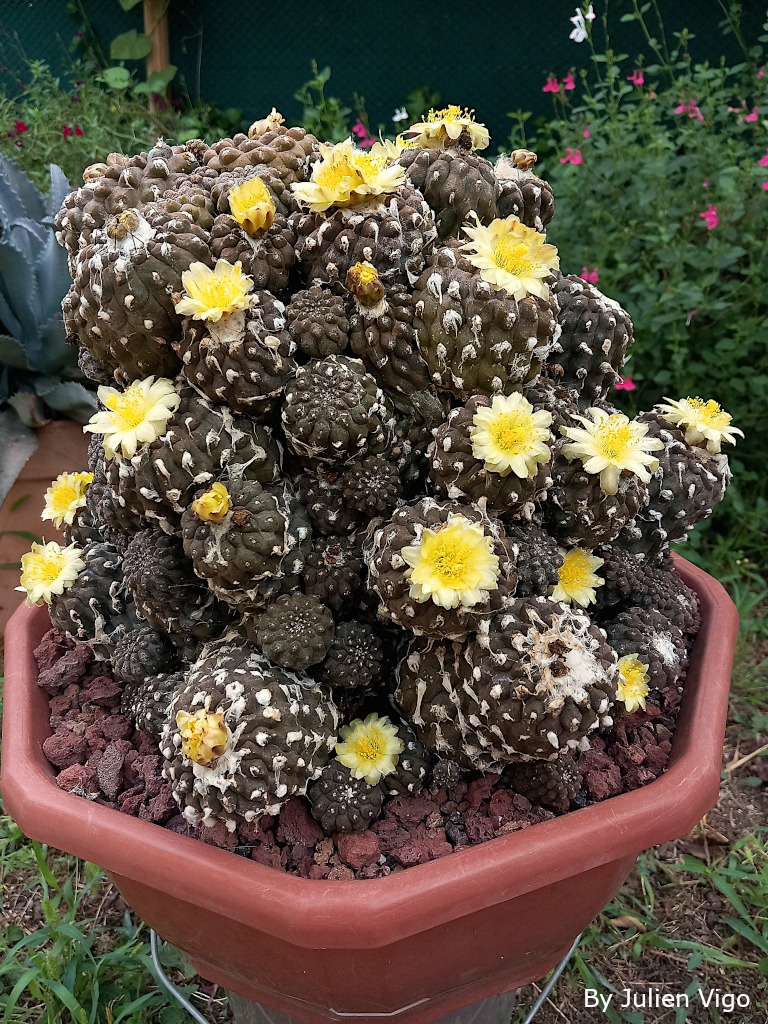
Stunning example grown in a greenhouse in the South of France by Julien Tropi’Qualité
The stem is depressed-globose, 3 to 6.5 centimeters in diameter in habitat (up to 7 centimeters in cultivation), growing flush with or below the soil surface. The apex is sunken, forming a shallow, roughly circular depression filled with white wool. This sunken apex is the only part of the plant normally visible above ground. The aerial portion is almost disc-shaped, grey-brown to bronzed, sometimes with a greenish cast in shaded conditions.
The ribs, if they can be called that, are dissolved into extremely low tubercles arranged in loose spirals. Individual tubercles are 4 to 8 millimeters apart, 4 to 7 millimeters in diameter, and up to 5 millimeters tall. The overall effect is more textural than architectural: the body surface looks pebbled or stippled rather than sharply ribbed.
Spines are minimal. The type form from north of Chañaral is nearly spineless, with only 1 to 6 marginal (radial) spines per areole, black, 2 to 4 millimeters long. Central spines are typically absent. Var. barquitensis produces slightly more prominent spination, including occasional centrals.
The root system is the hidden architecture. A tuberous, napiform (turnip-shaped) taproot connects to the stem through a narrow neck. This root is disproportionately large relative to the visible body: at repotting, a plant with a 4-centimeter exposed apex may reveal a root twice that diameter. The root stores water and nutrients against the long dry periods, and the narrow neck between root and stem creates a natural breakpoint that protects the root if the stem is damaged by an animal or a collector’s careless hand.
Flowers are yellow with reddish outer segments, approximately 2 to 2.2 centimeters long, emerging from the apical wool. Each flower opens for a single day. Fruits are small, globular, with shiny black seeds roughly 1.5 millimeters wide.
Why Underground?
The geophytic habit of Copiapoa hypogaea is a survival strategy, not a curiosity. By burying the body below the soil surface, the plant reduces its exposed surface area to a fraction of what a conventional globose cactus presents to the sun. Less surface means less water loss through transpiration. The soil itself acts as insulation, buffering temperature swings between day and night. And the tuberous root, sitting in deeper, cooler soil layers, can access moisture that evaporates from the surface before shallowly rooted plants can use it.
The trade-off is photosynthesis. A plant that hides most of its body underground has less chlorophyll-bearing surface area available for carbon fixation. Copiapoa hypogaea compensates by concentrating its photosynthetic activity in the exposed apex and by growing extremely slowly. The math works because the Atacama provides something that most deserts do not: a reliable, predictable source of trace moisture through fog condensation. The plant does not need to grow fast. It needs to not die. Going underground is the most effective way to ensure that.
This strategy has evolved independently in other cactus lineages. Ariocarpus in the Chihuahuan Desert and Aztekium in Nuevo León show analogous body-retraction behavior, pulling into the soil during drought. But Copiapoa hypogaea takes it further than either: it is permanently subterranean, not seasonally retractile. The body does not emerge when water is available. It stays underground, always.
The Forms of hypogaea
The type form of Copiapoa hypogaea, from north of Chañaral, has a rugose (rough, granular) epidermis that earned it the collector name Lizard Skin. The texture is distinctive and immediately recognizable: the body surface looks like it has been covered in fine sand or stippled with a tool. This form is rarer in cultivation than var. barquitensis and is prized by specialists for its unusual surface character.
Var. barquitensis has a smooth epidermis, slightly larger stems, and more prominent spination including occasional central spines. It forms denser clusters of 4 to 5 heads and is the form most commonly encountered in collections and the seed trade. Its type locality near Barquito is more accessible than the northern population, which has contributed to its wider distribution in cultivation.
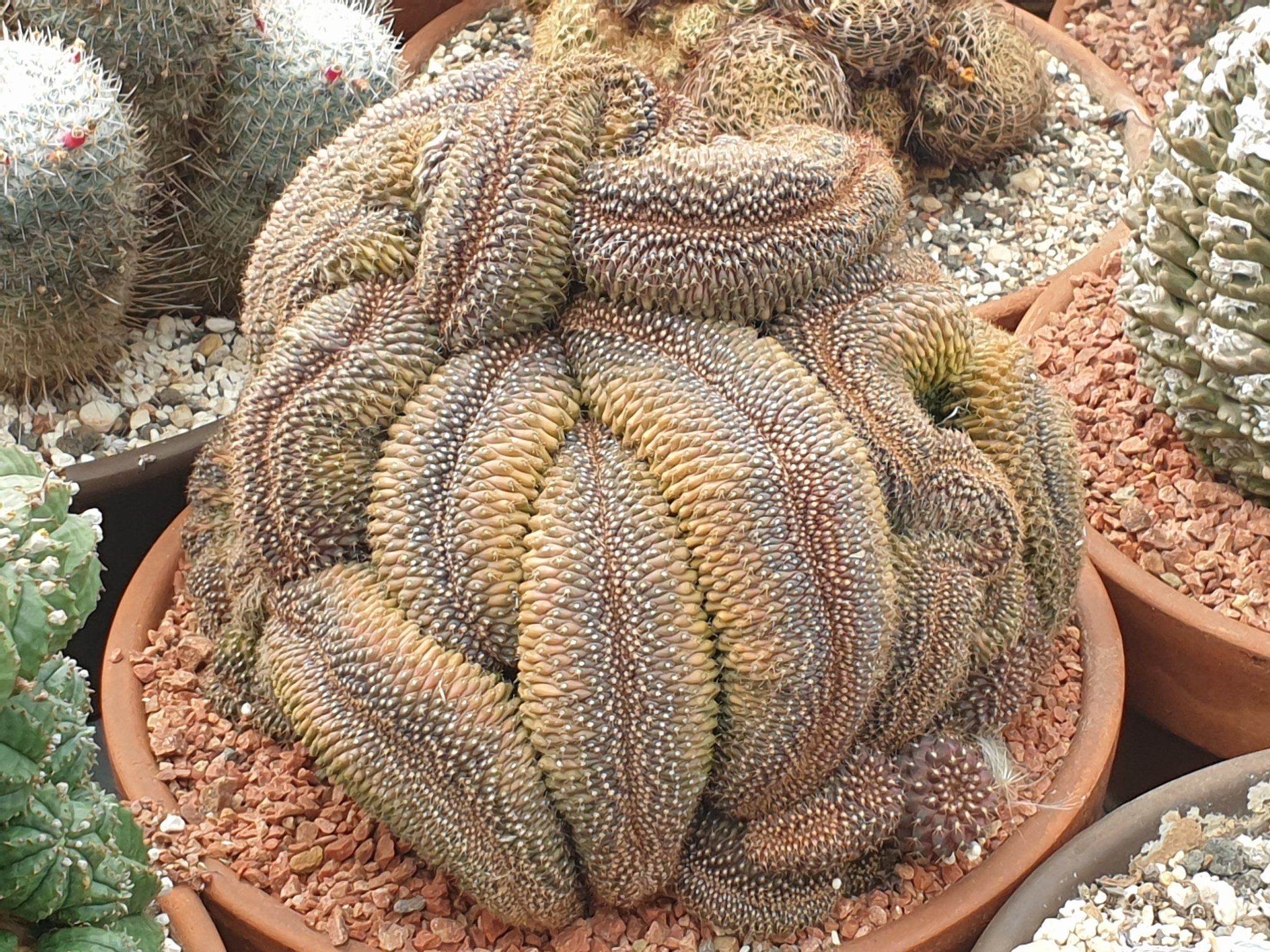
A crested form, Copiapoa hypogaea var. barquitensis f. cristata, circulates in the horticultural trade. Any crested hypogaea is unusual and commands a premium, though crests are not common in the species.
Locality Detail
Copiapoa hypogaea: confirmed localities
North of Chañaral (type locality)
- FR261: 5 km north of Chañaral
- Rugose “Lizard Skin” epidermis
- Low elevation, coastal gravel
- Rarer in cultivation
Barquito (var. barquitensis)
- South of Chañaral, near town
- Smooth epidermis, more spines
- Urbanized, mining-degraded site
- Most common form in trade
Copiapoa hypogaea care and cultivation
Substrate and containers
The tuberous root is the plant’s most important organ and dictates the container choice. Use a deep pot, at least twice the depth of the visible body, to accommodate the taproot without cramming; lava is raised to 18 per cent here specifically for that extra depth. The substrate should be almost entirely mineral: 27 per cent pumice, 18 per cent lava rock, 10 per cent zeolite, 25 per cent granite grit, 5 per cent limestone chip, 10 per cent coarse silica, and 5 per cent worm castings. Keep organic at 5 per cent, not higher: a high percentage of fine gravel with little organic material is the standing grower recommendation for this species specifically, aimed at keeping stagnant moisture off a root that rots easily when it sits wet. The zeolite handles pH buffering and slow mineral release.
All ten Copiapoa species on this site share a genus-flat 95/5 mineral-organic cultivation mix. Limestone stays at the low end of an indeterminate carbonate band and organic at the class-prior 5 percent; neither figure is a per-species finding. The only value that varies by species is lava, sized to container depth: the tuberous-rooted trio (hypogaea, hypogaea var. barquitensis, laui) gets a deeper pot allowance than the rest of the genus.
| Species | Pumice | Lava | Zeolite | Granite | Limestone | Silica | Organic |
|---|---|---|---|---|---|---|---|
| C. laui | 27% | 18% | 10% | 25% | 5% | 10% | 5% |
| C. humilis | 33% | 12% | 10% | 25% | 5% | 10% | 5% |
| C. humilis subsp. tenuissima | 33% | 12% | 10% | 25% | 5% | 10% | 5% |
| C. solaris | 33% | 12% | 10% | 25% | 5% | 10% | 5% |
| C. cinerea | 33% | 12% | 10% | 25% | 5% | 10% | 5% |
| C. cinerea subsp. cinerea | 33% | 12% | 10% | 25% | 5% | 10% | 5% |
| C. cinerea subsp. krainziana | 33% | 12% | 10% | 25% | 5% | 10% | 5% |
| C. esmeraldana | 33% | 12% | 10% | 25% | 5% | 10% | 5% |
| C. hypogaea (this page) | 27% | 18% | 10% | 25% | 5% | 10% | 5% |
| C. hypogaea var. barquitensis | 27% | 18% | 10% | 25% | 5% | 10% | 5% |
Watering and light
Water lightly during the growing season, with complete dryout between applications. The geophytic habit means the plant stores more water than its visible size suggests, and it is easy to overwater. A single thorough soaking followed by two to three weeks of drying is a reasonable starting rhythm during warm weather. In winter, keep completely dry. Resume very cautiously in spring: the narrow neck between root and stem is a rot entry point, and cold-wet conditions will kill the plant faster than drought.
Full sun produces the most compact, characterful growth and the best spine development. Shade produces softer, greener plants that lose the bronzed desert coloring of well-grown specimens. If your growing conditions offer strong light, use it. Unlike Copiapoa cinerea subsp. krainziana, which benefits from moderate shade, Copiapoa hypogaea wants direct exposure.
Seed grown versus grafted
Seed grown is the standard for serious collectors. The tuberous root, the flat disc apex, and the desert coloring of the body are all characters that develop best in seed grown plants. Grafted specimens grow faster but tend to produce an unnaturally elongated body that sits above the soil rather than flush with it, losing the defining visual character of the species.
Seed grown Copiapoa hypogaea are slow. Expect 5 to 8 years from seed to a plant that shows recognizable adult character. The “Lizard Skin” epidermis of the type form can take even longer to develop fully. Copiapoa humilis subsp. tenuissima grows faster and tolerates more mistakes, making it a better starting point for growers entering the genus.
Comparing Copiapoa hypogaea to Related Species
Copiapoa laui is the closest relative, and the two share the geophytic habit, tuberous root, and small body size. The differences are in degree: Copiapoa laui is even smaller (1 to 3 centimeters in diameter versus 3 to 6.5 for hypogaea), has finer and more bristly spination, and occurs near Esmeralda, well north of the Chañaral range. Each head of Copiapoa laui forms an independent root, allowing vegetative propagation by offset removal. Copiapoa hypogaea offsets less readily and the connection to the main taproot is less separable.
Copiapoa esmeraldana is another small-bodied species that shares the green, non-pruinose epidermis, but it is not geophytic: it grows above ground on steep cliff faces at Las Lomitas. The two occupy different ecological niches despite their similar body sizes, and molecular data (Larridon 2015) places them in different parts of the genus phylogeny.
From the Copiapoa cinerea complex, hypogaea could not be more different. Where cinerea is columnar, silver, and prominently spined, hypogaea is flat, buried, and nearly spineless. They represent opposite solutions to the same problem: surviving extreme aridity in the Atacama fog desert. Cinerea maximizes farina and height; hypogaea minimizes surface exposure and retreats underground. Both work.
Frequently asked questions
How difficult is Copiapoa hypogaea to grow?
How is Copiapoa hypogaea propagated from seed?
Is Copiapoa hypogaea legal to own?
Where does Copiapoa hypogaea grow in the wild?
When does Copiapoa hypogaea flower?
Related Taxa in the Genus
Copiapoa solarisThe sun cactus of the Atacama. Restricted to two fog-dependent localities near El Cobre and Blanco Encalada. Slower than Aztekium from seed.Copiapoa humilis subsp. tenuissimaA compact, dark-bodied form from the Paposo coast. Faster growing and more forgiving than the cinerea complex, it is an excellent entry point for collectors new to the genus.Copiapoa humilisThe parent species of the humilis complex. Miniature clustering habit, highly variable across its range from Paposo to Chañaral.Copiapoa cinereaThe silver ghost of the Atacama. Three geographically segregated subspecies span the coast from Caleta Colorado to Chañaral. The most iconic species in the genus.Copiapoa cinerea subsp. krainzianaThe shaggy-spined showpiece from the quebradas north of Taltal. Hair-like white spines are unique in the cactus family. A single known population.Copiapoa cinerea subsp. cinereaThe classic Taltal form. The nominotypical subspecies with the most iconic silver farina, dark spines, and the form most collectors picture when they hear the name.Copiapoa lauiA miniature species from a single site near Esmeralda. Tiny, densely clustering heads with fine white spines. Rivals Copiapoa solaris for restricted range.Copiapoa esmeraldanaEsmeralda coast. Best habitat condition of any Copiapoa but range extremely narrow. Affinities to the cinerea complex.Copiapoa hypogaea var. barquitensisDistinct variety from Barquito. Flatter, more tuberculate stems. Sought by specialist collectors for its unusual surface texture.
Sources & References
Ritter, F. (1960). Copiapoa hypogaea sp. nov. Cactus (Paris) 15(66): 19. · Schulz, R. & Kapitany, A. (1996). Copiapoa in Their Environment: Chañaral to El Cobre. · Hunt, D. (2013). The New Cactus Lexicon. · Faundez, L. et al. (2013). Copiapoa hypogaea. IUCN Red List 2013: e.T152083A595222. · Larridon, I. et al. (2015). An integrative approach to understanding the evolution and diversity of Copiapoa. American Journal of Botany 102: 1506–1520. · Villalobo-López, A. et al. (2024). Effects of trade and poaching pressure on extinction risk. Conservation Biology 38: e14353. · Royal Botanic Gardens, Kew. Plants of the World Online. Retrieved 2026.