
Astrophytum asterias f. nudum
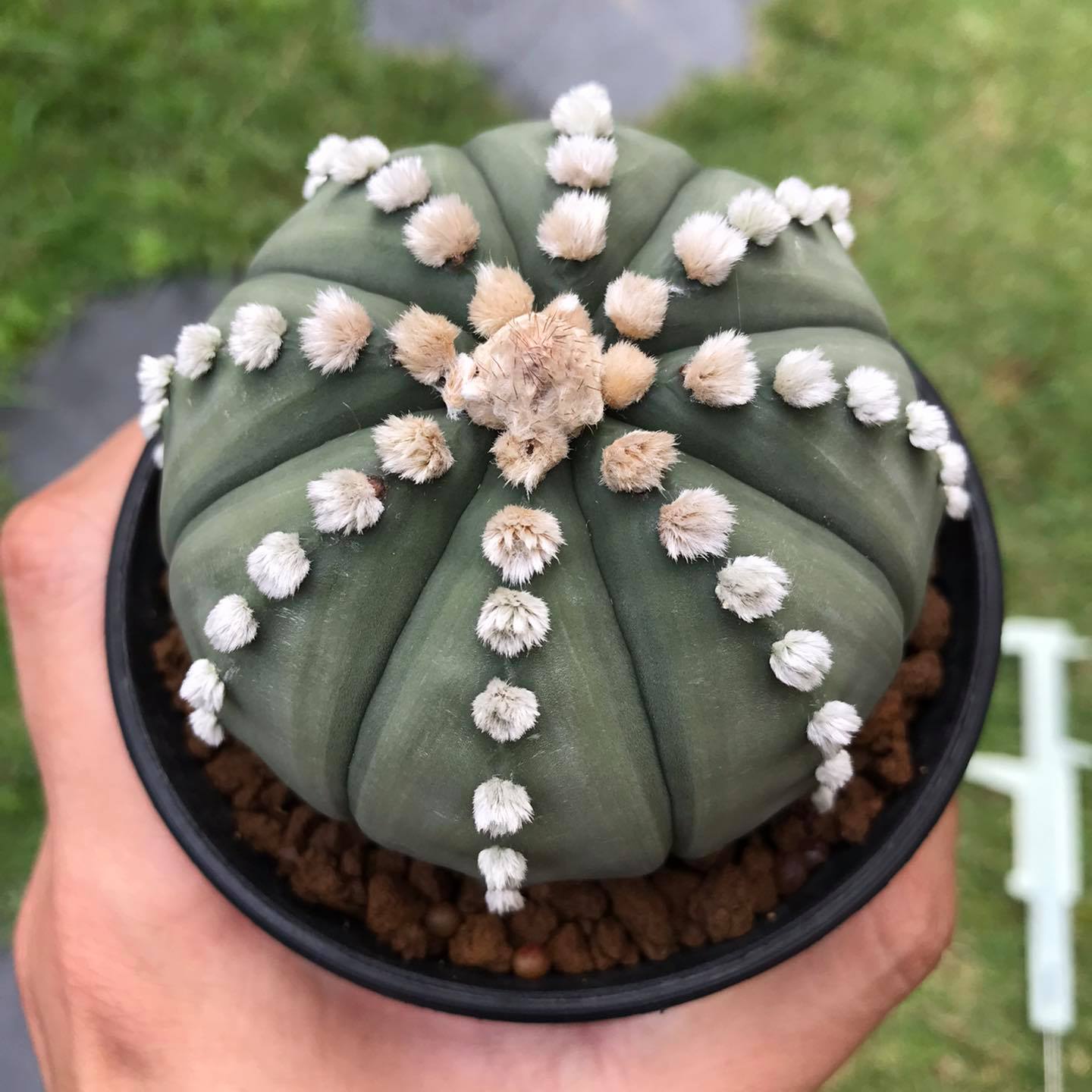
Astrophytum asterias f. nudum is the clean-skinned selection of the Tamaulipan star cactus: eight ribs, spineless, diurnal yellow flowers with an orange-red throat, identical in every structural character to its parent A. asterias, but without the scatter of white trichome tufts that normally cover the epidermis. The body reads as a dark green, grey-green, or slate disc with the areole line along each rib clearly visible against the unbroken skin.
Yoshio Itô formalised the selection as var. nudum in The Cactaceae: Classification and Illustration of Cacti (Tokyo, 1981, p. 508). POWO treats the name as a synonym of A. asterias rather than an accepted infraspecific taxon, which is the current Kew consensus on the whole species: no accepted varieties, subspecies, or formae. That does not reduce the collector significance of the trait; it is simply the point at which botanical rank and horticultural identity separate. Japanese growers have stabilised nudum lines for decades under the name Ruri Kabuto (lapis lazuli helmet), which is the cultivar circulation most serious collectors recognise.
The parent species is CITES Appendix I and US ESA Endangered, and all conservation framing applies to the form: f. nudum has no separate legal status. Wild nudum individuals do occur at low frequency in the Tamaulipan populations of A. asterias, but the collector pool is overwhelmingly nursery-propagated, selected, and stabilised. Sister selections include A. asterias f. variegata, which layers chimeric chlorophyll sectors on top of the parent body, and the kabuto body-form group described below.
Astrophytum asterias f. nudum quick reference
A horticultural selection of the Tamaulipan star cactus, differing from the typical form only in the absence of inter-areole trichome flecking. Values calibrated for seed grown plants in cultivation. The clean epidermis is the only trait that meaningfully shifts care away from the parent species.
Taxonomy & nomenclature
Yoshio Itô published the name as Astrophytum asterias var. nudum in The Cactaceae: Classification and Illustration of Cacti (Tokyo, 1981, p. 508). The IPNI record carries a “without type” flag, which has contributed to the name’s instability in formal nomenclature. Contemporary horticulture predominantly writes the name as f. nudum rather than var. nudum; this rank drift is informal and universal, and no further publication resolved it.
POWO, following Govaerts (1995), lists the name as a synonym of A. asterias (Zucc.) Lem. No infraspecific taxa are accepted under the parent species in the current Kew consensus: POWO treats the species as monotypic at rank below species. That is the botanical position; the horticultural position, in which nudum, variegata, kabuto, kikko, and ooibo circulate as stable and recognisable identities, is the one the market runs on.
Treat f. nudum as a universally used horticultural designation corresponding to Itô’s published variety name. The page uses f. nudum because that matches the collector-facing convention and the site’s URL slug.
Diagnostic character
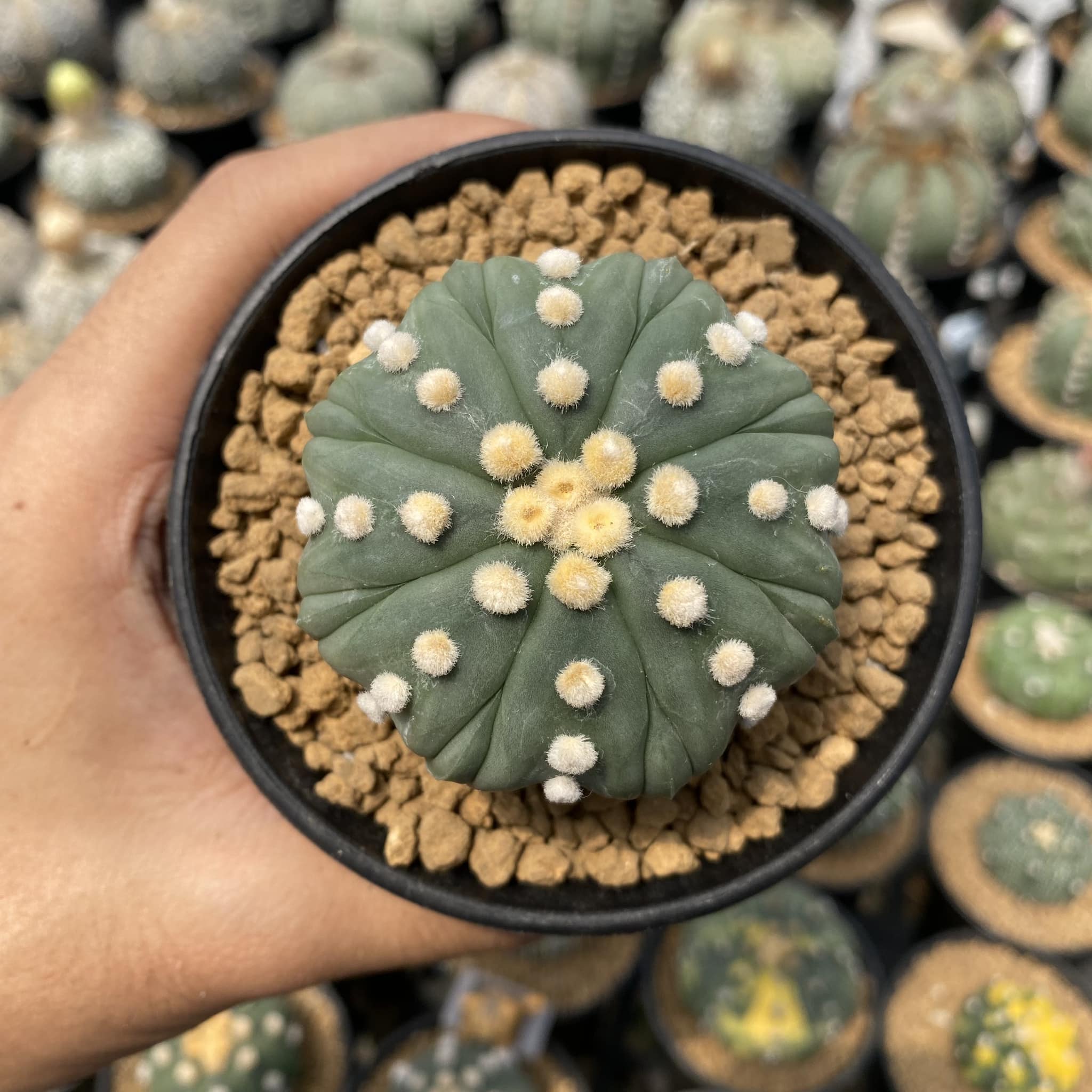
The single defining trait of f. nudum is the absence, or extreme reduction, of the white trichome flecks that normally cover the epidermis of the typical form. In the flecked parent, these scattered tufts of woolly hair give the plant a pale, almost silver-dusted appearance and drive the sand-dollar and sea-urchin common names. In nudum, the epidermis reads clean: dark green, grey-green, slate, or developing a bronze to reddish flush during cold dry winter rest.
The distinction collectors most often get wrong is areole versus inter-areole trichomes. The felty, woolly white areoles along each rib line are not absent in nudum; only the trichome layer between them is. Photographed next to a typical asterias, the nudum plant often looks more architectural because the rib geometry and the areole line dominate the visual field instead of the pale wash of flecking.
Every other structural character belongs to the parent species. Eight flat ribs, spineless body, 5 to 15 cm diameter on a 2.5 to 6 cm tall disc, yellow flowers 3 to 4 cm across with an orange-red throat, basal fruit dehiscence, helmet-shaped seeds with a prominent sunken hilum. Any structural rearrangement attributed to nudum by a seller belongs to another trait dimension, usually kabuto body form or ooibo areole enlargement, not to the nudum character itself.
Kabuto and nudum
Kabuto (helmet) and nudum are independent trait dimensions, not synonyms or opposites. Nudum describes epidermis surface character only, the absence of inter-areole trichome coverage. Kabuto describes body form: a lower, broader, more geometrically regular disc with prominent areoles, established from a single 1981 mutation Masaomi Takeo isolated at an American garden centre and handed to Tony Sato for development in Japan. Roughly seventy-three kabuto cultivar lines are documented in Japanese breeding literature.
A plant can be both. Ruri Kabuto (lapis lazuli helmet) is by definition the nudum form of a kabuto body: low, broad, with large woolly areoles and a clean fleck-free epidermis. llifle documents combinations like Ooibo Kabuto Ruri (Ooibo kabuto + nudum), which directly contradicts the occasional collector claim that kabuto and nudum are mutually exclusive. They are selected independently and stack freely; the confusion arises from conflating Superkabuto (maximum trichome flecking) with kabuto (body form).
For identification and labelling: Ruri Kabuto is the kabuto-plus-nudum intersection, the most collector-desirable combination in the group. Super Kabuto is the maximum-flecked kabuto form and sits at the opposite end of the trichome axis from nudum. Super Kabuto nudum is theoretically possible but biologically improbable, since the two traits press in opposite directions on the same character.
Locality context
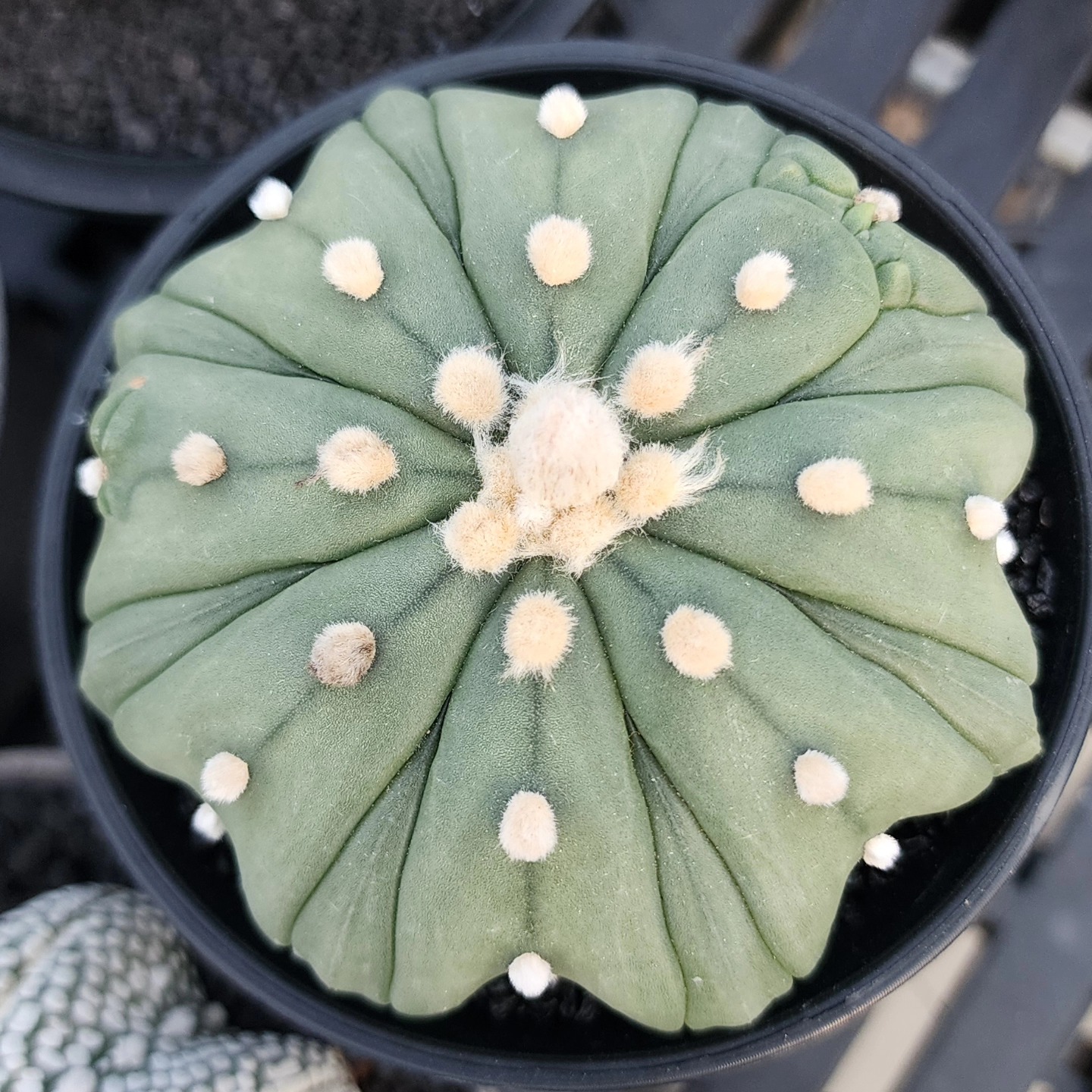
Nudum does not have its own native range. It is a horticultural selection from the parent species, which occupies a single confirmed Texas population in Starr County and scattered Tamaulipan localities in northeastern Mexico. Fleck-free individuals do occur in the wild at low frequency (Giromagi: “nude asterias may occasionally be found in nature, but clones are nursery produced”), but the collector supply is overwhelmingly Japanese and European nursery lines.
Astrophytum asterias f. nudum care and cultivation
Cultivation runs on the parent-species protocol with two form-specific adjustments. Full detail on substrate, container, winter rest, and propagation lives on the parent page; the differences below are the items a nudum grower cannot ignore. The substrate ratio table below mirrors the parent species: 40 per cent pumice, 15 per cent lava rock, 5 per cent zeolite, 25 per cent granite grit, 10 per cent limestone chip, and 5 per cent worm castings.
All seven Astrophytum pages share the genus 90/10 mineral-organic baseline. Limestone runs from 5 to 15 per cent across the four species, an amount set by the BCSS’s own genus-wide limestone-in-the-compost convention for Astrophytum rather than by a per-species study. No published source differentiates the proportion between asterias, caput-medusae, coahuilense, and myriostigma, and the current spread is unchanged house practice.
| Species | Pumice | Lava | Zeolite | Granite | Limestone | Silica | Organic |
|---|---|---|---|---|---|---|---|
| A. asterias | 40% | 15% | 5% | 25% | 10% | 0% | 5% |
| A. asterias f. nudum (this page) | 40% | 15% | 5% | 25% | 10% | 0% | 5% |
| A. asterias (variegata) | 40% | 15% | 5% | 25% | 10% | 0% | 5% |
| A. caput-medusae | 40% | 15% | 5% | 30% | 5% | 0% | 5% |
| A. coahuilense | 35% | 15% | 5% | 25% | 15% | 0% | 5% |
| A. myriostigma | 40% | 15% | 5% | 30% | 5% | 0% | 5% |
| A. myriostigma var. quadricostatum | 40% | 15% | 5% | 30% | 5% | 0% | 5% |
Light: more shade than typical asterias
The trichome flecks on a typical A. asterias scatter and reflect UV across the epidermis. The clean skin of nudum has no equivalent protection. In hot inland climates above about 32°C, afternoon shade is mandatory; corking and permanent epidermal scarring follow quickly from direct midday sun in summer. The llifle entry on Ruri Kabuto Nisiki is explicit: the clean-skinned selections “cannot tolerate prolonged exposure to direct sun light especially during the hottest summer days.” Partial shade also deepens the green coloration, which is part of the point of selecting for the trait in the first place.
Seed lines segregate
Nudum does not breed fully true from open pollination. Nudum-crossed-with-nudum seed batches produce a mix of clean-skinned, intermediate, and flecked seedlings, consistent with an incompletely dominant or polygenic character. Maintaining a stable line requires selecting only fleck-free parents and managing cross-pollination; any pollen drift from a typical asterias in the same collection produces flecked seedlings in the next generation. Japanese breeders have stabilised some lines over decades, but commercial “nudum seed” still segregates. Seed grown plants that develop full adult fleck-free expression are preferred over grafted stock for the same reason as the parent species: natural proportions and a correct flat disc habit.
Winter coloration: a feature, not a warning
Nudum plants commonly develop a reddish-bronze flush during cold dry winter rest. Giromagi and UnusualSeeds both note the character, and it is stress pigmentation rather than damage. The typical flecked form blanches less dramatically under the same conditions because the trichomes mask the underlying epidermis. A nudum plant that comes out of winter bronzed and reddens its ribs is healthy; one that develops hard brown patches or corking rings has taken sun damage and needs shade earlier the following summer.
Comparison
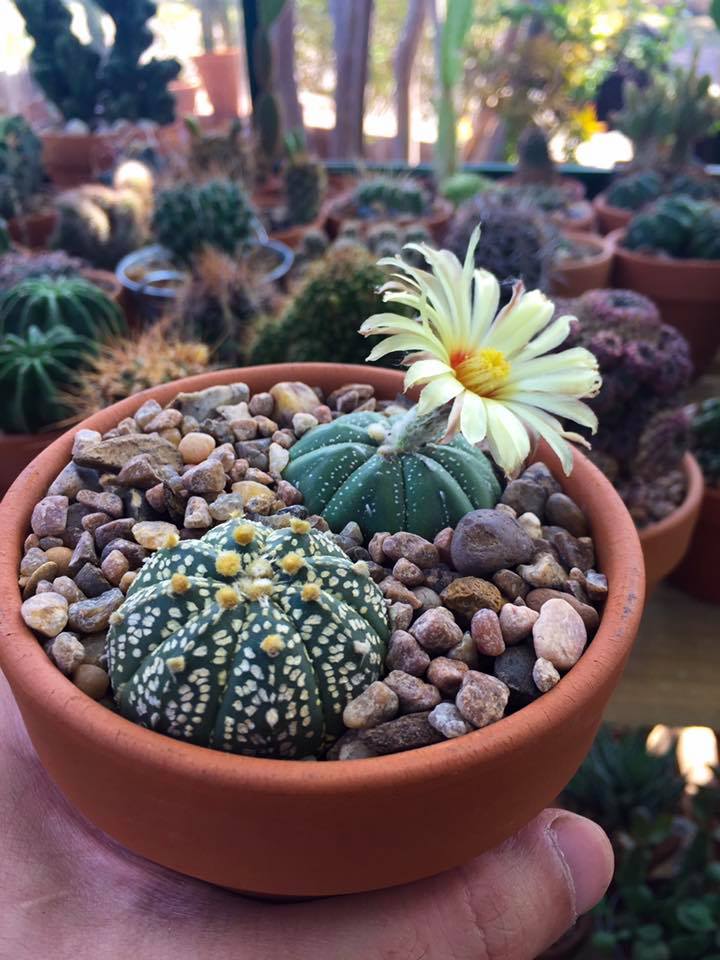
The comparison that matters is with the typical flecked form of A. asterias. Every other Astrophytum species is separated by rib count, body shape, or flower characters long before epidermis becomes the deciding trait: A. coahuilense has five ribs and lives at 1,100 to 1,600 m in Coahuila, A. myriostigma lacks the red throat and turns columnar with age, and A. caput-medusae has elongated snake-like tubercles unlike any other plant in the genus.
Within asterias, the flecked and nudum forms are identical to the eye except for the epidermis surface. Drag the slider in the first FAQ below to see how dramatically the visual emphasis shifts when the trichome layer is removed: the areole tufts and the rib geometry come forward, the body reads as a geometric object rather than a textured one, and winter bronze reveals through the clean skin in a way it cannot through the pale flecked surface.
Frequently asked questions
How do you tell A. asterias f. nudum apart from typical A. asterias?
The natural comparison is between the nudum form and the flecked typical form of the same species. Body structure, flowers, and seeds are identical; the table below focuses on the characters that actually shift between the two.


Epidermis surface is the primary visual read. Winter bronzing is a useful secondary check on a plant coming out of rest. Seed behaviour matters if a grower is trying to maintain the line.
What is the difference between nudum and kabuto?
Independent traits, not synonyms. Nudum describes the epidermis: no inter-areole trichome flecks. Kabuto describes body form: a lower, broader, more regular disc with prominent areoles, developed from a 1981 mutation by Takeo and Sato in Japan. A single plant can carry both traits simultaneously (Ruri Kabuto), neither trait (typical asterias), or either trait alone. Sources describing them as mutually exclusive are confusing Superkabuto (maximum flecks) with kabuto (body form).
Is A. asterias f. nudum a separate species?
No. It is a horticultural form of A. asterias. POWO treats all infraspecific names under the species as synonyms, including Itô’s 1981 var. nudum; the contemporary usage of f. nudum is unsanctioned rank drift rather than a new publication. Botanical authorities recognise one species; collectors and Japanese cultivar tradition recognise a stable phenotype named nudum, and both positions are internally coherent.
Can you grow nudum from seed?
Yes, but the line segregates. Seed from a nudum-by-nudum cross produces a mix of fleck-free, intermediate, and typically flecked seedlings, consistent with an incompletely dominant or polygenic character. Pollen drift from any typical A. asterias in the same collection introduces flecked progeny in the next generation. Japanese breeders have stabilised some commercial lines over decades; others still segregate. Seeds germinate in the same 2 to 5 days at 25 to 30°C window as the parent species.
Does nudum need more shade than typical asterias?
Yes. The trichome flecks on a typical A. asterias scatter UV across the epidermis; the clean nudum skin carries no equivalent shield. Growers in hot inland climates above about 32°C should shade nudum plants from direct midday summer sun, or accept corking and permanent epidermal scarring. Partial shade also intensifies the green coloration, which is part of why the trait is selected.
Is it legal to own nudum?
Yes, under the same conditions as any other A. asterias. The parent species is CITES Appendix I and US ESA Endangered, which prohibits commercial trade in wild-collected plants. Cultivated nursery stock is legal under CITES Article VII(4) with artificial-propagation certificates from a registered nursery. Private ownership of legally documented plants is not restricted.
Sources & further reading
Itô, Y., The Cactaceae: Classification and Illustration of Cacti, Tokyo, p. 508 (1981) · Kew POWO, A. asterias var. nudum (synonymy via Govaerts 1995) · IPNI record 916112-1 · Hernández et al., IUCN Red List assessment 2017 (T40961A121438670) · CITES Appendix I listing, effective 22 October 1987 · llifle Encyclopedia of Living Forms, A. asterias var. nudum · llifle, A. asterias cv. Ooibo Kabuto · llifle, A. asterias cv. Superkabuto (Takeo 1981 / Sato) · llifle, A. asterias cv. Ruri Kabuto Nisiki (Yellow) · Giromagi Cactus and Succulents, A. asterias var. nudum · UnusualSeeds, A. asterias hybrids guide · Cactus Conservation Institute, Astrophytum research page