
Astrophytum caput-medusae
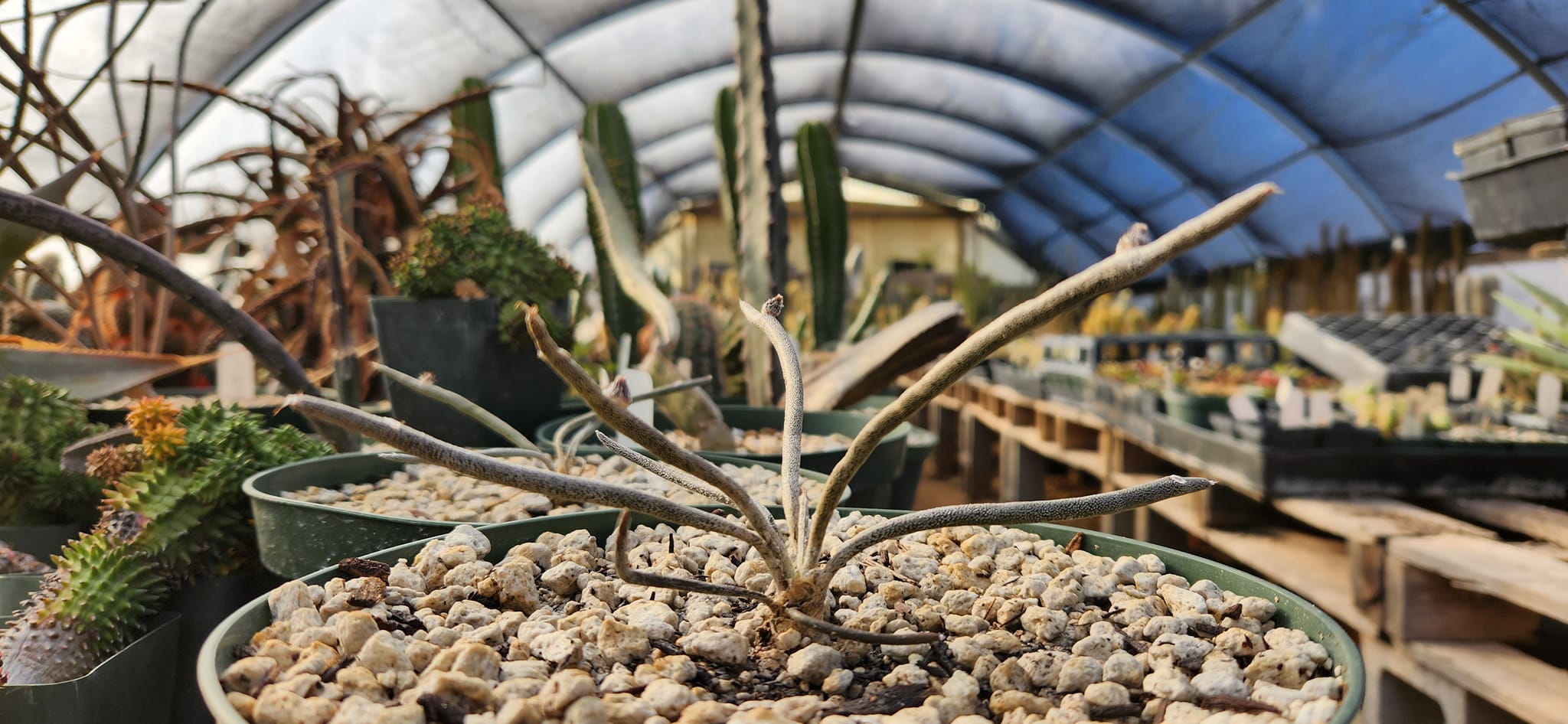
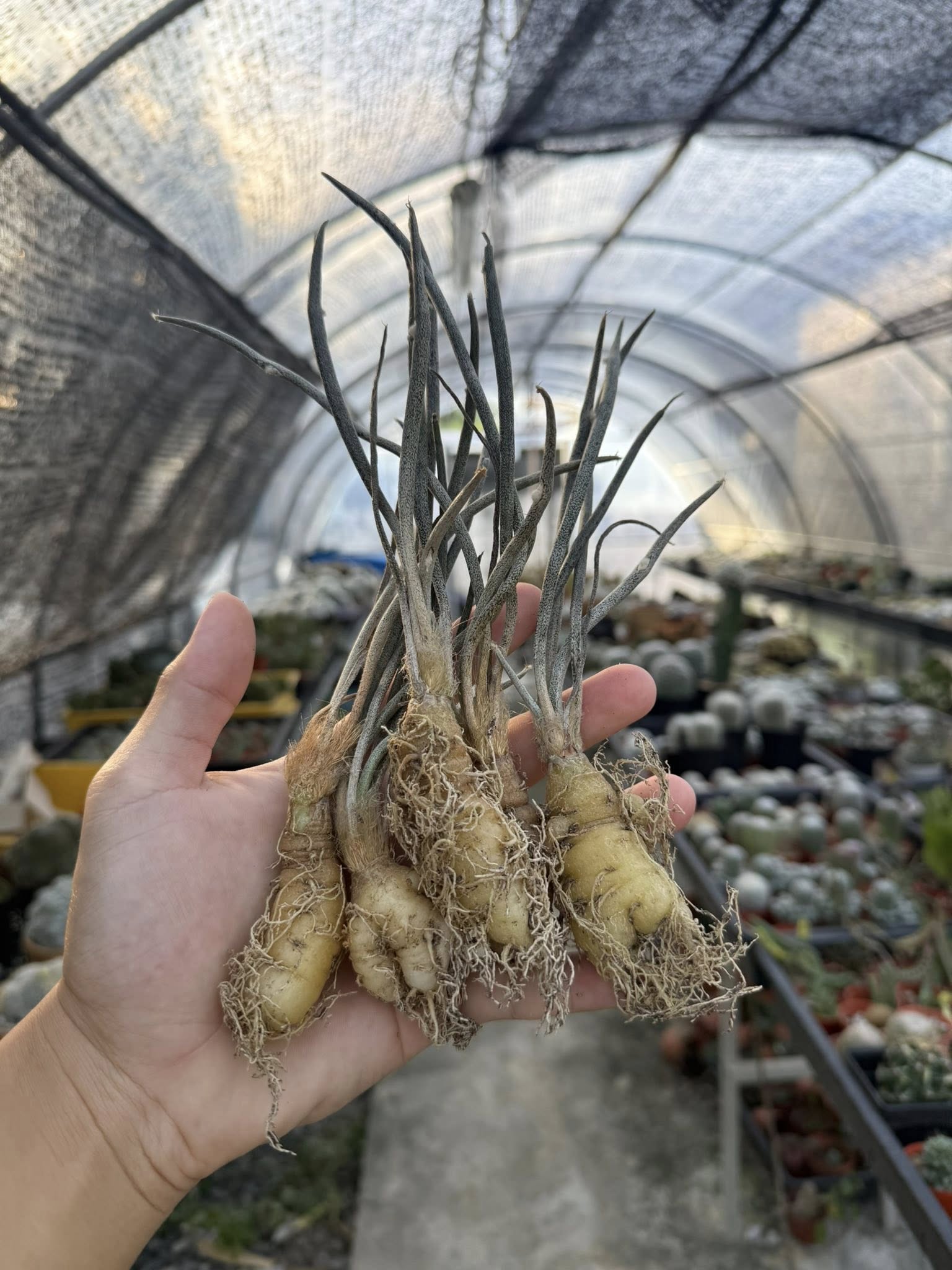
Astrophytum caput-medusae is the genus outlier, a caudiciform perennial that carries none of the rib-and-fleck architecture expected of Astrophytum. Instead, 10 to 25 or more long, cylindrical, snake-like tubercles radiate from a short central caudex, each covered in grey-white trichome scales and bearing dimorphic areoles: spiniferous at the tip, floriferous midway down. The Medusa’s head common name is exact. Carlos Gerardo Velazco Macías and Manuel Nevárez de los Reyes found it in northeastern Nuevo León in August 2001 and described it in 2002 under the new genus Digitostigma, arguing that the absence of ribs and the dimorphic areole system placed it outside Astrophytum entirely.
D.R.Hunt disagreed. In October 2003 he transferred the species to Astrophytum in Cactaceae Systematics Initiatives 16: 4, citing flower morphology, seed morphology, and chromosome count as genus-defining characters that the vegetative aberrance does not override. Molecular phylogeny has since confirmed his position: Molecular phylogenetics places A. caput-medusae within a clade alongside A. asterias, A. capricorne, and A. coahuilense. The name Digitostigma persists in trade but is not accepted by Kew POWO or IPNI.
The single confirmed wild locality is in northeastern Nuevo León, in flat Tamaulipan thornscrub at 100 to 200 m above sea level. Plants grow in partial shade under nurse shrubs, a position unlike any other Astrophytum. POWO includes Tamaulipas in the range, reflecting a possible second population near the Nuevo León border, but the IUCN assessment treats the species as occurring at a single location with a distribution under 100 km². That constrained geography is the central conservation problem: no second population exists to buffer against targeted collection or habitat loss.
Cultivation is possible but not simple. Young plants grown from seed frequently fail in the first one to two winters, a failure mode that does not occur with A. myriostigma or A. myriostigma var. quadricostatum under the same conditions. Grafted plants flower earlier and grow faster but are paradoxically more drought-sensitive than plants grown from seed. The species rewards close attention to winter humidity, shade, and substrate discipline in the pot; get those three right and the plant is unlike anything else in the genus.
Astrophytum caput-medusae quick reference
A caudiciform geophyte from the Tamaulipan thornscrub of northeastern Nuevo León, growing in partial shade under nurse shrubs on calcareous Xerosol. Values calibrated for seed grown plants in cultivation, drawn from habitat data, llifle, Giromagi Cactus, and BCSS grower community experience.
Taxonomy & nomenclature
The accepted name is Astrophytum caput-medusae (Velazco & Nevárez) D.R.Hunt, published in Cactaceae Systematics Initiatives 16: 4 (11 October 2003). IPNI (urn:lsid:ipni.org:names:70029496-1) and the Caryophyllales Network CDM portal both cite volume 16, page 4; Kew POWO cites volume 15: 6 for the same combination. The IPNI record is treated as authoritative here. Kew POWO accepts the combination without qualification and lists the distribution as Nuevo León and Tamaulipas, Mexico.
The basionym is Digitostigma caput-medusae Velazco & Nevárez, published in Cactáceas y Suculentas Mexicanas 47(4): 81 (2002). IPNI designates it nom. inval. (nomen invalidum): the original paper lacked the required Latin diagnosis and formal spec. nov. designation under the pre-2012 ICBN code. A dedicated nomenclature paper published in 2007 addressing the invalidity. Hunt’s 2003 transfer is therefore treated by POWO and IPNI as the valid first publication. Parenthetical credit to Velazco & Nevárez is retained by botanical convention to acknowledge the discoverers.
The epithet caput-medusae is Latin for Medusa’s head. The same epithet appears in Mammillaria caput-medusae, Euphorbia caput-medusae, and Tillandsia caput-medusae, all named for the same snake-haired Gorgon. The genus name Astrophytum is from Greek astron (star) plus phyton (plant), coined by Lemaire in 1839.
Subgeneric placement is contested. Hunt (2003/2006) created a new subgenus Stigmatodactylus D.Hunt to accommodate the species. Molecular analysis found support for placement within subgenus Neoastrophytum (sensu Backeberg 1950) instead, on the basis of shared bicoloured inner tepals and fruit dehiscence characters with A. asterias, A. capricorne, and A. coahuilense. No formal reassignment from Stigmatodactylus to Neoastrophytum has been published; both names are in current use.
The Digitostigma debate. Velazco Macías and Nevárez de los Reyes originally erected Digitostigma as a monotypic genus, citing three characters absent from all other Astrophytum: complete absence of ribs, tubercles up to 19 cm long unlike anything in the genus, and the dimorphic areole system with spiniferous terminal and floriferous subterminal areoles on the same tubercle. Hunt (2003) rejected generic separation on the grounds that flower architecture, seed morphology, and chromosome count are indistinguishable from Astrophytum and that vegetative divergence alone does not justify a new genus in a well-defined family. Molecular analyses using chloroplast markers and 353 nuclear genes respectively, both confirm A. caput-medusae as derived within Astrophytum, not as a basal or outgroup lineage. The generic-level debate is effectively closed by the molecular evidence, though the name Digitostigma caput-medusae continues to appear in trade and on some nursery labels. Use Astrophytum caput-medusae.
The hybridization data from the collector community reinforces the molecular story. CactiGuide forum records place A. caput-medusae in a separate hybridization group (Group C) from the other five species. Crosses between Group C and Group A (A. asterias, A. coahuilense, A. capricorne) or Group B (A. myriostigma, A. ornatum) produce seeds with very poor germination and non-flowering seedlings, consistent with a derived position and partial reproductive isolation within a monophyletic genus.
Historical synonym (1)
- Digitostigma caput-medusae Velazco & Nevárez, 2002 basionym
Sources: POWO (Kew) · IPNI · GBIF · Wikidata
Habitat
A. caput-medusae grows in Matorral espinoso tamaulipeco, the Tamaulipan thornscrub of northeastern Mexico. The single confirmed locality is in the flat terrain of northeastern Nuevo León at 100 to 200 m above sea level, placing this species at the lowest elevation of any Astrophytum. The ecoregion is the same flat calcareous plain that A. asterias occupies in southern Tamaulipas and South Texas, although the two species are not known to be sympatric.
Substrate is Xerosol, a calcareous, calcium-carbonate-rich soil with very little organic content (llifle, citing original description). Parent rock is limestone and calcareous alluvium, consistent with the broader Nuevo León geology at this elevation. Drainage is fast; the soil layer is thin. The WRB soil classification equivalent is Calcisol.
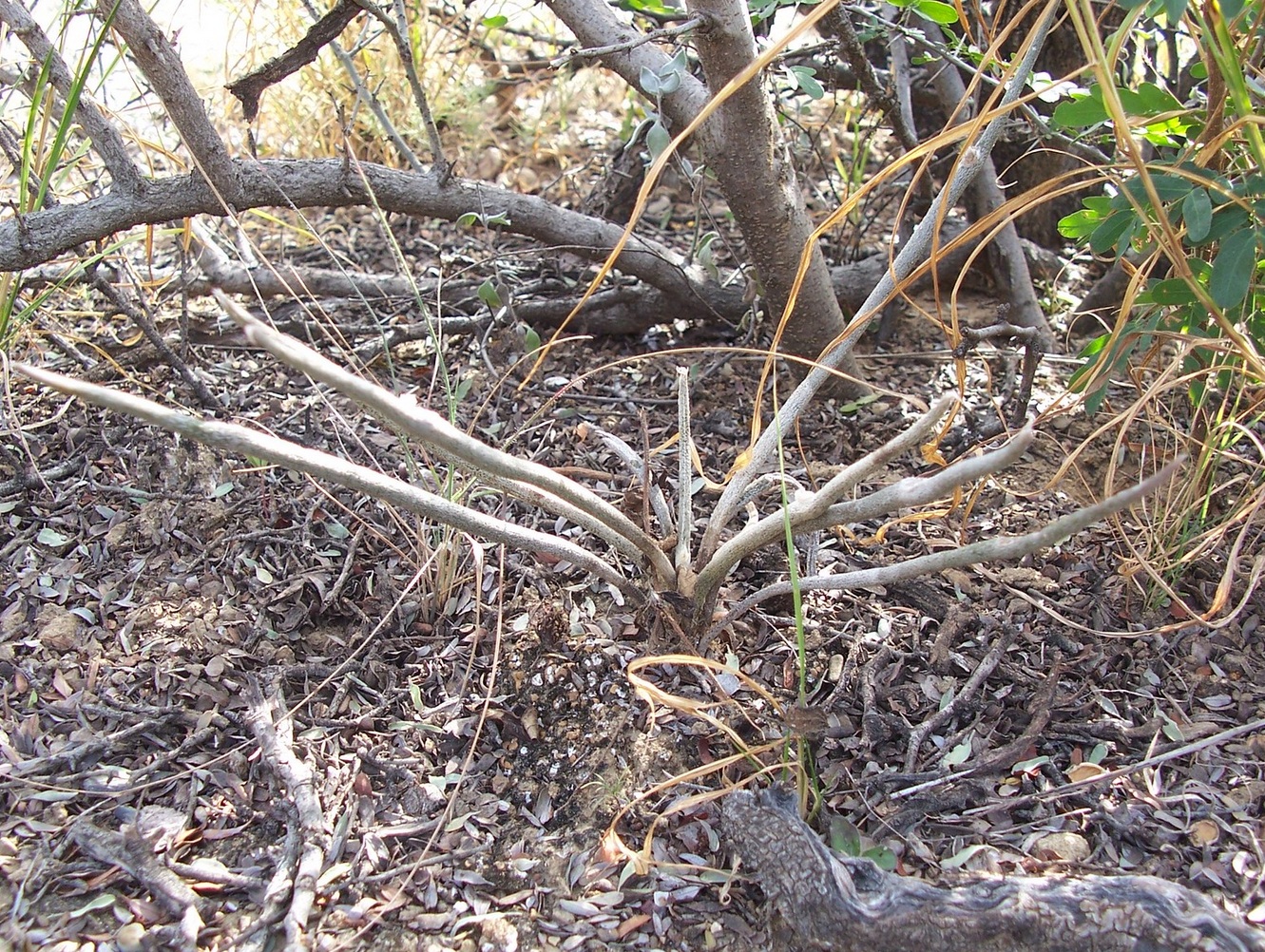
The defining microhabitat character is shade. Plants grow at the base of thornscrub shrubs in a partially shaded position, not in open sun. The matrix vegetation includes Prosopis spp. (mesquite), Acacia, Celtis, and Condalia, with seasonal grasses that may camouflage the grey-white tubercles among dry grass stems and shrub-base litter. This shade preference is the most consequential fact about the species for cultivation: every other Astrophytum in the genus is a full-sun plant.
Climate at the locality is semi-arid subtropical. Annual rainfall runs approximately 400 to 600 mm, summer-dominant from June to September tropical moisture events. Winters are dry and mild; freezing temperatures occur but are infrequent at this low elevation. The seasonal pattern produces a summer-active, winter-dormant growth cycle, with dormancy running from late August or September through March (llifle). POWO lists Tamaulipas as part of the accepted range, reflecting a possible second occurrence near the state boundary, but the 2013 IUCN assessment treats the species as a single-location endemic.
Morphology
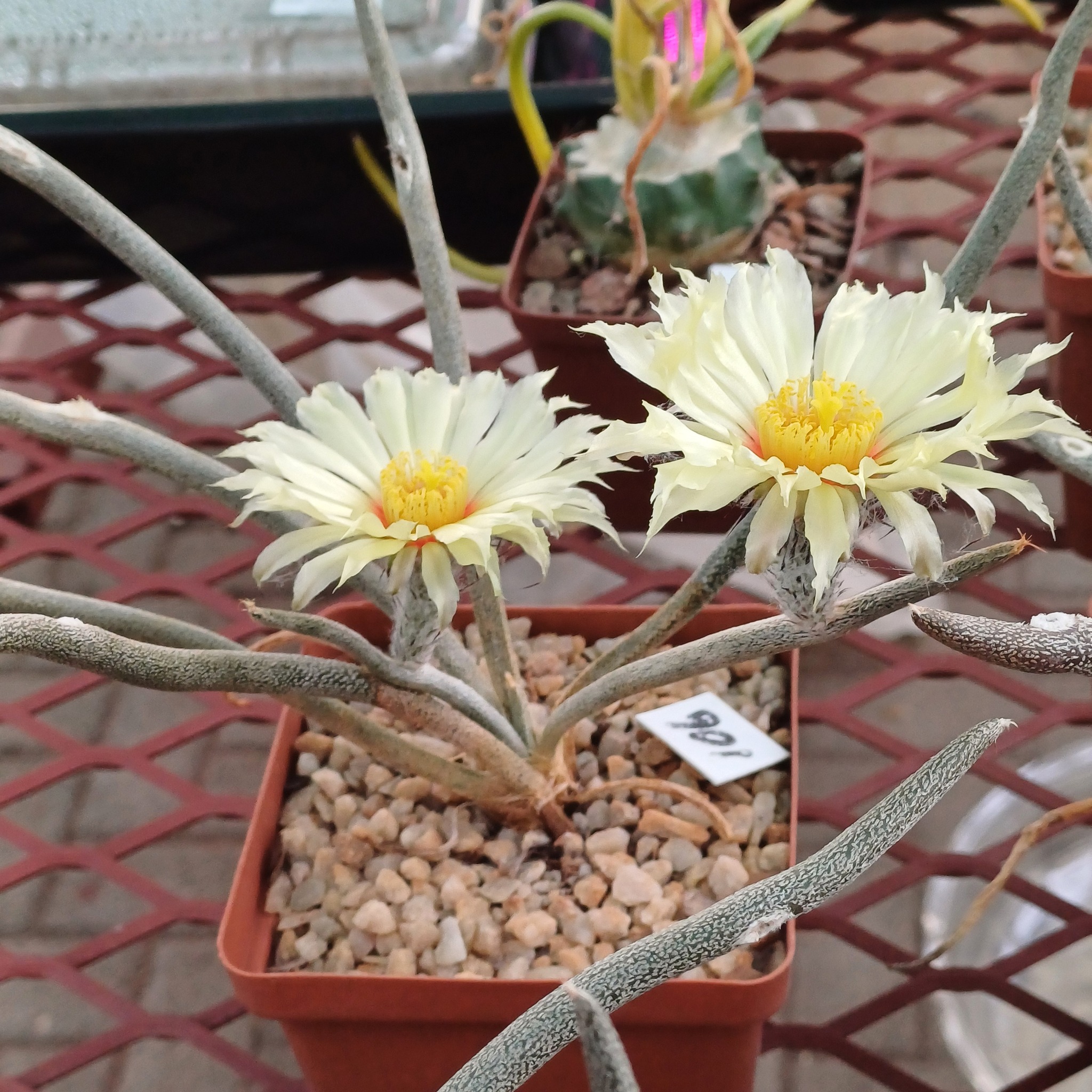
A. caput-medusae does not look like a cactus of the genus it belongs to. The plant consists of a short, squat, cylindrical caudex, rarely exceeding 6 cm in diameter, from which arise 10 to 25 or more long, finger-like, cylindrical tubercles. There are no ribs. The central stem does not form the ribbed globose or columnar body that defines every other Astrophytum; it is reduced to a fleshy junction point from which the tubercles extend radially outward and upward.
Tubercles reach up to 19 cm long and 2 to 5 mm wide (llifle, citing original description). The surface is slightly verrucose, glaucous-green, and almost entirely covered in greyish-white squamiform peltate trichomes, the same flat shield-like hair-scales found scattered on the body of other Astrophytum but here coating the entire tubercle surface in a dense grey-white layer. The plant is solitary or rarely forms clusters of up to 19 individuals by basal offsetting at the caudex (Giromagi Cactus). The primary root is fusiform and fleshy, similar in extent to the above-ground tubercle mass.
Areoles are dimorphic, a character unique in the genus. Spiniferous terminal areoles at the tip of each tubercle are circular, filled with white wool, and bear 0 to 4 very short spines, each 1 to 3 mm long, rigid, whitish at the base and dark-brown at the apex. Many tubercles carry no spines at all. Floriferous subterminal areoles, larger than the terminal ones, are positioned partway down each tubercle, spaced 18 to 46 mm from one another. Flowers arise from these subterminal areoles rather than from the caudex apex, a further divergence from the genus norm.
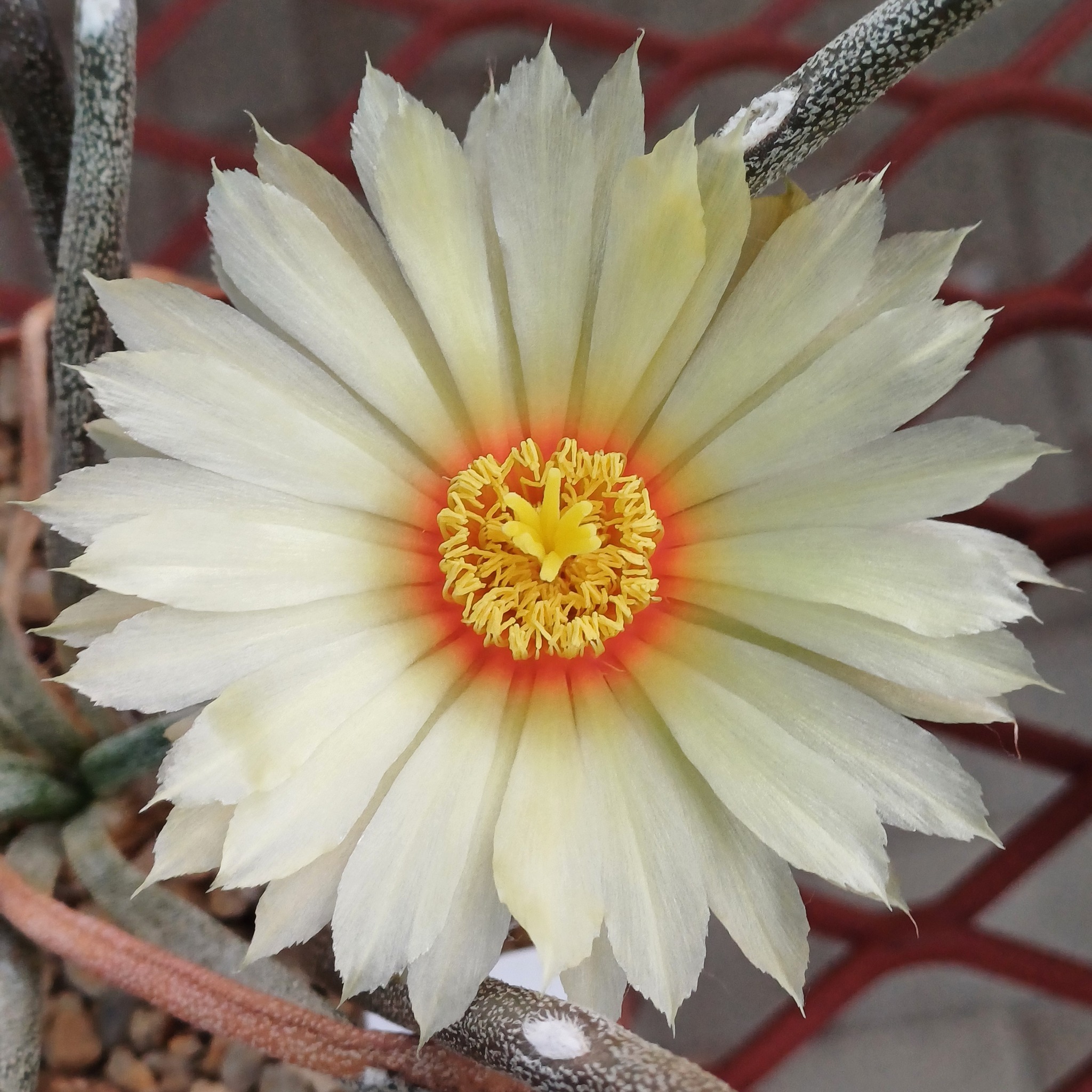
Flowers are diurnal, solitary, radially symmetrical, and large and funnel-shaped in genus-typical form. Outer perianth segments are greenish-yellow; inner segments are yellow with an orange-coloured base. Flower dimensions were not retrieved from primary sources and are not stated here. Flowering occurs in autumn (llifle, Giromagi Cactus; citing the original description context), though cultivated plants have been reported to flower in spring. Fruit shows irregular longitudinal dehiscence at maturity (llifle), which may differ from the basal or nearly-basal dehiscence attributed to the asterias-capricorne-coahuilense clade as a group; the tension between these accounts has not been resolved by a direct examination of fresh material. Seeds are up to 3 mm long, cap-shaped, dark black to coffee-brown, with a tuberculate testa, matching the seed morphology of the genus.
Locality detail
The type collection was made on 28 August 2001 by Nevárez de los Reyes and Velazco Macías in Nuevo León, Mexico; the holotype is deposited at the Universidad Autónoma de Nuevo León herbarium. The specific municipality was withheld in the original publication, consistent with the sensitivity of a population under the highest conservation concern recorded for any Astrophytum.
Seed-trade provenance records from CactusDNA name Los Herreras municipality in northeastern Nuevo León, approximately 90 km north-northeast of Monterrey, as a collection source. This is consistent with the 100 to 200 m elevation and Tamaulipan thornscrub habitat but the municipality name is not published here; the map below marks only a regional centroid. POWO includes Tamaulipas in the accepted range. A Succseed provenance listing cites El Herrero, Tamaulipas; whether this represents a verified second wild population or a mislabelled seed lot from the Nuevo León locality has not been confirmed by field survey. The 2013 IUCN assessment treats the species as a single-location endemic.
Astrophytum caput-medusae care and cultivation
Two facts drive the cultivation choices below. First, pot organic stays low, following the genus-wide summer-rain arid convention rather than a measurement of this species’ habitat soil; the mix stays mineral-dominant for that reason. Second, the plant grows in partial shade under nurse shrubs in the wild, which does carry over to the pot: it is not a full-sun species and performs better with filtered light than most cacti in a typical collection.
Substrate
Pumice is the primary component: BCSS grower reports describe established plants surviving even in a 100 per cent pumice medium, which is the basis for keeping pumice as the dominant aggregate here. The canonical ratio is 40 per cent pumice, 15 per cent lava rock, 5 per cent zeolite, 30 per cent granite grit, 5 per cent limestone chip, and 5 per cent worm castings. Granite is the primary hard-grit fraction, maintaining pore structure over years without breaking down, the same mechanical role it plays across every Astrophytum page. The limestone share follows the same genus-wide grower convention used on all seven pages rather than a species-specific study: no published source sets a per-species proportion, and the amount here is unchanged house practice. On hard tap water, reduce or omit the limestone fraction; on RO, distilled, or rainwater, keep it at the stated share. The organic share sits at the floor of the band used for summer-rain arid cacti generally; no cultivation source measures an organic percentage for this species specifically. The zeolite buffers pH and paces nutrients; the lava fraction is the structural drainage aggregate. What all grower reports agree on: drainage must be immediate and the mix must stay mineral.
All seven Astrophytum pages share the genus 90/10 mineral-organic baseline. Limestone runs from 5 to 15 per cent across the four species, an amount set by the BCSS’s own genus-wide limestone-in-the-compost convention for Astrophytum rather than by a per-species study. No published source differentiates the proportion between asterias, caput-medusae, coahuilense, and myriostigma, and the current spread is unchanged house practice.
| Species | Pumice | Lava | Zeolite | Granite | Limestone | Silica | Organic |
|---|---|---|---|---|---|---|---|
| A. asterias | 40% | 15% | 5% | 25% | 10% | 0% | 5% |
| A. asterias f. nudum | 40% | 15% | 5% | 25% | 10% | 0% | 5% |
| A. asterias (variegata) | 40% | 15% | 5% | 25% | 10% | 0% | 5% |
| A. caput-medusae (this page) | 40% | 15% | 5% | 30% | 5% | 0% | 5% |
| A. coahuilense | 35% | 15% | 5% | 25% | 15% | 0% | 5% |
| A. myriostigma | 40% | 15% | 5% | 30% | 5% | 0% | 5% |
| A. myriostigma var. quadricostatum | 40% | 15% | 5% | 30% | 5% | 0% | 5% |
Deep pots are required. The primary root is fusiform and fleshy, comparable in extent to the above-ground tubercle mass. Shallow containers constrain root development and make the plant unstable as the tubercles extend.
Watering and light
Water during the growing season (roughly March through August or September) when the substrate approaches dryness but before complete bone-dryness. Unlike A. asterias growing in open sun, A. caput-medusae grows under partial shrub canopy and its roots do not face the same extreme drying cycles. Grafted plants are notably drought-sensitive; llifle warns that waterlessness for even a few days causes tubercle loss on grafted specimens. Established plants grown from seed are more tolerant of brief dry intervals.
Winter dormancy runs from approximately late August or September through March (llifle). Withhold water entirely during dormancy for established plants. Seedlings in the first two winters are an exception: BCSS forum growers report that keeping young plants in a closed propagator with residual humidity through the first and second winters significantly improves survival compared to applying a hard dry-winter rest from the start. The standard dry-winter protocol applies from the third year onward.
Cold tolerance spans a range between two cited sources: llifle records no damage at a minimum nighttime temperature of 0°C, and Giromagi sets the safe minimum at 4°C. The practical guidance is to keep plants above 5°C when conditions are at all damp, and allow brief exposure down to 0°C only when the root zone is completely dry. Wet cold at any temperature is the primary kill vector.
Light: partial shade or filtered light throughout the growing season. In hot climates (SW USA, Mediterranean), afternoon shade is important; the plant will bleach and scorch under midday summer sun. In mild temperate climates (UK, northern Europe) a partly-shaded greenhouse position works well. Full sun in these mild settings is reported as tolerable but not optimal.
Propagation and sourcing
Seeds germinate within 1 to 3 weeks at 21 to 27°C (70 to 80°F) in bright indirect light with a humid cover. Germination itself is not the challenge. The critical period is the first two winters; seedlings that receive a standard hard dry-winter rest frequently wither between 18 months and 2 years of age (BCSS forum records). Keeping seedlings in a propagator with retained humidity through winters 1 and 2, then transitioning to a dry winter rest from year 3, is the approach that BCSS growers found most effective for improving survival. One BCSS grower reported first flowering from a seed grown plant approximately 3 years from purchase as a small seedling.
Grafting onto Trichocereus or Myrtillocactus is common in the trade and in specialist collections. Grafted plants flower within 1 to 2 years and avoid the difficult seedling mortality window. The trade-off is drought sensitivity: grafted plants require more attentive watering discipline because tubercle loss from brief dry spells is a real risk. Single tubercles, once removed and allowed to callus, can be rooted or grafted independently; llifle notes that each tubercle can reach maturity as an individual plant within a few weeks on a graft, an unusual propagation route specific to this species.
Source documented nursery stock only. CITES Appendix II means wild-collected plants require export and import permits; nursery-propagated plants are legal in most jurisdictions under standard CITES nursery provisions when properly documented. Purchase only from sellers who can provide documentation of nursery origin.
Comparison
Astrophytum caput-medusae is unmistakable in the vegetative state: its long snake-like tubercles occur in no other member of the genus. No experienced collector will confuse it with the ribbed discs of A. asterias or the columnar ribbed body of A. coahuilense.
The practical confusion in the collector and trade community is nomenclatural, not morphological. Plants are offered as Digitostigma caput-medusae, Astrophytum (Digitostigma) caput-medusae, and occasionally without a genus name at all. All of these refer to the same plant; the Digitostigma name is invalid per IPNI and not accepted by Kew POWO, but it persists in nursery catalogues and collector databases. The molecular phylogeny closes the genus debate. The name is Astrophytum caput-medusae.
Within the confirmed clade, the closest comparison partners are A. asterias, A. capricorne, and A. coahuilense. All four share yellow flowers with orange or red inner bases, white trichome flecking (scattered on the others, dense and full-coat on A. caput-medusae), and basal or nearly-basal fruit dehiscence as a clade marker. The shared flower characters are what Hunt used to justify inclusion in Astrophytum despite the radically different vegetative form.
A useful comparison is with Leuchtenbergia principis (agave cactus) and Mammillaria elongata, two unrelated cacti with long cylindrical tubercles. The convergent morphology has been noted in the literature as possible adaptation to the same thornscrub and dry grassland environments where tall-grass camouflage may reduce browsing pressure. The connection is explicit: recent molecular work cites A. caput-medusae’s long thin tubercles as an example of morphological convergence obscuring phylogenetic relationships within Cactaceae.
Frequently asked questions
How do you tell Astrophytum caput-medusae apart from other Astrophytum?
No other Astrophytum resembles A. caput-medusae in vegetative form. The closest comparison within the genus is A. capricorne, its nearest clade-member, which shows how radically different A. caput-medusae is from the genus norm. Drag the slider to see both plants, then work down the character table.


Body structure is the definitive character: no ribs plus long snake-like tubercles versus prominent ribs and no tubercles. The two plants are not visually similar; the table documents what makes A. caput-medusae unlike anything else in its genus.
Is Astrophytum caput-medusae really an Astrophytum or is it Digitostigma?
Astrophytum caput-medusae is the accepted name per Kew POWO and IPNI. The plant was originally described as Digitostigma caput-medusae in 2002 but that publication was invalid under the botanical code (IPNI: nom. inval.). D.R.Hunt validly published the transfer to Astrophytum in 2003. Molecular phylogeny confirms A. caput-medusae is derived within Astrophytum, sharing flower morphology, seed morphology, and chromosome count with the genus. The name Digitostigma persists in trade but has no current botanical standing.
Is Astrophytum caput-medusae hard to grow?
More challenging than most Astrophytum, specifically in the seedling stage. Seedlings grown from seed frequently fail between 18 months and 2 years old; BCSS growers found that keeping young plants in a humid propagator through the first two winters, rather than applying a hard dry-winter rest, substantially improved survival. Once established at 2 or more years, seed grown plants are stable and more drought-tolerant than grafted ones. Grafted plants grow faster and flower sooner but require more careful watering; llifle notes that a few dry days causes tubercle loss on grafted specimens.
Why is Astrophytum caput-medusae critically endangered?
Critically Endangered. The species is known from a single location in northeastern Nuevo León, Mexico, with a distribution under 100 km². Primary threats are illegal collection, the species being highly desirable to collectors from an accessible flat terrain habitat, and livestock trampling. The constrained single-location range means any local disturbance event can affect the entire wild population with no buffer from a second population.
Is Astrophytum caput-medusae legal to buy?
Yes, when the plant is nursery-propagated. A. caput-medusae is listed under CITES Appendix II, which means international trade in wild-collected plants requires export and import permits. Nursery-propagated plants are legal to buy and sell in most countries under standard CITES nursery provisions when properly documented. Unlike A. asterias (Appendix I), commercial trade in cultivated A. caput-medusae is accessible with the right documentation. Purchase only from sellers who can confirm nursery origin.
When does Astrophytum caput-medusae flower, and how old must it be?
Flowers in autumn from the subterminal floriferous areoles on the tubercles, not from the plant apex. Spring flowering is reported from some cultivated plants but autumn is the primary season per llifle and Giromagi Cactus, citing the original description context. One BCSS forum grower reported first flowering from a seed grown plant at approximately 3 years from purchase as a small seedling. Grafted plants can flower within 1 to 2 years of the graft taking. No systematic data on minimum flowering timeline is available; the 3-year data point is a single grower observation.
Sources & further reading
Velazco Macías, C.G. & Nevárez de los Reyes, M., Cactáceas y Suculentas Mexicanas 47(4): 76–86 (2002) · Hunt, D.R., Cactaceae Systematics Initiatives 16: 4 (11 October 2003) · Kiesling, R., Cactáceas y Suculentas Mexicanas 52(1): 20–24 (2007) · Kew POWO, Astrophytum caput-medusae (Velazco & Nevárez) D.R.Hunt (2024), urn:lsid:ipni.org:names:70029496-1 · IPNI, Astrophytum caput-medusae, urn:lsid:ipni.org:names:70029496-1 (2024) · IPNI, Digitostigma caput-medusae Velazco & Nevárez [nom. inval.], urn:lsid:ipni.org:names:20010952-1 (2024) · Caryophyllales Network CDM Portal, Astrophytum caput-medusae D.R.Hunt (2024) · Vázquez-Lobo, A. et al., Phylogeny and biogeographic history of Astrophytum, Systematic Botany 40(4): 1022–1030 (2015) · de Vos, J.M. et al., Phylogenomics and classification of Cactaceae, Plant Systematics and Evolution (2025), DOI: 10.1007/s00606-025-01948-z · Gómez-Hinostrosa, C. & Hernández, H.M., Astrophytum caput-medusae, IUCN Red List ID 152743 (2013) · CITES species database, Astrophytum caput-medusae, term/8089, Appendix II · GBIF, Astrophytum caput-medusae (Velazco & Nevárez) D.R.Hunt, species/5623659 (2024) · van der Meer, M.H.J., Astrophytum caput-medusae, Dictionary of Cactus Names (2023) · llifle Encyclopedia of Living Forms, Astrophytum caput-medusae entry (2024) · Giromagi Cactus and Succulents, Astrophytum digitostigma caput-medusae (2024) · BCSS Forum threads t=167701, t=162407: grower cultivation experience with this species (2024) · CONABIO, Fichas de especies mexicanas, Astrophytum caput-medusae (2010)