
Astrophytum coahuilense
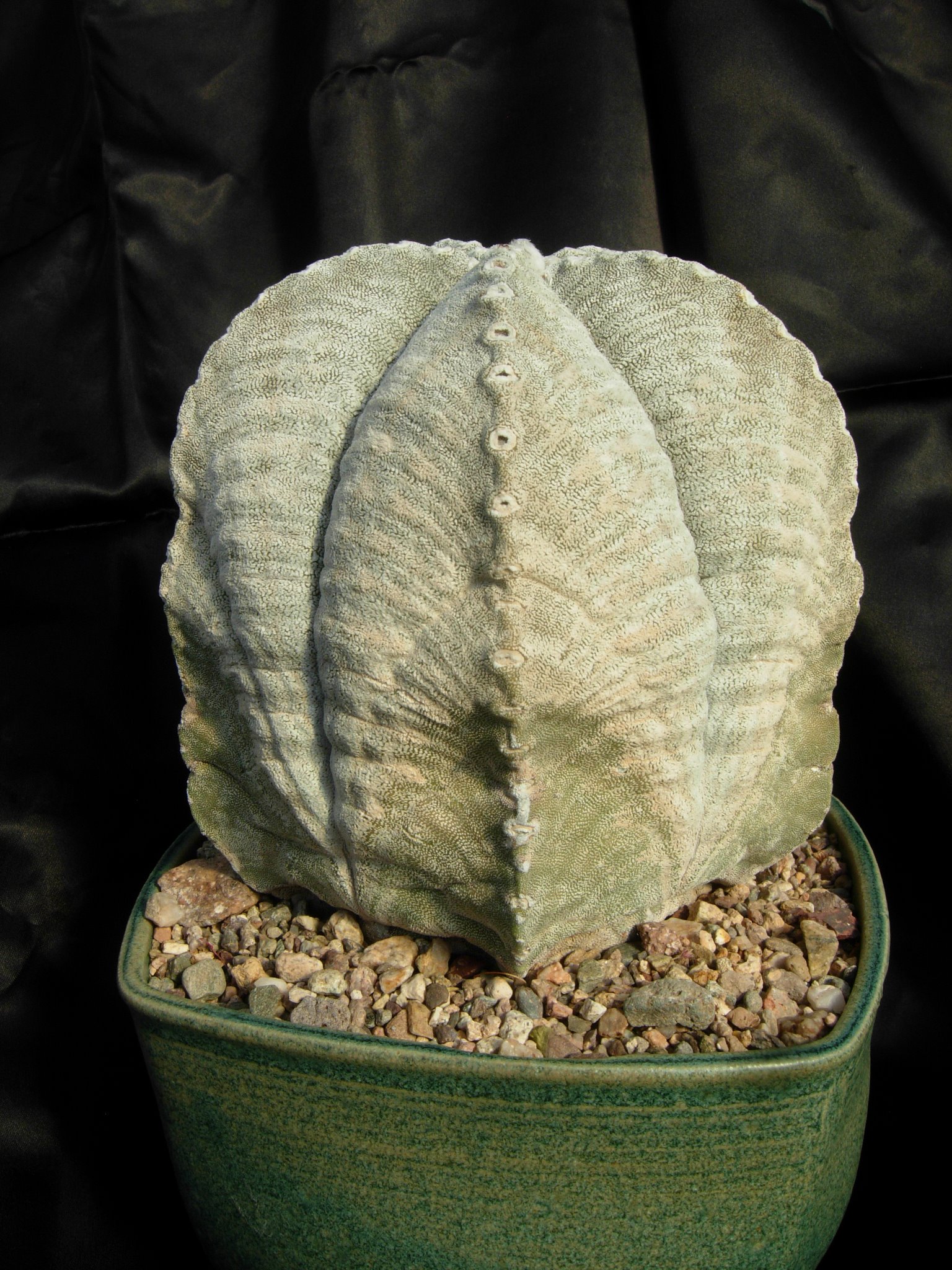
Astrophytum coahuilense is a spineless five-ribbed globose cactus from the limestone hills of southwestern Coahuila and adjacent Durango, Mexico. Heinrich Möller described it from Cerro Bola in 1927 as a subspecies of Echinocactus myriostigma; Kanfer elevated it to species rank in 1932 in Kakteenfreund vol. 1. The species differs from its closest ally A. myriostigma in its denser, softer trichome covering, red-throated flowers, basal fruit dehiscence, and reproductive isolation that makes the two mutually sterile under cross-pollination.
The body grows globose from seed and becomes columnar in old age, an arc shared with A. myriostigma and absent in A. asterias, which stays disc-flat throughout its life. Visually, coahuilense is most often confused with A. myriostigma: both carry five ribs, a spineless body, and trichome flecking, and coahuilense was in fact described in 1927 as a subspecies of myriostigma. The decisive separators are flower and fruit. Coahuilense carries a yellow flower with a red to orange-red throat and fruit that opens basally; myriostigma carries a pure yellow flower with no red and fruit that splits apically in a star pattern. Elevation also narrows the pair: coahuilense is a 1,100 to 1,600 m Chihuahuan Desert plant on limestone in southwestern Coahuila and Durango.
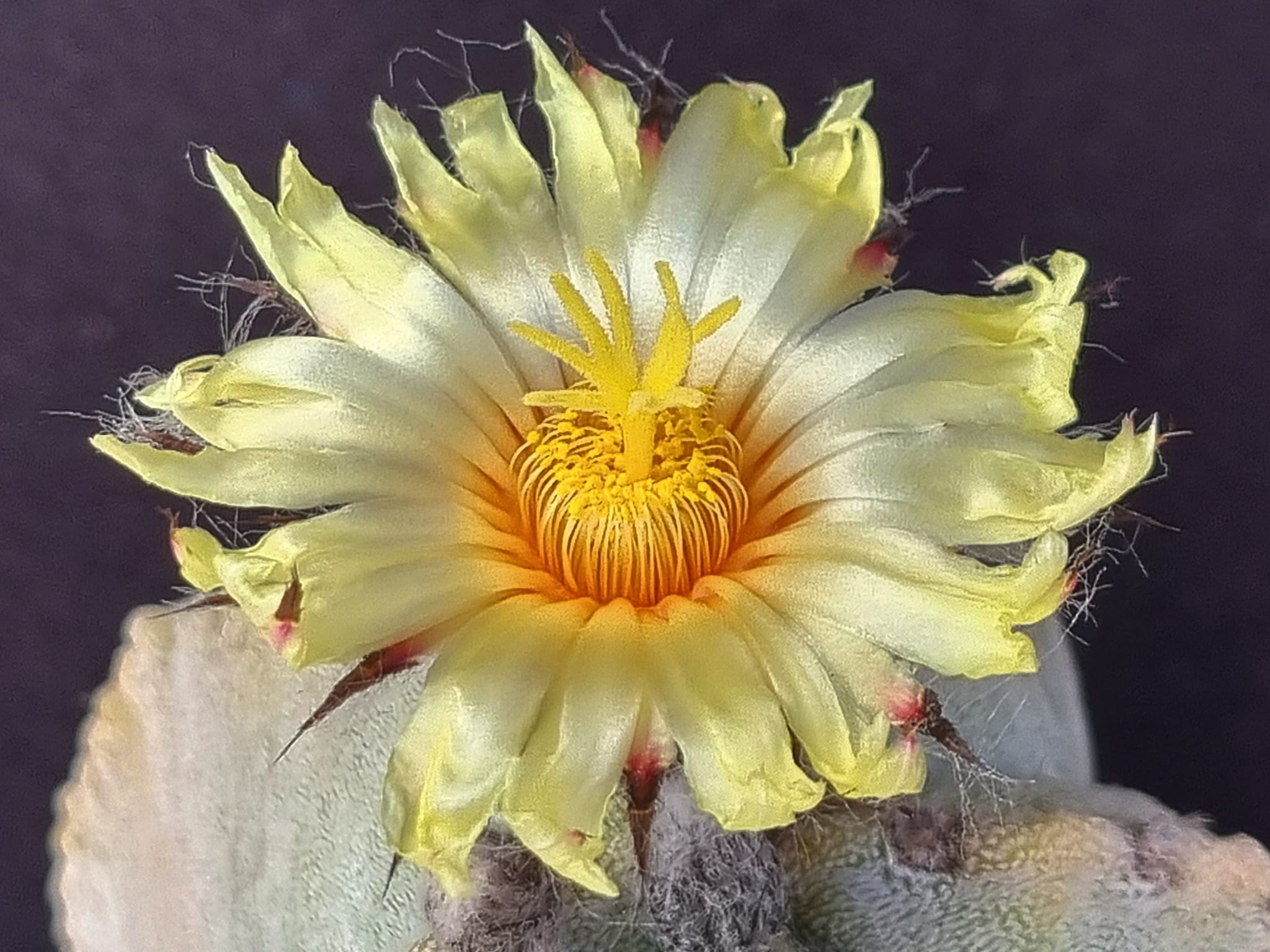
The yellow flower with its red to orange-red throat is the visual signature shared across the asterias-capricorne-coahuilense molecular clade. That shared throat colour also correlates with cross-compatibility: coahuilense hybridises freely with A. asterias and A. capricorne, but is (usually) sterile with A. myriostigma, which carries pure yellow flowers without a red centre. The cross-sterility with myriostigma is one of the strongest biological arguments for treating coahuilense as a full species rather than a myriostigma variety.
Three severely fragmented populations across less than 6,000 km² of extent of occurrence, all outside any protected reserve, underpin the conservation concern documented in the Red List assessment. Illegal collection and overgrazing are the primary documented threats. All Cactaceae, including coahuilense, are covered under CITES Appendix II; nursery-propagated stock is legal and the only traceable source for serious collectors.
Astrophytum coahuilense quick reference
A limestone-hill globose from the Chihuahuan Desert transition zone in Coahuila, spineless at maturity, with five stable ribs and yellow flowers with a red throat. Values calibrated for seed grown plants in cultivation, drawn from llifle, Giromagi Cactus and Succulents, Gardener’s Path, and the Henry Shaw CSS genus notes.
Taxonomy & nomenclature
The basionym is Echinocactus myriostigma subsp. coahuilensis H.Moeller, published in Zeitschrift für Sukkulentenkunde 3(3): 52–54 (1927) from material collected at Cerro Bola, Coahuila. Möller described plants there as a subspecies of E. myriostigma; the epithet coahuilensis (latinised genitive) was respelled as the adjectival coahuilense when the taxon was elevated to species rank.
Kew POWO accepts Astrophytum coahuilense (H.Moeller) Kanfer, citing Kakteenfreund 1: 57 (1932) as the place of publication. World Flora Online and Wikispecies instead use the authority K.Kayser at page 59 of the same journal volume. The same journal issue, two different author names, and two different page numbers: the most plausible interpretation is that the 1932 volume contains both the subspecies combination (p. 57, attributed to Kanfer per POWO) and possibly a separate treatment at p. 59 (attributed to K.Kayser per WFO). Access to the Kakteenfreund vol. 1 facsimile via Biodiversity Heritage Library would resolve the discrepancy definitively. This page follows the POWO-preferred form (Kanfer) as the project baseline, and notes the WFO/Wikispecies divergence as unresolved.
Principal synonyms: Echinocactus myriostigma subsp. coahuilensis H.Moeller (basionym, 1927); Astrophytum myriostigma subsp. coahuilense (H.Moeller) K.Kayser (1932); Astrophytum myriostigma var. coahuilense (H.Moeller) Borg (1937). Older literature treated coahuilense as a variety of A. myriostigma. The Cactus Family and the New Cactus Lexicon both elevated it to full species status; POWO reflects that treatment.
Molecular phylogenetics using three chloroplast markers places A. coahuilense in a clade with A. asterias, A. capricorne, and A. caput-medusae, separate from the clade containing A. myriostigma and A. ornatum. This placement directly contradicts the historical subspecific treatment: if coahuilense were simply a myriostigma variety, it would be expected to cluster within or sister to the myriostigma clade.
A contrasting morphological hypothesis analysed 13 vegetative and 10 reproductive characters and concluded that A. coahuilense originated through hybridisation between A. capricorne and A. myriostigma, noting that coahuilense is morphologically intermediate between those two species across most measured characters. The two analyses produce contradictory parentage conclusions: Molecular data places coahuilense with the asterias-capricorne clade and away from myriostigma; Morphological data implies myriostigma parentage. Cross-pollination behaviour adds a third data point: coahuilense hybridises freely with A. asterias and A. capricorne but is (usually) sterile with A. myriostigma, which argues against myriostigma as a biological parent. The discrepancy is unresolved in the current literature and both positions are represented here without adjudication.
Historical synonyms (3)
- Echinocactus myriostigma subsp. coahuilensis H.Moeller, 1927 heterotypic synonym
- Astrophytum myriostigma var. coahuilense (H.Moeller) Kanfer, 1937 heterotypic synonym
- Astrophytum myriostigma subsp. coahuilense (H.Moeller) Borg, heterotypic synonym
Sources: POWO (Kew) · IPNI · GBIF · Wikidata
Habitat
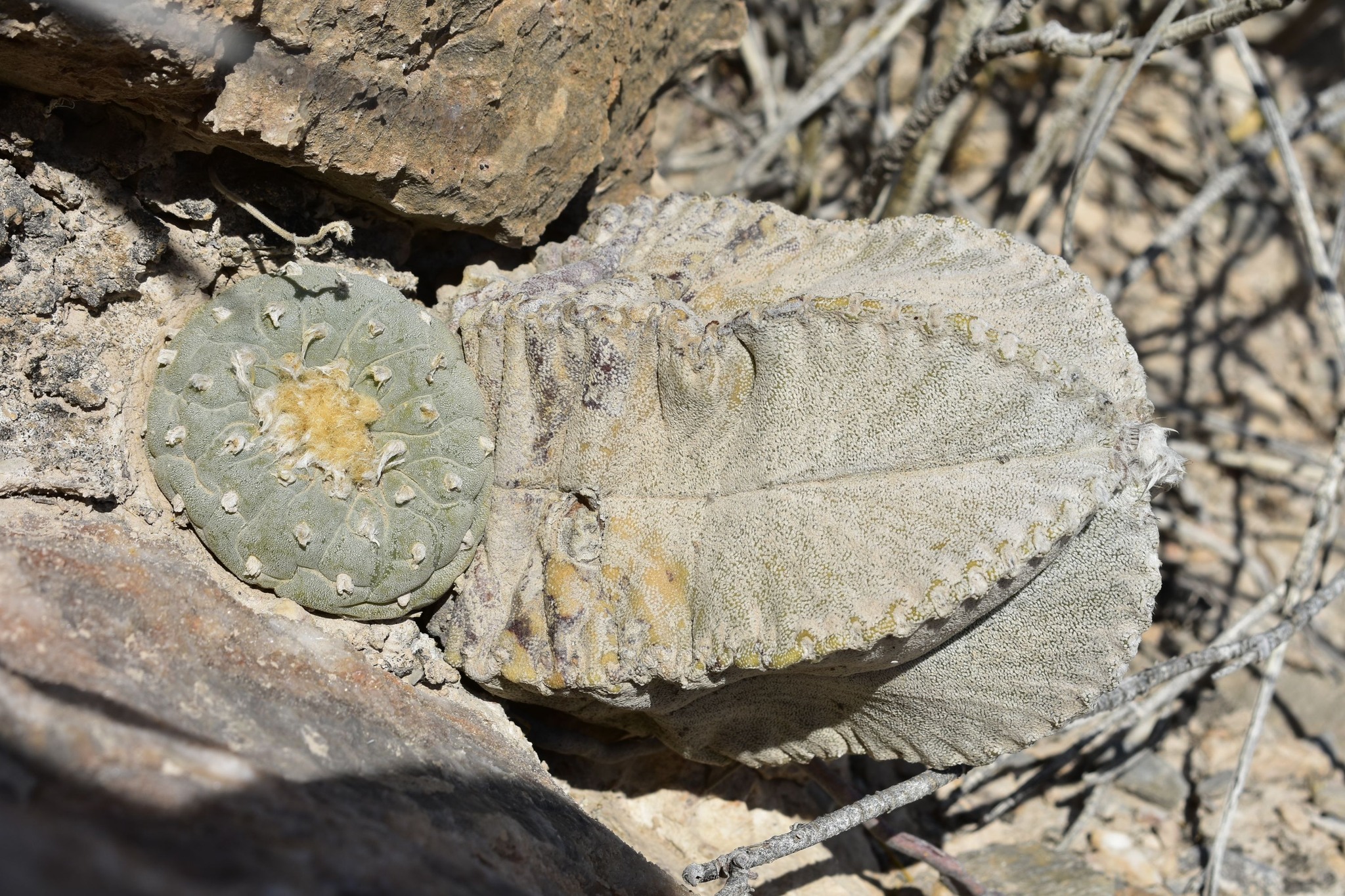
A. coahuilense is a Chihuahuan Desert transition-zone species restricted to xerophytic shrubland on limestone hills in southwestern Coahuila and the Coahuila-Durango border region. The IUCN assessment identifies three severely fragmented locations, including the Sierra Baicuco, the Cerro Bola area, the western Sierra Parras, and the Ciudad Lerdo margin along the Río Nazas. llifle gives the range as “Ciudad Lerdo, Sierra Baicuco, western Sierra Parras and south of this line up to the Sierra of El Número.” Additional localities documented by the German-language astrophytum.com site include Bei Ahuichila, Lagune von Viesca, and Cerro Bola itself at approximately 1,120 m.
The substrate is limestone-dominated. llifle describes the soil as “lime gravel and sand with isolated humus feedthroughs” on south- and east-facing slopes. The grey-white coloration of the substrate closely matches the plant’s grey-white trichome cover, a functional camouflage adaptation noted across multiple field accounts. Parent rock is calcareous throughout the documented range; gypsum has not been confirmed as a substrate component for this species.
Elevation runs 1,100 to 1,600 m, placing coahuilense significantly higher than A. asterias (50 to 200 m in Tamaulipan thornscrub). The higher elevation drives both the cooler winter temperatures and the stronger UV regime that coahuilense has adapted to. South- and east-facing slopes receive morning and midday sun; afternoon shade comes from the slope geometry itself, a natural equivalent of the afternoon-shade-above-38°C recommendation for cultivated plants. Associated taxa at the type locality include Ariocarpus lloydii and Thelocactus wagnerianus (llifle).
Rainfall near the Sierra Parras zone runs approximately 450 mm annually with a summer-dominant monsoon pattern (July to September). The dry-winter, wet-summer regime is the direct basis for the cultivation watering calendar. Climatic niche modelling shows the species’ climatic niche and found it has limited amplitude; the restricted niche breadth means the species cannot easily colonise climatically adjacent areas, which amplifies the conservation concern around climate change.
Morphology
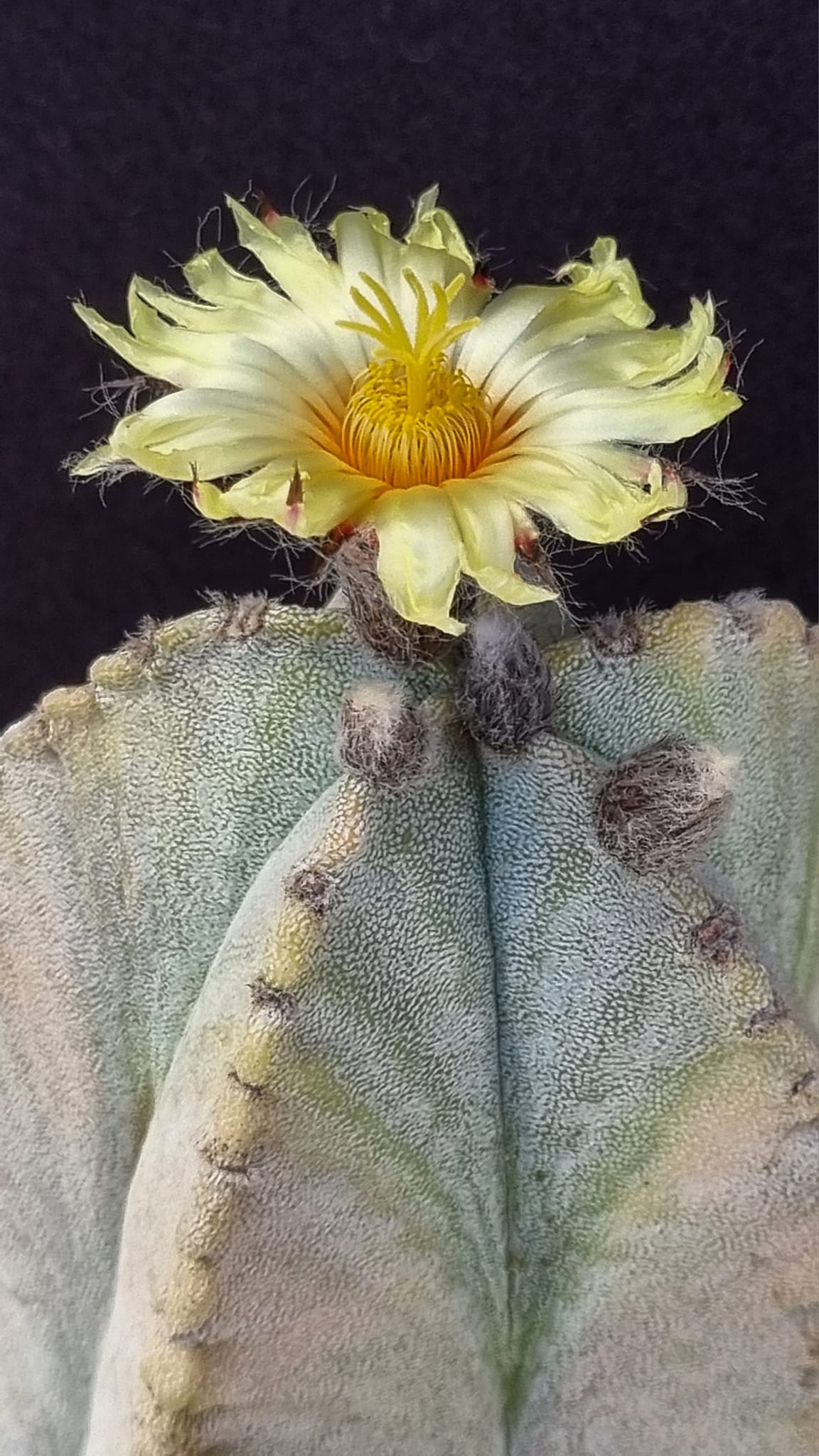
The body is spineless and globose when young, becoming barrel-shaped and eventually columnar in old age. Typical mature cultivated plants are 10 to 20 cm in diameter and 10 to 20 cm tall. Very old column-forming specimens in the wild can exceed 50 cm in height; the 65 cm figure in xochimankimx and the 100 cm upper bound in Giromagi represent extreme aged plants, not the collector-scale norm. The five ribs are prominent, well-defined, and stable from the seedling stage; xochimankimx notes that the five-rib count appears from germination and does not vary in wild-type plants. Cultivated variants with three or four ribs exist as named selections but are horticultural, not representative of the species in habitat.
Rib edges are slightly wavy rather than strictly straight, a character that separates coahuilense from the more rigidly straight-ribbed A. myriostigma under close inspection. Areoles are cream to white, 3 to 8 mm in diameter, spaced 10 to 20 mm apart on new growth, greying with age. No spines appear beyond the brief seedling stage; the rudimentary seedling spines are shed within weeks.
The trichome flecking is dense and uniformly distributed across the entire epidermis, giving the body a velvety, grey-white appearance. Multiple sources describe this as denser and softer than the flecking on A. myriostigma, which tends toward coarser, patchier trichome clusters. The visual effect is a more uniformly grey body in coahuilense versus the more spotted or marbled appearance of myriostigma.
Flowers are apical, diurnal, and funnel-shaped, 50 to 68 mm across when fully open. The tepals are yellow with a characteristic red to orange-red throat; some individual plants show a throat that extends to appear nearly pure scarlet, and very rarely flowers are pure yellow with no red pigment. The flower colour places coahuilense in the red-throated clade alongside A. asterias and A. capricorne, and separates it immediately from A. myriostigma, which carries pure yellow flowers without any red. Blooming runs from late spring to early summer in habitat; cultivated plants under warmth may flower into summer.
Fruit is pink to olive-green at maturity and opens from the base (basal dehiscence), confirmed across llifle, Wikipedia, and xochimankimx. Basal dehiscence is shared with A. asterias and A. capricorne; it is not a diagnostic character separating coahuilense from asterias, but it is a strong separator from A. myriostigma, whose fruit bursts apically in a star pattern. Each fruit contains 125 to 208 helmet-shaped dark brown seeds (xochimankimx; llifle upper bound ~200); the cap-shaped seed with sunken hilum is a genus-level Astrophytum character.
Locality detail
The confirmed wild range is entirely within Mexico: southwestern Coahuila and the adjacent Durango margin along the Río Nazas. The IUCN assessment groups the occurrence records into three severely fragmented locations. Key documented localities include Cerro Bola (the type locality at approximately 1,120 m), the Sierra Baicuco, the western Sierra Parras, the Sierra del Número, Bei Ahuichila, and the Lagune von Viesca area. Ciudad Lerdo on the Coahuila-Durango border is the best-documented Durango locality. Map markers sit at regional centroids consistent with published IUCN assessment guidance; sharp GPS coordinates are withheld at the collector community’s standard practice for CITES-listed taxa with documented collection pressure.
Astrophytum coahuilense care and cultivation
Cultivation turns on climate class and pot mechanics rather than on copying field conditions. Coahuilense sits in the summer-rain arid class, which sets a dry winter and a low organic floor; nothing about the pot needs to reproduce the elevation or slope aspect of the wild population.
Substrate
Coahuilense carries the highest limestone share of the four species on the live site. The canonical ratio is 35 per cent pumice, 15 per cent lava rock, 5 per cent zeolite, 25 per cent granite grit, 15 per cent limestone chip, and 5 per cent worm castings. The limestone share follows the same genus-wide grower convention used on all seven pages rather than a species-specific study: no published source sets a per-species proportion, and the amount here is unchanged house practice. On hard tap water, reduce or omit the limestone fraction; on RO, distilled, or rainwater, keep it at the stated share. The organic share sits at the floor of the band used for summer-rain arid cacti generally; no cultivation source measures an organic percentage for this species specifically. The site’s baseline genus split runs about nine parts mineral to one part organic; this page’s extra limestone share nudges that slightly further toward mineral, not because the local soil is harsher.
All seven Astrophytum pages share the genus 90/10 mineral-organic baseline. Limestone runs from 5 to 15 per cent across the four species, an amount set by the BCSS’s own genus-wide limestone-in-the-compost convention for Astrophytum rather than by a per-species study. No published source differentiates the proportion between asterias, caput-medusae, coahuilense, and myriostigma, and the current spread is unchanged house practice.
| Species | Pumice | Lava | Zeolite | Granite | Limestone | Silica | Organic |
|---|---|---|---|---|---|---|---|
| A. asterias | 40% | 15% | 5% | 25% | 10% | 0% | 5% |
| A. asterias f. nudum | 40% | 15% | 5% | 25% | 10% | 0% | 5% |
| A. asterias (variegata) | 40% | 15% | 5% | 25% | 10% | 0% | 5% |
| A. caput-medusae | 40% | 15% | 5% | 30% | 5% | 0% | 5% |
| A. coahuilense (this page) | 35% | 15% | 5% | 25% | 15% | 0% | 5% |
| A. myriostigma | 40% | 15% | 5% | 30% | 5% | 0% | 5% |
| A. myriostigma var. quadricostatum | 40% | 15% | 5% | 30% | 5% | 0% | 5% |
Watering and light
Water only when the substrate is fully dry, from March through October. The typical interval in summer is two to four weeks depending on heat and container size. From October onward, keep completely dry until March. llifle is explicit: “water sparingly from March till October” and “keep it perfectly dry in winter.” Wet-cold rot at the root neck is the primary kill vector, consistent across all cultivation sources.
Strong light is required: 5 to 8 hours direct sun daily. The south- and east-facing slope habitat gives the plant morning and midday sun with natural afternoon shade from slope geometry. Replicate that in cultivation: full sun until early afternoon, shading above 38°C on the hottest weeks. Cool coastal climates with diffuse light all day handle full exposure well; hot inland summers with peak temperatures above 40°C need managed shade in the hottest weeks to prevent corking or bleaching.
Propagation and sourcing
Germinates in standard cactus seed-raising conditions; consult species-specific grower reports for timing. Fresh seed is essential; shelf life is limited and germination rates decline significantly with older seed. Seedlings are notably rot-prone in the first season, more so than A. asterias at the same stage per grower community reports; maintain careful moisture without waterlogging during germination. Keep the germination vessel sealed for at least three months before acclimatising to ambient humidity.
Seed grown plants typically reach first flowering at 4 to 6 years from germination; some sources give up to six years, others report buds at four years under consistently warm conditions. Grafted stock flowers faster and grows taller, but seed grown plants maintain the natural globose-to-columnar habit and are the collector-standard for a specimen that will develop true character over time. Source documented nursery origin only; CITES Appendix II covers wild specimens and requires export documentation for international trade.
Comparison
The most common identification problem is between A. coahuilense and A. myriostigma. Coahuilense was originally described in 1927 as a subspecies of myriostigma (Echinocactus myriostigma subsp. coahuilensis H.Moeller), and the two share a five-ribbed spineless flecked body at every scale. On flowering plants the separation is immediate: myriostigma carries pure yellow flowers with no red, while coahuilense always shows a red to orange-red throat. Fruit is equally diagnostic on fruiting plants: coahuilense opens basally, myriostigma splits apically in a star pattern. Flecking pattern is the fastest vegetative read when fruit and flower are absent: coahuilense carries a uniformly dense velvety grey-white cover, while myriostigma shows discrete areole-linked tufts in a scattered dot pattern. Cross-pollination is (usually) sterile in both directions, one of the strongest biological arguments for treating coahuilense as a full species. Note that A. myriostigma is listed as Amenazada (Threatened) under NOM-059-SEMARNAT-2010; coahuilense was not individually listed at the time of that norm’s publication because it was not universally recognised as a distinct species.
A secondary confusion pair is A. coahuilense and A. asterias. Both are spineless, flecked, and carry yellow flowers with a red to orange-red throat, which is the character placing both in the cross-compatible red-throated clade with A. capricorne. Rib count is the fastest read (coahuilense five, asterias eight) and is reliable from the first seedling stage. Body shape at maturity diverges completely: coahuilense becomes columnar in age, asterias stays disc-flat throughout its life. Elevation and provenance are the most reliable single characters once available: coahuilense at 1,100 to 1,600 m on Coahuilan limestone, asterias at 50 to 200 m in Tamaulipan thornscrub.
A. myriostigma var. quadricostatum is a four-ribbed variety of myriostigma sought for its squared geometry. It does not enter the coahuilense identification problem because the four-rib count and pure yellow flower immediately distinguish it. A. caput-medusae does not enter the comparison set at all; its snake-like tuberculate body looks nothing like any other Astrophytum.
Frequently asked questions
How do you tell Astrophytum coahuilense apart from A. myriostigma?
These two species share a five-ribbed spineless flecked body, and for most of the 20th century coahuilense was treated as a subspecies of myriostigma. The decisive separators are flower throat and fruit dehiscence. Drag the slider to compare flecking pattern and body proportion, then work down the table.


Flower throat is the single decisive diagnostic on flowering plants; fruit dehiscence direction is decisive on fruiting plants. On vegetative material the flecking pattern is the fastest read, since coahuilense carries a uniformly dense velvet cover while myriostigma shows discrete areole-linked dots. Cross-pollination between the two is (usually) sterile, which is one of the strongest biological arguments for treating coahuilense as a full species.
Is Astrophytum coahuilense hard to grow?
Astrophytum coahuilense is within reach of an intermediate grower who respects two non-negotiable rules: a bone-dry winter rest and a sharply draining mineral substrate. The primary risk is root rot from wet-cold conditions in winter, which kills within days. Seedlings are more rot-prone early on than most other Astrophytum species, so the first season requires careful moisture management. An established plant in good conditions is durable and slow-growing; patience is the larger demand, not skill.
Is Astrophytum coahuilense endangered?
Astrophytum coahuilense is rated Vulnerable on the IUCN Red List based on an extent of occurrence under 6,000 km² across three severely fragmented locations in Coahuila and Durango, Mexico. The entire range falls outside any formally protected reserve. Threats include overgrazing, agricultural expansion, illegal collection, and climate change acting on a species with limited niche amplitude. All Cactaceae trade, including coahuilense, requires CITES Appendix II documentation for international transactions; nursery-propagated plants are legal to own and trade with appropriate documentation.
Where does Astrophytum coahuilense grow in the wild?
Restricted to southwestern Coahuila and adjacent Durango in Mexico, at 1,100 to 1,600 m elevation on limestone hills in xerophytic shrubland. The documented localities include the Sierra Baicuco, Cerro Bola (the type locality), the western Sierra Parras, the Sierra del Número, and the Ciudad Lerdo area at the Coahuila-Durango border. The species grows on south- and east-facing slopes in a dry bush community, often between white-grey limestone rocks that match its own grey-white trichome cover. Associated cacti include Ariocarpus lloydii and Thelocactus wagnerianus at confirmed localities (llifle).
When does Astrophytum coahuilense flower?
In habitat, peak flowering runs from late spring to early summer, approximately March to June. Each flower opens by day and lasts one to two days. Cultivated plants under consistent warmth may continue flowering into summer when water is available. Seed grown plants typically reach first flowering at 4 to 6 years from germination; grafted stock flowers earlier but develops a less natural body form. The red-throated yellow flower is distinctive enough that a single opening flower immediately rules out A. myriostigma, which carries pure yellow flowers without any red.
Can Astrophytum coahuilense hybridize with A. myriostigma?
No. Astrophytum coahuilense and A. myriostigma are (usually) mutually sterile when cross-pollinated; the astrophytum.com field notes confirm the two “cannot cross-pollinate” under normal conditions (llifle; astrophytum.com). This reproductive isolation is one of the primary biological arguments for treating coahuilense as a full species rather than a myriostigma variety. In contrast, coahuilense will hybridise freely with A. asterias and A. capricorne, which share the red-throated flower character and the same molecular phylogenetic clade. The A. coahuilense × A. asterias cross is a known and commercially available cultivar.
Sources & further reading
Möller, H. Zeitschrift für Sukkulentenkunde 3(3): 52–54 (1927) · Kanfer, Kakteenfreund 1: 57 (1932) [per POWO] · K.Kayser, Kakteenfreund 1: 59 (1932) [per WFO and Wikispecies; same vol., authority unresolved] · Anderson, E.F. The Cactus Family, Timber Press (2001) · Hunt, D. (ed.) The New Cactus Lexicon, dh Books (2006) · Kew POWO, Astrophytum coahuilense (H.Moeller) Kanfer (2024) · World Flora Online, WFO ID wfo-0000555059 (2024) · IUCN Red List assessment ID 152660 (Fitz Maurice et al. 2013) · Astrophytum coahuilense · CITES Appendix II · all Cactaceae (1975, current) · NOM-059-SEMARNAT-2010, DOF, México · A. myriostigma Amenazada · Vazquez-Lobo, A. et al. Systematic Botany 40(4): 1022–1030 (2015) · Montanucci, R.R. Journal of the Botanical Research Institute of Texas 18(1): 163–185 (2024) · Cardoza-Martinez, G.F. et al. Sustainability 11(4): 1138 (2019) · Carrillo-Angeles, I.G. et al. Journal of Arid Environments 124: 310–317 (2016) · Romero-Mendez, U. et al. Revista Chilena de Historia Natural 86(3) (2013) · llifle Encyclopedia of Living Forms, Astrophytum coahuilense entry (2024) · Xochimankimx, Astrophytum coahuilense descripcion (2015) · Astrophytum.com, Astrophytum coahuilense genus site (2024) · Giromagi Cactus and Succulents, Astrophytum coahuilense cultivation notes (2024) · Gardener’s Path, How to grow and care for Astrophytum cacti (2024) · Henry Shaw Cactus and Succulent Society, Plant of the Month: Astrophytum (2017)