
Astrophytum myriostigma
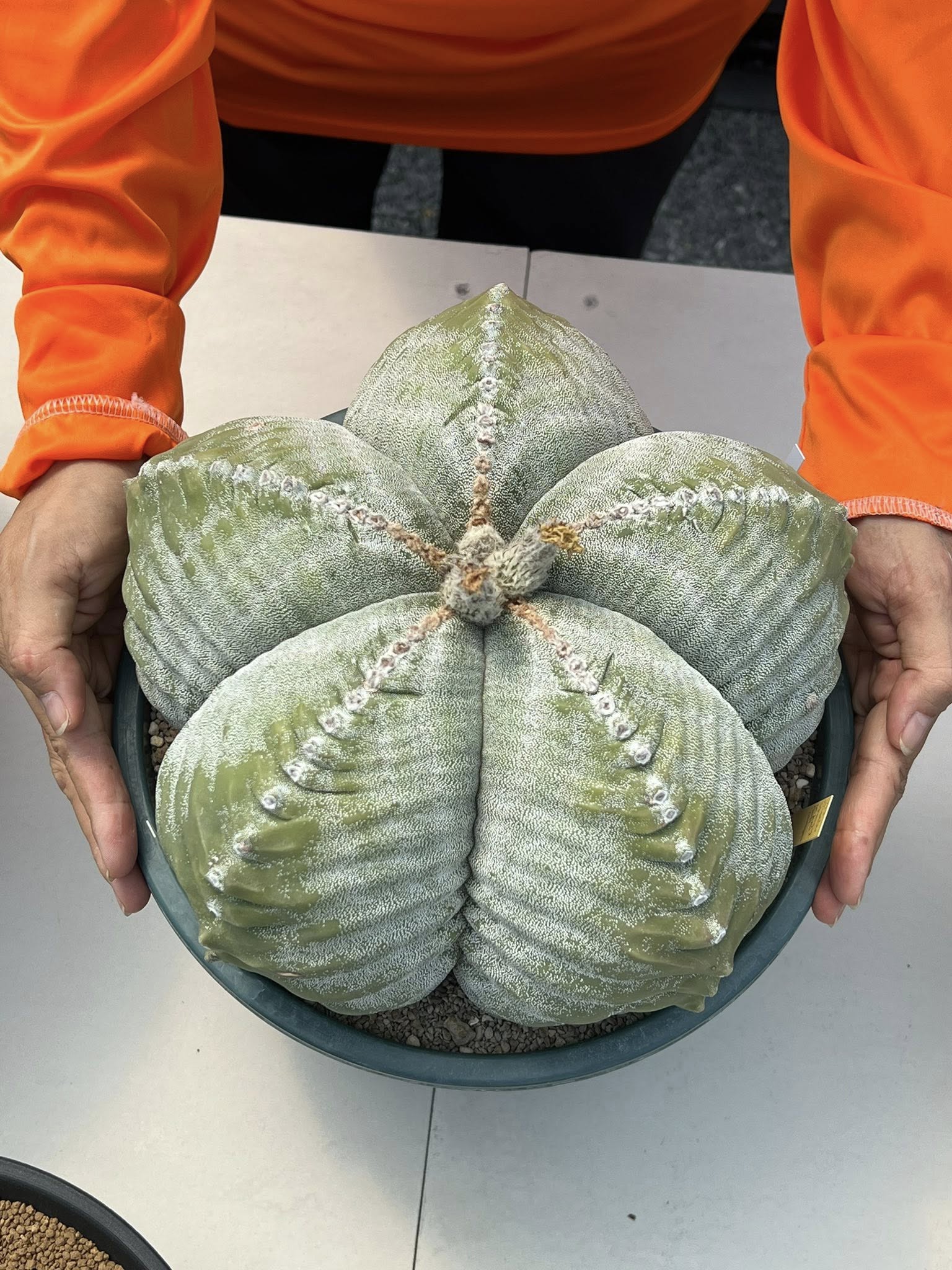
Astrophytum myriostigma is the species that founded the genus. Charles Lemaire described it in February 1839 in Cactearum Genera Nova Speciesque Novae, simultaneously establishing the genus Astrophytum and designating this plant as its type. The plant had been growing in the Paris nursery of Monville from Mexican material, most likely from San Luis Potosí. The name combines myrios (countless) and stigma (mark) for the thousands of white trichome spots covering the body.
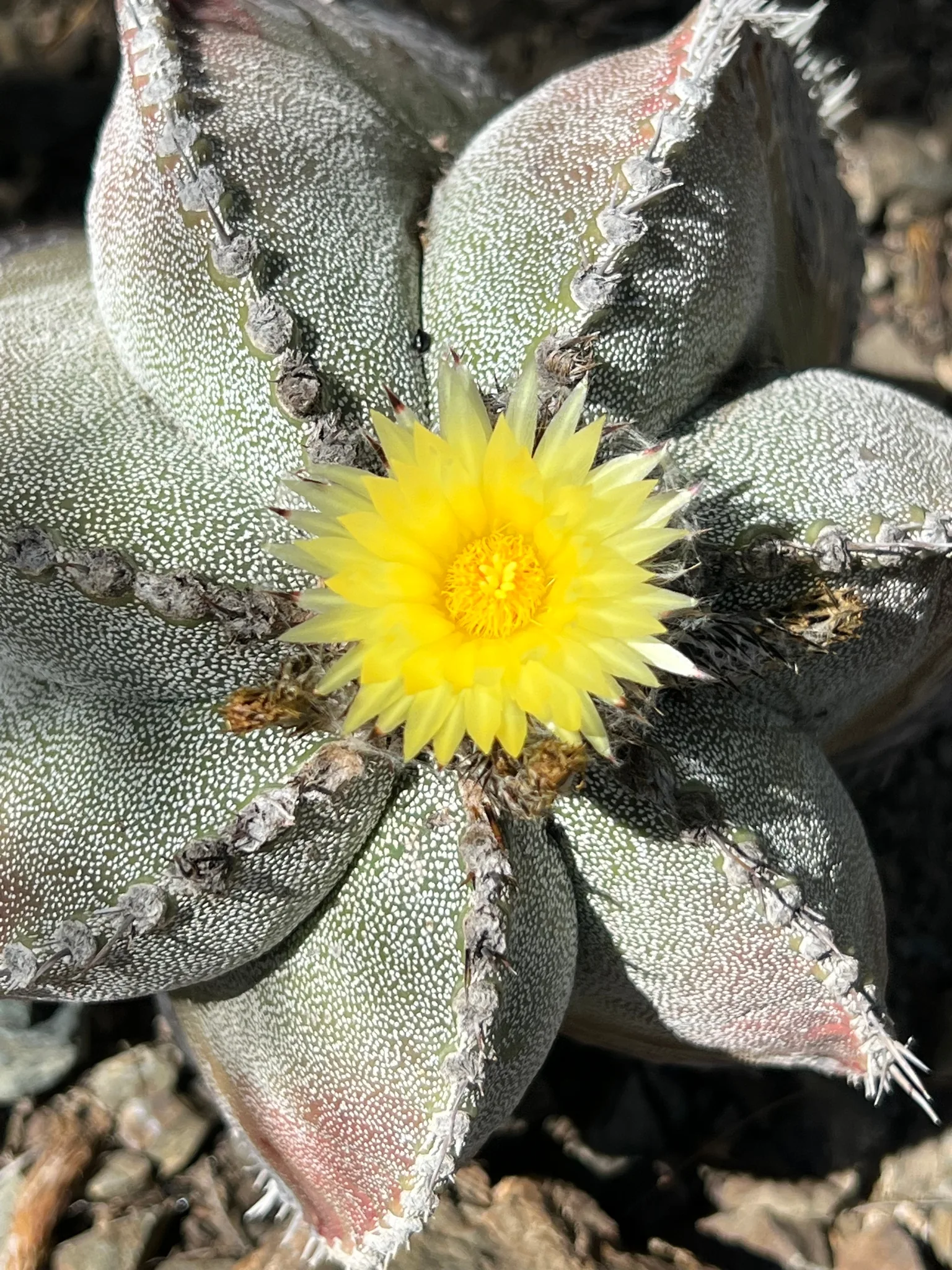
The body is globose in youth and becomes broadly columnar with age, typically five-ribbed, and entirely spineless at every growth stage. This spineless character is the fastest separation from the closely related A. coahuilense and from its molecular sister A. asterias, both of which are also spineless, but it is the cleanest separation from the other confirmed sister A. ornatum, which always carries five to eleven robust radial spines. The flower is pure yellow with no red throat, another character that separates myriostigma from asterias and coahuilense.
The species ranges across six Mexican highland states in the Chihuahuan Desert: Coahuila, Durango, Nuevo León, San Luis Potosí, Tamaulipas, and Zacatecas. Within that range, the four-ribbed Tamaulipas form is treated as subsp. quadricostatum by Kew POWO. The remaining populations across the five other states represent the nominotypical subspecies. A second subspecies, subsp. tulense, is recognised in the specialist literature but POWO has not yet adopted that treatment.
Of the six species in Astrophytum, myriostigma is the most widely grown, the most varied in horticultural selection, and the most forgiving in cultivation. Japanese breeders have produced a suite of trichome-pattern forms including the kabuto (dense white mosaic), onzuka (irregular swirling), and kikko (tortoise-shell rib) selections that drive significant collector interest alongside the typical species. The A. caput-medusae comparison, by contrast, requires no character table at all: its snake-like tubercles look nothing like a myriostigma disc.
Astrophytum myriostigma quick reference
A five-ribbed Chihuahuan Desert highland species with scattered white trichomes and pure yellow flowers, grown on calcareous limestone slopes at 750–1,500 m. Values calibrated for seed grown plants in cultivation, drawn from habitat data and specialist grower sources including llifle, Trex Plants, and the Henry Shaw Cactus and Succulent Society.
Taxonomy & nomenclature
Astrophytum myriostigma is an original description by Lemaire, not a transfer from an earlier name. In Cactearum Genera Nova Speciesque Novae (February 1839, pages 4–6, IPNI LSID urn:lsid:ipni.org:names:30030274-2), Lemaire established the genus Astrophytum and simultaneously described this species as its type. Plants grown in the Horto Monvilliano (Monville’s Paris nursery) from Mexican material were the basis. Two years later, Salm-Dyck moved it to Echinocactus as E. myriostigma (Lem.) Salm-Dyck (1841, Cact. Hort. Dyck. Anno 1841: 22), a homotypic synonym still cited in older horticultural literature but no longer accepted by Kew POWO.
The genus sits in tribe Cacteae of subfamily Cactoideae. Molecular phylogenetics, using chloroplast rbcL, trnL-trnF, and trnK-matK markers with Bayesian and maximum-likelihood methods, recovers two primary clades within Astrophytum. Myriostigma and A. ornatum form one clade (subgenus Astrophytum sensu Vazquez-Lobo), united by apical fruit dehiscence and invariably yellow inner tepals. The second clade contains A. asterias, A. capricorne, A. coahuilense, and A. caput-medusae. Diversification is estimated as Late Miocene, coinciding with the transition to drier climates in North America.
POWO currently accepts two infraspecific taxa under A. myriostigma. Subsp. myriostigma is the nominotypical form occurring broadly across the northeastern and central Mexican highlands. Subsp. quadricostatum (H.Moeller) K.Kayser (Kakteen-Freund 1: 57, 1932) is the four-ribbed form restricted to Tamaulipas; WFO lists it at variety rank (var. quadricostatum (H.Moeller) Baum) while POWO uses subspecies rank. This project follows POWO as the nomenclatural baseline. That taxon has its own specimen page at /encyclopedia/astrophytum-myriostigma-quadricostatum.
A third subspecies, subsp. tulense K.Kayser, is formally recognised on multiple morphological characters: a slender columnar body reaching 90 cm, acute ribs, pale to whitish-yellow tepals, fewer tepal rows (1–3 vs. 3–5 in subsp. myriostigma), and smaller seeds. POWO currently treats var. tulense as a synonym of subsp. myriostigma; the page follows POWO while noting that the 2021 paper presents the most current morphological analysis.
Historical synonymy is extensive. The most frequently encountered names are listed in the sidebar. POWO records 28 heterotypic synonyms under subsp. myriostigma alone, most of them horticultural varieties described in the late nineteenth and early twentieth centuries. The trichome-free form (formerly var. nudum) is treated as a forma rather than a geographic variety, based on polymorphic populations at 1,320–1,750 m altitude in San Luis Potosí where nude, semi-nude, and flecked individuals occur together in a clinal altitudinal pattern.
Historical synonyms (6)
- Astrophytum myriostigma var. quadricostatum (H.Moeller) Baum, 1933 homotypic synonym
- Astrophytum myriostigma subsp. glabrum Backeb., homotypic synonym
- Astrophytum myriostigma subsp. quadricostatum (H.Moeller) Kanfer, homotypic synonym
- Astrophytum myriostigma subsp. tamaulipense Kanfer, homotypic synonym
- Astrophytum myriostigma var. potosinum (Kanfer) Borg, homotypic synonym
- Echinocactus myriostigma var. coahuilensis H.Moeller, homotypic synonym
Sources: POWO (Kew) · IPNI · GBIF · Wikidata
Habitat
A. myriostigma is a Chihuahuan Desert highland species, growing on stony calcareous soils on scrubby alluvial plains and on steep east- or west-facing slopes between 750 and 1,500 m elevation (llifle). Tamaulipan and San Luis Potosí escarpment populations specifically reach 1,320–1,750 m. The substrate is classified as Lithosol-Regosol-calcaric at the Durango study site, with parent rock limestone or calcareous sedimentary formations, alkaline pH, low organic matter, and sharp drainage.
Vegetation type is xerophytic-rosetophilous scrubland. The dominant nurse plant recorded at Chihuahuan Desert sites is Agave lechuguilla, which grows where annual precipitation runs roughly 180–330 mm. At the San Luis Potosí populations of Rioverde and Pozas, Hechtia glomerata (Bromeliaceae) is the primary nurse plant, with 50–63% of individual myriostigma plants in association with it. Other consistent associates include Cylindropuntia leptocaulis, Larrea tridentata, Prosopis glandulosa, and Flourensia cernua.
The association with nurse plants is facultative, not obligate. Spatial distribution is aggregated in both studied populations, with associated plants at the Pozas site significantly larger than non-associated individuals, suggesting the nurse reduces surface temperature and moisture stress during establishment. A northern-slope orientation at the Rioverde population indicates preference for less-exposed aspects where light is filtered during the hottest hours. This ecology supports the cultivation practice of partial afternoon shade in hot inland climates.
Rainfall is summer-dominant. The Chihuahuan Desert character means most precipitation arrives June through September, with dry winters. Annual totals across the range run roughly 200–500 mm. Winter is dry and cold at the higher elevations, which explains the species’ tolerance for dry-cold conditions to -5 or -6°C.
Morphology
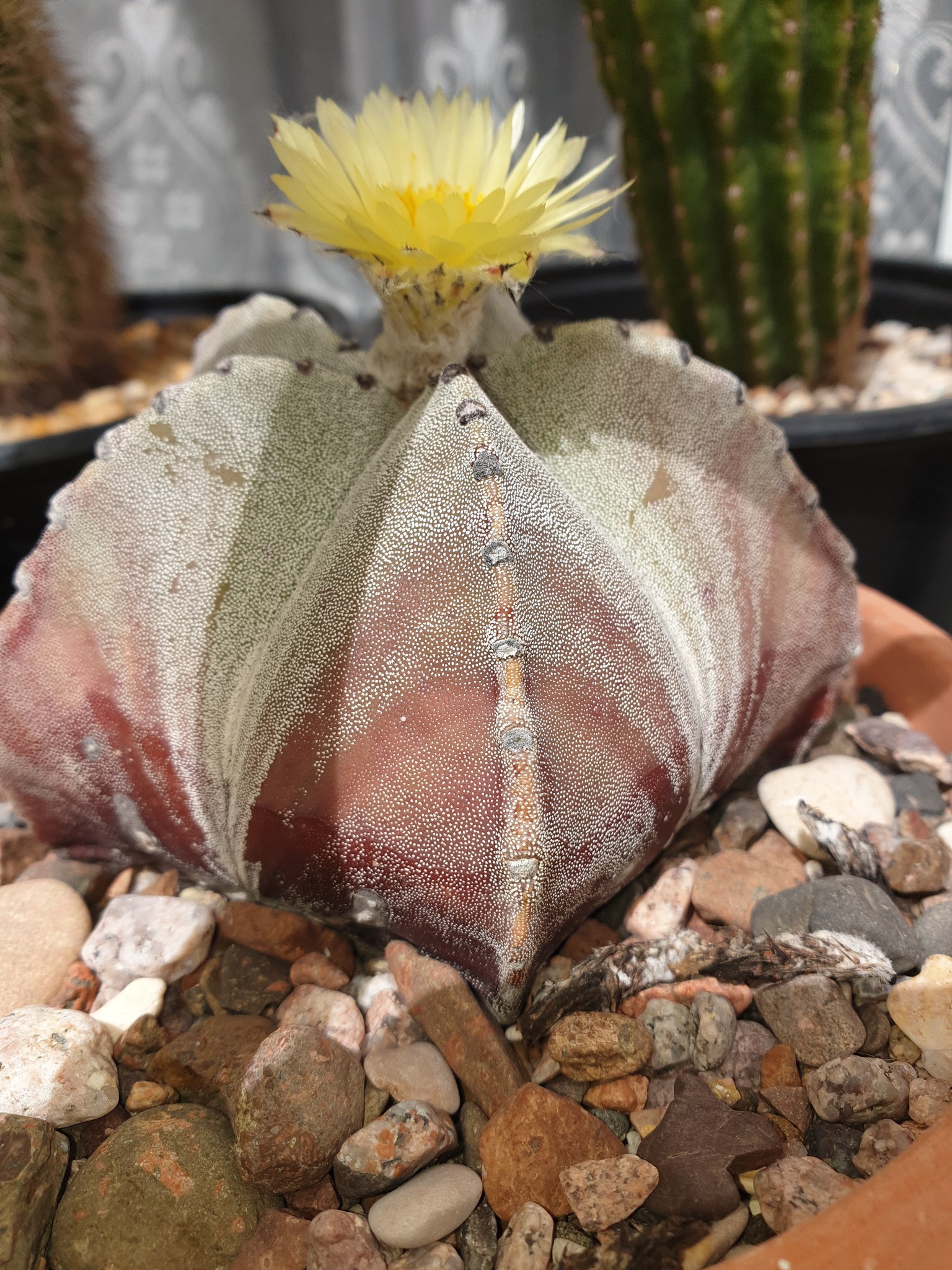
The stem is globose in young plants, becoming broadly columnar with decades of growth. Diameter typically runs 10–20 cm (llifle; Wikipedia); height reaches 50–100 cm in very old wild specimens, though cultivated plants rarely exceed 25 cm. Five ribs is the modal count across wild populations; the range in wild-type material runs from three to eight or more, with additional ribs developing on older plants (llifle). Ribs of subsp. myriostigma are rounded to moderately angular in profile.
Areoles are woolly-felted, spaced approximately 1 cm apart along the rib midline. Spines are absent at all growth stages in mature plants; rudimentary seedling spines are shed early. This complete spinelessness is the single fastest identification character at any size, separating the species absolutely from A. ornatum, which carries five to eleven robust radial spines per areole throughout life.
The epidermis is covered with scattered white trichomes, appearing as random white dots across the grey-green body surface. The distribution is random across the surface. This random pattern is the second reliable separation from A. ornatum, whose trichomes form distinct horizontal cross-bands around the body. Trichome density varies widely: the var. nudum / f. nudum form lacks trichomes entirely, and nude, semi-nude, and fully flecked plants occur within the same populations.
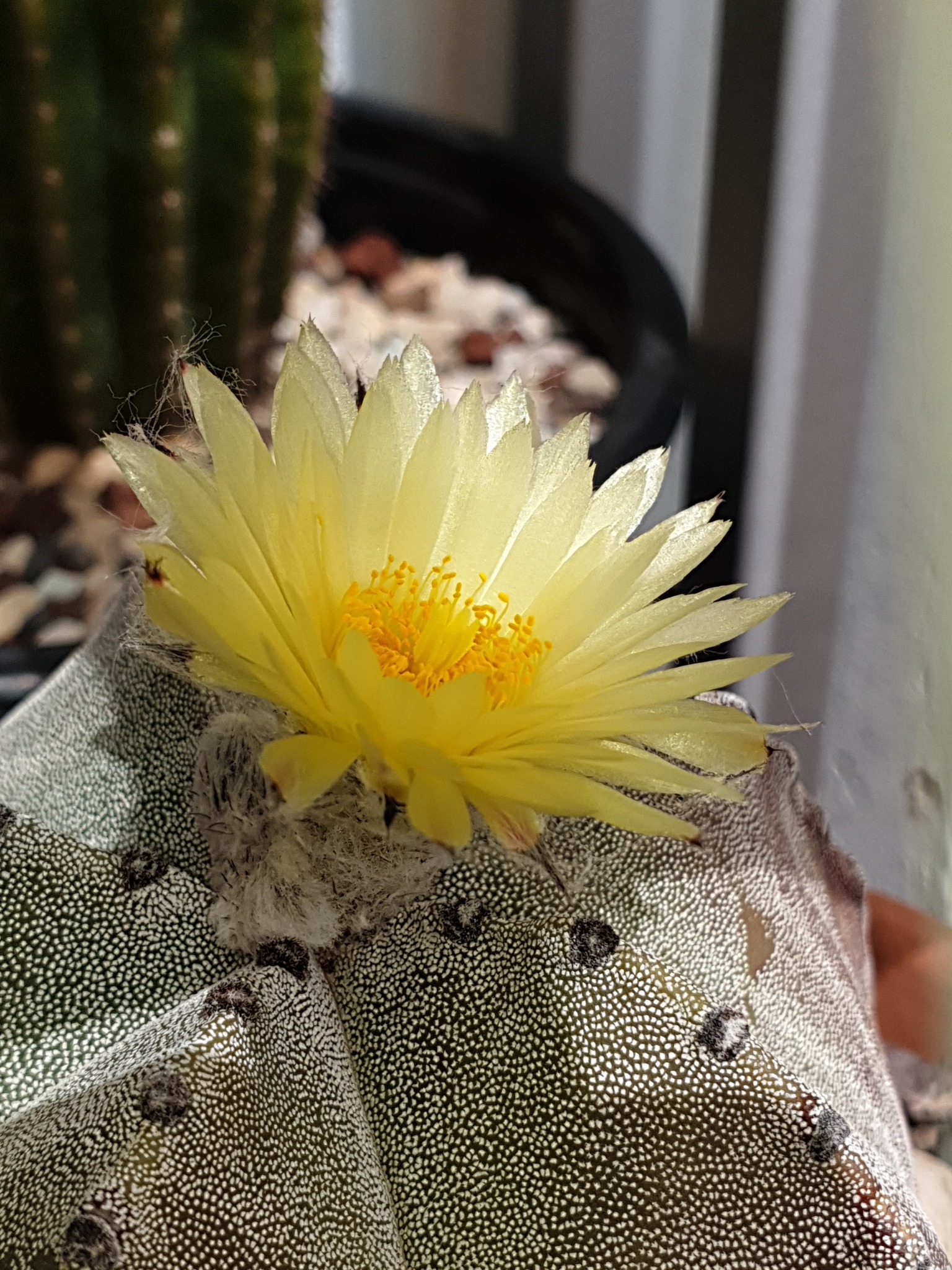
Flowers are apical, funnel-shaped, 4–7 cm long, 4–6 cm across (llifle; Wikipedia). Inner tepals are pure yellow in the typical form, occasionally showing a faint orange wash at the base in some individuals, but lacking the distinct red or orange-red throat that characterises A. asterias and A. coahuilense. Flowers are sweet-scented, diurnal, and produced at the apex. Peak bloom runs spring through summer; cultivated plants may flower repeatedly through warm months when water is available. First flowering from seed typically occurs at four to eight years, with six years the modal figure from multiple grower sources.
Fruit is globose, 2–2.5 cm in diameter, greenish to tannish-red at maturity. Dehiscence is APICAL, the fruit splitting in a star pattern from the apex at maturity. This apical dehiscence is a synapomorphy shared with A. ornatum in their molecular clade and contrasts with the basal dehiscence of A. asterias, A. coahuilense, and A. capricorne. Seeds are navicular (boat-shaped), nearly black, approximately 3 mm long by 2 mm wide.
Locality detail
The species occupies a broad highland arc from Zacatecas and Durango in the west through San Luis Potosí and Nuevo León to Tamaulipas in the east: six states in all, within the Chihuahuan Desert ecoregion. San Luis Potosí is the primary stronghold with multiple documented populations, including the type-locality area in the northeastern sector of the state. The Durango population at Sierra El Sarnoso sits at 25°31–43N, 103°35–40W in xerophytic-rosetophilous scrubland on calcareous soils. Map markers sit at regional centroids; sharper coordinates are deliberately withheld consistent with the species’ CITES Appendix II listing and ongoing collection pressure.
States explicitly excluded from the range based on current peer-reviewed literature: Chihuahua (unverified; mentioned only in aggregator sources with no primary source corroboration), Hidalgo and Querétaro (these are confirmed range states for the closely related A. ornatum, not for myriostigma).
Astrophytum myriostigma care and cultivation
A. myriostigma is the most forgiving species in the genus, reliably suited to controlled-environment cultivation; the cultivation problems are shared with every fully-mineral-substrate Mexican cactus rather than being species-specific. The Henry Shaw Cactus and Succulent Society notes that almost all Astrophytum species are good candidates for any level of cactus-growing experience, and myriostigma leads that assessment. Trex Plants confirms that the species does not require full desert sun to thrive, which gives it practical cultivation flexibility that the more narrowly adapted congeners lack.
Substrate
Highly mineral and fast-draining. The canonical ratio is 40 per cent pumice, 15 per cent lava rock, 5 per cent zeolite, 30 per cent granite grit, 5 per cent limestone chip, and 5 per cent worm castings. Granite is the dominant hard-grit fraction here, the same durable, slow-weathering aggregate role it plays on every Astrophytum page. The limestone share follows the genus-wide grower convention rather than a per-species study: no published source sets a proportion for A. myriostigma specifically, and the amount here is unchanged house practice. On hard tap water, reduce or omit the limestone fraction; on RO, distilled, or rainwater, keep it at the stated share. The zeolite handles cation exchange and pH buffering; the lava fraction is the structural drainage aggregate. The organic share sits at the floor of the band used for summer-rain arid cacti generally; no cultivation source sets an organic percentage for this species specifically.
All seven Astrophytum pages share the genus 90/10 mineral-organic baseline. Limestone runs from 5 to 15 per cent across the four species, an amount set by the BCSS’s own genus-wide limestone-in-the-compost convention for Astrophytum rather than by a per-species study. No published source differentiates the proportion between asterias, caput-medusae, coahuilense, and myriostigma, and the current spread is unchanged house practice.
| Species | Pumice | Lava | Zeolite | Granite | Limestone | Silica | Organic |
|---|---|---|---|---|---|---|---|
| A. asterias | 40% | 15% | 5% | 25% | 10% | 0% | 5% |
| A. asterias f. nudum | 40% | 15% | 5% | 25% | 10% | 0% | 5% |
| A. asterias (variegata) | 40% | 15% | 5% | 25% | 10% | 0% | 5% |
| A. caput-medusae | 40% | 15% | 5% | 30% | 5% | 0% | 5% |
| A. coahuilense | 35% | 15% | 5% | 25% | 15% | 0% | 5% |
| A. myriostigma (this page) | 40% | 15% | 5% | 30% | 5% | 0% | 5% |
| A. myriostigma var. quadricostatum | 40% | 15% | 5% | 30% | 5% | 0% | 5% |
Watering and light
Water sparingly March through October, allowing the substrate to dry fully between waterings (llifle). The interval in a hot summer growing environment runs two to four weeks depending on container and climate. From October onward, keep completely dry through winter. Wet cold is the primary kill vector: the plant tolerates brief -5 to -6°C dry (llifle; Monaco Nature Encyclopedia) but fails at temperatures above freezing when the root zone is moist. Winter rest at 5–15°C dry is the recommended regime.
Light requirements are flexible by Astrophytum standards. Native habitat is exposed limestone slopes under full Chihuahuan Desert sun at 750–1,500 m, but the documented nurse-plant association confirms that a meaningful fraction of wild plants establish under filtered light. In cultivation, Trex Plants recommends partial afternoon shade in hot inland climates above 35°C; near the coast or in temperate climates, near-full sun is fine. Young plants need gradual acclimation before exposure to high-intensity direct sun.
Propagation
Seeds germinate readily, typically within three to seven days at 25–30°C in bright indirect light with high humidity. Fresh seed achieves germination rates well above 70%. Smaller seeds germinate faster (3.8 seeds per day vs. 1.6 for larger seeds) and at higher percentages under some treatments. Distilled-water pre-soak and cooler pre-treatment improved germination. Seeds retain viability for several years under dry storage.
Grafting onto Hylocereus or Myrtillocactus is common in the trade for collector-grade horticultural forms (kikko, onzuka, kabuto), where it accelerates the development of complex rib and trichome patterns. Grafted plants develop unnaturally elongated bodies and loose proportions relative to seed grown material; for the typical species, seed grown specimens develop the correct bishop’s-cap proportions naturally at eight to ten centimetres. First flowers from seed arrive at four to eight years, with six years the modal figure.
Comparison
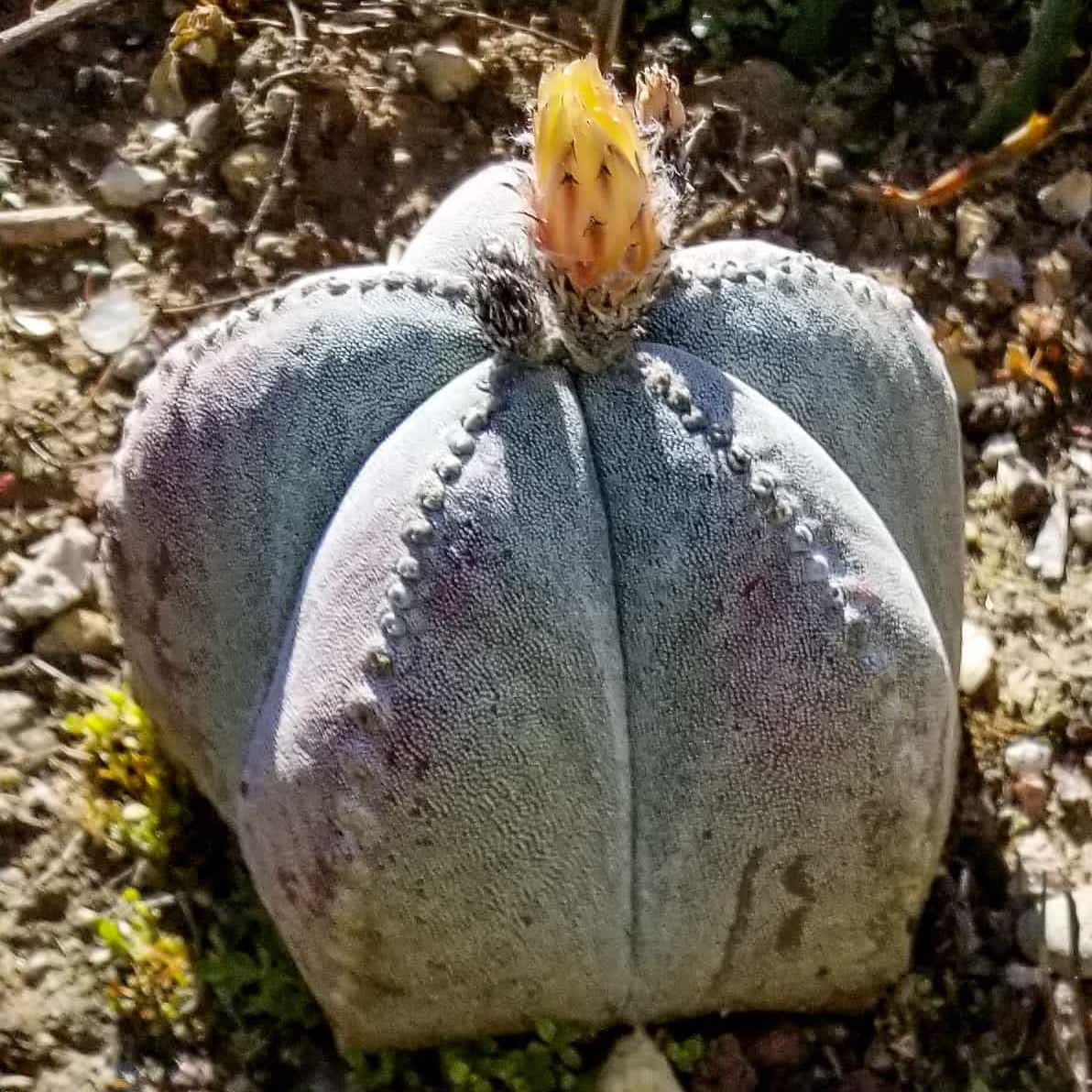
The two most common identification questions for myriostigma are its separation from A. ornatum and from the other spineless members of the genus. A. ornatum is the molecular sister of myriostigma and shares the same apical fruit dehiscence, but the separation is unambiguous once the plant is in hand. A. ornatum always carries robust spines (five to eleven radials plus one central per areole) and shows trichomes in regular horizontal cross-bands rather than the random scattered pattern of myriostigma. At seedling sizes of two to six centimetres, before spines fully harden, the banded versus scattered trichome pattern is still the fastest visual read.
Separation from A. asterias and A. coahuilense turns on flower colour and fruit dehiscence rather than vegetative characters. Both asterias and coahuilense carry a red or orange-red throat; myriostigma flowers are pure yellow. Both dehisce basally; myriostigma dehisces apically in a star pattern. Body shape also diverges over time: myriostigma becomes cylindrical to columnar with age, while asterias stays disc-flat and coahuilense is intermediate. These characters require flowering material to apply reliably, so provenance data (elevation and state) is often the cleanest route when working with vegetative plants.
The four-ribbed Tamaulipas form, subsp. quadricostatum, is now treated as a distinct taxon by POWO and has its own specimen page. Within the typical species, rib count varies from three to eight or more and is not a reliable identification character except at the extreme end: a four-ribbed plant from Tamaulipas is subsp. quadricostatum; a plant with six or more ribs from outside Tamaulipas is aging myriostigma. The rarely encountered trichome-free f. nudum resembles A. ornatum without trichomes even more than the typical form, making the spine character even more critical on nude plants.
Frequently asked questions
How do you tell Astrophytum myriostigma apart from A. ornatum?
Both species are flecked with white trichomes on a ribbed globose body. Drag the slider to compare their appearance, then read down the character table. Spines and trichome pattern are the two fastest reads; both work on seedlings too small to show flowers.

Spines are the definitive diagnostic at any size. No spines means myriostigma; spines mean ornatum. No overlap exists. Trichome banding is the reliable second character when spines are ambiguous on very young seedlings.
Is Astrophytum myriostigma hard to grow?
No, not compared to most rare Mexican highland cacti. The Henry Shaw Cactus and Succulent Society rates the genus accessible at any cultivation level, and myriostigma is the easiest entry point. The two failure modes are wet-cold rot in winter and insufficient light. A completely dry winter rest, a highly mineral substrate, and at least six hours of direct sun solve both. Germination is fast (typically within a week at 25–30°C) and seedling growth, while slow by greenhouse standards, is reliable. The patience requirement is the four-to-eight-year wait for first flowers, not the care regime itself.
Can Astrophytum myriostigma be grown from seed?
Yes, readily. Seeds germinate within three to seven days at 25–30°C in bright indirect light at high humidity, with fresh seed reaching germination rates well above 70%. Smaller seeds from this species germinate faster and at higher percentages than larger seeds. Seed grown plants develop the correct bishop’s-cap body proportions naturally; grafted plants on Hylocereus or Myrtillocactus are faster to flower but develop elongated proportions that distort the characteristic geometry.
When does Astrophytum myriostigma flower?
Spring through summer in both wild and cultivated settings, with repeat flowering possible through warmer months in cultivation when water is available. Individual flowers are funnel-shaped, 4–7 cm across, pure yellow, sweet-scented, and diurnal; each lasts one to three days. First flowers from seed typically arrive at the plant’s fourth to eighth year, with six years the most commonly reported threshold (Monaco Nature Encyclopedia; Wikipedia; Planet Desert). Some well-grown plants at eight to ten centimetres have flowered at four years.
Is Astrophytum myriostigma endangered?
The IUCN rates it Least Concern (2022) based on its broad range across six Mexican states. Under Mexican law, NOM-059-SEMARNAT-2010 classifies it as Amenazada (Threatened), a stricter designation than Least Concern but less severe than the En Peligro de Extinción category applied to A. asterias. Like all Cactaceae, it is CITES Appendix II: commercial trade requires documentation and export permits, and collection from the wild in Mexico is prohibited. Seed grown plants from registered nurseries are legal to buy and sell with appropriate provenance records.
Why does Astrophytum myriostigma have white spots?
The white spots are clusters of trichomes: fine epidermal hairs produced at and around each areole. They are thought to scatter and reflect intense solar radiation on exposed limestone slopes, reducing surface temperature. The distribution is random across the body of myriostigma; compare this to the sister species A. ornatum, where trichomes form neat horizontal cross-bands. Trichome density varies naturally across populations, with plants at higher elevations (1,320–1,750 m in San Luis Potosí) more likely to be trichome-free, a pattern best treated as f. nudum rather than a geographic variety. In Japanese horticultural breeding, trichome density and arrangement have been selected into extreme forms: the kabuto (dense white mosaic covering all inter-areole surface), onzuka (irregular swirling pattern created by Tsutomu Onzuka ca. 1974–1977), and kikko (tortoise-shell pattern from modified rib edges) are among the most sought cultivar lines in the global collector market.
Sources & further reading
Lemaire, C., Cactearum Genera Nova Speciesque Novae: 4–6 (February 1839) [original description; genus type] · Salm-Dyck, J., Cact. Hort. Dyck. Anno 1841: 22 (1841) [Echinocactus myriostigma, homotypic synonym] · Kew POWO (2024). Astrophytum myriostigma Lem. Plants of the World Online. Royal Botanic Gardens, Kew · IPNI (2024). LSID urn:lsid:ipni.org:names:30030274-2. International Plant Names Index · IUCN Red List (2022). Astrophytum myriostigma Least Concern; Taxon ID 151868. IUCN 2022.2 · CITES Appendix II (Cactaceae, all species). Effective 1 July 1975 · NOM-059-SEMARNAT-2010. Categoría Amenazada (A). Diario Oficial de la Federación, México · Vazquez-Lobo, A. et al. (2015). Phylogeny and biogeographic history of Astrophytum (Cactaceae). Systematic Botany 40(4): 1022–1030 · Montanucci, R.R. & Kleszewski, K.-P. (2021). Taxonomic history and variation in Astrophytum myriostigma and subsp. tulense. JBRIT 15(2): 327–341 · Montanucci, R.R. & Kleszewski, K.-P. (2020). A taxonomic evaluation of Astrophytum myriostigma var. nudum. JBRIT 14(2): 255–264 · Romero-Mendez, U. et al. (2013). Ecomorphological variation of Astrophytum myriostigma in Sierra El Sarnoso, Durango. Rev. Chilena de Historia Natural 86(3) · Lopez-Flores, D. et al. (2018). Spatial distribution and association with nurse plants of Astrophytum myriostigma. Southwestern Naturalist 63(3): 186–193 · Sanchez-Salas, J., Flores, J. & Martinez-Garcia, E. (2006). Seed size effect on germination of Astrophytum myriostigma. Interciencia 31(5): 371–375 · Driskill, E. (Henry Shaw Cactus and Succulent Society) (2017). Plant of the Month: Astrophytum. HSCSS · Trex Plants (2024). How to grow Astrophytum myriostigma · llifle Encyclopedia of Living Forms (2024). Astrophytum myriostigma Lem. · Monaco Nature Encyclopedia (2024). Astrophytum myriostigma (Bishop’s cap)