
Astrophytum Care: Growing the Star Cactus
All ArticlesAstrophytum care comes down to a mineral, calcium-rich substrate, strong light, and a completely dry winter. The genus holds six species described by Charles Lemaire from 1839, all star-ribbed and flecked with white trichomes. Most are forgiving in summer and rot only when left wet and cold. This guide covers all six.
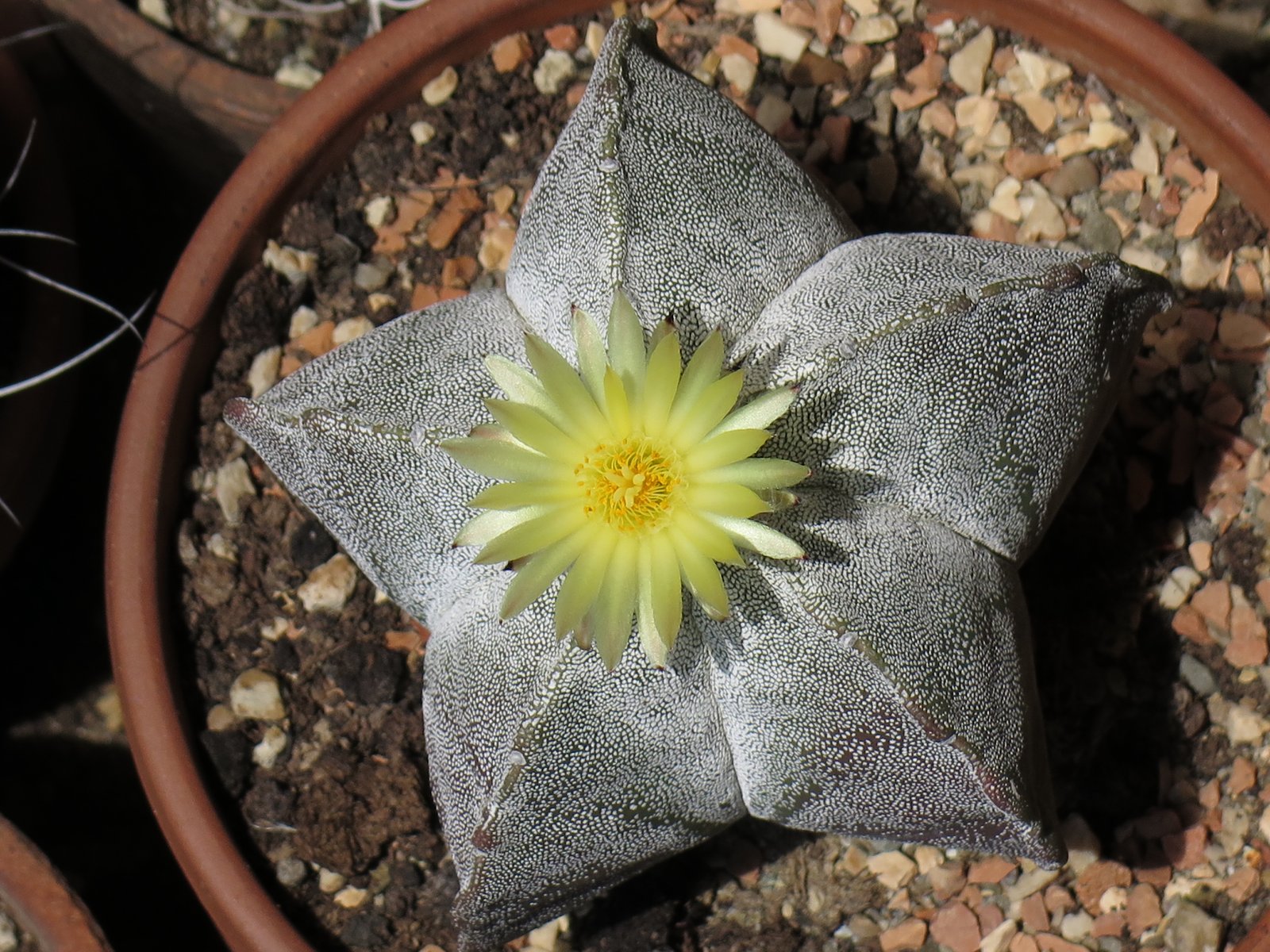
What are the white dots on an Astrophytum?
The white dots on an Astrophytum are trichomes: fine white epidermal scales, not a pest, a fungus, or scale insects. They reflect sunlight, lower the surface temperature of the body, and slow water loss in the open desert, and their density is what breeders have spent decades selecting for. Astrophytum myriostigma takes its name from them, the countless dots, while plants of the nudum forms carry none at all and show a clean dark-green skin.
Flecking density varies plant to plant and is the single most prized trait in the genus. The Japanese A. asterias selection called Super Kabuto, reportedly traced to a single mutant found in 1981 and refined by Japanese growers, was bred for dense raised trichomes that cover the whole body in a white mosaic. None of this changes the care. A heavily flecked plant and a bare nudum want the same mineral mix, the same light, and the same dry winter.
How often should you water an Astrophytum?
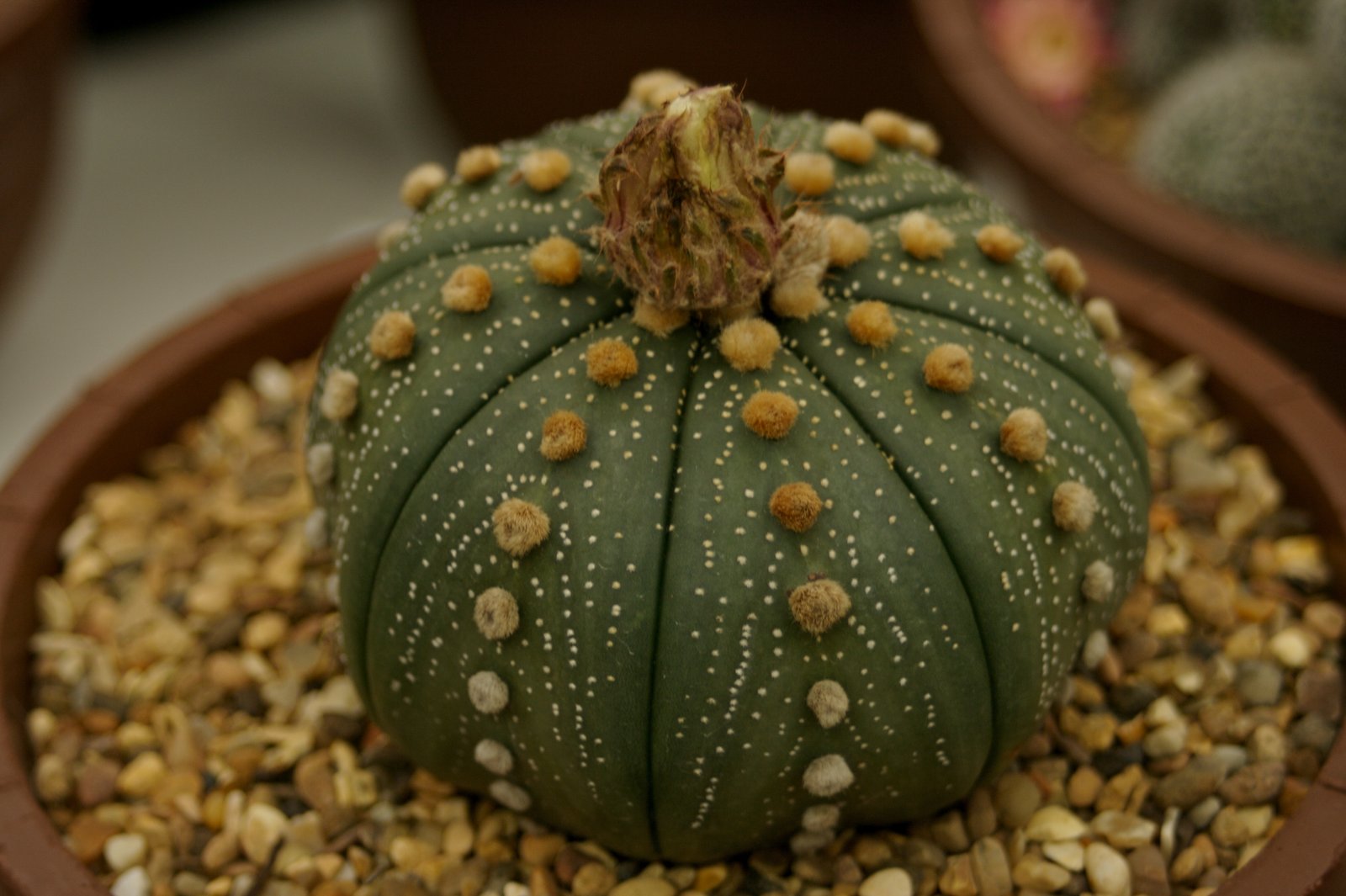
Astrophytum grow in summer and rest in winter. Through the growing season, from spring into early autumn, water thoroughly and then let the substrate dry out completely before the next watering, which in a fast mineral mix usually falls every two to four weeks depending on heat and pot size. The plant signals thirst by contracting: the body pulls flatter and the ribs stand out in a pronounced star. A firm, full body needs no water.
From October, stop. Astrophytum need a completely dry winter rest, and wet cold at the root collar is the main way they die, especially the flat-bodied A. asterias whose spineless disc sits flush with the soil and holds water in the crown. Kept bone dry, most species tolerate brief cold to around minus five degrees Celsius; the same plants rot at far milder temperatures if the substrate is damp. Dry cold is survivable, wet cold is not. If a plant does soften at the base, our root rot guide covers the rescue.
What is the best soil for Astrophytum?
Astrophytum grow on calcareous, limestone-derived soils with very little organic matter and an alkaline lean. A cultivation mix should be roughly ninety percent mineral and ten percent organic, with a calcium source built in. That ratio is the genus baseline, shifted leaner in cool or humid climates and slightly richer where summers are hot and dry.
Build the mineral fraction from pumice, lava, and granite grit, add crushed limestone for the calcium and the alkaline pH these plants grow in naturally, and keep the organic share to a little worm castings. The ingredients popular guides still recommend, perlite, builder’s sand, and peat, all work against you here: they hold water against the flat disc and rot-prone taproot. The full component logic is in our cactus soil mix guide, and the warning about commercial bagged mixes in the Miracle-Gro breakdown.
How much light does a star cactus need?
Bright light, with the amount tuned to the species. In the wild Astrophytum often grow under a nurse shrub that filters the fiercest sun, and in cultivation the brightest position is right for most of the genus as long as the plant has been hardened to it. Astrophytum asterias takes six or more hours of strong light once mature; A. myriostigma is more shade-tolerant and keeps its colour better with some afternoon shade inland; A. caput-medusae actually prefers filtered light.
The failure modes sit at both ends. Too little light and the body etiolates, stretching and losing the compact star, and a drawn plant rarely flowers. Too much unacclimated sun in a hot inland summer and the skin corks or bleaches, particularly on the spineless flat species. Northern growers short on winter sun can hold plants under bright supplemental light through the dark months without harm.
Astrophytum species, and how their care differs
The genus splits cleanly into the spineless species, grown for their flecking and geometry, and the spined species, grown for their form. The full set is on the Astrophytum genus hub; the care-relevant differences are below.
Astrophytum asterias, the star cactus, is the flat eight-ribbed species and the most demanding to keep, because the spineless disc collects water and the plant rots if kept damp or cold. Its yellow flower has a red throat. It is also the most protected: IUCN Vulnerable, listed as Endangered under the US Endangered Species Act, and one of the few cacti on CITES Appendix I. The nudum and variegata forms and the Super Kabuto cultivars are all selections of this species and want identical care.
Astrophytum myriostigma, the bishop’s cap, is the most forgiving and the most widely grown. It is typically five-ribbed, carries a pure yellow flower with no red throat, and tolerates more shade than asterias. The four-ribbed form, var. quadricostatum, is the squared-off selection that gives the genus its reputation for geometry. Astrophytum coahuilense looks like a denser, more uniformly white myriostigma but carries the red flower throat of the asterias group and is rated Vulnerable.
Astrophytum caput-medusae is the oddity, with no ribs at all but long snake-like tubercles, a single known locality, a Critically Endangered rating, and a strong preference for shade. It is the hardest to grow from seed and the most often grafted. The two spined species sit outside the site’s specimen pages but belong in any care guide: A. capricorne, the goat’s horn, carries long twisted papery spines and a red-throated yellow flower, and A. ornatum, the largest and fastest-growing of the genus, wears its white flecking in neat horizontal bands and flowers pure yellow.
When does Astrophytum flower, and how do you grow it from seed?
Astrophytum flower in spring and summer, opening yellow by day for a day or two at a time over a long season. Flowering is gated by size more than by age: a plant flowers once it reaches a few centimetres across, which for a seed grown A. asterias usually means several years and for the faster A. ornatum rather less. A. asterias is an obligate outcrosser, so a single plant sets no seed; two unrelated plants flowering together, hand-pollinated, are needed for fruit.
Seed is the collector standard and the genus germinates readily. Fresh seed sprouts within a few days at twenty-five to thirty degrees Celsius in bright, humid conditions, and fresh asterias seed clears eighty percent. Grafting onto a fast rootstock such as Pereskiopsis accelerates early growth and brings flowering forward, which is why A. asterias and A. caput-medusae are so often sold grafted, but a grafted plant grows oversized and loses the tight habit. Why most serious collectors hold out for seed grown plants is the same argument that runs through the whole genus.
Why is my Astrophytum rotting or going soft?
Rot is the main killer, and it is almost always wet cold at the root collar or crown. The flat A. asterias is the most exposed, since water pools on its spineless disc, and wild populations have been hit by Phytophthora after heavy rain. The fix is preventive: a sharply mineral mix, a dry winter, top-dressing that keeps the collar dry, and a pot that drains. A plant that has gone soft and translucent through the body cannot be saved; one caught with localised rot can be cut back to clean tissue and re-rooted as in the diagnostic guide.
Mealybugs, including root mealybugs hidden in the substrate, are the other common problem and respond to a bare-root, wash, and repot. Corking or bleaching of the skin is usually unacclimated sun rather than disease, and eases with afternoon shade in peak summer. Keep the plant lean, bright, and dry in winter and Astrophytum is a durable, long-lived genus.
Frequently asked questions about Astrophytum care
How often should you water an Astrophytum?
Water Astrophytum only in the growing season, from spring into early autumn, and only when the substrate has dried out completely, which is usually every two to four weeks in a fast mineral mix. Stop watering entirely from October through winter. A contracted, starfish-shaped body signals thirst; a firm, full body does not.
What are the white dots on my Astrophytum?
The white dots are trichomes, fine epidermal scales, not a pest or disease. They reflect sunlight and reduce water loss, and their density varies by plant and by species. Astrophytum myriostigma is named for them; nudum forms have none. Heavily flecked Super Kabuto plants are simply asterias selections bred for dense trichomes.
Is Astrophytum asterias endangered, and is it legal to own?
Astrophytum asterias is rated Vulnerable by the IUCN, listed as Endangered under the US Endangered Species Act, and placed on CITES Appendix I, one of the few cacti at that tier. Wild collection is illegal, but nursery-propagated, seed grown plants are legal to buy and own with the right documentation for international movement.
What soil does a star cactus need?
Astrophytum need a calcium-rich mineral substrate: about 90 percent pumice, lava, and granite grit with crushed limestone for calcium, and around 10 percent worm castings. No perlite, no builder sand, no peat, all of which hold water against the flat body and rot-prone taproot. Match the alkaline, calcareous soils these plants grow on in the wild.
How long does Astrophytum take to flower from seed?
Astrophytum flowering is gated by size more than age. A seed grown plant flowers once it reaches a few centimetres across, which for Astrophytum asterias usually means several years and for the faster Astrophytum ornatum rather less. Grafted plants flower sooner but grow oversized. Asterias is an obligate outcrosser, so two plants are needed to set seed.
Plants of the World Online (POWO), Royal Botanic Gardens Kew, Astrophytum Lem. · IUCN Red List, Astrophytum assessments · US Fish and Wildlife Service, Astrophytum asterias (star cactus) listing · CITES Appendices I, II, III (current) · Strong & Williamson, pollination and breeding system of Astrophytum asterias (2007) · Martínez-Ávalos et al., habitat and threats to Astrophytum asterias (2007) · Anderson, E.F., The Cactus Family (Timber Press) · Hunt, D., The New Cactus Lexicon (DH Books) · llifle, Encyclopedia of Living Forms · Henry Shaw Cactus and Succulent Society, genus notes
Photos: Astrophytum myriostigma by Petar43 and A. asterias by Mike Peel (both CC BY-SA 4.0), via Wikimedia Commons.