Why Is My Cactus Turning Yellow? A Diagnostic Guide
All ArticlesA cactus turning yellow usually means one of five things: root rot from overwatering, light stress, spider mites, nutrient exhaustion, or a natural seasonal colour shift. Where the yellow sits, and whether the tissue is firm or soft, tells you which one you have and how urgently you need to act.
How do you read a yellowing cactus?
Reading a yellowing cactus comes down to two questions: where the yellow is, and whether that tissue is firm or soft. Those two readings separate almost every cause. Firm yellow tissue points to a cultural or environmental problem you have time to correct: light stress, a nutrient shortfall, cold, or a natural pigment shift. Soft, sunken, or mushy yellow tissue means rot is already underway and you have a day or two, not a month.
Location refines it further. Yellow climbing from the base upward is a water problem. Yellow on one sun-facing face is a light problem. Yellow stippling at the growing tip is usually pests. Uniform pale yellow across the whole plant is most often nitrogen exhaustion or, if the tissue is also soft, advanced overwatering. The sections below take each in turn, then a four-question triage at the end ties them together.
Why is my cactus turning yellow at the base?
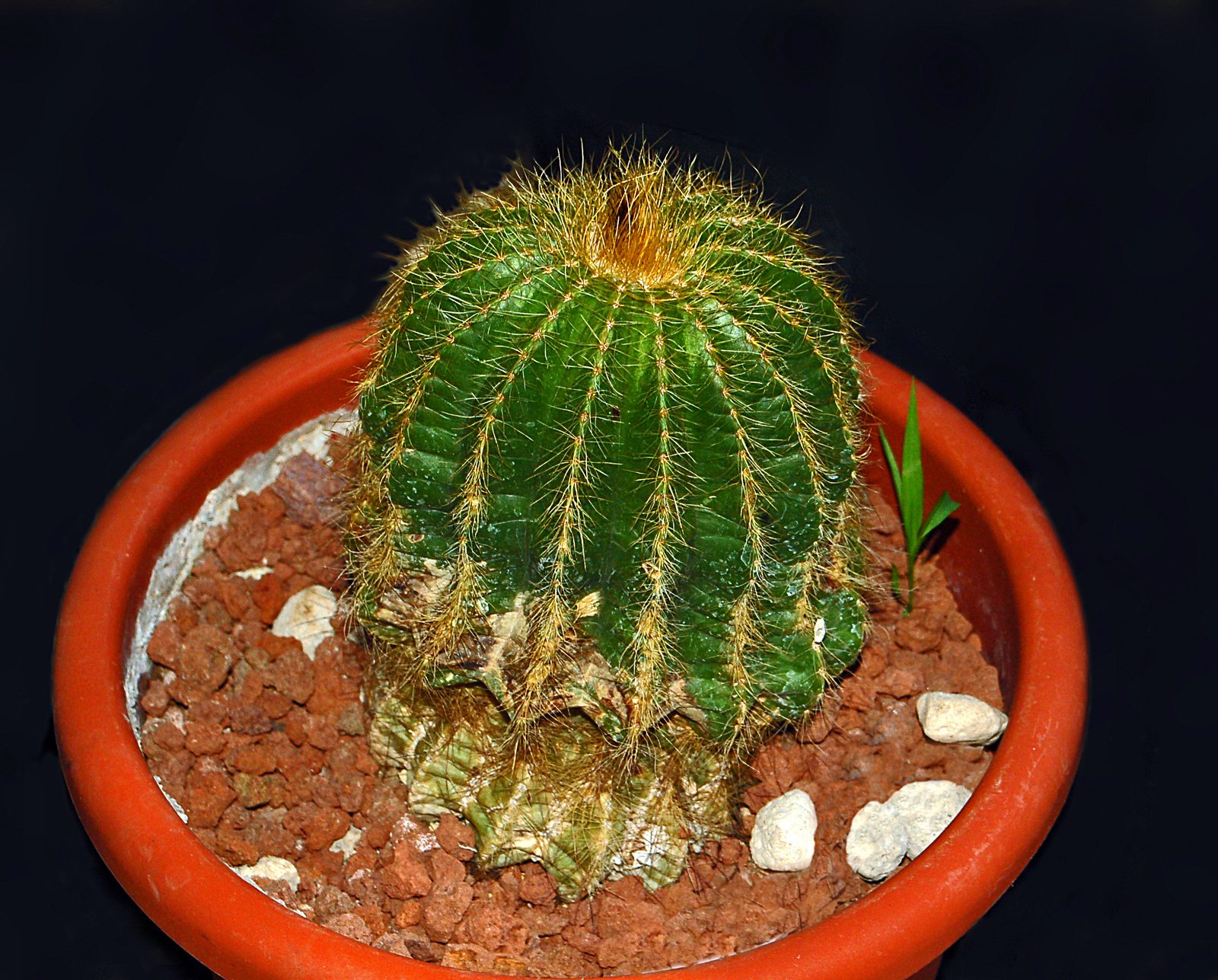
Base-up yellowing with soft, water-swollen tissue is overwatering, and it is the failure mode that kills the most cacti. Saturated substrate drives oxygen out of the root zone; the roots suffocate, and soil fungi such as Pythium, Phytophthora, and Fusarium move into the weakened tissue. The plant pales from the bottom because that is where the failing roots meet the stem. Under warm conditions the yellow can turn to brown or black rot within days.
Confirm it with three checks: press the base (soft or yielding is bad), feel the pot weight or probe the soil (still wet seven to ten days after watering means the drainage is wrong), and if either is true, unpot and look at the roots. White and firm is healthy; brown, black, or slimy is rot. Cut every soft root back to clean tissue with sterile scissors, dust the cuts with sulphur or cinnamon, dry the plant in open air for three to five days, and repot into fresh dry mineral mix. Do not water for at least a week. If the base of the stem itself is soft all the way through, or the roots are uniformly black and soggy, the plant cannot be saved. The full rescue sequence is in our root rot guide; repot using the dry-rootball method in our repotting guide.
What does sun-stress yellowing look like?
Yellowing confined to one face, the side that takes the most direct sun, is light stress. It starts as a warm golden or orange shift while the tissue stays firm. At this stage it is reversible: the plant is dumping excess light energy through its xanthophyll pigments and protecting itself, and it will green back up over days to weeks in bright indirect light. If the exposure continues, the patch bleaches to a pale yellow-white and the cells die, leaving a permanent papery scar that later hardens to tan. The scar stage is covered in the cactus turning brown guide; the goal here is to move the plant before the bleached-white stage arrives.
This is almost always a recent-change problem: a plant moved outdoors for summer, set against a newly sunny window, or put under a grow light too close. After winter dormancy or a shipment spent in the dark, a cactus has no sun conditioning at all and burns fast. Acclimate over ten to fourteen days, starting with bright indirect light and adding an hour or two of gentle morning sun every few days, skipping the harsh midday hours, before any full exposure.
Is pale new growth the same as yellowing?
No, and confusing the two leads to the wrong fix. When the newest growth at the top of a cactus comes in pale, thin, and stretched, with widely spaced areoles and a lean toward the window, that is etiolation: too little light, not too much, and not a pigment failure in existing tissue. The plant is racing toward the light and skimping on chlorophyll along the way. The tell is the shape. Etiolated tissue is elongated and narrow as well as pale, while true yellowing colours tissue that keeps its normal girth.
Move the plant to a brighter spot or add a grow light, acclimating gradually so the soft new growth does not burn. The stretched section will not shrink back, but everything grown afterward returns to normal colour and form. Our cactus etiolation guide covers correcting and, where possible, hiding the damage.
Pests that turn a cactus yellow
Spider mites feed on the metabolically rich tissue near the growing tip, puncturing cells one at a time. Each feeding site leaves a pale dot, and at scale those dots merge into a yellow or bronze haze across the upper stem, usually with fine silken webbing strung between the spines. Tap the plant over white paper and look for moving specks, or wipe the surface with a damp white tissue and watch for rust-coloured streaks. Mites thrive in hot, dry, still air; a strong water jet, raised humidity, and a neem-oil treatment once or twice a week for three weeks clears them.
Scale and mealybugs cause more localised yellowing around their feeding sites. Mealybugs show as white cottony tufts in the areoles and stem junctions; armoured scale looks like small brown shells stuck to the skin, easy to mistake for natural areole texture. Both wipe off with a 70-percent isopropyl alcohol swab, followed by neem every five to seven days. The full pest playbook is in our cactus pests guide.
Nutrient shortage and exhausted soil
Uniform pale yellowing with slow growth during the warm months, on a plant that is otherwise firm and well-watered, can be a nutrient shortfall, but treat this as a diagnosis of exclusion. Cacti evolved in mineral-poor ground and need very little feeding, so true deficiency mainly shows up on plants left in the same exhausted substrate for three or more years with no feeding at all. Nitrogen shortage pales the whole plant or the older sections first; iron shortage, by contrast, whitens the newest growth at the tip because iron cannot move within the plant. Both correct with a half-strength low-nitrogen cactus feed during the growing season, covered in our cactus fertilizer guide.
Often the real fix is a repot rather than a feed. Roots spiralling out of the drainage holes, a crust of white mineral deposit on the surface, water that beads instead of soaking in, and no new growth across two seasons all point to spent substrate. Fresh mineral mix restores colour within a single growing season. Never feed a plant that is stressed, rotting, or carrying pests; fix that first.
Why is my cactus turning yellow in winter?
Two very different things turn a cactus yellow in winter, and the firmness test separates them. The harmless one is a seasonal pigment shift: as light and warmth drop, the plant sheds some chlorophyll and its underlying carotenoid pigments show through, giving a pale olive-yellow cast that is firm to the touch and reverses with spring light. Cacti and their relatives build these accessory colours from betalains rather than the anthocyanins other plants use, which is why cold-stressed specimens can also flush purple or red rather than yellow. None of this needs treatment.
The dangerous one is overwatering during dormancy. A cactus barely drinks in winter, so the same watering that was fine in July leaves the substrate wet for weeks and rots the roots, producing soft yellowing at the base. The rule that prevents it is in our cactus winter care guide: cut water hard once growth stops. If a winter-yellow plant is also soft, treat it as rot, not as a seasonal colour change. Genuine freeze damage adds its own pale-then-mushy collapse on the exposed face and needs the plant moved somewhere stable and above freezing.
When yellow is normal and not a problem
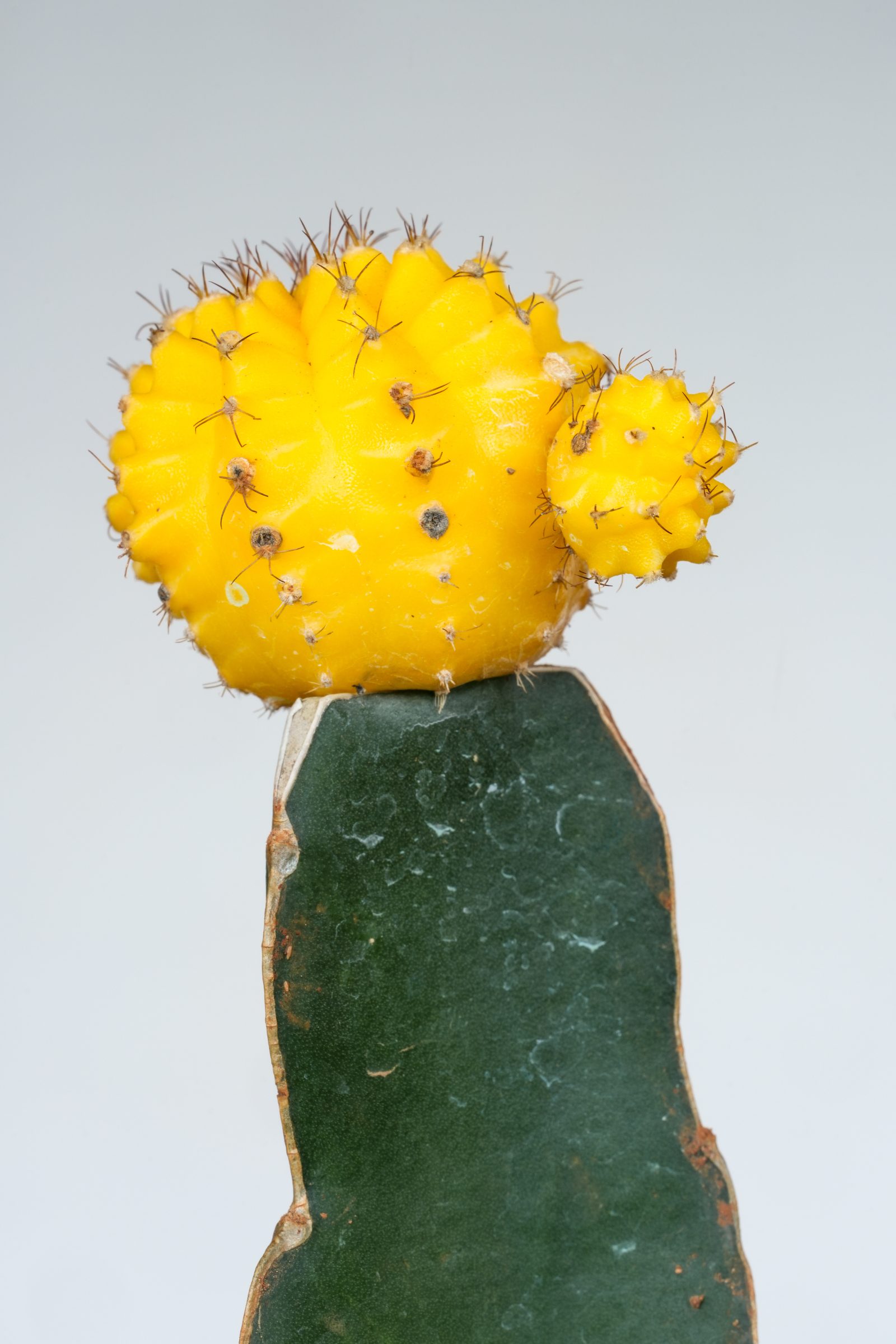
Some yellow is by design. The bright yellow, orange, and red moon cactus sold everywhere is Gymnocalycium mihanovichii bred to lack chlorophyll entirely; its colour comes from betalain pigments with no green to mask them, and it is grafted onto a photosynthetic rootstock precisely because it cannot feed itself. A yellow moon cactus on a healthy green base is working exactly as intended. The same goes for variegated cultivars that carry stable cream-to-yellow sectors, and for the lowest, oldest pads on an Opuntia, which yellow and drop with age while the young growth above stays green. In every one of these cases the firmness test still applies: a normal yellow plant is firm, and only softening signals trouble.
A four-question triage to find the cause fast
Run these in order and most plants resolve to one or two causes. One, where is the yellow? Base and climbing up means overwatering; one sunny side means light; the growing tip means mites or iron; uniform all over means nitrogen or severe overwatering; only the oldest bottom pads means natural age. Two, is it firm or soft? Soft or sunken means rot, and you act within a day or two; firm means you have time; wrinkled and dull means underwatering instead. Three, what was the watering like over the last month? Weekly water or soil that stays wet for a week points straight back to overwatering whatever else is going on. Four, did the light change in the last 30 days? Moved brighter means sunburn; moved darker means etiolation; no change clears both and sends you to water, pests, or nutrients.
If the plant is soft, smells sour, and the rot has reached the core, it may be past saving; our guide to a dying cactus covers triage and the cuttings you can still rescue from a failing plant.
Frequently Asked Questions
Can a yellow cactus turn green again?
It depends on the cause. Yellowing from light stress reverses over days to weeks once the plant is moved to bright indirect light, as long as the tissue has not bleached white and died. Overwatering yellowing can recover if rot has not reached the core. But a sunburn scar and dead, softened tissue do not turn green again; the plant grows past them instead.
Why is my cactus turning yellow and soft?
Soft plus yellow means rot, almost always from overwatering. The saturated soil suffocated the roots and fungi moved in. This is urgent: stop watering, unpot, cut away every soft root and any mushy stem base with sterile tools, dry the plant for several days, and repot into fresh dry mineral mix. If the stem is soft all the way through, it cannot be saved, though firm offsets can be cut and rerooted.
Is a yellow cactus dying?
Not necessarily. Yellowing is a stress signal across a wide range of severity. Firm yellow tissue with no softness or smell usually recovers once you fix the cause. Soft, sunken, or foul-smelling yellow at the base is advanced rot and can be fatal without quick intervention. The firmness test is the fastest way to tell which situation you are in.
Why is my cactus turning yellow after repotting?
Most likely transplant shock. Disturbing the roots interrupts water uptake for one to three weeks, and the plant can pale slightly while it re-establishes. Keep it in bright indirect light, hold off on water for about two weeks so the cut roots can callus, and make sure the new pot drains freely. If the yellowing is soft and spreading rather than mild and stable, suspect rot from a too-wet new substrate instead.
Why is my moon cactus yellow?
Because it is meant to be. The moon cactus is a chlorophyll-free Gymnocalycium mihanovichii mutant whose yellow, orange, or red colour comes from betalain pigments with no green to hide them. It is grafted onto a green rootstock that photosynthesises for it. A yellow scion on a firm green base is healthy; only concern yourself if the scion goes soft or the graft union fails.
Texas A&M AgriLife, Aggie Horticulture: diagnosing nutritional deficiencies (N, Mg, Fe, K symptom patterns) · Royal Horticultural Society: glasshouse red spider mite · Pacific Northwest Pest Management Handbooks: Schlumbergera stem and root rots (Pythium, Phytophthora, Fusarium) · Sánchez-Martínez et al., Fusarium and Neocosmospora associated with rot of Cactaceae, Journal of Fungi (2022) · Plants in Action (Australian Society of Plant Scientists): photoinhibition and photoprotection, the xanthophyll cycle · Seasonal photoinhibition of photosystem II in Opuntia cespitosa, Haseltonia 28 (2022) · Natural pigment (betalain) stress response in Stenocereus queretaroensis, peer-reviewed cell-culture study · Betalain and anthocyanin mutual exclusivity in Caryophyllales (review) · NC State Extension and horticultural references on Gymnocalycium mihanovichii grafting · Toronto Master Gardeners: root rot assessment · Images via Wikimedia Commons: Hectonichus (CC BY-SA 3.0, Parodia base rot) · Timothy A. Gonsalves / Tagooty (CC BY-SA 4.0, yellow moon cactus)