
Copiapoa cinerea subsp. cinerea
| Familie | Cactaceae |
| Benannt von | Autonym (automatisch) |
| Elternart | Copiapoa cinerea |
| Typuslokalität | Hueso Parado, Quebrada Taltal |
| Natürliches Verbreitungsgebiet | ~10 km N bis ~20 km S von Taltal |
| Höhenlage | Nahe Meeresspiegel bis 950 m |
| Rippen | <30, breit, tief |
| Dornen | Schwarz, pfriemlich, <10 insgesamt |
| Perianth | Rot gespitzte Segmente |
| IUCN-Status | LC (Artniveau) |
| CITES | Appendix II |
Diese Pflanze steht am Anfang von allem. Als Rodolfo Amando Philippi in den 1850er-Jahren die Hügel oberhalb von Taltal erklomm und das Exemplar sammelte, aus dem später Echinocactus cinereus werden sollte, blickte er auf das, was wir heute Copiapoa cinerea subsp. cinerea nennen: die nominotypische Form, die Typuspopulation, das Original. Jede andere benannte Form innerhalb der Art wird dadurch definiert, wie sie sich von dieser unterscheidet.
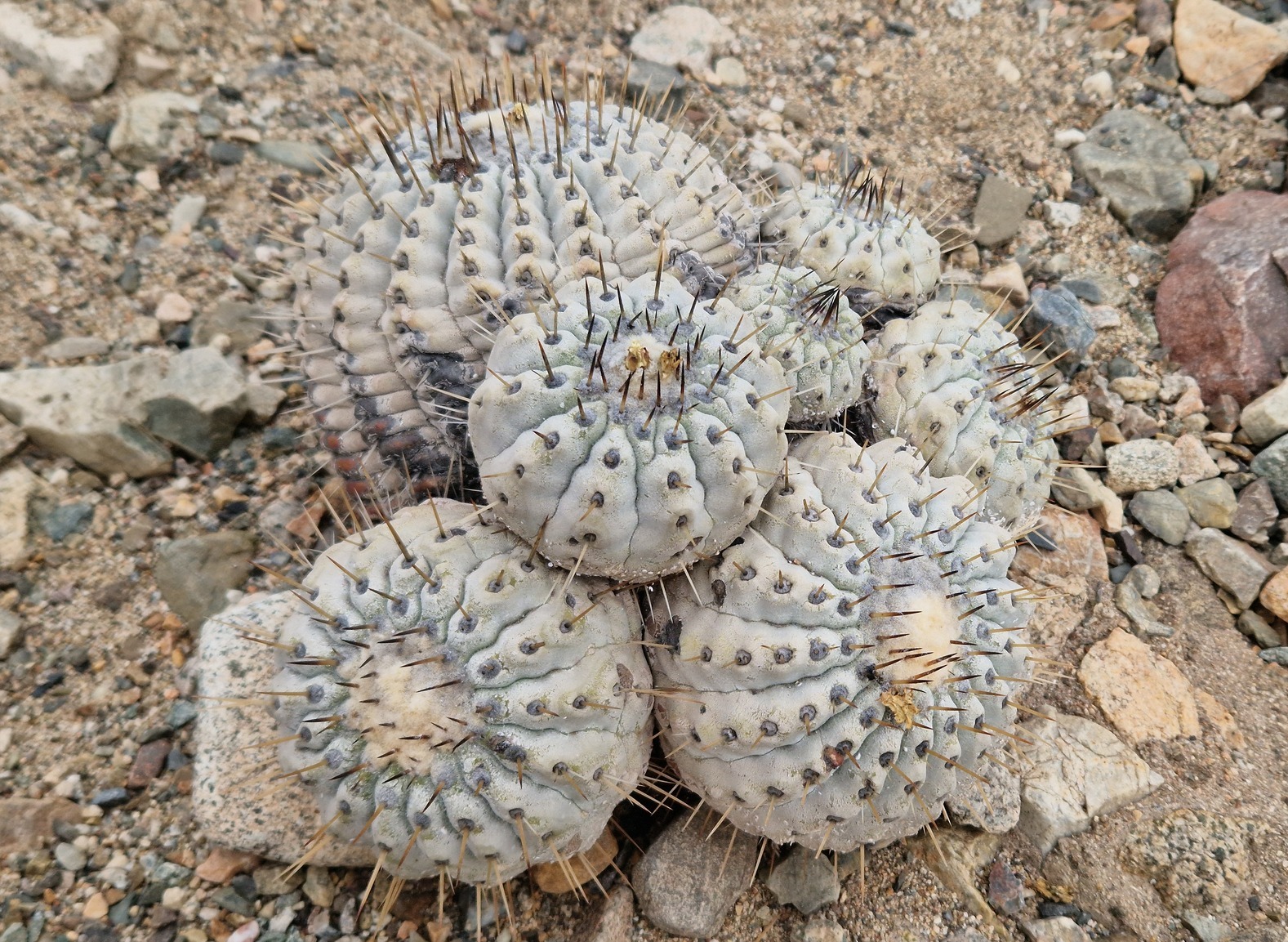
Die Taltal-Form ist das Bild, das den meisten Sammlern in den Sinn kommt, wenn sie an Copiapoa cinerea denken. Ein kugeliger bis kurz-zylindrischer Körper, überzogen von leuchtend silberweißer Farina. Dunkle, fast schwarze Dornen, die aus wolligen Areolen hervortreten. Ein flacher, dicht wolliger Scheitel. Der visuelle Kontrast zwischen dem hellen Körper und der dunklen Bewehrung ist das Merkmal, das diese Unterart zu einem der meistfotografierten und zugleich teuersten Kakteen der Erde gemacht hat.
Im Habitat umfassen manche Populationen nahe Taltal Hunderttausende Individuen. Das Tal östlich der Stadt beherbergt, was Schulz (2006) als eine der größten Einzelpopulationen der Gattung beschrieb. Doch diese Fülle täuscht. Diese Unterart weist die niedrigste Sämlingsrate und den höchsten Anteil toter oder überalterter Individuen aller Copiapoa cinerea-Unterarten auf. Die Kolonien bestehen fort, weil die Pflanzen jahrhundertelang leben, doch die nächste Generation ersetzt sie womöglich nicht in einem nachhaltigen Tempo.
Auf dem Sammlermarkt stehen aus Samen gezogene Exemplare der subsp. cinerea mit dokumentierter Herkunft aus dem Taltal-Gebiet an der Spitze der Preishierarchie für die Art. Eine gut entwickelte, aus Samen gezogene Pflanze von 15 bis 20 Jahren mit vollständiger Silberschicht und ausgereiftem Dornencharakter kann für 3.000 bis 8.000 US-Dollar verkauft werden. Die außergewöhnlichsten Exemplare, Pflanzen mit fast 30 Jahren und jenem tiefen Körpercharakter, den nur Jahrzehnte langsamen, geduldigen Wachstums hervorbringen können, haben in Privatverkäufen über 10.000 US-Dollar erzielt. Das ist keine Spekulation und kein Hype: Es ist schlicht eine Folge davon, wie lange es dauert, eine Pflanze dieser Qualität heranzuziehen, und wie wenige Züchter die Geduld dafür aufbringen.
Schutzstatus
Copiapoa cinerea wird von der IUCN Red List als Least Concern eingestuft (Guerrero et al., 2024). Die Einstufung als LC auf Artebene bleibt bestehen, weil die südliche Unterart columna-alba große, gesunde Populationen aufweist. Die Situation der subsp. cinerea rund um Taltal ist weniger beruhigend: Schulz und Kapitany (1996) dokumentierten eine geringe Sämlingsrate, erhöhte Seneszenz und den höchsten Anteil toter Individuen unter den drei Unterarten.
Inhalt
Was der doppelte Name bedeutet
Das doppelte Epitheton in Copiapoa cinerea subsp. cinerea ist weder ein Tippfehler noch ein Stottern. Es ist eine formale Folge der Regeln der botanischen Nomenklatur. Wird eine Art in Unterarten gegliedert, schreibt der Internationale Code der Nomenklatur vor, dass die Unterart mit dem Typusexemplar einen Namen erhält, der das Artepitheton wiederholt. Dieses „Autonym“ wird von keinem einzelnen Taxonomen veröffentlicht. Es entsteht automatisch in dem Moment, in dem eine weitere Unterart formal beschrieben wird.
Bei Copiapoa cinerea war der Auslöser Friedrich Ritters Beschreibung von Copiapoa columna-alba aus dem Jahr 1959, die später als Copiapoa cinerea subsp. columna-alba in den Rang einer Unterart überführt wurde. Von diesem Moment an wurde die ursprüngliche Population bei Taltal, die mit Philippis Typusexemplar aus Hueso Parado, automatisch zur subsp. cinerea. Derselbe Mechanismus erzeugte das Autonym, als Copiapoa cinerea subsp. krainziana anerkannt wurde.
Was der Name einem Sammler sagt, ist konkret und nützlich: Dies ist die Form vom Typusfundort. Es ist die Population, die Philippi gesammelt hat. Sie ist die morphologische Referenz, an der die anderen Unterarten gemessen werden. Wer eine Pflanze mit dem Etikett subsp. cinerea kauft, sollte den Taltal-Phänotyp erwarten: breite Rippen, dunkle Dornen, rot gespitztes Perianth und den klassischen silbernen Körper. Eine Pflanze, die nur als Copiapoa cinerea ohne Unterartepitheton etikettiert ist, kann jede der drei Formen sein.
Habitat & das Verbreitungsgebiet bei Taltal
Die subsp. cinerea ist von etwa 10 Kilometern nördlich von Taltal bis rund 20 Kilometer südlich verbreitet und wächst vor allem im Landesinneren auf felsigen Hängen bis in 950 Meter Höhe. Die höchsten bestätigten Populationen stehen auf dem Cerro Perales (Schulz 2006). Einige Pflanzen kommen auch nahe Meereshöhe vor, die dichtesten Bestände liegen aber in mittleren Höhen, wo der Camanchaca-Nebel am zuverlässigsten ankommt.
Der Untergrund ist überwiegend granitisch, die Pflanzen wurzeln in Ritzen und Spalten felsiger Hänge. Niederschlag ist vernachlässigbar: Taltal erhält etwa 1 bis 5 Millimeter pro Jahr. Praktisch die gesamte Feuchtigkeit stammt aus dem Nebel. Die Ökologie gleicht hier dem, was Copiapoa solaris weiter nördlich bei El Cobre erlebt, doch die cinerea-Populationen besiedeln eine breitere Höhenspanne und zeigen über die Landschaft hinweg mehr morphologische Variation.
Straßenbau und die Ausdehnung der Stadt Taltal sind in diesem Teil des Areals die wichtigsten Bedrohungen des Lebensraums. Der Ort liegt mitten im Verbreitungsgebiet der Unterart, und der Siedlungsdruck nimmt zu. Anders als die südliche Unterart columna-alba, die mit einigen Populationen im Nationalpark Pan de Azúcar vorkommt, genießt die subsp. cinerea um Taltal keinen formalen In-situ-Schutz.
Morphologie
Die subsp. cinerea verzweigt sich seitlich und an der Basis und bildet manchmal lockere Hügel aus mehreren Köpfen. Diese Verzweigung unterscheidet sie von der meist solitären subsp. columna-alba. Die einzelnen Triebe sind kugelig bis gestreckt-zylindrisch und erreichen bei alten Pflanzen beachtliche Größen: Triebe bis zu einem Meter Höhe und 18 Zentimeter Durchmesser sind belegt, auch wenn die meisten Pflanzen im Habitat kleiner sind.
Die Rippen sind weniger als 30, breit und tief, kaum gewellt. Diese breitere Rippenstruktur ist eines der Hauptmerkmale, die die subsp. cinerea von der subsp. columna-alba trennen, die bis zu 50 schmale, flache, gewellte Rippen bildet. Die breiteren Rippen der subsp. cinerea geben der Pflanze von oben betrachtet ein kräftigeres, architektonischeres Profil.
Die Dornen sind wenige, meist weniger als 10 insgesamt, pfriemlich, beim Austreiben schwarz oder sehr dunkelbraun und im Lauf der Jahre vergrauend. Der Kontrast zwischen frischen dunklen Dornen am Scheitel und verwitterten grauen Dornen weiter unten am Körper erzeugt einen optischen Verlauf, der zu den schönsten Merkmalen der Pflanze gehört. Dornenlänge und -stärke schwanken zwischen den Populationen: Manche Taltal-Formen bilden kräftige, nach außen gerichtete Mitteldornen, andere sind nahezu dornenlos.
Die Blüten tragen das nützlichste taxonomische Merkmal, um diese Unterart von columna-alba zu unterscheiden. Die inneren Perianthsegmente sind rot gespitzt, die äußeren zeigen einen rötlichen Mittelstreifen. Diese roten Zeichnungen fehlen bei der subsp. columna-alba, deren Perianth einheitlich blassgelb ist. Die Blüten sind trichterförmig, 2,5 bis 3,5 Zentimeter breit und erscheinen aus der grauen bis weißen Scheitelwolle.
Zustand der Populationen
Die Populationsdynamik der subsp. cinerea ist ein Paradox. Manche Populationen sind riesig. Das Tal östlich von Taltal trägt womöglich Hunderttausende Individuen, eine der größten Einzelansammlungen einer Copiapoa-Art überhaupt. Die Zahlen allein ließen auf eine gesicherte Population schließen.
Die Altersstruktur erzählt etwas anderes. Schulz und Kapitany (1996) dokumentierten, dass die subsp. cinerea den geringsten Sämlingsnachwuchs der drei Unterarten hat. Jungpflanzen sind im Verhältnis zur Gesamtpopulation selten. Zugleich ist der Anteil toter oder vergreister Individuen der höchste aller Copiapoa cinerea-Unterarten. Dieses Muster, viele alte Pflanzen und wenige junge, deutet auf eine Population hin, die vom angesammelten Kapital früherer Fortpflanzungsereignisse lebt, sich aber nicht in einem Tempo erneuert, das langfristige Stabilität sichert.
Aufschlussreich ist der Vergleich mit der subsp. columna-alba. Im Nationalpark Pan de Azúcar und an anderen südlichen Standorten umfassen die columna-alba-Populationen reichlich Sämlinge aller Größenklassen, ein Zeichen für aktive, fortlaufende Verjüngung. Welcher Umwelt- oder biologische Faktor die Etablierung von Sämlingen im Raum Taltal auch begrenzt, er scheint die südlichen Populationen nicht im gleichen Maß zu treffen.
Ob dies ein natürliches demografisches Muster einer sehr langlebigen Art widerspiegelt (jahrhundertealte Pflanzen bringen womöglich Fortpflanzungsschübe hervor, die Jahrzehnte auseinanderliegen) oder einen echten Rückgang durch Lebensraumzerstörung und veränderte Nebelmuster, ist eine offene Frage. Die Neubewertung von Guerrero et al. 2024 nannte abnehmende Lebensraumqualität und geringen Nachwuchs als Sorgen für einen Großteil der Gattung.
Wichtige Fundorte
Der Typusfundort ist Hueso Parado in der Quebrada Taltal, wo Philippi 1854 das Originalmaterial sammelte. Das Gebiet ist bis heute das Zentrum der Verbreitung der Unterart. Karel Kníže sammelte unter der Feldnummer KK77 Material aus dem Raum Taltal in 300 bis 600 Meter Höhe, aus dem kurze, gedrungene, schwarzdornige Pflanzen hervorgingen, die im Samenhandel bis heute beliebt sind. Der Cerro Perales markiert mit etwa 950 Metern die obere Höhengrenze und bringt Pflanzen mit etwas anderen Körperproportionen hervor als die Populationen in tieferen Lagen.
Die Populationen nördlich von Taltal gehen allmählich in das Areal der subsp. krainziana über. In dieser Zone kommen Zwischenformen vor, deren Dornenmerkmale die pfriemlichen Dornen der subsp. cinerea mit den fadenförmigen Dornen von krainziana verbinden. Diese Übergangspflanzen sind für Sammler wie Taxonomen gleichermaßen interessant, denn sie zeigen den Genfluss, den Larridon et al. (2018) mit molekularen Daten bestätigt haben.
Copiapoa cinerea subsp. cinerea: Pflege und Kultur
Substrat und Gießen
Das Kultursubstrat entspricht dem von Copiapoa cinerea auf Artebene: 33 Prozent Bims, 12 Prozent Lavagestein, 10 Prozent Zeolith, 25 Prozent Granitsplitt, 5 Prozent Kalksteinsplitt, 10 Prozent grober Quarz und 5 Prozent Wurmhumus. Schneller Abfluss ist wichtiger als jede einzelne Zutat; diese Nominatunterart teilt die gattungsweite Fäulnisanfälligkeit, die den organischen Anteil bei 5 Prozent deckelt. Der Zeolith puffert den pH-Wert und dosiert Nährstoffe; der Quarzanteil ist ein strukturgebender Zuschlag, dieselbe Rolle als haltbarer Splitt, die Granit spielt, ohne chemische Wirkung. Der Farinabelag, der die subsp. cinerea so unverwechselbar macht, bildet sich unter starker UV-Strahlung; das Substrat beeinflusst das nur indirekt, indem es den Wurzelhals trocken hält und die Epidermis an Stress gewöhnt.
Alle zehn Copiapoa-Arten auf dieser Website teilen eine einheitliche 95/5-Kulturmischung aus mineralischem und organischem Anteil für die ganze Gattung. Kalkstein bleibt am unteren Ende eines unbestimmten Karbonatbereichs und der organische Anteil beim klassentypischen Ausgangswert von 5 Prozent; keine der beiden Zahlen ist ein artspezifischer Befund. Der einzige Wert, der je nach Art schwankt, ist Lava, bemessen nach der Topftiefe: Das Trio mit Rübenwurzeln (hypogaea, hypogaea var. barquitensis, laui) erhält einen tieferen Topf als der Rest der Gattung.
| Art | Bims | Lava | Zeolith | Granit | Kalkstein | Quarz | Organisch |
|---|---|---|---|---|---|---|---|
| C. laui | 27% | 18% | 10% | 25% | 5% | 10% | 5% |
| C. humilis | 33% | 12% | 10% | 25% | 5% | 10% | 5% |
| C. humilis subsp. tenuissima | 33% | 12% | 10% | 25% | 5% | 10% | 5% |
| C. solaris | 33% | 12% | 10% | 25% | 5% | 10% | 5% |
| C. cinerea | 33% | 12% | 10% | 25% | 5% | 10% | 5% |
| C. cinerea subsp. cinerea (diese Seite) | 33% | 12% | 10% | 25% | 5% | 10% | 5% |
| C. cinerea subsp. krainziana | 33% | 12% | 10% | 25% | 5% | 10% | 5% |
| C. esmeraldana | 33% | 12% | 10% | 25% | 5% | 10% | 5% |
| C. hypogaea | 27% | 18% | 10% | 25% | 5% | 10% | 5% |
| C. hypogaea var. barquitensis | 27% | 18% | 10% | 25% | 5% | 10% | 5% |
Die Farina entwickeln
Wer die subsp. cinerea gezielt wegen ihres silberweißen Aussehens pflegt, sollte von klein auf viel Licht geben. Pflanzen, die ihre ersten Jahre im Schatten verbringen, entwickeln eine Epidermis, die nie ganz zu früh lichtabgehärteten Pflanzen aufschließt. Die Farina ist ein epikutikuläres Wachs, das die Pflanze als Reaktion auf UV-Stress bildet. Mehr Licht bedeutet mehr Wachs. Das heißt nicht, die Pflanze ohne Eingewöhnung in praller Sommersonne zu verbrennen; es heißt, ihr das stärkste Licht zu geben, das sie ohne Schaden verträgt, die Belichtung schrittweise zu steigern und sie über Jahre gleichmäßig zu halten.
Wuchstempo und Geduld
Die subsp. cinerea wächst langsam, wenn auch nicht so extrem wie Copiapoa solaris oder Copiapoa laui. Rechnen Sie damit, dass eine aus Samen gezogene Pflanze unter guten Bedingungen in etwa 10 Jahren einen Körperdurchmesser von 5 bis 8 Zentimetern erreicht. Der Übergang von kugelig zu zylindrisch erfolgt nach 15 bis 20 Jahren. Der volle Adultcharakter mit vollständigem Silberbelag, verwitterten Dornen und ausgeprägter Verzweigung braucht 25 bis 30 Jahre. Das sind grobe Richtwerte, keine Garantien. Manche Pfleger berichten unter optimalen Gewächshausbedingungen von schnelleren Fortschritten; andere erleben, dass ihre Pflanzen jahrelang stagnieren, bevor sie sichtbar weiterwachsen.
Pfropfen beschleunigt die frühe Entwicklung, bringt aber weicheres Wachstum ohne den festen, harten Körper aus Samen gezogener Pflanzen. Für eine Pflanze, die ein langfristiges Schaustück werden soll, liefert die Anzucht aus Samen von Anfang an das beste Ergebnis. Copiapoa humilis subsp. tenuissima wächst schneller und verzeiht mehr Fehler; sie bleibt der empfohlene Einstieg in die Gattung für Pfleger, die sich mit dem cinerea-Komplex noch nicht sicher fühlen.
Preise & Herkunft
Die subsp. cinerea erzielt unter den drei Unterarten die höchsten Preise, weil sie die ikonischste Form ist und im Alter optisch am eindrucksvollsten wirkt. Junge, aus Samen gezogene Pflanzen unter fünf Jahren sind für 50 bis 200 $ erhältlich. Mit 10 bis 15 Jahren, mit sich entwickelnder Farina und ausgeprägter Bedornung, erreichen die Preise 1.000 bis 3.000 $. Pflanzen von 20 bis 30 Jahren mit vollem Silbercharakter, reifer Verzweigung und der tiefen Körperhärte, die aus Jahrzehnten langsamen Wachstums entsteht, werden für 5.000 bis 10.000 $ oder mehr verkauft.
Die Herkunft treibt erhebliche Aufpreise. Eine Pflanze aus Samen einer dokumentierten Wildsammlung mit bekannter Feldnummer (KK77 aus Taltal ist das klassische Beispiel) ist deutlich mehr wert als eine gleich alte Pflanze unbekannter oder nicht überprüfbarer Abstammung. Die Feldnummer verbindet die kultivierte Pflanze mit einer bestimmten Wildpopulation, was einen genetischen, wissenschaftlichen und naturschutzfachlichen Wert jenseits des Gärtnerischen hat.
Der Markt für reife Copiapoa cinerea subsp. cinerea ist weder spekulativ noch von kurzlebigen Trends getrieben. Er beruht auf einer grundlegenden Tatsache: Diese Pflanzen lassen sich nicht schnell produzieren. Wer heute eine Pflanze aus Samen zieht und 25 Jahre gut pflegt, besitzt etwas, das sich per Definition in keinem kürzeren Zeitraum reproduzieren lässt. Diese mathematische Gewissheit trägt das Preisgefüge.
Wie sich die subsp. cinerea von den anderen Unterarten unterscheidet
Im Vergleich zur subsp. krainziana sind die Unterschiede drastisch. Krainziana bildet zahlreiche fadenförmige Dornen, die den Körper wie eine zottige Masse bedecken, während die subsp. cinerea wenige, kräftige, pfriemliche Dornen hat, die einzeln stehen. Beide besiedeln benachbarte Areale nördlich von Taltal und hybridisieren dort, wo sie aufeinandertreffen, sodass Zwischenformen mit Dornenmerkmalen zwischen den beiden Extremen entstehen. Krainziana ist Critically Endangered mit einer einzigen bekannten Population; die subsp. cinerea ist weit häufiger, auf lange Sicht wegen ihres schwachen Nachwuchses aber womöglich weniger stabil.
Im Vergleich zur subsp. columna-alba sind die Unterschiede feiner, aber beständig. Columna-alba bildet bis zu 50 schmale, flache, gewellte Rippen, gegenüber weniger als 30 breiten, tiefen Rippen der subsp. cinerea. Columna-alba wächst meist solitär, während die subsp. cinerea sich von der Basis her verzweigt. Den Blüten von columna-alba fehlen die roten Perianthspitzen, die die subsp. cinerea kennzeichnen. Geografisch besiedelt columna-alba sandige Küstentäler weiter südlich, während die subsp. cinerea felsige Hänge im Landesinneren um Taltal bevorzugt.
Häufig gestellte Fragen
Wie schwierig ist Copiapoa cinerea subsp. cinerea in der Kultur?
Wie wird Copiapoa cinerea subsp. cinerea aus Samen vermehrt?
Ist es legal, Copiapoa cinerea subsp. cinerea zu besitzen?
Wo wächst Copiapoa cinerea subsp. cinerea in der Wildnis?
Wann blüht Copiapoa cinerea subsp. cinerea?
Verwandte Taxa der Gattung
Copiapoa solarisDer Sonnenkaktus der Atacama. Beschränkt auf zwei nebelabhängige Fundorte bei El Cobre und Blanco Encalada. Aus Samen langsamer als Aztekium.Copiapoa humilis subsp. tenuissimaEine kompakte, dunkelkörperige Form von der Küste bei Paposo. Schnellwüchsiger und nachsichtiger als der cinerea-Komplex, ein hervorragender Einstieg für Sammler, die die Gattung neu kennenlernen.Copiapoa humilisDie Stammart des humilis-Komplexes. Miniatur mit Gruppenwuchs, über ihr Areal von Paposo bis Chañaral sehr variabel.Copiapoa cinereaDas silberne Gespenst der Atacama. Drei geografisch getrennte Unterarten besiedeln die Küste von Caleta Colorado bis Chañaral. Die ikonischste Art der Gattung.Copiapoa cinerea subsp. krainzianaDas zottig bedornte Schaustück aus den Quebradas nördlich von Taltal. Die haarartigen weißen Dornen sind in der Familie der Kakteen einzigartig. Eine einzige bekannte Population.Copiapoa lauiEine Miniaturart von einem einzigen Standort bei Esmeralda. Winzige, dicht gruppierte Köpfe mit feinen weißen Dornen. Steht Copiapoa solaris an Kleinräumigkeit des Areals kaum nach.Copiapoa esmeraldanaKüste bei Esmeralda. Der beste Lebensraumzustand aller Copiapoa-Arten, aber ein äußerst schmales Areal. Verwandtschaft zum cinerea-Komplex.Copiapoa hypogaeaTeilweise unterirdisch. Die ungewöhnlichste Wuchsform der Gattung, der Trieb steckt größtenteils unter der Bodenoberfläche.Copiapoa hypogaea var. barquitensisEigenständige Varietät aus Barquito. Flachere, stärker gehöckerte Triebe. Von Spezialsammlern wegen ihrer ungewöhnlichen Oberflächenstruktur gesucht.
Quellen & Literatur
Philippi, R.A. (1860). Flora Atacamensis, p. 23. · Britton, N.L. & Rose, J.N. (1922). The Cactaceae, vol. 3, p. 86. · Hutchison, P.C. (1953). Studies of South American Cactaceae 2. Cactus and Succulent Journal: 34–37. · Schulz, R. & Kapitany, A. (1996). Copiapoa in Their Environment: Chañaral to El Cobre. · Schulz, R. (2006). Copiapoa. · Hunt, D. (2013). The New Cactus Lexicon. · Larridon, I. et al. (2018). Investigating taxon boundaries in Copiapoa subsection Cinerei. Kew Bulletin 73: 55. · Guerrero, P.C. et al. (2024). Copiapoa cinerea. IUCN Red List 2024: e.T212479449A212480302. · Villalobo-López, A. et al. (2024). Effects of trade and poaching pressure on extinction risk. Conservation Biology 38: e14353. · Royal Botanic Gardens, Kew. Plants of the World Online. Abgerufen 2026.