
Blossfeldia liliputana
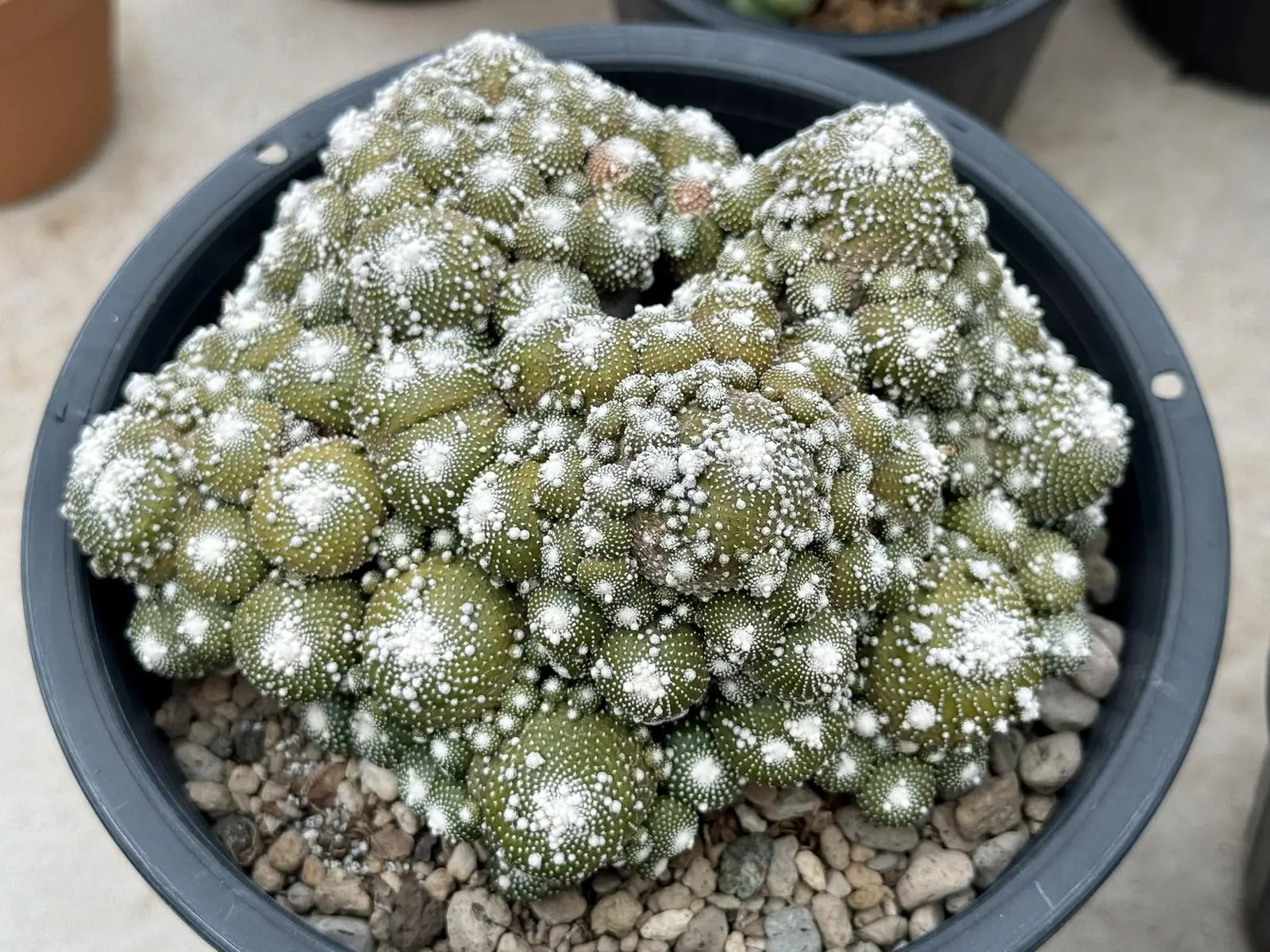
Blossfeldia liliputana is the smallest cactus in the world, and it stops at 10 to 12 mm across. There are no ribs, no tubercles and no spines. What sits on the rock is a flat grey-green disc, often a little sunken at the apex, its unbroken epidermis marked only by areoles set in a spiral and tufted with white wool.
Erich Werdermann published the species in 1937, from material Harry Blossfeld and Oreste Marsoner had collected in northern Argentina the year before. The epithet is a nod to Swift’s island of tiny people. The genus has stayed monotypic ever since, and the mid-century run of segregate names is all sunk back into this one plant.
It does not grow in soil. Plants wedge into cracks and fissures in vertical to near-vertical rock walls in shaded Andean gorges between northwest Argentina and southern Bolivia, anchored by tuberous roots that dwarf the body above them, often close enough to a waterfall to catch the spray.
The physiology is what makes botanists care. The plant carries 0.6 stomata per square millimetre, the lowest figure recorded in any terrestrial autotrophic vascular plant, and it does without the thickened cuticle, thickened outer cell walls and thickened hypodermal layers that every other globular cactus leans on. Rather than hold water it lets water go, shedding up to 80 per cent of its weight over a year and reviving when moisture returns, the way a moss or a lichen does. Poikilohydry is a mould-breaking strategy for a succulent, and this is the only cactus that has committed to it.
Blossfeldia liliputana quick reference
A crevice lithophyte from shaded Andean gorges between northwest Argentina and southern Bolivia, taking intermittent moisture off vertical rock and shutting down between. Values calibrated for seed grown plants in cultivation.
Taxonomy & nomenclature
The accepted name is Blossfeldia liliputana Werderm., published in Kakteenkunde 1937: 162 (IPNI id 273352-2). The genus honours Harry Blossfeld, who collected the plant with Oreste Marsoner in 1936. A second, later publication of the same name by Werdermann and Krainz in 1946 is an isonym and is not the protologue.
The epithet is liliputana. The variant liliputiana circulates widely, including on pages that otherwise know what they are talking about, but it has no nomenclatural standing at all: the register carries twenty Blossfeldia names and every one of them spells it liliputana.
The genus is monotypic. Friedrich Ritter, Curt Backeberg, Martin Cardenas and Hans Krainz between them cut it into a run of species and varieties on differences that turned out to be trivial, and Blossfeldia atroviridis, B. campaniflora, B. fechseri, B. minima and B. pedicellata are all sunk into the one species. Nigel Taylor recombined the plant as Parodia liliputana in 1987, a nomenclatural synonym sharing Werdermann’s 1937 type, and it sat in Parodia until molecular work pulled it back out.
Where it landed is more interesting than where it came from. Blossfeldia is now placed in its own tribe, Blossfeldieae, and that lineage is sister to the entire rest of subfamily Cactoideae. Its nearest relatives, in other words, are everything else. Older treatments put the genus in Notocacteae, and society literature still does here and there; that placement is superseded rather than merely unfashionable. The plant is listed on CITES Appendix II under the family-wide Cactaceae listing, which is what governs moving it across a border.
Two trade labels are worth naming, because both are live search terms and neither is a taxon. Material from near Tarabuco in southern Bolivia circulates as “v. tarabucoensis”; the genus is monotypic, so that is a locality label and not an accepted variety. “Pedicellata” is sold as though it were a species and is a synonym. Cristate material is real and is offered, and takes the parenthetical form Blossfeldia liliputana (cristate).
Historical synonyms (12)
- Blossfeldia campaniflora Backeb., 1959 basionym
- Blossfeldia liliputana var. caineana Cárdenas, 1964 homotypic synonym
- Blossfeldia liliputana f. fechseri (Backeb.) Krainz, 1975 homotypic synonym
- Blossfeldia liliputana var. atroviridis (F.Ritter) Krainz, 1975 homotypic synonym
- Blossfeldia liliputana var. campaniflora (Backeb.) Krainz, 1975 homotypic synonym
- Blossfeldia liliputana var. pedicellata (F.Ritter) Krainz, 1975 homotypic synonym
- Blossfeldia liliputana var. fechseri (Backeb.) F.Ritter, 1980 homotypic synonym
- Blossfeldia liliputana var. formosa F.Ritter, 1980 homotypic synonym
- Parodia liliputana (Werderm.) N.P.Taylor, 1987 homotypic synonym
- Blossfeldia fechseri Backeb., 1962 heterotypic synonym
- Blossfeldia atroviridis F.Ritter, 1965 heterotypic synonym
- Blossfeldia pedicellata F.Ritter, 1965 heterotypic synonym
Sources: POWO (Kew) · IPNI · GBIF · Wikidata
Habitat
Blossfeldia liliputana lives on bare rock rather than in soil, wedged into crevices and fissures in vertical to near-vertical walls in the shaded Andean gorges the region calls quebradas, between northwest Argentina and southern Bolivia. There is no soil in the habitat at all. The plants are held in place by tuberous roots working as anchors first and absorbers second, and the rooting medium is whatever thin mineral debris has collected in the crack.
Water arrives intermittently and leaves fast. The plant turns up repeatedly near waterfalls and seeps, which is the clue that unlocks the whole cultivation problem: this is not a desert cactus in the Copiapoa sense, taking one soaking a season and storing it. It is a crevice plant that takes moisture when moisture is there and shuts down when it is not.
Recorded elevation runs roughly 1,200 to 3,500 m, across monte, chaco and prepuna vegetation. Exposure is unsettled. Published accounts split between shaded rock walls in gorges and sunny dry places between boulders on rocky slopes, and both are probably true of different populations. Specialist cultivation practice lands on shade, which settles the practical question even if the botanical one stays open.
Morphology
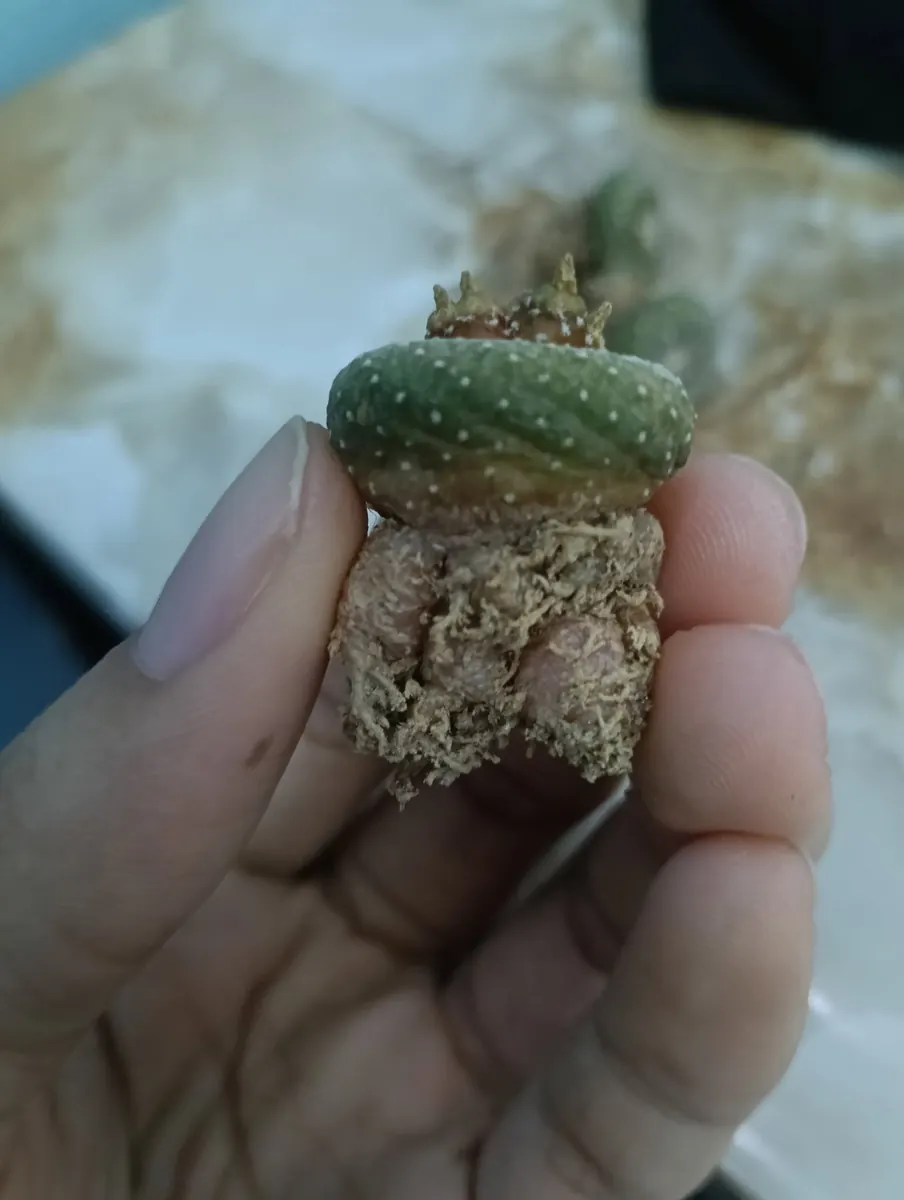
Blossfeldia liliputana is a flattened grey-green disc that reaches 10 to 12 mm across, with the outer bound reported near 13 mm. The body is button-like, pressed against the rock and often sunken at the apex, matte. Plants are solitary or form clustered colonies in a fissure, and the offsets arise from areole and apical tissue rather than from the base.
Three absences do the identification work: no ribs, no tubercles, no spines. That combination is close to unique in Cactaceae. The areoles are arranged in a spiral over an unbroken epidermis, some of the spirals running one way and some the other, and they bear nothing but white wool and trichomes, felt-like under a fingertip.
The root is the organ the photographs never prepare you for. It is tuberous and disproportionately large against a body a centimetre wide, and it is doing a mechanical job before a physiological one, holding the plant onto a wall.
Then the stomata. At 0.6 per square millimetre the plant is very nearly astomate, and no other terrestrial autotrophic vascular plant is known to go lower. It manages this without any of the xeromorphic armour the rest of the family carries: no thickened cuticle, no thickened outer cell walls, no thickened hypodermal layers. It runs CAM photosynthesis, and it is poikilohydric, losing up to 80 per cent of its weight across a year and tolerating further drought on top of that. The literature calls it a succulent resurrection plant, which is a fair description of something that behaves less like a cactus than like a moss with a taproot.
Flowers open at or near the apex, 6 to 15 mm long and 5 to 7 mm across, white and rarely pink. A flower can slightly exceed the diameter of the entire plant carrying it. The fruit is a globose red berry, woolly, and the seed inside it is the second oddity of the species: under half a millimetre, brown, and hairy, where every other cactus seed is hard and relatively smooth. When a pod opens the contents look like grit or dust.
Each seed carries a large fleshy strophiole, an outgrowth near the hilum that most writing on the plant simply calls an aril. Ants move the seed. Exactly what the ants are doing is unsettled, and no reward relationship is established: harvester ants are recorded as seed predators of this group, with dispersal happening when a seed is dropped in transit rather than as payment for the aril. The same convergent seed design appears on the other side of the Americas in Strombocactus disciformis, and Aztekium keeps company in the same ant-moved group.
Locality detail
Blossfeldia liliputana occurs in northwest Argentina and southern Bolivia. The finer distribution is contested. Jujuy, Salta, Catamarca and Mendoza in Argentina, and Potosí and Santa Cruz in Bolivia, are backed by two or more sources apiece. Tucumán is reported from one lineage of sources; La Rioja, San Juan, Chuquisaca, Cochabamba and Tarija are reported from another.
Recorded elevation runs roughly 1,200 to 3,500 m, and both ends of that band are contested by 100 m or more. Records from Brazil exist in the aggregators but are flagged as managed or cultivated occurrence, so Brazil is not part of the native range.
The type locality is not securely established: the protologue cites a holotype, but the collector, the collection number and the herbarium sheet are not confirmed against the primary record, so no secure place name exists to plot. The map shows regional centroids only.
Cultivation
Blossfeldia liliputana wants sharp drainage, shade with moving air, and a bone-dry winter, and that is very nearly the whole regime. Two facts drive all of it: the plant comes from a shaded crevice where moisture arrives intermittently and drains away within minutes, and it has a tuberous root far larger than the body sitting on top of it. Everything that kills this species is a variation on water sitting somewhere it should not.
Substrate
Use a soil mix of 35 per cent pumice, 10 per cent lava, 10 per cent zeolite, 20 per cent granite grit, 0 per cent limestone, 15 per cent silica and 10 per cent low-nutrient organic matter, worm castings for preference. That puts the mix at 90 per cent mineral and 10 per cent organic. Sift it fine: every source that describes sowing or growing this plant asks for a fine particulate, extremely free-draining medium, and a coarse mix built for a barrel cactus is the wrong tool.
Two numbers differ from a standard cactus mix. Limestone sits at zero because nothing in the habitat record indicates a calcium preference, which leaves zeolite as the only pH lever in the mix, so it stays at its baseline rather than getting cut to make room elsewhere. Silica runs high at 15 per cent because the seed is under half a millimetre and germinates on the surface, and dust needs a fine mineral bed to land on. The organic fraction stays at 10. The aggregator recipes calling for 20 to 30 per cent organic are roughly triple that, and on a crevice plant with a rot-prone tuberous root they are an instruction to kill it slowly.
Blossfeldia is monotypic, so this table carries a single row rather than the usual per-species spread. The mix is derived from the habitat rather than inherited from a genus baseline, and no substrate percentage has been published for this plant.
| Species | Pumice | Lava | Zeolite | Granite | Limestone | Silica | Organic |
|---|---|---|---|---|---|---|---|
| B. liliputana (this page) | 35% | 10% | 10% | 20% | 0% | 15% | 10% |
Watering and light
Water sparingly through the warm months while the plant is in growth, and keep it completely dry and cool through winter at 5 to 15°C. Never water onto the body in direct sun. Habitat rainfall and seasonality have not been published for this species, so the March-to-October calendars in the literature are convention rather than observation, and in any case the plant is southern-hemisphere. Follow the plant, not the month.
Give it some shade and plenty of moving air. This is the point where the generic care pages are actively dangerous: several of them prescribe abundant bright direct light within a foot of a window, which is succulent boilerplate applied to a plant that lives on a shaded gorge wall. Hold it above 5°C. Reports that it survives deep frost are self-contradictory and describe what a dry plant can endure, not a recommendation.
Propagation and the grafting question
Seed germinates readily. Survival is the problem, not germination. Surface sow the dust onto a finely sifted mineral mix, do not bury it, mist until moist rather than soaking, seal the container so humidity holds, and leave it alone until the seedlings appear. Then uncover gradually over several days and mist-water only. Growth from there is extremely slow: seedlings need two to five years before a normal watering regime, and flowering is longer still.
That timeline is why the trade grafts. Pereskiopsis carries seedlings and Echinopsis carries larger plants, growers commonly graft at two to three months old, and grafted plants are markedly less prone to root rot. Every major retailer sells this species grafted, several of them with the word in the product title, and it is rarely offered ungrafted at all. That growers reach for the knife that early is itself the evidence that the bottleneck sits in the first few months.
The cost is habit. Grafted plants offset heavily and build into many-headed specimens, which is not how the species presents on a cliff, where it is a solitary or lightly clustered flat disc. At rarecactus.com we calibrate our figures for ungrafted plants, because a grafted Blossfeldia is being watered through somebody else’s roots and almost none of this applies to it.
Comparison
The plant Blossfeldia liliputana gets confused with is Frailea, not anything in its own genus. There is no sibling to compare it against and the nearest relatives are the rest of Cactoideae, so the genus worth putting beside it is the one that is simultaneously tiny, near-spineless, flat to button-shaped, sold in the same size class, and confusable at seedling stage. A buyer could receive the wrong plant and not notice.
Three characters separate them. Blossfeldia has no ribs and no tubercles at all, over a smooth unbroken epidermis, where Frailea has weak ones; the split is none against weak rather than none against obvious, so look properly. Blossfeldia is truly spineless and Frailea carries small pubescent spines a few millimetres long. And the size is decisive: Blossfeldia stops around 12 mm, while the smallest Frailea starts where Blossfeldia ends and most run several times larger. Flower colour settles any remaining doubt, because Frailea flowers yellow and this plant flowers white.
Two further contrasts are worth knowing and one trap is worth avoiding. Many Frailea species are cleistogamous, setting seed without opening the flower, and their seed is larger, smooth, and carries a hilum cup that lets it travel on water rather than on ants. Whether Blossfeldia self-pollinates is not established, and the assumption that it does is almost certainly the Frailea habit migrating across the comparison; treat it as unknown. The other thing not to use is the root, since both genera are tuberous. And the older confusion with Parodia is nomenclatural rather than visual: every Parodia has conspicuous ribs and spines, so the plants were never hard to tell apart, only the names were.
Frequently asked questions
Is Blossfeldia liliputana hard to grow?
Yes, and it is an advanced plant rather than an intermediate one. A settled plant is not fussy, but getting there is: early seedling survival is the bottleneck, and it is why the trade grafts almost everything it sells. Growth is extremely slow even when nothing goes wrong, with seedlings needing two to five years before they can take a normal watering regime. The single hardest thing is keeping water away from the root neck while still giving the plant the intermittent moisture it actually wants.
How big does Blossfeldia liliputana get?
It stops at 10 to 12 mm across, with the largest reports reaching about 13 mm. That is the whole plant, not a seedling stage, and it makes this the smallest cactus in the world. Clustered colonies can spread wider across a crevice, but every individual head stays at that size. The flowers are 6 to 15 mm long and can be wider than the body carrying them.
How often do you water Blossfeldia?
Sparingly, and by the plant rather than by the calendar. Water through the warm months while it is in growth, letting the mix dry between, and keep it completely dry through winter at 5 to 15°C. Never water onto the body in direct sun. In habitat the plant takes moisture intermittently off a rock face and shuts down between, so a rhythm of wet-then-properly-dry is closer to right than any fixed interval.
What are common Blossfeldia problems?
Rot, in every variation. Overwatering at any age is the headline, and root rot at the neck is what kills seedlings on their roots. Water left on the body in direct sun and any moisture at all through a cold winter are the next two. After that come the two errors that come from bad advice rather than bad luck: too much direct light, because the aggregator care pages prescribe a bright windowsill for a shaded-gorge plant, and too much organic matter, because those same pages call for roughly triple the organic fraction this plant should ever see.
Does Blossfeldia liliputana flower?
It does, and readily once it is mature. The flowers open at or near the apex, 6 to 15 mm long and 5 to 7 mm across, white and occasionally pink, and a single bloom can slightly exceed the diameter of the plant beneath it. The fruit that follows is a small globose red berry, woolly, holding dust-scale seed. No flowering month range and no age at first flower have been published for this species.
Sources & further reading
Werdermann, E. 1937. Neue und kritische Kakteen aus den Sammelergebnissen der Reisen von Harry Bloßfeld und O. Marsoner durch Südamerika 1936/37, III. Kakteenkunde 1937: 161–164 (protologue, p. 162) · IPNI, International Plant Names Index, Blossfeldia liliputana Werderm., id 273352-2 · Kew POWO, Blossfeldia liliputana Werderm. · GBIF Secretariat, GBIF Backbone Taxonomy, Blossfeldia liliputana (accepted name, synonymy, distribution, conservation category) · Taylor, N.P. 1987. Parodia liliputana (Werderm.) N.P.Taylor. Bradleya 5: 93 · Ritter, F. 1980. Kakteen in Südamerika 2. Spangenberg (segregate names now in synonymy) · Barthlott, W. & Porembski, S. 1996. Ecology and morphology of Blossfeldia liliputana (Cactaceae): a poikilohydric and almost astomate succulent. Botanica Acta 109: 161–166 · Nyffeler, R. & Eggli, U. 2010. A farewell to dated ideas and concepts: molecular phylogenetics and a revised suprageneric classification of the family Cactaceae. Schumannia 6: 109–149 · Nobel, P.S. (ed.) 2002. Cacti: Biology and Uses. University of California Press, Berkeley (Wallace & Gibson, Table 1.1, p. 7; Valiente-Banuet & Godínez-Alvarez, p. 97) · Leuenberger, B.E. 2008. Type specimens of Cactaceae names in the Berlin Herbarium (B). Willdenowia 38 · Henry Shaw Cactus and Succulent Society, Plants of the Month: Blossfeldia · llifle, Encyclopedia of Cacti, Blossfeldia liliputana · IUCN Red List of Threatened Species, Blossfeldia liliputana (Least Concern) · Guinness World Records, Smallest cactus species · Wikidata Q137117, Blossfeldia liliputana (CITES Appendix II; IUCN taxon id 152364)