
Ferocactus viridescens
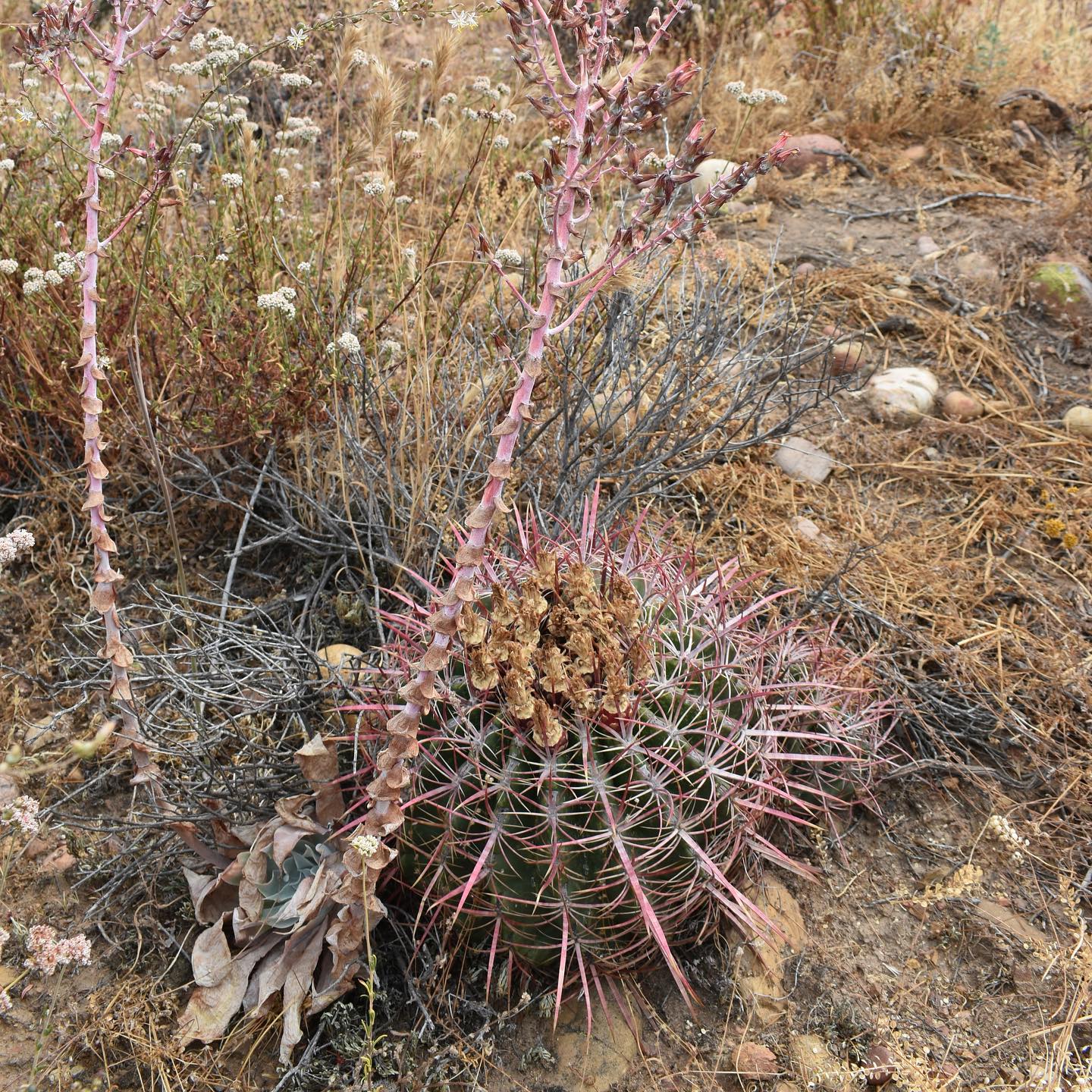
Ferocactus viridescens is the barrel cactus of the San Diego coast, a compact, depressed-globose species that grows in coastal sage scrub and maritime succulent scrub from Oceanside south through San Diego County and into northwestern Baja California, never more than a few kilometers from the Pacific. Rarely exceeding 30 cm in height, it carries 13 to 21 blunt, rounded ribs armed with red-banded spines that mature through yellow to dull gray. The specific epithet viridescens is Latin for “turning green,” describing the notably glossy green stem that distinguishes this species at a glance from the more blue-toned larger barrels of the Mojave and Sonoran deserts.
Thomas Nuttall collected the type specimens in 1836 at San Diego harbor while waiting for passage home to Boston aboard a Bryant and Sturgis ship. John Torrey and Asa Gray formally described the species in 1840 as Echinocactus viridescens; Britton and Rose transferred it to the new genus Ferocactus in 1922. Within the genus, F. viridescens is notable for its fidelity to a narrow fog-influenced coastal strip; the species declines northward as frost risk increases and inland as summer heat and frost push the limits of its tolerance.
The California picture is sharper than the rangewide threat assessment suggests. The state’s most extensive urban expansion has rolled through exactly this species’ habitat corridor over the last century. The California Native Plant Society ranks F. viridescens 2B.1: rare, threatened, or endangered in California, seriously threatened in-state, and more common elsewhere in its range. The “elsewhere” is the Baja California Norte coastline, where populations remain more extensive and less fragmented than the California side. Conservation data on the California segment is detailed and alarming; the Baja data is less granular. For collectors, Ferocactus cylindraceus is the species most commonly confused with F. viridescens in California collections, though the two could scarcely differ more in mature form.
Seed germination and early establishment are reliable for the genus. Plants begin producing their characteristic chartreuse to greenish-yellow flowers at roughly 12 to 14 cm diameter, meaning collectors do not face the decade-long wait that applies to Ferocactus glaucescens or the harder specialist genera. The Royal Horticultural Society has reportedly awarded this species its Award of Garden Merit, a recognition that reflects its compact habit and the reliability of its spring bloom in cultivation.
Ferocactus viridescens quick reference
A fog-belt coastal barrel from sandy and gravelly mineral soils in coastal sage scrub and maritime succulent scrub, San Diego County to northern Baja California. Values calibrated for seed grown plants in cultivation, drawn from habitat data and specialist grower experience.
Taxonomy & nomenclature
The accepted name is Ferocactus viridescens (Torr. & A.Gray) Britton & Rose, published in Cactaceae (Britton & Rose) 3: 140 on 12 October 1922. The basionym is Echinocactus viridescens Torr. & A.Gray (1840), published in Flora of North America 1: 554 and based on specimens collected by Thomas Nuttall during a three-week stay at San Diego harbor in 1836. F. viridescens is the accepted name under Kew POWO (IPNI lsid urn:lsid:ipni.org:names:103693-2) and the World Checklist of Vascular Plants.
POWO lists eleven synonyms. The most commonly encountered in horticultural literature are Echinocactus orcuttii Engelm. ex Orcutt (1886), based on San Diego plants described by Charles Russell Orcutt, and its Ferocactus combination Ferocactus orcuttii (Engelm. ex Orcutt) Britton & Rose. Two legacy infraspecific names persist in collector and nursery circles despite being sunk under POWO: var. orcuttii (G.Unger) and subsp. orcuttii (F.Wolf & R.Wolf, 2004, published in Ferokakt. Baja California: 218), applied to populations near Valle de las Palmas in Baja California Norte; and var. littoralis G.E.Linds. / subsp. littoralis (G.E.Linds.) F.Wolf & R.Wolf (2004), applied to a coastal Baja California population with a more golden spine hue, greater height, and higher rib and spine counts, ranging from north of Ensenada near Punta Salsipuedes south to Misión Santo Domingo. Wolf & Wolf’s 2004 monograph recognized three subspecies; POWO does not follow this treatment and currently sinks all infraspecific taxa as synonyms.
The specific epithet viridescens means “turning green” in Latin, referring to the notably glossy green stem, a departure from the more glaucous or gray-green tones of larger-bodied relatives. George Lindsay’s 1955 doctoral dissertation, published posthumously in 1996 by the Cactus and Succulent Society of America, provides the definitive pre-molecular taxonomy for the genus, recognizing F. viridescens as a distinct species restricted to San Diego County and coastal northern Baja California. Lindsay’s treatment is the taxonomic foundation on which all subsequent accounts build.
Historical synonym (1)
- Echinocactus viridescens Nutt., 1840 basionym
Sources: POWO (Kew) · IPNI · GBIF · Wikidata
Habitat
Ferocactus viridescens is a coastal fog-belt species. Its primary vegetation communities are coastal sage scrub and maritime succulent scrub, often with coast prickly pear (Opuntia littoralis), cliff spurge (Euphorbia misera), coastal agave (Agave shawii), California sagebrush (Artemisia californica), chalk dudleya (Dudleya pulverulenta), and various buckwheats (Eriogonum spp.). The CNPS Inventory also records occurrences in chaparral, valley and foothill grassland, coastal sage scrub-grassland ecotone, and occasionally at vernal pool edges, though coastal sage scrub accounts for the bulk of documented localities.
Topographically, plants favor hilltops, slope crests, and bluffs overlooking the ocean, often in positions with a direct view of the Pacific. Sea bluffs, marine terraces, arid hills, and dry sandy or rocky coastal slopes are all documented substrates. Native soil pH ranges from 5.2 to 7.6, indicating tolerance of both slightly acidic and mildly alkaline conditions. Soils are consistently sandy or gravelly and mineral-rich, with low organic content; the species is notably tolerant of coastal salts and mineral concentrations typical of marine terrace soils.
The climate is Mediterranean: dry summers, mild wet winters. Significant fog cover provides morning and evening moisture throughout the growing season, a factor that distinguishes this coastal niche from the inland desert habitats of Ferocactus hamatacanthus. The species is described as “vulnerable to freezing temperatures,” consistent with its adaptation to a coastal frost-free microclimate; plants are present both immediately at the coast and in warmer inland areas that may see occasional autumn or winter frosts. Elevation is typically sea level to 200 m; the CNPS database records a wider range (3 to 450 m) that likely reflects occasional outlier inland records rather than the species’ typical range.
Peer-reviewed field studies have documented a previously unrecognized ecological interaction that is now a conservation concern. Native ant species formed a food-for-protection mutualism with the cactus: ants tended by the native Crematogaster californica were associated with higher seed set, likely because territorial ants deterred flower visitors that rob nectar without pollinating. The invasive Argentine ant (Linepithema humile) has displaced 18 native ant species in invaded San Diego coastal sites, and its presence correlates with reduced pollinator visitation and seed set in F. viridescens populations. Primary pollinators are Diadasia cactus bees and honey bees (Apis mellifera).
Morphology
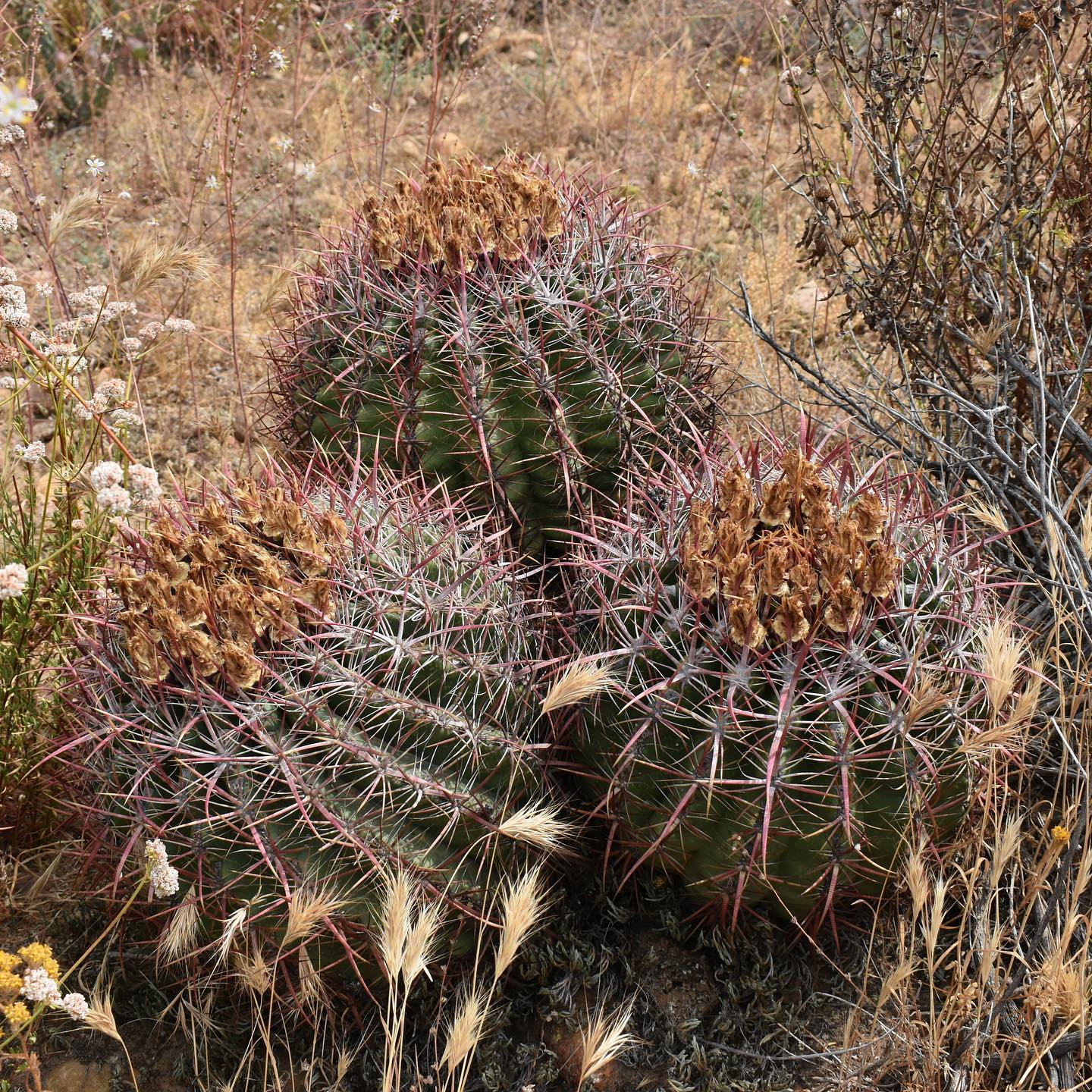
Ferocactus viridescens is solitary, never clustering. The body is depressed-globose (wider than tall) to short-cylindrical; plants maintain a neat globe and, critically, never elongate into the column that characterizes old specimens of F. cylindraceus. Typical dimensions are 10 to 30 cm tall and 10 to 20 cm in diameter, with exceptional specimens occasionally reaching 45 cm in height or 35 cm across. The stem color is pale to deep green, somewhat glossy, a character reflected in the Latin epithet. Plants frequently sit deep-seated in the surrounding substrate, a feature noted by the Flora of North America as diagnostically useful for the species.
Ribs number 13 to 21 on the type variety, rounded and obtuse in cross section, 1 to 2 cm tall, with a slightly undulate (wavy) surface. Some sources cite up to 25 or even 34 ribs; the higher figures likely reflect inclusion of var. littoralis plants from Baja California, which display notably higher rib and spine counts than the type variety. The rib edges are blunt, never sharp, a reliable character separating this species from the keeled ribs of some larger barrels. Areoles are narrow-elliptic to oval, 10 to 20 mm long, with brownish tomentum.
Each areole carries 10 to 19 spines total. The 4 central spines are flattened in cross-section and curved; the principal central spine (the lowermost) is the most distinctive, measuring 30 to 50 mm long and 2 to 3 mm broad. Multiple secondary sources print “30 to 50 cm” for this measurement, which is clearly a transcription error: a 30 to 50 cm spine on a 20 cm plant is physically impossible. The americansouthwest.net account independently confirms the correct dimension as “up to 2 inches (50 mm).” Young spines emerge deep red-pink and mature through yellow to dull gray, giving older plants a banded tricolor spine palette that is immediately recognizable. Radial spines number 10 to 20 per areole, similar in form to the centrals but shorter at 1 to 2 cm, and more slender. There are no hooked spines in this species, which at once distinguishes it from Ferocactus hamatacanthus, the Turk’s head cactus of the Chihuahuan Desert, with its diagnostic curved-hook principal central.
Flowers are apical, infundibuliform (funnel-shaped), 2.5 to 5 cm long and 3 to 6 cm in diameter. Perianth segments are greenish-yellow to chartreuse, sometimes tinged with pink, and may carry reddish-brown midstripes. The chartreuse tone is both distinctive and frequently cited as an identification character. Bloom season peaks in May and June; coastal populations sometimes begin flowering as early as March and may extend to July. Plants begin flowering at approximately 12 to 14 cm stem diameter. Fruit is barrel-shaped, bright yellow when ripe, fleshy with a pleasant acid flavor, 20 to 35 mm long and 15 to 25 mm wide. Seeds are elongate-obovoid, 1.6 to 1.8 mm long.
The Hidalgo-endemic Ferocactus glaucescens presents a marked contrast in nearly every morphological character: a markedly blue-green (glaucous) stem versus the glossy green of F. viridescens, 12 to 17 ribs with a different profile, and entirely yellow spines that are neither red-banded nor tricolored with age. Geography immediately separates the two; F. glaucescens occurs exclusively on limestone hills in central Mexico’s Hidalgo and Querétaro states and has no range overlap with coastal California.
Locality detail
Few Ferocactus species have a range as geographically restricted as Ferocactus viridescens. In the United States, it is found only in coastal San Diego County, California, with the northern limit near the San Luis Rey River at Oceanside and the southern limit at the US-Mexico border near Tijuana. The species declines northward with increasing frost risk and inland with summer heat extremes. Documented management areas with confirmed populations include the Tijuana River Valley, Mission Trails Regional Park, Otay Ranch Preserve, and the Torrey Pines area.
South of the border, the species is a common coastal plant from the US-Mexico border south to approximately San Quintín, Baja California Norte, marking the approximate southern limit of the California Floristic Province. Populations near Punta Banda and Ensenada are well-documented. The CNPS Inventory records 249 occurrence records in 20 quadrangles across San Diego County, of which 97 are considered recent (within 20 years), 152 historical. Of the 249 records, 237 are presumed extant, 11 are possibly extirpated, and 1 is confirmed extirpated.
The Leaflet map above uses regional centroids for both the California and Baja California populations. Specific locality coordinates are not published on this page, consistent with the CNPS-documented history of horticultural collection as a threat (6 percent of CNPS-tracked threat incidents). San Diego County populations are protected under the Multiple Species Conservation Program (MSCP); impacts on populations require CEQA review and mitigation.
Ferocactus viridescens care and cultivation
Ferocactus viridescens is among the most tractable species in the genus. It is widely available from California native plant nurseries, CNPS seed sales, and specialist cactus growers; seed is commercially available and germinates reliably. Unlike many rare cacti on this site, grafting is not a standard practice for this species; seed grown plants grow at a reasonable rate and produce flowers at relatively modest size. Overwatering is the primary cultivation failure mode.
Substrate
Wild plants grow in sandy and gravelly mineral-rich coastal soils on rocky bluffs, marine terraces, and arid hillsides from San Diego County through Baja California Norte. Native soil pH runs 5.2 to 7.6 across both acidic granite-derived sands and near-neutral loam. That range is a habitat figure, not a pot-mix target, and no source establishes the species as needing a strongly acidic or an alkaline mix. The canonical ratio is 40 per cent pumice, 15 per cent lava rock, 5 per cent zeolite, 30 per cent granite grit, no limestone chip, and 10 per cent worm castings. The higher granite fraction is house convention, not a copy of the dominant granitic and decomposed-granite coastal geology; the lava is the structural drainage aggregate; the zeolite handles cation exchange and moisture buffering through the fog-zone growing season. No peat, standard potting soil, or high-organic medium is appropriate.
All four Ferocactus species on this site share the genus 90/10 mineral-organic baseline, and the limestone share in every row is house convention rather than a species requirement. Granite weight shifts between species; the glaucescens and hamatacanthus rows match each other closely.
| Species | Pumice | Lava | Zeolite | Granite | Limestone | Silica | Organic |
|---|---|---|---|---|---|---|---|
| F. viridescens (this page) | 40% | 15% | 5% | 30% | 0% | 0% | 10% |
| F. cylindraceus | 40% | 15% | 5% | 30% | 5% | 0% | 5% |
| F. glaucescens | 35% | 15% | 5% | 25% | 15% | 0% | 5% |
| F. hamatacanthus | 35% | 15% | 5% | 25% | 15% | 0% | 5% |
Container choice can follow the grower’s climate. In coastal California where summers are mild and fog-moderated, glazed or ceramic containers that dry more slowly are suitable. In humid temperate climates under glass, unglazed terracotta or a fast-draining mix reduces rot risk. The root system is not strongly taprooted, so standard-depth containers are adequate; the species does not need the deep narrow pots appropriate for geophytic or strongly taprooted genera.
Watering and light
The Mediterranean coastal climate dictates a winter-wet, summer-dry pattern in the wild, modulated by fog moisture year-round. In cultivation, the practical schedule for most temperate-climate growers runs inverted: water during the warmer months (spring through early summer) when plants are actively growing, and reduce through autumn to near-zero supplemental water in winter (roughly November through February). Once established outdoors, watering no more than once monthly is appropriate; in containers under glass, more frequent watering in warm weather is appropriate provided the substrate dries completely between applications. The single consistent rule across all sources is to let the substrate dry completely before the next watering event.
Light requirements are full sun; plants in habitat favor exposed hilltops and coastal bluff positions. In hot-summer inland cultivation (eastern San Diego County, Inland Empire, Phoenix-area gardens), some afternoon shade can reduce desiccation stress in July and August. Under glass in temperate climates, provide the maximum available light. Low-light cultivation produces etiolated growth and suppresses flowering.
Cold tolerance
The species is native to a coastal frost-free microclimate and has not evolved significant frost tolerance. The practical safe minimum for cultivation is 5°C (41°F), the figure most consistently cited by cactus society sources. Field observations indicate plants can tolerate brief exposure to 30°F (-1°C) when completely dry. A figure of -5°C appears in one horticultural source but is not supported by any other account and is not used here for widget calibration. The fundamental risk is not low temperature alone but the combination of cold and moisture: plants wet at or below freezing will rot. Winter dormancy should be dry.
Propagation
Seed propagation is the standard approach. Seeds from CNPS chapter seed sales, TradeWinds Fruit, Mesa Garden, and specialist cactus nurseries are commercially available. Germination conditions are warm (24 to 29°C / 75 to 85°F), moist substrate, with germination occurring in 1 to 4 weeks. Ferocactus as a genus is noted as very easy from seed, with attractive early spine development and reasonable growth rates. From seed to first bloom is estimated at 8 to 15 years under good conditions, based on the documented bloom threshold of 12 to 14 cm diameter combined with typical growth rates in the genus; no viridescens-specific measured figure has been published.
Comparison
The most practically important identification comparison for Ferocactus viridescens is with F. cylindraceus, the compass barrel or California barrel, which overlaps in the California collector market even though the two species occupy almost completely different habitats. Taxonomic distinctions between the two can be unclear for large viridescens plants that lack geographic data. The fastest check is maximum size and form: a barrel cactus over approximately 50 cm tall is almost certainly F. cylindraceus, not F. viridescens. The two species are covered in detail in the FAQ distinguishing table below.
Geography settles most ambiguous cases. A plant collected or purchased from the San Diego coastal zone is viridescens; a plant from the Mojave, Anza-Borrego interior, or Arizona is cylindraceus. At bloom time, flower color is diagnostic without ambiguity: chartreuse to greenish-yellow petals indicate viridescens; bicolored maroon exterior with bright yellow interior indicates cylindraceus. A collector who purchases an unlabeled globose barrel with red spines and chartreuse flowers from a San Diego coastal nursery has almost certainly acquired viridescens.
Two other congeners occasionally appear in the same collections and cause less confusion because they look so different. Ferocactus glaucescens, the Mexican blue barrel, has a markedly blue-green (glaucous) stem, 12 to 17 ribs, and entirely yellow spines without any red banding; the geographic and visual contrast with viridescens is substantial. Ferocactus hamatacanthus, the Turk’s head barrel of the Chihuahuan Desert, is immediately separated by its strongly hooked principal central spine, large yellow flowers with scarlet centers, and 13 to 17 loosely tubercled ribs. Neither species overlaps F. viridescens in geography or in the characters that matter for field identification.
Frequently asked questions
How do you tell Ferocactus viridescens apart from Ferocactus cylindraceus?
Ferocactus cylindraceus is the barrel cactus most commonly encountered in California collections and the one a San Diego coastal collector is most likely to confuse with F. viridescens on an unlabeled plant. Taxonomic distinctions between the two are unclear for some large viridescens plants that lack geographic provenance. Drag the slider to compare their habits, then use the character table to resolve any remaining uncertainty.


Body size and form is the fastest check: a barrel cactus more than roughly 50 cm tall is almost certainly F. cylindraceus. At bloom time, flower color removes all ambiguity: chartreuse is viridescens; bicolored maroon-and-yellow is cylindraceus. When geographic provenance is known, it settles the question before any other character needs to be examined.
Is the San Diego barrel cactus endangered?
The IUCN classifies Ferocactus viridescens as Least Concern globally (2017 assessment), reflecting the comparatively large and less fragmented Baja California Norte populations that anchor the global range. The California picture is different. The California Native Plant Society ranks the species 2B.1: rare, threatened, or endangered in California and seriously threatened in-state. The CNPS database records 11 possibly extirpated localities and 1 confirmed extirpated locality out of 249 California occurrence records. Development and urbanization account for 42 percent of tracked threat incidents in CNPS data. The IUCN’s Least Concern designation and the CNPS 2B.1 rank are not contradictory; they assess different geographic scales. For collectors, the California half of the range is in genuine decline.
How long does Ferocactus viridescens take to flower from seed?
Llifle documents that plants begin flowering at approximately 12 to 14 cm stem diameter. Combined with typical Ferocactus genus growth rates, that diameter threshold suggests a timeline of 8 to 15 years from seed under good cultivation conditions. No F. viridescens-specific confirmed figure exists in the published literature; the estimate is an inference from the documented bloom-size threshold and genus-level data. Grafted plants flower substantially faster, but grafting is not standard practice for this species.
Can I legally collect or purchase Ferocactus viridescens?
Collecting from the wild in California is prohibited under California Penal Code Section 384a, which bans taking listed native plants from land not owned by the collector without written landowner permission. Populations on public and managed land are further protected under the San Diego MSCP, which triggers CEQA review for any project impacting the species. F. viridescens is not listed under the US Endangered Species Act or the California Endangered Species Act, so no federal or state ESA permit is required for possession of legally acquired plants. All Ferocactus are covered under CITES Appendix II; international movement requires permits. Nursery-propagated plants are commercially available from CNPS chapter seed sales, Theodore Payne Foundation, Mesa Garden, TradeWinds Fruit, and specialist California native plant nurseries; purchase from these sources with documented captive-propagation origin is fully legal.
Where does the San Diego barrel cactus grow in the wild?
Ferocactus viridescens grows in coastal sage scrub and maritime succulent scrub along a narrow fog-influenced strip from the San Luis Rey River near Oceanside, California, south through San Diego County to the US-Mexico border, and continues down the Baja California Norte coast to approximately San Quintín. Elevation is typically sea level to 200 m. Plants favor exposed hilltops, coastal bluffs, marine terraces, and sandy or rocky arid slopes, often in positions overlooking the ocean. The fog-moderated Mediterranean climate is a defining factor; the species does not occur in the hot desert interior that characterizes the range of most other Ferocactus species.
What pollinates the San Diego barrel cactus, and why are Argentine ants a problem?
Diadasia cactus bees are the primary native pollinators, with honey bees (Apis mellifera) also visiting. A peer-reviewed field study published in Oecologia (2013; DOI: 10.1007/s00442-013-2739-z) documented a native mutualism: native ant species, particularly Crematogaster californica, tended the cactus and their territorial behavior was associated with higher seed set, likely because they deterred nectar robbers. The invasive Argentine ant (Linepithema humile) has displaced 18 native ant species in invaded San Diego coastal sites. Argentine ant invasion correlates with reduced pollinator visitation and lower seed set in F. viridescens populations at those sites, threatening long-term recruitment. This ant-mediated disruption is now recognized as a conservation threat operating alongside the better-publicized development pressure.
Sources & further reading
Torrey, J. & Gray, A. (1840). Echinocactus viridescens. Flora of North America 1: 554 · Britton, N.L. & Rose, J.N. (1922). Cactaceae 3: 140. Transfer to Ferocactus; basionym Torr. & A.Gray 1840 · Lindsay, G.E. (1955/1996). The Taxonomy and Ecology of the Genus Ferocactus: Explorations in the USA and Mexico. Cactus and Succulent Society of America, 1996 (posthumous) · Wolf, F. & Wolf, R. (2004). Ferokakt. Baja California: 218. Three-subspecies treatment (orcuttii, littoralis, nominate); not followed by POWO · Kew POWO, Ferocactus viridescens (Torr. & A.Gray) Britton & Rose, IPNI lsid urn:lsid:ipni.org:names:103693-2 · California Native Plant Society (CNPS) Rare Plant Inventory, Ferocactus viridescens entry #812. rareplants.cnps.org · IUCN Red List of Threatened Species, Ferocactus viridescens assessment, 2017 (Least Concern; narrative via secondary citations) · llifle.com Encyclopedia of Living Forms, Ferocactus viridescens entry ID 13617 · San Diego Management and Monitoring Program (SDMMP), Ferocactus viridescens species page. sdmmp.com · Calscape (CNPS), Ferocactus viridescens species page. calscape.org · americansouthwest.net, Ferocactus viridescens, San Diego barrel cactus · Calflora, Ferocactus viridescens taxon page, crn=3575. calflora.org · Lady Bird Johnson Wildflower Center, USDA Plants Database, Ferocactus viridescens. wildflower.org · Oecologia (Springer), Argentine ant mutualism field study at San Diego sites, 2013. DOI: 10.1007/s00442-013-2739-z