Echinopsis chiloensis
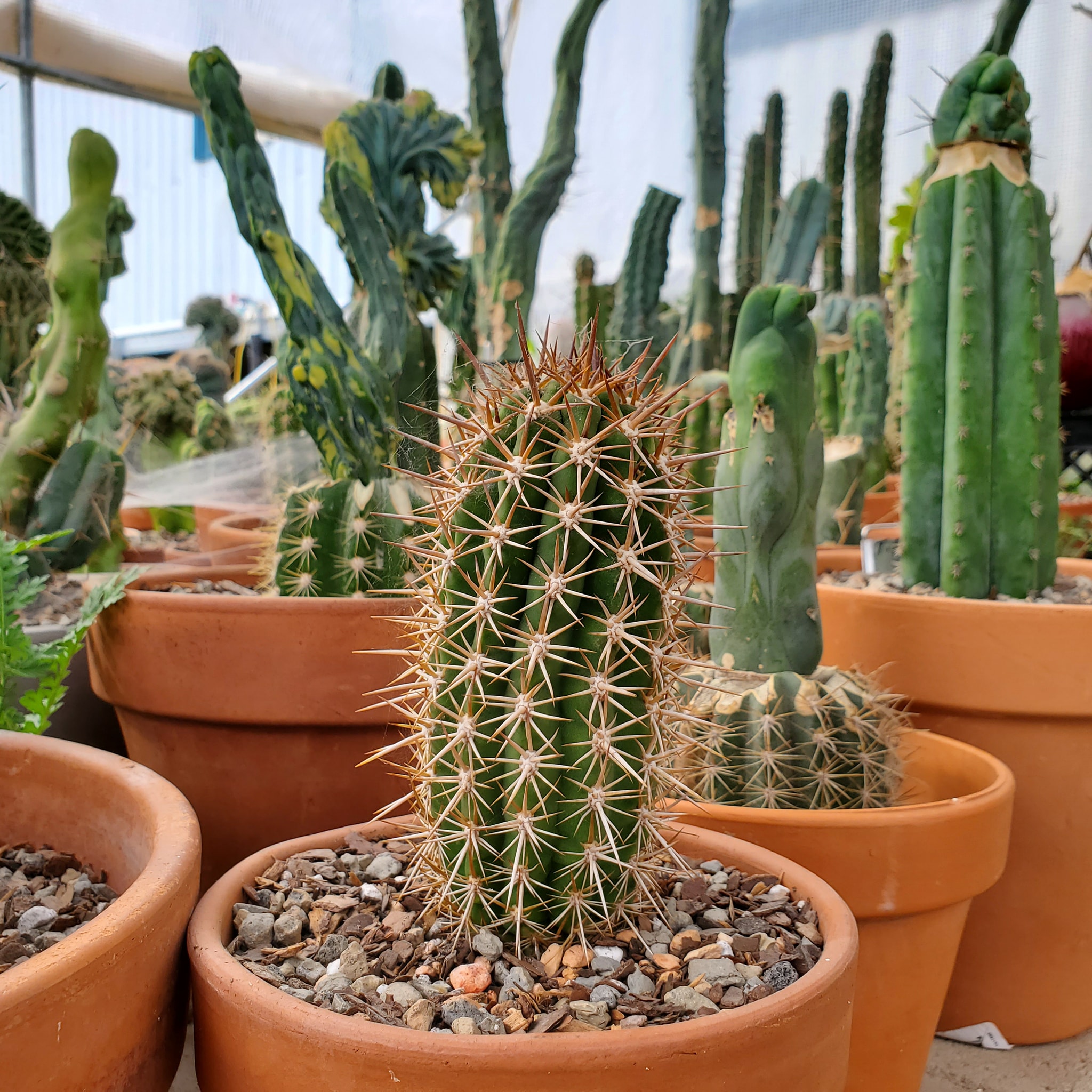
Echinopsis chiloensis is the quisco of central Chile, a candelabra-forming columnar cactus of the Mediterranean sclerophyll shrublands between the Coquimbo and Maule Regions. It is the only species in the rarecactus.com Echinopsis set native to a winter-rain Mediterranean climate; all five sibling species are Andean summer-rain plants from Peru, Bolivia, or Ecuador. This single ecological fact determines the cultivation approach and separates the quisco from the rest of the genus more cleanly than any morphological character.
The species was first described in 1826 by Luigi Colla from Chilean material of uncertain provenance collected by a Chilean correspondent. Colla assigned the epithet chiloensis, meaning “of Chiloé,” the island archipelago off southern Chile, a misnomer: the plant does not grow on Chiloé. Carl Skottsberg argued in 1950 that the correct form should be chilensis, but the rules of botanical nomenclature give priority to the original spelling, and chiloensis stands in all valid combinations. The trade still uses the name Trichocereus chiloensis (Britton & Rose 1920) or the Friedrich & Rowley 1974 transfer Echinopsis chiloensis, both of which predate the current POWO treatment by Schlumpberger (2012).
In central Chile the quisco is a landscape plant of the north-facing matorral slopes around Santiago, as common along the Andean foothills as it is on the coastal range. The species is most often confused in the trade with E. peruviana, the Peruvian torch of highland Peru, because both are tall, white-flowered columnar Echinopsis still sold under the Trichocereus name. Rib count (10–17 for chiloensis versus 6–9 for peruviana) and skin colour (plain green versus frosted blue-glaucous) separate them at a glance on mature plants. The near-spineless San Pedro E. pachanoi is distinct by its 6–8 ribs and almost spineless areoles from the juvenile stage.
The candelabra branching habit distinguishes the quisco from most other columnar Echinopsis: branches arise near the mid-trunk rather than from the base, producing the classic candelabra silhouette at maturity. The E. lageniformis Bolivian torch and the long-spined E. cuzcoensis both branch primarily from the base; neither branches from the mid-trunk. The coastal ecotype informally known as subsp. litoralis is shrubby rather than candelabra-forming, a habit interpreted as adaptation to coastal storm winds.
Echinopsis chiloensis quick reference
A Chilean Mediterranean-climate columnar cactus of the central matorral zone, native to winter-rain shrubland from the Coquimbo to Maule Regions at 0–2,000 m. Values calibrated for seed grown plants in cultivation, drawn from habitat data and specialist grower sources including chileflora.com, trichocereus.net, and llifle.
Taxonomy & nomenclature
POWO currently accepts Leucostele chiloensis (Colla) Schlumpb. as the valid name for this species. The combination was published by Boris Oliver Schlumpberger in Cactaceae Systematics Initiatives 28: 29 (October 2012), based on the phylogenetic demonstration by Schlumpberger & Renner (American Journal of Botany 99(8): 1335–1349, 2012) that Echinopsis sensu lato is polyphyletic at every level, and that the Chilean columnar group forms a distinct clade (Leucostele Backeb.) sister to all genera of subtribe Trichocereinae. IPNI records the combination at ID 77122512-1. This page uses the collector-trade name Echinopsis chiloensis as its working name because the rarecactus.com Echinopsis genus framing, the page slug, and virtually all nursery and society-journal references still apply that combination; an alternative taxonomy following Govaerts (2001) also accepts Echinopsis chiloensis as the standard name.
The basionym is Cactus chiloensis Colla, published in Hortus Ripulensis Appendix 2: 342 (1826). Luigi Colla described the plant from material of uncertain provenance likely received from a Chilean correspondent. The epithet chiloensis means “of Chiloé,” the island archipelago off southern Chile, and is a misnomer: the species does not occur on Chiloé. Carl Skottsberg identified the error in 1950 and argued the correct form should be chilensis; however, the rules of botanical nomenclature require an author’s original spelling to be retained when no orthographic error by the author is demonstrable, so chiloensis stands in all valid combinations. The transfer through subsequent genus concepts runs: Cereus chiloensis (Colla) DC. (1828); Echinocereus chiloensis (Colla) Console & Lem. (1864); Trichocereus chiloensis (Colla) Britton & Rose (1920); Echinopsis chiloensis (Colla) H.Friedrich & G.D.Rowley (1974). A neotype was designated by Hunt & Taylor (2006, New Cactus Lexicon) as Werdermann 478, collected at Río San Francisco, Santiago Province, in December 1924, held at Kew.
Further synonyms encountered in the literature include Cereus quisco Web. ex K.Schum., Cereus chilensis Salm-Dyck, Trichocereus skottsbergii Backeb., Trichocereus bolligerianus F.Ritter, Trichocereus nigripilus Backeb., Echinopsis litoralis (Johow) H.Friedrich & G.D.Rowley, and Trichocereus litoralis (Johow) Looser. The name “quisco” persists as a common name in Chile; the variety epithet quisco is synonymized and no longer carries taxonomic standing.
POWO currently accepts five subspecies of Leucostele chiloensis: the nominate subsp. chiloensis (central-range columnar type), subsp. australis (F.Ritter) Schlumpb. (southern populations), subsp. borealis (F.Ritter) Lodé (Coquimbo northern populations), subsp. eburneus (K.Schum.) Schlumpb. (ivory-spined form), and subsp. panhoplites (K.Schum.) Schlumpb. (heavily armed form). A sixth entity, the coastal ecotype widely recognized in grower literature (llifle, trichocereus.net) as subsp. litoralis (Johow) G.D.Rowley, is not currently accepted at subspecific rank in POWO, which synonymizes it to the nominate subspecies. The trichocereus.net account notes that “so many intermediate forms exist between T. chiloensis and T. litoralis that it is extremely difficult to draw the line,” accurately framing the taxonomic difficulty as biological rather than purely nomenclatural. Growers working with coastal Chilean material should treat the litoralis ecotype as meaningfully distinct in habit and habitat even in the absence of formal subspecific acceptance at POWO.
Habitat
E. chiloensis occupies the Chilean matorral, the sclerophyllous shrubland of central Chile’s Mediterranean climate zone. The range runs from the Valle del Elqui in the Coquimbo Region (~30°S) south to the Talca area of the Maule Region (~35–36°S), spanning approximately 600 km of latitude. Within that band the species grows on north-facing (equatorial-facing) slopes of the coastal cordillera and Andean foothills from near sea level to approximately 2,000 m, with Murua et al. (2010) study populations spanning 150–1,800 m across both Mediterranean and xeric bioclimates.
The climate is winter-rain Mediterranean. Annual rainfall across the range varies from 300–800 mm, falling predominantly in the austral winter (May–September). Summers in the core range are hot and dry: chileflora.com documents a 3–5 month drought for wetter north-facing sites and a 6–10 month drought for more arid exposures. Mean annual temperatures at the mid-elevation sites where the species is most common are broadly 12–18°C, with frost episodes documented down to −8°C at higher elevations (chileflora.com). This winter-rain pattern makes chiloensis unique within the rarecactus.com Echinopsis set: every sibling species evolved under an Andean summer-rain regime at high elevation.
The substrate is mineral-dominant, derived from granitic and metamorphic parent rock of the Chilean coastal range. The La Campana National Park geology, where a protected population occurs, is granitic. No calcareous or limestone substrate has been documented for the species, contrasting with many Mexican columnar cacti on this site; the central Chilean matorral sits on predominantly acidic-to-neutral granitic soils.
Associated vegetation is characteristic of the Chilean matorral. Dominant sclerophyll trees include Quillaja saponaria (quillay soapbark) and Lithraea caustica (litre). In valley espinal habitats the co-dominant shrub is Acacia caven (espino). Terrestrial bromeliads Puya chilensis and Puya berteroniana grow in the same communities. Other Chilean columnar cacti, Eulychnia acida and Eulychnia breviflora, co-occur on matorral slopes across much of the range, and at the arid northern margins the composition shifts toward Copiapoa spp. and Eriosyce spp. The parasitic plant Tristerix aphyllus has been specifically documented using Leucostele chiloensis stems as host. Eulychnia acida is known locally as copao, a name often misapplied to the quisco; the two columnar species share matorral sites but belong to entirely separate genera.
Ethnobotanical uses of the quisco documented in central Chile include production of the palo de agua (rain stick): dried woody skeletons of the columnar stems are filled with the plant’s own dried spines and sealed to produce a water-sound percussion instrument. The green globular fruit, locally called guillay or guillave, is eaten fresh and described by Chilean informants as excellent in flavor (especieschilenas.blogspot.com). The plant has also served as a living fence and boundary marker in rural central Chile. These uses are documented without any connection to psychoactive or ritual practice; no huachuma or curanderismo tradition involving this species is recorded in any source reviewed.
Morphology
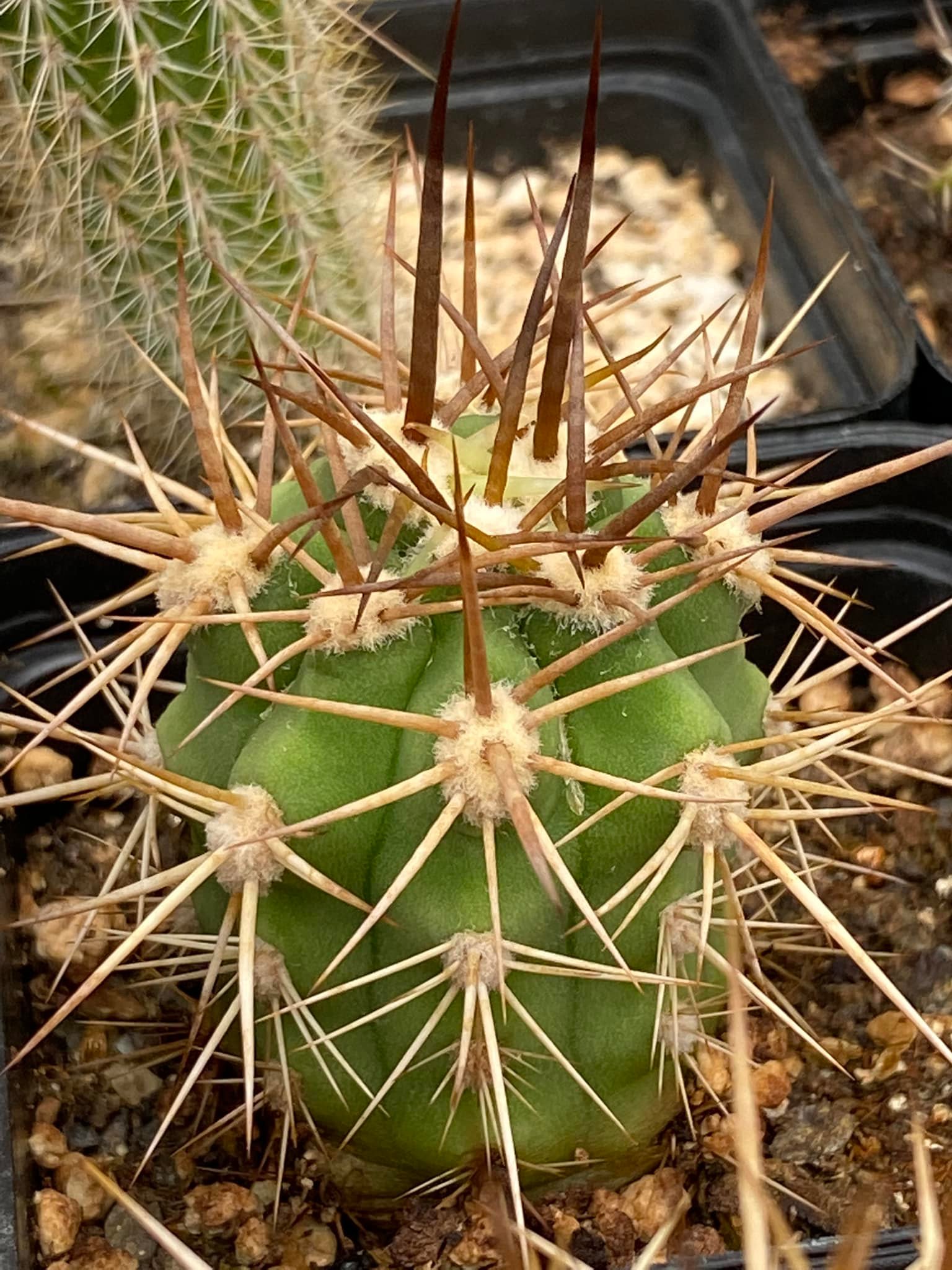
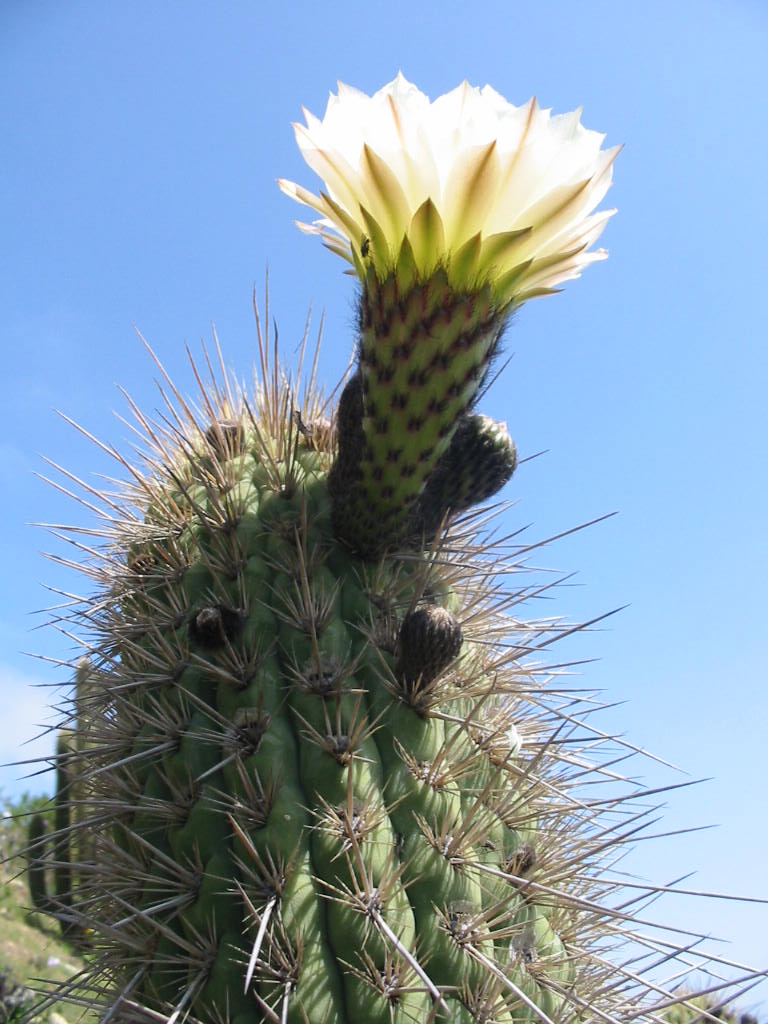
E. chiloensis is a robust columnar tree cactus reaching 6–8 m in height (llifle; chileflora.com; Murua et al. 2010 study populations 3–6 m). The growth form is initially single-stemmed and columnar; with age the plant develops candelabra branching from the mid-trunk, with branches arising near right angles to the main stem before turning erect. This mid-trunk candelabra habit distinguishes type chiloensis from basal-branching Andean species such as E. pachanoi and E. peruviana. Stem diameter runs 10–15 cm (llifle: 10–12 cm; trichocereus.net: to 15 cm). Skin is green to grey-green with no pronounced glaucous bloom; this plain green epidermis is one of the clearest visual separators from E. peruviana, which retains a frosted blue-glaucous colour at maturity.
Ribs number 10–17 in typical type-subspecies material (llifle: “10 to 17 low and broad”; confirmed across multiple sources). This rib count is significantly higher than any other Echinopsis in the rarecactus.com set: pachanoi carries 6–8 ribs, peruviana 6–9, lageniformis 4–10, cuzcoensis 7–9, and scopulicola 6–8. Ribs are broad and low, “separated by narrow intervals, divided into large tubercles even when fully mature” (llifle). Areoles are large, whitish when young, spaced approximately 2 cm apart.
Spines are yellow to honey-brown when young, turning grey with age, straight and firm; not hooked or pectinate. Radial spines number 8–12 per areole, 1–4 cm long. Central spines number 1–4 (typically 2–4 per llifle and trichocereus.net), 5–7 cm long in typical specimens, rarely reaching 25 cm in exceptional individuals. The coastal subsp. litoralis ecotype carries more numerous (9–28) and shorter radial spines and 3–6 shorter, thinner centrals, interpreted as adaptation to coastal wind exposure.
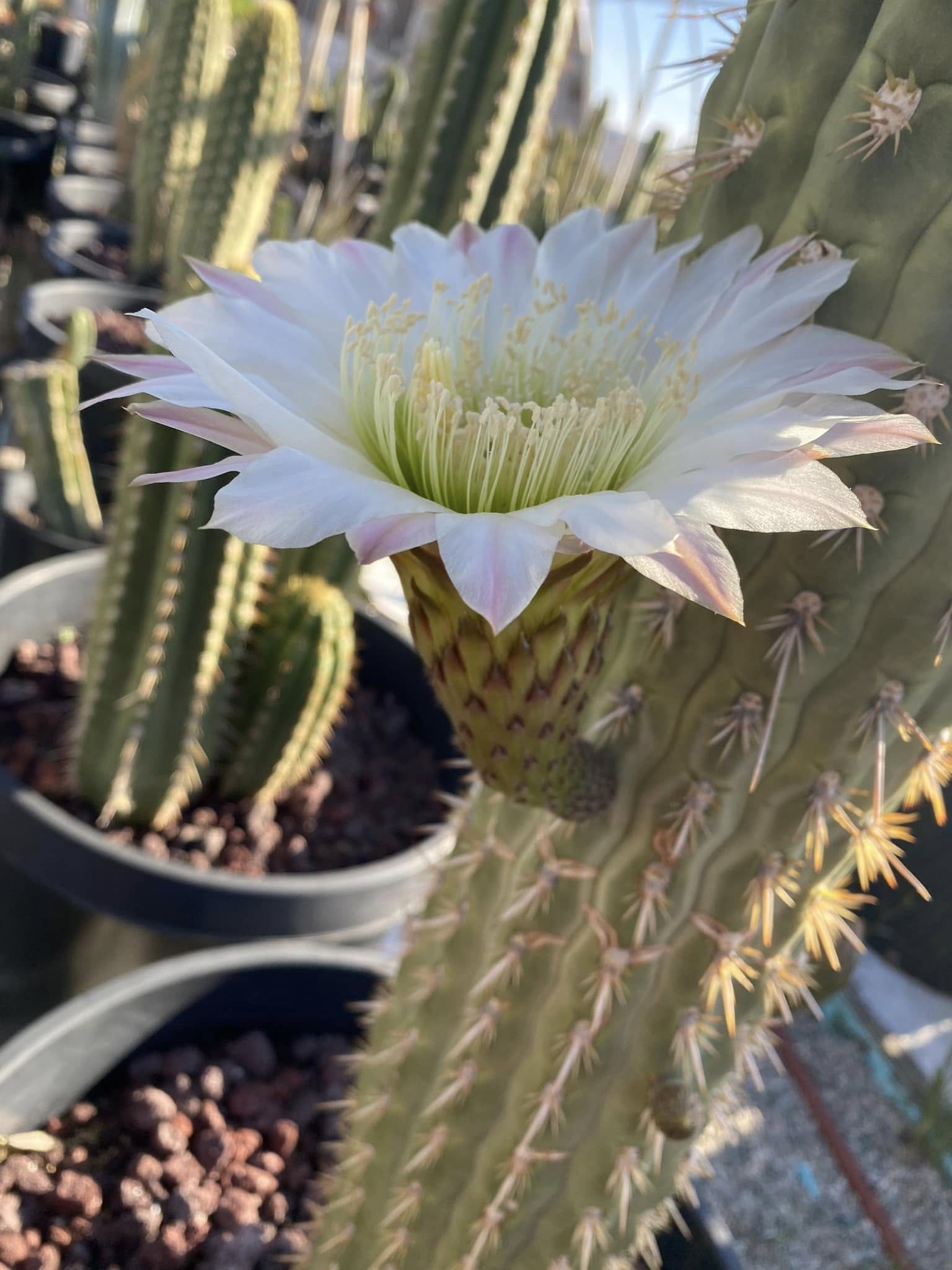
Flowers are terminal to subterminal, primarily nocturnal but with extended anthesis of 17–42 hours (Murua et al. 2010), remaining accessible to diurnal visitors. Flowers measure 14–16(–20) cm long, white with outer segments sometimes tinged red-brown; style cream to green with approximately 18 cream stigma lobes. Murua et al. (2010) documented a mixed pollination syndrome: sphingid moths are the most efficient nocturnal pollinators, but hummingbirds and diurnal insects also contribute to fruit set. Flowering season in central Chile runs November to mid-January; some northern populations at 30°S begin up to six weeks earlier (Murua et al. 2010). Fruit is globular, green at maturity, edible, known locally as guillay or guillave; ripening October–November in the southern hemisphere.
Locality detail
The native range is restricted to central Chile: no populations outside Chile have been confirmed by any source reviewed. The species occupies five administrative regions from north to south: Coquimbo (IV) in the north, Valparaiso (V), Metropolitana (RM), O’Higgins (VI), and Maule (VII) in the south, with the Talca province marking the approximate southern limit documented by Murua et al. (2010) field populations.
Two ecologically distinct population types occur within this range. Coastal populations (the litoralis ecotype) grow on marine bluffs and coastal cliffs from near sea level to 300 m, from north of Valparaíso into the Coquimbo and Atacama Regions. Inland and Andean-foothill populations (the nominate type chiloensis) grow on north-facing slopes of the coastal cordillera and at the margins of the central valley at 500–2,000 m. Both ecotypes occur in the Valparaiso Region, where intermediate forms between them are common (trichocereus.net). The neotype (Werdermann 478, Río San Francisco, Santiago) anchors the type to the inland Metropolitan Region population.
La Campana National Park in the Valparaiso Region (a UNESCO World Biosphere Reserve covering roughly 8,000 ha of Chilean matorral on granitic coastal range geology) provides protected habitat for a representative population and functions as the reference locality for the species’ association with the sclerophyll woodland community. Markers on the map sit at regional centroids; the species is common enough around Santiago that specific locality coordinates are widely available, but the convention across this encyclopedia is to use centroids consistently.
Cultivation
E. chiloensis is the easiest introduction to Chilean columnar cacti for Mediterranean-climate gardeners. Its native biome matches California, the Mediterranean basin, and analogous climates more closely than any other species in this encyclopedia: winter rainfall, summer drought, full sun on exposed slopes. The specialist cultivation note from tropical.britain.co.uk states directly that “as a Mediterranean climate cactus, it should be fine with cold winter rains” when drainage is adequate. In cold-winter continental climates the dry winter rest is still safest.
Substrate
Fertile and fast-draining. The native matorral soils are mineral-dominant shallow granitic or metamorphic-derived substrates, not the extreme desert substrates of the Atacama-origin genera. An appropriate cultivation mix is 40–50% pumice or granite grit for drainage structure, 30–40% low-organic mineral cactus base, and 10–20% decomposed granite or lava rock. A small organic fraction of 5–10% is acceptable and may benefit growth given the more fertile native soil character; this is a practical departure from the near-zero-organic approach appropriate for Atacama cacti. No limestone addition is warranted: the central Chilean matorral geology is granitic and non-calcareous.
Watering and light
Water generously spring through late summer. The species can accept more regular moisture than Andean desert-origin Echinopsis; llifle notes it “grows better with more water than most cacti.” Allow the substrate to dry between waterings in the growing season, but do not apply the extreme drought rest used for Copiapoa or other Atacama genera. In Mediterranean outdoor cultivation, winter rainfall is tolerated without rot risk provided substrate drainage is sharp and temperatures stay above approximately −5°C. In cold-winter zones, reduce to near-dry October through March; moisture at the root neck in cold conditions remains the primary kill vector (llifle: “keep dry during cold periods to prevent black rot”).
Full sun is the native light regime. Chileflora.com describes the habitat as “fully exposed to the sun” on north-facing slopes; no shade adaptation is documented. In the first summer season outdoors, gradual acclimation protects unacclimated plants from epidermal scorch.
Propagation
Seeds germinate within 2–6 weeks at 25–30°C and remain viable for 5–10 years (trichocereus.net). From germination to first flower takes 6–10 years under good conditions. Cuttings propagate readily: a fresh section calluses and roots within a few weeks, producing a genetic clone of the parent. Seed grown plants from documented Chilean provenance represent the full genetic diversity of the species and are the preferred route for collector-quality material.
Comparison
The most commonly confused sibling is E. peruviana, the Peruvian torch. Both are tall, white-flowered Echinopsis-group columnars still sold under the Trichocereus name in most nursery and specialist trade. Rib count is the single fastest separator at any growth stage: chiloensis at 10–17 ribs is distinctly more ribbed than peruviana at 6–9. Skin colour on mature plants reinforces this: chiloensis is plain green to grey-green with no persistent glaucous bloom, while peruviana retains a frosted blue-glaucous colour at maturity. Climate origin is the most useful character for cultivation decisions: chiloensis is a Mediterranean winter-rain plant; peruviana is an Andean summer-rain plant from approximately 2,800 m.
E. pachanoi (San Pedro) is distinguished by its 6–8 ribs and near-spineless areoles. Even juvenile chiloensis plants carry well-developed yellow radial spines from early on; pachanoi in the trade is often completely without spines at juvenile stage. The skin colour overlap (pale green on both) does not help on juvenile material, but spine density eliminates the confusion reliably. E. cuzcoensis of the Urubamba drainage carries longer, darker spines and a more pronounced knobbed spine base, combined with the lower 7–9 rib count; it is not regularly encountered alongside Chilean material in the trade.
The coastal litoralis ecotype is occasionally available from specialist sources under that name and raises its own identification question. Shrubby habit (1–2 m rather than 6–8 m), more numerous and flexible radial spines (9–28 versus 8–12), and a higher rib count (15–22 in litoralis versus 10–17 for the type) distinguish it from the inland nominate form. The trichocereus.net account is explicit that intermediate forms make the boundary difficult to draw, and material labeled litoralis in trade should be treated as a phenotypic continuum with the nominate rather than as a sharply distinct taxon.
Frequently asked questions
How do you tell Echinopsis chiloensis apart from Echinopsis peruviana?
Both species are tall, white-flowered Echinopsis-group columnars widely sold under the Trichocereus name and frequently cross-labelled in nursery and specialist trade. Drag the slider to compare mature stems side by side, then read down the character table. Rib count is the fastest separator at any growth stage; skin colour is reliable only on plants past the juvenile stage.
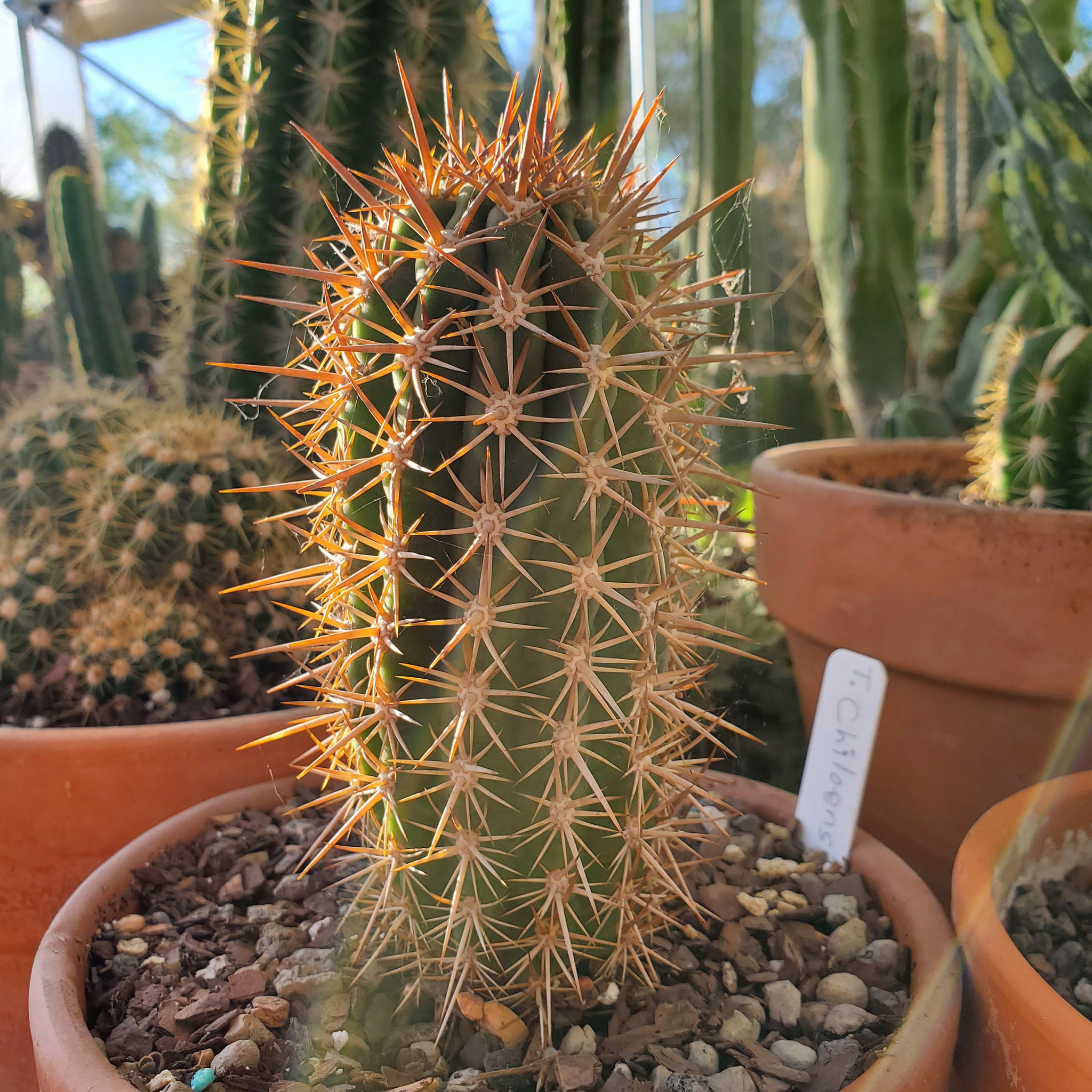
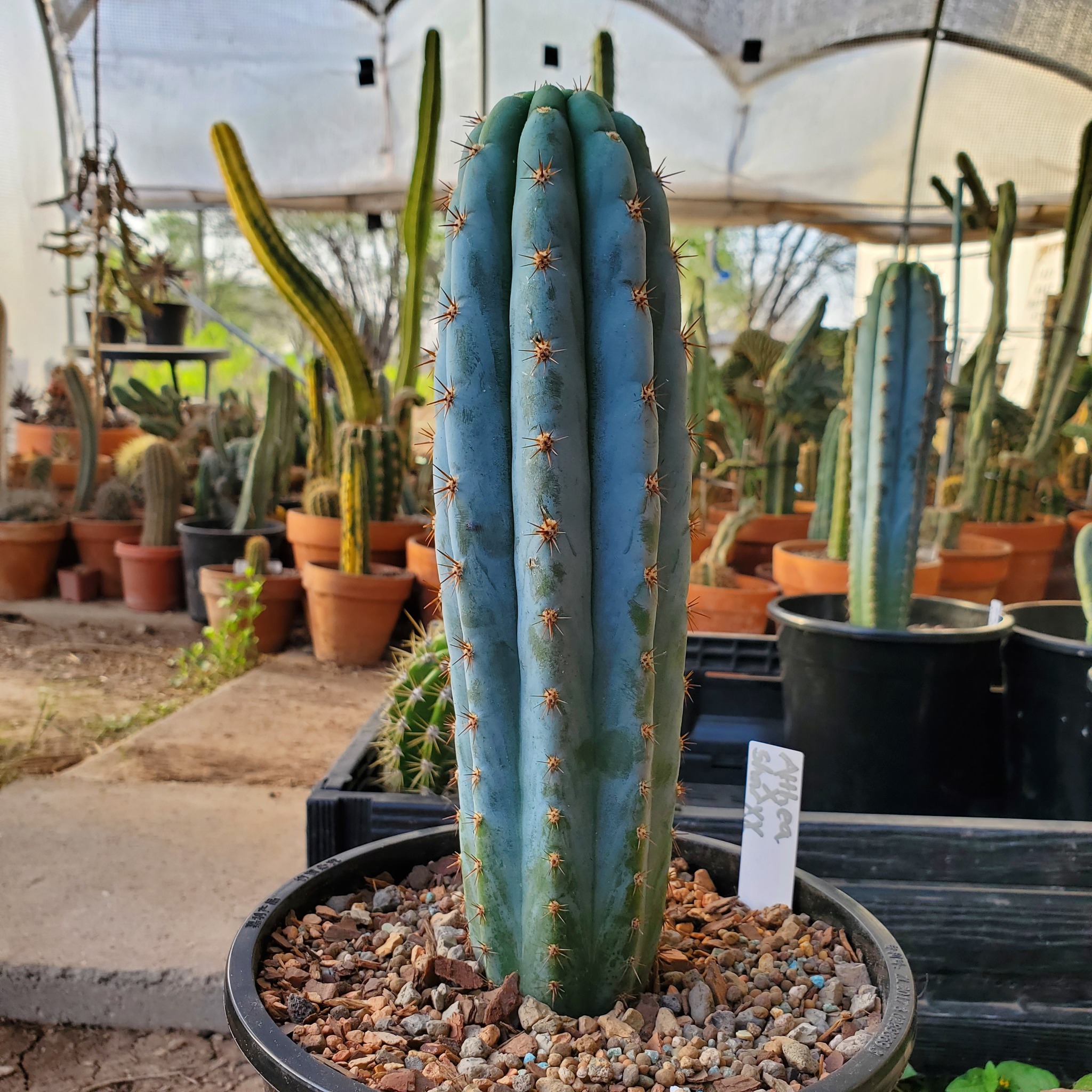
Rib count plus skin colour is the most reliable combination at any size. E. peruviana never shows more than 9 ribs; E. chiloensis almost never shows fewer than 10. Climate origin is the most critical character for cultivation decisions: chiloensis is the only winter-rain Mediterranean species in the genus, and growing it on a summer-rain Andean watering schedule produces no practical problem, but Mediterranean-climate gardeners can let it experience winter rainfall that would threaten peruviana.
Is quisco (Echinopsis chiloensis) hard to grow?
Not for Mediterranean-climate gardeners. The quisco is native to central Chile’s Mediterranean matorral zone, so California, the Mediterranean basin, and similar climates match its natural regime closely. In those conditions it tolerates winter rainfall without rot risk, provided drainage is adequate. In cold-winter continental climates the rules are the same as for other large Echinopsis: dry winter dormancy is essential, and the failure mode is wet-cold rot at the root crown. Growth rates of approximately 20 cm per year under good conditions (llifle) make it faster than most rare columnar cacti on this site, and seed to first flower of 6–10 years is moderate for a columnar of this scale.
How cold-hardy is Echinopsis chiloensis?
Chileflora.com documents −8°C as the cold floor, with tolerance of occasional snow cover for up to a couple of weeks per year. Trichocereus.net gives −9°C. Llifle claims −12°C or lower, a figure that likely reflects brief dry-cold exposure on established plants. USDA zones 8a–8b are the practical range for outdoor cultivation. As with all columnar cacti, the condition is substrate dryness: the −12°C figure does not apply to plants with a moist root zone, which can fail at well above freezing.
Where does quisco (Echinopsis chiloensis) grow in the wild?
Central Chile, from the Valle del Elqui in the Coquimbo Region (~30°S) south to the Talca area of the Maule Region (~35–36°S). The species is endemic to Chile; no wild populations outside Chile have been confirmed. It grows on north-facing (equatorial-facing) slopes of the coastal cordillera and Andean foothills from sea level to approximately 2,000 m, in the Chilean matorral sclerophyllous shrubland. Around Santiago it is one of the most frequently encountered cacti. A protected population occurs in La Campana National Park (Valparaiso Region), a UNESCO World Biosphere Reserve.
When does Echinopsis chiloensis flower?
November to mid-January in central Chile, which corresponds to the austral spring and early summer. Murua et al. (2010) documented this timing across study populations from 30°S to 36°S; northern populations at 30°S begin flowering up to six weeks earlier than southern populations. In northern hemisphere cultivation the timing shifts: grown in California or Europe the plant generally flowers in spring to early summer (May–June) under appropriate outdoor conditions. Flowers are white, 14–16 cm long, primarily nocturnal but remaining open into the following day, with a mixed pollination syndrome documented by Murua et al. that includes sphingid moths, hummingbirds, and diurnal insects.
What is the difference between Trichocereus chiloensis and Echinopsis chiloensis?
The same plant under two genus placements. Trichocereus chiloensis (Colla) Britton & Rose (1920) was the standard name for much of the 20th century. Friedrich & Rowley (1974) transferred it to Echinopsis as part of a broad genus merger supported by the International Organization for Succulent Plant Study. Kew POWO currently further complicates the picture by accepting neither name as the primary combination: under the Schlumpberger (2012) treatment POWO places the species in Leucostele as L. chiloensis. All three combinations (Trichocereus chiloensis, Echinopsis chiloensis, and Leucostele chiloensis) refer to the same Chilean columnar quisco. Nursery stock and specialist society references most commonly circulate as Trichocereus chiloensis or Echinopsis chiloensis.
Sources & further reading
Colla, L. (1826). Hortus Ripulensis, Appendix 2: 342. [Basionym: Cactus chiloensis; protologue] · de Candolle, A.P. (1828). Prodromus Systematis Naturalis Regni Vegetabilis 3: 465. [Cereus chiloensis (Colla) DC.] · Britton, N.L. & Rose, J.N. (1920). The Cactaceae volume 2: 137. Carnegie Institution of Washington. [Trichocereus chiloensis] · Friedrich, H. & Rowley, G.D. (1974). Echinopsis chiloensis. IOS Bulletin 3(3): 94. [Transfer to Echinopsis] · Hunt, D. & Taylor, N. (2006). The New Cactus Lexicon. dh Books, Milborne Port. [Neotype designation Werdermann 478, Kew] · Schlumpberger, B.O. (2012). Leucostele chiloensis (Colla) Schlumpb. Cactaceae Systematics Initiatives 28: 29. [Current POWO-accepted combination] · Schlumpberger, B.O. & Renner, S.S. (2012). Molecular phylogenetics of Echinopsis (Cactaceae): polyphyly at all levels. American Journal of Botany 99(8): 1335–1349 · Murua, M., Espinoza, C., Bustamante, R., Marquez, J.L. & Labra, F.A. (2010). Floral biology of Echinopsis chiloensis ssp. chiloensis (Cactaceae): evidence for a mixed pollination syndrome. Flora 205: 781–790 · Kew POWO (2024). Leucostele chiloensis (Colla) Schlumpb. Plants of the World Online. Royal Botanic Gardens, Kew. LSID urn:lsid:ipni.org:names:77122512-1 · IPNI (2024). Leucostele chiloensis (Colla) Schlumpb. International Plant Names Index. ID 77122512-1 · Caryophyllales Network / Cactaceae Database (2024). Leucostele chiloensis taxon page. [Synonymy; neotype; Caryophyllales Network identifier ab073a07] · IUCN Red List (2017). Leucostele chiloensis (as Echinopsis chiloensis). Least Concern. ID 151864. Assessed 2017 per secondary sources (temperate.theferns.info; Wikipedia Leucostele chiloensis) · CITES Secretariat (2024). Cactaceae, Appendix II. [Family-wide listing effective 1 July 1975] · chileflora.com (2024). Echinopsis chiloensis (Quisco). [Habitat; cold tolerance −8°C; precipitation regimes; full sun; distribution Coquimbo–Valparaiso] · llifle Encyclopedia of Living Forms (2024). Echinopsis chiloensis (Colla) H.Friedrich & G.D.Rowley. [Morphology; cold −12°C; 20 cm/yr growth; distribution] · llifle Encyclopedia of Living Forms (2024). Echinopsis chiloensis subsp. litoralis. [Coastal ecotype morphology; distribution Zapallar–Los Vilos] · trichocereus.net (2024). Trichocereus chiloensis / Echinopsis chiloensis. [Morphology; cold −9°C; germination; cultivation] · trichocereus.net (2024). Trichocereus litoralis / Echinopsis chiloensis subsp. litoralis. [Coastal ecotype characters; intermediate-form note] · especieschilenas.blogspot.com (2015). El Quisco (Echinopsis chiloensis). [Ethnobotany; palo de agua; guillay/guillave fruit; conservation concerns] · temperate.theferns.info (2024). Leucostele chiloensis. Useful Temperate Plants Database. [IUCN LC 2017; edible fruit; uses] · Erowid Cactus Vault (2024). Visionary Cactus Guide: Trichocereus alkaloid content. [T. chiloensis listed with “unspecified alkaloids” only; absent from mescaline-species list]