Echinopsis scopulicola
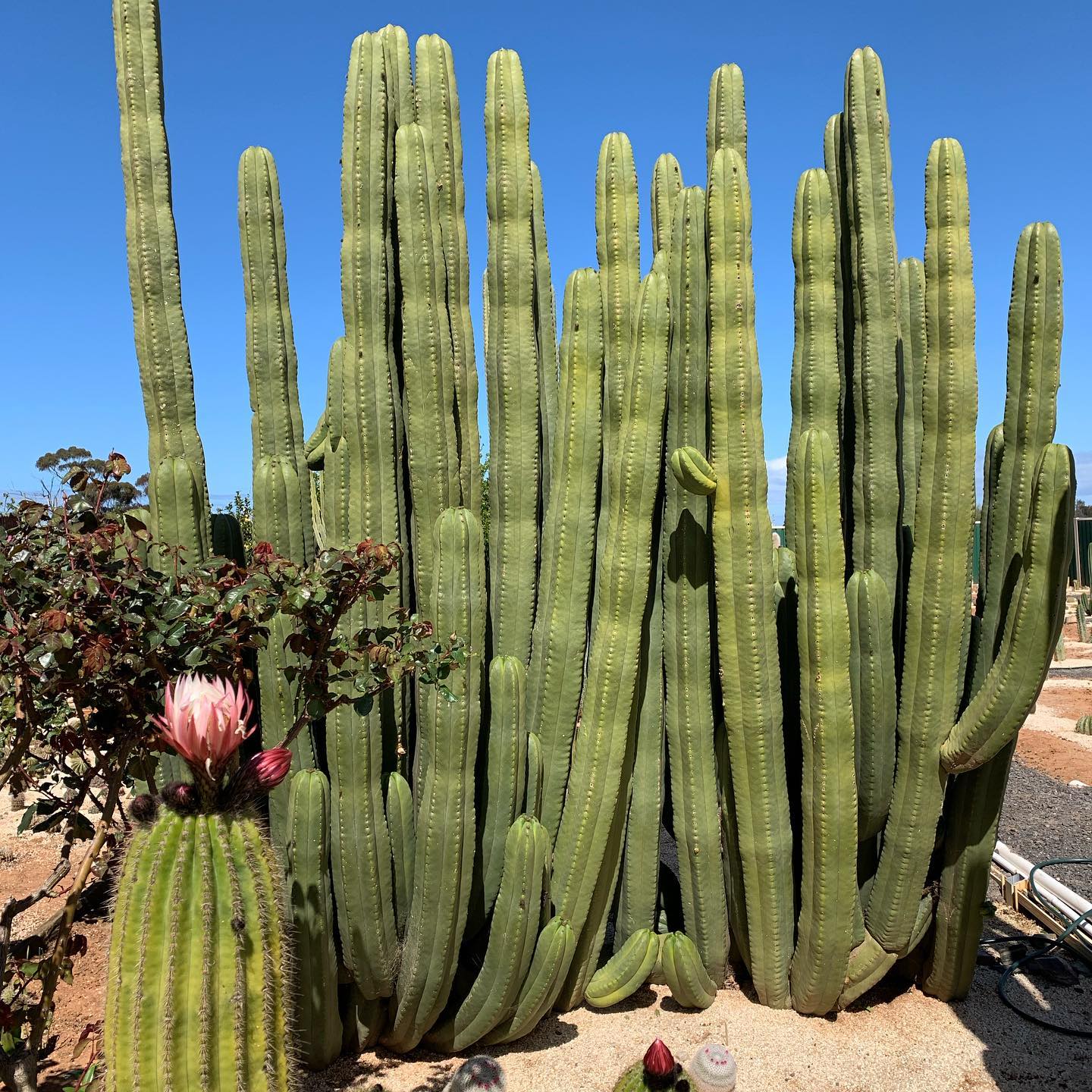
Echinopsis scopulicola is the near-spineless Bolivian columnar known informally as the Bolivian smooth columnar or simply Scopulicola. The type material was collected by Friedrich Ritter in 1959 at Tapecua, Province O’Connor, Department Tarija, Bolivia (Ritter field number FR991), and formally described the following year as Trichocereus scopulicola F.Ritter in Cactus (Paris) No. 87: 14 (1966). Roy Mottram transferred the combination to Echinopsis in Cactaceae Consensus Initiatives 2: 8 (1997). The epithet derives from Latin scopulus (cliff, crag) and -cola (dweller), a reference to the rocky canyon slopes of the O’Connor Province that Ritter documented as native habitat.
In trade, the species is consistently recognised by two characters: the dark, slightly rough epidermis that collectors describe as “grainy, like Braille” (sanpedrosource.com), and the adult near-spinelessness. Most mature plants carry at most three to six vestigial spines per areole, none longer than 1.5 mm. These features separate it at a glance from the amber-spined, blue-green Echinopsis lageniformis with which POWO currently synonymizes it, and from the smoother, lighter-skinned Echinopsis pachanoi that dominates the San Pedro trade. It is frequently crossed with both of those siblings to produce robust collector cultivars.
Taxonomy is contested. Kew POWO (2024) treats E. scopulicola as a heterotypic synonym of E. lageniformis (C.F.Forst.) H.Friedrich & G.D.Rowley following Hunt’s CITES Cactaceae Checklist (3rd edition, Kew, 2019) and the World Checklist of Vascular Plants (WCVP 2021). This encyclopedia maintains the species as distinct, following the Mottram (1997) combination and the morphological evidence summarised in the Taxonomy section below.
Wild populations have not been confirmed at Tapecua since Ritter’s 1959 collection. Specialist collector sources (trichopedia.org; trichocereus.net) consistently note that wild populations are unknown or possibly extirpated, and that all cultivated material worldwide traces to the FR991 seed stock distributed by Hildegard Winter. This is an unusual conservation situation: a taxon well established in cultivation, with morphological distinctness documented by specialist growers, but possibly without an extant wild counterpart at its type locality. The related Echinopsis peruviana and the Chilean Echinopsis chiloensis share the same Trichocereus heritage and carry their own distinct collector profiles.
Echinopsis scopulicola quick reference
A columnar cactus from the montane valley systems of O’Connor Province, Tarija, Bolivia, native to rocky slopes at 1,000–1,500 m with a strongly seasonal climate and a pronounced dry winter. Values calibrated for seed grown plants in cultivation, drawn from habitat data and specialist grower sources including trichocereus.net, sanpedrosource.com, and trichopedia.org.
Taxonomy & nomenclature
The basionym Trichocereus scopulicola F.Ritter was published in Cactus (Paris) No. 87: 14 (1966), based on Ritter’s own field collection FR991 from Tapecua, Province O’Connor, Department Tarija, Bolivia (IPNI record 1001124-1, verified 2026-04-21). Friedrich Ritter (1898–1989) was the German-born field botanist who documented much of the South American cactus flora across his 1950s–1980s expeditions; his Kakteen in Südamerika vol. 2 (1980) provides a more detailed morphological redescription of the species, though nomenclatural priority rests with the 1966 publication. Roy Mottram, editor of Cactaceae Consensus Initiatives, transferred the combination to Echinopsis in that journal’s vol. 2: 8 (1997), producing the current binomial.
Kew POWO (2024) treats Echinopsis scopulicola as a heterotypic synonym of Echinopsis lageniformis (C.F.Forst.) H.Friedrich & G.D.Rowley, following Hunt’s CITES Cactaceae Checklist (3rd edition, Kew 2019) and the World Checklist of Vascular Plants (WCVP 2021). The synonymization lumps the narrow-stemmed, near-spineless, dark-green Tarija plant with the broader-stemmed, amber-spined, blue-green taxon distributed across four Bolivian departments. GBIF backbone taxonomy (species record 5621993) likewise maps scopulicola onto the lageniformis concept.
This encyclopedia maintains Echinopsis scopulicola as distinct, following the Mottram (1997) combination. The morphological case for distinctness rests on four characters consistently documented across independent specialist sources (trichopedia.org; trichocereus.net; sanpedrosource.com): near-spineless adult habit (versus definite amber spines 0.1–7 cm in lageniformis), darker and texturally rough epidermis (versus blue-green glaucous in lageniformis), narrower stem diameter of 5–10 cm (versus 15–20 cm in the broad POWO lageniformis concept), and a reduced rib count centred on five. The Useful Tropical Plants database drawing on Anderson (2001) gives E. lageniformis stems as 10–15 cm, which supports the argument that the narrow-stemmed scopulicola is not comfortably accommodated in the broadened taxon. The reader is best served by knowing both positions: POWO synonymizes; the collector and specialist literature maintains these as separable plants.
Ritter himself considered T. scopulicola close to T. bridgesii (a synonym of E. lageniformis) and possibly a natural hybrid stabilization rather than an independent species. The domestication hypothesis circulated in the specialist collector community (Shroomery forum discussion 27761346; trichocereus.net) adds a further layer: reduced spination, reliable potency, and the absence of confirmed wild populations at Tapecua are consistent with long-term human selection, which would complicate the species concept regardless of formal nomenclature. Trichocereus crassicostatus F.Ritter has been suggested as a possible synonym by trichocereus.net; POWO lists it separately as a synonym of E. lageniformis, and the relationship to scopulicola specifically remains unresolved. The phylogenetic work of Schlumpberger & Renner (American Journal of Botany 99(8): 1335–1349, 2012) found Echinopsis s.l. not monophyletic at any level examined, providing context for the ongoing instability of circumscriptions in this group without resolving the specific scopulicola/lageniformis boundary.
Habitat
The type locality at Tapecua, Province O’Connor, Department Tarija, Bolivia sits at approximately 1,000–1,500 m elevation in the montane valley systems of southern Bolivia. O’Connor Province occupies the western part of Tarija Department, characterised by river valleys cut by the Pilaya and its tributaries, rocky slopes with cliff outcrops at mid-elevation, and mixed vegetation transitioning between dry intermontane scrub at the chaco margin and Yungas forest elements at higher elevations. Trichopedia.org and trichocereus.net both describe the native habitat as “rocky slopes and boulder fields within montane forests”; the species epithet scopulicola (cliff dweller) confirms Ritter’s own assessment of the habitat character.
Substrate chemistry at the type locality is calcareous. The Pilaya Canyon, the defining geographic feature of O’Connor Province, has limestone cliff walls (aroundus.com: “steep limestone cliffs form the canyon walls, revealing multiple geological layers across kilometers of landscape”). Independent confirmation comes from the USGS stratigraphic record for the Tarija region (Open-File Report 99-0050C), which documents carbonate and calcareous rock units including Vitiacua, Collasuyo, Copacabana, and Caliza Sacta limestone formations in the regional sedimentary sequence. The combination of limestone parent rock and sharply draining rocky slope position is directly reflected in the recommended cultivation substrate.
Climate across Province O’Connor follows the Bolivian inter-Andean valley pattern: approximately 500–900 mm annual rainfall, strongly summer-concentrated (November through April wet season), with a pronounced dry rest from May through October. Night temperatures during the dry season can drop toward 0°C on the coldest nights at type-locality elevations, consistent with the reported cold tolerance of −5°C dry for brief periods. Species-level plant associates at the Tapecua type locality are not documented in the botanical literature reviewed; no named associates are listed here.
Morphology
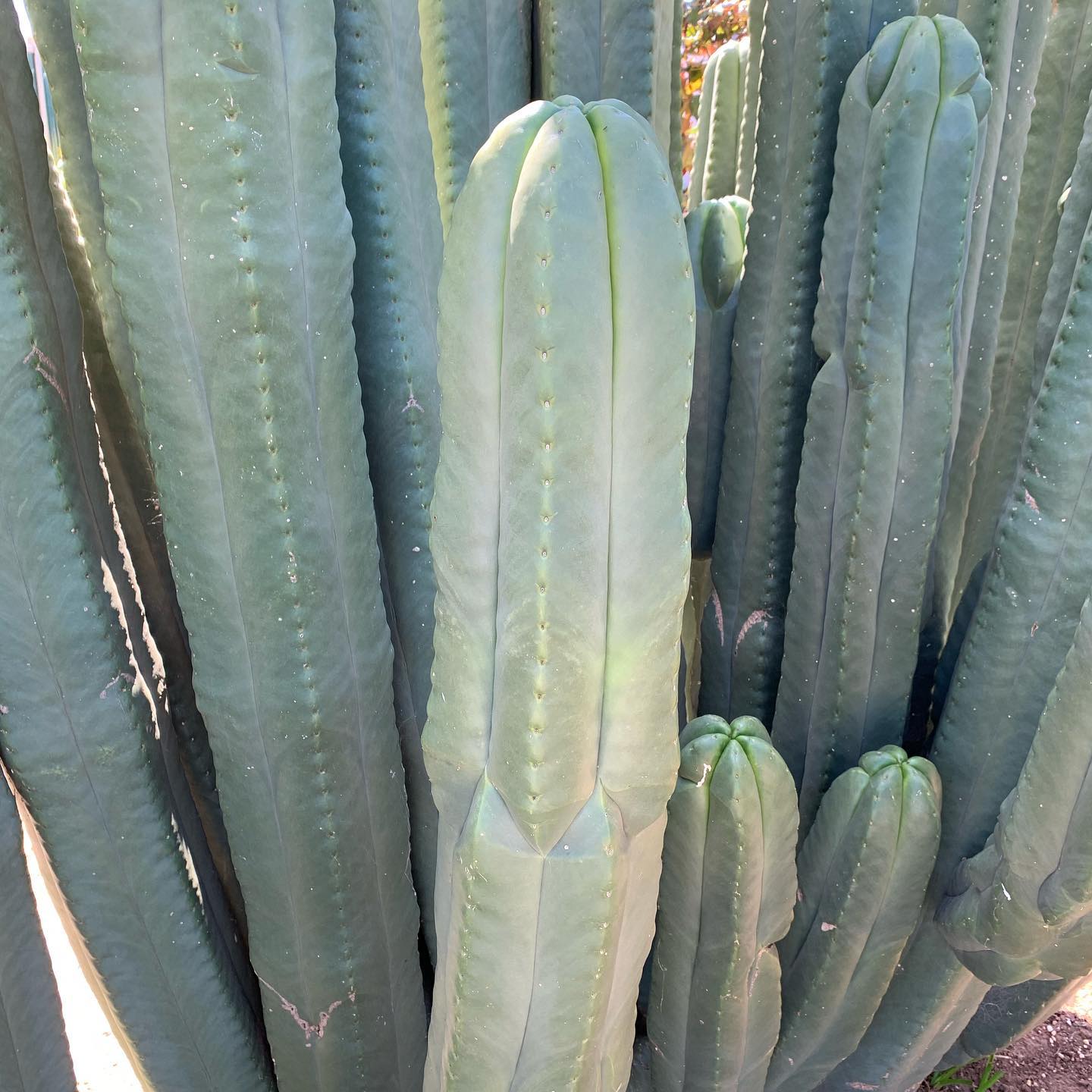
E. scopulicola is a columnar, erect tree cactus reaching up to 4 m at maturity. Branching is infrequent; most columns remain unbranched, producing a single-stemmed habit unlike the multi-branched candelabra of E. pachanoi. Stem diameter runs 5–10 cm (trichopedia.org; trichocereus.net; both citing the FR991 cultivated lineage from Ritter’s seed), markedly narrower than the 15–20 cm diameter cited for the broad E. lageniformis concept by Wikipedia and POWO. Epidermis colour is dark green, consistently described as such by specialist sources; the texture is distinctive, slightly roughened and granular to the touch. Sanpedrosource.com characterises it as “grainy, like Braille” and notes it as one of the clearest visual separators from the smoother, blue-green E. lageniformis.
Ribs number 4–6, typically 5 (trichopedia.org; trichocereus.net; sanpedrosource.com all agree). The ribs are broad, blunt, and rounded in profile with even furrows between them. A strong furrow or crease appears directly above each areole (sanpedrosource.com), a character absent in E. pachanoi where the groove runs between, not above, the areoles. No V-shaped notch above the areoles is present, distinguishing scopulicola from the notched-rib profile of pachanoi. Areoles are very small for a columnar Trichocereus relative: 1–4 mm long by 1–2 mm wide, spaced 15–30 mm apart along the rib midline, with minimal white wool, and appearing sunken or dimpled. Flower-bearing areoles reach 4–5 mm diameter.
The spine character is the most diagnostic feature of the adult plant. Mature plants carry 0–6 very short spines per areole, maximum 1.5 mm in length (trichopedia.org; trichocereus.net; independently consistent). Juvenile plants and seedlings bear 7–14 needle-like spines 2–3 mm long including one or two centrals; this juvenile spine expression causes confusion with young E. pachanoi, from which seedling-stage scopulicola is separable by the unusual rib morphology and strongly sunken areoles. The adult near-spineless character is the most reliable single diagnostic across all growth stages above the seedling; no other Bolivian columnar in regular trade approaches this level of spine reduction in adults.
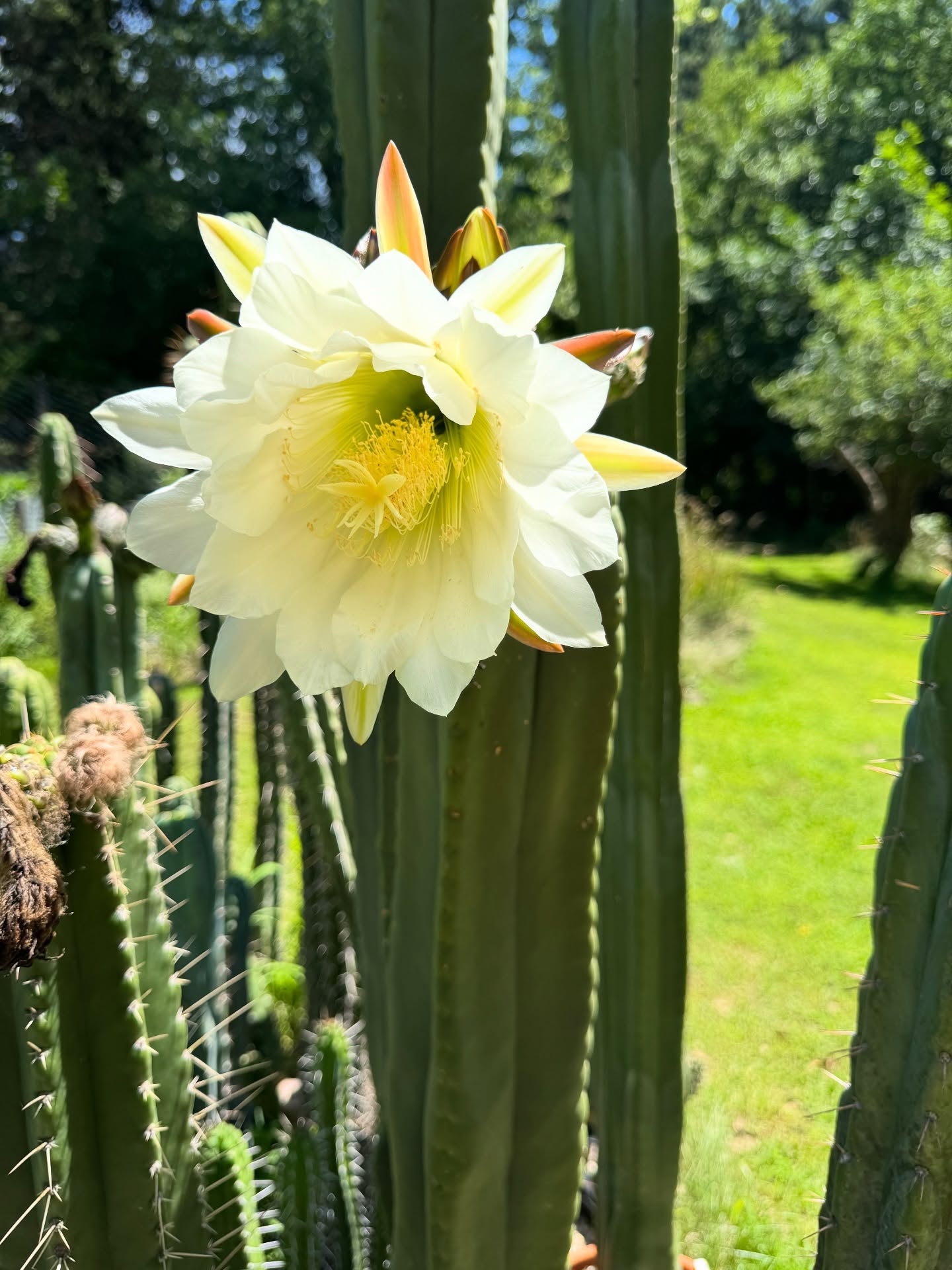
Flowers are large, white, nocturnal, 15–22 cm long in broad funnel form, emerging from near-apical areoles and occasionally from lower stem areoles (trichopedia.org; trichocereus.net). Flowers open at dusk and remain open into late morning. The floral tube bears black to brown hairs (sanpedrosource.com). Fragrance is present (trichocereus.net). The species is self-sterile; cross-pollination is required for fruit set. Fruit is green, approximately 6 cm in diameter, described as edible and pleasant-tasting by trichocereus.net. The alkaloid chemistry of FR991 material (Tapecua, O’Connor Province) was established by Ogunbodede, McCombs, Trout, Daley & Terry (Journal of Ethnopharmacology 131(2): 356–362, 2010), who measured mescaline at 0.85% by dry weight in the outer chlorenchyma layer; the study spanned 14 Echinopsis taxa with concentrations ranging 0.053–4.7% dry weight.
Locality detail
As a distinct taxon, E. scopulicola is restricted to Department Tarija, specifically Province O’Connor, in south-central Bolivia. The province occupies the western part of Tarija Department and is defined topographically by the Pilaya river drainage, a system of montane valleys with limestone canyon walls that represents the calcareous substrate environment Ritter documented for the species. Markers on the map sit at province-level centroids; specific GPS coordinates for the type locality at Tapecua are not published here, consistent with the site’s convention for CITES-listed species with small or uncertain wild populations.
Under the broad E. lageniformis concept accepted by POWO, the taxon’s range extends across Departments La Paz, Cochabamba, Tarija, and Chuquisaca at 1,000–3,300 m. The conservation-relevant question is whether wild populations of the scopulicola morphotype persist at Tapecua at all: specialist sources consistently report that wild plants have not been confirmed since Ritter’s 1959 FR991 collection, and that all cultivated material worldwide traces to the seed stock Hildegard Winter distributed from that single collection. No formal field survey confirming extirpation or persistence at Tapecua has been published in any source reviewed.
Cultivation
E. scopulicola is an undemanding columnar cactus for growers who observe three requirements: a purely mineral fast-draining substrate, full sun, and a dry winter rest. The strongly seasonal Bolivian inter-Andean climate of its type locality, with a wet summer growing season and a dry rest from May to October, translates directly into cultivation practice. The main failure mode, as with all Trichocereus relatives, is root rot caused by moisture during cold or cool conditions.
Substrate
Purely mineral substrate is the collector consensus (trichocereus.net; sanpedrosource.com; botanicohub.com). The recommended mix: 50% pumice as the primary drainage aggregate, 30% decomposed granite to mimic the rocky Andean slope substrate, and 20% low-nutrient cactus mineral soil for trace structure. Limestone chip at 5–10% of the total is appropriate as a partial aggregate, reflecting the confirmed calcareous geology of the Pilaya canyon system at the type locality (aroundus.com canyon geology; USGS OF-99-0050C Tarija stratigraphy). Use no organic-heavy amendments in the aggregate mix.
Watering and light
Water only when the substrate is fully dry during the growing season (spring through early autumn). Trichocereus.net describes watering every few days during hot summers once the soil dries completely, but cautions against any watering “when it’s cold or rainy because that can cause rot.” Reduce to near-dry from October through March; the native climate at Tapecua has a pronounced May–October dry season and growers who replicate it report the best growth and cold-tolerance. Plants in wet or cool conditions lose cold hardiness rapidly.
Full sun across all sources (trichocereus.net; sanpedrosource.com; trichopedia.org). Indoor cultivation requires the brightest available position; supplemental grow lights are recommended by sanpedrosource.com for plants grown under glass. No partial-shade recommendation has been documented for this species specifically.
Propagation
Stem cuttings root readily and are the standard propagation method in the trade. All seed stock in circulation traces to FR991, distributed via Hildegard Winter’s seed lists; seed is occasionally available from specialist suppliers. The species is self-sterile; cross-pollination is required for viable seed set (sanpedrosource.com). As a scion host, scopulicola accepts graftings readily and is used as grafting rootstock in the collector community (trichocereus.net). Seed grown plants represent the full genetic expression of FR991; cutting-propagated material is genetically uniform within a given cutting lineage.
Comparison
The primary identification question for E. scopulicola is its separation from E. lageniformis, treated in depth in the FAQ section below with a character table. The adult near-spineless character is the single fastest field separator: lageniformis adults consistently carry honey-brown to amber spines 0.1–7 cm long, typically two to six per areole (Wikipedia; cactusgrowguide.com). The combination of spine character, epidermis colour (dark green and granular versus blue-green and glaucous), and narrower stem diameter (5–10 cm versus the broader lageniformis range) provides reliable separation on any adult plant of known provenance.
Juvenile plants cause more identification difficulty. Young scopulicola closely resembles juvenile E. pachanoi (trichocereus.net; trichopedia.org; both note this explicitly). At seedling stage the distinguishing characters are the rib count and profile: scopulicola carries 4–6 broad blunt ribs centred on 5, versus the 5–8 more sharply defined ribs of pachanoi. The strong crease or furrow above each areole, absent in pachanoi (which shows a V-notch between areoles rather than above them), is the most reliable structural separation at any growth stage. The dark green granular epidermis of scopulicola versus the lighter, smoother skin of pachanoi is a secondary confirmation.
In trade, the confusion between scopulicola and E. lageniformis is compounded by the POWO synonymy itself: plants received as “bridgesii” or “lageniformis” may or may not carry the scopulicola morphotype depending on the seller’s source. On provenance-documented FR991-lineage material, the near-spineless adult and dark-green granular epidermis are consistent; on undocumented trade material, spine character is the only field-usable separator. The E. cuzcoensis of the Urubamba drainage presents no confusion: its much longer dark spines and knobbed spine bases separate it at a glance.
Frequently asked questions
How do you tell Echinopsis scopulicola apart from Echinopsis lageniformis?
POWO currently synonymizes these two as a single taxon. In the collector and specialist literature they are treated as separable plants; their closeness is precisely what drives identification errors. Read down the character table to compare mature specimens. The spine character is the most reliable diagnostic at any adult growth stage.
Spine character is the most reliable single diagnostic. No adult E. scopulicola of the FR991 lineage carries spines longer than 1.5 mm; no adult E. lageniformis across the four-department population is reported near-spineless. Where spine loss may occur with age in lageniformis, the combination of epidermis colour (dark green versus blue-green) and stem diameter (narrow versus stout) provides the secondary distinction.
Is Echinopsis scopulicola the same species as Echinopsis lageniformis?
Kew POWO (2024) treats them as synonyms, with E. scopulicola subsumed under E. lageniformis. The synonymization follows Hunt’s CITES Cactaceae Checklist (3rd edition, 2019) and the World Checklist of Vascular Plants (WCVP 2021). Specialist growers and collector databases including trichopedia.org, trichocereus.net, and sanpedrosource.com maintain them as distinct based on morphological grounds: near-spineless adult habit, darker granular epidermis, and narrower stem diameter in scopulicola. This encyclopedia follows the Mottram (1997) combination recognising scopulicola as distinct. Both positions are sourced; the reader should weigh the botanical authority of POWO against the morphological evidence the collector literature documents.
Is Echinopsis scopulicola hard to grow?
Not particularly demanding for an experienced grower. The requirements are mineral fast-draining substrate, full sun, and a near-dry winter rest; these are standard for Bolivian inter-Andean columnar cacti. Cold tolerance reaches approximately −5°C dry for brief periods (trichocereus.net), with damage beginning below −1.1°C if the substrate is wet (sanpedrosource.com). The one reliable failure mode is root rot from wet-cold conditions. Growers who replicate the strongly seasonal Bolivian climate, wet summer and dry winter, report no major difficulties.
Where does Echinopsis scopulicola grow in the wild?
Native to Department Tarija, Province O’Connor, Bolivia. The type locality is Tapecua, where Ritter collected the FR991 material in 1959 at approximately 1,000–1,500 m on rocky slopes and boulder fields in montane scrub. The Pilaya canyon system that drains O’Connor Province has limestone cliff walls that match the species’ calcareous substrate requirements. Wild populations have not been confirmed since the 1959 FR991 collection; all cultivated material worldwide traces to that single seed collection. The species may persist only in cultivation.
How fast does Echinopsis scopulicola grow?
Intermediate to average. Sanpedrosource.com’s field guide explicitly contrasts scopulicola as “Average Growth Rate” against pachanoi as “Fast Growing.” Growth accelerates sharply during the warm spring-summer growing season when temperatures are high and watering regular; no quantified cm-per-year figure has been published in the specialist literature. Most cultivated specimens remain under 2 m for many years. The narrower stem and drier Tarija origin are consistent with a more measured pace than the fast Andean columnars.
When does Echinopsis scopulicola flower, and what do the flowers look like?
Flowers are white, large (15–22 cm long), nocturnal, and fragrant, emerging from near-apical areoles (trichopedia.org; trichocereus.net). The floral tube carries black to brown hairs (sanpedrosource.com). In cultivation in the northern hemisphere, flowering typically occurs in summer when temperatures are high and growing conditions are at their best; the flowers open at dusk and remain open into late morning the following day. The species is self-sterile; cross-pollination is required for fruit set.
Sources & further reading
Ritter, F. (1966). Trichocereus scopulicola F.Ritter. Cactus (Paris) No. 87: 14. [Basionym; type FR991, Tapecua, O’Connor, Tarija, Bolivia] · Mottram, R. (1997). Echinopsis scopulicola (F.Ritter) Mottram. Cactaceae Consensus Initiatives [England] 2: 8. [Transfer to Echinopsis; IPNI record 1001124-1] · Kew POWO (2024). Echinopsis scopulicola (F.Ritter) Mottram. Plants of the World Online. LSID urn:lsid:ipni.org:names:1001124-1. [Listed as synonym of E. lageniformis] · Kew POWO (2024). Echinopsis lageniformis (C.F.Forst.) H.Friedrich & G.D.Rowley. Plants of the World Online. LSID urn:lsid:ipni.org:names:132706-1 · IPNI (2024). Echinopsis scopulicola. International Plant Names Index. Record 1001124-1 · GBIF (2024). Echinopsis scopulicola (F.Ritter) Mottram. Species record 5621993 · Schlumpberger, B.O. & Renner, S.S. (2012). Molecular phylogenetics of Echinopsis (Cactaceae): polyphyly at all levels. American Journal of Botany 99(8): 1335–1349. DOI 10.3732/ajb.1100288 · Ogunbodede, O., McCombs, D., Trout, K., Daley, P. & Terry, M. (2010). New mescaline concentrations from 14 taxa/cultivars of Echinopsis spp. (Cactaceae). Journal of Ethnopharmacology 131(2): 356–362. DOI 10.1016/j.jep.2010.07.021. [E. scopulicola FR991: 0.85% mescaline by dry weight] · IUCN Red List (2010). Echinopsis lageniformis. Least Concern. IUCN ID 156918 · Hunt, D. (ed.) (2019). CITES Cactaceae Checklist, 3rd edition. Royal Botanic Gardens, Kew · Trichopedia (2024). Scopulicola. trichopedia.org/about/scop/ · Trichocereus.net (2024). Trichocereus scopulicola / Echinopsis scopulicola. trichocereus.net · Trichocereus.net Blog (2015). Trichocereus scopulicola. trichocereusnet.blogspot.com · San Pedro Source (2024). Scopulicola 101. sanpedrosource.com · San Pedro Source (2024). Identifying the 5 Major Types of San Pedro Cactus. sanpedrosource.com · Cactusgrowguide.com (2024). Bolivian Torch Cactus (Echinopsis lageniformis). [Lageniformis morphology comparator] · Around Us (2024). Cañón del Pilaya. aroundus.com/p/4269962-canon-del-pilaya. [Limestone cliff geology, O’Connor Province] · USGS Open-File Report 99-0050C (1999). Tarija Province of Central South America: Los Monos. [Carbonate formations, Tarija stratigraphy] · Anderson, E.F. (2001). The Cactus Family. Timber Press, Portland. [Authority-tier genus reference; lageniformis broad concept] · Hunt, D. et al. (2006). The New Cactus Lexicon. DH Books. [Updated nomenclatural treatment]