Echinopsis cuzcoensis
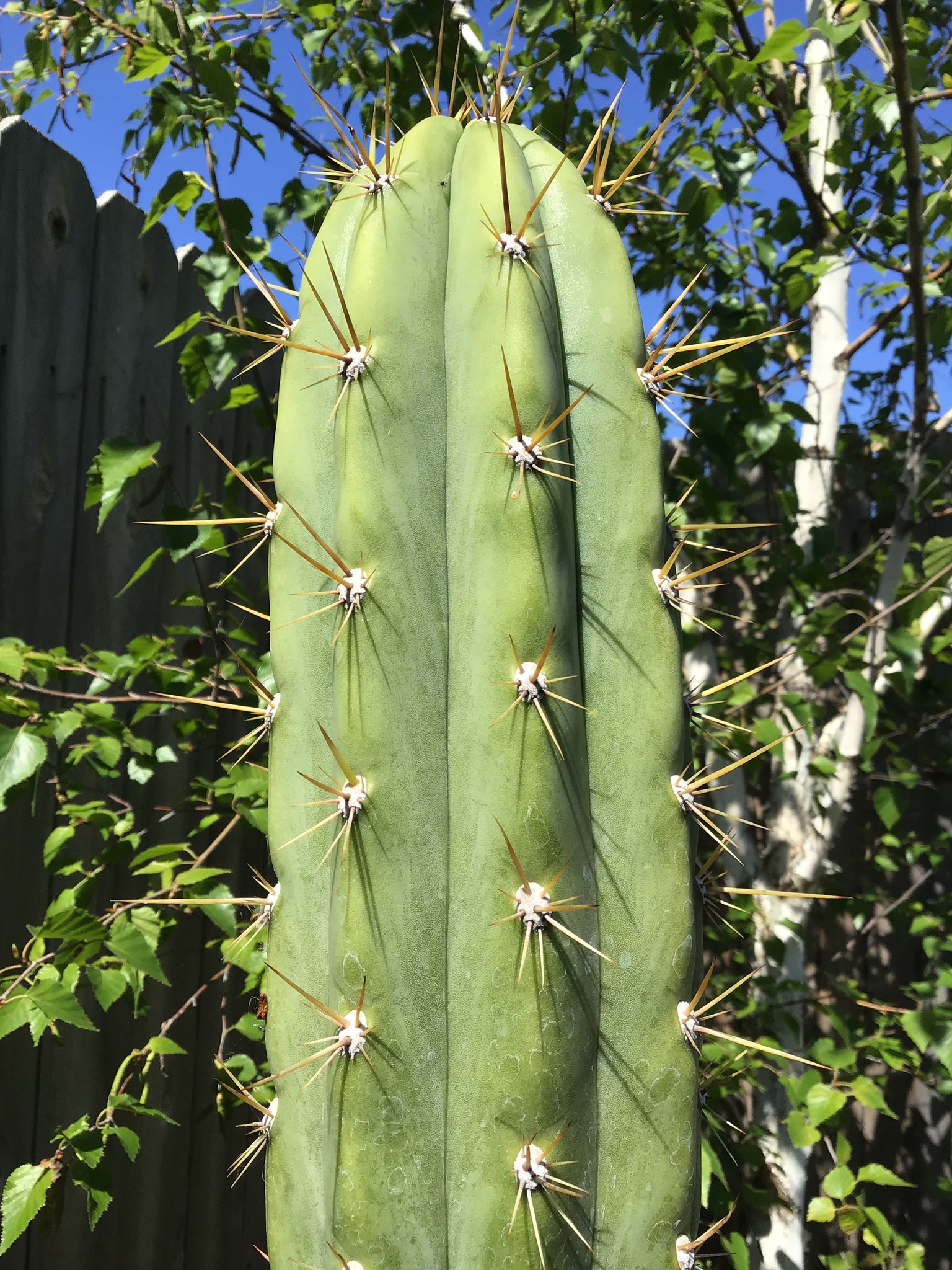
Echinopsis cuzcoensis is the Cuzco torch of the Peruvian high Andes, a stout, heavily armed columnar cactus of the Urubamba and Vilcanota drainage systems in the Cuzco region of southeastern Peru. N.L. Britton and J.N. Rose described the species in 1920 as Trichocereus cuzcoensis from material near Cuzco, naming the plant for the city and department that mark its core range. The name cuzcoensis used the older colonial orthography; the modern Peruvian spelling is Cusco. H.Friedrich and G.D.Rowley transferred the species to Echinopsis in 1974 in IOS Bulletin 3(3): 95; Kew POWO follows this treatment. The name Trichocereus cuzcoensis remains the standard in the collector trade.
The species sits at the upper elevation band of the Andean columnar group, documented from 3,100 to 3,600 m (Anderson & Eggli, Das grosse Kakteen-Lexikon, 2005, pp. 226–227; confirmed by Karel Knize’s KK340 collection record at 3,200 m near Huachac, Cuzco region). That elevation advantage over E. peruviana (approximately 2,000–2,800 m) and E. pachanoi (2,000–3,000 m) is directly reflected in cultivation: the Cuzco torch handles dry-cold conditions that would stop either sister species.
The identification character that defines the species is the swollen, knobbed base of each spine at the areole. Britton and Rose called this out specifically in the 1920 protologue as the character separating T. cuzcoensis from T. peruvianus. All subsequent specialist sources confirm it. The knobbing is visible by close inspection of fresh areoles or with a hand lens on dry specimens and separates E. cuzcoensis from both E. peruviana and the near-spineless E. pachanoi at a glance.
Like all Cactaceae, E. cuzcoensis is CITES Appendix II. Dried stems are harvested commercially in Peru for rainstick manufacture, a trade use documented in CITES sources.
Echinopsis cuzcoensis quick reference
A robust high-Andean columnar cactus from the Urubamba drainage at 3,100–3,600 m with a seasonal wet/dry climate and regular winter frosts. Values calibrated for seed grown plants in cultivation, drawn from habitat data (trichocereus.net, Freaky Cacti cold hardiness guide, Anderson & Eggli 2005, KK340 field documentation). Substrate recommendation inferred from habitat; no peer-reviewed substrate analysis exists for this species.
Taxonomy & nomenclature
Echinopsis cuzcoensis (Britton & Rose) H.Friedrich & G.D.Rowley was published in IOS Bulletin: Journal of the International Organization for Succulent Plant Study 3(3): 95 (1974). The basionym, Trichocereus cuzcoensis Britton & Rose, appeared in The Cactaceae vol. 2, pp. 134–136 (Carnegie Institution of Washington, 1920). Britton and Rose described the species from material collected in the vicinity of Cuzco, Peru, naming it for the department. The IPNI record (n/88373-2) confirms the 1974 transfer. Kew POWO (LSID urn:lsid:ipni.org:names:88373-2) accepts Echinopsis cuzcoensis as the current name; the native range is Peru and the introduced range includes the Canary Islands.
POWO lists eleven synonyms. The most frequently encountered in trade and literature are Trichocereus cuzcoensis Britton & Rose (basionym; homotypic), Cereus cuzcoensis (Britton & Rose) Werderm. (1931), Echinopsis knuthiana (Backeb.) H.Friedrich & G.D.Rowley, Trichocereus tarmaensis Rauh & Backeb. (1956), Trichocereus knuthianus Backeb. (1958), and the combination Helianthocereus cuzcoensis used by some South American sources. Karel Knize’s collection codes KK242, KK340, and KK1911 designate Cuzco-region collection areas rather than individual mother plants and are not distinct clones.
The broader generic treatment follows the pattern of the Echinopsis debate common to all species in this encyclopedia. Schlumpberger & Renner (American Journal of Botany 99(8): 1335–1349, 2012), sequencing chloroplast DNA from 162 plants, found Echinopsis sensu lato not monophyletic under any previous circumscription and explicitly deferred realignment. The companion cladistic study of Albesiano & Terrazas (Haseltonia 17: 3–23, 2012) argued for retaining Trichocereus as a distinct genus, supported by three synapomorphies (basitonic growth with prostrate branches, imbricate floral tube scales, subglobose fruits). This page follows POWO on the accepted name.
The relationship between E. cuzcoensis and E. peruviana is an active unresolved question. The trichocereus.net specialist author notes that the two hybridize freely where their ranges overlap and produce numerous intermediates, suggesting possible subspecies-or-variety status rather than full species separation. No published molecular study has resolved this as of the research date. For cultivation and identification purposes the knobbed-spine-base character remains the working distinction; plants without documented field provenance from the Cuzco region should be annotated as “Trichocereus peruvianus/cuzcoensis complex” in collection records. The E. scopulicola and E. chiloensis pages cover the contrasting near-spineless Bolivian and Chilean columnars in this genus.
Habitat
E. cuzcoensis grows in inter-Andean dry valleys and puna shrubland at 3,100–3,600 m in southeastern Peru, with the Urubamba and Vilcanota river systems forming the primary ecological context. The Cuzco basin sits at the convergence of these drainages and represents a distinct climatic zone: sheltered from Pacific moisture by the western Andes but receiving Atlantic and Amazonian precipitation driven west by the eastern Andean barrier during the austral summer. Karel Knize’s KK340 collection record documents plants at Huachac, Cuzco region, at 3,200 m, the most precisely georeferenced field locality in the literature reviewed.
The Cuzco region climate is strongly seasonal: an October–April wet season driven by Atlantic and Amazonian moisture incursion, and a May–September dry season when frosts occur regularly at city elevation of approximately 3,400 m. Annual rainfall in the Cuzco basin averages 600–800 mm, concentrated in the wet season. Dry-season day–night temperature swings of 15–20°C are characteristic, and lows below 0°C occur frequently from June through August. The warm wet-season growth period followed by cold dry-season dormancy is the climate pattern that drives both cultivation protocol and the exceptional cold tolerance reported by specialist growers.
Plants grow on rocky slopes, hillsides, and ridges in the inter-Andean valley system. No published substrate analysis exists for E. cuzcoensis populations; habitat descriptions consistently note rocky, well-drained inter-Andean slopes. The Cuzco region geology includes Paleozoic and Mesozoic sedimentary formations, granitic intrusions, and red-bed sandstones, particularly in the Urubamba valley, but no peer-reviewed study mapping substrate conditions at E. cuzcoensis localities was found in either research round.
No field study has documented the plant associates of E. cuzcoensis specifically; the species grows in inter-Andean scrub at 3,100–3,600 m alongside the Puya, Opuntia, and Andean shrub assemblage typical of that elevation band in southeastern Peru.
Morphology
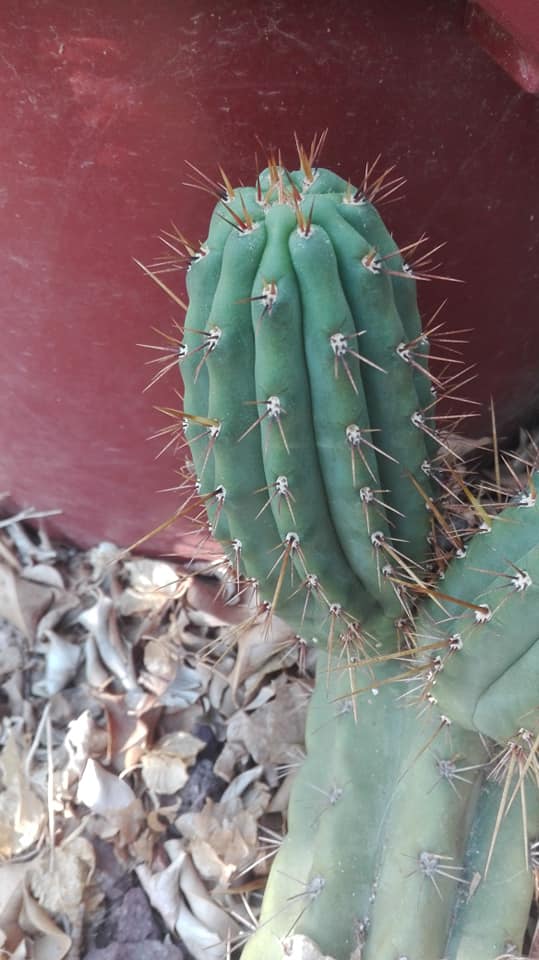
E. cuzcoensis is a columnar, tree-shaped cactus with basal branching that produces a candelabra habit at maturity. Habitat plants reach 5–6 m (Anderson & Eggli, Das grosse Kakteen-Lexikon, 2005, pp. 226–227, via Wikipedia; confirmed by trichocereus.net). Stem diameter is up to 15 cm (trichocereus.net; Botanico Hub). New growth is bright green with no glaucous bloom, a character that directly contrasts with the persistent frosted blue-green epidermis of most E. peruviana regional forms.
Ribs number 7–8, low and rounded, a figure consistent across Britton & Rose (1920) and Anderson & Eggli (2005 via Wikipedia). Trichocereus.net records 5–8 as a range but notes that plants showing fewer than 7 ribs are likely misidentified or of hybrid origin; use 7–8 as the canonical count. Areoles are white to grey-felted, spaced 1–2 cm apart along the rib margins.
The spines are the diagnostic character of the species. Spine count per areole is 8–12, typically about 12 per Britton & Rose (1920). Spine length is typically 5–10 cm (trichocereus.net); Anderson & Eggli (2005) give up to approximately 7 cm; the discrepancy is moderate and probably reflects clone and growing-condition variation. New spines are yellow or dark brown; mature spines are dark grey to white with black undertones or black tips. The defining feature is the swollen, knobbed base where each spine meets the areole, visible to the naked eye on fresh growth and with a hand lens on dry specimens. This knobbing was specified by Britton and Rose in the 1920 protologue as the primary character separating the species from Trichocereus peruvianus and remains the working identification character confirmed by all specialist sources.
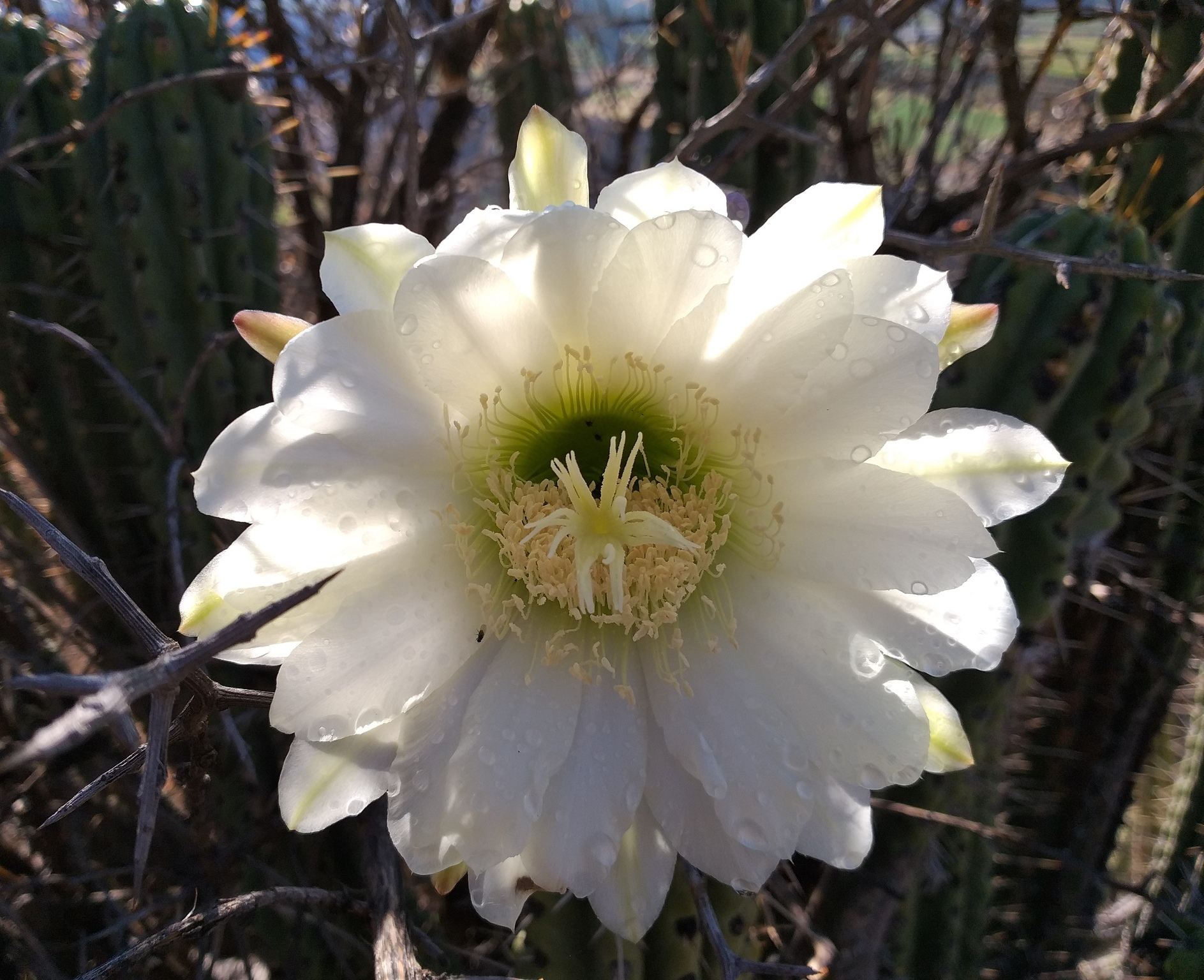
Flowers are nocturnal and funnel-shaped, white, 12–14 cm long and up to 16 cm in diameter when fully open (trichocereus.net). The floral tube is green, 7–8 cm long, and fragrant (Botanico Hub). Flowers persist until the following morning. The species is self-sterile; two genetically distinct plants are required for seed production.
Locality detail
The confirmed core range is the Cuzco (Cusco) department of southeastern Peru, centred on the Urubamba and Vilcanota river drainages (the Sacred Valley of the Inca). The type locality, “near Cuzco, Peru” (Britton & Rose 1920), carries no finer precision than the departmental capital; the KK340 Knize collection record from Huachac at 3,200 m is the most precisely documented locality from field work. The 2013 IUCN assessment (Jose Roque) records populations in Huancavelica and Ayacucho departments in addition to the core Cuzco range; these are cited as IUCN-reported rather than independently field-verified. Populations within the buffer zone of the Santuario Histórico de Machu Picchu are confirmed by the same assessment. Map markers sit at regional centroids consistent with CITES Appendix II convention for this genus.
The species’ elevation band of 3,100–3,600 m places it above the typical range of E. peruviana (approximately 2,000–2,800 m at the Matucana type) and E. pachanoi (2,000–3,000 m). A wider elevation figure of 2,000–4,000 m appears in Botanico Hub but likely includes mis-identified material or populations at the range margins; the Anderson & Eggli (2005) figure of 3,100–3,600 m is cross-verified against the IUCN assessment text and KK340 field data and is used as the canonical range here.
Cultivation
E. cuzcoensis tolerates more cold than E. pachanoi or E. peruviana, an artefact of its 3,100–3,600 m origin where frosts occur regularly in the dry season. Specialist grower sources describe the species as relatively easy, with fewer pest problems than many comparable large columnars. The primary failure mode is wet-cold rot when a moist root zone encounters low winter temperatures; the Andean winter-dry protocol is the critical cultivation lever.
Substrate
No peer-reviewed substrate analysis exists for E. cuzcoensis populations; the recommendation below is inferred from habitat. The species grows on rocky, well-drained inter-Andean slopes with mineral-dominant soils and no standing moisture. An appropriate mix is approximately 60% mineral aggregate (pumice as the primary drainage component, granite grit or lava rock for structure and mineral content) plus 40% low-nutrient mineral cactus base. The high aggregate fraction mirrors the fast-draining rocky habitat and accommodates the large, actively growing root system without allowing retention of moisture through the winter dormancy period.
Watering and light
Water regularly during the active growing season (October–May in the southern hemisphere; adapt to northern hemisphere growing conditions accordingly), allowing the substrate to dry between applications but not letting the plant remain dry for extended periods during active growth. In European cultivation, the trichocereus.net protocol is to stop watering September–October and resume in April–May. A cold winter dormancy maintained under dry conditions enhances subsequent flowering; warm, wet winters suppress it.
Full sun is required. The species grows on exposed inter-Andean valley slopes at high elevation with intense UV radiation; no shade adaptation is documented in any source reviewed. In temperate greenhouse cultivation, the brightest available position is appropriate year-round. Acclimate greenhouse-grown plants gradually before moving outdoors.
Propagation
From cuttings: the standard approach for large columnars. Allow the cut surface to callus fully before planting; rooting is relatively fast compared to globular rare cacti. From seed: germination occurs at 26–30°C in two to six weeks with quality seed (trichocereus.net). Seeds require light and minimal moisture for germination; gibberellic acid or UV light treatment may improve germination rates, though this is not widely confirmed in formal literature. The species is self-sterile; two genetically distinct plants are required for seed production. Plants grown from seed represent the full genetic diversity of the species and will not carry the growth artifacts of cutting-derived stock from a single parent.
Comparison
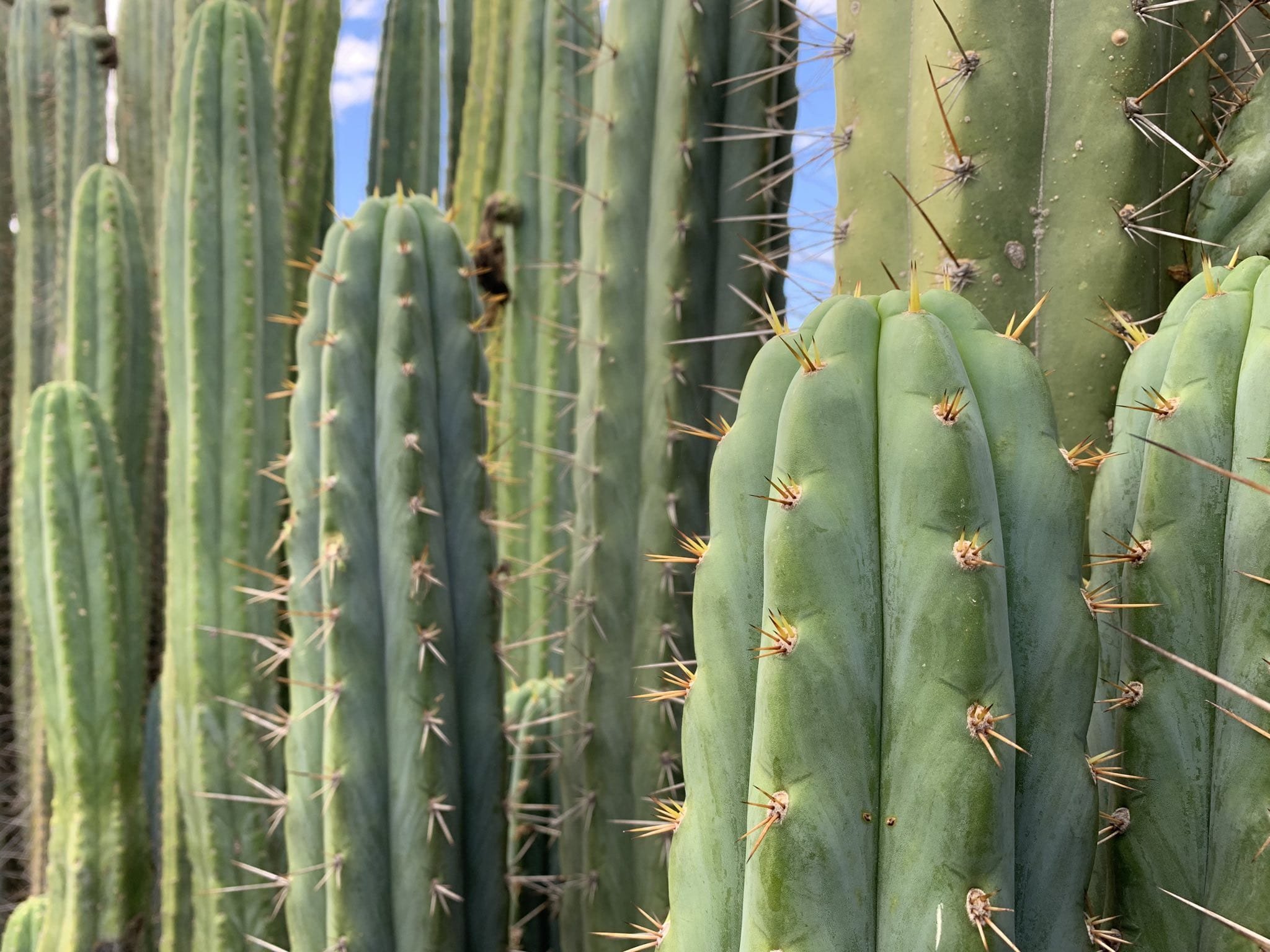
The knobbed spine base is the single most reliable identification character for E. cuzcoensis, and it works against both of its most frequently confused relatives simultaneously. Against E. peruviana, the smooth-based spines of the Peruvian torch separate it from the knobbed-based Cuzco torch at the areole level; the comparison is covered in full detail in the FAQ section below with a character table. Against E. pachanoi, the near-spineless San Pedro, the distinction is even more immediate: a plant with 8–12 long, dark, knobbed spines per areole cannot be confused with a plant carrying 0–7 short, smooth-based, often vestigial spines.
The more difficult identification problem is distinguishing E. cuzcoensis from E. peruviana in trade, because both are heavily spined Peruvian columnars sold under both Trichocereus names. Spine base is decisive: smooth on peruviana, knobbed on cuzcoensis. Skin colour adds supporting evidence on mature plants: the persistent frosted blue-glaucous epidermis of most E. peruviana regional forms is absent on E. cuzcoensis, which maintains a bright green stem without a persistent bloom. Elevation provenance is definitive on documented material: 3,100–3,600 m for cuzcoensis versus approximately 2,000–2,800 m for the Matucana-type peruviana.
Hybridization between E. cuzcoensis and E. peruviana is documented where their ranges overlap (trichocereus.net), and cultivated material in trade without provenance documentation may be genetic intermediates showing mixed spine-base characters. The alkaloid profile provides a chemically objective separation, though it requires laboratory analysis: E. cuzcoensis has 3-methoxytyramine as the dominant alkaloid and returned 0.0% mescaline in the specimen analysed by Ogunbodede et al. (2010, Journal of Ethnopharmacology 131(2): 356–362), while E. pachanoi and E. peruviana are mescaline-dominant. The Bolivian E. lageniformis is rarely confused with E. cuzcoensis once the spine characters are clear, but shares the fast columnar growth habit at similar cultivation temperatures.
Frequently asked questions
How do you tell Echinopsis cuzcoensis apart from Echinopsis peruviana?
Both are heavily spined Peruvian columnar cacti formerly placed in Trichocereus and routinely cross-labelled in the collector trade. Drag the slider to compare mature stems side by side, then read the character table. Spine base is the single most reliable separator at any size.
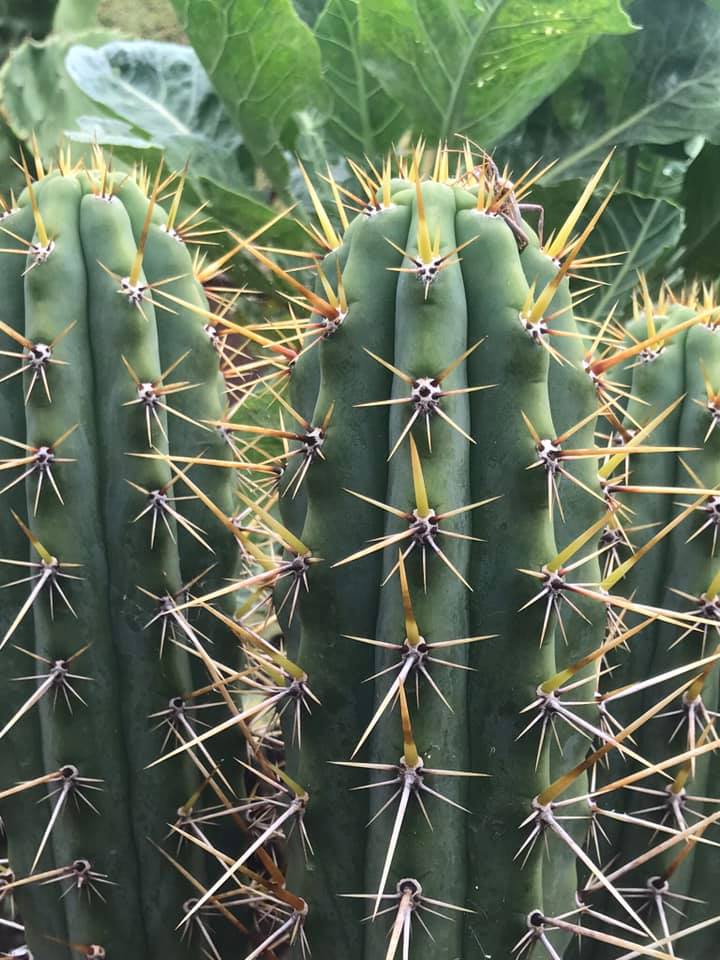
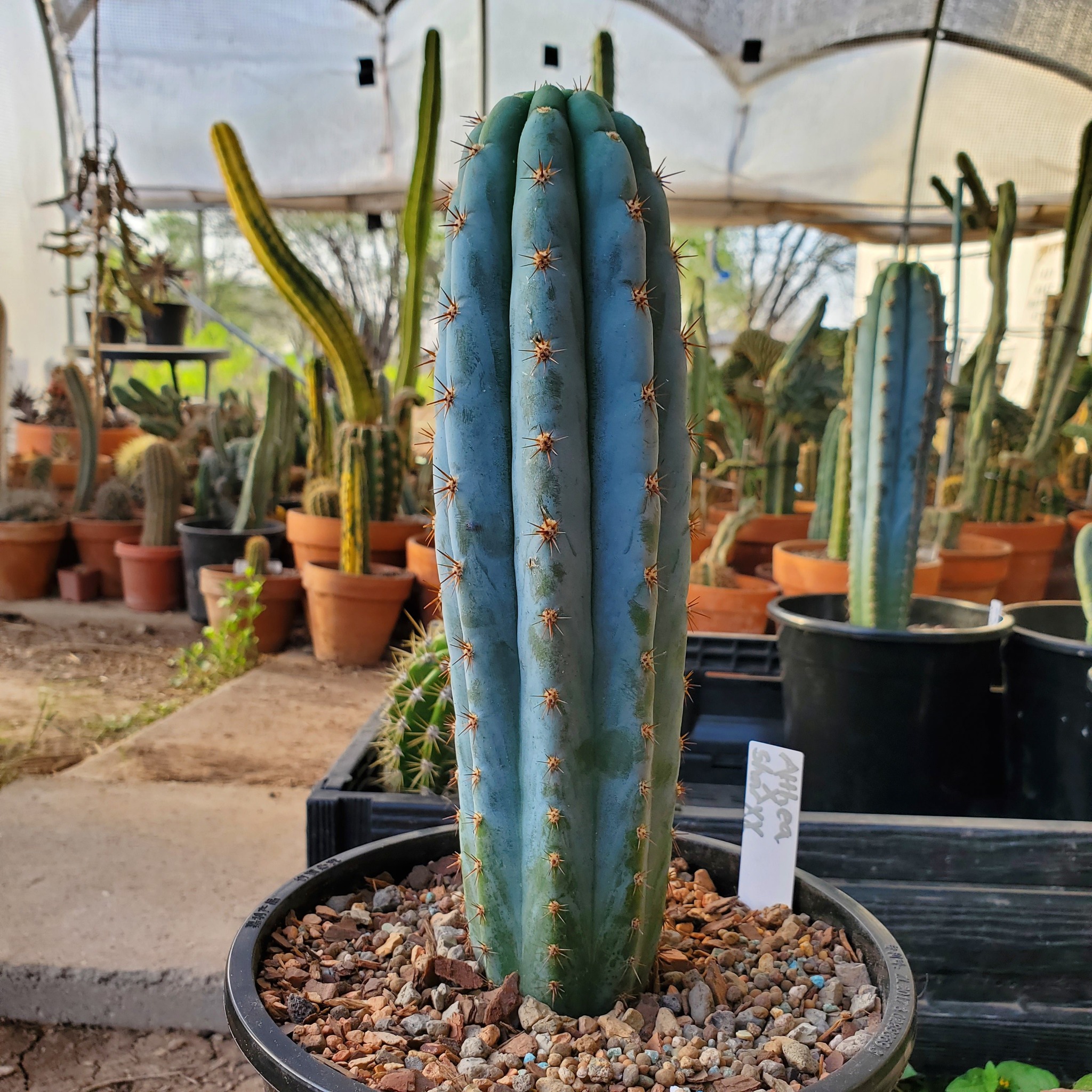
The knobbed spine base is visible without magnification on fresh areoles and with a hand lens on dry specimens. Smooth spine bases on a heavily spined Peruvian columnar indicate E. peruviana, not E. cuzcoensis. Where ranges overlap and hybrids exist, intermediate spine-base characters may occur; elevation provenance is definitive on documented material.
Is Echinopsis cuzcoensis the same as Trichocereus cuzcoensis?
Yes. Trichocereus cuzcoensis Britton & Rose (1920) is the basionym; Echinopsis cuzcoensis (Britton & Rose) H.Friedrich & G.D.Rowley (1974) is the current POWO-accepted name. Both names refer to the same plant. The Trichocereus name remains dominant in the collector trade, specialist literature, and alkaloid chemistry papers because the 1974 generic lumping into Echinopsis is disputed (Albesiano & Terrazas 2012). Kew POWO is used as the baseline on this site; the Trichocereus epithet is retained in the synonymy and in all trade-facing contexts.
Is Echinopsis cuzcoensis easy to grow?
Relatively easy for a large Andean columnar. The species is more cold-tolerant than E. pachanoi or E. peruviana due to its 3,100–3,600 m high-elevation origin. trichocereus.net describes it as having fewer pest problems than many comparable large columnars. The primary risk is wet-cold rot at the root zone during dormancy: keep the substrate bone-dry below 10°C to maintain the documented cold floor. Full sun and sharply draining mineral substrate are the other requirements; the species rewards the Andean winter-dry protocol with subsequent flowering.
How cold-hardy is Echinopsis cuzcoensis?
Cold-hardy for an Andean columnar, consistent with native frosts at 3,100–3,600 m in the Cuzco region. trichocereus.net documents brief tolerance to −9°C when the substrate is kept dry; the Freaky Cacti cold hardiness guide lists −12°C as an approximate minimum for the species (both figures are grower-compiled estimates, not peer-reviewed data). The two figures agree directionally: the species handles brief dry-cold well below freezing. Wet cold at any above-freezing temperature is far more dangerous than dry frost; the dry winter dormancy is the non-negotiable condition for the published cold floor to apply.
What elevation does Echinopsis cuzcoensis grow at in the wild?
3,100–3,600 m in the Cuzco region of southeastern Peru. This 3,100–3,600 m band sits 500–700 m above the typical E. pachanoi range and 300–800 m above the Matucana-type E. peruviana band. Karel Knize’s KK340 collection record places plants at 3,200 m near Huachac, the most precisely documented field locality in the literature reviewed. A wider range of 2,000–4,000 m appears in Botanico Hub but likely includes mis-identified material; the 3,100–3,600 m figure is cross-verified against Anderson & Eggli (2005), the IUCN assessment, and the KK340 field record.
Is Echinopsis cuzcoensis protected or regulated?
Like all Cactaceae, E. cuzcoensis is listed on CITES Appendix II. Wild-collected specimens require export permits from Peru’s SERNANP or equivalent national authority, and import permits in the receiving country. Cultivated plants propagated legally may be traded under CITES Appendix II annotation. Note that dried stems are harvested commercially in Peru for rainstick manufacture, a documented CITES-regulated trade use, so the species carries real commercial harvest pressure at the population level.
Sources & further reading
Britton, N.L. & Rose, J.N. (1920). The Cactaceae vol. 2: 134–136. Carnegie Institution of Washington. [Basionym Trichocereus cuzcoensis; type locality near Cuzco, Peru; diagnostic knobbed spine-base character] · Friedrich, H. & Rowley, G.D. (1974). Echinopsis cuzcoensis. IOS Bulletin: Journal of the International Organization for Succulent Plant Study 3(3): 95. [Transfer to Echinopsis; POWO accepted combination] · Kew POWO (2024). Echinopsis cuzcoensis (Britton & Rose) H.Friedrich & G.D.Rowley. LSID urn:lsid:ipni.org:names:88373-2. [Accepted name, 11 synonyms, native range Peru, introduced Canary Islands] · IPNI (2024). Echinopsis cuzcoensis. International Plant Names Index n/88373-2. [Publication details; author abbreviations confirmed] · Anderson, E.F. & Eggli, U. (2005). Das grosse Kakteen-Lexikon. Ulmer, Stuttgart. pp. 226–227. [Elevation 3,100–3,600 m; 7–8 ribs; about 12 spines up to 7 cm; flowers 12–14 cm; Cusco distribution. Cited via Wikipedia; Wikipedia’s attribution is explicit and specific to these pages] · Schlumpberger, B.O. & Renner, S.S. (2012). Molecular phylogenetics of Echinopsis (Cactaceae): polyphyly at all levels. American Journal of Botany 99(8): 1335–1349. DOI: 10.3732/ajb.1100288 · Albesiano, S. & Terrazas, T. (2012). Cladistic analysis of Trichocereus (Cactaceae). Haseltonia 17: 3–23. DOI: 10.2985/1070-0048-17.1.2 · IUCN Red List (2013). Echinopsis cuzcoensis. Assessor: Jose Roque (Global Cactus). Least Concern; population >10,000 mature individuals; stable. [Primary assessment returned 403 in both research rounds; category, assessor, population, and Machu Picchu buffer zone confirmed via multiple secondary sources] · CITES Checklist of Cactaceae (2024). Appendix II (family-wide listing) · Agurell, S., Bruhn, J.G., Lundström, J. & Svensson, U. (1971). Cactaceae alkaloids X: alkaloids of Trichocereus species and some other cacti. Lloydia 34(2): 183–187. [3-methoxytyramine as major alkaloid in T. cuzcoensis; mescaline minor] · Ogunbodede, O., McCombs, D., Trout, K., Daley, P. & Terry, M. (2010). New mescaline concentrations from 14 taxa/cultivars of Echinopsis spp. Journal of Ethnopharmacology 131(2): 356–362. DOI: 10.1016/j.jep.2010.07.021. [E. cuzcoensis confirmed; mescaline 0.0% dry weight in studied specimen from Cotaruse, Arequipa] · trichocereus.net (2024). Trichocereus cuzcoensis / Echinopsis cuzcoensis species profile. [Morphology; cold tolerance −9°C; germination data; watering protocol; relationship to T. peruvianus] · trichocereus.net (2024). KK340 Trichocereus cuzcoensis field documentation. [Knize collection locality Huachac, Cuzco region, 3,200 m; 1998 seed list; field code designates collection area] · trichocereus.net (2024). Echinopsis peruviana species profile. [Peruviana spine characters for Section 7 distinguishing table; frosted blue epidermis; smooth spine base; elevation approximately 2,800 m at Matucana] · Freaky Cacti cold hardiness guide (2024). Cactus cold hardiness by minimum temperature. URL: freakycacti.com/cultivation-advice/cactus-cold-hardiness-by-minimum-temperature/. [T. cuzcoensis listed at −12°C minimum; approximate guide from grower literature and personal experience] · Botanico Hub (2024). Trichocereus cuzcoensis species profile. [Elevation cross-check; habitat type; secondary distribution notes]