Echinopsis peruviana
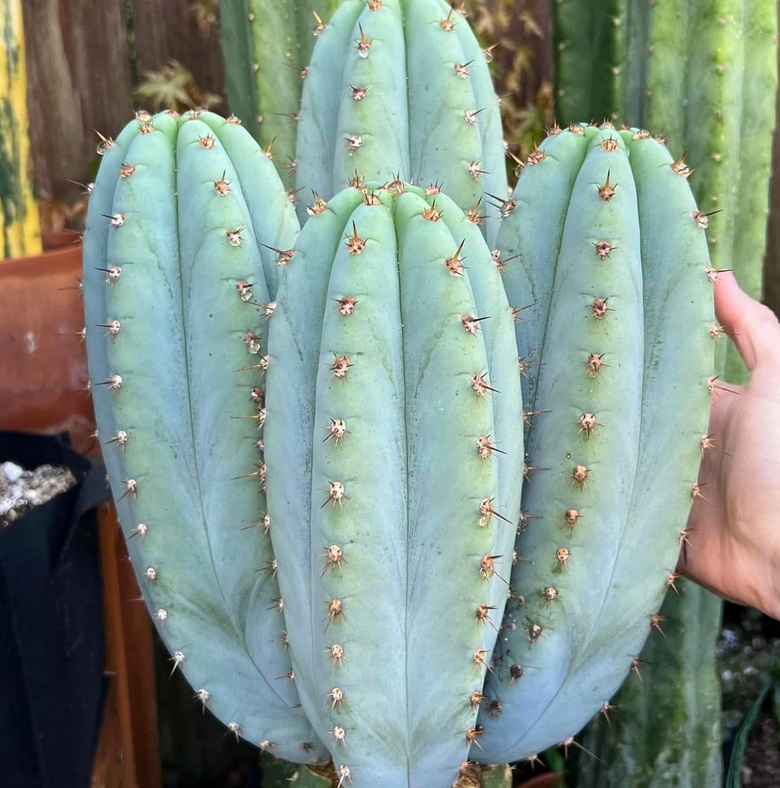
Echinopsis peruviana is the Peruvian torch, a stout blue-glaucous columnar cactus of the western Andean inter-valley system of central and southern Peru. The type material was collected near Matucana in the Río Rímac valley, Lima Department, by Britton and Rose, who published it in 1920 as Trichocereus peruvianus. It is the most consistently blue-skinned of the large Andean columnars, a character that persists on mature stems where the bloom fades on its closest relative, E. pachanoi (San Pedro).
The plant grows on rocky slopes of deeply incised Andean inter-valley corridors at 2,000–3,000 m, where the annual rainfall is 200–400 mm concentrated in a short summer wet season. This drier regime than the Ecuadorian and northern Peruvian habitat of E. pachanoi shapes its cultivation requirements: more conservative summer water and a harder winter rest. In the trade it is still almost universally sold under the older name Trichocereus peruvianus. The Bolivian E. lageniformis (Bolivian torch) is the most commonly offered companion species in the same market, though its 4–6 ribs and different skin character separate it cleanly.
Three taxonomic positions currently compete for this plant. Kew POWO accepts Echinopsis macrogona (Salm-Dyck) H.Friedrich & G.D.Rowley as the name, sinking E. peruviana as a synonym on the basis of Albesiano & Kiesling’s 2012 neotypification of Cereus macrogonus Salm-Dyck (1850). The name E. peruviana is retained on this page because IUCN assesses the species under that name (ID 152559; 2022 assessment), it is the name in the alkaloid chemistry literature, and it is the name most growers and collectors recognise. The Taxonomy section covers all three positions.
Echinopsis peruviana quick reference
A columnar cactus from the western Andean inter-valley slopes of central Peru, native to the 2,000–3,000 m elevation band with a drier summer-rainfall climate (200–400 mm annually) than its Ecuadorian relative E. pachanoi. Values calibrated for seed grown plants in cultivation, drawn from habitat data and specialist grower sources including trichocereus.net and RHS Plant Finder.
Taxonomy & nomenclature
Echinopsis peruviana (Britton & Rose) H.Friedrich & G.D.Rowley was published in IOS Bulletin 3(3): 97 (1974), the transfer of the 1920 basionym Trichocereus peruvianus Britton & Rose into Echinopsis Zucc. The basionym appeared in The Cactaceae volume 2, page 136 with figure 197, based on material from Matucana, Río Rímac valley, Lima Department, Peru, at approximately 2,350 m (Britton & Rose 1920). IPNI LSID: urn:lsid:ipni.org:names:88459-2.
Three positions compete on the accepted name. Kew POWO (2025) treats the plant as Echinopsis macrogona (Salm-Dyck) H.Friedrich & G.D.Rowley, on the basis that Albesiano & Kiesling (Haseltonia 17: 24–34, 2012) designated a neotype of Cereus macrogonus Salm-Dyck (1850) matching the Peruvian form, and that the 1850 basionym has nomenclatural priority over the 1920 T. peruvianus. Hunt’s New Cactus Lexicon (2013) and Anderson’s The Cactus Family (2001) maintain E. peruviana as distinct from E. macrogona, treating the latter as a separate Bolivian-weighted taxon. Albesiano & Terrazas (Haseltonia 17: 3–23, 2012) and the molecular phylogeny of Schlumpberger & Renner (American Journal of Botany 99(8): 1335–1349, 2012) both argue that Echinopsis s.l. is polyphyletic, supporting resurrection of Trichocereus as a valid genus; under that third position the plant would be Trichocereus peruvianus Britton & Rose.
This page follows the horticulturally current name Echinopsis peruviana because IUCN assesses the species under this name (ID 152559; 2022 assessment), the alkaloid chemistry literature consistently uses it, and it is the name collectors and growers recognise. The synonymy under E. macrogona is recorded in the sidebar and will be updated if POWO revises its position.
The species epithet peruviana is the Latin feminine adjective for Peru, recording the country of origin; T. peruvianus was the first member of the Trichocereus group formally described from Peru by Britton and Rose. A nearly spineless form from the Puquio area of Ayacucho department, E. peruviana subsp. puquiensis (Rauh & Backeb.) H.Friedrich & G.D.Rowley, has been recognised by Ostolaza (Cactus Peru, 2014); POWO treats it as another synonym of E. macrogona. Subsp. puquiensis is near-spineless and superficially close in appearance to E. pachanoi.
Habitat
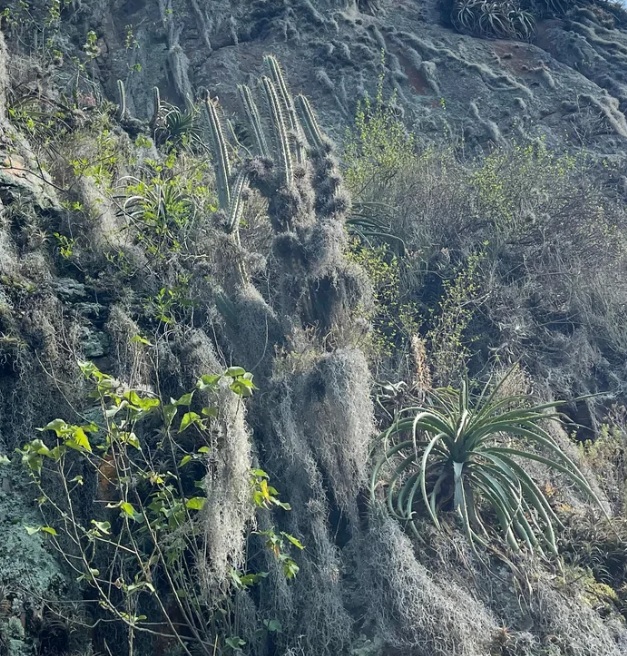
E. peruviana occupies the western slope inter-Andean dry valleys of central and southern Peru at 2,000–3,000 m. These are steeply incised corridors carved by Andean rivers draining to the Pacific, running west from the Continental Divide through a rain-shadow zone that transitions from hot coastal desert below to puna grassland above. The Río Rímac valley and its Matucana tributary, Lima Department, constitute the type locality and the best-documented habitat reference.
Climate is semi-arid montane. Annual precipitation at Matucana is approximately 300–350 mm, concentrated in a short summer wet season from January through March driven by Amazonian moisture crossing the eastern Andes. The remaining nine months are near-dry. This rainfall figure is substantially lower than the 500–800 mm of the Ecuadorian and northern Peruvian habitat of E. pachanoi, and it is the ecological basis for the more conservative watering regime in cultivation. Night temperatures at 2,000–2,500 m fall to 5–10°C during winter months, with episodic frost from June through August.
Substrate is rocky, steeply sloped, and mineral-dominant: soils are thin and gravelly, derived from granitic and volcanic parent rock. The plant grows on cliff edges, rocky outcrops, and scree faces where drainage is immediate. No calcareous substrate is specifically documented for the Rimac valley populations; the geology is predominantly granite and volcanic intrusions.
Vegetation is typical of Rimac valley dry matorral; Opuntia, Puya, and Agave americana commonly accompany the species in this corridor. Documented departments in Peru are Lima, Ancash, Ayacucho, Apurímac, Cuzco, Junín, and La Libertad. The range may extend into Bolivia under the broad E. macrogona treatment (POWO), but under the narrower E. peruviana treatment the native range is considered Peruvian.
Morphology
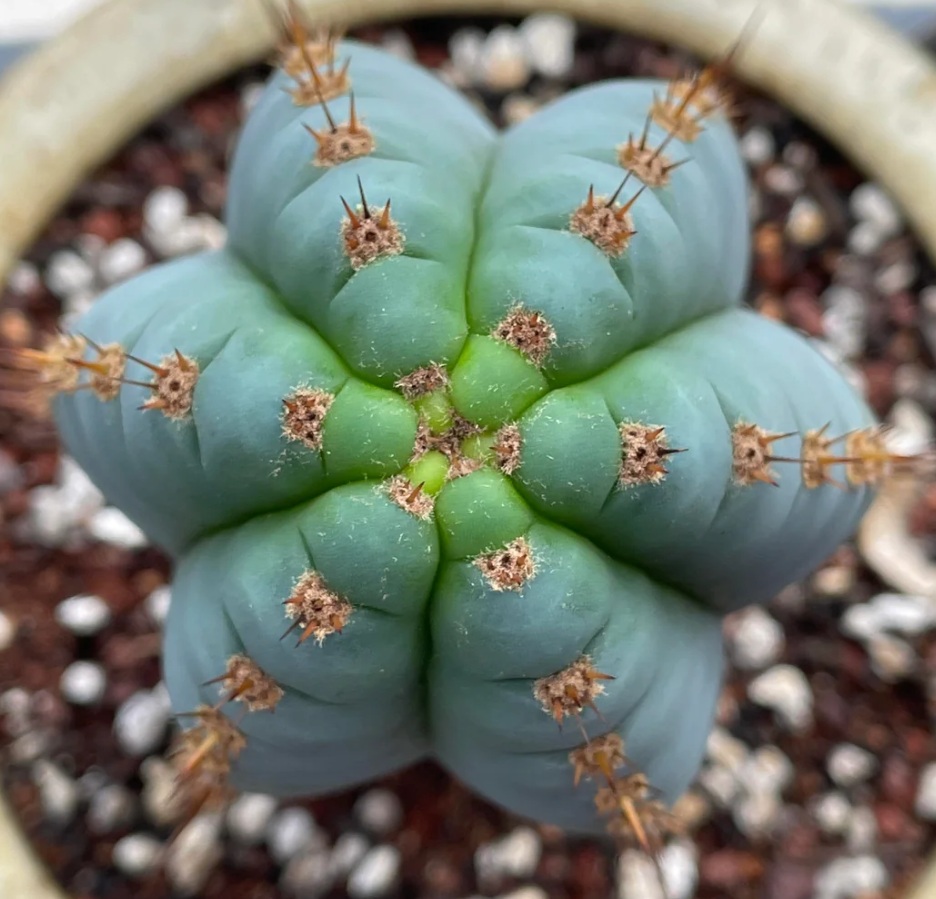
E. peruviana is a stout columnar cactus, 3–6 m tall at maturity in habitat, occasionally arching or becoming semi-prostrate on cliff faces where old stems lose vertical support. Stems branch from the base and from mature columns, forming multi-stemmed clumps. Stem diameter runs 8–18 cm. The epidermis is distinctly blue-glaucous: a frosted waxy bloom covers young stems and persists on mature growth, giving the plant a blue-grey to blue-green colouration documented consistently across independent sources (trichocereus.net; HandWiki; San Pedro Source comparative guide). This blue wax bloom is the most diagnostic single visual character versus E. pachanoi, whose glaucous bloom fades on older stems to bright green.
Ribs number 6–8, broadly rounded; natural variation extends to 9. Areoles are beige to brown felted, approximately 2.5 cm apart, and described as large relative to E. pachanoi (San Pedro Source). Spines number 6–8 per areole, honey-brown aging to dark brown or grey at the tips, up to 4 cm long. Spine bases are not swollen or knobbed, which separates E. peruviana from the E. cuzcoensis of the Urubamba drainage, where conspicuously enlarged spine bases are the diagnostic field character. The spine count and length also exceed typical E. pachanoi, which carries fewer, shorter spines and is often near-spineless on cultivated stock.
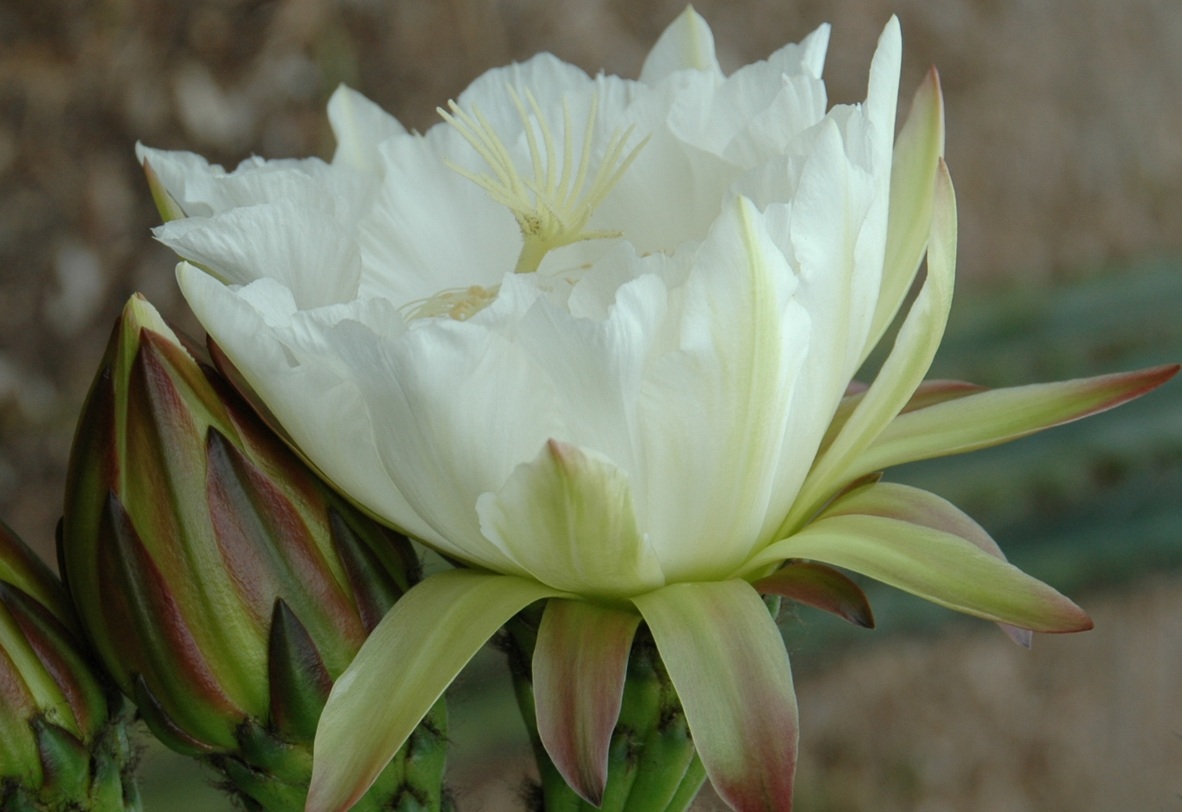
Flowers are white, funnel-form, nocturnal, 15–25 cm long, and open in late spring to summer in cultivation. They are fragrant and close by the following day. The floral tube carries dense dark hairs, a character of the former Trichocereus group. Fruit is round. Seeds are small (0.9–1.1 mm), broadly ovoid, and viability can exceed ten years under dry storage (trichocereus.net). Seeds are light-germinators: sow on the surface without burial.
Locality detail
The native range, under the narrow E. peruviana treatment, spans the western Andean inter-valley system of central and southern Peru across at least seven departments: Lima, Ancash, Ayacucho, Apurímac, Cuzco, Junín, and La Libertad. The type locality at Matucana, Río Rímac valley, Lima Department, remains the most-cited provenance for wild-origin material. Markers sit at regional centroids rather than sharp GPS coordinates, consistent with CITES Appendix II practice across this encyclopedia.
The nearly spineless subsp. puquiensis was collected from the Puquio area of Ayacucho Department and is represented in the southern Peru marker. Under POWO’s broad E. macrogona treatment, the native range also extends into Bolivia; under the narrower E. peruviana treatment followed here, Bolivia is not included in the primary native range.
Cultivation
E. peruviana is a forgiving columnar cactus for cultivation, easier than the slow-growing globular rarities this site covers. The central cultivation lesson follows from its habitat: the Matucana type area receives roughly 300–350 mm of annual rainfall, and the plants spend the majority of the year without significant moisture. Getting that winter rest right is the single most important cultivation lever; summer culture is relatively tolerant of variation.
Substrate
Mineral and fast-draining. An appropriate mix is 50–60% pumice as the primary drainage aggregate, 20–30% low-organic mineral cactus base, and 15–20% decomposed granite or lava rock grit. A small addition of loam (5–10%) is consistent with the valley-floor origin soils that carry modest organic content from seasonal runoff; this distinguishes E. peruviana from purely mineral-substrate Atacama genera. Native substrate is derived from granite and volcanic parent rock on steep exposed slopes; drainage must be immediate.
Watering and light
Water weekly during peak summer growth in warm conditions, backing off in cooler shoulder months as growth slows. The winter rest should be drier overall than for E. pachanoi, reflecting the shorter and drier Matucana wet season. Near-dry October through April is the practical winter target; soil should never remain wet for more than a few hours at any time of year. Wet root conditions in winter are the mechanism behind the rot failures most commonly reported on this species in cultivation.
Light tolerance is broad: full sun is preferred and produces the most pronounced blue-glaucous colour on new growth. Acclimate gradually to full outdoor sun from lower-light conditions; direct exposure on unacclimated plants produces epidermal burn, especially after overwintering. Half-shade is acceptable in hot inland climates and produces slower but healthy growth.
Propagation
Cuttings of at least 20 cm callus and root readily, making vegetative propagation practical and reliable (trichocereus.net; RHS). Allow the cut end to dry and callus before planting into mineral substrate. Seed grown plants represent the full genetic diversity of the species and are the route to wild-type provenance; seed is light-dependent and should be surface-sown without burial at approximately 24°C (RHS). Seeds remain viable up to ten years under dry storage. Grafting onto columnar rootstock is practised commercially to accelerate early growth, though the species is vigorous enough unaided that grafting is unnecessary for cultivation rather than speed.
Comparison
The principal identification question for E. peruviana is its separation from E. pachanoi, addressed with a character table and drag slider in the FAQ below. In summary: skin colour is the most diagnostic character on mature plants (persistent frosted blue versus pale green), spine length and count are reliable at any size (2–4 cm heavy spination versus near-spineless or very short), and native range separates central-to-southern Peruvian material from Ecuadorian and northern Peruvian material. The blue-glaucous colour does appear on juvenile E. pachanoi, so on young plants spines carry more weight than skin colour.
E. cuzcoensis of the Urubamba drainage is the second common confusion, because both are Peruvian columnars with heavy dark spination. The separating character is the spine base: E. cuzcoensis has conspicuously swollen or knobbed spine bases that E. peruviana never shows. Elevation and areole spacing also help: E. cuzcoensis sits at 3,100–3,600 m with areoles spaced roughly 1–2 cm apart, versus 2,000–3,000 m and ~2.5 cm for E. peruviana. Market misidentification of cuzcoensis as peruvianus is documented (trichocereus.net); the knobbed spine base check is the fastest resolution.
The E. chiloensis of central Chile is a candelabra-branching columnar also carrying a blue-glaucous bloom on young growth, and it occasionally appears alongside E. peruviana in collections. It differs in its strongly ribbed profile (12–17 ribs versus 6–8 for E. peruviana), its Chilean provenance, and its distinctive candelabra branching habit above a distinct trunk rather than basal branching.
Frequently asked questions
How do you tell Echinopsis peruviana apart from Echinopsis pachanoi (San Pedro)?
Both species are columnar Andean cacti from the former Trichocereus group, routinely cross-labelled in trade. Drag the slider to compare mature specimens, then read the character table. Persistent skin colour is the single fastest character on mature plants; spine length and count are reliable at any size.
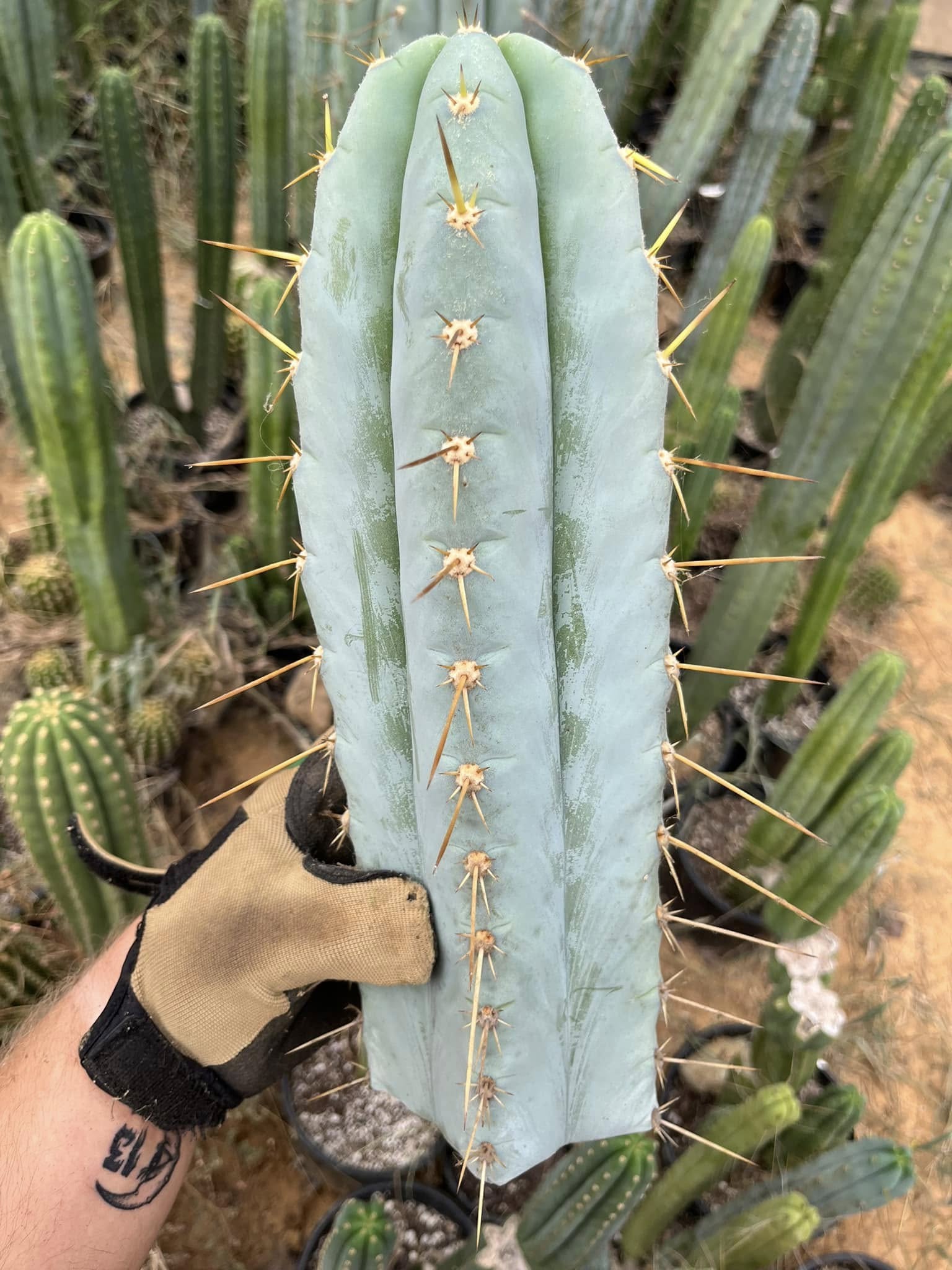
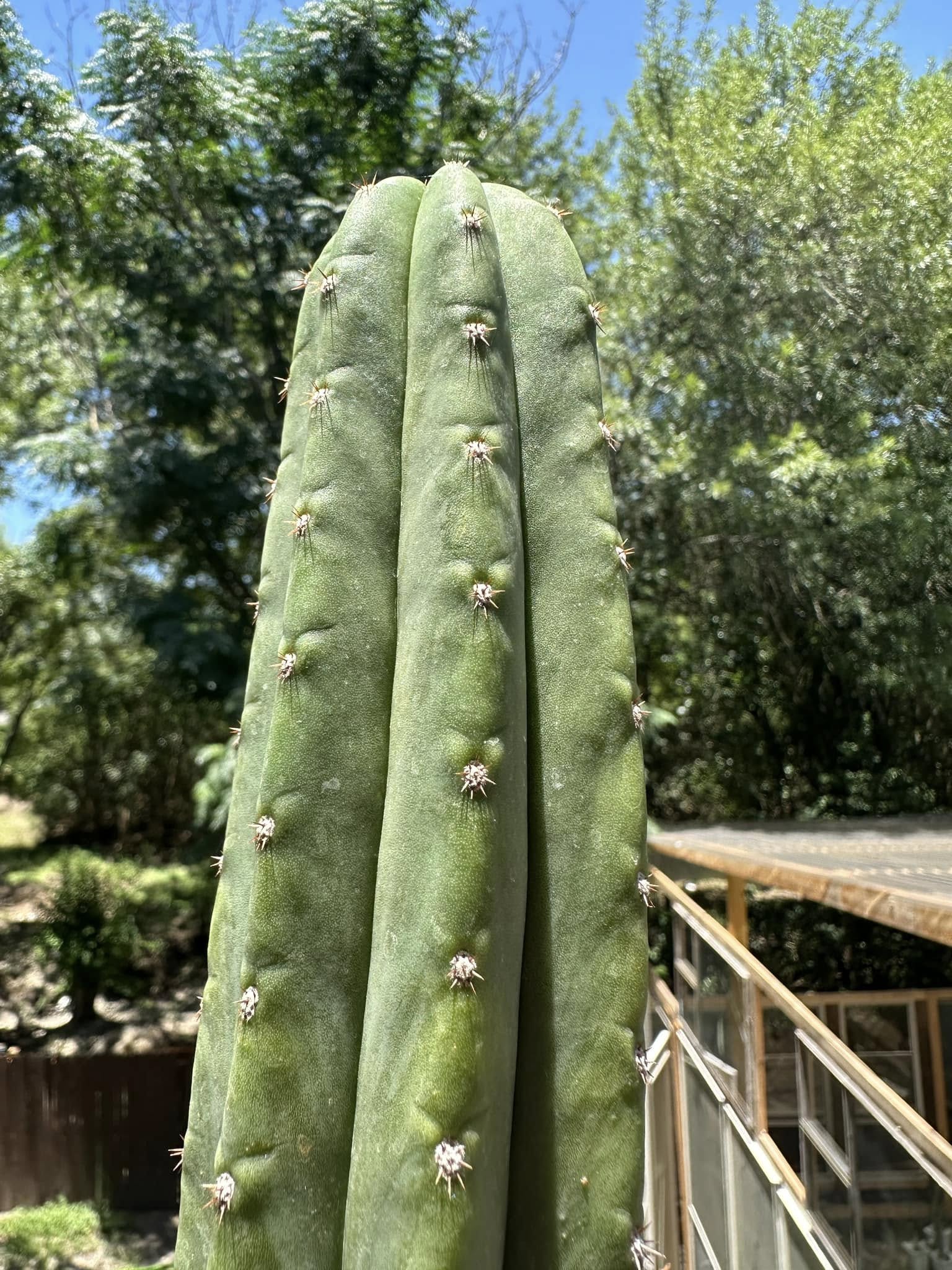
Persistent frosted blue skin plus heavy 2–4 cm spination is the most reliable combination for identifying E. peruviana on mature plants. On juveniles, where both species show a glaucous bloom, spine length and density carry more diagnostic weight. Provenance documentation (Matucana versus Cuenca) resolves ambiguous intermediate plants.
Is Echinopsis peruviana hard to grow?
E. peruviana is forgiving in cultivation relative to the Atacama-origin globular rarities. The main risks are overwatering during the winter rest and sunburn on unacclimated plants moved to full sun. For growers accustomed to Atacama-origin genera, the summer watering tolerance can feel unexpectedly liberal; the habitat receives 200–400 mm annually and the plants respond to summer moisture with robust growth. Winter is the demanding period: keeping the substrate near-dry from late autumn through early spring is what confers cold hardiness and prevents root rot.
How cold-hardy is Echinopsis peruviana, and can it grow outdoors year-round?
The published operational cold floor is −5°C for established plants grown dry (RHS H3 rating). Brief dips to −9°C are reported by specialist growers (trichocereus.net) for fully acclimated, bone-dry specimens, but this should not be treated as a reliable sustained minimum. Wet cold at any above-freezing temperature causes root failure faster than dry frost. USDA Zone 10 is the safe outdoor boundary; in Zone 9 and colder, frost protection or greenhouse overwintering is advisable.
Where does Echinopsis peruviana grow in the wild, and at what elevation?
Echinopsis peruviana grows in the western Andean inter-valley system of central and southern Peru at 2,000–3,000 m. The type locality is Matucana in the Río Rímac valley, Lima Department, at approximately 2,350 m (Britton & Rose 1920). The native range spans at least Lima, Ancash, Ayacucho, Apurímac, Cuzco, Junín, and La Libertad departments. These are the steep, rocky, summer-dry montane inter-valley corridors above the coastal desert and below the Andean puna grasslands.
Does Echinopsis peruviana contain mescaline?
Yes. Mescaline is the primary alkaloid. Concentration varies across populations and individuals: published studies cite a range of 0.24–0.82% dry weight (Pardanani, McLaughlin, Kondrat & Cooks, Lloydia 40(6): 585–590, 1977; Ogunbodede, McCombs, Trout, Daley & Terry, Journal of Ethnopharmacology 131(3): 356–362, 2010). Cultivar variability explains most of the spread: individual wild plants have tested at or near zero mescaline in some assays. Legal status varies by jurisdiction; the living plant moves under CITES Appendix II as part of the blanket Cactaceae listing.
What is the difference between Trichocereus peruvianus and Echinopsis peruviana?
The name Trichocereus peruvianus is the basionym published by Britton & Rose in 1920. It was transferred to Echinopsis by Friedrich & Rowley in 1974, giving the combination Echinopsis peruviana. IUCN, the alkaloid chemistry literature, and the collector trade all use E. peruviana as the current working name. Kew POWO formally synonymises both under Echinopsis macrogona (Albesiano & Kiesling 2012), a treatment not universally accepted by specialist monographs. All three names refer to the same plant; the active disagreement is about which name has nomenclatural priority.
Sources & further reading
Britton, N.L. & Rose, J.N. (1920). The Cactaceae volume 2: 136, fig. 197. Carnegie Institution of Washington. [Protologue; type Matucana, Lima, Peru] · Friedrich, H. & Rowley, G.D. (1974). Echinopsis peruviana. IOS Bulletin 3(3): 97. [Transfer to Echinopsis; IPNI LSID urn:lsid:ipni.org:names:88459-2] · Albesiano, S. & Kiesling, R. (2012). Identity and neotypification of Cereus macrogonus, the type species of Trichocereus (Cactaceae). Haseltonia 17: 24–34. DOI 10.2985/1070-0048-17.1.3 · Albesiano, S. & Terrazas, T. (2012). Cladistic analysis of Trichocereus (Cactaceae: Cactoideae). Haseltonia 17: 3–23 · Schlumpberger, B.O. & Renner, S.S. (2012). Molecular phylogenetics of Echinopsis (Cactaceae): polyphyly at all levels. American Journal of Botany 99(8): 1335–1349. DOI 10.3732/ajb.1100288 · Kew POWO (2025). Echinopsis macrogona (Salm-Dyck) H.Friedrich & G.D.Rowley. LSID urn:lsid:ipni.org:names:132717-1. [POWO treats E. peruviana as synonym] · IUCN Red List (2022). Echinopsis peruviana. ID 152559. Least Concern; Red List 2022.2. iucnredlist.org/species/152559 · CITES Checklist of Cactaceae (2024). Appendix II (family-wide listing, effective 1 July 1975) · Hunt, D. (ed.) (2013). The New Cactus Lexicon. DH Books, Milborne Port. [Retains E. peruviana as distinct from E. macrogona] · Anderson, E.F. (2001). The Cactus Family. Timber Press, Portland. [General reference; E. peruviana treatment] · Ostolaza, C. (2014). Cactus Perú. Ministerio de Agricultura y Riego del Perú. [E. peruviana subsp. puquiensis recognised; southern Peruvian distribution data] · Pardanani, J.H., McLaughlin, J.L., Kondrat, R.W. & Cooks, R.G. (1977). Cactus alkaloids XXXVI: mescaline and related compounds from Trichocereus peruvianus. Lloydia 40(6): 585–590. PMID 600028 · Ogunbodede, O., McCombs, D., Trout, K., Daley, P. & Terry, M. (2010). New mescaline concentrations from 14 taxa/cultivars of Echinopsis spp. Journal of Ethnopharmacology 131(3): 356–362. DOI 10.1016/j.jep.2010.07.021 · RHS Plant Finder (2025). Echinopsis peruviana. Royal Horticultural Society. [H3 hardiness; full sun; 2.5–4 m; 20–50 years; germination 24°C] · trichocereus.net (2025). Trichocereus peruvianus / Echinopsis peruviana Mega Page. [Type locality Matucana; morphology; cold tolerance to −9°C; cultivation notes] · San Pedro Source (2025). Identifying the 5 major types of San Pedro cactus. sanpedrosource.com. [Comparative E. peruviana vs E. pachanoi character table] · GBIF (2025). Echinopsis peruviana (Britton & Rose) H.Friedrich & G.D.Rowley. Species ID 7281309. gbif.org · IPNI (2025). Echinopsis peruviana. International Plant Names Index. urn:lsid:ipni.org:names:88459-2 · HandWiki / Wikipedia (2025). Echinopsis peruviana. [Secondary: distribution departments; morphology dimensions; CITES status]