
Ferocactus glaucescens
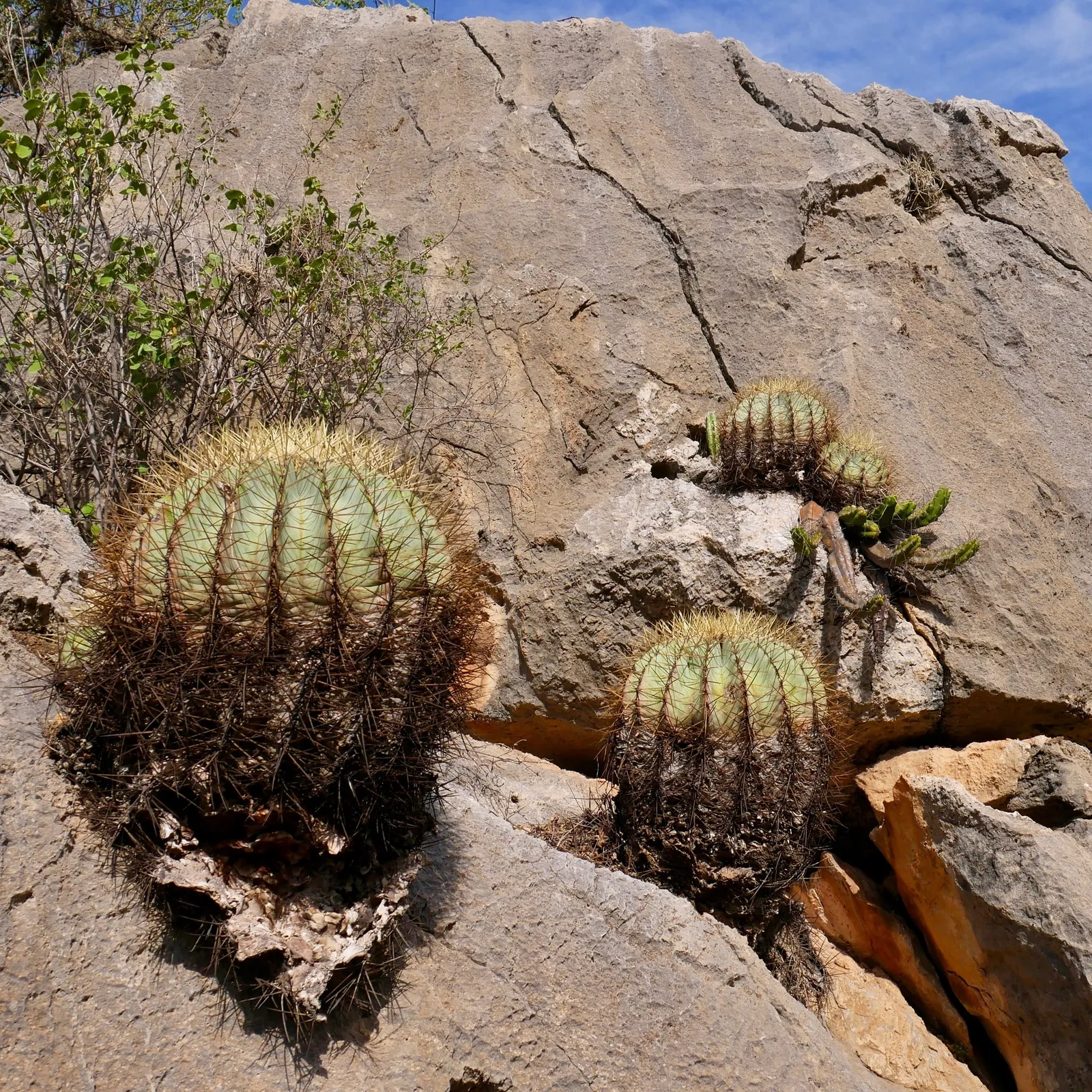
Ferocactus glaucescens, the Mexican blue barrel cactus, carries the most distinctive epidermis in the genus. The thick, frost-like waxy bloom coating the stem produces an intense blue-green colour that is absent in the great majority of barrel cacti and that collectors recognise at a glance from across a growing house. The epithet glaucescens is precise: from the Latin glaucus, “sea-green,” with the suffix -escens, “becoming,” describing how the wax bloom intensifies as the plant matures.
In the wild, the species is confined to the limestone hill country of central Mexico, with the core range running across Hidalgo, Querétaro, Guanajuato, and San Luis Potosí. Kew POWO extends the native range northeast to Veracruz, though field records there are marginal and not well-documented in the specialist literature. Plants grow on rocky limestone slopes and outcrops where drainage is immediate, water never pools, and the substrate is essentially mineral. The Barranca de Metztítlan canyon system in Hidalgo is the best-known habitat reference point; the type locality, collected by George Lindsay, lies five miles south of Jacala at approximately 1,524 m.
In cultivation, F. glaucescens is the most beginner-accessible Ferocactus in cultivation. The compact body stays under 55 cm, lemon-yellow flowers appear reliably once a plant reaches 13 to 15 cm in diameter, and the RHS has awarded it the Award of Garden Merit. The species should not be confused with Ferocactus viridescens, an unrelated coastal Californian species. The spineless cultivar trades under the names f. inermis and f. nudus, strictly horticultural mutations with no wild counterpart, and the accentuated glaucous body makes them particularly sought after.
Like all Ferocactus, the species is covered by the CITES Cactaceae family-level Appendix II listing. Wild collection requires export permits; nursery-propagated plants with documented captive origin can be traded with appropriate documentation. For a full overview of barrel cactus species covered on this site, see the Ferocactus genus guide.
Ferocactus glaucescens quick reference
A globose to short-cylindric Mexican barrel cactus from limestone hill country in Hidalgo and Querétaro, growing at 550–2,300 m in full sun with rapid drainage. Values calibrated for seed grown plants in cultivation, drawn from habitat ecology and specialist grower experience.
Taxonomy & nomenclature
The accepted name is Ferocactus glaucescens (DC.) Britton & Rose, published in The Cactaceae vol. 3: 137 (Carnegie Institution of Washington, 1922). The basionym is Echinocactus glaucescens DC., published in Mém. Mus. Hist. Nat. 17: 115 (1828). Kew POWO (IPNI lsid urn:lsid:ipni.org:names:103632-2) treats the name as accepted and stable.
Augustin Pyramus de Candolle described the species in 1828 as Echinocactus glaucescens, the epithet precisely recording the blue-grey waxy bloom of the epidermis. Britton and Rose transferred it to the newly circumscribed genus Ferocactus in 1922. Curt Backeberg subsequently treated Echinocactus pfeifferi Zucc. as the correct prior name and published Ferocactus pfeifferi in 1961, but this heterotypic synonymy is not followed by POWO or the New Cactus Lexicon. The name Ferocactus glaucescens has been stable in modern treatments since Hunt et al. (2006).
The published synonym list is long. Homotypic synonyms (same type as the accepted name) include Bisnaga glaucescens (DC.) Orcutt (1926) and Parrycactus glaucescens (DC.) Doweld (2000). Heterotypic synonyms include Echinocactus pfeifferi Zucc. ex Pfeiff., Echinocactus hybocentrus Lehm. ex Pfeiff., Echinocactus mammillarioides Hook., Echinocactus theiacanthus Lem., and Echinofossulocactus pfeifferi (Zucc.) Lawr., among others. All major references converge on a single stable taxon with no unresolved species-level disputes.
George Lindsay designated a neotype (Lindsay 2611, DS 370681, Dudley Herbarium, Stanford University) from the limestone outcrops five miles south of Jacala, Hidalgo, at approximately 1,524 m. In Lindsay’s revision, the species was placed in Subgenus Bisnaga, grouping species with fleshy persistent fruits; this placement is not followed in current POWO, which does not list formal subgenera within Ferocactus. The Orcutt name Bisnaga glaucescens (1926) reflects this earlier subgeneric circumscription.
Historical synonyms (12)
- Echinocactus glaucescens DC., 1828 basionym
- Parrycactus glaucescens (DC.) Doweld, 2000 homotypic synonym
- Echinocactus mammillarioides Hook., 1837 heterotypic synonym
- Echinocactus theionacanthus Lem., 1838 heterotypic synonym
- Echinocactus theiacanthus Lem., 1839 heterotypic synonym
- Echinocactus dietrichianus C.F.Först., 1861 heterotypic synonym
- Echinofossulocactus pfeifferi (Zucc.) Lawr., 1922 heterotypic synonym
- Malacocarpus mammillarioides (Hook.) Britton & Rose, 1922 heterotypic synonym
- Pyrrhocactus mammillarioides (Hook.) Backeb., 1936 heterotypic synonym
- Neoporteria mammillarioides (Hook.) Backeb., 1939 heterotypic synonym
- Neoporteria subgibbosa var. mammillarioides (Hook.) Donald & G.D.Rowley, 1966 heterotypic synonym
- Echinocactus pfeifferi Seitz, heterotypic synonym
Sources: POWO (Kew) · IPNI · GBIF · Wikidata
Habitat
Ferocactus glaucescens is a plant of limestone. All sources converge on this substrate: the species grows on limestone hills, boulders, and outcrops where drainage is immediate and water never stagnates. The pH of the rooting substrate is expected to be neutral to moderately alkaline given the geology, though no measured pH for glaucescens microhabitat has been published.
The vegetation community is xerophilous scrub: matorral xerófilo of the Mexican interior plateau and Sierra Madre foothills, transitioning in places toward the Chihuahuan-Tehuacanan boundary zone. At higher elevations the habitat grades into juniper woodland, with Juniperus spp. as companions alongside Agave lechuguilla, Hechtia spp., and Yucca spp. At lower-elevation limestone outcrops the vegetation transitions to thorn scrub. Astrophytum ornatum co-occurs in the Metztítlan canyon system of Hidalgo, which falls within the documented range.
Elevation records vary between sources. The most widely cited range, appearing in llifle and tracing to Anderson (2001), is 550 to 2,300 m. Lindsay’s revision cites a narrower range of 1,000 to 2,500 m from type-locality data; the lower-elevation records at 550 m may represent valley-bottom populations where limestone outcrops occur at reduced altitude. The Jacala type locality itself sits at approximately 1,524 m, within the core elevation band. Multiple sources note a preference for north-facing slopes in Hidalgo, which provides some relief from the most intense midday sun.
The Barranca de Metztítlan Biosphere Reserve in Hidalgo protects a canyon system along the Río Metztítlan that supports more than 70 cactus species in xerophilous scrub. The locality “Meztítlan” appears in historical collection records for F. glaucescens and corresponds to this canyon. The reserve operates ex-situ conservation nurseries for selected cactus species; whether glaucescens is specifically included has not been confirmed in retrieved literature.
Morphology
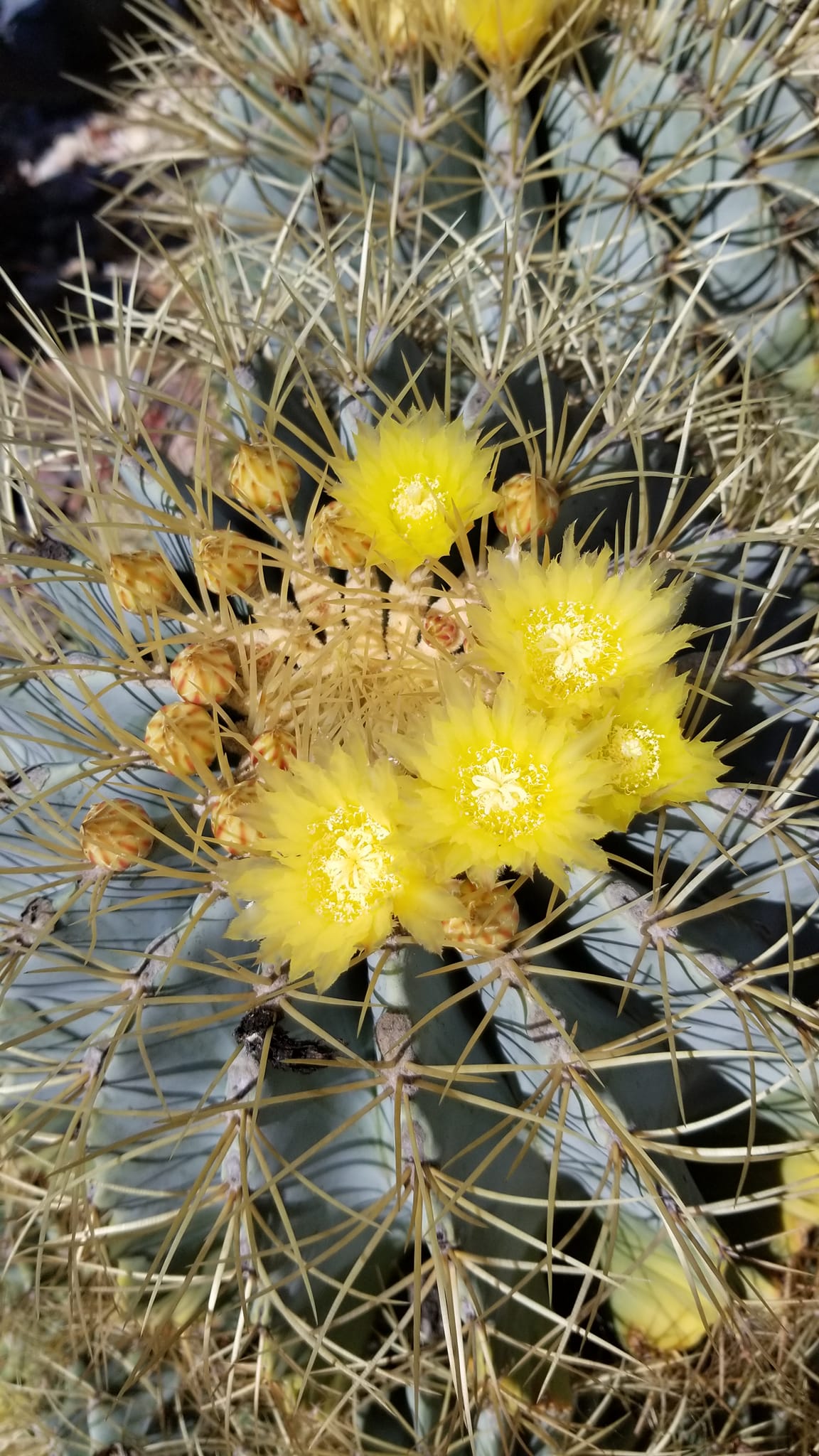
The body is globose in young plants, becoming short-cylindric with age, and typically solitary. Old plants in habitat occasionally produce basal offsets and form clustering mounds. Mature height reaches 45 to 55 cm, with occasional larger specimens reported; the RHS gives “to 60 cm in height” and NParks records up to 70 cm for the tallest plants. Diameter reaches 50 to 60 cm in the largest specimens. These are compact dimensions for the genus: the species stays at a manageable collector size throughout its life.
The epidermis is the defining character. The glaucous blue-grey to blue-green waxy cuticle produces a frost-like bloom absent in the majority of Ferocactus species. The wax serves a photoprotective and desiccation-reduction function on exposed limestone slopes. This bloom is what named the species: glaucescens, becoming sea-green. Once seen, it cannot be confused with any other barrel cactus in a collection setting. The related species Ferocactus histrix occupies similar central Mexican limestone habitat and has comparable body geometry, but its green (non-glaucous) epidermis and higher rib count of 17 to 25 separate it immediately from glaucescens; histrix is a similar limestone-substrate species not covered on this site.
Rib count is 11 to 15 per most sources, citing Anderson (2001); Wikipedia notes up to 17 ribs are recorded, which may represent natural variation at the upper end. Ribs are broad and rounded, slightly wavy in some specimens. Areoles are elongated, woolly on young plants, and in mature specimens often connected by a felt-like crest along the rib edge.
Spines are pale yellow to light golden-yellow throughout: 6 to 7 radials per areole, 2.5 to 4 cm long, straight, not hooked. The central spine count is 0 to 1; when present, it is similar in length and character to the radials. The near-absence of a differentiated central spine, and the uniform pale colouration, immediately distinguish glaucescens from the reddish or dramatically long-spined species such as Ferocactus cylindraceus or Ferocactus hamatacanthus, which bears hooked central spines.
Flowers are funnel-shaped (infundibuliform), lemon yellow, approximately 3 to 4 cm across. Outer tepals may show faint violet or purple tinting on some plants. Flowers are produced in a ring around the apex, with several opening simultaneously in a crown. Bloom season is late spring to summer, with some sources noting March to April in warmer or lower-elevation habitats, suggesting the window can begin earlier in the right conditions.
Fruit is the second most diagnostic character of the species. The white to whitish-yellow, chalky-wax fruit, 2 to 2.5 cm long and covered with yellowish fringed scales, is described in llifle as “unmistakable” among Ferocactus. Remnants of the flower persist at the fruit tip. The flesh is fleshy and edible; the fruit has been used in traditional Mexican cuisine for pit-baked preparations and cactus candy.
The f. inermis form. The spineless selection sold under the names f. inermis and f. nudus (the two are used interchangeably in the trade; their formal nomenclatural priority has not been resolved) does not occur in the wild. It is a strictly horticultural mutation derived from spontaneous spineless variants selected in cultivation. The body is otherwise identical to the typical species: same globose form, same glaucous blue-green epidermis, same rib count, same lemon-yellow flowers. The absence of spines accentuates the blue-green bloom, which is the primary reason for its popularity. Crested (monstrose) forms of f. nudus exist and are extremely rare. Young plants of the inermis form occasionally produce a few vestigial spines that disappear as the plant matures.
Locality detail
The core range of Ferocactus glaucescens spans four central Mexican states: Hidalgo, Querétaro, Guanajuato, and San Luis Potosí. Kew POWO extends the native range to Veracruz in the northeast, though most specialist sources and field guides do not document records there; Veracruz is best understood as the marginal eastern limit of the distribution.
Named collection localities include Metztítlan, Jacala, Toliman, and Zimapan in Hidalgo; Villa Hermosa and the Jalpan area in Querétaro; and the Arroyo Carrizal region in San Luis Potosí. The type locality is the most precisely documented: five miles south of Jacala, Hidalgo, on limestone boulders and outcrops at approximately 1,524 m above sea level (Lindsay 2611, Dudley Herbarium, Stanford University). This places the neotype collection within the rugged limestone hill country of northern Hidalgo.
The elevation range across the full distribution is approximately 550 to 2,300 m. The lower bound reflects valley-bottom limestone outcrop populations; the bulk of documented populations sit at 800 to 2,000 m. Lindsay’s revision cites a narrower range of 1,000 to 2,500 m, which better describes the type-locality band but may not capture the lowest-elevation valley populations documented in later sources.
Ferocactus glaucescens care and cultivation
Ferocactus glaucescens rewards growers reliably. NParks calls it “one of the easiest to grow in the genus”; the Royal Horticultural Society has awarded it the Award of Garden Merit, reflecting consistent performance under UK garden conditions. The primary cultivation risks are wet-cold root rot in winter and insufficient light, which prevents flowering.
Substrate
The habitat is strictly limestone, well-draining, with water never pooling; all sources converge on limestone hills, boulders, and outcrops across Hidalgo, Querétaro, and San Luis Potosí at 550 to 2,300 metres. The canonical cultivation ratio is 35 per cent pumice, 15 per cent lava rock, 5 per cent zeolite, 25 per cent granite grit, 15 per cent limestone chip, and 5 per cent worm castings. The limestone fraction at 15 per cent is house convention, not a species requirement or a copy of the calcareous Regosol: no source establishes the species as a calcicole or a calcifuge. Hard tap water already supplies calcium and bicarbonate at every watering; rainwater and RO water supply neither. The zeolite handles cation exchange and nutrient buffering through summer watering; the lava is the structural drainage aggregate. Zero peat, zero standard potting soil. Giromagi’s recipe combines pumice, clay, and loam; the mineral-heavy limestone-chip approach here is a grower choice, and habitat ecology does not decide between the two.
All four Ferocactus species on this site share the genus 90/10 mineral-organic baseline, and the limestone share in every row is house convention rather than a species requirement. Granite weight shifts between species; the glaucescens and hamatacanthus rows match each other closely.
| Species | Pumice | Lava | Zeolite | Granite | Limestone | Silica | Organic |
|---|---|---|---|---|---|---|---|
| F. viridescens | 40% | 15% | 5% | 30% | 0% | 0% | 10% |
| F. cylindraceus | 40% | 15% | 5% | 30% | 5% | 0% | 5% |
| F. glaucescens (this page) | 35% | 15% | 5% | 25% | 15% | 0% | 5% |
| F. hamatacanthus | 35% | 15% | 5% | 25% | 15% | 0% | 5% |
Container depth should accommodate the taproot that develops on established plants. A container proportionate to the body diameter works well; shallow dishes suitable for mat-forming cacti are not appropriate. In humid climates, terracotta dries fast enough to prevent stem-collar rot; in dry climates, a glazed or plastic container preserves enough moisture for summer growth without waterlogging in winter.
Watering and light
Full sun year-round is the target, matching the exposed limestone hillside habitat. At least six hours of direct sun daily supports strong growth and reliable flowering. Outdoor full-sun cultivation strongly outperforms indoor windowsill growing for flowering performance. One practical note: do not wet the stem from above in strong sun, which can cause surface burns on the glaucous epidermis.
During the growing season (spring through summer), water thoroughly when the substrate is fully dry, roughly weekly in warm conditions. The “soak and dry” method is universally recommended by growers and matches the seasonal summer-rain pattern of the native habitat. Reduce watering progressively through autumn. When temperatures drop below 10°C, keep the plant completely dry; wet-cold conditions are the most common cause of root and crown rot in cultivation. Balanced liquid fertiliser at low strength every two to three weeks during active growth is recommended by the RHS; given the near-sterile limestone habitat, over-fertilisation is a greater risk than under-fertilisation.
Cold tolerance
Two cold-tolerance figures circulate in the literature and they tell the same story from different angles. The RHS rates F. glaucescens at H2, corresponding to a winter minimum of 1 to 5°C with no frost survival. Giromagi gives 6°C as the lower limit. At the other end of the observed range, USDA zone 9b data and cultivation forum reports indicate that a dry, established plant can survive a brief dip to -4°C without damage. The discrepancy is explained by moisture state: a bone-dry plant in well-drained substrate handles brief cold better than a plant carrying any moisture in the roots or crown. The care widget uses 5°C as the practical safe minimum; the -4°C figure applies only to established plants that are completely dry and is not a recommended operating temperature.
Propagation
Seed is the preferred propagation method for collectors. Sow on a mineral cactus mix in spring or summer, cover lightly with fine quartz grit, and provide bottom heat if possible. Germination rate is not documented in published sources. Notably, some populations of F. glaucescens appear to be self-fertile: forum reports from CactiGuide and BCSS growers describe seed set without a second plant, suggesting self-compatibility in at least some individuals. Cactus-lexicon.org notes that “some populations display self-fertility while others are self-sterile,” indicating intraspecific polymorphism. This is grower-level observation, not peer-reviewed data, but it is consistent across independent reports. If flowers open and no second plant is available, hand-pollinating with a dry brush from the same flower cluster is worth attempting. Plants grown from seed begin flowering at approximately 13 to 15 cm in diameter, which NParks estimates at about 12 years under good conditions. Basal offsets from clustering specimens can also be removed, dried for two to three days at the cut surface, and replanted.
Comparison
Among the four Ferocactus species covered on this site, F. glaucescens is the most visually distinctive in a collection setting, yet new collectors occasionally confuse it with other barrel cacti encountered in the trade. The blue-grey glaucous body is the immediate separator: no other common Ferocactus carries this wax bloom.
The most practically important collection-level comparison is with Ferocactus cylindraceus, the compass barrel cactus of the Mojave and Sonoran deserts. A young cylindraceus before its characteristic red-spined adult state, or a larger-than-typical glaucescens in its more cylindric habit, could be confused at a brief glance. The FAQ table below resolves the identification definitively across seven characters. The epidermis is the fastest check: any plant with the intense blue-green frost is glaucescens. The spine system confirms: glaucescens has modest, straight, uniformly pale yellow spines with 0 to 1 central; cylindraceus has dramatically longer, often reddish or grey-red, curved or hooked central spines among its 4 to 7 centrals per areole.
Ferocactus hamatacanthus is less likely to be confused with glaucescens because its hooked central spines, large yellow-and-red flowers up to 7 cm, and green-to-grey-green (non-glaucous) body are striking differences in person. The flower colour is binary: glaucescens produces lemon-yellow flowers; hamatacanthus has conspicuous red centres on otherwise yellow flowers. The third covered sibling, Ferocactus viridescens, is a compact coastal California species with a green (non-glaucous) body and highly variable reddish or yellow-red spines; its coastal San Diego and Baja California habitat is completely disjunct from glaucescens’ central Mexican range.
Frequently asked questions
How do you tell Ferocactus glaucescens apart from Ferocactus cylindraceus?
Ferocactus cylindraceus, the compass barrel cactus of the Mojave and Sonoran deserts, is the sibling species most likely to be confused with F. glaucescens in a mixed collection, particularly in younger plants where adult spine characters are not yet fully expressed. Drag the slider to compare both plants, then check the seven-character table.


The epidermis is the fastest and most reliable check: the blue-grey waxy bloom of glaucescens is absent in cylindraceus and in essentially every other barrel cactus a collector is likely to encounter. Any plant showing that frost-like surface colour is glaucescens or its spineless form. The spine system confirms: glaucescens has modest, straight, uniformly pale spines with at most one central that resembles the radials; cylindraceus has dramatically elongated, curved or hooked centrals in a distinct red or grey-red tone. For fruiting plants, the white chalky fruit of glaucescens is binary against the yellow fruit of cylindraceus.
Is Ferocactus glaucescens easy to grow?
Yes, relative to most rare barrel cacti. NParks describes it as “one of the easiest to grow in the genus Ferocactus,” and the RHS Award of Garden Merit reflects reliable performance under temperate garden conditions. The requirements are simple: full sun, a very well-draining mineral substrate, generous water in summer, and complete drought in winter below 10°C. The main failure mode is wet-cold root rot, which is avoided by keeping the plant bone-dry from autumn through winter. Indoor cultivation is possible at a bright south-facing window, but outdoor full sun is the route to reliable flowering.
How cold hardy is the blue barrel cactus?
The RHS hardiness rating H2 gives a safe minimum of 1 to 5°C, and the RHS recommends frost-free conditions. Giromagi cites 6°C as the practical lower limit for cultivation. At the other extreme, USDA zone 9b data and grower reports indicate that a dry, established plant can survive a brief temperature dip to -4°C (25°F). The difference between these figures is moisture state: a bone-dry plant handles cold much better than one carrying moisture in the roots. In practice, grow frost-free for safety; 5°C is the recommended winter minimum. The -4°C tolerance is a ceiling for brief emergencies, not a target operating temperature.
When does Ferocactus glaucescens flower, and what triggers it?
Bloom season is late spring to summer, with some low-elevation populations and warm-climate cultivations flowering as early as March or April. Flowers are lemon yellow, funnel-shaped, 3 to 4 cm across, produced in a ring around the growing apex with several open simultaneously. The size threshold for first flowering is approximately 13 to 15 cm in diameter; NParks estimates this is reached at about 12 years from seed under good conditions. This is notably early for the genus and is one of the cultivation advantages frequently cited for the species. Full sun and a warm growing season are the primary triggers in cultivation; plants kept in shade or in cool conditions often fail to flower even at flowering size.
Is Ferocactus glaucescens protected, and can I import it?
All Cactaceae are listed under CITES Appendix II, which includes Ferocactus glaucescens. Cross-border movement of any plant or cutting requires CITES documentation; collection from wild habitat is prohibited under Mexican federal law regardless of CITES appendix. Nursery-propagated plants with documented captive origin can be imported with the appropriate Appendix II permits. Within national borders in most countries, ownership of nursery-propagated plants is legal. The conservation status under international red-list criteria does not add further restriction beyond CITES. Always purchase from suppliers who provide documentation of propagated origin.
What is the spineless blue barrel cactus, f. inermis?
The spineless form sold under the names f. inermis and f. nudus is a strictly horticultural selection. It does not occur in the wild; it is derived from spontaneous spineless mutations discovered and propagated in cultivation. The body is identical to the typical species: same globose to short-cylindric form, same glaucous blue-green epidermis, same 11 to 15 ribs, same lemon-yellow flowers. The absence of spines makes the blue-green waxy bloom even more visible, which is the primary aesthetic appeal. Young plants of the inermis form occasionally produce a few vestigial spines that disappear as the plant matures. Cultivation requirements are identical to the typical species. The formal nomenclatural priority between f. inermis and f. nudus has not been resolved in retrieved literature; both names refer to the same horticultural form.
Sources & further reading
Britton, N.L. & Rose, J.N. (1922). The Cactaceae, vol. 3: 137. Carnegie Institution of Washington, Washington, DC · De Candolle, A.P. (1828). Mém. Mus. Hist. Nat. 17: 115. Basionym: Echinocactus glaucescens DC. · Anderson, E.F. (2001). The Cactus Family. Timber Press, Portland, Oregon. ISBN 978-0-88192-498-5 · Hunt, D., Taylor, N. & Charles, G. (2006). The New Cactus Lexicon. DH Books, Milborne Port, UK · Lindsay, G. & Cota, J.H. (1996). The Taxonomy and Ecology of the Genus Ferocactus (Lindsay 1955 doctoral thesis, published posthumously by Cota). Neotype designation: Lindsay 2611, Dudley Herbarium, Stanford · Kew POWO. Ferocactus glaucescens (DC.) Britton & Rose. IPNI lsid urn:lsid:ipni.org:names:103632-2. powo.science.kew.org · llifle.net Encyclopedia of Living Forms, Ferocactus glaucescens entry ID 1532 · Royal Horticultural Society (RHS). Ferocactus glaucescens plant profile; RHS Award of Garden Merit; RHS hardiness H2. rhs.org.uk · NParks Flora & Fauna Web (Singapore). Ferocactus glaucescens. nparks.gov.sg · Giromagi Cactus and Succulents. Ferocactus glaucescens and Ferocactus glaucescens f. inermis species pages. giromagicactusandsucculents.com · Gardening Know How. “Blue Barrel Cactus Care.” gardeningknowhow.com · Useful Tropical Plants / tropical.theferns.info. Ferocactus glaucescens. IUCN Least Concern rationale and traditional-use notes · Wikipedia. Ferocactus glaucescens. Distribution, synonymy, morphology, CITES Species+ ID 22610 · Wikispecies. Ferocactus glaucescens. Complete synonym list with author abbreviations and IPNI identifiers · CITES Cactaceae listing (cites.org/eng/taxonomy/term/8664). Appendix II family-level listing confirmed via secondary sources · CactiGuide.com forum; BCSS forum. Self-fertility of F. glaucescens grower reports (forum-level evidence; cited as supporting observation only)