
Ferocactus hamatacanthus
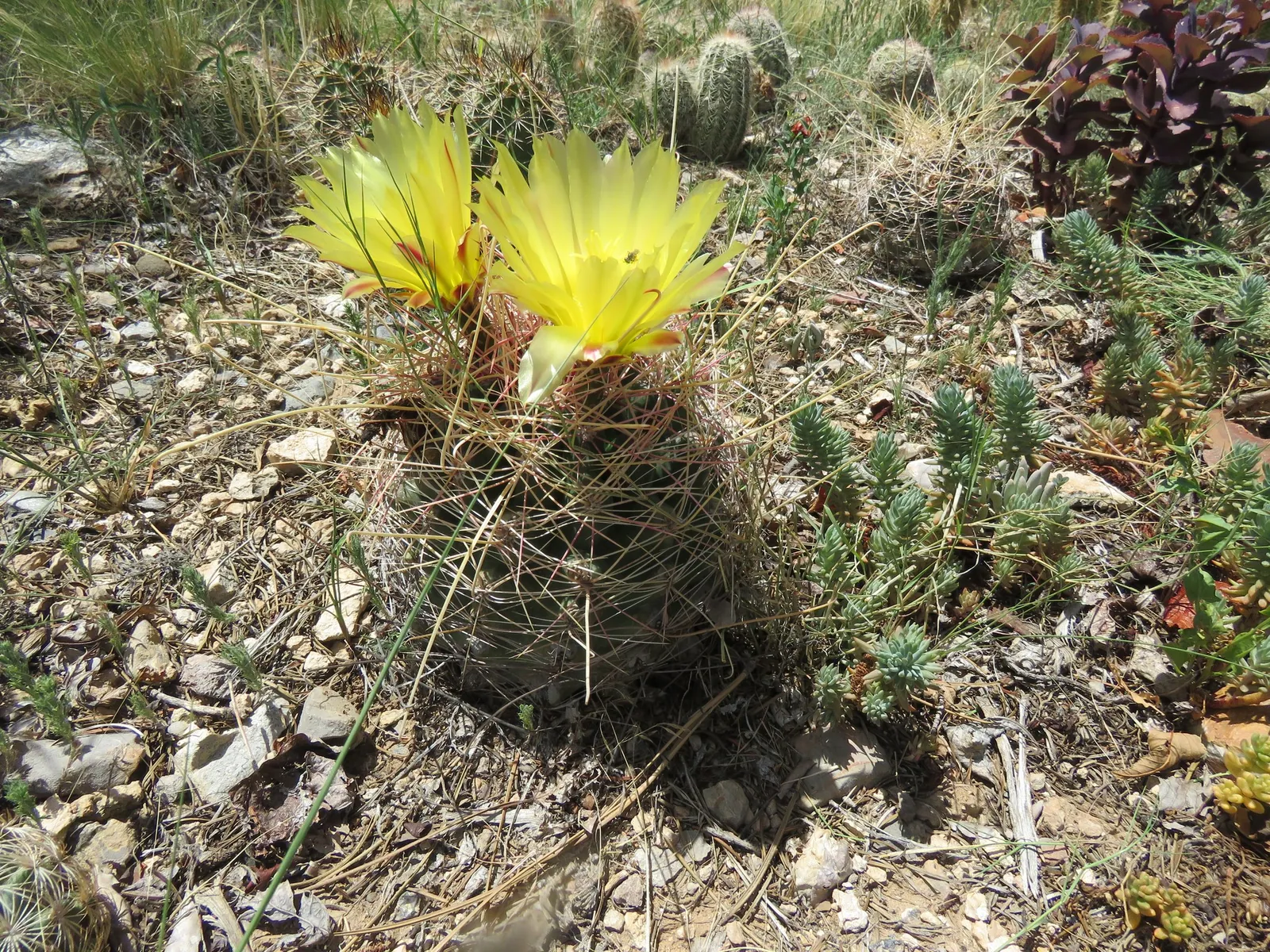
Ferocactus hamatacanthus is the Chihuahuan Desert’s defining barrel cactus and the cold-hardiest species in the genus. Its solitary globose-to-barrel body carries 13 to 17 strongly tubercled ribs armed with a principal central spine that curves sharply into a pronounced hook at the apex; no other Ferocactus species consistently produces this character. The hooked spine inspired both the species epithet (from Latin hamatus, hooked, and Greek akanthos, spine) and all three of its common names.
The species occupies a broad range across the Chihuahuan Desert of Texas, southern New Mexico, and northern Mexico, from Chihuahua and Coahuila south through Nuevo León, Tamaulipas, San Luis Potosí, Durango, and Zacatecas. Two subspecies are recognized by POWO: the nominate subsp. hamatacanthus, which occupies the Trans-Pecos highlands and Mexican interior at 600 to 2,150 m elevation, and subsp. sinuatus (A.Dietr.) N.P.Taylor, a lower-elevation form of South Texas and Tamaulipan thornscrub at 0 to 500 m. The neotype (Palmer 374, deposited at Kew) was designated in 1984 from Saltillo, Coahuila.
Flowers are large relative to plant size, reaching up to 9 cm across, golden yellow with reddish-brown veining on the outer tepals, and notably fragrant. The bloom season runs June through August; subsp. sinuatus may extend slightly into September. Fruit is thin-skinned and juicy, a quality unusual enough within the genus to earn the colloquial name “Mexican fruit cactus.” Ferocactus glaucescens, the Mexican blue barrel, and Ferocactus viridescens, the San Diego coast barrel, share the genus but differ substantially in habit, range, and flower character.
In the Trans-Pecos Texas population at Big Bend National Park, mature plants are commonly 20 to 30 cm tall; the 60 cm maximum reported for the species reflects core Mexican populations under more favorable growing conditions. F. hamatacanthus is the only Ferocactus species in Big Bend National Park; the closest congeners, including Ferocactus cylindraceus, are concentrated in the Sonoran Desert to the west.
Ferocactus hamatacanthus quick reference
A robust Chihuahuan Desert barrel cactus from limestone hillsides and gravelly benches at 600 to 2,150 m elevation, with summer rainfall, cold dry winters, and full desert sun. Values calibrated for seed grown plants in cultivation, drawn from habitat data and specialist grower records.
Taxonomy & nomenclature
The accepted name is Ferocactus hamatacanthus (Muehlenpf.) Britton & Rose, published in The Cactaceae 3: 144–146 (1922). The basionym, Echinocactus hamatacanthus Muehlenpf., appeared in Allgemeine Gartenzeitung 14: 371 in 1846 (under the orthographic variant “hamatocanthus,” corrected in later nomenclature). Kew POWO (IPNI lsid urn:lsid:ipni.org:names:103636-2) and ITIS (TSN 19799) both accept the species under Ferocactus, following Hunt’s New Cactus Lexicon (2006) and Korotkova et al. (2021) in Willdenowia 51(2): 251–270.
Two subspecies are recognized by POWO. Subsp. hamatacanthus is the type; subsp. sinuatus (A.Dietr.) N.P.Taylor was published in Cactaceae Consensus Initiatives 5: 13 (1998), with its basionym Echinocactus sinuatus A.Dietr. dating to 1851. Older names for the sinuatus population include Hamatocactus sinuatus (A.Dietr.) Orcutt (1926) and Brittonia davisii Houghton & C.A.Armstr. (1934).
The generic placement has attracted more debate than is common for a Chihuahuan Desert species. In 1936, F.M. Knuth transferred the species to Hamatocactus, a small segregate genus characterised by the strongly hooked central spine and juicy (rather than dry) fruit. Some US horticultural literature still uses Hamatocactus hamatacanthus. Curt Backeberg later placed the species in Glandulicactus, grouping it with G. uncinatus based on extrafloral gland characters in the areoles. Neither Hamatocactus nor Glandulicactus is accepted by POWO or ITIS; both are treated as synonyms of Ferocactus.
Molecular work supports the current placement. Vazquez-Sanchez et al. (2013) in Systematics and Biodiversity found that Ferocactus sensu lato is polyphyletic with respect to Glandulicactus, Leuchtenbergia, Stenocactus, and Thelocactus, but did not support the segregation of Hamatocactus as a separate genus; the hamatacanthus group sits within the broader Ferocactus clade. De Vos et al. (2025) in Plant Systematics and Evolution recognized Ferocactinae as a monophyletic subtribe containing Ferocactus, Glandulicactus, Kroenleinia, Leuchtenbergia, Stenocactus, and Thelocactus, with F. hamatacanthus placed within it. The species is treated under section or subgenus Bisnaga in some classifications, reflecting the juicy-fruit character shared with certain other barrel cacti.
Historical synonyms (12)
- Echinocactus hamatacanthus Muehlenpf., 1846 basionym
- Echinocactus hamatacanthus var. brevispinus (Engelm.) J.M.Coult., 1896 homotypic synonym
- Echinocactus hamatacanthus var. longihamatus (Galeotti ex Pfeiff.) J.M.Coult., 1896 homotypic synonym
- Hamatocactus hamatacanthus (Muehlenpf.) F.M.Knuth, 1935 homotypic synonym
- Hamatocactus hamatacanthus var. davisii (Houghton & C.A.Armstr.) W.T.Marshall, 1941 homotypic synonym
- Ferocactus hamatacanthus var. crassispinus (Engelm.) L.D.Benson, 1974 homotypic synonym
- Echinocactus longihamatus Galeotti ex Pfeiff., 1847 heterotypic synonym
- Echinocactus setispinus var. longihamatus (Galeotti ex Pfeiff.) Poselg., 1853 heterotypic synonym
- Echinocactus longihamatus var. brevispinus Engelm., 1856 heterotypic synonym
- Echinocactus longihamatus var. gracilispinus Engelm., 1856 heterotypic synonym
- Echinocactus longihamatus var. crassispinus Engelm., 1857 heterotypic synonym
- Echinocactus haematochroanthus Hemsl., 1880 heterotypic synonym
Sources: POWO (Kew) · IPNI · GBIF · Wikidata
Habitat
Ferocactus hamatacanthus is a characteristic plant of the Chihuahuan Desert, the largest desert in North America. Subsp. hamatacanthus grows on rocky limestone hillsides, canyon walls, gravelly benches, and alluvial valleys from the Trans-Pecos region of Texas and extreme southern New Mexico south into Chihuahua, Coahuila, Durango, Nuevo León, San Luis Potosí, and Zacatecas. Limestone is the primary substrate; the species is also documented on hills with igneous rock soils and old river gravels.
Subsp. sinuatus occupies a markedly different ecological context: Tamaulipan thornscrub along the lower Rio Grande from the Pecos River east and south to near Brownsville, Texas, and northeast to the Camp Wood area, together with adjacent northeastern Mexico (Tamaulipas). This population grows in heavy clay and caliche soils at 0 to 500 m elevation, substantially lower and flatter terrain than the nominate subspecies.
Plants in the Trans-Pecos core range, including Big Bend National Park, grow in exposed positions on limestone hills near the Rio Grande, rarely on flat valley floors. Subsp. hamatacanthus spans approximately 600 to 2,150 m elevation; the Big Bend National Park population at the northern range edge typically produces plants of 20 to 30 cm, while the full 60 cm maximum is documented from core Mexican populations at higher elevations. Typical associates in the Trans-Pecos include Agave lechuguilla, Echinocereus species, Echinocactus horizonthalonius, Larrea tridentata, Coryphantha species, Yucca species, and scattered Opuntia. F. hamatacanthus is the sole Ferocactus in Big Bend National Park; the Sonoran-Desert congeners reach their eastern limits well to the west.
The Chihuahuan Desert receives most of its precipitation as summer thunderstorms, with winters that are cold and dry. Night temperatures at higher elevations in the Trans-Pecos can drop below −10°C in hard winters, which is the likely driver of this species’ exceptional cold tolerance among Ferocactus.
Morphology
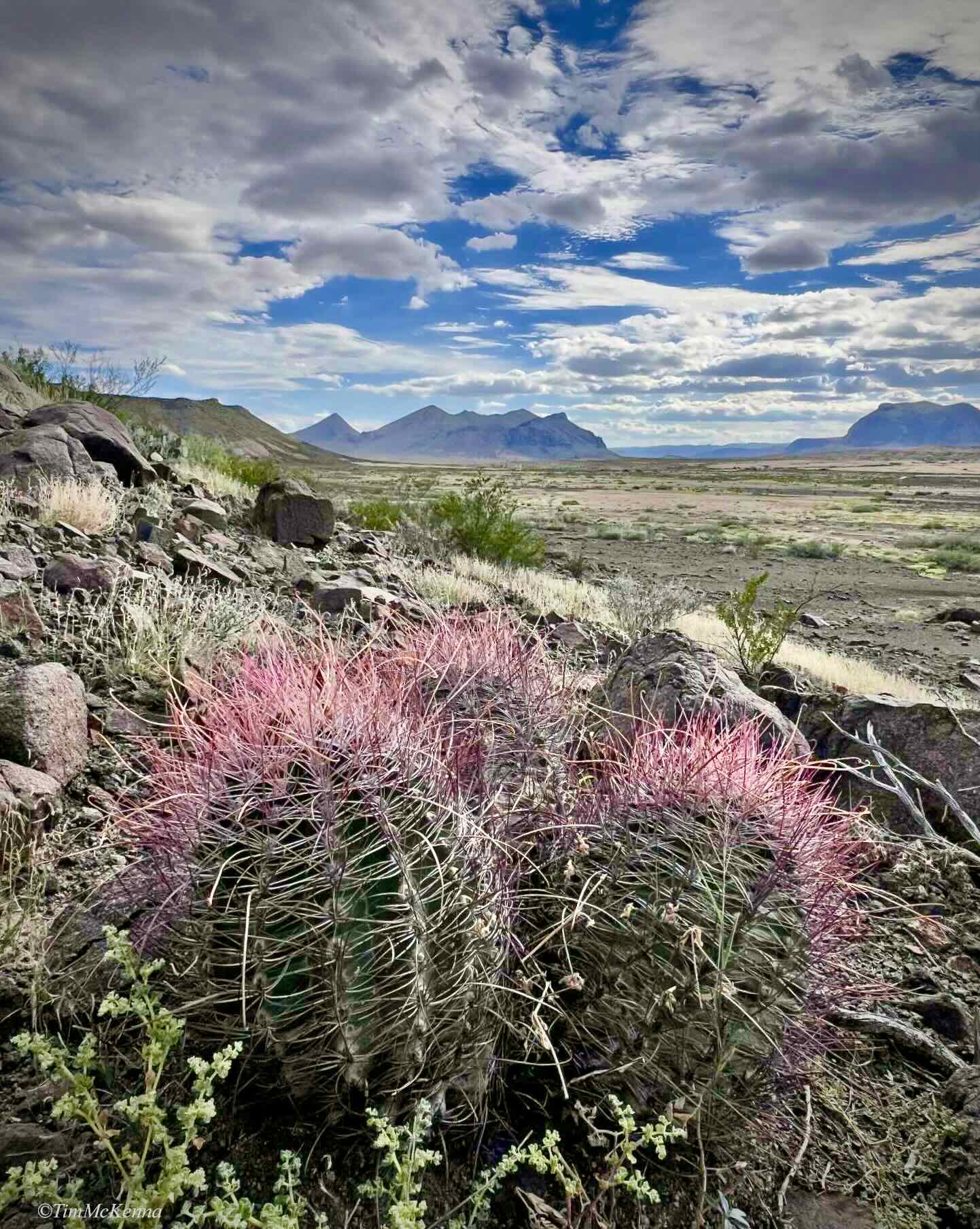
The body is globose when young, becoming broadly cylindrical to barrel-shaped with age. Stems reach 60 cm tall and 30 cm wide, though Big Bend-area plants are often smaller at 20 to 30 cm. The stem is dark green, occasionally tinged purplish under intense sun. Growth is solitary; occasional basal branching in old specimens may produce small clumps.
Ribs number 13 to 17, strongly tubercled, 2 to 3 cm high. The rib surface is acute at the crest in subsp. sinuatus, with somewhat undulate to deeply crenate edges. Areoles are large and woolly. Young areoles between the flower-bearing zone and the spine cluster carry elongated glands 2 to 4 mm long, a character noted in the historical literature as unusual within the genus; they harden and become spine-like with age.
Central spines number 4 to 8 per areole. The principal central spine is the defining character of the species: strongly hooked at the apex, flattened (not round in cross-section), and ridged with transverse annulations. It reaches up to 15 cm in full-grown plants, reddish when new and yellowing to straw-coloured with age. The remaining central spines are curved or slightly hooked but less dramatically so. Radial spines number 8 to 14 per areole, acicular (needle-like) and terete (round in cross-section), 3.5 to 7 cm long, grey to reddish.
Flowers are large for the genus: 6 to 9 cm across, 6 to 8 cm long, funnelform. The inner petals are golden yellow; outer perianth segments carry reddish-brown veining on the reverse. Flowers are notably fragrant, a character confirmed by multiple independent grower records. The Lady Bird Johnson Wildflower Center describes up to 30 petals, sometimes reddish at the base.
Fruit is oblong to globose, 2 to 5 cm long, thin-skinned and very juicy at maturity. Dried floral remains are retained at the fruit apex. The flesh has been compared to kiwi fruit by multiple sources; spines from mature fruit were historically used as needles. Seeds are glossy black, approximately 1 mm long, pitted (foveolate). The juicy fruit is atypical of Ferocactus broadly and was part of the historical argument for segregating the hamatacanthus group into separate genera.
Locality detail
Ferocactus hamatacanthus spans two broadly separated distribution centres. The main range of subsp. hamatacanthus runs from the Trans-Pecos region of western Texas and extreme southern New Mexico southward through the Mexican Chihuahuan Desert states: Chihuahua, Coahuila, Nuevo León, San Luis Potosí, Durango, and Zacatecas. POWO’s distribution summary places it in southeastern New Mexico, western Texas, and Mexico Central, Gulf, and Northeast; Puebla is not included in that summary and is excluded here pending confirmation from primary regional flora sources.
Subsp. sinuatus occupies the Lower Rio Grande Valley of South Texas, extending from the Pecos River confluence eastward to near Brownsville and northeastward to the Camp Wood area of Uvalde and Real counties; it continues into adjacent Tamaulipas in northeastern Mexico. Taylor’s 1998 subspecies treatment reflected the view that no single clean morphological character separates sinuatus from the nominate taxon in hand, but the ecological, elevational, and distributional divergence is sufficient to warrant subspecific recognition.
The neotype (Palmer 374, Kew) fixes the type locality as Saltillo, Coahuila, Mexico; the 1984 neotype designation resolved the original Muehlenpfordt description’s imprecise “Mexico” locality. Big Bend National Park is the most accessible and best-documented US locality and provides the reference population for most published natural-history accounts of the species in Texas.
Ferocactus hamatacanthus care and cultivation
F. hamatacanthus tolerates a wide cultivation range with little fuss. The wide natural range, exposure to genuine winter cold in the Trans-Pecos, and summer-rainfall-adapted growth pattern mean it tolerates conditions that stress narrowly adapted Mexican endemics. The following guidance is drawn from habitat data and specialist grower records; it is written for plants growing from seed without grafting, not for grafted material.
Substrate
Limestone hills, gravelly alluvial benches, and canyon walls define the habitat across the Trans-Pecos and northeast Mexico Chihuahuan Desert. The canonical cultivation ratio is 35 per cent pumice, 15 per cent lava rock, 5 per cent zeolite, 25 per cent granite grit, 15 per cent limestone chip, and 5 per cent worm castings. The limestone fraction is house convention, not a species requirement or a copy of the alkaline calcium-rich geology: no source establishes the species as a calcicole or a calcifuge. Hard tap water already supplies calcium and bicarbonate at every watering; rainwater and RO water supply neither. The 6.1 to 7.8 soil pH listed for the species is a ground-soil figure, not a pot-mix target. The zeolite handles cation exchange and pH buffering; the lava is the structural drainage aggregate. Subsp. sinuatus from clay and caliche soils tolerates slightly more moisture retention but benefits from the same excellent drainage in cultivation. No peat, no high-organic medium.
All four Ferocactus species on this site share the genus 90/10 mineral-organic baseline, and the limestone share in every row is house convention rather than a species requirement. Granite weight shifts between species; the glaucescens and hamatacanthus rows match each other closely.
| Species | Pumice | Lava | Zeolite | Granite | Limestone | Silica | Organic |
|---|---|---|---|---|---|---|---|
| F. viridescens | 40% | 15% | 5% | 30% | 0% | 0% | 10% |
| F. cylindraceus | 40% | 15% | 5% | 30% | 5% | 0% | 5% |
| F. glaucescens | 35% | 15% | 5% | 25% | 15% | 0% | 5% |
| F. hamatacanthus (this page) | 35% | 15% | 5% | 25% | 15% | 0% | 5% |
Repot every 3 to 4 years in fresh mineral substrate. At maturity (up to 60 cm), this species needs progressively larger containers; plan ahead. Ensure the pot has generous drainage holes; the root system is relatively fine and fibrous and does not tolerate prolonged wet conditions at the soil-to-root interface.
Watering and light
The Chihuahuan Desert summer-rain pattern translates directly to a cultivation schedule: active watering through the warmer months, near-complete rest in winter. From spring through early autumn, water thoroughly when the substrate has dried completely, roughly every 10 to 20 days depending on temperature and pot size. Reduce progressively through autumn as temperatures fall. From October through March, keep the substrate near-dry to fully dry; the plant is not actively growing and substrate moisture at sub-zero temperatures significantly raises the risk of crown rot.
Avoid wetting the stem directly in strong direct sun; water droplets on the ribs or central spine can cause localised sunscald. Water at the base, not from above.
Light requirements follow directly from the habitat: full sun. A minimum of 6 hours direct light per day in the growing season keeps spines compact and growth characteristic. Under inadequate light, the body etiolates and spacing between areoles extends.
Cold tolerance
This is the most cold-hardy species in the genus. Published grower figures span a range: llifle gives −7°C as a reliable cold floor for subsp. sinuatus; americansouthwest.net reports −15°C for Trans-Pecos provenance plants; a UK grower on Dave’s Garden documented survival at −8°C under dry shelter. The Big Bend National Park habitat itself experiences occasional hard freezes to approximately −10°C in exceptional winters. The widget uses −10°C as the conservative working figure for dry plants in good drainage, consistent with the Trans-Pecos habitat floor and the UK grower record.
Moisture state is the critical variable. A dry plant at −10°C is within the documented range of reported hardiness; any substrate moisture at 0°C or below is a meaningful rot risk. Some commercial listings cite USDA zone 6a (equivalent to −23°C), a figure not supported by any field or grower data for this species. Zone 8 to 10 is the responsible outdoor-cultivation range; zone 7 may be possible with exceptional drainage, full shelter, and dry winters.
Propagation
Seeds germinate readily at 20°C and above. Germination is reliable and the species is fast-growing for the genus; it rewards seed growers reliably. Growth from seed is well suited to collectors who want plants with documented captive origin; cuttings are rarely taken given the largely solitary growth form. Light annual fertilisation in spring is described by some growers; regular repotting in fresh mineral substrate provides adequate trace elements without requiring a dedicated feeding program.
Comparison
Among the four Ferocactus species covered on this site, F. hamatacanthus is the easiest to distinguish by spine character alone: the strongly hooked principal central spine is definitive. Neither F. glaucescens (pale straight yellow spines, glaucous blue-green body, Hidalgo limestone) nor F. viridescens (compact coastal San Diego species with red-banded spines and no hook) produce a hooked central. Within the broader genus, the only other species where the central spine can approach hooked is F. cylindraceus, discussed below.
The two subspecies of hamatacanthus are worth separating in ecological terms even if morphology does not cleanly distinguish them. Subsp. hamatacanthus is the larger plant, reaching 60 cm, growing on limestone hillsides and desert benches at 600 to 2,150 m across the Trans-Pecos and Mexican interior. Subsp. sinuatus stays smaller (up to 30 cm), occupies Tamaulipan thornscrub in heavy clay soils at 0 to 500 m, and may extend the bloom season slightly into September. No single in-hand vegetative character cleanly separates them; provenance is the most reliable guide.
The juicy, edible fruit is worth mentioning as a secondary comparison point against congeners. F. cylindraceus fruit is dry to slightly fleshy and not noted as edible. F. glaucescens and F. viridescens similarly produce conventional dry fruit. The juicy fruit is the character that historically supported segregation of the hamatacanthus group into Hamatocactus and Bisnaga; molecular work does not support that separation at generic rank, but the fruit character remains a useful identification tool in hand.
Frequently asked questions
How do you tell Ferocactus hamatacanthus apart from Ferocactus cylindraceus?
Ferocactus cylindraceus, the compass barrel or California barrel cactus, is the most practically confusable species in the genus for a collector holding an unlabelled young plant: both are barrel-bodied, reddish when young, and the central spine of some cylindraceus forms can appear curved or slightly hooked. The ranges do not overlap (hamatacanthus is Chihuahuan Desert; cylindraceus is Mojave and Sonoran), so a wild plant is unambiguous by location. Nursery or seed-mix confusion is the practical scenario. Drag the slider to compare, then check the seven characters below.


The most diagnostic combination in hand: rib count (13–17 vs 18–27), degree of hook curvature on the principal central spine, and mature plant size. Flower fragrance and juicy fruit confirm hamatacanthus at bloom and fruiting time; no additional dissection is needed.
How cold-hardy is Ferocactus hamatacanthus?
Ferocactus hamatacanthus is the most cold-tolerant species in the genus. Published grower figures range from −7°C (llifle, subsp. sinuatus) to −15°C (americansouthwest.net, Trans-Pecos provenance). A UK grower documented survival at −8°C under dry shelter; the Big Bend habitat itself records occasional hard freezes to approximately −10°C. The critical condition is dry substrate: any moisture in the pot at sub-zero temperatures makes rot damage likely. Outdoor overwintering is reliable in USDA zones 8 to 10; zone 7 is feasible with excellent drainage and consistent winter dryness. Zone 6a claims appearing in some commercial listings (−23°C) are not supported by any field or grower data.
Is the fruit of Ferocactus hamatacanthus edible?
Yes; the fruit is edible and notably juicy. Multiple independent sources compare the flesh in flavour to kiwi fruit. The fruit is oblong to globose, 2 to 5 cm long, thin-skinned, and green to pale yellowish at maturity, retaining the dried floral remains at the apex. The dried floral buds (cabuche) are also edible and were traditionally harvested and pickled as a food source across the Mexican range. The juicy fruit character is unusual within Ferocactus and is one of the features that historically prompted taxonomists to place this species in the segregate genus Hamatocactus. Spine handling requires care; harvest with tongs or thick gloves.
How do I grow Ferocactus hamatacanthus from seed?
Seeds germinate readily at 20°C and above, making F. hamatacanthus the most forgiving barrel cactus for seed propagation. Sow in a well-drained mineral mix (decomposed granite and pumice work well), keep warm and lightly moist until germination, then treat seedlings as you would mature plants with progressively drier cycles. This species is fast-growing for a barrel cactus; established seedlings put on noticeable size each season under good conditions. Expect 5 to 10 years from seed to first flowering size, depending on growing conditions and summer temperatures. The solitary growth form means cuttings are rarely used for propagation.
When does Ferocactus hamatacanthus flower?
The primary bloom season is June through August. Flowers open near the apex, funnel-shaped, 6 to 9 cm across, golden yellow with reddish-brown veining on the outer tepals. They are notably fragrant; growers report opening in the morning and closing at night. Subsp. sinuatus may extend the season slightly, with some reports of flowering into September in the Lower Rio Grande region. In cultivation, established plants bloom reliably every summer once they reach maturity; one grower reported 9 buds in a single season.
Is Turk’s head cactus the same as Melocactus?
No, though the name belongs primarily to Melocactus. The common name “Turk’s head” originated with Melocactus, the cephalium-bearing genus whose mature plants develop a fibrous, reddish, turban-shaped structure at the crown that closely resembles a traditional Ottoman fez or Turk’s headgear. Melocactus is unrelated to Ferocactus; it belongs to a different tribe and is concentrated in the Caribbean and northeastern South America. Ferocactus hamatacanthus carries the “Turk’s head” name regionally in Texas, where the hooked spine cluster at the crown of mature plants evokes the same visual association, but this is a secondary and regional application. Searches and AI responses for “Turk’s head cactus” are more likely to surface Melocactus than F. hamatacanthus, and the two plants look nothing alike in cultivation.
Sources & further reading
Muehlenpfordt, P.A.F. (1846). Echinocactus hamatacanthus. Allgemeine Gartenzeitung 14: 371 · Britton, N.L. & Rose, J.N. (1922). The Cactaceae 3: 144–146. Carnegie Institution of Washington · Kew POWO, Ferocactus hamatacanthus (Muehlenpf.) Britton & Rose, IPNI lsid urn:lsid:ipni.org:names:103636-2 · ITIS, Ferocactus hamatacanthus (Muehlenpf.) Britton & Rose, TSN 19799, authority Hunt, New Cactus Lexicon (2006) · Taylor, N.P. (1998). Subsp. sinuatus combination. Cactaceae Consensus Initiatives 5: 13 · Korotkova, N. et al. (2021). Cactaceae at Caryophyllales.org. Willdenowia 51(2): 251–270 · Vazquez-Sanchez, M., Terrazas, T., Arias, S. & Ochoterena, H. (2013). Molecular phylogeny, origin and taxonomic implications of the tribe Cacteae. Systematics and Biodiversity 11(1). DOI 10.1080/14772000.2013.775191 · de Vos, J.M., Eggli, U., Nyffeler, R., Larridon, I. et al. (2025). Phylogenomics and classification of Cactaceae based on hundreds of nuclear genes. Plant Systematics and Evolution. DOI 10.1007/s00606-025-01948-z · Anderson, E.F. (2001). The Cactus Family. Timber Press, Portland · Lady Bird Johnson Wildflower Center, UT Austin. Ferocactus hamatacanthus (Turk’s Head). https://www.wildflower.org/plants/result.php?id_plant=feha2 · llifle.com Encyclopedia of Living Forms. Ferocactus hamatacanthus subsp. sinuatus (A.Dietr.) N.P.Taylor · Useful Temperate Plants database. Ferocactus hamatacanthus. https://temperate.theferns.info/plant/ferocactus+hamatacanthus · Dave’s Garden Plant Files. Ferocactus hamatacanthus grower records. https://davesgarden.com/guides/pf/go/100251 · Wikipedia. Ferocactus hamatacanthus. https://en.wikipedia.org/wiki/Ferocactus_hamatacanthus · cacti.1400ml.com. Ferocactus hamatacanthus entry. https://cacti.1400ml.com/ferocactus-hamatacanthus/