
Leuchtenbergia principis
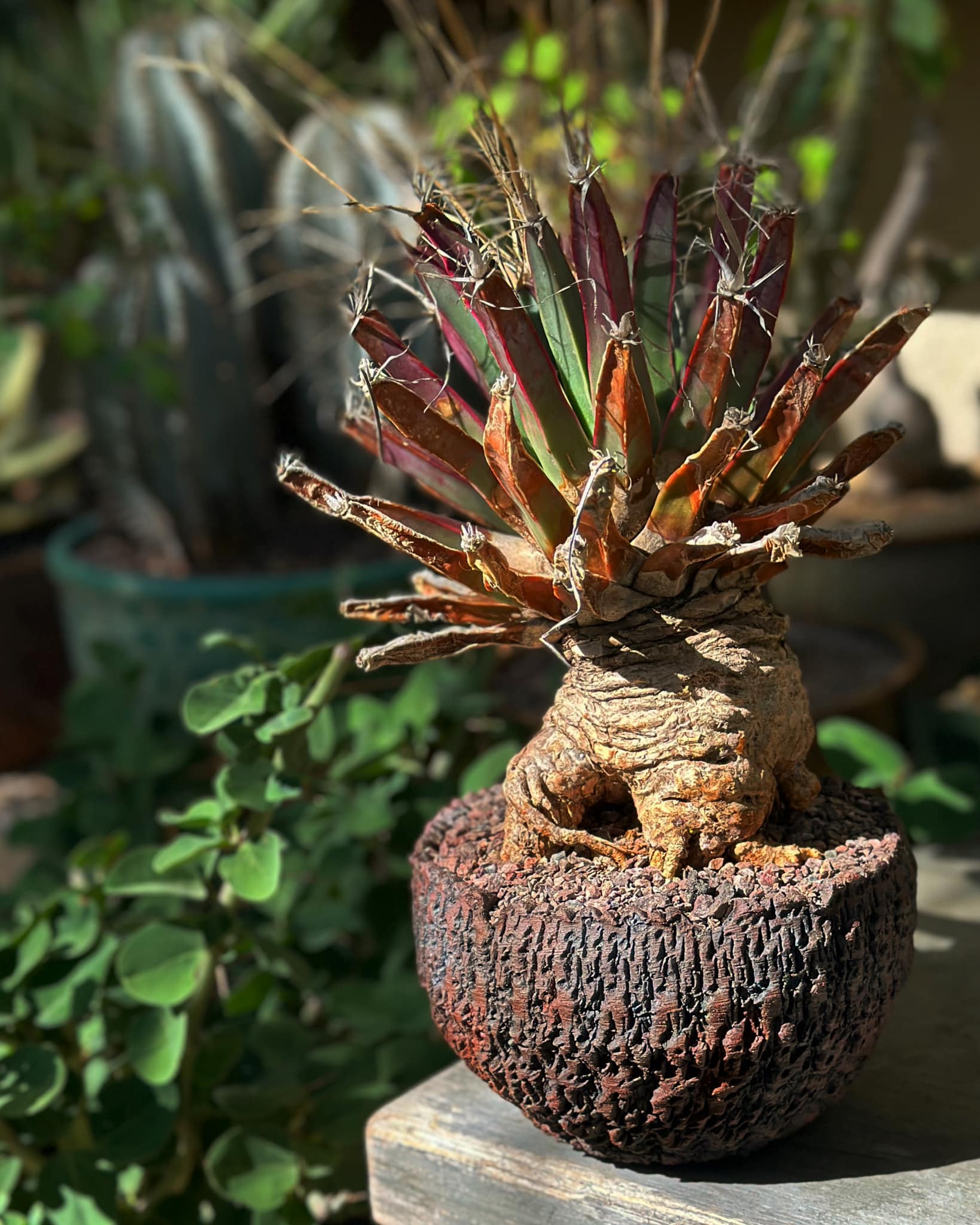
Leuchtenbergia principis Hook. is the sole species in a monotypic genus, published in Curtis’s Botanical Magazine in 1848 from a specimen flowering at the Royal Botanic Gardens, Kew, sourced originally from Mineral del Monte in Hidalgo, Mexico. William Jackson Hooker formally described the plant from material circulated earlier by Friedrich Ernst Ludwig Fischer, then director of the Imperial Botanical Garden of St Petersburg, giving the full authorship string “Fisch. ex Hook.” in modern nomenclature, though the short form “Hook.” is standard in current literature. No second species has ever been accepted into the genus, making L. principis simultaneously the founding and terminal entry in Leuchtenbergia.
The genus name honours Maximilian de Beauharnais, 3rd Duke of Leuchtenberg (1817-1852), a member of the Bavarian-Russian Beauharnais line who was resident in St Petersburg from his 1839 marriage to Grand Duchess Maria Nikolaevna onward. The living-dedicatee reading fits the publication date of 1848 precisely; some earlier secondary sources credit Eugène de Beauharnais, the 1st Duke, who died in 1824, twenty-four years before Hooker published the name. The specific epithet principis is Latin genitive singular of princeps: “of the prince.” Together the binomial reads “the prince of Leuchtenberg’s plant.”
Molecularly, L. principis sits inside subtribe Ferocactinae, a clade that also contains Ferocactus, Stenocactus, Thelocactus, Glandulicactus, and Kroenleinia. The close phylogenetic relationship with Ferocactus is why the intergeneric hybrid genus ×Ferobergia (Ferocactus × Leuchtenbergia) produces fully fertile F1 offspring and survives into F2 and later generations. Despite this clade membership, nothing in the family shares L. principis’s diagnostic silhouette: long, triangular, pencil-like tubercles 6 to 12 cm long, each ending in an apical areole carrying a tuft of papery flexible spines, the look that earns it the trade name “agave cactus.”
The plant grows across the calcareous Chihuahuan Desert of central-north Mexico, documented in eight states: Coahuila, Nuevo León, San Luis Potosí, Zacatecas, Durango, Tamaulipas, Guanajuato, and Hidalgo. Core populations concentrate on limestone slopes and stony bajadas at 1,500 to 2,000 m, often sheltering at the base of Agave lechuguilla clumps, where the papery spine tufts and glaucous grey-green tubercles produce remarkable visual camouflage against dried agave leaf bases.
Leuchtenbergia principis quick reference
An endemic of calcareous Chihuahuan Desert at 1,500 to 2,000 m across eight Mexican states; the critical cultivation constraints are a deep pot for the napiform taproot and a completely dry winter rest. Values calibrated for seed grown plants in cultivation, drawn from species-specific habitat data and grower sources.
Taxonomy & nomenclature
The accepted name is Leuchtenbergia principis Hook., published in Curtis’s Botanical Magazine 74: tab. 4393 (1848). The protologue plate was engraved by Walter Hood Fitch from a specimen flowering at Kew; the original material came from Mineral del Monte, Hidalgo, Mexico, which therefore stands as the type locality. POWO records the full author string as “Fisch. ex Hook.” to reflect that Friedrich Ernst Ludwig Fischer had circulated the name in correspondence and seed catalogues before Hooker’s valid publication; the short form “Hook.” is standard where only the validating author is required.
The genus is monotypic. POWO accepts only L. principis; no second species has ever received acceptance. POWO records one formal homotypic synonym: Anhalonium leuchtenbergii A.Dietr. (1848), flagged as nom. illeg. superfl. (illegitimate, superfluous). Published nearly simultaneously with Hooker’s name and set aside under nomenclatural priority. The variety trachythele K.Schum. and the horticultural form names f. cristata, f. monstruosa, and f. gracilis appear in grower literature but are not accepted at formal taxonomic rank.
Phylogenetic placement is within subtribe Ferocactinae (Korotkova et al. 2021; de Vos et al. 2025), a monophyletic group inside tribe Cacteae. Vázquez-Sánchez et al. (2013) recovered Ferocactus as polyphyletic with respect to Leuchtenbergia, Stenocactus, Thelocactus, and Glandulicactus; the same assemblage is formalised as Ferocactinae in the 2025 phylogenomic treatment. Nomenclatural priority of Leuchtenbergia (Hook. 1848) over Ferocactus (Britton & Rose 1922) prevents the practical lump even though the molecular evidence would support it.
Habitat
Leuchtenbergia principis is endemic to Mexico, documented across eight states of the central-north Mexican Plateau and the Sierra Madre Oriental foothills: Coahuila, Nuevo León, San Luis Potosí, Zacatecas, Durango, Tamaulipas, Guanajuato, and Hidalgo. The Sierra de Parras and Sierra de la Paila in Coahuila are cited as zones of unusual abundance; populations in Hidalgo cluster around the Mineral del Monte district, the type-locality region. Elevation runs 1,500 to 2,000 m across most of the range, with easternmost (Tamaulipas) and southernmost (Hidalgo) populations pushing toward 2,300 m.
Substrate is calcareous Chihuahuan Desert throughout the range: limestone slopes, stony calcareous bajadas, and the bench gravels of Sierra Madre Oriental foothills. Native soil pH runs 7.0 to 7.8. Plants grow singly and are sparsely scattered even where the species is technically common. The most consistently cited plant associates are Agave lechuguilla and Hechtia terrestrial bromeliads; individual L. principis rosettes often shelter at the base of Agave lechuguilla clumps or within the litter of Hechtia mats. Yucca filifera is a frequent companion in the type-locality elevation band.
The combination of glaucous grey-green tubercles and papery straw-coloured spines provides remarkable visual camouflage in this habitat. Juvenile plants with tubercles 4 to 6 cm long are regularly confused with Agave lechuguilla or Agave striata seedlings at survey distance; the diagnostic check is the apical areole with its spine cluster at each tubercle tip, a character that no agave carries.
Morphology
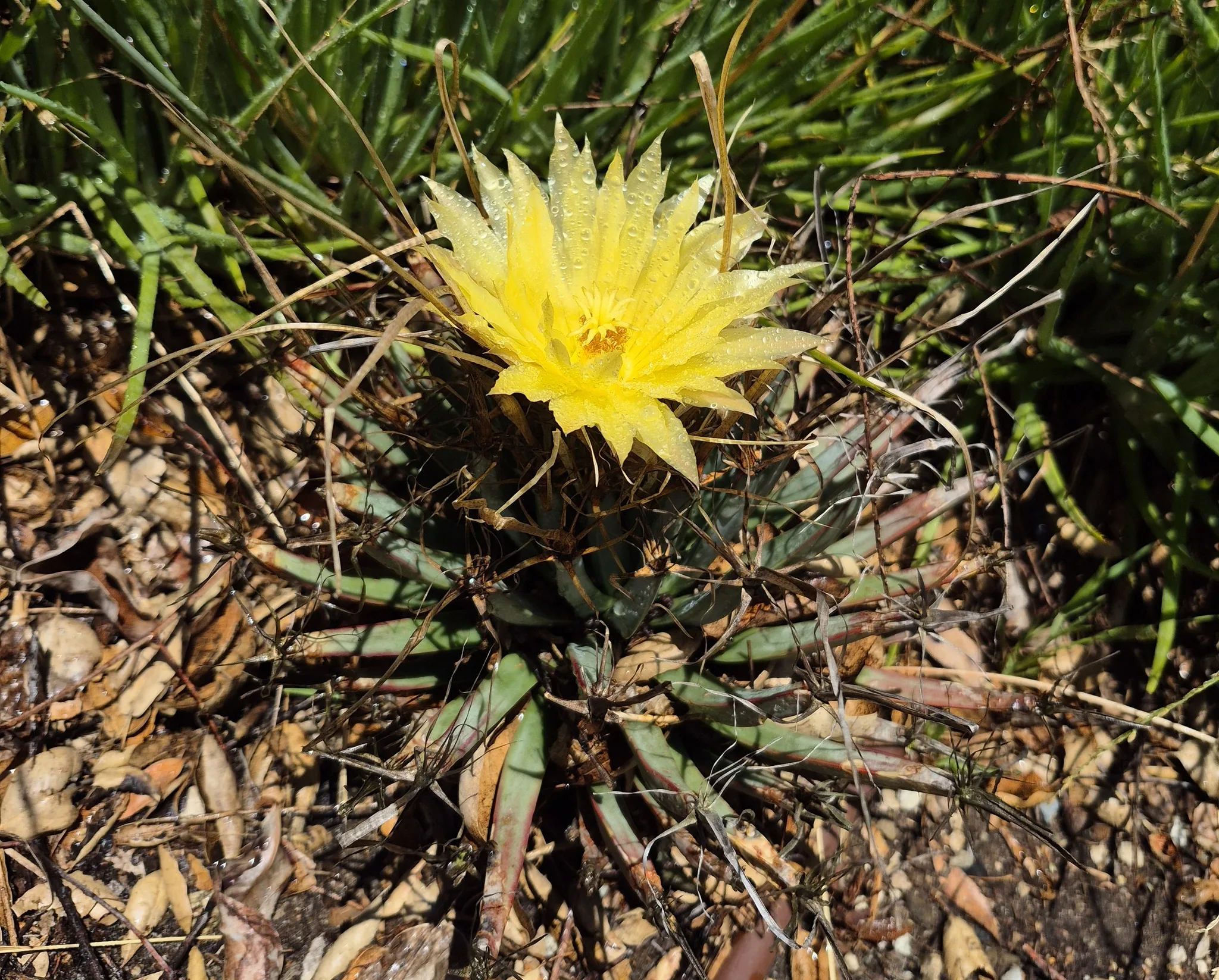
Body solitary as a rule; rarely a second head forms from the base on very old plants. The stem proper is short and cylindrical, ultimately 5 to 10 cm in diameter and up to 70 cm tall on habitat specimens of exceptional age, though most cultivated plants stay 20 to 35 cm. The lower stem becomes corky and bare as old tubercles abscise; the live rosette of new tubercles occupies only the upper crown. Below ground, a large napiform (turnip-shaped) tuberous taproot extends 20 to 25 cm long and up to 7.5 cm in diameter on mature plants, often exceeding the above-ground body in total mass.
The tubercles are the defining character. They project outward and slightly upward from the central stem in a loose rosette, each one triangular in cross-section (three-sided, like an agave leaf base), 6 to 12 cm long and typically 1.3 to 2 cm wide at the insertion, tapering to a blunt point. Colour is glaucous grey-green to bluish-green, often with a purplish-red flush at the tip on younger tubercles; older, lower tubercles dry from the tip downward to a brown papery finish. The areole sits at the very apex of each tubercle, carrying grey wool; its position at the tip, not on a rib, is the structural character that kept Hooker firmly inside Cactaceae despite the agave silhouette.
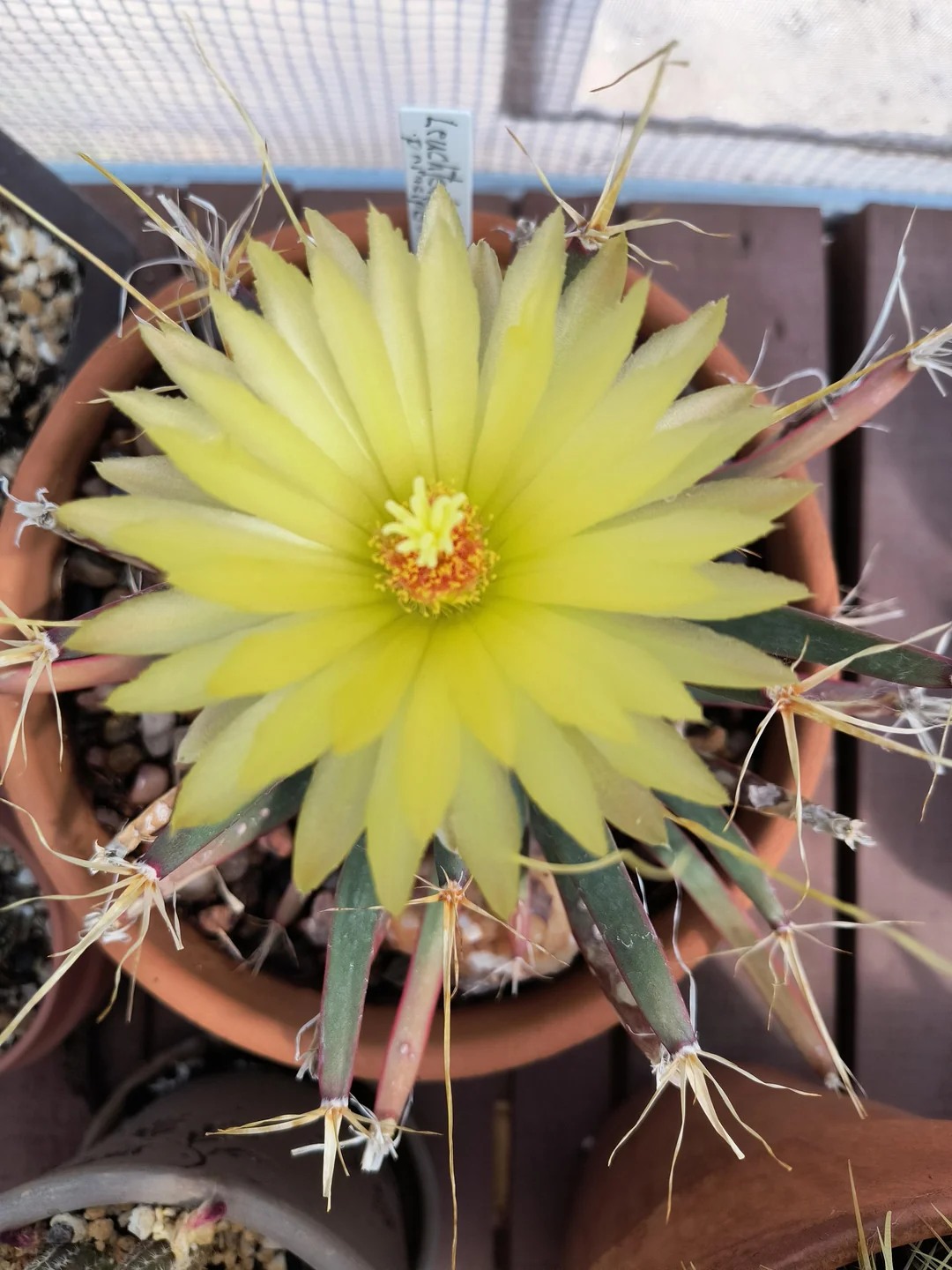
Spines are the second diagnostic character: papery, flexible, and twisted. They cannot be broken cleanly; they bend. Nothing else in Cactaceae at this spine scale looks similar. Eight to fourteen radial spines per areole, typically 5 to 10 cm long, spreading laterally and slightly forward; one to two central spines up to 20 cm long, often curving and twisting like dried grass blades. Colour light brown to straw-yellow on new growth, weathering to greyish-brown. The overall impression at the tip of each tubercle is a tuft of papery grass blades, not a conventional cactus spine cluster.
Flowers are funnel-form (infundibuliform), clear yellow to lemon-yellow with a slight silky sheen on the inner tepals, 5 to 8 cm in diameter, fragrant, borne at the apical areoles of the youngest tubercles at the centre of the rosette. They open during the day, close at night, and reopen the following morning. Plants produce intermittent flushes from late spring through autumn, with peak in early to mid summer. Mature plants from 4 to 5 years from seed flower regularly; plants in unsuitable containers or light may not flower for 6 to 8 years. Fruit is a glaucous green to violet-tinted cylinder, roughly 3 cm long by 2 cm wide, dehiscing from the base; seeds are dark brown to black, several hundred per fruit.
Locality detail
The type locality is Mineral del Monte, Hidalgo, Mexico, recorded in Hooker’s 1848 protologue as the source of the original Kew specimen. Some grower literature misplaces the type area in San Luis Potosí; the primary protologue is unambiguous. The map marks one named population centroid per state rather than point-level population coordinates. Exact locality data for individual populations is withheld from public publication to reduce collection pressure on a NOM-059-listed species.
Core abundance is in Coahuila, particularly the Sierra de Parras and Sierra de la Paila, where calcareous slopes at 1,500 to 2,000 m support the densest documented populations. Nuevo León populations concentrate in the Sierra Madre Oriental foothills around Galeana and Aramberri. The Hidalgo type-locality region and the Guanajuato outlier populations represent the southernmost documented limit; elevation at these southern sites approaches 2,300 m. All eight states share the same calcareous substrate; the species has not been confirmed on igneous or metamorphic bedrock within its range.
Leuchtenbergia principis care and cultivation
Leuchtenbergia principis is forgiving once the grower has matched the two critical habitat dimensions: a deep root run and a completely dry winter. Both constraints flow directly from the napiform taproot, which stores the plant’s reserves through the long Chihuahuan dry season and is the single most common failure point in cultivation. A shallow pot crushes the root and produces a stunted, non-flowering plant; wet substrate in winter at low temperatures causes crown rot that kills within a week.
Container
The napiform taproot drives the container choice more decisively than for almost any other cultivated cactus. Minimum internal pot depth is 15 cm for juveniles and 20 to 25 cm for mature plants; the taproot reaches 20 to 25 cm long on adults. A deep, narrow pot (12 to 15 cm diameter, 20 cm depth) produces a better long-term plant than a wide, shallow bowl. Unglazed terracotta or stoneware lets the substrate dry from the outside in; both are appropriate in temperate climates. In hot, dry climates, glazed ceramic slows drying slightly and reduces summer root stress.
Substrate
Wild plants grow on calcareous Chihuahuan substrates, limestone slopes, stony calcareous bajadas, and Sierra Madre Oriental bench gravels; native pH runs 7.0 to 7.8. The cultivation mix must replicate fast drainage on a deep root run. Locked ratio, 100 by volume: 35 percent pumice for aeration and moisture regulation across the full root column; 25 percent granite grit for mineral structure; 15 percent lava rock for bottom-pot drainage in deep containers; 10 percent limestone chip as house convention for the genus, not a species requirement; 5 percent zeolite for pH buffering and cation exchange; 5 percent horticultural silica grit at 1 to 3 mm for sharp drainage at the root crown; and 5 percent worm castings as the sole organic component. The leaner-than-standard 95/5 mineral-to-organic split reflects the napiform taproot’s vulnerability to crown rot if the root-neck stays wet. The grower’s water bears on the limestone share: hard tap water already supplies calcium and bicarbonate at every watering, while rainwater and RO water supply neither.
The genus is monotypic; L. principis is the only entry. The 95/5 split is leaner than the standard Cactaceae 90/10 baseline, reflecting the napiform taproot and winter-rot vulnerability of this species.
| Species | Pumice | Lava | Zeolite | Granite | Limestone | Silica | Organic |
|---|---|---|---|---|---|---|---|
| L. principis (this page) | 35% | 15% | 5% | 25% | 10% | 5% | 5% |
Watering and light
Water thoroughly from late spring through early autumn when the substrate is dry to within 2 cm of the pot base. In a 20 cm deep pot under summer sun this typically means a weekly soak followed by four to five days of drying before the next. Keep completely dry from October through March; the taproot respires slowly through winter and does not uptake water, so any moisture in the pot at low temperatures sits against the root crown and triggers rot. A single light watering in midwinter is acceptable in hot, arid climates only.
Full sun during the warm months is required. Plants grown at lower light intensities etiolate, lose the triangular tubercle cross-section that defines the silhouette, and stop adding new tubercles. Outdoor summer growing in temperate climates is ideal. In a greenhouse, position the pot near the roof glass to maximise light intensity and encourage fast substrate drying. Plants moved from indoor to outdoor full sun need a two-to-three-week acclimation period to prevent apical scorch on the tubercle epidermis.
Propagation
Seed grown plants are the only propagation route that produces a proper specimen with the full napiform taproot structure. Sow on the substrate surface (do not bury), mist with a fine spray, cover with a clear lid for humidity, and maintain 25 to 28°C with bright indirect light. Germination typically begins in 7 to 14 days; first tubercles appear within a few weeks. Plants reach first flower at 4 to 5 years under good conditions, 6 to 8 years more typically. Grafting onto Pereskiopsis accelerates the timeline to 2 to 3 years to first flower, but grafted plants develop atypical body proportions and lack the proper taproot that defines a collector-grade specimen. Tubercle cuttings are technically possible but rooting is erratic and the plant that results lacks the napiform taproot entirely.
Comparison
The genus is monotypic, so there are no sibling species to compare against. The identification challenges in the trade are with ×Ferobergia hybrids and with vegetative agave seedlings in the field.
The most common collector confusion pairs a true seed grown L. principis against a ×Ferobergia (Ferocactus × Leuchtenbergia principis) F1 or backcross. Ferobergias are made with a Ferocactus species (most commonly F. glaucescens, F. histrix, or F. echidne) as the seed parent and L. principis as the pollen parent. The F1 plants combine the barrel body structure of the Ferocactus parent with elongated tubercles that stop well short of the 6 to 12 cm of the pure species; they also carry a pronounced chin (decurrent ridge) at the base of each tubercle that neither parent shows alone. The spine character resolves the identification instantly on the live plant: L. principis spines are papery, flexible, and twist without breaking; Ferobergia spines are stiffer and often carry Ferocactus colouring (red, yellow, or bicoloured). A thumbnail photograph can be ambiguous; a hand check is definitive.
In habitat, juvenile L. principis with tubercles 4 to 6 cm long is regularly misidentified as a small Agave lechuguilla or Agave striata seedling at survey distance. The diagnostic is the apical areole at the tubercle tip with its papery spine cluster; no agave carries an areolar tuft because agaves are Asparagaceae, not Cactaceae. At arms’ length in cultivation the confusion never arises because the spine-tuft is unmistakable.
Within the Ferocactinae clade, the phylogenetic relatives are Ferocactus, Stenocactus, Thelocactus, and Glandulicactus. None of them share the diagnostic morphology. Stenocactus (formerly Echinofossulocactus) has deeply crisped, wavy ribs with no discrete tubercles; Thelocactus has a globose ribbed body with stout straight spines; Ferocactus is a barrel cactus with continuous ribs and often hooked centrals. The molecular clade connection is the intellectual interest; there is no visual confusion.
Frequently asked questions
Is Leuchtenbergia principis hard to grow?
Intermediate. The two constraints are the deep pot requirement for the napiform taproot and a completely dry winter rest. Get both right and the species is forgiving; most other care decisions are conventional Chihuahuan Desert cactus practice. A shallow container crushes the taproot and produces a stalled plant that may never flower. Wet substrate at any temperature below 8°C triggers crown rot that kills within a week. Match those two dimensions and L. principis is not demanding.
Can Leuchtenbergia principis be grown from seed?
Yes. Sow on the substrate surface at 25 to 28°C; germination typically begins in 7 to 14 days. First flower arrives at 4 to 5 years from seed under good conditions, 6 to 8 years in average cultivation. Grafting onto Pereskiopsis compresses the flowering timeline to 2 to 3 years, but grafted plants develop atypical body proportions and lack the napiform taproot structure that defines a collector-grade specimen. Plants grown from seed without grafting are the target for serious collectors. The species is reported as self-compatible in cultivation; isolated plants regularly produce viable seed.
Is Leuchtenbergia principis legal to own?
Leuchtenbergia principis falls under CITES Appendix II by the family-default Cactaceae listing, which permits commercial trade with documentation. It is not listed under the US Endangered Species Act; the species has no US native range and does not cross the Rio Grande. The practical constraint for buyers is Mexican law: NOM-059-SEMARNAT-2010 lists the species as Threatened (A), making wild collection and export prohibited under Mexican federal law. Nursery-propagated stock with CITES documentation is the legally defensible source. The species was briefly on CITES Appendix I from 1983 to 1994; it was restored to Appendix II at CoP9 once nursery propagation proved sufficient to supply collector demand.
Where does Leuchtenbergia principis grow in the wild?
Across the calcareous Chihuahuan Desert of central-north Mexico, documented in eight states: Coahuila, Nuevo León, San Luis Potosí, Zacatecas, Durango, Tamaulipas, Guanajuato, and Hidalgo. The species is endemic to Mexico; no populations exist across the US border. Core abundance is in Coahuila, particularly the Sierra de Parras and Sierra de la Paila. Elevation runs 1,500 to 2,000 m, with southern and eastern populations approaching 2,300 m. Plants grow singly on limestone slopes and stony bajadas, often sheltering at the base of Agave lechuguilla clumps. IUCN estimates approximately 500,000 mature individuals with a stable population trend.
When does Leuchtenbergia principis flower?
Mature plants produce intermittent flushes of flowers from late spring through autumn, with peak activity in early to mid summer (June through August in the Northern Hemisphere). Individual flowers are funnel-form, clear yellow to lemon-yellow, 5 to 8 cm in diameter, fragrant, and borne at the apical areoles of the youngest tubercles at the centre of the rosette. Each flower opens during the day, closes at night, and reopens the following morning; the plant flushes several times across the warm months rather than producing a single concentrated blooming event. Plants from seed grown reach first flower at 4 to 5 years under good conditions.
Sources & further reading
Hooker, W.J. (1848). Leuchtenbergia principis. Curtis’s Botanical Magazine 74: tab. 4393. London. · Plants of the World Online (Kew POWO). Leuchtenbergia principis Fisch. ex Hook., taxon urn:lsid:ipni.org:names:133853-1. powo.science.kew.org · llifle.com Encyclopedia of Living Forms. Leuchtenbergia principis, record 12924. llifle.com · Vázquez-Sánchez, M., Terrazas, T., Arias, S. & Ochoterena, H. (2013). Molecular phylogeny, origin and taxonomic implications of the tribe Cacteae (Cactaceae). Systematics and Biodiversity 11(1): 103–116. · De Vos, J.M. et al. (2025). Phylogenomics and classification of Cactaceae based on hundreds of nuclear genes. Plant Systematics and Evolution. DOI 10.1007/s00606-025-01948-z. · World of Succulents. Leuchtenbergia principis (Agave Cactus). worldofsucculents.com · Lascurain Rangel, M. & Martínez Ruíz, R. (2016). Leuchtenbergia principis: The Odd One Out. academia.edu/37113122 · Henry Shaw Cactus and Succulent Society (2008, 2003). Plants of the Month: Leuchtenbergia principis. hscactus.org · IUCN Red List of Threatened Species. Leuchtenbergia principis Hook., taxon 152704; assessed by Fitz Maurice, B. & Fitz Maurice, W.A. (2013), Least Concern. iucnredlist.org/species/152704 · CITES species taxonomy. Leuchtenbergia principis, reference ID 8839. cites.org · Cactus-Art.biz. ×Ferobergia (Ferocactus × Leuchtenbergia principis) hybrid pages. cactus-art.biz · Biodiversity Heritage Library. Curtis’s Botanical Magazine v.74 (1848), item 14352. biodiversitylibrary.org