
Geohintonia mexicana
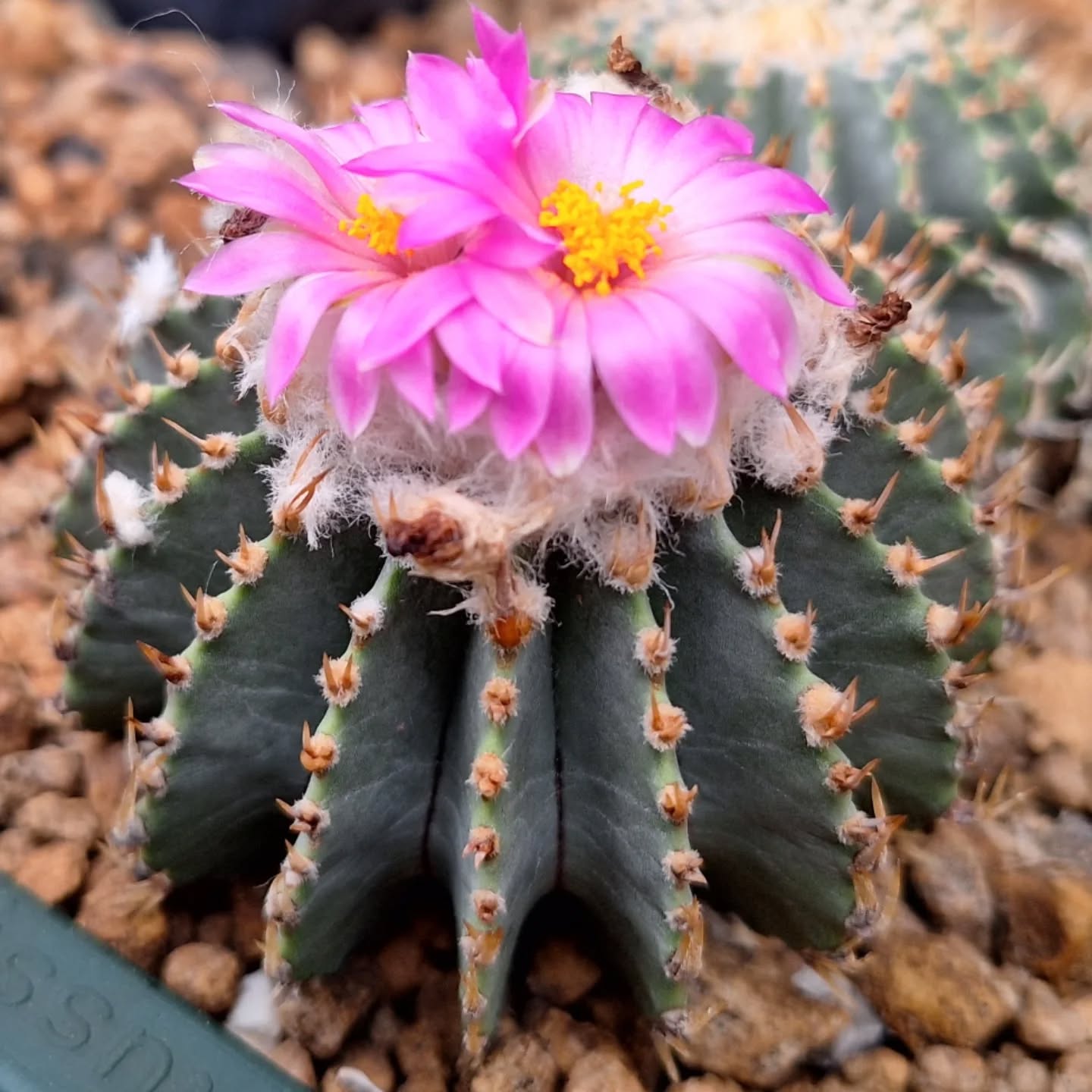
Geohintonia mexicana Glass & W.A.Fitz Maur. is the sole species of its genus, a monotypic lithophytic cactus from the near-vertical gypsum cliffs of the Sierra Madre Oriental in Nuevo León, Mexico. It was described in 1992 in Cactáceas y Suculentas Mexicanas 37: 17-19 by Charles Edward Glass and Walter Alfred Fitz Maurice, based on material collected by George Sebastián Hinton during field surveys of the Galeana canyon system the previous year. The genus name honours Hinton, the third-generation Mexican botanist who discovered the plants on those gypsum walls in 1991.
The 1992 description event was remarkable. Working at the same canyon system in the same season, Hinton located two entirely new genera: Glass and Fitz Maurice described Geohintonia mexicana and Aztekium hintonii back-to-back in the same journal issue, on the same cliff substrate, from the same survey. The two genera have been closely associated ever since. Molecular phylogenetics places them as an early-diverging sister pair within tribe Cacteae, and some authors have proposed that Geohintonia is descended from an ancient intergeneric hybridisation event with an Aztekium-related maternal parent. POWO maintains the genera as separate, and no formal taxonomic act has arisen from the hypothesis.
The entire wild population of G. mexicana occupies a single canyon system between Galeana and Rayones at 1,200 to 1,350 m elevation. Every individual in the species grows on gypsum, not limestone; that is a habitat fact, not a rule for the pot. No cultivation source shows the species needing calcium carbonate in the root zone or being harmed by it, and the mix on this page leaves limestone out by house convention. Silica grit fills the calcium-mineralogy role in cultivation mixes.
In habit the plant is globose to short-cylindrical, 2 to 6 cm in typical cultivation dimensions, with 18 to 20 prominently raised ribs and a glaucous grey pruina on the epidermis. The pruina reads as silver-grey against the white gypsum cliff substrate and is the fastest single visual separator from the sympatric Aztekium hintonii, which lacks the powdery coating. Pink to magenta funnel flowers, 2 to 4 cm in diameter, emerge from the woolly apical crown from spring through autumn.
Geohintonia mexicana quick reference
A monotypic gypsum-cliff lithophyte from a single canyon system in the Sierra Madre Oriental of Nuevo León, Mexico, at 1,200-1,350 m. Values calibrated for seed grown plants in cultivation, derived from habitat data and specialist grower sources rather than genus-level extrapolation.
Taxonomy & nomenclature
The accepted name is Geohintonia mexicana Glass & W.A.Fitz Maur., published in Cactáceas y Suculentas Mexicanas 37: 17-19 (1992), with the holotype deposited at MEXU (the National Herbarium of Mexico at the Universidad Nacional Autónoma de México). POWO, IPNI (record 305415-2), GBIF (taxon 3956935), and World Flora Online all treat the species as the sole accepted member of Geohintonia, making it the only monotypic Mexican cactus genus elevated from a single 1991 field survey.
The same survey produced Aztekium hintonii, described by Glass and Fitz Maurice immediately preceding the Geohintonia protologue in the same 1992 journal issue. The two genera were discovered at the same Galeana canyon, described back-to-back in the same publication, and remain ecologically inseparable on the same gypsum cliff substrate. Molecular phylogeny places them as an early-diverging sister pair within tribe Cacteae: plastid rpl16 intron sequencing across 62 members of the tribe by Butterworth, Cota-Sánchez, and Wallace (2002) recovered the two genera as monophyletic relative to all other Cacteae sampled. That same study raised the hypothesis that Geohintonia descends from an ancient intergeneric hybrid event, with an Aztekium-related maternal parent as the donor of the plastid genome. POWO does not act on the hypothesis; the genera are maintained as separate, and the hybridisation question remains open in the molecular literature.
The genus name honours George Sebastián Hinton (born 1949, Monterrey), the botanist who discovered the plants during the 1991 survey and invited Glass and Fitz Maurice to handle the formal description. Two recombinations have been proposed in the literature but have not been adopted by mainstream taxonomy: Aztekium mexicanum (Glass & W.A.Fitz Maur.) Barmon & Corman would sink the genus into Aztekium, and Echinocactus mexicanus (Glass & W.A.Fitz Maur.) Halda reaches further back to the old catch-all. Neither is in current use. There are no accepted infraspecific taxa; a crested mutation (G. mexicana cristate form) exists in cultivation but is not a wild taxon.
Historical synonyms (2)
- Echinocactus mexicanus (Glass & W.A.Fitz Maur.) Halda, 2000 basionym
- Aztekium mexicanum (Glass & W.A.Fitz Maur.) Barmon & Corman, 2015 homotypic synonym
Sources: POWO (Kew) · IPNI · GBIF · Wikidata
Habitat
Geohintonia mexicana is a single-population microendemic. Every documented wild individual grows on the gypsum cliff system between Galeana and Rayones in the Sierra Madre Oriental of Nuevo León, Mexico. The IUCN 2013 assessment characterises the range as a single location with an extent of occurrence and area of occupancy of approximately 25 km². POWO records the native range as Nuevo León only; no field-verified population outside that state is recorded in specialist literature.
The substrate is crystalline gypsum, calcium sulphate dihydrate, on near-vertical to overhanging cliff walls. Plants are obligate gypsophiles, rooting into fine gypsum silt that fills crevices in the cliff face. The canyon system is sharply incised, with predominantly north-facing wall exposures that receive diffuse indirect light for much of the day. Annual precipitation at the Galeana basin runs roughly 400 to 450 mm in the rain shadow of the Sierra Madre Oriental. The plants receive intermittent rainfall plus condensation off the cliff face; the near-vertical surface drains instantly, meaning no water pools in the root zone under any conditions.
Associated taxa on the same cliff walls include Aztekium hintonii, with which G. mexicana co-occurs at the level of individual square metres of substrate. Other cliff-wall associates include Mammillaria candida and Selaginella lepidophylla, the latter appearing to act as a nurse plant in seedling germination in the sympatric Aztekium population, and possibly serving a similar function for Geohintonia seedlings, though no published study confirms this. The canyon system around Galeana has been subject to documented poaching pressure on the co-occurring Aztekium hintonii population, and both species face the same single-location vulnerability to any catastrophic event affecting the cliff.
Morphology
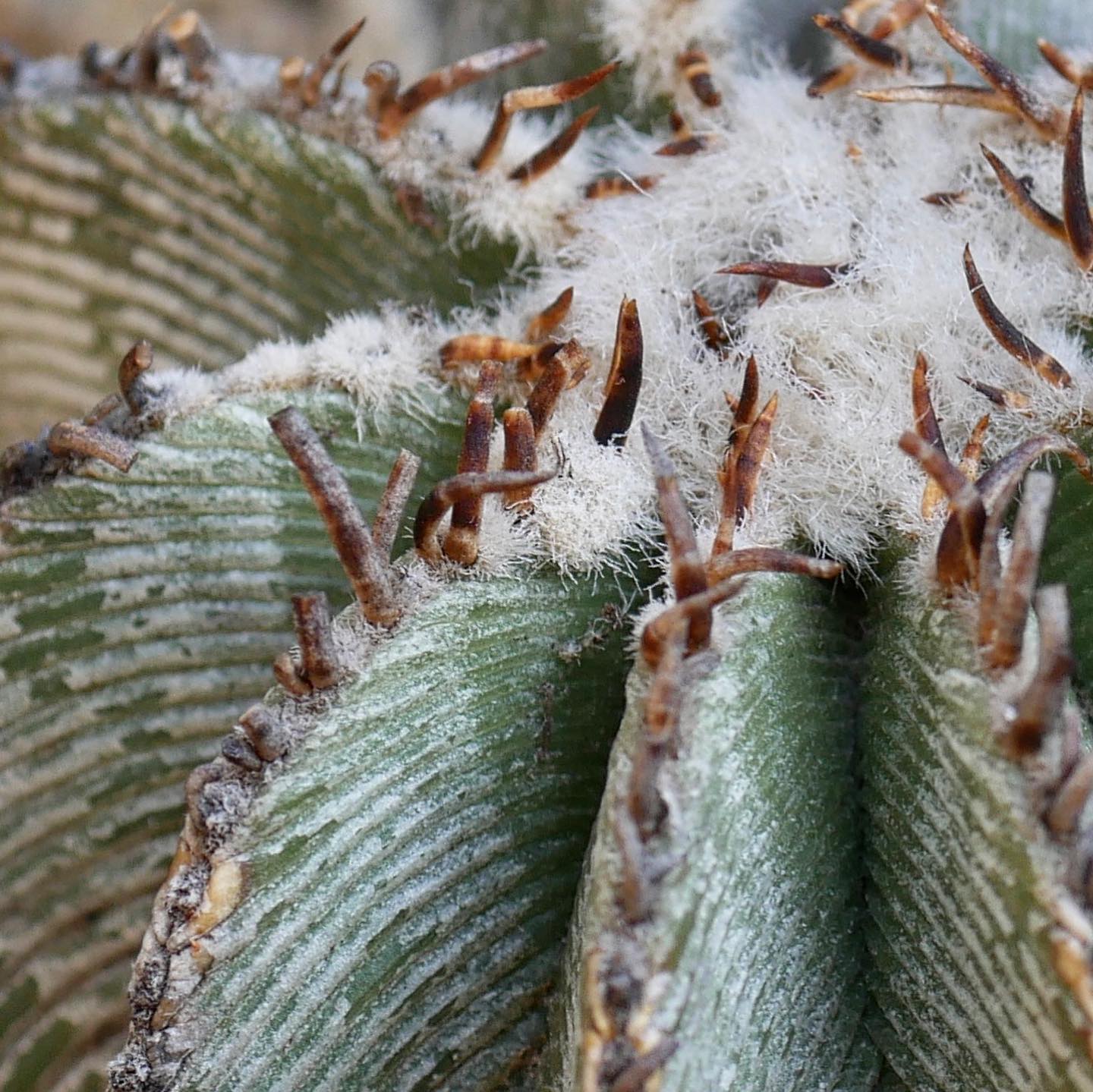
Body solitary, globose when young, slowly becoming short-cylindrical with age. Mature wild plants reach up to 10 cm tall and 10 cm in diameter; cultivated specimens typically measure 4 to 8 cm in both dimensions, with the 10 cm maximum reserved for old cliff plants. The epidermis is dark green to brown-green, overlaid with a glaucous grey pruina that produces the characteristic matte, almost silvery appearance against the white gypsum substrate. This powdery coating is the single most reliable visual separator from both Aztekium species at a distance.
Ribs 18 to 20, prominently raised, sharp-edged, and deeply furrowed between. The rib count is the clearest quantitative separator from the sympatric Aztekium hintonii, which carries 10 to 15 ribs with fine transverse corrugations on the rib flanks, and from Aztekium ritteri, which has only 9 to 11 ribs with pronounced secondary interpolated ribs. Geohintonia ribs are plain-sided, lacking the transverse corrugation pattern that gives Aztekium its distinctly wrinkled profile.
Areoles are positioned along rib crests, woolly when young and becoming bare with age. Spines 3 per areole, yellowish, 3 to 15 mm long, triangular to flattened in cross-section, corky in texture, and quickly deciduous; older areoles are often effectively spineless. The apex is heavily wool-filled, cream to white, dense enough to obscure the meristem when the plant is not in flower. Flowers apical, funnel-shaped, rich pink to magenta, 1.5 to 2 cm long and 2 to 4 cm in diameter when fully open, diurnal. Flowering runs spring through autumn in cultivation (March to October), with individual flowers lasting a few days only. Fruit oval, approximately 9 mm long, pinkish to brown, hidden in the apical wool at maturity.
Locality detail
Every documented individual of G. mexicana grows within a single canyon system between Galeana and Rayones in the Sierra Madre Oriental of Nuevo León. The IUCN 2013 assessment records an extent of occurrence and area of occupancy of approximately 25 km², consistent across all specialist literature. The map marker is placed at the Galeana municipality centroid rather than the cliff location; precise locality coordinates are withheld following the precedent of primary sources, which also do not publish GPS data for this species.
The justification for redaction is the species’s single-location vulnerability, its Near Threatened status, and the documented poaching events in 2019 to 2021 that affected the co-occurring Aztekium hintonii population at the same cliff system (PROFEPA recorded a seizure of over 2,000 illegally collected cacti in July 2025 at the same site). Publishing precise coordinates in this context would facilitate collection rather than conservation.
Geohintonia mexicana care and cultivation
Geohintonia mexicana is intermediate to advanced in cultivation difficulty. The slow growth rate and strict watering discipline are the two non-negotiable conditions. Everything else is conventional cactus care for a high-elevation Chihuahuan-adjacent species.
Substrate
The substrate question for Geohintonia is where habitat and pot mix are easiest to confuse. The species grows exclusively on gypsum (calcium sulphate, CaSO₄) cliffs in habitat, yet no cultivation source shows it either needing or rejecting calcium carbonate in the root zone. Limestone grit, which growers add to Ariocarpus and Lophophora williamsii mixes by convention, is left out here as a house choice. Silica grit fills the calcium-mineralogy role at 10%, providing sharp drainage without altering pH the way limestone does. Gypsum and limestone are different minerals, and the gypsum habitat settles nothing about limestone in the pot.
Target composition: 45% pumice (3 to 6 mm), 15% lava rock (scoria), 10% zeolite (clinoptilolite, 4 to 6 mm), 10% granite grit, 0% limestone, 10% horticultural silica (1 to 3 mm), 10% worm castings. Total inorganic 90%, organic 10%. Target pH 7.5 to 8.0. Growers with access to crystalline gypsum chips can substitute up to 5% of the silica column with gypsum chips to more closely mimic the cliff substrate; this is optional. The locked ratio is the baseline across all climate zones; hot-dry growers (Phoenix, Las Vegas) can raise worm castings to 20% by reducing pumice.
Geohintonia mexicana is the sole species in the genus; the limestone column is 0% because the species rejects calcium carbonate in the root zone, with silica filling the calcium-mineralogy role at 10%.
| Species | Pumice | Lava | Zeolite | Granite | Limestone | Silica | Organic |
|---|---|---|---|---|---|---|---|
| G. mexicana (this page) | 45% | 15% | 10% | 10% | 0% | 10% | 10% |
Watering and light
Active season is March through October: water every 5 to 8 days at peak, allowing the substrate to dry completely between applications. The cliff habitat drains instantly on vertical rock; pooling moisture at the roots under any condition is fatal. Winter dormancy runs November through February: keep the plant completely dry. If the growing space stays above 10°C through winter, a light watering once a month is acceptable; below 10°C, withhold entirely.
Light should be bright throughout the growing season. Specialist growers, including Giromagi in Italy and HSCactus in the US, consistently recommend full sun or strong light for compact growth; shade-grown plants develop a taller, more columnar habit that loses the species’s characteristic squat profile. The canyon walls receive direct light reflected off the white gypsum substrate; the “north-facing shaded cliff” description understates the light intensity the plants experience in practice.
Propagation
Propagation is almost exclusively from seed; vegetative offsetting is rare in habitat and infrequent in cultivation. Germination is slow but reliable under sterile conditions with bottom heat at 22 to 25°C. Seedlings are sensitive to overwatering and benefit from a fine top-dressing of pure pumice or silica grit to keep the cotyledons clear of moisture. Seed grown plants reach 2 cm diameter in 6 to 8 years and flowering size in 10 to 15 years; grafting onto Pereskiopsis or Hylocereus compresses the timeline to flowering at 3 to 5 years. Degrafted specimens are preferred to permanently grafted material by most collectors; seed grown specimens represent the highest tier for serious collections.
Comparison
The species most commonly confused with Geohintonia mexicana is Aztekium hintonii, the only other cactus that shares the same Galeana gypsum cliff system and was described at the same moment by the same authors. Both are small, ribbed, lithophytic, and produce pink to magenta apical flowers; both require mineral substrates without limestone in cultivation. The separators are consistent and visible at arm’s length. Geohintonia carries 18 to 20 sharply raised plain-sided ribs with a glaucous grey pruina on the epidermis; Aztekium hintonii carries 10 to 15 ribs with fine transverse wrinkles on the rib flanks and a matte grey-green epidermis without pruina. On the same cliff face, in the same light, the pruina makes Geohintonia visibly silver-grey while Aztekium reads as plain dark green.
Aztekium ritteri, the type species of the sister genus described in 1929 from a separate cliff system in Nuevo León, is occasionally compared with Geohintonia in collector circles given the shared genus-level relationship and the Nuevo León provenance. The morphological distance is substantial: A. ritteri has only 9 to 11 ribs with a dramatically corrugated surface and conspicuous secondary interpolated ribs between the main ones, a combination absent in Geohintonia. Rib count and the presence or absence of secondary ribs resolve any ambiguity instantly. A. ritteri also grows on limestone, not gypsum, which means its cultivation substrate includes a limestone fraction that would damage Geohintonia; growers who keep both genera should maintain separate substrate batches.
Beyond the Aztekium comparison, Geohintonia mexicana stands apart from all other ribbed Mexican cacti by its combination of extremely high rib count (18-20), absence of any tuberculate interruption to the ribs, glaucous pruina, strictly apical flowers, and a habitat restricted to gypsum cliffs. No species in Ariocarpus, Turbinicarpus, or Mammillaria shares all five characters simultaneously. In cultivation, the house mix for G. mexicana leaves out the limestone grit that growers add by convention for several genera in the same collector-interest bracket; that is a house choice, not a documented lime aversion.
Frequently asked questions
Is Geohintonia mexicana hard to grow?
Intermediate to advanced. Three requirements separate it from easier Mexican cacti: the substrate must be completely free of limestone (despite the species’s gypsum-cliff habitat, calcium carbonate in the root zone causes root failure), the watering schedule must be strictly dry through winter, and the growth rate is among the slowest in cultivation. A seed grown plant takes 6 to 8 years to reach 2 cm diameter and 10 to 15 years to flower. The species tolerates neglect on the dry side far better than any excess moisture.
Can Geohintonia mexicana be grown from seed?
Yes, and seed is the preferred route for serious collectors. Germination is slow but reliable under sterile conditions with bottom heat at 22 to 25°C; seedlings emerge within a few weeks on a moist sterile mineral mix. The timeline from seed to first flower is 10 to 15 years under ungrafted conditions; grafting to Pereskiopsis for 2 to 3 years compresses that to 3 to 5 years, after which the plant can be degrafted or kept on the rootstock. Seed grown specimens are the collector standard, prized for natural body proportions and slow-built spine character that grafted stock cannot replicate.
Is Geohintonia mexicana legal to own?
Geohintonia mexicana is covered by CITES Appendix II via the blanket family-level listing of Cactaceae spp., in force since 1975. Appendix II permits international commercial trade with proper documentation: an export permit from Mexico (issued by SEMARNAT) and import permits where the destination country requires them. Artificially propagated nursery stock qualifies for simplified Appendix II documentation, and seed is freely tradable under standard Cactaceae annotations. Wild plants are illegal under both CITES and Mexican federal law; nursery-propagated material from documented seed-grown provenance is the legally and ethically sound source for collectors.
Where does Geohintonia mexicana grow in the wild?
On near-vertical gypsum cliffs between Galeana and Rayones in the Sierra Madre Oriental of Nuevo León, Mexico, at 1,200 to 1,350 m elevation. The entire wild population occupies a single canyon system covering approximately 25 km²; the IUCN 2013 assessment characterises this as a single location. The substrate is crystalline gypsum (calcium sulphate dihydrate), not limestone, which has direct consequences for cultivation substrate. No population outside Nuevo León is field-verified in specialist literature.
When does Geohintonia mexicana flower?
Spring through autumn in cultivation, roughly March to October at northern hemisphere latitudes. Flowers are diurnal, funnel-shaped, rich pink to magenta, 1.5 to 2 cm long and 2 to 4 cm in diameter when fully open. Individual blooms last only a few days, and synchronous flowering on a single plant is rare, making a fully open specimen a notable cultivation event. Seed grown plants take 10 to 15 years to reach flowering size; grafted material flowers in 3 to 5 years.
Sources & further reading
Glass, C. & Fitz Maurice, W.A. (1992). Geohintonia mexicana gen. et sp. nov. Cactáceas y Suculentas Mexicanas 37: 17-19. · International Plant Names Index (IPNI). Geohintonia mexicana Glass & W.A.Fitz Maur., record 305415-2. ipni.org · Plants of the World Online (Kew POWO). Geohintonia mexicana Glass & W.A.Fitz Maur., taxon urn:lsid:ipni.org:names:305415-2. powo.science.kew.org · GBIF Secretariat. Geohintonia mexicana Glass & W.A.Fitz Maur., taxon 3956935. gbif.org · Butterworth, C.A., Cota-Sánchez, J.H. & Wallace, R.S. (2002). Molecular systematics of tribe Cacteae (Cactaceae: Cactoideae): a phylogeny based on rpl16 intron sequence variation. Systematic Botany 27(2): 257-270. DOI 10.1043/0363-6445-27.2.257 · IUCN Red List of Threatened Species. Geohintonia mexicana, taxon 152816, assessed by Fitz Maurice, B., Fitz Maurice, W.A., Hernández, H.M., Sotomayor, M. & Smith, M. (2013), category Near Threatened, criteria v3.1. iucnredlist.org/species/152816 · CITES Secretariat. Cactaceae spp., Appendix II listing since 1975 (CoP1, taking effect 1976). cites.org/eng/taxonomy/term/8701; Hunt, D. (ed.) (2016). CITES Cactaceae Checklist (3rd ed.). Royal Botanic Gardens Kew. · Hernández, H.M. & Gómez-Hinostrosa, C. (2011). Mapping the Cacti of Mexico: Their Geographical Distribution Based on Referenced Records. Succulent Plant Research Vol. 7. DH Books. · Henry Shaw Cactus and Succulent Society (2010). Plant of the Month, July 2010: Geohintonia mexicana. hscactus.org · llifle (Encyclopedia of Living Forms). Geohintonia mexicana, record 11571. llifle.com · Giromagi Cactus and Succulents. Geohintonia cultivation notes. giromagicactusandsucculents.com · CONABIO Enciclovida. Geohintonia mexicana Glass & W.A.Fitz Maur., taxon 143937, common name Biznaga del yeso. enciclovida.mx