
Mammilloydia candida
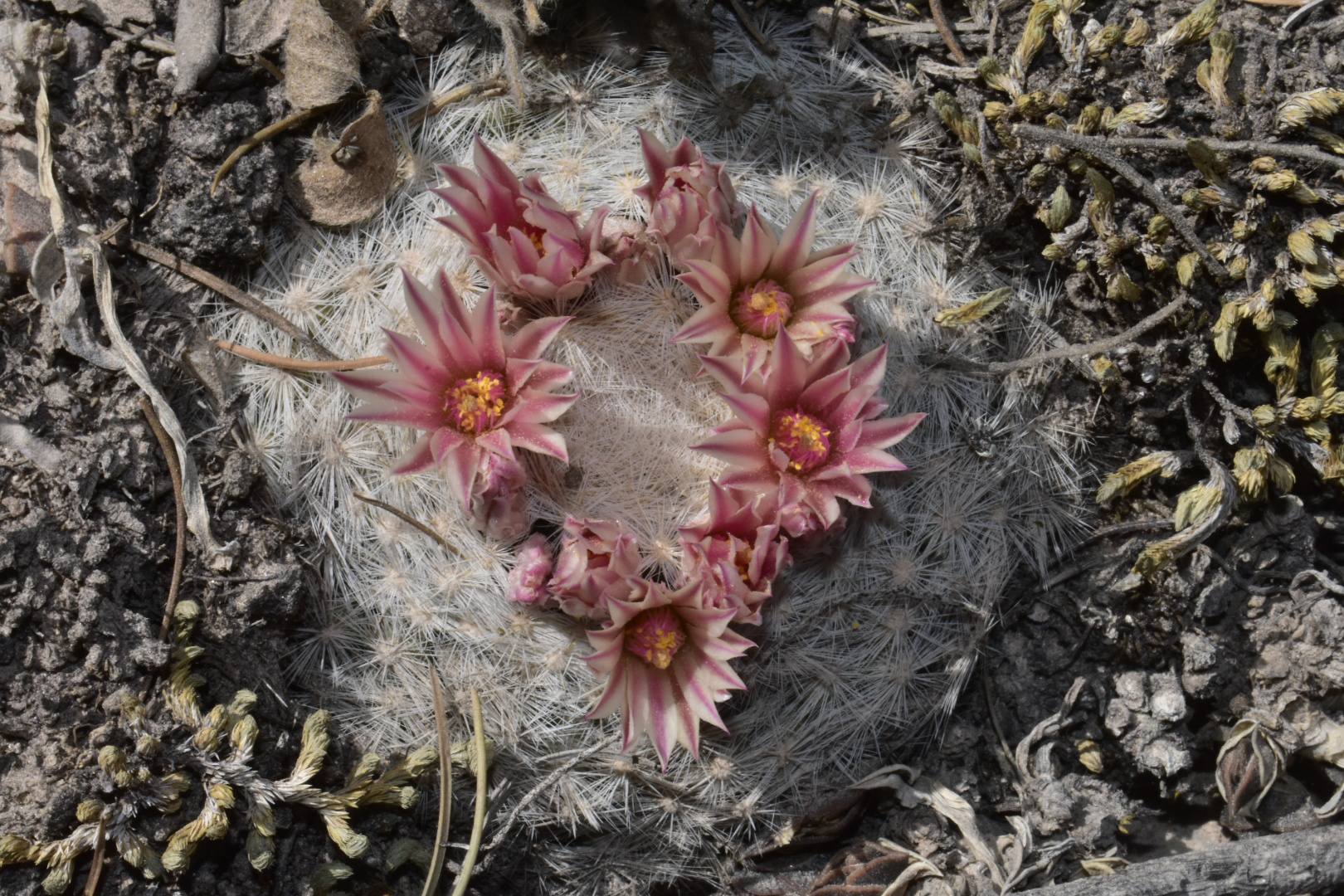
Mammilloydia candida (Scheidw.) Buxb. is the only species in Mammilloydia, a monotypic genus that Franz Buxbaum segregated from Mammillaria in 1951. The segregation rests on two seed-anatomy characters: the testa of M. candida is smooth rather than tuberculate or pitted, and the perisperm is absent. Michael Joseph Scheidweiler published the basionym Mammillaria candida in Bulletins de l’Académie Royale des Sciences et des Belles-Lettres de Bruxelles 5: 496 (1838), from material supplied by Henri Guillaume Galeotti with a type locality in San Luis Potosí, Mexico. Kew POWO maintains Mammilloydia as a distinct monotypic genus; the 2021 Breslin revision did not absorb it into Mammillaria.
In the nursery trade the plant is almost universally sold as Mammillaria candida, and collectors encountering it under that older binomial are looking at the same plant. The species ranges across five states of northeast Mexico: Coahuila, Nuevo León, San Luis Potosí, Tamaulipas, and Guanajuato in the south. It grows on calcareous limestone soils and scree between 500 and 2,500 m, consistently on alkaline substrates derived from limestone parent rock.
The visual identity of the species is immediate. Radial spines number 50 to 120 per plant, spreading pectinately in a flat plane so that the body reads as a uniform white sphere at any viewing distance. The central spines, 6 to 12 in count, are also white or pinkish-white, barely projecting beyond the radial mass. This total-coverage spination pattern is the defining character and is why collectors call it the snowball cactus. A white-spined look-alike from an overlapping region is Epithelantha greggii in Coahuila, though the size difference at maturity removes any ambiguity quickly: Mammilloydia candida reaches 30 cm tall and 20 cm wide, dwarfing the smaller Epithelantha.
Growth is slow. A seed grown plant reaches flowering size in roughly five to ten years. The spring flower ring is pale cream-pink with brownish or greenish midveins; the fruit is oblong, red or pinkish, and indehiscent. Seeds are black and smooth-coated, the latter being the seed character that marks the genus boundary with Mammillaria.
Mammilloydia candida quick reference
A cactus of limestone hills and scree across northeast Mexico, growing between 500 and 2,500 m in the Chihuahuan Desert margin and subtropical dry shrubland. Values calibrated for seed grown plants in cultivation, drawn from species-specific habitat data and specialist grower consensus.
Taxonomy & nomenclature
The accepted name is Mammilloydia candida (Scheidw.) Buxb. The basionym is Mammillaria candida Scheidweiler, described in Bulletins de l’Académie Royale des Sciences et des Belles-Lettres de Bruxelles 5: 496 (1838). Material was supplied by Henri Guillaume Galeotti, with a type locality in San Luis Potosí, Mexico. The type specimen is not preserved; secondary sources confirm the collecting locality from Scheidweiler’s original text.
Franz Buxbaum erected Mammilloydia in Oesterreichische Botanische Zeitschrift 98: 64–65 (1951) on the basis of two seed-anatomy characters: (1) the testa of M. candida is smooth rather than tuberculate or pitted as in true Mammillaria, and (2) the perisperm is absent, whereas Mammillaria carries persistent perisperm. Buxbaum also noted intermediate characters between Mammillaria and Neolloydia, but the seed characters were the primary diagnostic. A later re-examination by Riša in 1975 found the smooth-seed distinction was consistent across cultivated sources, and the smooth testa plus perisperm-absent combination remains the accepted diagnostic separating the two genera.
Kew POWO (2025) accepts Mammilloydia candida as the correct name; Mammillaria candida Scheidw. is listed as a synonym. Some online databases and Wikipedia entries incorrectly state that the species was reclassified back into Mammillaria; this reflects older catalogue usage and is not the current POWO disposition. POWO is the project’s taxonomic arbiter, and Mammilloydia candida is used throughout this page.
Several infraspecific names have been applied. POWO treats Mammilloydia candida subsp. ortizrubioana (Bravo) Krainz as a synonym of the species rather than accepting it at subspecific rank. Older literature, including llifle, treats it as a recognised subspecies from Xichú and Guamúchil, Guanajuato. This page follows POWO: no infraspecific rank is recognised. Other synonyms include Neomammillaria candida (Scheidw.) Britton & Rose (1923), Chilita candida (Scheidw.) Orcutt (1926), Cactus sphaerotrichus Kuntze (1891), and Mammillaria sphaerotricha Lem.
Historical synonyms (12)
- Mammillaria sphaerotricha Lem., 1839 basionym
- Mammillaria candida f. rosea (Salm-Dyck ex K.Schum.) Schelle, 1907 homotypic synonym
- Mammillaria candida var. sphaerotricha Schelle, 1907 homotypic synonym
- Neomammillaria candida (Scheidw.) Britton & Rose, 1923 homotypic synonym
- Chilita candida (Scheidw.) Orcutt, 1926 homotypic synonym
- Mammilloydia candida var. rosea (Salm-Dyck) Krainz, 1962 homotypic synonym
- Mammillaria candida var. caespitosa Voss, 1970 homotypic synonym
- Mammillaria candida subsp. ortiz-rubiana (Bravo) Krainz, 1973 homotypic synonym
- Mammilloydia candida f. rosea (Salm-Dyck) Buxb., 1973 homotypic synonym
- Mammilloydia candida subsp. ortizrubioana (Bravo) Krainz, 1973 homotypic synonym
- Mammilloydia candida subsp. ortizrubiona (Bravo) Krainz, 1973, 1973 homotypic synonym
- Neomammillaria candida var. rosea (Salm-Dyck) Y.Itô, 1981 homotypic synonym
Sources: POWO (Kew) · IPNI · GBIF · Wikidata
Habitat
Mammilloydia candida is endemic to northeast Mexico, distributed across five states: Coahuila, Nuevo León, San Luis Potosí, Tamaulipas, and Guanajuato in the south (Guanajuato records are associated with populations formerly referred to subsp. ortizrubioana at Xichú and Guamúchil). The species is absent from the Baja peninsula and the Pacific slope. Kew POWO summarises the range as northeast Mexico.
The species grows in the wild exclusively on calcareous substrates: limestone scree, limestone hillsides, canyon walls, and rocky slopes where the parent rock is alkaline. Plants are found in crevices in limestone rock and on open hilltops, with shelter under xerophytic bushes at lower elevations. At higher elevation sites above 1,500 m, more exposed rocky hillside positions are documented. The pH of the substrate at population sites is broadly alkaline, consistent with limestone parent rock throughout the range.
Elevation spans 500 to 2,500 m, a wide band that encompasses low-elevation Tamaulipas scrubland edge up to montane limestone in San Luis Potosí. Associated vegetation includes Pelecyphora strobiliformis, Turbinicarpus pseudopectinatus, Astrophytum senile, Astrophytum capricorne, Ferocactus hamatacanthus, Yucca filifera, Hechtia glomerata, and Agave stricta, assemblages characteristic of the Chihuahuan Desert margin and transition zones in northeast Mexico.
Climate follows the Chihuahuan Desert monsoon-driven pattern: summer rainfall arrives predominantly July through September and triggers the main growth flush. Annual precipitation across the core range is approximately 300 to 500 mm, concentrated in summer. Winters are dry and cold. Fog or dew is not a significant moisture input at any part of the range. The strong seasonal contrast between a wet growing period and a cold dry winter rest is the key driver of cultivation practice for this species.
Morphology
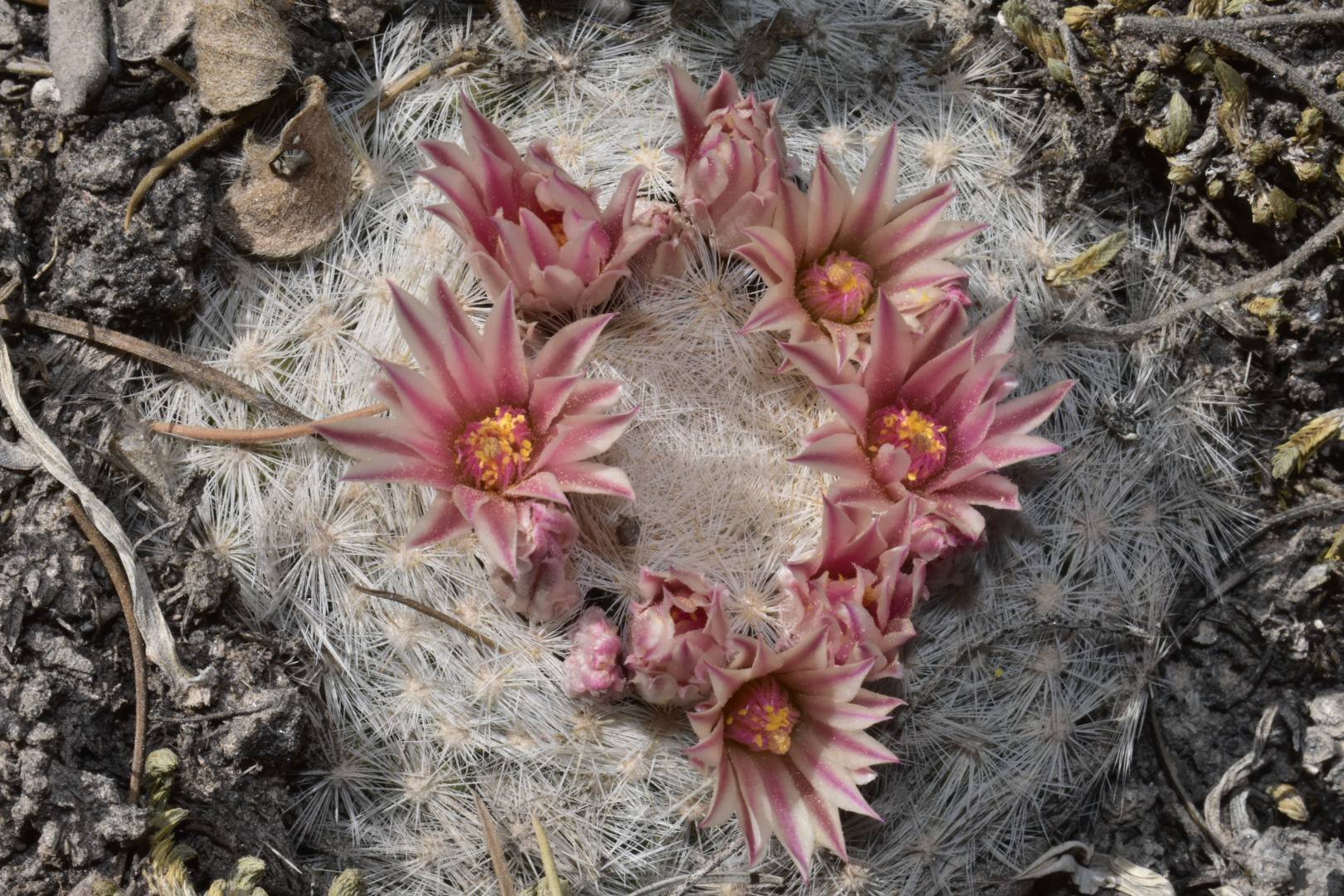
The body is globose, flattening or becoming slightly depressed at the crown, and with age becomes short-cylindrical. Mature plants reach up to 30 cm tall and (3–)6–12(–20) cm wide. The underlying epidermis is pale bluish-green, but at maturity it is completely concealed by spination and never visible without deliberate removal of the spines. Plants are typically solitary; clustering is documented but appears more common in cultivated specimens than in wild populations. The crown is distinctly depressed or flat at the apex.
Tubercles are broadly cylindrical, obtuse, not grooved, 5–6 mm long. Axils carry 4–7 white bristles. The total spine count ranges from 50 to 80 in several series on typical plants; large-bodied old-growth individuals can carry up to 120 radials plus 12 centrals. Radial spines number 50 to 120, pure white, up to 15 mm long, spreading laterally and pectinately in a flat plane so the body reads as a uniform sphere of white spines from any viewing angle. Central spines number 6 to 12, also pure white or pinkish-white with pinkish or brownish tips, 5–10 mm long, pointing outward. The distinction between radial and central series is less sharply defined than in many Mammillaria species; the spines grade into one another.
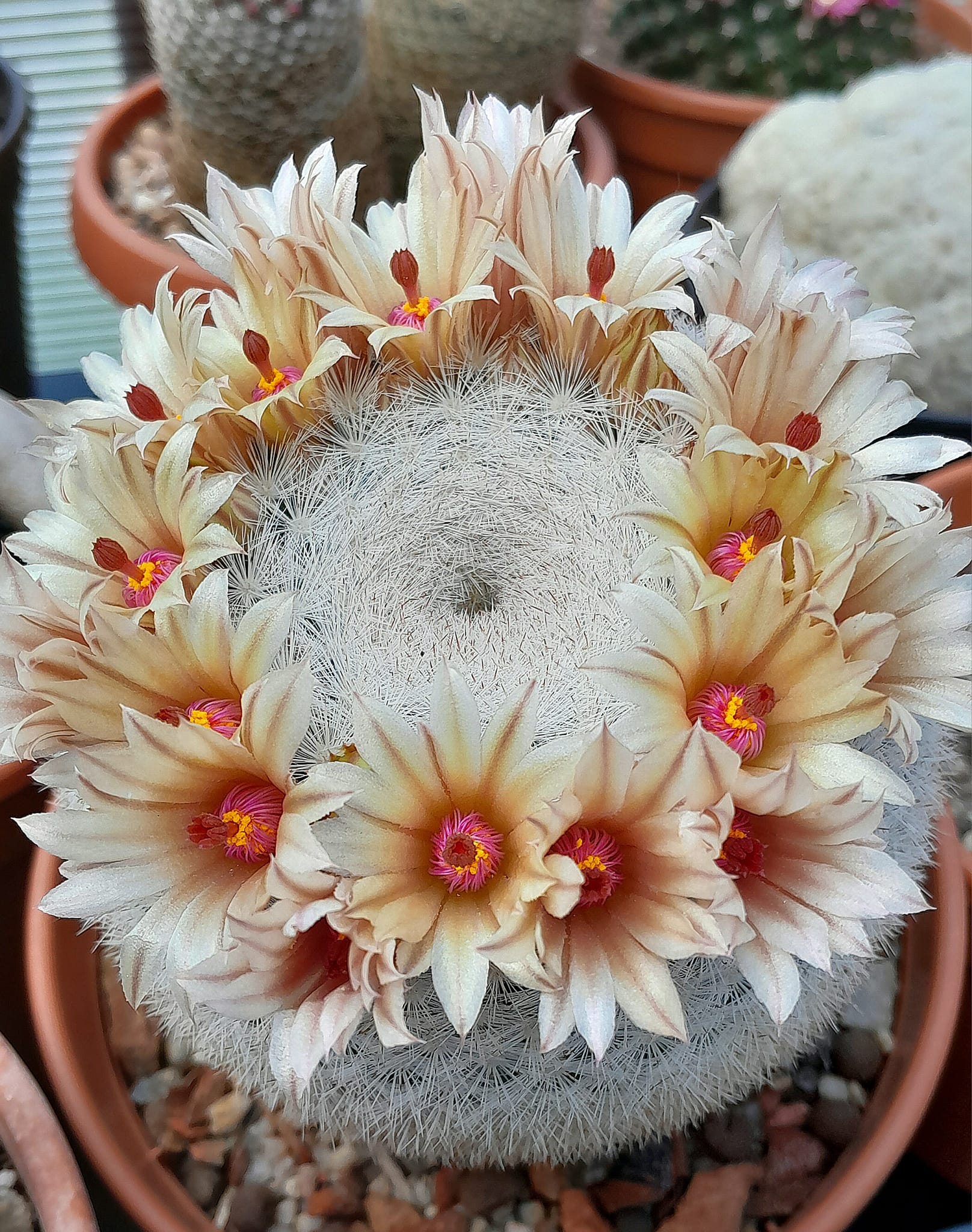
Flowers form a ring at the apex in spring. Individual flowers are 2–3 cm long, campanulate to short-funnelform, with approximately 12–13 oblong, obtuse perianth segments. The colour is rose-pink to cream-white with greenish or creamy-brown midveins and white margins; some individuals show a light purple centre. Stamens are white; style and stigma lobes are purplish or green. Fruit is oblong to clavate, red or pinkish, 7–14 mm long, juicy and indehiscent. Seeds are black, approximately 1 mm, with a smooth testa and no perisperm: the two characters that define the genus boundary with Mammillaria.
Locality detail
The type locality from Scheidweiler’s 1838 protologue is San Luis Potosí, Mexico, with the collector given as Galeotti (s.n.). The type specimen is recorded as not preserved in secondary literature. The species is confirmed across five Mexican states by multiple independent sources: Coahuila and Nuevo León form the core of the northern range, San Luis Potosí anchors the type-locality region in the west, and Tamaulipas extends the range to the east. Guanajuato represents the southernmost limit, where populations on the canyon walls of the Río Xichú at 1,250–1,500 m have historically been treated under the now-synonymised subsp. ortizrubioana.
The map above marks state-level centroids rather than precise locality coordinates. The species is distributed across limestone hill and scree habitats throughout the northeast Mexico plateau, with multiple subpopulations at each state level. Multiple subpopulations across the five-state range are large enough to support the 2013 assessment’s stable population trend.
Mammilloydia candida care and cultivation
Mammilloydia candida is an unforgiving patient when the substrate is wrong, but settles into long-term cultivation readily on the correct calcareous mix. The two failure modes that account for almost all losses are root rot from winter moisture and a substrate that is too acidic or too organic. Both are correctable at the next repot.
Substrate
No cultivation source establishes the species as calcicole or calcifuge; wild populations are documented on alkaline limestone-derived soils and scree across all five range states, a plain habitat fact. The correct mineral framework is 30% pumice, 15% lava rock (scoria), 10% zeolite (clinoptilolite), 10% granite grit, 20% crushed limestone, 10% silica grit (horticultural grade, 1–3 mm), and 5% organic matter (worm castings). This sums to 100% with an inorganic fraction of 95% and organic of 5%. The limestone fraction at 20% follows house convention rather than documented evidence; this is above the 10% baseline used elsewhere on this site. Organic content is kept low at 5% following multiple specialist grower sources that warn against organic-heavy mixes for this species.
Mammilloydia is monotypic; this table shows the single species’s substrate ratio.
| Species | Pumice | Lava | Zeolite | Granite | Limestone | Silica | Organic |
|---|---|---|---|---|---|---|---|
| M. candida (this page) | 30% | 15% | 10% | 10% | 20% | 10% | 5% |
Watering and light
Cease watering from late autumn through winter. The substrate must cycle completely dry during the cool season; cold wet substrate collapses the root system without visible above-ground symptoms until the plant is beyond recovery. Resume watering in spring with a single thorough soak once temperatures reliably exceed 10°C, then allow complete drying over 10–14 days before the next cycle. From late spring through summer, water when the top 4–5 cm is fully dry. Water at the base, not from above; the dense apical spination traps moisture and dries slowly.
Light should be full sun to filtered bright light. Strong light encourages bronzing in the spination and improves flowering. Plants kept under excessive shade lose vigour and the uniformly white body becomes more yellowish or dull. A south-facing position under glass is the minimum at temperate latitudes. Gradual acclimation is advised for plants moving from lower to higher light intensities to avoid sunscorch on the exposed apical spines.
Comparison
Mammilloydia is monotypic, so the comparison question is cross-genus. The species most likely to be confused with Mammilloydia candida in the nursery trade is Mammillaria geminispina (Haw.) DC., the twin-spined cactus. Both are white-spined globose plants sold historically under the Mammillaria umbrella in the same specialist nursery channels; partial range overlap at San Luis Potosí and Guanajuato puts them in the same field habitat. At distance and in juvenile stage both read as white balls. The confusion is real and documented in grower communities.
The diagnostic split is clear on close inspection. On Mammilloydia candida the central spines are 6 to 12 in number, white or pinkish-white, 5–10 mm long, and do not project visibly beyond the radial mass. On Mammillaria geminispina there are typically only 2 prominent central spines (occasionally up to 6) that are considerably longer, 5–40 mm, and protrude conspicuously beyond the radials: this is the “twin spines” character of the epithet. Radial spine counts also differ: 50–120 on M. candida against 16–20 on M. geminispina. Flower colour is the second quick separator: M. candida flowers are cream to pale pink with brownish midveins; M. geminispina flowers are distinctly carmine-pink to deep pinkish-red. At maximum body size, M. candida also runs substantially larger: up to 30 cm tall versus 18 cm per stem head for M. geminispina.
Seed anatomy confirms the genus-level split. Mammilloydia candida seeds have a smooth testa and no perisperm. Mammillaria geminispina seeds have a tuberculate testa and retain perisperm, the same condition as most of the 200-plus species in Mammillaria sensu stricto. Distribution also helps: M. geminispina is predominantly a central Mexico species (Guanajuato, Hidalgo, Querétaro, San Luis Potosí), whereas M. candida extends further northeast into Coahuila, Nuevo León, and Tamaulipas.
Frequently asked questions
Is Mammilloydia candida hard to grow?
Intermediate. The species survives comfortably on a fast-draining mineral substrate with a hard winter dry rest, but overwatering in the cool season collapses the root system with no visible above-ground warning. The two non-negotiables are sharp drainage and a bone-dry dormancy from late autumn through winter. On those two conditions the species is long-lived and rewarding; skip either and losses are rapid.
Can Mammilloydia candida be grown from seed?
Yes, and seed grown is the collector standard. Seeds germinate in 7–14 days at 21–27°C; sow in early spring at 19–24°C on a lean mineral seedling mix. Move seedlings into full light early to develop compact adult spination. First flowering on a well-grown plant with a respected winter rest typically arrives at five to ten years from seed. Seed grown plants develop natural body proportions and spine character that grafted stock never settles into. Offsets are produced occasionally and can be separated and rooted when a few centimetres in diameter.
Is Mammilloydia candida legal to own?
Yes, with documentation. All Cactaceae are listed under CITES Appendix II, which permits international commercial trade with appropriate export permits from the country of origin. The species is widely available as nursery-propagated stock from documented seed-grown sources. Domestic trade in nursery stock within a single country does not require CITES documentation. The species also appears in the NOM-059-SEMARNAT-2010 register of Mexican protected species; the specific NOM-059 category has not been confirmed from a primary Diario Oficial source. Nursery-propagated material with documented origin is both the legally defensible and ethically correct source.
Where does the snowball cactus grow in the wild?
Northeast Mexico: Coahuila, Nuevo León, San Luis Potosí, Tamaulipas, and Guanajuato. The species grows exclusively on calcareous limestone soils and scree between 500 and 2,500 m elevation. Populations occur on limestone hilltops, rocky slopes, and canyon walls, often sheltered under xerophytic shrubs at lower elevations and more exposed at higher sites. Associated cacti in the habitat include Pelecyphora strobiliformis, Turbinicarpus pseudopectinatus, and Astrophytum senile.
When does Mammilloydia candida flower?
Spring: approximately March through May in northeast Mexico habitat, correlated with the onset of warmer temperatures after the dry winter rest. In cultivation at temperate latitudes, flowering typically occurs April through June after the dormancy break. Flowers are pale cream-pink to rose, 2–3 cm long, forming a ring at the crown apex. The fruit that follows is oblong, red or pinkish, 7–14 mm long, and persists on the plant through summer. A respected winter dry rest is the single most reliable trigger for reliable spring flowering in cultivation.
Sources & further reading
Scheidweiler, M.J. (1838). Mammillaria candida [basionym]. Bulletins de l’Académie Royale des Sciences et des Belles-Lettres de Bruxelles 5: 496. · Britton, N.L. & Rose, J.N. (1923). The Cactaceae: Descriptions and Illustrations of Plants of the Cactus Family, Vol. 4: 130. Carnegie Institution of Washington. (Neomammillaria combination.) · Buxbaum, F. (1951). Genus erection Mammilloydia. Oesterreichische Botanische Zeitschrift 98: 64–65. (Primary source for generic segregation on smooth-seed and perisperm-absent characters.) · Anderson, E.F. (2001). The Cactus Family. Timber Press, Portland, Oregon. (Mammillaria alliance taxonomy and cultivation; morphological cross-check.) · Fitz Maurice, B.; Fitz Maurice, W.A.; Hernandez, H.M.; Sotomayor, M.; Smith, M. (2013). Mammilloydia candida. The IUCN Red List of Threatened Species 2013. (Least Concern assessment; assessors cited; 2013 assessment year.) · Plants of the World Online (POWO) (2025). Mammilloydia candida (Scheidw.) Buxb. Royal Botanic Gardens, Kew. powo.science.kew.org · llifle ; Encyclopedia of Living Forms (Korotkova et al., compilers). Mammilloydia candida. llifle.com/Encyclopedia/CACTI/Family/Cactaceae/9012/Mammilloydia_candida (Full morphological description, elevation, associated species, cultivation notes, cold tolerance, IUCN narrative.) · Henry Shaw Cactus and Succulent Society (2010). Plant of the Month: Mammillaria geminispina. hscactus.org (Morphological description for comparator analysis.) · Royal Horticultural Society (2025). Mammilloydia candida snowball pincushion. RHS Plant Finder. rhs.org.uk (Hardiness H2; cultivation period; propagation temperatures.) · Giromagi Cactus and Succulents (2025). Mammillaria candida care guide. giromagicactusandsucculents.com (Cultivation guidance; substrate; cold tolerance; watering regime.) · Desert Tropicals (2025). Snowball Cactus (Mammilloydia candida). desert-tropicals.com (Morphological description; distribution; cold hardiness.) · llifle. Mammillaria candida subsp. ortizrubioana. llifle.com/Encyclopedia/CACTI/Family/Cactaceae/9019/ (Guanajuato population morphology and distribution; Xichú and Guamúchil localities.) · CITES Appendix II Cactaceae blanket listing. cites.org