
Obregonia denegrii
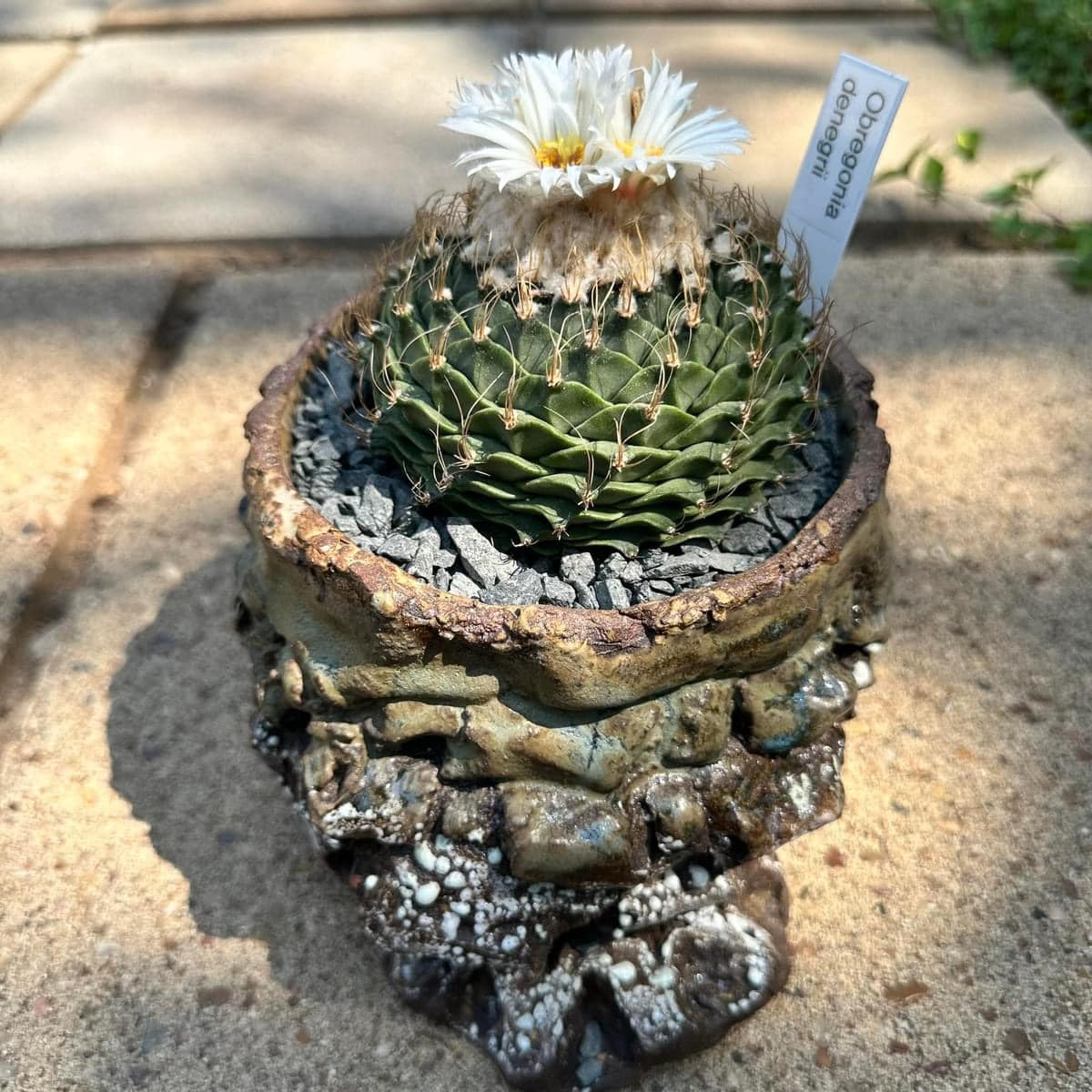
Obregonia denegrii Frič is the sole species of a monotypic genus in tribe Cacteae, a solitary flat-rosette endemic to the Jaumave Valley of southern Tamaulipas in northeast Mexico. The genus name honours President Álvaro Obregón of Mexico, making Obregonia one of the very few cactus genera named for a head of state. The species epithet commemorates Ramón P. De Negri, who served as Minister of Agriculture when Albert Vojtěch Frič collected the type material in 1923 during a journey through the Jaumave valley. The formal publication in the Czech serial Život v Přírodě did not appear until 1925, which is the controlling botanical date.
The body is immediately distinctive. A flat, geophytic rosette of overlapping triangular tubercles arranged in steep parastichies produces the silhouette of an artichoke head at a glance, which is why the English common name has stuck even among growers who rarely use vernacular names. Each tubercle is broad-based, flat-topped, and narrows to a triangular tip with a small woolly areole carrying a few soft, often shed, whitish-brown spines. The apical crown of dense wool, from which pale pink funnel-shaped flowers emerge in late spring and summer, defines the look of a mature plant.
Molecular work on tribe Cacteae places Obregonia close to Lophophora williamsii and to Aztekium and Strombocactus, rather than within Ariocarpus, where the species was briefly assigned as Ariocarpus denegrii in 1946. That placement reflected a real morphological echo: both genera share a geophytic habit, a taproot, and tuberculate bodies with apical wool. The molecular evidence confirms the original generic separation as correct.
CITES Appendix I status and IUCN Endangered designation together rank Obregonia denegrii among the most tightly protected cacti in international trade. Wild collection is effectively prohibited. Documented seed-grown stock from registered nurseries is the only legally defensible route into a private collection, and cross-border movement of any specimen, including seed, requires paired export and import permits.
Obregonia denegrii quick reference
A geophytic rosette of the calcareous Jaumave Valley, growing on weathered limestone and dolomitic valley fill between 800 and 1,200 m in Tamaulipas, Mexico. Values calibrated for seed grown plants in cultivation, drawn from species-specific habitat data and grower experience rather than genus-level extrapolation.
Taxonomy & nomenclature
The accepted name is Obregonia denegrii Frič, published in Život v Přírodě 29(2): 14 (1925). POWO, IPNI (record 171350-2), Tropicos, and World Flora Online all accept this name. The genus Obregonia is monotypic; no other species exist or have been described. It is the only cactus genus named for a Mexican head of state.
Two heterotypic synonyms appear in the historical record. W.T. Marshall transferred the species to Ariocarpus in 1946 as Ariocarpus denegrii (Frič) W.T.Marshall, published in Cactus and Succulent Journal (Los Angeles) 18: 56. G.D. Rowley moved it again in 1974 to Strombocactus denegrii (Frič) G.D.Rowley, published in Repertorium Plantarum Succulentarum 23: 9. Neither combination is currently accepted. Molecular work on tribe Cacteae, including the rpl16 intron analysis by Butterworth and Wallace, places Obregonia close to Lophophora, Aztekium, and Strombocactus, validating Frič’s original generic circumscription.
A persistent confusion in horticultural literature conflates 1923 with 1925. Frič collected the type in the Jaumave valley in 1923 while travelling with engineer Marcello Castañeda; the genus name honoured President Álvaro Obregón, then in office. The formal publication did not appear until 1925. POWO and IPNI both record 1925 as the year of nomenclatural authority, which is the controlling date under the International Code.
Historical synonyms (2)
- Ariocarpus denegrii (Fric) W.T.Marshall, 1946 basionym
- Strombocactus denegrii (Fric) G.D.Rowley, 1972 homotypic synonym
Sources: POWO (Kew) · IPNI · GBIF · Wikidata
Habitat
Obregonia denegrii is confined to the Jaumave Valley and adjacent intermontane basins in southern Tamaulipas, northeast Mexico. POWO additionally lists Nuevo León within the stated range; field-level conservation literature places every confirmed extant subpopulation inside Tamaulipas, almost entirely within the Jaumave system. The known extent of occurrence is approximately 2,000 km² and the area of occupancy roughly 350 km², with no more than five subpopulations.
Plants grow in Tamaulipan thornscrub on lower hill slopes, almost always on stony ground over weathered limestone or dolomitic valley fill. They sit nearly flush with the gravel, protected between cushions of thornscrub shrubs such as Acacia, Prosopis, and Cordia, or under the skirts of Yucca filifera and Agave lechuguilla. Companion succulents on the same slopes include Astrophytum myriostigma, Ariocarpus retusus, Ferocactus hamatacanthus, and several Mammillaria. Elevation runs from 800 m to 1,200 m, with most records clustering around the 1,000 m contour.
The climate is semi-arid subtropical. Rainfall arrives in two seasonal pulses: a heavier summer set from June through September and a lighter winter input. Hard frost is rare; brief light frost down to around −4 °C occurs on still nights at valley margins. Soils are calcareous, fast-draining, and alkaline, with pH commonly in the 7.0 to 7.8 band.
Morphology
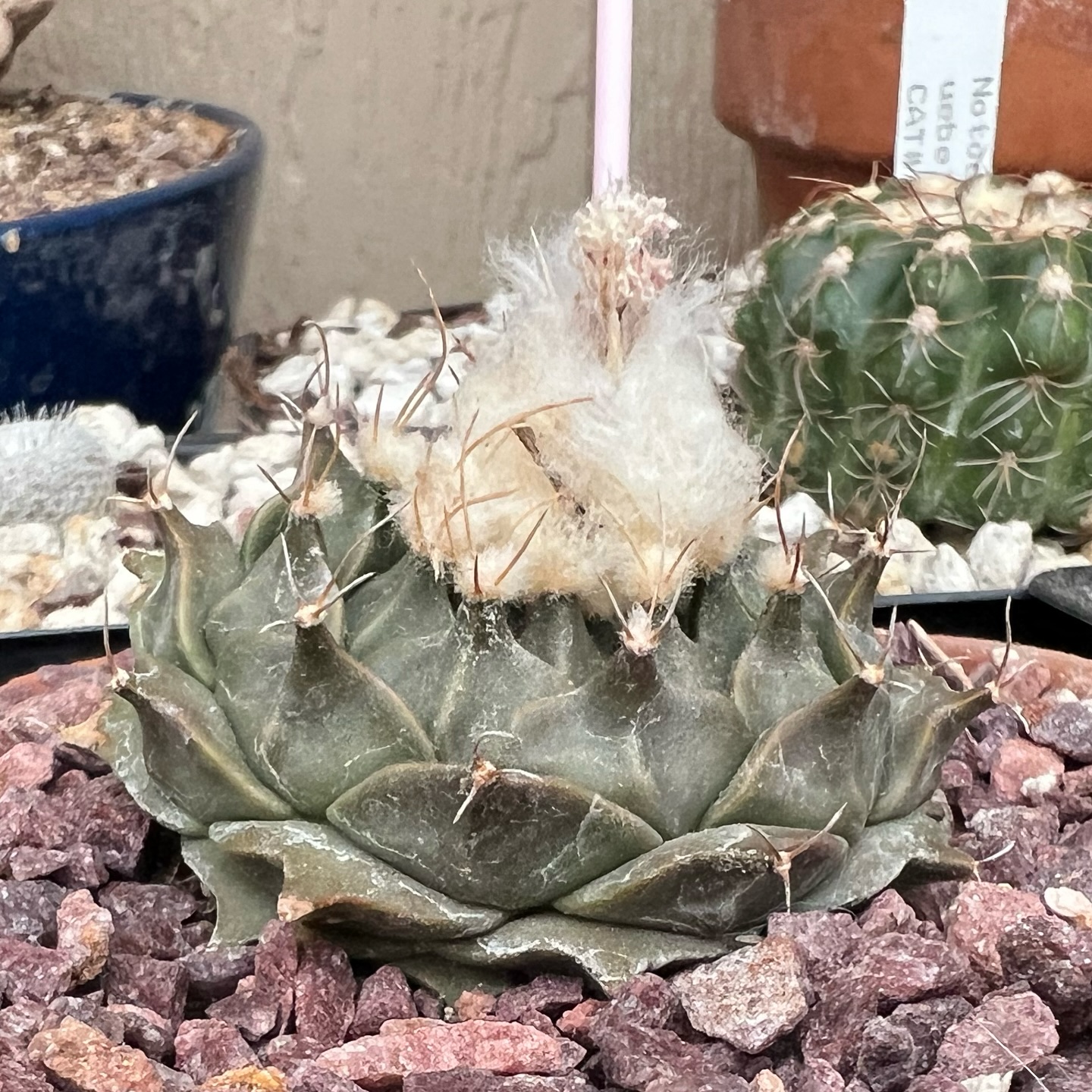
Body solitary, geophytic, flat-rosette. Adult diameter is 8 to 15 cm, occasionally to 20 cm in long-cultivated specimens. The body sits at or just above ground level, anchored by a single thick taproot descending well below the visible plant. Body colour ranges from greyish to dark green, sometimes with a glaucous bloom in strong light.
The diagnostic feature is the tubercle. Each is broad-based, flat-topped, and narrows abruptly to a triangular tip; the arrangement in steep overlapping parastichies is the source of the artichoke comparison. Tubercles measure 8 to 15 mm long. Each carries a small woolly apical areole that produces 2 to 4 fine, soft, weak, whitish-brown spines of 5 to 15 mm. The spines are frequently shed by the second or third year, leaving older tubercles spineless. Areolar wool persists, producing the dense whitish crown from which flowers and fruit emerge.
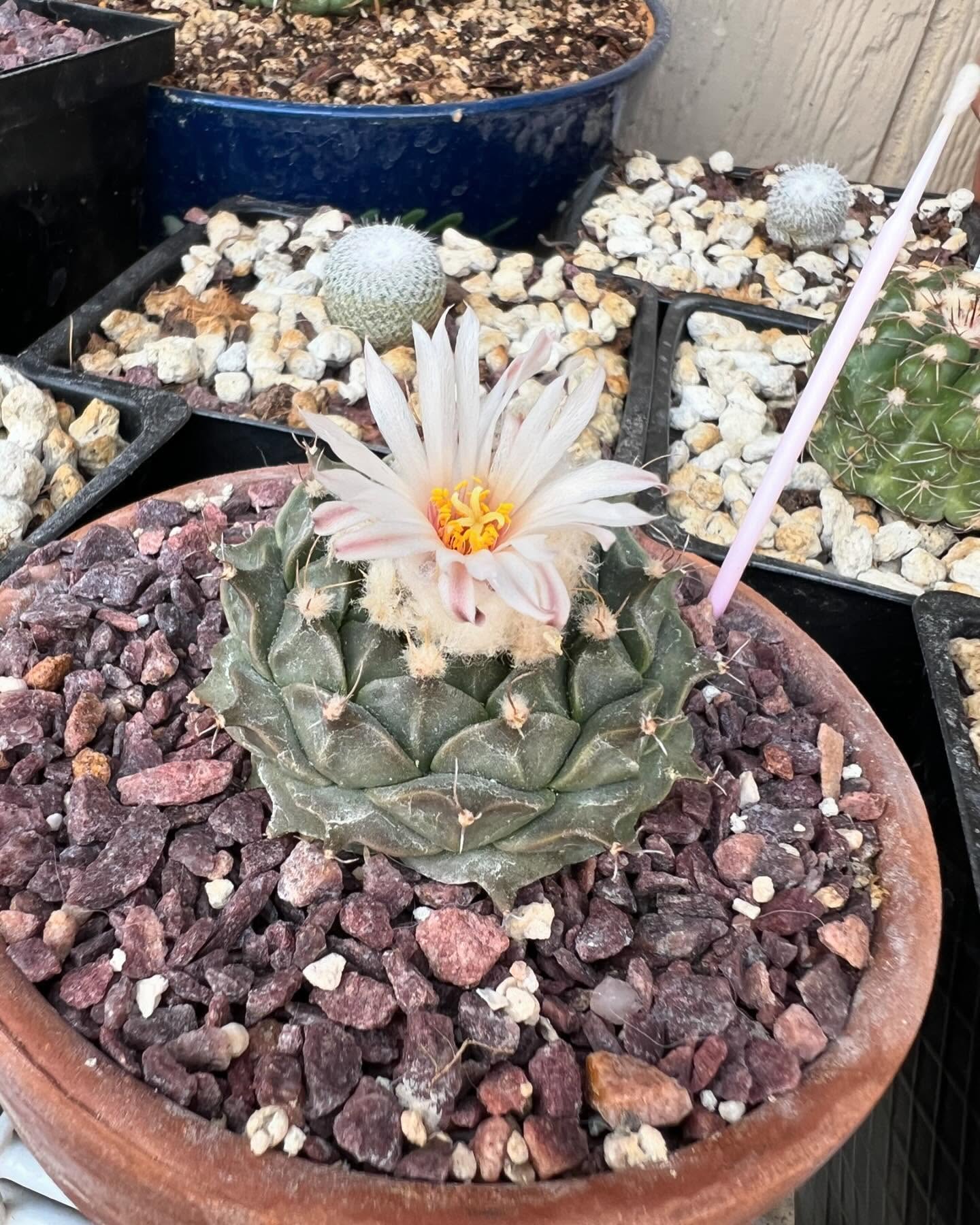
Flowers arise from the apical wool, not from lateral tubercle areoles. They are funnel-shaped and diurnal, 2.5 cm in diameter and 2.5 to 3 cm long, with white to faintly pink tepals and yellow stamens. Flowering runs from late spring into summer, May through September in cultivation, with a primary flush around June and July. The species is self-incompatible; two genetically distinct individuals must be present for seed to set. Fruits are small, naked, pear-shaped, white to pinkish, fleshy when fresh, and ripen hidden inside the apical wool. Seeds are large for the body size: black, 1 to 1.4 mm.
Locality detail
The type locality is the Valle de Jaumave in southern Tamaulipas, collected by Frič in 1923. All confirmed extant subpopulations fall within the Jaumave valley system; the literature recognises no more than five subpopulations, all concentrated in a single localised area for IUCN assessment purposes.
The map marks a single redacted regional centroid rather than point-level population coordinates. For a CITES Appendix I species that has suffered documented population decline from illegal collection, publishing precise GPS data would facilitate collection rather than conservation. The regional centroid conveys the range without exposing individual populations.
Obregonia denegrii care and cultivation
Obregonia denegrii is governed by three facts from its Jaumave valley habitat: a calcareous limestone substrate, a thick taproot, and a hot dry summer paired with a near-rainless winter. Match those three and the plant is forgiving. Diverge from any of them and the taproot rots before the symptoms reach the body.
Substrate
The calcareous Jaumave valley fill is the load-bearing cultivation detail. The 7-component mix for O. denegrii uses 35% pumice (3 to 6 mm), 20% crushed lava rock, 15% granite grit, 12% crushed limestone or chick grit, 5% zeolite, 3% silica sand, and 10% worm castings. That sums to 100%, with 90% inorganic and 10% organic. Target pH is 7.2 to 7.6. The 12% limestone fraction lifts the pH into the alkaline band the Jaumave valley soil occupies; this differentiates the mix from a Lophophora or Astrophytum recipe. Pumice and lava provide the macropore drainage the taproot demands. Zeolite holds a trickle of nutrient between sparse waterings. Worm castings supply the modest organic fraction without the cation-exchange spike or hydrophobic dry-out of richer composts.
Obregonia is monotypic. The single row shows the house mix at 90% inorganic / 10% organic, with the elevated limestone fraction (12%) set by house convention for this group of Mexican genera, not by a tested requirement of the species. Hard tap water already supplies calcium and bicarbonate at every watering; rainwater and RO water supply neither.
| Species | Pumice | Lava | Zeolite | Granite | Limestone | Silica | Organic |
|---|---|---|---|---|---|---|---|
| O. denegrii (this page) | 35% | 20% | 5% | 15% | 12% | 3% | 10% |
Watering and light
Keep the substrate completely dry from late autumn through early spring. The plant retracts slightly into the soil during winter rest, which is normal. Resuming water before the plant has swollen back from its retracted state risks rotting the taproot; this is the most common cultivation mistake. Do not water if night temperatures are below 10 °C.
From late spring, when nights warm above 12 °C, water deeply when the substrate has been fully dry for several days. Under glasshouse conditions the interval is roughly 10 to 14 days in summer, slightly longer in spring and early autumn. Taper frequency as temperatures cool in autumn. Summer ambient up to 38 °C is comfortable provided airflow is good.
In habitat plants grow under full sun but shelter among shrubs during the hottest months, giving some afternoon shade. Bright filtered light or full morning sun with afternoon shade works well in cultivation. The woolly apical crown is prone to scorch if exposed to intense midday sun without gradual acclimation after a dark winter rest. Plants that have been winter-rested under low light should be re-introduced to spring sun over three to four weeks.
Propagation
Almost exclusively from seed. Germination is reliable on a sterile mineral medium with bottom heat of 22 to 25 °C and gentle humidity. Published in vitro work reports germination rising from 22% on untreated control to 85% with GA3 pre-treatment after seven days. Seedlings are extremely slow. First flowering takes 7 to 8 years from seed under good conditions.
The self-incompatibility of the species has a direct practical consequence for seed production: a single plant, or a collection of clonal plants raised from cuttings of the same original, will flower freely but set no seed. Two genetically distinct individuals must be present and hand-pollination in cultivation is usually necessary, as native insect pollinators are not available. Adult plants do not offset reliably and grafting is uncommon in serious collections; seed grown from documented multi-parent bowls is the standard propagation path.
Comparison
Because Obregonia is monotypic, there are no congeners to compare. The relevant comparisons run across genera within tribe Cacteae. The closest morphological and ecological parallels are Lophophora williamsii, Strombocactus disciformis, and the broader Ariocarpus genus.
Lophophora williamsii is the nearest in feel: woolly apex, single geophytic growth point, calcareous substrate, dry winter rest, and a similar alkaloid chemistry responsible for the peyotillo common name applied to both. The separations are clear on inspection. Obregonia tubercles are sharply triangular and tightly overlapping; Lophophora tubercles are rounded mounds. Obregonia carries spines, even if soft and shed quickly; Lophophora has none. The substrate for Obregonia calls for a higher limestone fraction and a slightly higher pH target than the Lophophora mix. Cold hardiness differs importantly: Lophophora is markedly more cold-tolerant, a distinction that matters when both are grown in the same collection.
Strombocactus disciformis shares the flat overlapping-tubercle silhouette that prompted Rowley’s 1974 transfer and is the species most easily confused with Obregonia in photographs. The differences are reliable in hand: Strombocactus has stiffer, persistent, pectinate spines and a different apex structure; Obregonia’s spines are soft and deciduous, leaving the older tubercles spineless. The Ariocarpus comparison, which prompted Marshall’s 1946 transfer, is largely historical; the flattened tubercle silhouette overlaps with some Ariocarpus fissuratus forms, but Ariocarpus tubercles are furrowed and the genus grows significantly larger. For cultivation, Obregonia sits closer to Ariocarpus than to Lophophora in its calcareous substrate requirement, deep taproot, and similar dry winter rest.
Frequently asked questions
Is Obregonia denegrii hard to grow?
Intermediate. The calcareous substrate and the non-negotiable dry winter rest are the two requirements that catch most growers out. The mix on this page includes a limestone fraction targeting pH 7.2 to 7.6 as a house convention, not a documented species requirement. The winter rest means bone-dry substrate from late autumn through early spring and no watering until the plant visibly swells back from its retracted winter state. Wet roots at sub-zero temperatures are fatal. Given correct substrate and an uncompromising dry winter, O. denegrii is a durable plant that rewards the patience its slow growth demands.
Can Obregonia denegrii be grown from seed?
Yes, though self-incompatibility adds a complication most cacti do not impose. A single plant, or a group of clonal plants derived from one original, will flower freely but set no seed at all; two genetically distinct individuals must be hand-pollinated to produce viable fruit. Once that condition is met, germination on a sterile mineral medium with bottom heat of 22 to 25 °C is reliable, and GA3 pre-treatment improves both speed and final germination percentage. Seedlings are very slow; first flowering typically takes 7 to 8 years. The case for starting with two or more unrelated seed-grown plants is both botanical and practical.
Is Obregonia denegrii legal to own and buy?
Obregonia denegrii is currently listed on CITES Appendix I, the highest tier of international protection. Appendix I requires both an export permit from the country of export and a separate import permit from the country of import for any cross-border movement, including of seed. Commercial trade in wild-collected specimens is effectively prohibited. Owning a documented seed-grown plant purchased from a CITES-registered nursery is legal in most jurisdictions. Moving any specimen across a national border requires paired permits obtained before the shipment crosses the border; a plant or seeds posted internationally without those permits are subject to customs seizure regardless of the sender’s intent. Within Mexico the species is also listed as Amenazada (Threatened) under NOM-059-SEMARNAT-2010, making removal from wild habitat a federal offence.
Where does Obregonia denegrii grow in the wild?
The Jaumave Valley and adjacent intermontane basins in southern Tamaulipas, northeast Mexico. The species is confined to Tamaulipan thornscrub on lower hill slopes over weathered limestone and dolomitic valley fill, at elevations of 800 to 1,200 m, with most records around the 1,000 m contour. The IUCN 2013 assessment identifies no more than five subpopulations, all concentrated within the Jaumave system and totalling fewer than 5,000 mature individuals. Plants typically grow nestled between thornscrub cushions and beneath the skirts of Yucca filifera and Agave lechuguilla, sitting nearly flush with the stony gravel surface.
When does Obregonia denegrii flower?
Late spring through summer, May to September in cultivation, with a primary flush around June and July. Flowers are funnel-shaped, diurnal, 2.5 cm in diameter, white to faintly pink with yellow stamens. They emerge from the dense woolly apical crown rather than from individual tubercle areoles. Because the species is self-incompatible, visible flowering in a single-plant collection produces no fruit. Fertilised flowers produce small, naked, pear-shaped white fruit that ripen hidden inside the apical wool and contain large black seeds of 1 to 1.4 mm.
Sources & further reading
Frič, A.V. (1925). Obregonia denegrii gen. et sp. nov. Život v Přírodě 29(2): 14. · International Plant Names Index (IPNI). Obregonia denegrii Frič, record 171350-2. ipni.org · Plants of the World Online (Kew POWO). Obregonia denegrii Frič, taxon urn:lsid:ipni.org:names:171350-2. powo.science.kew.org · IUCN Red List of Threatened Species 2013: e.T40968A2948122. Obregonia denegrii. Endangered B1ab(iii,v)+2ab(iii,v); assessors Gómez-Hinostrosa, C. & Guadalupe Martínez, J. iucnredlist.org/species/40968/2948122 · CITES Secretariat. Obregonia denegrii, Appendix I (entire genus). cites.org/eng/taxonomy/term/9130 · NOM-059-SEMARNAT-2010. Obregonia denegrii: Amenazada (A). Diario Oficial de la Federación / PROFEPA. · Hernández, H.M. & Gómez-Hinostrosa, C. (2005). Geographic Distribution and Conservation of Cactaceae from Tamaulipas, Mexico. Biodiversity and Conservation 14(7): 1623–1639. · Anderson, E.F. (2001). The Cactus Family. Timber Press. Obregonia treatment. · Hunt, D., Taylor, N. & Charles, G. (2013). The New Cactus Lexicon (illustrated edition). DH Books. Obregonia. · Malda, G. et al. In vitro propagation of Obregonia denegrii Frič (Cactaceae). MS medium with GA3, BAP, CPPU. ResearchGate publication 262261883. · Neal, J.M. & Sato, P.T. (1972). Cactus Alkaloids XI. Isolation of tyramine, N-methyltyramine and hordenine from Obregonia denegrii. Economic Botany 26: 208–214. · LLIFLE Encyclopedia of Living Forms. Obregonia denegrii. llifle.com/Encyclopedia/CACTI/Family/Cactaceae/2100/Obregonia_denegrii