
Pseudolithos caput-viperae
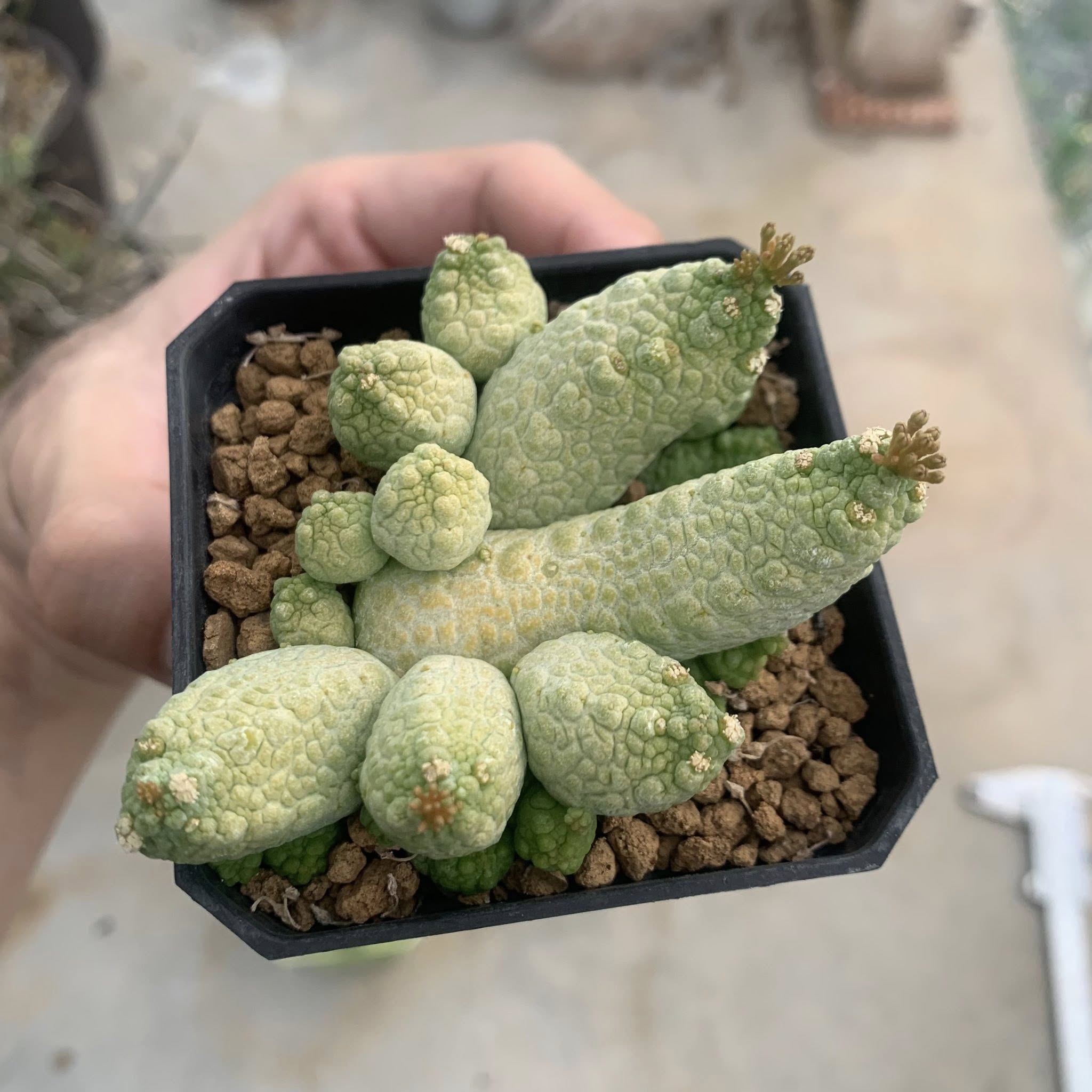
Pseudolithos caput-viperae Lavranos was described in 1974 in Cactus and Succulent Journal (Los Angeles) 46(3): 126, from a collection made near the Eil airstrip in the Bari region of northeastern Somalia. The type specimen (Lavranos & Horwood 10155) is held at the National Herbarium of South Africa, Pretoria, with an isotype at the Royal Botanic Gardens Kew. John Jacob Lavranos (1926–2018) was a Greek-South African botanist who described approximately 300 species across the Horn of Africa, Arabian Peninsula, and Madagascar; P. caput-viperae is among his most distinctive Somali collections.
Although Pseudolithos caput-viperae belongs to the milkweed family rather than Cactaceae, its stone-mimicking habit and extreme drought adaptation place it squarely in the rare-succulent collector world. The plant is classified in Apocynaceae, subfamily Asclepiadoideae, tribe Ceropegieae, subtribe Stapeliinae; it is a stapeliad, not a cactus. What draws collectors is the same convergent character that defines the genus: a body that looks more like a piece of weathered limestone than a living plant, with waxy carrion-scented flowers that give away the biology only when they appear.
Pseudolithos caput-viperae is freely branching, forming clusters of up to roughly ten club-shaped stems from seedling age. Juveniles begin to offset at around twelve months and continue producing lateral branches throughout the plant’s life. Among the four taxa covered on this site, caput-viperae and Pseudolithos mccoyi are freely branching while Pseudolithos cubiformis and Pseudolithos migiurtinus remain solitary. Within this group, the branching habit combined with the snake-scale tubercle pattern are the most reliable diagnostic characters for caput-viperae.
The Latin epithet caput-viperae translates as “viper’s head”: caput = head, viperae = of the viper. The name refers to the raised, irregular tuberculation that covers each stem body, producing a scaly, reptilian surface that collectively resembles the pattern on a viper’s head. This tessellation is a genus-wide stone-mimicry trait in Pseudolithos (the genus name means “false stone” in Greek), but in caput-viperae the branched cluster of knobbly segments intensifies the serpentine effect beyond what the solitary-stemmed congeners achieve.
Pseudolithos caput-viperae quick reference
A branching stone-mimic stapeliad from hyper-arid northeastern Somalia, growing on rocky limestone terrain near sea level in the Bari region. Values calibrated for seed grown plants in cultivation, drawn from genus-level grower consensus and habitat data; species-specific cultivation figures for P. caput-viperae are limited in published literature.
Taxonomy & nomenclature
The accepted name is Pseudolithos caput-viperae Lavranos, published in Cactus and Succulent Journal (Los Angeles) 46(3): 126 (1974). Kew POWO (IPNI lsid urn:lsid:ipni.org:names:100734-1) accepts Pseudolithos caput-viperae as the current name under a recognised genus Pseudolithos. The only synonym on record is Ceropegia caput-viperae (Lavranos) Bruyns, published in South African Journal of Botany 112: 413 (2017) by Bruyns, Klak, and Hanacek, who proposed sinking all 31 stapeliad genera (and additional Brachystelma lineages) into a greatly expanded Ceropegia. This page follows POWO, which does not accept that treatment.
Pseudolithos itself was established by P.R.O. Bally in 1965, replacing his earlier Lithocaulon (1956), a name that was preoccupied by fossil algae. Molecular phylogenetic work in 2002 placed the genus as most closely related to the North African Caralluma, with Echidnopsis and Rhytidocaulon as more distant relatives within the Ceropegieae framework. The genus counts approximately nine accepted species, all from Somalia, Yemen, and Oman, with P. gigas extending into eastern Ethiopia.
Within Pseudolithos, no published molecular phylogeny resolves the internal species relationships for P. caput-viperae specifically; the 2002 phylogenetic work operates at genus level. A separate taxonomic proposal transferred P. mccoyi to Anomalluma based on stem morphology and molecular data, though POWO retains P. mccoyi in Pseudolithos; this debate does not affect the standing of P. caput-viperae.
Habitat
Pseudolithos caput-viperae grows in the Bari region of Puntland, northeastern Somalia, in hyper-arid terrain near the coastal town of Eyl (also spelled “Eil”), where the type collection was made near the local airstrip. The Bari region falls within the Acacia-Commiphora bushland biome of the Horn of Africa, characterised by open, stony ground with sparse shrub cover. Parent rock in this part of Puntland is predominantly Jurassic-Cretaceous limestone and dolomite, with gypsum outcrops; substrate is stony, mineral-dominant, and extremely low in organic content.
Annual rainfall near Eyl is typically under 200 mm, delivered across two rainy seasons: the Gu (April to June) and the Deyr (October to December). Two dry seasons follow: the Jilaal (December to March) and the Hagaa (July to September). The coastal position means seasonal fog from the Gulf of Aden provides additional moisture input, particularly during the Hagaa southwest monsoon period. This fog contribution is ecologically plausible for xerophytic plants in the Eyl area but has not been confirmed as a specific moisture source for P. caput-viperae in published species literature.
Elevation at the type locality has not been published. Eyl is a coastal settlement at near sea level; the surrounding Bari region rises to 500–900 m. Specific microsite details (rock crevice, flat ground, cliff face) for P. caput-viperae at Eil have not been documented in retrievable literature. Across the genus, Pseudolithos species grow in exposed rocky terrain, often on or between stones, relying on cryptic coloration and stone-mimicry for concealment from herbivores.
Morphology
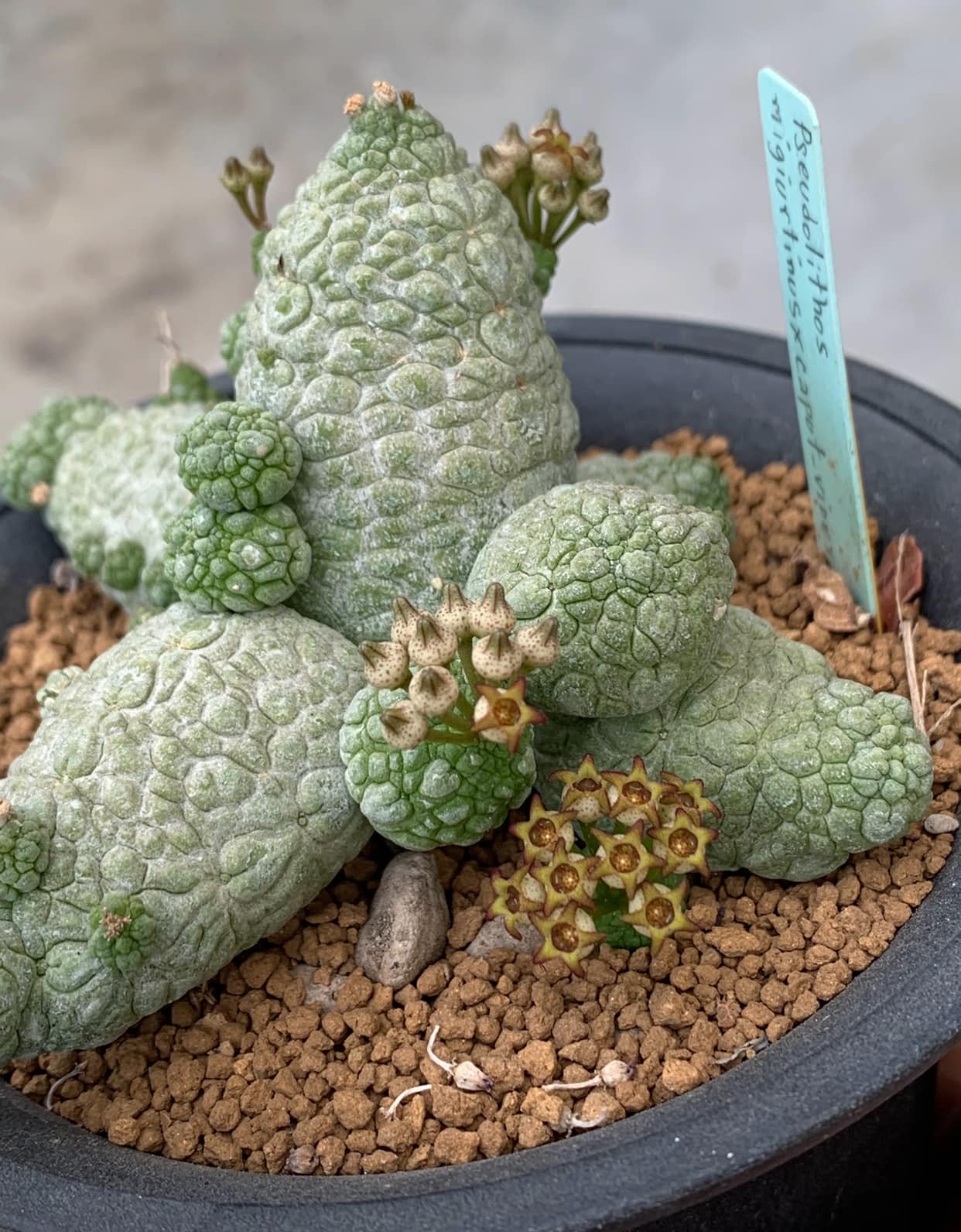
Pseudolithos caput-viperae is freely branching, beginning at roughly 12 months from seed, and eventually forms clusters of up to roughly ten stems. P. cubiformis and P. migiurtinus are solitary, sitting as individual stones on the ground; caput-viperae builds a spreading clump. This freely-branching growth pattern is so consistent that it functions as a primary diagnostic character for the species when compared with cubiformis specifically: a Pseudolithos with solitary cube-shaped habit is cubiformis; a multi-stemmed knobbly clump is almost certainly caput-viperae.
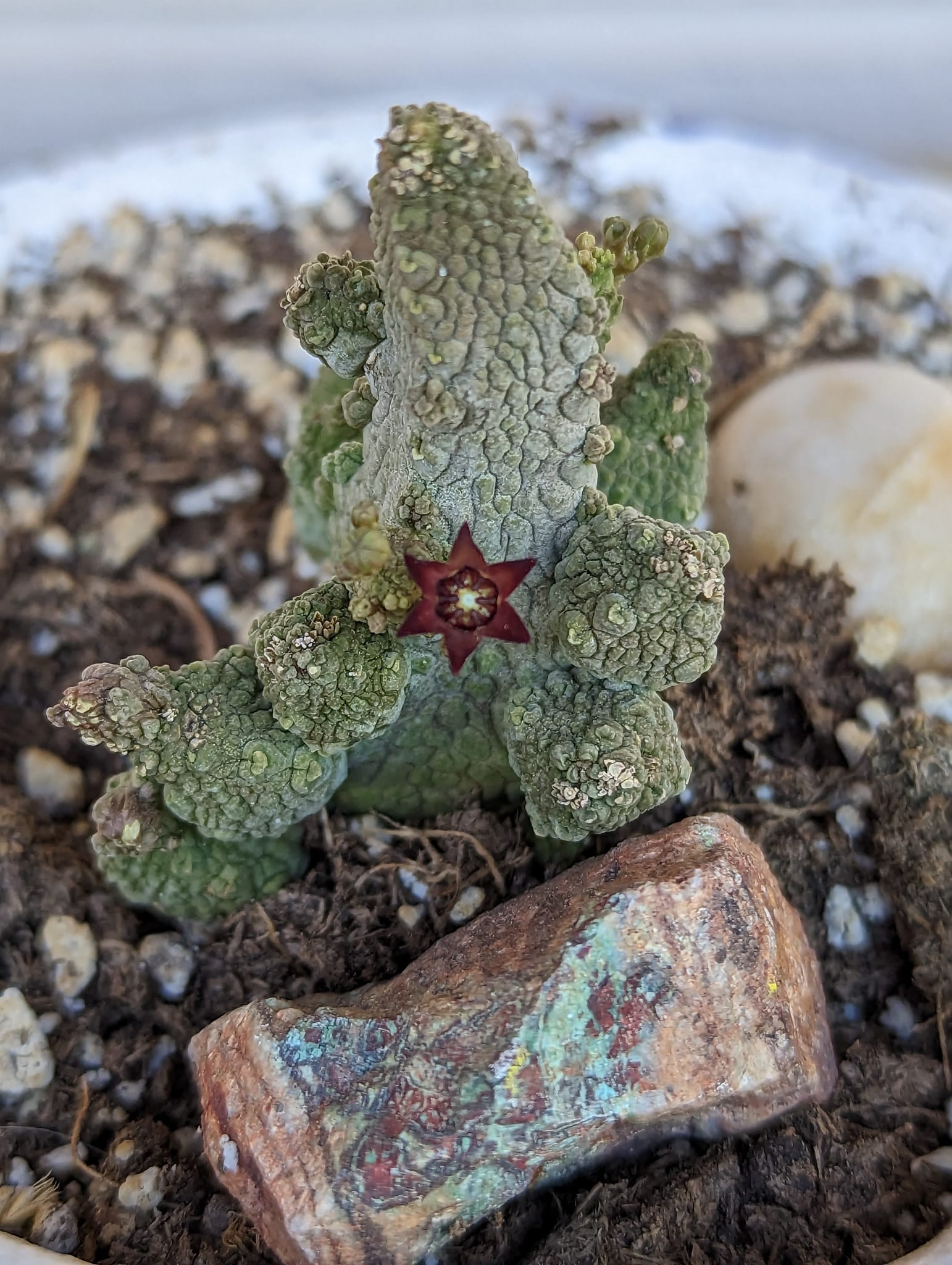
Individual stems are club-shaped, ovoid, or subglobose, somewhat dorsiventrally flattened, reaching 15–40 mm long and 8–15 mm wide at single-stem scale. Multi-stem clumps can reach 6–8 cm overall height. Body colour is green to brownish, with individual plants showing olive-green, grey, or dusty brown tones depending on light intensity and season; more sun exposure drives the reddish-brown end of the range. The stem surface is covered with raised, irregular tubercles that create a corky, knobbly appearance intensifying with age. This is the tessellation that gives the species its name: the pattern of irregular scales across a branched clump of stems collectively evokes the patterned skin of a viper’s head.
Flowers are produced from the stem surface (not the apex), several times yearly, with individual flowers lasting several days. The corolla is two-zoned: the tube is white to pale green, globose, approximately 2.5 mm long and 2.5 mm wide; the lobes are dark reddish-brown to maroon, triangular, spreading, bearing short tufted hair-like appendages at their tips, with a waxy texture. This two-zone colouration is consistent with the broader stapeliad pattern of pale tube and pigmented lobes. Scent is carrion-like; pollination is by carrion flies and beetles, typical for the Stapeliinae. Fruit consists of paired follicles (twin seed horns) reaching up to 8 cm; seeds carry a coma of white hairs for wind dispersal, the standard stapeliad dispersal mechanism.
Locality detail
The type specimen (Lavranos & Horwood 10155) was collected near the Eil airstrip in the Bari region of Puntland, northeastern Somalia. Eyl (the modern spelling) is a coastal town approximately 7.97°N, 49.82°E on the Gulf of Aden coast. This places the type locality within the internationally recognised territory of Somalia, in the Puntland semi-autonomous administration. Holotype is at the National Herbarium of South Africa, Pretoria (PRE); isotype at the Royal Botanic Gardens Kew (K).
No GPS coordinates for the specific type-collection site have been published in retrievable literature. Somalia is a conflict-affected region and field access has been severely restricted for decades; the true current population status of P. caput-viperae at Eil is unknown. The map above uses a regional centroid at the town level. No other confirmed localities for this species beyond the original type collection site have been documented in available sources.
All available sources agree the range is Somalia-only; no records from Ethiopia, Yemen, or Oman have been published for P. caput-viperae. The congener P. gigas reaches eastern Ethiopia, but no equivalent range extension is documented for this species.
Pseudolithos caput-viperae care and cultivation
Pseudolithos caput-viperae is grown by a small number of specialist succulent collectors worldwide. In the northern hemisphere it is frequently encountered as a grafted plant on an asclepiad rootstock such as Hoodia gordonii, Ceropegia linearis, or Caralluma spp. Grafted plants grow and flower faster than seed grown specimens; the graft bond forms quickly (growers report bonding within three days on Hoodia rootstock, compared with seven or more days for cactus scions). Seed grown plants are rare; seed availability for P. caput-viperae specifically is noted as limited in specialist cultivation literature, though small-quantity seed offerings from specialist suppliers do appear. Growth from seed is described as very slow; no confirmed years-to-flowering figure for seed grown plants has been located in published literature.
Substrate
Pseudolithos caput-viperae is prone to rot at the stem base, so the substrate has to dry within a day of watering rather than reproduce any particular habitat profile. The recipe is 45 per cent pumice, 8 per cent lava rock, 10 per cent zeolite, 20 per cent granite grit, 10 per cent coarse silica, and 7 per cent worm castings. That organic share comes from grower-practice evidence at the arid stapeliad and caudiciform group level; no source publishes a figure naming P. caput-viperae alone. Limestone chip is absent: no source recommends limestone, dolomite, or oyster grit for this genus. The zeolite handles cation exchange and pH buffering; the lava and granite fraction together form the structural drainage layer. Moisture retention beyond 24 hours risks stem collapse from rot; the substrate must drain immediately and completely after each watering. A top dressing should not contact the stem body directly.
All four Pseudolithos species on this site share one substrate vector. No published source distinguishes one Pseudolithos species from another on substrate composition, so the same recipe applies across the genus rather than a figure invented per species. Limestone stays at 0 percent because no source at any tier recommends limestone, dolomite, or oyster grit for this genus. The organic share is set from grower-practice evidence at the arid stapeliad and caudiciform group level, not from any single Pseudolithos-only source.
| Species | Pumice | Lava | Zeolite | Granite | Limestone | Silica | Organic |
|---|---|---|---|---|---|---|---|
| P. cubiformis | 45% | 8% | 10% | 20% | 0% | 10% | 7% |
| P. migiurtinus | 45% | 8% | 10% | 20% | 0% | 10% | 7% |
| P. caput-viperae (this page) | 45% | 8% | 10% | 20% | 0% | 10% | 7% |
| P. mccoyi | 45% | 8% | 10% | 20% | 0% | 10% | 7% |
Watering and light
During the active growing season (spring through summer in the northern hemisphere, roughly April through September), water thoroughly when the substrate is completely dry. Underwatering during active growth causes visible stem deflation; overwatering at any season causes rapid rot. Avoid wetting the stem body when watering. From November through February, reduce to bare minimum or cease entirely; the plant is dormant and the rot risk climbs sharply when any moisture combines with cool temperatures.
Light requirements are high: very bright, direct light for most of the day is appropriate for acclimatised plants, matching the open, exposed limestone terrain of the Bari region. Newly acquired or recently moved plants should be acclimated gradually to full sun rather than placed directly in the strongest light; susceptibility to scorching is well documented when exposure to intense summer heat is too sudden. Some midday shade during the hottest summer weeks is a sensible precaution during acclimation.
Cold tolerance
The practical cultivation minimum is 10°C, based on grower consensus across the genus. Pseudolithos cubiformis and P. mccoyi cultivation notes both give 10°C as the floor; 8°C is the absolute minimum with gentle heating. No P. caput-viperae-specific cold tolerance figure has been located; the genus-level range of 8–10°C minimum is used here, flagged as a cross-species inference. Frost is not tolerated by any Pseudolithos. Bone-dry conditions are essential during any cold period; a combination of cool temperatures and any substrate moisture accelerates rot rapidly.
Comparison
With four taxa in the genus on this site, the identification comparisons are compact. The most practically important contrast is caput-viperae versus P. cubiformis: both are northeastern Somalian species with knobbly tessellated surfaces and roughly similar single-stem proportions, making them the pair most likely to be confused in a mixed collection, particularly with young plants. The FAQ distinguishing table below works through the head-to-head characters in detail.
The comparison with P. migiurtinus is less demanding at adult scale. P. migiurtinus is described as the most commonly cultivated species in the genus, so it is the plant a collector most likely already knows. At adult size the two species look substantially different: migiurtinus is a compact, smooth-surfaced rounded pebble mimic, distinctly less knobbly than the tessellated, branching clump of caput-viperae. The one point of real confusion is at the seedling or single-stem stage, before caput-viperae has begun to branch, when both species show a subglobose green-to-brown body. At that stage the surface texture is the faster check: caput-viperae already shows prominent raised tubercles; migiurtinus is comparatively smooth.
Pseudolithos mccoyi presents no identification challenge. Its stems are quadrangular, elongated, and finger-like, immediately distinct from the club-shaped branching clump of caput-viperae. Some authorities treat mccoyi under Anomalluma based on molecular and morphological evidence; POWO retains it in Pseudolithos, the treatment this site follows.
Frequently asked questions
How do you tell Pseudolithos caput-viperae apart from Pseudolithos cubiformis?
Pseudolithos cubiformis is the closest visual match to a young or single-stemmed caput-viperae: both share knobbly tessellated surfaces, northeastern Somalia provenance, and roughly similar single-stem proportions. At adult scale the two species diverge sharply. Drag the slider to compare both plants, then check the character table.


Against cubiformis specifically, the most reliable diagnostic pair is branching habit combined with tubercle pattern: caput-viperae produces a multi-stemmed knobbly clump with irregular snake-scale tessellation, while cubiformis sits solitary with four cardinal ridges and more regular shielding. In young, single-stemmed plants before branching begins, the irregular knobbly tubercle pattern of caput-viperae is visually rougher than the more regular four-ridged tessellations of cubiformis. Flower size confirms at bloom time: the tiny 2.5 mm corollas of caput-viperae contrast with the largest flowers in the genus produced by cubiformis.
Is Pseudolithos caput-viperae difficult to grow?
Advanced, for two reasons. First, the substrate must be 100 percent mineral with zero organic content; any water retention beyond a day or two risks rapid collapse from rot. Second, temperature management during winter is critical: the plant needs a warm, bone-dry rest from roughly November through February, and a combination of cool temperatures with any moisture accelerates rot. The branching habit makes cutting propagation more practical than for solitary-stemmed congeners, which provides some insurance, but maintaining the characteristic compact clump form requires patience and correct mineral substrate rather than organic mixes that force fast, soft growth.
Why does Pseudolithos caput-viperae smell like rotting meat when it flowers?
Pseudolithos belongs to the Stapeliinae, a group of succulents in the milkweed family that evolved carrion-mimicry to attract blow flies and carrion beetles as pollinators. The flowers produce volatile sulfur compounds and other odour chemicals that mimic decomposing animal tissue. Pollinator flies land on the waxy, darkly coloured lobes (which also mimic decaying flesh in texture and colour) and transfer pollen while searching for oviposition sites. The scent intensity varies across the Stapeliinae; in Pseudolithos the flowers are small (2.5 mm) but the carrion odour is described as pungent. Flowers last several days and the plant blooms several times yearly, maximising pollination opportunities.
Is Pseudolithos caput-viperae a cactus?
No. Pseudolithos caput-viperae is classified in Apocynaceae (the milkweed or dogbane family), not Cactaceae. It belongs to the subfamily Asclepiadoideae and tribe Ceropegieae; it is a stapeliad succulent, not a cactus. The resemblance to cacti is convergent evolution: both groups evolved succulent stems, stone-mimicking body forms, and extreme drought tolerance independently in response to similar arid-habitat pressures. The differences become clear on close inspection: Pseudolithos has no areoles, no true cactus spines, no ribs, and produces flowers with the typical milkweed corona and pollinium structure, not the brush-like staminal columns of cacti. Practically for collectors, Apocynaceae stapeliads also carry no blanket CITES Appendix II listing, unlike Cactaceae, so P. caput-viperae can be traded across borders with standard nursery documentation rather than requiring CITES permits.
Where does Pseudolithos caput-viperae grow in the wild?
Northeastern Somalia, specifically the Bari region of the Puntland semi-autonomous administration. The type specimen was collected near the Eil (Eyl) airstrip on the Gulf of Aden coast; no other confirmed wild localities have been published. The surrounding terrain is hyper-arid Acacia-Commiphora bushland on stony limestone and gypsum soils, with annual rainfall under 200 mm. Somalia’s longstanding conflict and access restrictions mean the population status at the type locality is unknown as of 2026; no field surveys have been published from this area since Lavranos’ 1974 collection.
Is Pseudolithos caput-viperae legal to buy?
Pseudolithos caput-viperae is not listed in any CITES Appendix as of 2026. Apocynaceae stapeliads have no blanket CITES listing comparable to Cactaceae’s Appendix II default, so nursery-propagated plants can be traded across borders without CITES documentation (though standard phytosanitary export/import rules apply). Note that the synonym Ceropegia caput-viperae (Bruyns 2017) is not accepted by POWO; if trade documentation uses the Bruyns combination, this should not be confused with any CITES-listed Ceropegia species (which historically concerned Indian tuberous species, not Somali stapeliads). Wild collection from Somalia is subject to Somali national law; purchase only from sellers with documented nursery-propagation origin.
Sources & further reading
Lavranos, J.J. (1974). Pseudolithos caput-viperae sp. nov. Cactus and Succulent Journal (Los Angeles) 46(3): 126 · Kew POWO, Pseudolithos caput-viperae Lavranos, IPNI lsid urn:lsid:ipni.org:names:100734-1 · IPNI, urn:lsid:ipni.org:names:100734-1 · JSTOR Global Plants, Pseudolithos caput-viperae compilation (type specimen data; corolla description tracing to protologue) · Bruyns, P.V., Klak, C. & Hanacek, P. (2017). A revised, phylogenetically-based concept of Ceropegia (Apocynaceae). South African Journal of Botany 112: 399–436. DOI: 10.1016/j.sajb.2017.06.021 · Meve, U. & Liede, S. (2002). A molecular phylogeny and generic rearrangement of the stapelioid Ceropegieae (Apocynaceae-Asclepiadoideae). Plant Systematics and Evolution 234: 171–209. DOI: 10.1007/s00606-002-0220-2 · Plowes, D. (c. 2015). In-depth review of Pseudolithos. Asklepios no. 120 (Journal of the International Asclepiad Society) · NParks Flora & Fauna Web, Pseudolithos caput-viperae, National Parks Board, Singapore · Henry Shaw Cactus and Succulent Society. Pseudolithos (Plant of the Month 2009). hscactus.org · Plantiary. Pseudolithos caput-viperae plant care. plantiary.com · Giromagi Cactus and Succulents. Pseudolithos cubiformis species page. giromagicactusandsucculents.com · Wikipedia: Pseudolithos (genus); Wikipedia: Pseudolithos caput-viperae; Wikipedia: John Jacob Lavranos