
Pseudolithos cubiformis
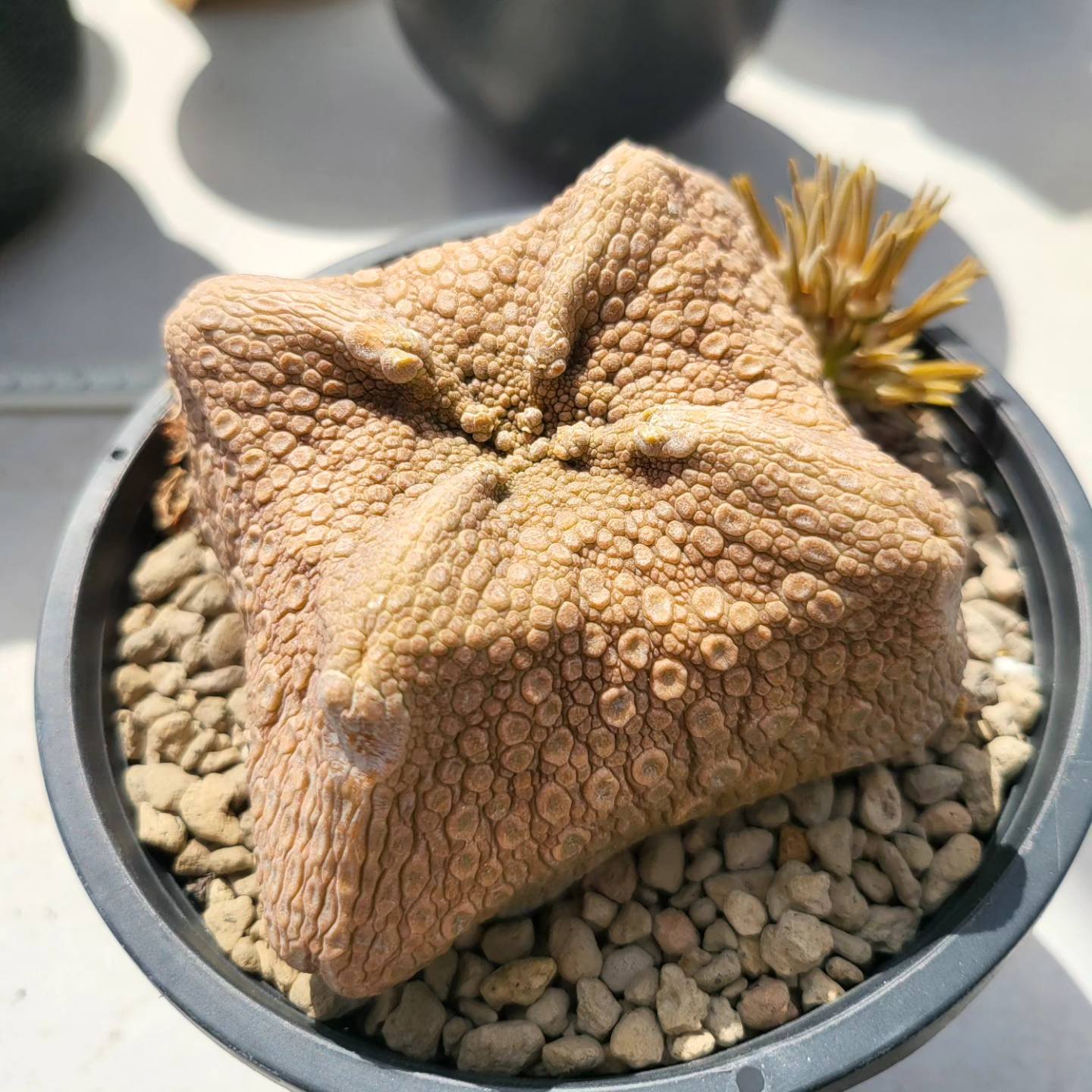
Although Pseudolithos cubiformis belongs to the milkweed family rather than Cactaceae, its stone-mimicking habit and extreme drought adaptation place it squarely in the rare-succulent collector world. Among all the stapeliads in the genus Pseudolithos, cubiformis is the most architecturally distinctive: the stem develops into a nearly perfect four-sided cube up to 12 cm across, grey-green and tessellated, camouflaged against the grit plains of northeastern Somalia until a cluster of hairy, carrion-scented flowers betrays its position to flies.
Bally first collected this species in the 1950s and placed it in a new genus, Lithocaulon, in 1959. When it emerged that the name Lithocaulon was already occupied by a fossil alga described by Meneghini in 1857, Bally erected the replacement genus Pseudolithos (Greek: false stone) in 1965 and simultaneously created the new combination Pseudolithos cubiformis. The specific epithet simply means cube-shaped, a description that needs no elaboration for anyone who has seen the plant.
The genus Pseudolithos is confined to the Horn of Africa and southern Arabia, and cubiformis is the largest-bodied species in the group. Its closest relatives within the genus include Pseudolithos migiurtinus, the type species and the most commonly cultivated Pseudolithos, and Pseudolithos caput-viperae, a compact species with viper-head-like elongated stems. The fourth taxon covered on this site, Pseudolithos mccoyi, has freely branching quadrangular stems quite unlike the solitary cube of cubiformis.
Cultivation is unforgiving. A single watering event at the wrong temperature can kill the plant within hours as rot spreads through the stem. Understanding the temperature-gated watering rule is not optional for anyone attempting this species. The reward, for those who succeed, is the most visually improbable plant in cultivation.
Pseudolithos cubiformis quick reference
A stone-mimicking stapeliad from arid grit plains in northeastern Somalia, with a cube-shaped stem, fibrous roots, and extreme sensitivity to cold or wet conditions during the rest period. Values calibrated for seed grown plants in cultivation, drawn from habitat data and specialist grower experience.
Taxonomy & nomenclature
The accepted name is Pseudolithos cubiformis (P.R.O.Bally) P.R.O.Bally, published in Candollea 20: 41 (1965). Kew POWO (IPNI lsid urn:lsid:ipni.org:names:100735-1) currently treats this as the accepted combination. The taxonomic history involves two publication dates: Bally originally described the species as Lithocaulon cubiforme P.R.O.Bally in Candollea 17: 58 (1959), placing it in a new genus he coined. The name Lithocaulon was a later homonym of a fossil alga described by Meneghini in 1857, so it had to be replaced. Bally’s solution was to erect the replacement genus Pseudolithos in 1965 and simultaneously create the new combination, making himself both the original describer of the basionym and the author of the accepted combination.
Two synonyms appear in the literature. The basionym Lithocaulon cubiforme P.R.O.Bally (1959) is the homotypic predecessor. The combination Ceropegia cubiformis (P.R.O.Bally) Bruyns, published in the South African Journal of Botany 112: 413 (2017), reflects Bruyns, Klak, and Hanacek’s proposal to absorb all 36 genera of stapeliads into an expanded Ceropegia on molecular-phylogenetic grounds. POWO does not currently follow that treatment; the page follows POWO. A third entry, Pseudolithos cubiformis var. viridiflorus F.K.Horw. (1975), appears to represent a colour variant with distinctly green-tinged flowers; POWO lists it as a heterotypic synonym.
The family placement is Apocynaceae, subfamily Asclepiadoideae, tribe Ceropegieae, subtribe Stapeliinae. Within the subfamily, molecular phylogenetic work places Pseudolithos as most closely related to the North African Caralluma clade, with Echidnopsis and Rhytidocaulon as a more distantly related sister branch. Under POWO’s current circumscription, the genus includes eight accepted species.
Historical synonyms (2)
- Lithocaulon cubiforme P.R.O.Bally, 1959 basionym
- Pseudolithos cubiformis var. viridiflorus Horw., 1975 homotypic synonym
Sources: POWO (Kew) · IPNI · GBIF · Wikidata
Habitat
Pseudolithos cubiformis grows on grit plains in northeastern Somalia, in the former Migiurtinia region corresponding to modern Puntland and adjacent areas. All secondary sources consistently describe the substrate as grit: coarse mineral soil with fast drainage and minimal organic content, likely reflecting decomposed limestone or gravel plains given the regional geology. Parent rock chemistry has not been specifically documented for this species.
The ecoregion is the Somali Acacia-Commiphora bushlands and thickets, dominated by Acacia (now largely Vachellia and Senegalia under updated nomenclature), Commiphora, and Boswellia. The landscape is low-canopy dry scrub where the dominant trees are leafless for up to nine months per year. Species-level plant associates at the microsite level have not been documented in the available literature; the broader ecoregion matrix is the closest context for understanding the plant’s ecological situation.
The climate is arid to semi-arid with a bimodal rainfall pattern: the main Gu rains fall April through June and the secondary Deyr rains fall October through November, separated by two dry seasons. Annual precipitation in the Bari and Nugaal regions of northeastern Somalia is generally below 200 mm in the most arid zones. Whether coastal fog contributes meaningful moisture at the cubiformis collection localities is undocumented. Elevation is not recorded for this species.
There are no known population counts or formal range surveys.
The stone-mimicry strategy is not incidental. In a landscape of uniform grey-brown grit, a cube-shaped succulent with a tessellated surface matching the surrounding rock fragments is essentially invisible. Herbivores overlook it; only the carrion-scented flowers, briefly visible at the end of summer, attract the fly pollinators needed for seed set. The strategy works precisely because it demands nothing from the plant except extreme drought tolerance and morphological precision.
Morphology
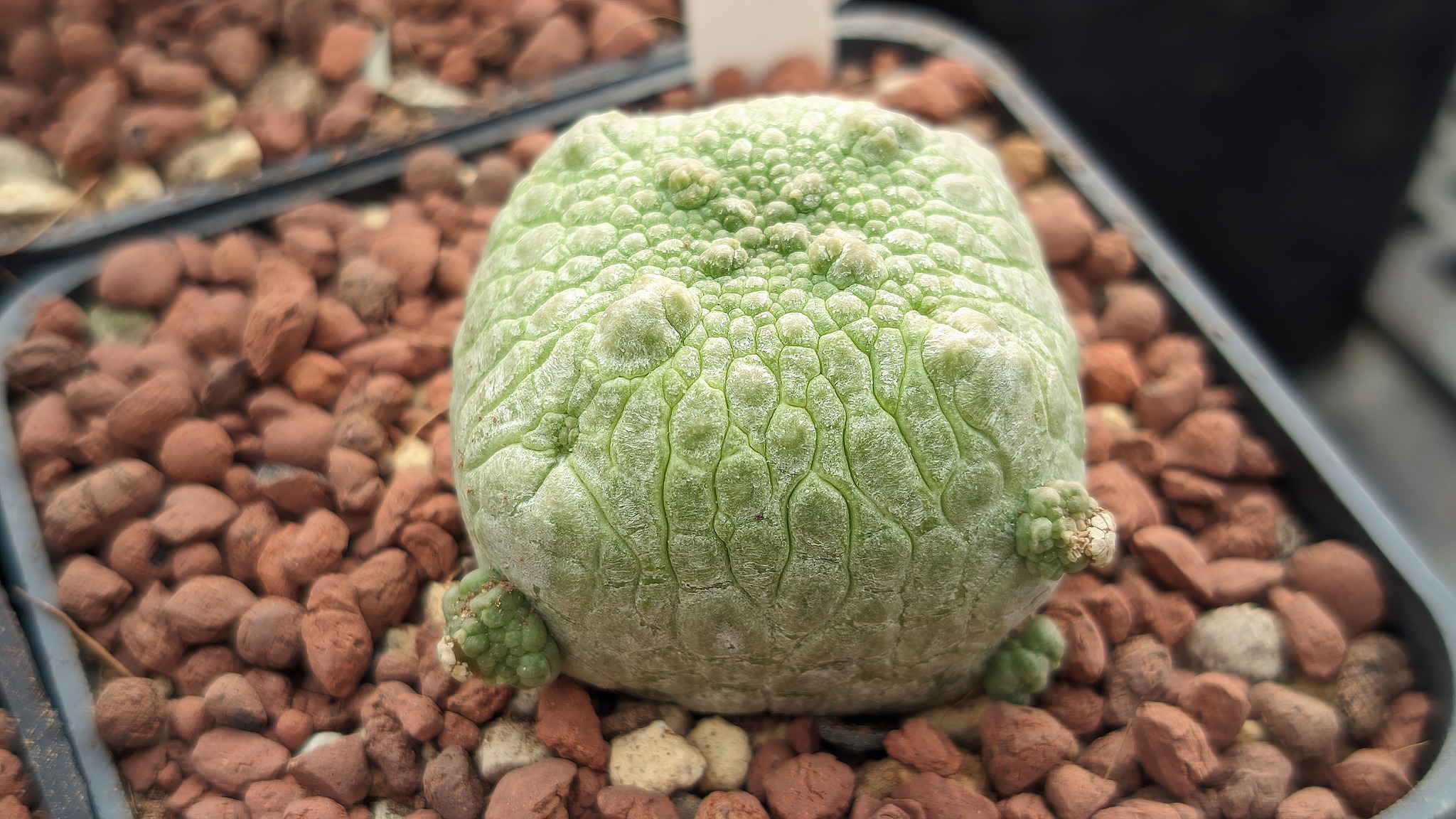
Pseudolithos cubiformis produces a solitary stem that develops a characteristically four-sided, cube-like profile at maturity. Branching is extremely rare; old plants may occasionally produce a lateral offset, but the species is essentially single-stemmed throughout its life. Maximum body size reaches 12 cm by 12 cm, making cubiformis the largest-bodied species in the genus. Some sources cite 8 cm as an upper figure; the 12 cm figure has broader corroboration and likely reflects fully mature plants under good cultivation conditions.
The stem surface is tuberculate, divided into low, irregular projections that form a tessellated mosaic: 2 to 5 mm diameter irregular facets, with four larger shield rows running along the cardinal axes and abbreviated lateral shoots arising from the corners as inflorescence bases. The texture is leathery, not papery, and the plant carries no true spines. Body colour is highly variable with light level: light green in shade, olive-grey or “granite grey” under moderate light, and reddish-brown under intense or full sun. All are normal responses, not signs of stress.
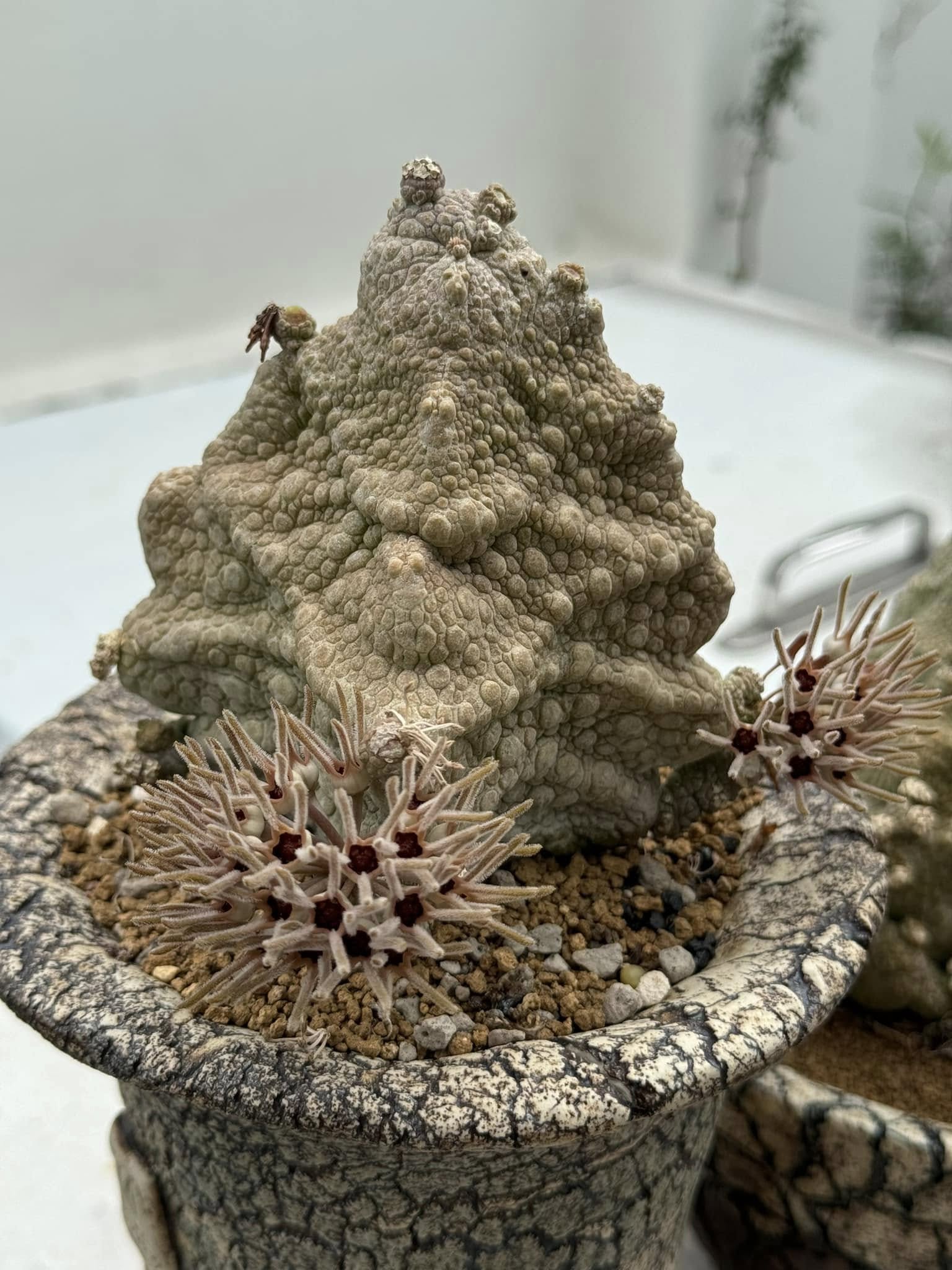
Flowers are star-shaped and clustered, arising from the corners and flanks of the stem. The corolla colour is variable: sources describe the lobes variously as greyish-green with purple centres, pale yellow to pale maroon, or reddish-brown to dark maroon with white to pale-green corolla tubes. This variation is genuine and likely accounts for the var. viridiflorus synonym, which was described for distinctly green-flowered individuals. Pseudolithos cubiformis produces the largest flowers in the genus; precise individual corolla diameter was not confirmed in a primary morphological source during research and is therefore not given here as a specific measurement. The scent is carrion-like across all colour forms, attracting fly pollinators. Bloom season is late summer, though cultivated specimens can flower more than once per year.
Fruit consists of paired follicles reaching approximately 8 cm in length, the typical asclepiad form. Seeds number 10 to 20 per follicle and are comose, carrying a silky hair tuft that lifts them on the wind when the follicle opens. The root system is fibrous without a thickened caudex or taproot, distinguishing Pseudolithos from some other stapeliads that develop bulb-like root bases.
Locality detail
The range of Pseudolithos cubiformis is northeastern Somalia, in the region corresponding to the former Migiurtinia Sultanate and today’s Puntland federal member state. Bally’s original 1959 protologue in Candollea 17 would contain the type locality, but that publication was not directly accessed during research, and no secondary source names a specific collection site or gives coordinates. The map marker above shows a regional centroid for the Bari coast area; it is not a precise locality.
Northeastern Somalia is a region where independent field survey has been essentially impossible for several decades due to ongoing instability. As a result, population data, precise range limits, and any formal conservation assessment are absent from the literature. The genus name Pseudolithos migiurtinus encodes the region of origin, and cubiformis is attributed to the same northeastern zone across all sources.
Sharp GPS coordinates are not published on this page for a taxon from a region with no functional wildlife enforcement and a well-documented collector trade. The regional centroid on the map locates the general area for context; it is not a field guide.
Pseudolithos cubiformis care and cultivation
Growing Pseudolithos cubiformis successfully reduces to one rule above all others: never apply water when the temperature is below 23°C (73°F). This threshold comes from specialist grower guidance, not a peer-reviewed physiological study, but it is corroborated across multiple independent grower sources and is consistent with the plant’s known habitat climate. Below that temperature the plant is physiologically inactive and even a small amount of moisture at the root zone triggers rapid stem rot. The consequences can be visible within hours.
Substrate
Pseudolithos cubiformis needs a substrate that drains within hours, not one built to recreate its native ground. The recipe is 45 per cent pumice as the primary aggregate, 8 per cent lava rock for structural drainage, 10 per cent zeolite for cation exchange and pH buffering, 20 per cent granite grit for structure and slow mineral release, 10 per cent coarse silica as a top dressing that helps keep moss and algae off the stem base, and 7 per cent worm castings as the organic component. That organic figure comes from grower-practice evidence at the arid stapeliad and caudiciform group level, not from a source naming P. cubiformis by itself. Limestone chip is absent: no source recommends limestone, dolomite, or oyster grit for this genus. The substrate must drain completely within 24 hours of watering. Keep the plant sitting at or just above the substrate surface; burying the base promotes rot at the collar.
All four Pseudolithos species on this site share one substrate vector. No published source distinguishes one Pseudolithos species from another on substrate composition, so the same recipe applies across the genus rather than a figure invented per species. Limestone stays at 0 percent because no source at any tier recommends limestone, dolomite, or oyster grit for this genus. The organic share is set from grower-practice evidence at the arid stapeliad and caudiciform group level, not from any single Pseudolithos-only source.
| Species | Pumice | Lava | Zeolite | Granite | Limestone | Silica | Organic |
|---|---|---|---|---|---|---|---|
| P. cubiformis (this page) | 45% | 8% | 10% | 20% | 0% | 10% | 7% |
| P. migiurtinus | 45% | 8% | 10% | 20% | 0% | 10% | 7% |
| P. caput-viperae | 45% | 8% | 10% | 20% | 0% | 10% | 7% |
| P. mccoyi | 45% | 8% | 10% | 20% | 0% | 10% | 7% |
Watering and light
The growing season runs from late spring through early autumn when temperatures consistently exceed 23°C. During this window, water sparingly every 14 to 30 days, allowing the substrate to dry completely between waterings and avoiding wetting the stem body directly. As temperatures fall in autumn, reduce watering and stop entirely once conditions drop below the threshold. Winter rest is bone dry.
The plant visibly deflates during drought, with the stem flattening slightly as it exhausts stored moisture. This is normal, not a distress signal. The body plumps again when watering resumes in the next warm season. Attempting to rescue a deflated plant by watering it out of season is the most common way to kill it.
Light requirements sit in a range. Multiple specialist sources recommend bright indirect light with protection from intense midday sun; NParks Singapore notes full sun, which likely reflects equatorial diffuse light rather than a hot continental summer. For Northern Hemisphere growers, bright indirect light or morning sun with afternoon shade is the practical target. Body colour responds to light intensity: the reddish-brown morph seen in some collections indicates high light, while olive or light green indicates moderate to lower light. Both are sustainable; the intensity of colour can be tuned by adjusting exposure.
Cold tolerance
Two thresholds must be kept separate. The watering-safe minimum is 23°C; this applies to any decision about applying moisture and is non-negotiable. The cold-survival floor, for a dry plant in winter rest, is lower: most specialist sources place the practical minimum at 10°C, with brief reported survivability to 5 to 8°C when the plant is completely dry. A greenhouse maintained at a minimum of 8°C through winter is cited in grower accounts. Wet cold at any temperature is more damaging than dry cold at a lower temperature.
Grafting and propagation
Grafting onto stapeliad rootstocks is practised for production speed; documented stocks include Echidnopsis dammanniana, Ceropegia woodii, and Caralluma species. Grafted plants flower faster and tolerate cultivation errors more readily than ungrafted plants, but the compact, angular cube habit is lost as the grafted scion grows larger than it would when grown from seed. Seed grown plants are the horticultural ideal for body form.
Propagation from seed is the primary method; vegetative cuttings are possible but rarely practised. Sow in a mineral substrate at germination temperatures of 14 to 25°C with maintained humidity. Time to flowering from seed is reported by some growers as one to two years; this figure may reflect grafted plants or optimal conditions, and no peer-reviewed account of plants grown from seed to flowering age has been located. Cross-pollination between Pseudolithos species is documented, and a single follicle pair can yield over 150 seeds when hand-pollination is successful.
Comparison
Within the genus, the most common confusion is with P. migiurtinus, the type species and the species most frequently encountered in cultivation. Both present as grey-green, tuberculate, stone-like succulent bodies, and at small sizes or in photographs lacking a scale reference the two look similar enough to cause misidentification. The FAQ table below covers the identification characters in detail; the most reliable check at a glance is body shape: cubiformis has clearly defined angular corners and flat faces between them, while P. migiurtinus is rounder and more pebble-like at all sizes.
The comparison with P. caput-viperae is less practically urgent because caput-viperae is notably smaller, branches early, and has an elongated ovoid form quite unlike the squat cube of cubiformis. A collector holding a mature plant of either species has no realistic reason to confuse it with the other. Juvenile plants are more similar, but caput-viperae begins branching within its first year of growth, which is not a habit cubiformis shares.
The fourth taxon covered on this site, P. mccoyi, has freely branching quadrangular finger-like stems that look nothing like the solitary cube of cubiformis. No field identification challenge exists between the two. The comparison focus is therefore on cubiformis versus migiurtinus, which is what the FAQ slider addresses.
Frequently asked questions
How do you tell Pseudolithos cubiformis apart from Pseudolithos migiurtinus?
Pseudolithos migiurtinus is the type species of the genus and the most commonly held Pseudolithos in cultivation. Both species share a grey-green tuberculate stone-like habit; collectors who know one species most readily confuse it with the other, particularly from photographs. Drag the slider to compare body form, then check the character table.


Body shape is the single most reliable in-hand character. P. cubiformis has clearly defined flat faces meeting at angular ridges; P. migiurtinus is consistently rounder with no flat planes. At maturity the size difference reinforces this, but the shape contrast is diagnostic even on juveniles once you know what to look for.
How difficult is Pseudolithos cubiformis to grow?
Advanced, primarily because of the temperature-gated watering rule. Specialist growers recommend never applying water when temperatures are below 23°C (73°F); below that threshold the plant is physiologically inactive and stem rot spreads rapidly after any moisture reaches the root zone. The practical consequence is a narrow active season and a bone-dry winter rest. Growers with reliable climate control find the species manageable; growers in variable or cool climates without a heated greenhouse face a more difficult challenge. The substrate must also be mineral-only with near-zero organic content, which is a different regime from most cactus growing even for experienced collectors.
Can Pseudolithos cubiformis be propagated from seed?
Yes, and seed is the primary propagation method. Sow in a mineral substrate at 14 to 25°C with maintained humidity until germination. Cross-pollination between plants is required for viable seed set; hand-pollination between two specimens during the short summer flowering window is the standard method. A single pollinated follicle pair can yield over 150 seeds. See the conservation note above; acquiring nursery-propagated stock from growers with documented provenance is the best available conservation action for collectors.
Where does Pseudolithos cubiformis grow in the wild?
On grit plains in northeastern Somalia, in the region historically known as Migiurtinia and now part of Puntland. The habitat is the Somali Acacia-Commiphora bushland ecoregion: low-canopy dry scrub dominated by Acacia, Commiphora, and Boswellia species, with fast-draining mineral substrate and annual rainfall generally below 200 mm. The stone-mimicry camouflage is an adaptation to this open, exposed environment; the plant is effectively invisible against the surrounding grey-brown grit until it flowers. Precise type locality coordinates are not published in available secondary literature, and none appear on this page.
Why do the flowers of Pseudolithos cubiformis smell like rotting meat?
The carrion odour is a pollination strategy, not a by-product. Pseudolithos cubiformis is fly-pollinated: the hairy, dark-coloured corollas and the putrid scent together mimic decaying animal matter with enough fidelity to attract blowflies and other saprophagous flies that probe the flower for food or a laying site. In doing so the fly picks up or deposits pollen. The plant offers no actual reward; this is deceptive pollination. The same strategy is found across the Stapeliinae tribe and is one reason stapeliads are often called “carrion flowers.” For cultivation purposes, flowering plants benefit from being kept outdoors or in ventilated space during bloom season.
Is Pseudolithos cubiformis a cactus?
No. Pseudolithos cubiformis is a member of the milkweed family Apocynaceae, not Cactaceae. Specifically it belongs to the subfamily Asclepiadoideae, tribe Ceropegieae, subtribe Stapeliinae, the stapeliads. Cacti and stapeliads are entirely unrelated; they share superficial similarities (succulent stems, extreme drought tolerance, reduced leaves or none) because they have independently evolved similar solutions to arid environments on different continents. Cacti are almost exclusively from the Americas; stapeliads are from Africa, Arabia, and Asia. rarecactus.com covers Pseudolithos because its stone-mimicry habit and collector profile align with the rare-succulent ethos of the site, not because of any cactus affinity. The genus name itself captures the relationship clearly: Pseudolithos means false stone in Greek, not false cactus.
Sources & further reading
Bally, P.R.O. (1959). Lithocaulon cubiforme P.R.O.Bally. Candollea 17: 58 · Bally, P.R.O. (1965). Pseudolithos cubiformis (P.R.O.Bally) P.R.O.Bally. Candollea 20: 41 · Kew POWO, Pseudolithos cubiformis (P.R.O.Bally) P.R.O.Bally, IPNI lsid urn:lsid:ipni.org:names:100735-1 · IPNI, International Plant Names Index, urn:lsid:ipni.org:names:100735-1 and urn:lsid:ipni.org:names:99064-1 · Meve, U. & Liede, S. (2002). A molecular phylogeny and generic rearrangement of the stapelioid Ceropegieae (Apocynaceae-Asclepiadoideae). Plant Systematics and Evolution 234: 171–209 · Bruyns, P.V., Klak, C. & Hanacek, P. (2017). A revised, phylogenetically-based concept of Ceropegia (Apocynaceae). South African Journal of Botany 112: 399–436 · Bally, P.R.O., Horwood, F.K. & Lavranos, J.J. (1975). A Monograph of the Genera Pseudolithos and Whitesloanea. National Cactus and Succulent Society (cited via Wikipedia and llifle) · llifle.com Encyclopedia of Living Forms, Pseudolithos cubiformis · llifle.com Encyclopedia of Living Forms, Pseudolithos migiurtinus · Driskill, E. (2009). Pseudolithos. Plant of the Month. Henry Shaw Cactus and Succulent Society · navajoa (2015). Asklepios 120 and growing Pseudolithos. Spikes and Spines blog · bihrmann.com Caudiciforms, Pseudolithos cubiformis · NParks Flora & Fauna Web (Singapore), Pseudolithos cubiformis species ID 6951 · Giromagi Cactus and Succulents, Pseudolithos cubiformis species page · One Earth / WWF, Northern Acacia-Commiphora Bushlands and Thickets ecoregion profile · CITES Appendices (checklist.cites.org): Pseudolithos not listed on any appendix