
Strombocactus corregidorae
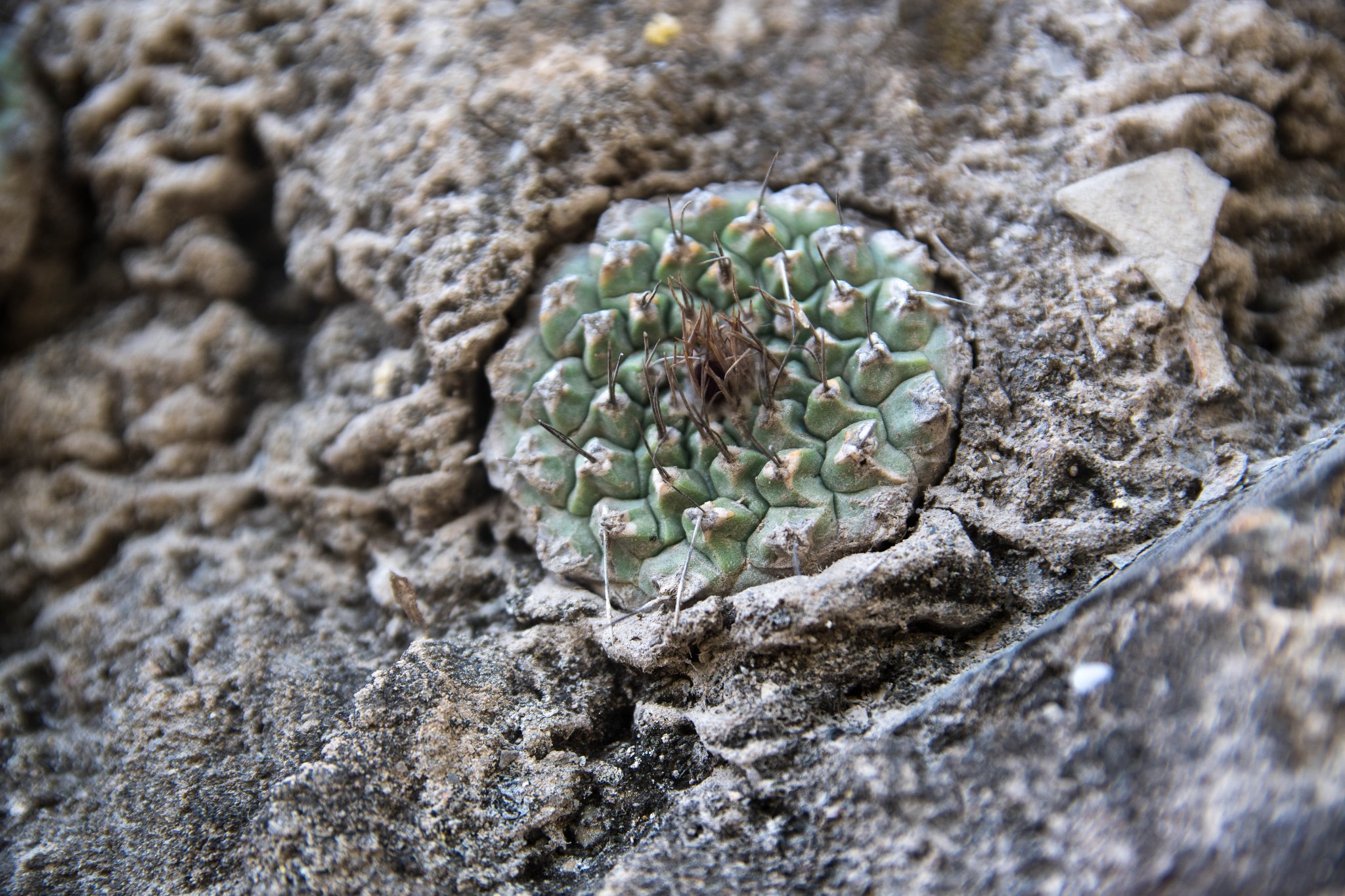
Strombocactus corregidorae S.Arias & E.Sánchez is a Mexican microendemic cactus described in 2010 from the Cañón del Infiernillo of the Río Moctezuma, on the border of Querétaro and Hidalgo states. The protologue, published in Revista Mexicana de Biodiversidad, established the species on morphological grounds: it is larger, more globose, and carries heavier, darker, more persistent spines than its better-known congener Strombocactus disciformis, the disc cactus of the same canyon system. The epithet honours Josefa Ortiz de Domínguez (1773–1829), known as la Corregidora de Querétaro for her role in the Mexican independence movement.
Three localities are known from the lower Cañón del Infiernillo, all restricted to calcareous shale cliffs of Upper Cretaceous origin. Published locality data is deliberately coarse; the original authors provided coordinates rounded to the nearest minute, and subsequent field reports decline to publish finer positions at the request of local hosts. The species is listed under NOM-059-SEMARNAT-2010 as Amenazada (A) under the 2019 modification, and the entire genus Strombocactus has carried CITES Appendix I status since the Convention’s 1975 entry-into-force, which predates the species’ description by more than three decades.
The species sits at the centre of an ongoing generic controversy. Bárcenas and colleagues (2021) argued, on the basis of plastid phylogeny, that Strombocactus as traditionally circumscribed is paraphyletic, and proposed the monotypic genus Chichimecactus to accommodate this taxon. Kew POWO has not adopted the transfer; the site follows POWO and retains Strombocactus corregidorae as the current accepted name pending wider consensus. The synonym Chichimecactus corregidorae will appear in horticultural and some recent systematic literature.
The literature pool for this species is thin by design. Fewer than ten peer-reviewed papers address it directly, and no formal IUCN Red List assessment exists. Where a claim in the sections below rests on a single source, that is the published record; the species is recently described, narrowly endemic, and infrequently collected. Cultivation guidance extrapolates from the well-documented S. disciformis template, modulated for the habitat data in the 2010 protologue.
Strombocactus corregidorae quick reference
A Querétaro canyon lithophyte growing on near-vertical calcareous shale at roughly 1,500 m, with three known localities and near-zero presence in general cultivation. Values calibrated for seed grown plants in cultivation, extrapolated from S. disciformis grower consensus and the 2010 protologue habitat data.
Taxonomy & nomenclature
The accepted name is Strombocactus corregidorae S.Arias & E.Sánchez, published in Revista Mexicana de Biodiversidad 81(3): 619–624 (2010). The holotype is E. Sánchez 338, collected 7 May 2008 from the Cañón del Infiernillo near the Acueducto II diversion dam, Cadereyta de Montes, Querétaro; deposited at MEXU, with isotypes at IEB and QMEX. The 2008 collection date is the holotype gathering date, not the year of description; the binomial was not validly published until 2010.
The only formally valid synonym is Chichimecactus corregidorae (S.Arias & E.Sánchez) Bárcenas, H.M.Hern. & P.Hern.-Led., proposed in Phytotaxa 512(3): 155 (2021). Bárcenas and colleagues analysed three plastid markers (matK, psbA-trnH, atpB-rbcL) and found Strombocactus as traditionally circumscribed to be paraphyletic, with S. corregidorae placed sister to a clade containing Ariocarpus, Turbinicarpus, and the remaining Strombocactus. They erected the monotypic genus Chichimecactus to resolve that paraphyly. Kew POWO has not adopted the transfer; pending broader consensus, this site retains the original Strombocactus combination.
The specific epithet honours Josefa Ortiz de Domínguez (1773–1829), known as la Corregidora de Querétaro, a central figure in the Mexican independence movement of 1810. The common name Biznaga trompo de la Corregidora reflects both the top-shaped (trompo) growth habit and the dedication. The genus name Strombocactus derives from the Greek strombos (spinning top), a reference to the same morphological character.
The seed coat of S. corregidorae differs from S. disciformis in two anatomically significant ways: the periclinal walls of the testa cells are flat rather than convex, and the strophiole present in S. disciformis at the hilum-micropylar region is absent. These differences were corroborated by Velázquez-Rosas and colleagues in a 2018 comparative seed anatomy study published in Flora, providing evidence independent of gross morphology for the species-level separation.
Historical synonym (1)
- Chichimecactus corregidorae (S.Arias & E.Sánchez) Bárcenas, H.M.Hern. & P.Hern.-Led., 2021 basionym
Sources: POWO (Kew) · IPNI · GBIF · Wikidata
Habitat
Strombocactus corregidorae is known from three localities, all within the lower Cañón del Infiernillo where the canyon cuts the border between Querétaro (municipio de Cadereyta de Montes) and Hidalgo. The type locality sits near the Acueducto II diversion dam at roughly 20°46′N, 99°30′W, at 1,500 m elevation. No broader altitudinal range has been published.
Geology is the defining frame for this species. Plants colonise lutitas calcáreas (calcareous shales) of the Upper Cretaceous Soyatal-Mexcala formation, on slopes with steep southern aspect, near-vertical walls, and very thin substrate accumulating in fissures. The substrate is alkaline (pH 7.5–8.2), free-draining, and almost devoid of organic matter. Reports attaching “gypsum” to the genus in some horticultural notes are inaccurate for this species; the protologue specifies calcareous shale, dominated by calcium carbonate rather than calcium sulfate. Strombocactus disciformis, the disc cactus, colonises equivalent walls further north along the same drainage system.
Companion flora at the type locality, recorded in the protologue, includes Pseudosmodingium andrieuxii, Fouquieria splendens, Acacia vernicosa, Agave difformis, Opuntia microdasys, O. stenopetala, O. leptocaulis, Euphorbia antisyphilitica, Echinocactus platyacanthus, Astrophytum ornatum, Bursera schlechtendalii, B. morelensis, and Turnera diffusa. The Astrophytum ornatum / Echinocactus platyacanthus / Pseudosmodingium assemblage is characteristic of the Querétano-Hidalguense canyon ecotone and overlaps closely with S. disciformis habitat further upstream.
Habitat threats documented in the protologue and subsequent field reports include specialist-trade collection of live plants and seed, opportunistic collection by canyon visitors reaching the site, and physical disturbance from water infrastructure works along the Río Moctezuma, of which the Acueducto II works at the type locality are the most direct example. Feral burro and goat browsing on the lower slopes is a secondary pressure.
Morphology
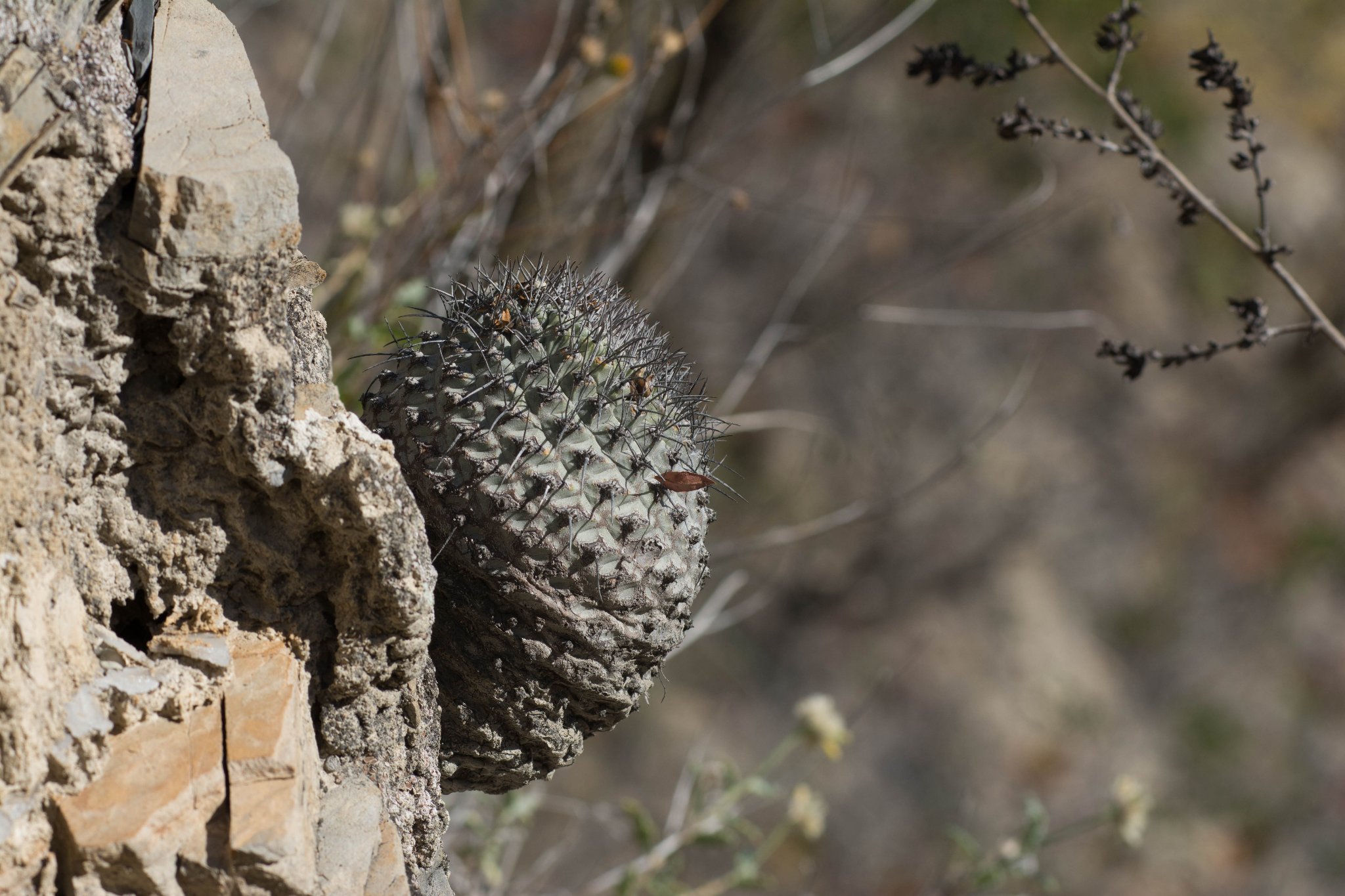
Strombocactus corregidorae has a solitary body. Juvenile plants are distinctly globose; mature plants elongate to a short cylinder, reaching 18–23 cm tall by 8–12 cm in diameter. This is substantially larger than an equivalent-age S. disciformis, which remains markedly flattened and rarely exceeds 8 cm across. Ribs 8–13, spirally arranged. Tubercles 7–13 mm long by 9–20 mm wide at the base, irregularly rhomboid. Areoles 4.2–4.9 mm by 2.9–3.1 mm.
Spination: 3–5 spines per areole, 2–3.5 cm long, rigid, thick, persistent. Grey when young, ageing to nearly black-grey. Spines cover at least two-thirds of the body. S. disciformis by contrast bears shorter, more flexible, often deciduous, pale spination. This difference in spination character, density, and persistence is the fastest field separator between the two species, and the diagnostic character in the protologue.
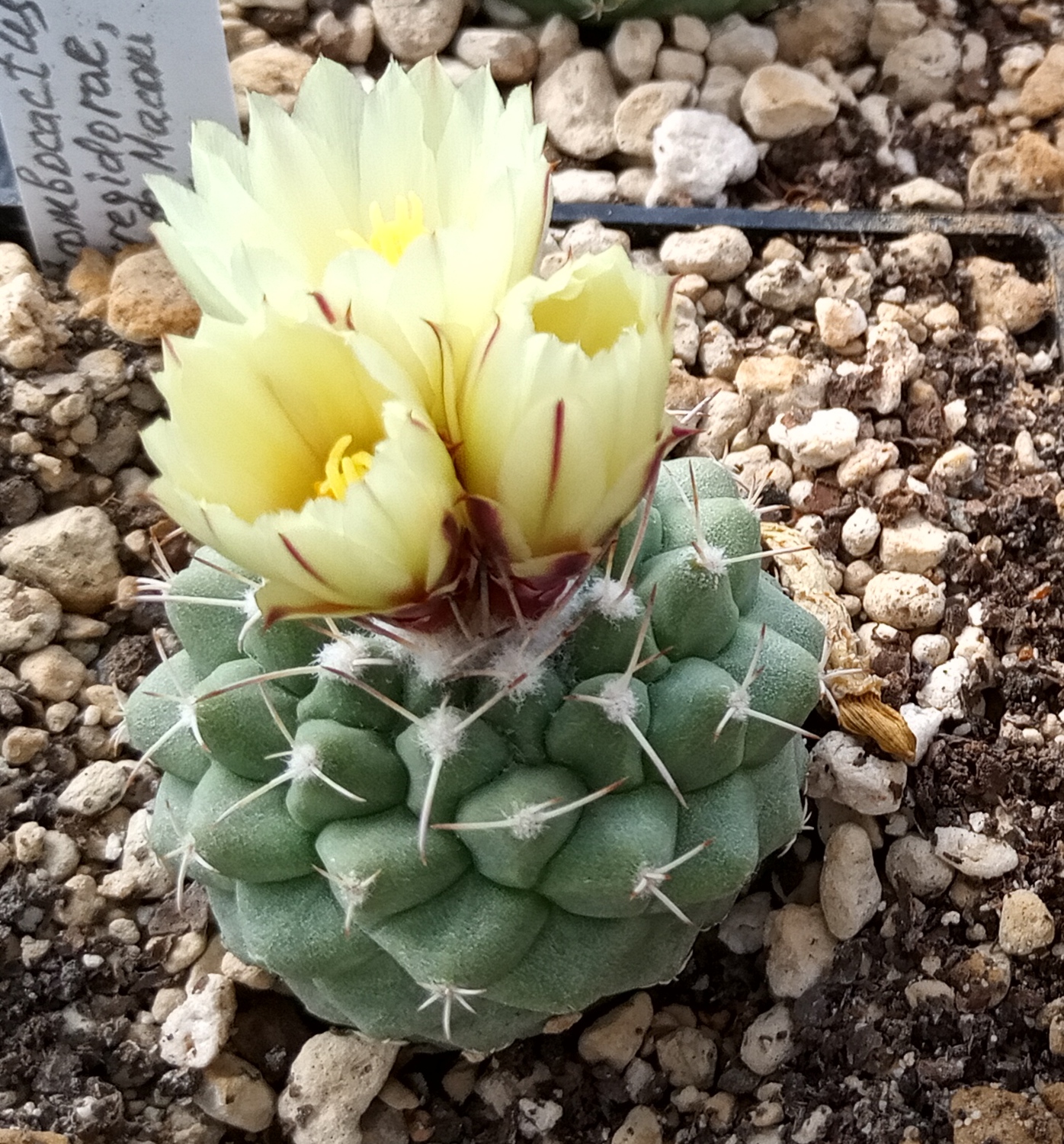
Flowers 3.5–4 cm long and across, uniformly yellow perianth segments, pericarpel 7–8 mm, receptacular tube approximately 1.8 cm, style 11–15 mm and yellowish. The yellow colouring throughout distinguishes S. corregidorae flowers from S. disciformis flowers, which are smaller (under 3.5 cm), pale yellow with a white throat, and in some forms tinged magenta. Fruit 9–11 mm long, 6–7 mm in diameter, ellipsoid, naked, longitudinally dehiscent. Seeds 0.5–0.6 mm long, obovoid, reddish-brown; periclinal walls flat (not convex as in S. disciformis); strophiole absent.
Locality detail
Three localities are recorded for S. corregidorae, all within the lower Cañón del Infiernillo where the canyon cuts the Querétaro-Hidalgo state border. The type locality near the Acueducto II diversion dam is the only site for which even an approximate coordinate appears in print; subsequent field reports from 2014 and later decline to publish precise positions at the request of local hosts. The published coordinate is rounded to the nearest arc-minute.
The map marks a single regional centroid rather than individual population coordinates. For a CITES Appendix I microendemic with three known localities and a documented history of targeted collection, publishing precise position data would facilitate extraction rather than conservation. The centroid conveys the canyon system without exposing individual populations.
Strombocactus corregidorae care and cultivation
Strombocactus corregidorae is an advanced subject. The combination of CITES Appendix I sourcing constraints, a strict calcareous substrate requirement, slow growth, and almost no margin for overwatering error in winter means this plant is rarely found outside specialist collections in Europe, Japan, and the United States. Cultivation guidance here extrapolates from the well-documented S. disciformis template, modulated for the habitat data in the 2010 protologue.
Substrate
The habitat is a thin shale-derived layer in vertical fissures, alkaline (pH 7.5–8.2), free-draining, and almost devoid of organic matter. The cultivated substrate must track this. The recommended mix is 30% pumice (3–6 mm), 20% lava rock (3–6 mm), 20% crushed limestone or limestone chip (3–6 mm), 10% zeolite (clinoptilolite, 4–6 mm), 5% granite grit (2–4 mm), 5% coarse silica grit (1–3 mm), and 10% worm castings. The 20% limestone fraction follows house convention rather than a certified species requirement: without a calcareous component the substrate buffers below pH 7 and the plant slowly etiolates and refuses to flower in cultivation. Total inorganic content is 90%, organic 10%.
Both Strombocactus species on this site share one mineral baseline: 90% inorganic, 10% organic, with 20% limestone held as house convention for the genus.
| Species | Pumice | Lava | Zeolite | Granite | Limestone | Silica | Organic |
|---|---|---|---|---|---|---|---|
| S. corregidorae (this page) | 30% | 20% | 10% | 5% | 20% | 5% | 10% |
| S. disciformis | 30% | 20% | 10% | 5% | 20% | 5% | 10% |
Watering and light
Treat as a mid-elevation Mexican summer-grower with a hard winter rest. No water December through early March. Begin cautiously in April, watering once and allowing the substrate to dry completely before the next. From April through September, water when the substrate is dry to the pot base; typical interval is every 14–21 days at moderate temperatures. Reduce to a single capillary moisten in October–November, then dry through winter. Most cultivation losses occur from overwatering during the autumn shoulder season or in years when the grower does not enforce a true dry winter rest.
Full sun is required. The diagnostic dark persistent spination develops fully only under strong direct light. Indoor growers need a south-facing window with supplemental LED to approach outdoor intensity; summer growing under full outdoor sun in temperate climates is the preferred arrangement.
Growth rate and propagation
Seedlings reach 1 cm diameter in three to four years; flowering size (5 cm or more with full spination) takes 8–12 years on roots, considerably faster grafted. Vegetative offsets are uncommon in the wild and rarely seen in cultivation. Seed is the only practical propagation route.
Most material in specialist European and Japanese collections traces to ex-situ propagation by Mexican botanic gardens under SEMARNAT permits, plus seed exchanged through ISI and equivalent programmes. Grafted plants, typically on Pereskiopsis for early establishment then transferred to Hylocereus or Trichocereus for long-term display, accelerate flowering by four to six years over seed-grown plants and are common in specialist circles. Seed grown specimens require patience but produce the tight dark spination that grafted early-growth plants rarely match.
Comparison
The only taxon in the genus available for direct comparison on this site is Strombocactus disciformis, and the two species present a clear morphological contrast once seen side by side. S. disciformis is markedly flattened, rarely exceeding 8 cm in height, with a broad disc-like body that sits nearly level with the rock surface. S. corregidorae is taller and more globose, reaching 18–23 cm tall by 8–12 cm in diameter in maturity. The body-shape difference alone is usually sufficient for identification of adults.
Spination is the faster separator for juveniles and mid-sized plants. S. corregidorae carries 3–5 rigid, persistent spines per areole, 2–3.5 cm long, ageing from grey to near-black and covering at least two-thirds of the body. S. disciformis bears shorter, more flexible, often deciduous, pale spines that leave the body partially visible even at maturity. In a typical cultivated collection the heavier dark armature of corregidorae is immediately recognisable.
Flowers differ as well. S. corregidorae flowers are 3.5–4 cm across with uniformly yellow perianth segments. S. disciformis flowers are smaller (under 3.5 cm), pale yellow with a white throat, and in some forms tinged magenta. Seeds distinguish the species at the anatomical level: flat periclinal walls and no strophiole in S. corregidorae versus convex walls and a present strophiole in S. disciformis, a difference independently confirmed by seed anatomy work published in Flora in 2018.
Frequently asked questions
Is Strombocactus corregidorae hard to grow?
Advanced. Three factors account for the difficulty rating. First, the strict calcareous substrate: the species grows in alkaline shale fissures in habitat and consistently performs poorly in pure pumice or generic mineral mixes that lack a limestone fraction. Second, the overwintering regime is unforgiving; any moisture at the root collar during the December-March rest risks crown rot in a plant that cannot be easily replaced. Third, CITES Appendix I status means legally sourced material from documented ex-situ propagation commands significant prices, so a cultivation failure has high replacement cost.
Can Strombocactus corregidorae be grown from seed?
Yes, and seed is the only practical propagation route; vegetative offsets are uncommon in both habitat and cultivation. Surface-sow on a sterile calcareous mineral mix in spring, keep humid under cover for the first 10–14 days, then progressively ventilate as seedlings reach pinhead size. Germination follows the Strombocactus template: a calcareous substrate from the start produces stronger seedlings than a neutral pumice medium. Flowering size takes 8–12 years ungrafted; grafted seedlings on Pereskiopsis for 12–18 months compress that timeline considerably.
Is Strombocactus corregidorae legal to own?
Ownership of legitimately propagated plants is legal in most countries, but the sourcing chain must be clean. The genus Strombocactus carries CITES Appendix I status; international commercial trade in wild-collected material is prohibited outright, and even artificially propagated material requires paired export and import CITES permits plus a phytosanitary certificate for any cross-border movement. Under Mexican federal law, NOM-059-SEMARNAT-2010 (2019 modification) lists the species as Amenazada (A); collection from the wild without SEMARNAT permit is illegal. Nursery-propagated material from documented ex-situ sources is the only legally and ethically defensible route for collectors.
Where does Strombocactus corregidorae grow in the wild?
Three known localities, all within the lower Cañón del Infiernillo of the Río Moctezuma, on the border of Querétaro and Hidalgo states in central Mexico. Plants grow on near-vertical calcareous shale cliffs of Upper Cretaceous origin, at approximately 1,500 m elevation, on south-facing slopes with full sun exposure and very thin substrate in rock fissures. Precise coordinates are not published in the literature; the protologue gives a rounded coordinate only, and subsequent field parties have declined to release finer positions at the request of local hosts.
When does Strombocactus corregidorae flower?
Spring through early summer in cultivation and in habitat. The protologue describes the holotype flowering material collected in May 2008. Grower reports and the broader Strombocactus cultivation literature place peak bloom from April through June under temperate Northern Hemisphere conditions, with the timing driven by temperature rise after the dry winter rest rather than day length. Flowers are 3.5–4 cm across with uniformly yellow perianth segments, produced at the apex of the plant. The winter dry rest is the trigger; plants that receive moisture through winter frequently fail to bud the following spring.
Sources & further reading
Arias, S. & Sánchez-Martínez, E. (2010). Una especie nueva de Strombocactus (Cactaceae) del río Moctezuma, Querétaro, México. Revista Mexicana de Biodiversidad 81(3): 619–624. · Plants of the World Online (Kew POWO). Strombocactus corregidorae S.Arias & E.Sánchez, taxon urn:lsid:ipni.org:names:60457205-2. powo.science.kew.org · Bárcenas, R.T., Hernández, H.M., Hernández-Ledesma, P. & Montoya Gómez, A. (2021). Chichimecactus (Cactoideae, Cactaceae), a new genus based on molecular characterisation of highly endangered Strombocactus species. Phytotaxa 512(3): 151–167. · Velázquez-Rosas, N. et al. (2018). Seed development and germination of Strombocactus species (Cactaceae): a comparative morphological and anatomical study. Flora 240: 132–141. · SEMARNAT (2019). Modificación del Anexo Normativo III, Lista de especies en riesgo, NOM-059-SEMARNAT-2010. Diario Oficial de la Federación, 14 November 2019. · CITES Secretariat. Appendices I, II and III (current edition). Convention on International Trade in Endangered Species of Wild Fauna and Flora. cites.org · The Cactus Trip Diaries (PK Cactus). Sunday 9 March 2014: Tecozautla, in search of Strombocactus corregidorae. pkcactus.info · Henry Shaw Cactus and Succulent Society (2012). Strombocactus. Plant of the Month bulletin. hscactus.org · Giromagi Cactus and Succulents. Strombocactus genus cultivation notes. giromagi.it