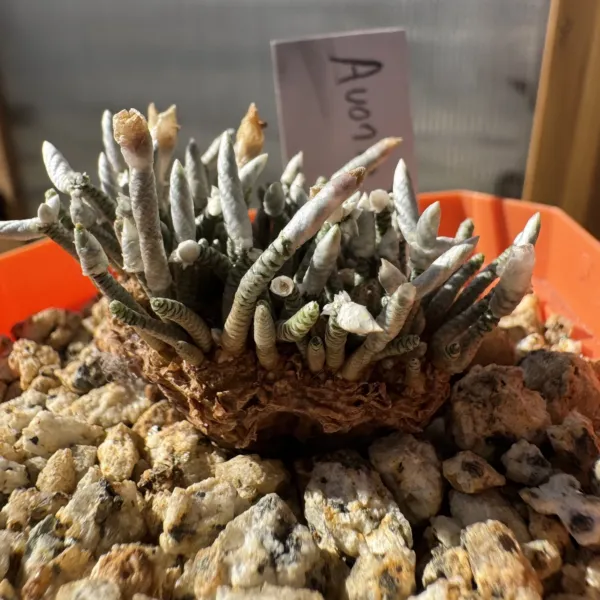
What arrives in an Avonia order
At rarecactus.com every Avonia we sell is seed grown in our greenhouse in Orange County, California, and never wild collected. Each listing gives the size of the plant, and the photographs show the exact plant you receive.
Plants ship dry and well rooted, ready to pot straight up. Set the caudex at the surface, never buried, so the neck stays dry, and give no water for about two weeks while it settles in.
How we grow and ship Avonia
We grow Avonia in full sun in an almost entirely mineral mix of pumice, silica grit, zeolite, lava and granite, with a small share of organic matter and no limestone. Most species, Avonia quinaria among them, grow from March to October: we soak them only once the mix is completely dry and keep them dry and frost-free through winter. The care panel on the Avonia encyclopedia hub sets this out in six rows.
Orders leave within 1 to 3 business days and ship for a flat $12, within the United States only. Sales are final, and if a plant arrives dead we ask for your order number and clear photos of the plant and the packaging within a couple of days of delivery, so we can work toward a fair resolution.
Why seed grown Avonia matters
Avonia quinaria germinates in a week or two but takes years to build a caudex of any size, so few nurseries raise it, and the demand has long been met from the wild. South Africa’s national Red List assesses it as Endangered because of poaching.
A plant raised from seed in a greenhouse carries none of that history.
CITES and permits
Avonia is covered by CITES through the listing of the genus Anacampseros. Avonia quinaria moved to Appendix I on 5 March 2026; the other species stay on Appendix II. CITES governs trade between countries, so a plant shipped within the United States needs no permit, and Avonia quinaria is not listed under the US Endangered Species Act.
Avonia buying questions
Is Avonia a cactus?
Avonia is not a cactus. It belongs to the Anacampserotaceae, a small family of southern African succulents, and Kew’s Plants of the World Online files its species under Anacampseros. Its care is that of a summer-growing caudiciform: strong light, water in the warm months, a dry winter.
Does Avonia quinaria need a CITES permit?
Not inside the United States. Its Appendix I listing governs trade between countries, so a seed grown plant bought and shipped within the US needs no permit. We do not ship abroad.
When does Avonia grow?
Most Avonia, Avonia quinaria included, grow from March to October and rest dry through winter. Two species reverse that: A. mallei and A. herreana take their water in the cool season.
Is this Avonia grafted?
No. Every Avonia we sell is seed grown and ungrafted, with a strong root system.