
Turbinicarpus alonsoi
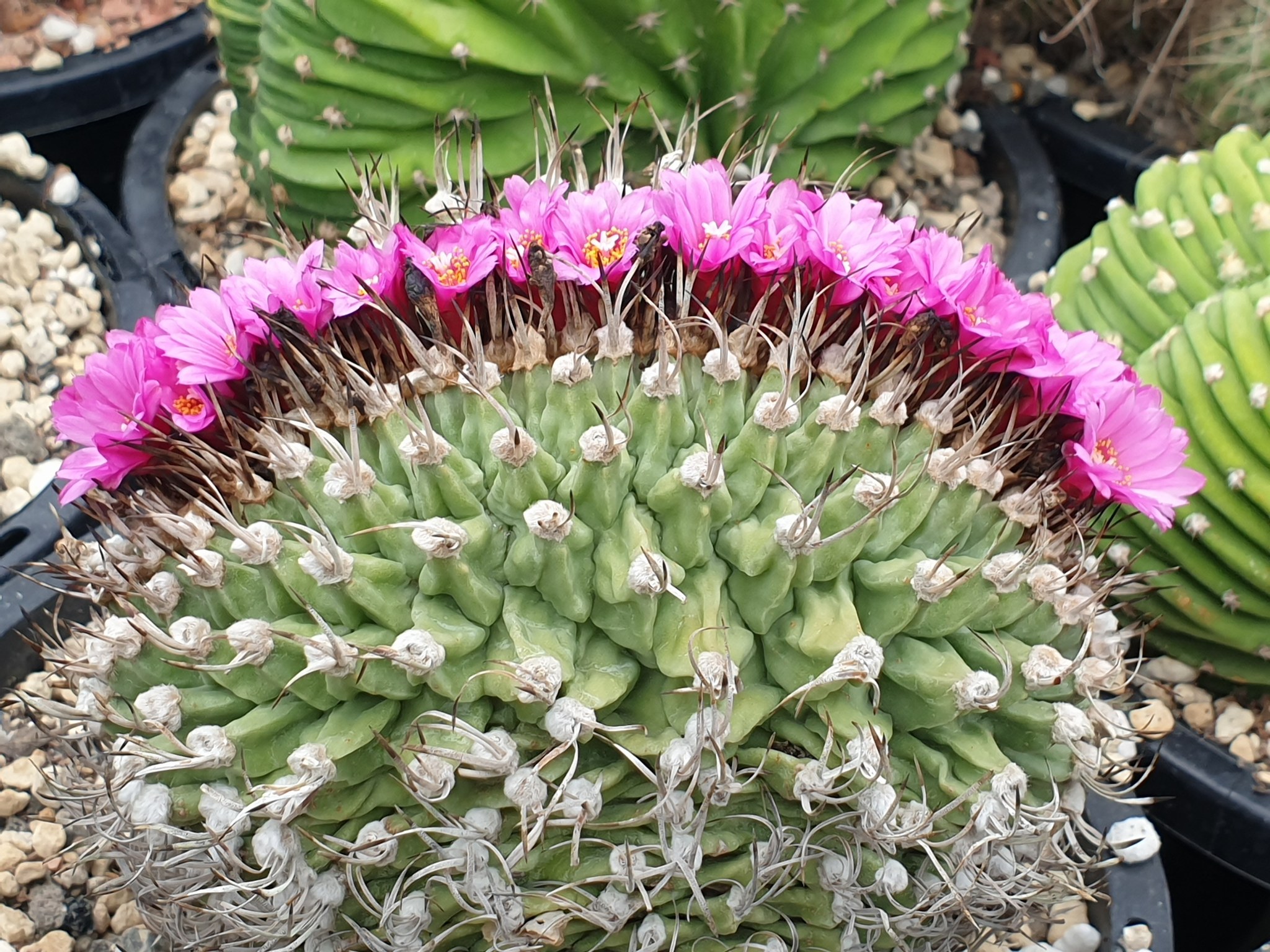
Turbinicarpus alonsoi is a geophytic cactus restricted to a single canyon system in Xichú, Guanajuato, with an area of occupancy below 10 km² and fewer than 5,000 mature individuals remaining. It grows buried to the apex in rock-crevice accumulations of wind-blown limestone dust. Charles Glass and Salvador Arias described it in 1996 in Kakteen und Sukkulenten 47(2): 26, naming the species for Alonso Garcia Luna, the Mexican botanist who discovered it. The body is small, flattened-globose, reaching 6 to 9 cm in diameter, with grey papery spines and a disproportionately large cherry-red to magenta flower that makes the plant unmistakable when blooming.
Turbinicarpus has a disputed nomenclatural history, with species at various times placed in Gymnocactus, Neolloydia, Pediocactus, and the recently resurrected Kadenicarpus and Rapicactus. Vázquez-Sánchez et al. (2019) demonstrated via molecular phylogenetics that the genus sensu lato was polyphyletic and supported three monophyletic lineages. Kew POWO retains T. alonsoi in Turbinicarpus s.s. following that 2019 analysis; it has not been transferred to Kadenicarpus or Rapicactus. Halda’s 1998 placement as Pediocactus alonsoi is rejected by POWO, GBIF, and Tropicos alike.
Within the genus, T. alonsoi sits apart by both range and spine character. Its flat, cardboard-like grey spines are entirely unlike the long twisted papery spines of T. pseudomacrochele or the feathery pectinate radials of T. valdezianus. The Guanajuato limestone canyon habitat is also unusual for the genus; most species with deep CITES-concern status are associated with gypsum or calcareous flats in San Luis Potosí or Querétaro, not with the steep rocky canyon walls of the Río Mezquital drainage.
Population decline since the species’ 1996 discovery has been severe. Illegal collection for the horticultural trade is the dominant driver, with wild numbers reduced by more than 50 percent. Fewer than 5,000 mature individuals remain across an area of occupancy under 10 km². Turbinicarpus alonsoi is listed on CITES Appendix I, prohibiting international commercial trade in wild-collected material. Cultivated plants raised from seed represent the only legal path for collectors outside Mexico and the only sustainable way to keep the species in collections. Sharing the tight single-locality threatened status of its limestone-endemic neighbours, T. saueri shows how even a more-generous range within the genus offers little protection against collection pressure at a single canyon.
Turbinicarpus alonsoi quick reference
A geophytic Turbinicarpus from limestone canyon walls at 1,900 m in Xichú, Guanajuato, with a summer-dominant rainfall regime and dry, cool winters. Values calibrated for seed grown plants in cultivation, drawn from habitat data and specialist grower experience.
Taxonomy & nomenclature
The accepted name is Turbinicarpus alonsoi Glass & S.Arias, published in Kakteen und Sukkulenten (Kakteen Oth. Sukk.) 47(2): 26, fig. (1996). The original description is a basionym by the authors themselves; T. alonsoi is not a recombination. Kew POWO (urn:lsid:ipni.org:names:315102-2), GBIF (taxon key 3950869), and Tropicos (name ID 50181431) all accept this combination as current.
The specific epithet honors Alonso Garcia Luna, the Mexican botanist who first collected the species. The genus name Turbinicarpus derives from the Latin turbo (spinning top) plus Greek karpos (fruit), coined by Buxbaum & Backeberg in 1937 when they elevated Backeberg’s original subgenus of Strombocactus to generic rank.
The only synonym of consequence is Pediocactus alonsoi (Glass & S.Arias) Halda, published in Acta Musei Richnoviensis, Sect. Nat. 5: 22 (1998). Halda proposed placing the species in Pediocactus, a North American genus whose biogeographic centre lies far north of the Guanajuato type locality. This transfer is rejected by POWO, GBIF, and Tropicos; Pediocactus alonsoi is treated as a heterotypic synonym. The CITES species database records the plant under Turbinicarpus alonsoi at Appendix I, consistent with the POWO position.
The generic circumscription of Turbinicarpus has been exceptionally unstable. Species have been transferred in and out of Echinocactus, Gymnocactus, Mammillaria, Neolloydia, Normanbokea, Pediocactus, Pelecyphora, and Thelocactus at various points. One treatment recognised Rapicactus as a distinct genus for what they called the beguinii group, and also segregated Lodia (for T. mandragora and T. pailanus). Vázquez-Sánchez et al. (2019, Bot. J. Linn. Soc. 190: 405–420) confirmed via molecular phylogenetics that Turbinicarpus sensu lato was polyphyletic and supported three monophyletic lineages: Kadenicarpus, Rapicactus, and Turbinicarpus s.s. POWO retains T. alonsoi in Turbinicarpus s.s. following the 2019 analysis; no transfer to Kadenicarpus or Rapicactus has been published.
Distribution: Kew POWO lists Guanajuato and San Luis Potosí. Field collections and field studies consulted during this build all attribute the species to Guanajuato only. The San Luis Potosí record in POWO is not corroborated by any field collection or field study reviewed; it is likely an aggregation artifact or mis-georeferenced specimen. The type locality and CITES single-locality treatment both point to Xichú, Guanajuato as the confirmed occurrence.
Historical synonym (1)
- Pediocactus alonsoi (Glass & S.Arias) Halda, 1998 basionym
Sources: POWO (Kew) · IPNI · GBIF · Wikidata
Habitat
Turbinicarpus alonsoi grows on the steep rocky limestone canyon walls of the Río Mezquital drainage near Xichú, Guanajuato, at approximately 1,900 m above sea level. The Xichú region sits within the Sierra Gorda fold-thrust belt, predominantly limestone and dolomite stratigraphy. Substrate is a shallow lithosol, thin accumulations of wind-blown calcareous dust and weathered rock in crevice pockets, with fast drainage and essentially no organic content.
The plant is geophytic: the stem is described as “mostly underground,” with only the compressed apex visible at ground level. The total stem reaches up to 11 cm in length, the buried portion acting functionally as a water reservoir in a habitat that receives essentially no precipitation for five to six months of the year.
A 1996 field photograph from viridis.net documents T. alonsoi growing “virtually under a Hechtia,” with Echeveria xichuensis and Echinocereus sp. co-occurring at the same site. These are the only plant taxa with confirmed field co-occurrence at the type locality in any source reviewed. The wider Sierra Gorda de Guanajuato Biosphere Reserve encompasses matorral xerófilo with Opuntia spp. at lower elevations, and izotal with Agave and Hechtia at mid-elevations; the canyon-wall microsite occupied by T. alonsoi sits at the intersection of these two communities.
Climate at Xichú municipality is semi-arid, summer-dominant. Annual rainfall runs approximately 600 to 900 mm at state level; the species’ canyon microsite likely receives somewhat less due to its aspect and rain shadow position. Seasonality is strongly summer-biased: the growing season runs from June through September, with November through March essentially dry. The 1,900 m elevation moderates temperature extremes; occasional winter frost occurs at the type locality, consistent with the documented cold tolerance of -4°C dry.
Morphology
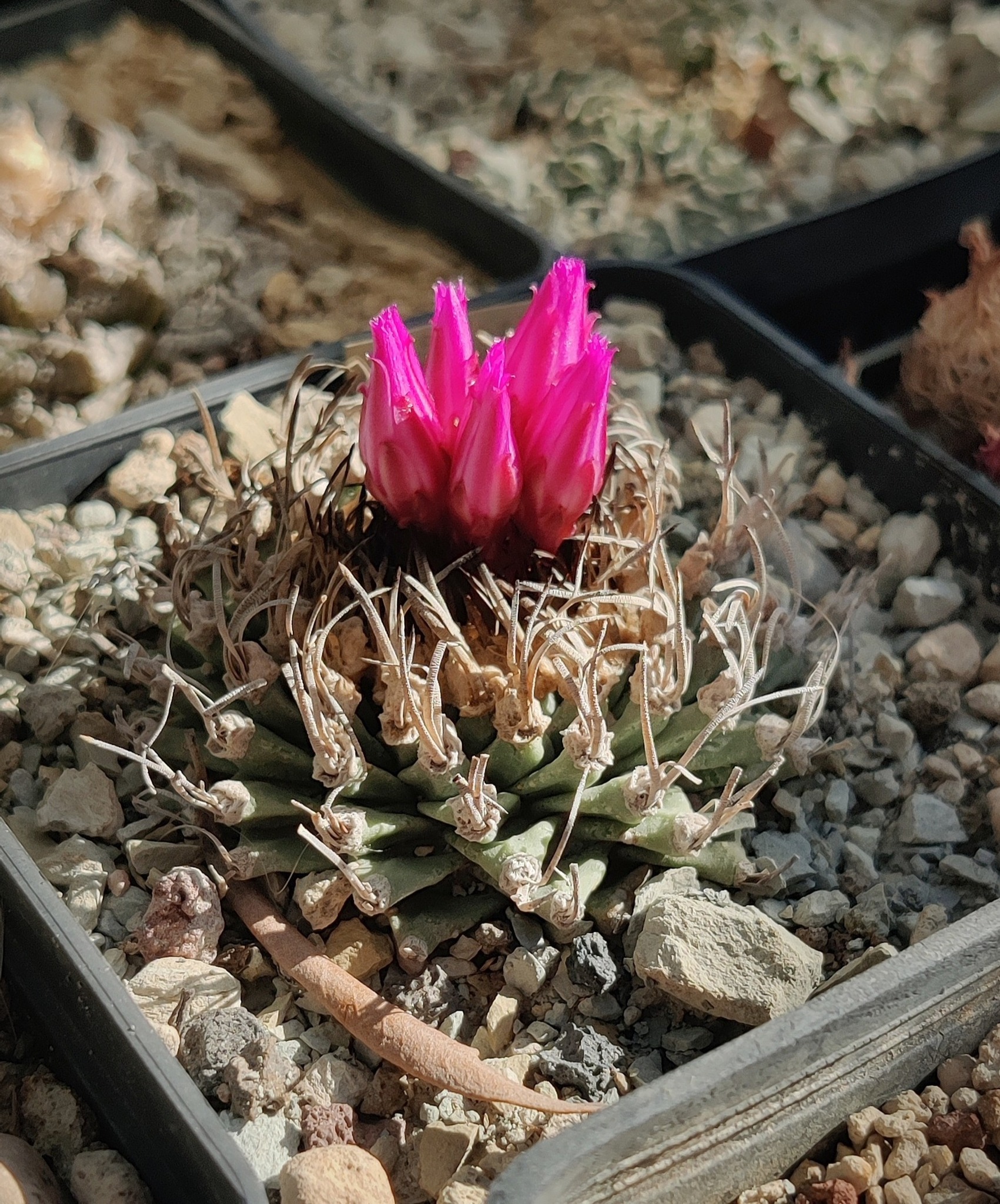
Turbinicarpus alonsoi is solitary and geophytic. The exposed apex is flattened-globose, 6 to 7 cm in diameter and occasionally to 9 cm; the total stem including the buried portion reaches 11 cm in length. Stem colour is grey-green to glaucous. Tubercles are spirally arranged in 5:8 or 8:13 parastichy patterns, approximately 15 mm long and 13 mm wide at the base, angular, with a keeled upper surface and concave base. Areoles bear reddish wool that turns grey with age.
Spination is unlike that of any other Turbinicarpus in the genus. Each areole carries 3 to 5 spines, up to 20 mm long, which are distinctly flat and cardboard-like in texture: flexible, not sharp, not piercing. Color is grey with dark brown to black tips, and the spines are irregularly bent inward. No distinction between central and radial spines is evident. Older spines weather and persist on the plant, giving mature bodies a layered grey-brown halo. This flat papery spine character contrasts markedly with the long twisted spines of T. pseudomacrochele or the tiny pectinate radials of T. valdezianus.
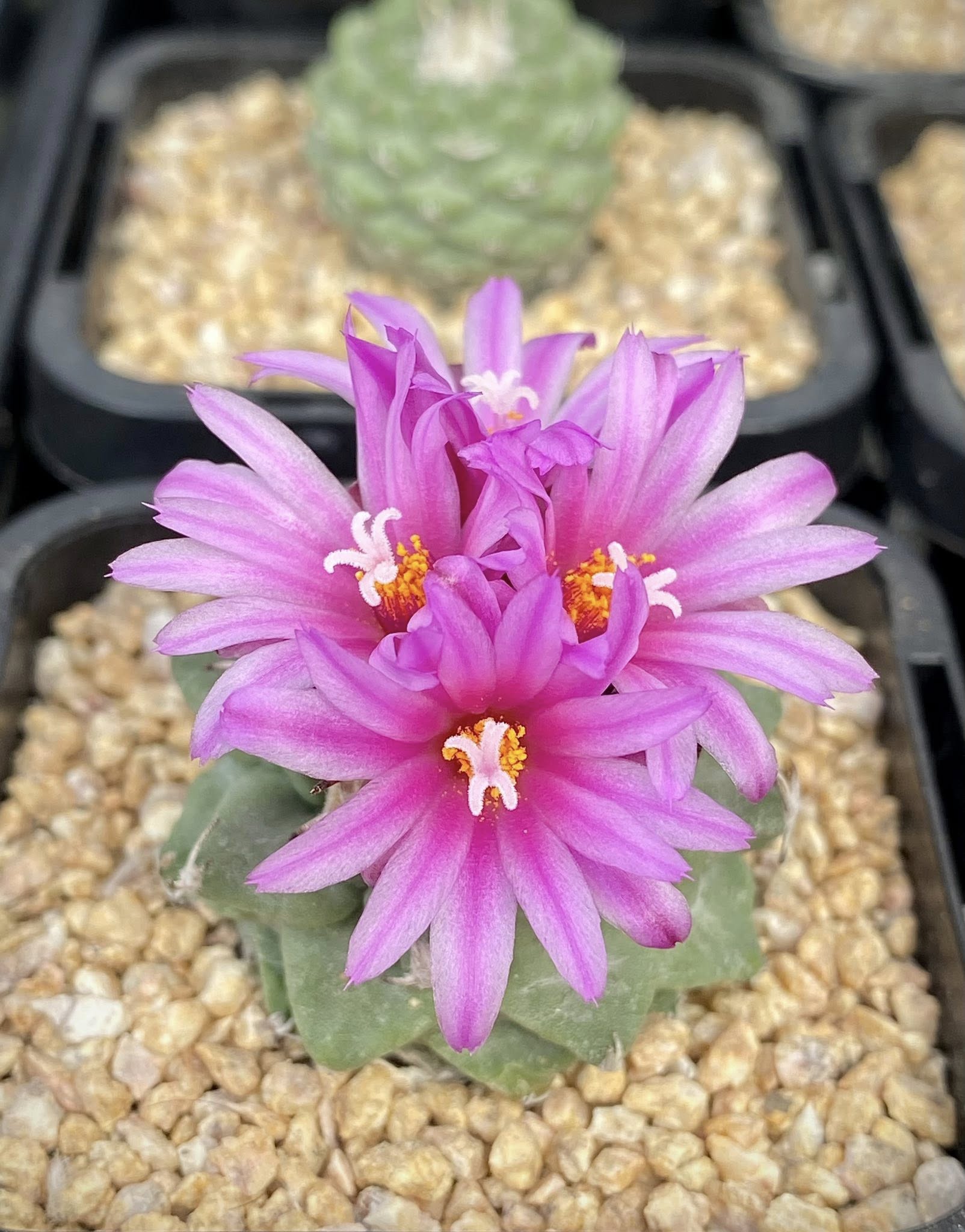
Flowers are large relative to the body, 20 to 30 mm in diameter and 25 to 35 mm long, cherry-red to pink-magenta with a more intensely coloured midstripe. They stand approximately 10 mm above the tubercles at the apex. Inner perianth segments number approximately 22; the pistil is 15 mm long and white, with 6 white stigma lobes of 1.5 to 2.5 mm. The species flowers from March through October in the wild, with the peak from April through June (llifle, citing Glass & Arias 1996).
A critical cultivation note: T. alonsoi is not self-fertile. Cross-pollination from a second, genetically distinct individual is required for fruit set (CactiGuide forum). Fruit is smooth, slightly elongate, 10 mm long and 5 mm in diameter, reddish to dark purple, dehiscing with 1 to 2 longitudinal tears. Seeds are 1 mm long and 0.75 mm high. A cristata form is documented in cultivation (llifle, cactus-art.biz) but has not been formally described.
Locality detail
The type collection was made by Alonso Garcia Luna in the canyon area near Xichú, Guanajuato, Mexico, and described by Glass and Arias in 1996. The confirmed locality is the Río Mezquital canyon system within Xichú municipality, at approximately 1,900 m elevation. Field-collection labels from CactusDNA record the provenance as “Rio Mezquital, Xichu, GUA, Mexico.”
All field-sourced documentation reviewed places T. alonsoi exclusively in Guanajuato. Kew POWO additionally lists San Luis Potosí in the accepted distribution, but no herbarium specimen, field study, or iNaturalist record reviewed during research corroborates this second-state record. It is cited here as an unresolved discrepancy; the CITES single-locality treatment aligns with the Guanajuato-only field evidence.
Turbinicarpus alonsoi care and cultivation
Two habitat facts set the frame for cultivation. The substrate is a shallow lithosol in calcareous rock crevices with essentially no organic content and immediate drainage. The climate is summer-dominant with a hard dry winter. Both must be reproduced in cultivation or the elongated buried stem rots.
Substrate
The canonical ratio is 35 per cent pumice, 15 per cent lava rock, 5 per cent zeolite, 20 per cent granite grit, 20 per cent limestone chip, and 5 per cent worm castings. The pumice and lava together form the drainage backbone; the zeolite buffers pH around 7.0 to 7.5 and paces nutrients through the summer watering cycle. No published cultivation source gives a limestone proportion specific to T. alonsoi; the 20 per cent limestone chip carried in the mix is the site’s bloc-level convention for the Mexican limestone genera, not a species-specific finding. In habitat the species roots in a shallow lithosol of wind-blown calcareous dust in cliff crevices around the Xichú canyon, a fact that describes the plant’s origin rather than the reason for any number in this recipe. The mix must drain immediately when watered; any substrate that holds moisture at the stem collar invites rot, particularly during autumn when temperatures drop unevenly.
All seven Turbinicarpus species on this site share a 95/5 mineral-organic baseline; no published grower source gives a per-species limestone proportion for the genus, so limestone is carried as bloc-level convention (Doorbar and Quail’s Mexican-limestone-genera practice), not a species-specific finding. T. lophophoroides currently ships a different limestone and silica split with no cultivation source behind the difference; that figure is under review against the genus baseline.
| Species | Pumice | Lava | Zeolite | Granite | Limestone | Silica | Organic |
|---|---|---|---|---|---|---|---|
| T. alonsoi (this page) | 35% | 15% | 5% | 20% | 20% | 0% | 5% |
| T. valdezianus | 35% | 15% | 5% | 20% | 20% | 0% | 5% |
| T. boedekerianus | 35% | 15% | 5% | 20% | 20% | 0% | 5% |
| T. lophophoroides | 35% | 15% | 5% | 20% | 10% | 10% | 5% |
| T. pseudomacrochele | 35% | 15% | 5% | 20% | 20% | 0% | 5% |
| T. pseudomacrochele subsp. krainzianus | 35% | 15% | 5% | 20% | 20% | 0% | 5% |
| T. saueri | 35% | 15% | 5% | 20% | 20% | 0% | 5% |
The buried stem reaches 11 cm in length on adult plants, which means the container must provide depth before width. Shallow dishes confine root development and destabilise the plant as the stem grows. Minimum depth of 12 to 15 cm for established plants is the practical floor.
Watering and light
The native summer-dominant rainfall pattern translates directly to cultivation watering. From June through August, water thoroughly once the substrate is completely dry; in warm, bright conditions this means roughly once every 10 to 14 days. Begin watering cautiously in March to May as nights warm above 10°C, at two- to three-week intervals. Taper through September and October. From November through February, withhold water entirely unless the plant shows severe shrivelling, which is uncommon if the plant entered dormancy healthy.
Wet rot at the buried stem junction is the most common cause of loss. The risk is highest in autumn and spring when soil temperature is dropping or rising unevenly; plants that enter or exit dormancy with wet substrate are particularly vulnerable. Avoid wetting the spine clusters or exposed apex when watering.
Light requirements are high. In the wild at 1,900 m, the plant receives intense UV on canyon walls. In cultivation, full sun or near full sun promotes compact body form, mature spine character, and reliable flowering. Partial midday shade is worthwhile in very hot and humid temperate climates, but low light produces etiolated, soft-bodied plants that flower poorly.
Propagation
Seeds germinate in 7 to 14 days at 21 to 27°C. Spring sowing under a humid cover in bright indirect light is standard. Growth from seed to flowering size takes approximately 6 to 12 years. Grafting onto Myrtillocactus geometrizans, Hylocereus, or Pereskiopsis spathulata is practised to compress the juvenile phase; grafted plants can flower within 2 to 5 years. For collector quality, degraft once the scion reaches 1.5 to 2 cm diameter. Seed grown plants grown on their own buried stem maintain the characteristic compressed flattened-apex form that grafted plants lose. One cultivation curiosity: artificial crosses between Strombocactus disciformis and T. alonsoi have been documented in collector greenhouses, producing intermediate offspring (CactiGuide forum); this is of no conservation significance and does not affect the species’ independent botanical standing.
Commercial supply of legal, seed-raised plants is available from European specialist nurseries operating within CITES Appendix I permit frameworks. Seed sales operate under different regulatory rules from live plant sales; verify applicable regulations before any import. Purchase only from sellers who can document nursery propagation origin.
Comparison
In vegetative terms the most diagnostic character of T. alonsoi is the flat, cardboard-like spine. No other small-bodied Turbinicarpus in cultivation produces spines of that texture. The comparison with T. schmiedickeanus subsp. jauernigii (the trade name T. jauernigii) resolves on multiple characters, the most obvious being flower colour: the vivid cherry-red to magenta flower of T. alonsoi is unmistakable against the creamy yellow to greenish-cream flowers of the schmiedickeanus group.
Body size is a supporting character. T. alonsoi reaches 6 to 9 cm in diameter; T. schmiedickeanus subsp. jauernigii reaches 2 to 3 cm diameter and grows nearly flat to the ground. On a collection bench, the size difference is evident even in juvenile specimens. The spine counts also differ: 3 to 5 flat papery spines in T. alonsoi versus 6 to 8 flexible, tortuous (curly) yellow-brown spines in jauernigii that eventually become deciduous as the plant matures.
Geographic range provides a field-collection context. T. alonsoi is known only from Xichú, Guanajuato. T. schmiedickeanus subsp. jauernigii has a broader range in Tamaulipas and San Luis Potosí (POWO). Any Turbinicarpus offered with a Guanajuato field-collection provenance and showing flat grey papery spines should prompt immediate verification against the characters in the table below; wild-collected T. alonsoi are illegally obtained under CITES Appendix I and must not enter collections.
Within the genus, T. pseudomacrochele and its subspecies T. pseudomacrochele subsp. krainzianus both occupy a similar small-globose body plan but are reliably separated by their long twisted spines. T. boedekerianus from Nuevo León differs in its flat-topped crown, woolly white apex, and short pectinate radials. None of these share the distinctive flat cardboard-like spine texture of T. alonsoi.
Frequently asked questions
How do you tell Turbinicarpus alonsoi apart from Turbinicarpus schmiedickeanus subsp. jauernigii?
The most-confused pair in the trade. T. jauernigii (the widely-used collector name) is accepted by POWO as Turbinicarpus schmiedickeanus subsp. jauernigii (G.Frank) D.R.Hunt; both names are noted here. Drag the slider to see both plants side by side, then check the character table.


Flower colour is the single most reliable field character: magenta versus creamy-yellow. On plants not yet in flower, the flat papery grey spines of T. alonsoi versus the flexible tortuous yellowish spines of jauernigii separate the two at a glance.
Is Turbinicarpus alonsoi difficult to grow?
More demanding than many small-bodied cacti, primarily because of the elongated buried stem. That stem rots rapidly if kept wet during cool periods; a completely dry winter from November through February is not optional, it is the plant’s natural dormancy condition. Given correct substrate (fast-draining mineral mix), deep container, and a hard dry winter rest, established plants are stable. The main practical difficulty is patience: growth from seed is very slow, typically 6 to 12 years to first flower, and the plant offers little visible progress year to year until it reaches flowering age.
Can Turbinicarpus alonsoi be grown from seed, and is it self-fertile?
Seeds germinate readily in 7 to 14 days at 21 to 27°C in spring. The practical obstacle is time, not germination: seed grown plants take approximately 6 to 12 years to reach flowering size. Grafting onto Myrtillocactus or Hylocereus rootstocks compresses the juvenile phase to 2 to 5 years. The critical self-fertility note: T. alonsoi is not self-fertile (CactiGuide forum). Producing seed from a flowering plant requires a second, genetically distinct individual for cross-pollination, a constraint that matters both for collectors attempting to propagate from their own plants and for any conservation seed-banking programme.
Is Turbinicarpus alonsoi legal to own, and what does CITES Appendix I mean?
Turbinicarpus alonsoi is listed on CITES Appendix I, the highest level of international trade protection for a wild species. International commercial trade in wild-collected plants is prohibited; cross-border movement of any specimen requires CITES permits. Within national borders, seed-raised plants can be bought and sold under applicable national legislation; European specialist nurseries (Uhlig Kakteen, Giromagi) sell within the EU under domestic permit frameworks. US importers require USDA APHIS PPQ 587 permits plus Appendix I CITES documentation. Seed sales from reputable suppliers operate under different rules from live plant sales. Legal acquisition is possible; purchase only from sellers with documented nursery propagation origin. Wild plants must never be purchased.
Where does Turbinicarpus alonsoi grow in the wild?
The species is a strict single-locality endemic, known only from the canyon walls of the Río Mezquital drainage near Xichú, Guanajuato, Mexico, at approximately 1,900 m elevation. Field documentation places it growing geophytically in shallow calcareous lithosol pockets on steep limestone cliff faces, associated with Hechtia, Echeveria xichuensis, and Echinocereus sp. The area of occupancy is below 10 km², and population decline of more than 50 percent since 1996 has been documented. Exact GPS coordinates are withheld from public sources per IUCN sensitive-locality guidance for CITES Appendix I taxa facing active poaching pressure.
When does Turbinicarpus alonsoi flower, and what do the flowers look like?
In the wild, T. alonsoi flowers from March through October, with the peak from April through June. In cultivation, flowering timing follows the growing season and correlates with active watering. Flowers are cherry-red to pink-magenta with a deeper-coloured midstripe on the inner segments, 20 to 30 mm in diameter and 25 to 35 mm long. The proportion is striking: the flower frequently exceeds the diameter of the exposed apex. Fruit set requires cross-pollination from a second individual; solitary plants bloom but do not set seed. Mature plants reach flowering age at approximately 6 to 12 years from germination.
Sources & further reading
Glass, C.E. & Arias, S., Kakteen und Sukkulenten 47(2): 26, fig. (1996); original description · Halda, J.J., Acta Musei Richnoviensis, Sect. Nat. 5: 22 (1998); Pediocactus alonsoi combination (not followed by POWO) · Kew POWO, Turbinicarpus alonsoi Glass & S.Arias, IPNI lsid urn:lsid:ipni.org:names:315102-2 (accessed 2026-04-21) · GBIF, Turbinicarpus alonsoi Glass & S.Arias, taxon key 3950869 (accessed 2026-04-21) · Tropicos, Missouri Botanical Garden, Turbinicarpus alonsoi Glass & S.Arias, name ID 50181431 (accessed 2026-04-21) · CITES Secretariat, species database, Turbinicarpus alonsoi, Appendix I, cites.org/eng/taxonomy/term/9623 (accessed 2026-04-21) · Fitz Maurice, W.A. et al. 2013. Turbinicarpus alonsoi. IUCN Red List of Threatened Species, assessment ID T40972A2948392 · Vázquez-Sánchez, M. et al. 2019. Polyphyly of the iconic cactus genus Turbinicarpus (Cactaceae). Botanical Journal of the Linnean Society 190(4): 405–420 · Donati, D. & Zanovello, C. 2004. Knowing, Understanding, Growing Turbinicarpus-Rapicactus. Cactus Trentino SudTirol, Italy (via secondary citations) · Anderson, E.F. 2001. The Cactus Family. Timber Press, Portland (via secondary citations) · Hunt, D. et al. 2006. The New Cactus Lexicon. DH Books, Milborne Port (via secondary citations) · llifle Encyclopedia of Cacti, Turbinicarpus alonsoi entry (accessed 2026-04-21; cites Glass & Arias 1996 directly) · Travaldo’s blog, Turbinicarpus alonsoi care and culture (2018, accessed 2026-04-21) · Desert-Tropicals (Faucon, P.), Turbinicarpus alonsoi (accessed 2026-04-21) · CactusDNA, AL 184 Rio Mezquital, Xichu, GUA, Mexico (field-collection label, accessed 2026-04-21) · viridis.net, Cacti in Mexico field photograph series, Xichú locality, October 1996 (Hechtia co-occurrence documentation) · BotanicoHub, Turbinicarpus jauernigii page (accessed 2026-04-21) · Kew POWO, Turbinicarpus schmiedickeanus subsp. jauernigii (G.Frank) D.R.Hunt, accessed 2026-04-21