
Turbinicarpus pseudomacrochele
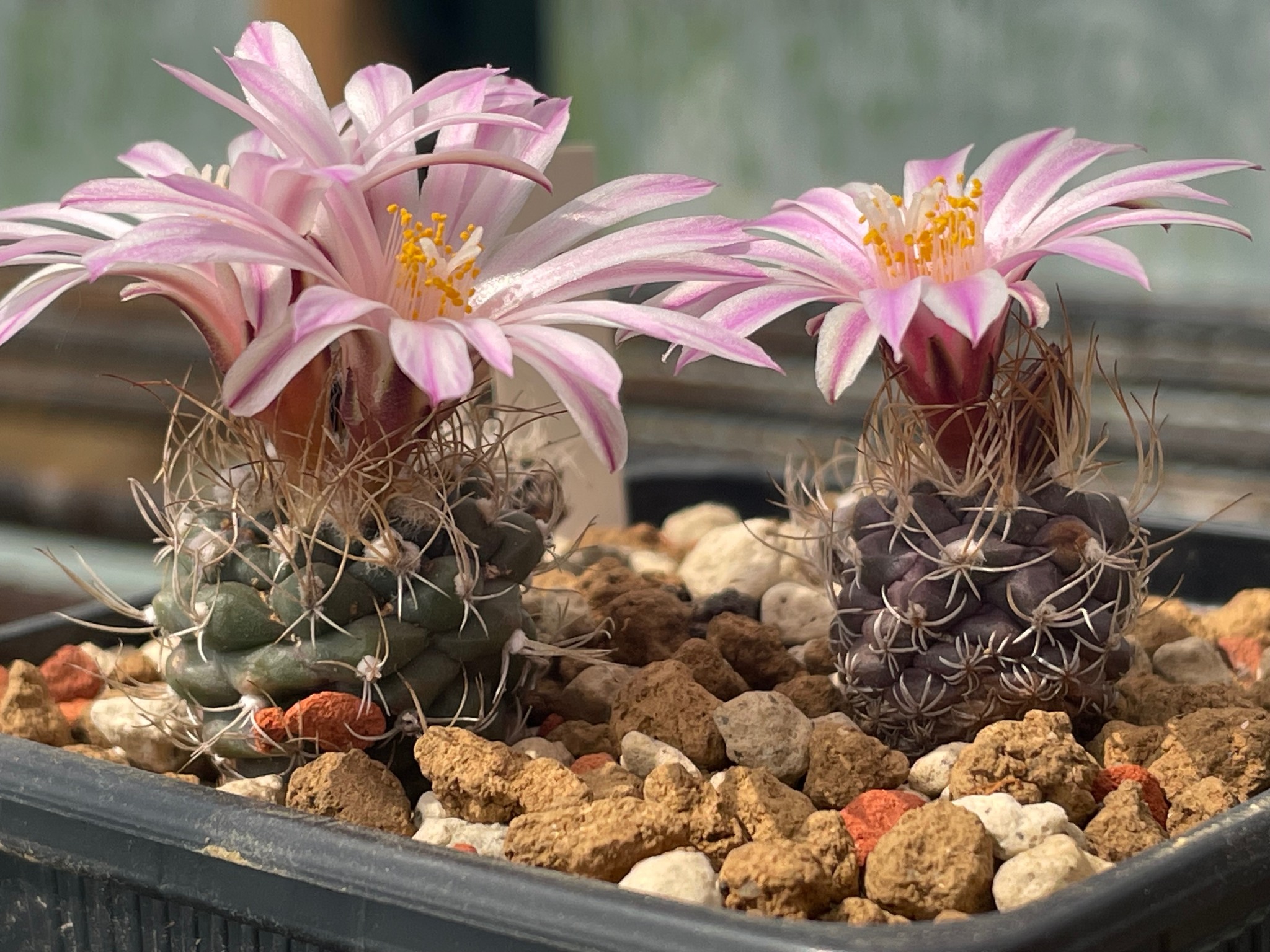
Turbinicarpus pseudomacrochele (Backeb.) Buxb. & Backeb. is a small globose cactus from the limestone highlands of Hidalgo and Querétaro in north-central Mexico, where it occupies rock crevices and calcareous scree between 1,400 and 2,200 m. The plant is easily overlooked in the field: a solitary globe rarely exceeding 3.5 cm across, pale green, anchored in its limestone crevice by a large fleshy taproot. What gives the autonym its character, and its collector appeal, is the spination: 6 to 8 long, twisted, flexible, papery spines per areole, yellowish-brown when new and fading to grey with dark tips, each one distinctly tortuous along its shaft. The epithet pseudomacrochele signals what Backeberg saw: something that resembles the big-spine schmiedickeanus subspecies but is not the same plant.
The taxonomy is contested across three nomenclatural layers. At the species level, Curt Backeberg described it in 1935 as Strombocactus pseudomacrochele; Buxbaum and Backeberg transferred it to Turbinicarpus in 1937. At the subspecific level, T. pseudomacrochele subsp. krainzianus has been recognised since the 1980s and maintains its own encyclopedia page here, as does the form subsp. minimus per recent molecular phylogenetics. ITIS additionally accepts a fourth subspecies, lausseri (Diers & G.Frank) Doweld, not currently recognised by POWO. At the generic level, Doweld’s 1998 Kadenicarpus concept, and the molecular phylogeny supporting it by molecular phylogenetics, means that the plant appears on Kew POWO under a different name from the one collectors, literature, and this encyclopedia use. That split is addressed in the Taxonomy section below.
Two other Querétaro-highland cacti provide range context. Mammillaria herrerae occupies the same Sierra Gorda de Querétaro geology at overlapping elevations, and its conservation profile mirrors this species closely: CITES Appendix I, fewer than 2,500 mature individuals in documented populations, limestone substrate. Turbinicarpus lophophoroides occupies gypsum flats in San Luis Potosí, a different substrate and state, but the genus-level conservation concern is the same: small globose bodies, habitat specialists, prime targets for illegal collection. Both comparators are in the same CITES Appendix I tier as this species.
In cultivation, T. pseudomacrochele rewards growers who replicate the limestone microsite: highly mineral substrate with limestone chip, deep container for the taproot, full sun, and near-complete drought in winter. The alkaloid profile of the autonym is documented but modest: hordenine only, at 1 to 10 mg per 100 g fresh weight. This contrasts with the complex mescaline-bearing profile of subsp. krainzianus, a distinction directly relevant to CITES enforcement context.
Turbinicarpus pseudomacrochele quick reference
A small geophytic cactus from limestone crevices and calcareous scree in Hidalgo and Querétaro, Mexico, at 1,400 to 2,200 m. Values calibrated for seed grown plants in cultivation, drawn from habitat data and specialist grower consensus.
Taxonomy & nomenclature
The basionym is Strombocactus pseudomacrochele Backeb., published by Curt Backeberg in Blätter für Kakteenforschung 1935[3] (exact page not retrieved from the BHL scan; deferred per research protocol). Buxbaum and Backeberg transferred the species to Turbinicarpus in 1937, published as T. pseudomacrochele (Backeb.) Buxb. & Backeb. in Cactaceae (Berlin) 1937(1): 27. That combination is the primary binomial for this encyclopedia and for collector usage worldwide.
POWO currently places this species in Kadenicarpus Doweld, following molecular phylogenetic analysis, which demonstrated that Turbinicarpus sensu lato is polyphyletic and that the pseudomacrochele lineage constitutes a separate monophyletic genus. Some authorities retain Turbinicarpus in the broad sense, and collector usage worldwide remains Turbinicarpus. This page follows the encyclopedia’s Turbinicarpus convention, with Kadenicarpus pseudomacrochele (Doweld 1998) noted as the POWO-current alternative name.
The full synonymy (POWO, ITIS, Wikispecies): Strombocactus pseudomacrochele Backeb. (1935) is the basionym; Toumeya pseudomacrochele (Backeb.) W.T.Marshall (1946) and Neolloydia pseudomacrochele (Backeb.) E.F.Anderson (1986) reflect mid-century generic rearrangements; Pediocactus pseudomacrochele (Backeb.) Halda (1998) and Kadenicarpus pseudomacrochele (Backeb.) Doweld (1998) are contemporaneous alternatives reflecting two competing phylogenetic interpretations. The epithet itself derives from Greek pseudo (false) and the specific name of T. schmiedickeanus subsp. macrochele, signalling that Backeberg saw a close resemblance but recognised the plant as distinct.
Kew POWO recognises three accepted subspecies under K. pseudomacrochele: the autonym subsp. pseudomacrochele (the subject of this page), subsp. krainzianus (Gerhart Frank) Vázquez-Sánchez (transferred from T. krainzianus by recent molecular revision), and subsp. minimus (Gerhart Frank) Vázquez-Sánchez (basionym T. krainzianus f. minimus Gerhart Frank, Succulenta 68(12): 272, 1989). ITIS additionally recognises a fourth subspecies, lausseri (Diers & G.Frank) Doweld, not currently in the POWO baseline.
Subsp. lausseri is worth a separate paragraph because its distinguishing characters directly affect how source material is interpreted. Plants of subsp. lausseri occur on steep rocky slopes of the Sierra del Doctor, Querétaro, extending into adjacent Hidalgo (Bihrmann; ITIS). The body is distinctly dark green, the tubercles are more pointed than in the autonym, and the flowers are deep reddish-purple with lighter edges. This reddish-purple flower colour is the source of older literature attributions that appear to describe subsp. pseudomacrochele as red-flowered; the autonym bears pale pink flowers with a darker mid-stripe (Desert-Tropicals), not reddish-purple. The Bihrmann and some earlier Turbinicarpus grower notes that describe reddish-purple coloration are referring to subsp. lausseri, regardless of the binomial used in those sources. Cultivation advice and morphology on this page apply to the autonym only.
Historical synonyms (12)
- Strombocactus pseudomacrochele Backeb., 1935 basionym
- Toumeya pseudomacrochele (Backeb.) Bravo & W.T.Marshall, 1946 homotypic synonym
- Neolloydia pseudomacrochele (Backeb.) E.F.Anderson, 1986 homotypic synonym
- Turbinicarpus pseudomacrochele var. lausseri Diers & G.Frank, 1991 homotypic synonym
- Kadenicarpus pseudomacrochele var. lausseri (Diers & G.Frank) Doweld, 1998 homotypic synonym
- Pediocactus pseudomacrochele (Backeb.) Halda, 1998 homotypic synonym
- Pediocactus pseudomacrochele var. lausseri (Diers & G.Frank) Halda, 1998 homotypic synonym
- Pediocarpus pseudomacrochele (Backeb.) Halda, 1998 homotypic synonym
- Pediocarpus pseudomacrochele subsp. lausseri (Diers & G.Frank) Halda, 1998 homotypic synonym
- Turbinicarpus pseudomacrochele f. lausseri (Diers & G.Frank) Panar., 1998 homotypic synonym
- Turbinicarpus pseudomacrochele subsp. lausseri (Diers & G.Frank) C.E.Glass, 1998 homotypic synonym
- Kadenicarpus pseudomacrochele subsp. lausseri (Diers & G.Frank) Doweld, 2000 homotypic synonym
Sources: POWO (Kew) · IPNI · GBIF · Wikidata
Habitat
T. pseudomacrochele grows in limestone crevices, on calcareous rocky hillsides, and on canyon walls within the Sierra Madre Oriental system of Hidalgo and Querétaro, northeastern Mexico. At the publication level, the species occupies two named protected-area units: the Barranca de Metztitlán Biosphere Reserve in Hidalgo (96,043 ha, spanning the junction of the Sierra Madre Oriental and the Trans-Mexican Volcanic Belt) and the Sierra Gorda de Querétaro. A GBIF-registered population dynamics study confirmed T. pseudomacrochele among six threatened cacti monitored specifically within the Barranca de Metztitlán Reserve.
Elevation range is approximately 1,400 to 2,200 m, derived from collection records in the BCSS Field Number Finder. Canyon floors in the Barranca de Metztitlán system bottom out at 1,200 to 1,300 m; surrounding plateau and ridge terrain reaches 1,800 to 2,600 m (LACGeo, UNESCO MAB documentation). Plants occupy the limestone-rich mid-elevation band within this gradient.
Substrate is limestone and calcareous scree. Turbinicarpus sensu lato grows overwhelmingly on limestone rather than volcanic substrates; more than 80% of species in the group occupy rock cracks or the rubble beneath them. Individual plants nestle in crevices rather than open soil, anchored by their large fleshy taproot in a mineral-dominant, fast-draining microsite. Organic matter is minimal.
Climate is semi-arid, with summer rains concentrated May to October and a dry winter period. At 1,400 to 2,200 m, nightly lows can reach near 0°C in winter; intense UV characterises the summer growing season. Canyon-wall positions often face north or east, moderating midday solar intensity while providing strong morning light. Associated vegetation in the reserve includes xerophilous scrub with Prosopis, Opuntia, Myrtillocactus, Stenocereus, acacias, and other semi-arid scrub taxa.
Morphology
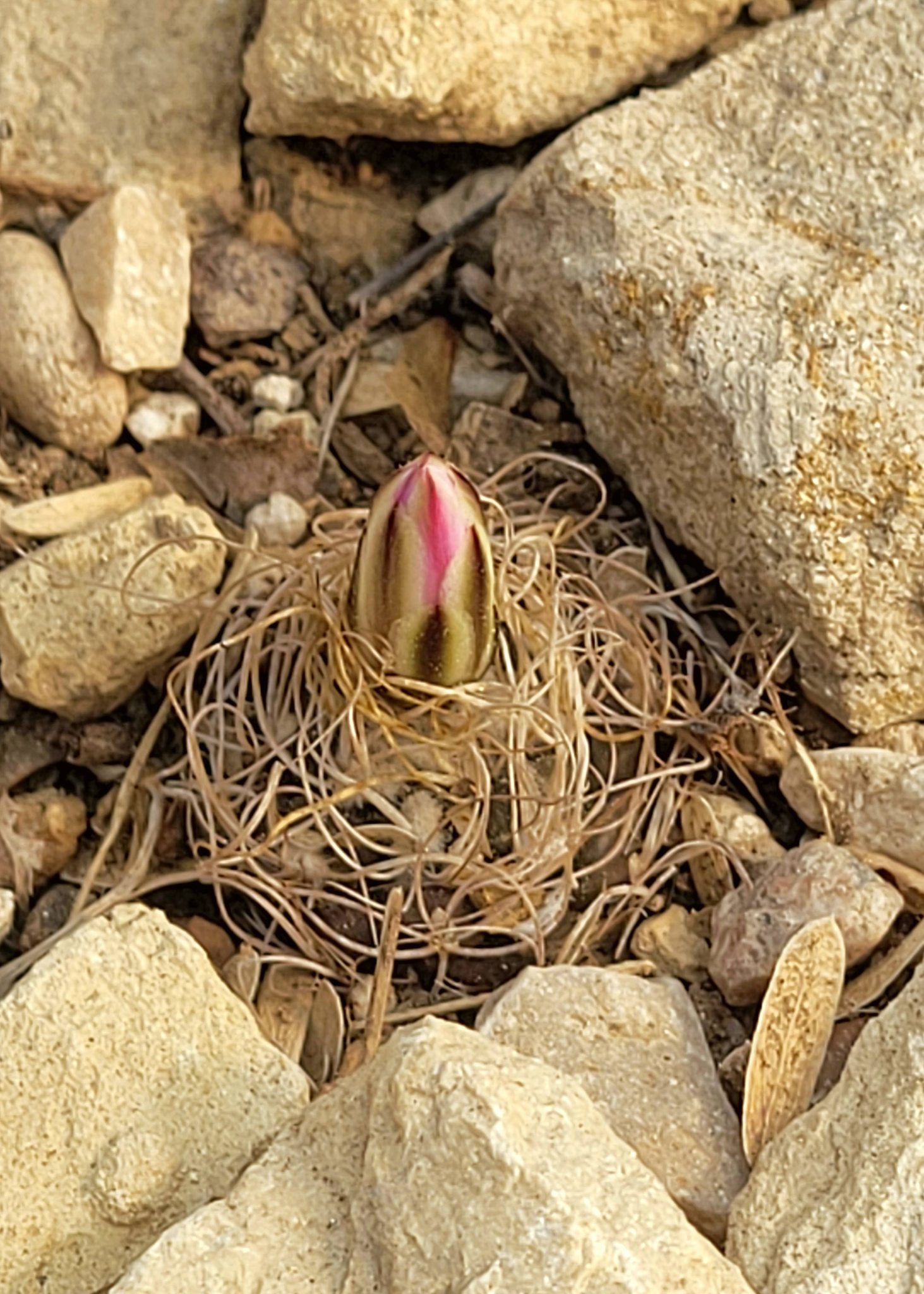
T. pseudomacrochele subsp. pseudomacrochele is a small, solitary, globose to short-cylindrical cactus with a stem typically 2 to 4 cm tall and 2.5 to 3.5 cm in diameter. The body is pale to mid-green. A dense white woolly mass covers the crown apex. Beneath the crown, a large fleshy taproot anchors the small stem in limestone crevices, disproportionate to the modest above-ground mass. Unlike subsp. krainzianus, which clusters readily, the autonym is predominantly solitary.
Tubercles are low, rounded to conical above and rhomboid below, arranged in approximately 11 parastichies (spiral tubercle rows). Turbinicarpus taxa have discrete tubercles, not ribs; the body of this species is not ribbed and must not be described in rib terms. Areoles sit at tubercle tips, white and woolly when young, becoming bare with age.
The spines are the most consistent and diagnostic character. Each areole carries 6 to 8 spines, 12 to 30 mm long, conspicuously twisted or tortuous along their length, flexible rather than rigid, and papery in texture rather than pungent. Colour is yellowish-brown when new, transitioning to grey with dark tips, then eventually shedding. The upper spine in each cluster is typically the longest. Anatomical study documented the basis: fiber walls in T. pseudomacrochele are “not so heavily sclerified, attaining a thickness of 1.5 to 1.7 µm” with “narrow lumina,” producing the flexible, bristly texture. Spine count (6 to 8 per areole) is the fastest field character for distinguishing the autonym from T. schmiedickeanus subsp. macrochele, which carries only 1 to 4.
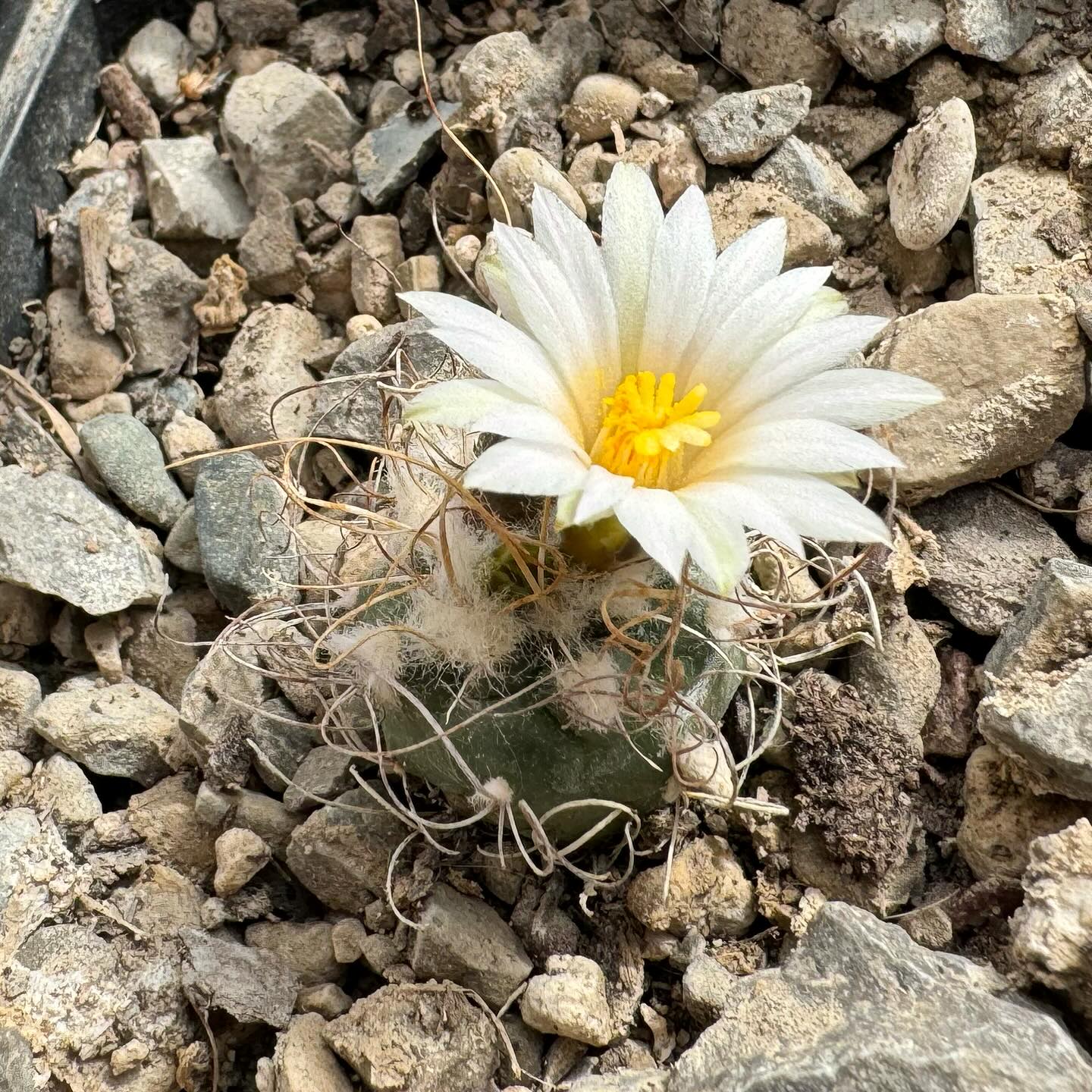
Flowers are diurnal and funnelform, emerging from the woolly crown apex. Primary colour for the autonym is pale pink with a darker rose or pinkish mid-stripe on each petal (Desert-Tropicals). Some cultivated specimens produce inner petals in greenish-cream to yellowish-cream tones, a documented clone or growing-condition variation within the autonym (Sacredcacti). Flowers reach approximately 2 cm long and up to 3.5 cm in diameter. Flowering season is late spring to early summer, with some cultivated plants producing multiple flushes. A sustained cool, dry winter dormancy promotes the subsequent flowering season. Fruit is ovate to globose, 3 to 5 mm in diameter, green becoming reddish at maturity; seeds are black, approximately 1 mm, with a finely tuberculate coat.
The alkaloid chemistry of the autonym is documented in early phytochemical work: hordenine is the sole alkaloid at 1 to 10 mg per 100 g fresh material. This contrasts with the complex profile of subsp. krainzianus, which carries mescaline at 2.48% of its alkaloid fraction . The chemical distinction is relevant in CITES enforcement contexts where laboratory identification of subspecies is required.
Locality detail
At publication level, T. pseudomacrochele subsp. pseudomacrochele is documented across two protected-area units in Hidalgo and Querétaro: the Barranca de Metztitlán Biosphere Reserve and the Sierra Gorda de Querétaro. The Barranca de Metztitlán system is carved through limestone and associated sedimentary formations; canyon floors reach 1,200 to 1,300 m and surrounding ridges top out at 1,800 to 2,600 m. The Sierra Gorda de Querétaro is the same limestone-highland corridor that harbours other CITES Appendix I cacti including, at overlapping elevations, Mammillaria herrerae.
Precise collection localities exist in the BCSS Field Number Finder records for this species but are withheld from publication here in accordance with CITES Appendix I guidance and the documented history of targeted collection pressure on Turbinicarpus taxa. The map below marks reserve-level centroids only.
Turbinicarpus pseudomacrochele care and cultivation
The cultivation approach follows directly from the habitat profile: limestone crevices, mineral-dominant substrate, strong light, dry winters, and a deep container for the taproot. The two commonest failures in cultivation are an organic-rich mix that retains moisture and a shallow container that constrains root development; both can be avoided by taking the field microsite seriously.
Substrate
The canonical ratio is 35 per cent pumice, 15 per cent lava rock, 5 per cent zeolite, 20 per cent granite grit, 20 per cent limestone chip, and 5 per cent worm castings. Pumice and lava together form the drainage backbone; the zeolite buffers pH around 7.0 to 7.5 and paces nutrients between waterings. No published cultivation source gives a limestone proportion specific to T. pseudomacrochele; the 20 per cent limestone chip carried in the mix is the site’s bloc-level convention for the Mexican limestone genera, not a species-specific finding. Particle sizes in the 2 to 6 mm range keep the mix free-draining and resist compaction over time. The mix must drain immediately and not retain moisture between waterings.
All seven Turbinicarpus species on this site share a 95/5 mineral-organic baseline; no published grower source gives a per-species limestone proportion for the genus, so limestone is carried as bloc-level convention (Doorbar and Quail’s Mexican-limestone-genera practice), not a species-specific finding. T. lophophoroides currently ships a different limestone and silica split with no cultivation source behind the difference; that figure is under review against the genus baseline.
| Species | Pumice | Lava | Zeolite | Granite | Limestone | Silica | Organic |
|---|---|---|---|---|---|---|---|
| T. alonsoi | 35% | 15% | 5% | 20% | 20% | 0% | 5% |
| T. valdezianus | 35% | 15% | 5% | 20% | 20% | 0% | 5% |
| T. boedekerianus | 35% | 15% | 5% | 20% | 20% | 0% | 5% |
| T. lophophoroides | 35% | 15% | 5% | 20% | 10% | 10% | 5% |
| T. pseudomacrochele (this page) | 35% | 15% | 5% | 20% | 20% | 0% | 5% |
| T. pseudomacrochele subsp. krainzianus | 35% | 15% | 5% | 20% | 20% | 0% | 5% |
| T. saueri | 35% | 15% | 5% | 20% | 20% | 0% | 5% |
Container depth matters more than width for this species. The large fleshy taproot needs vertical run; a shallow bowl constrains it and produces unstable, poorly-rooted plants. Deep terracotta or clay composite suits humid-climate growers and those prone to overwatering; glazed or plastic is acceptable in drier climates or for disciplined waterers.
Watering and light
During the active growing season (spring through early autumn): water thoroughly, then allow the substrate to dry completely before the next watering. In warmest months, this often means once every 7 to 14 days depending on pot size and climate. As temperatures drop in autumn, taper frequency. From late October to late February, withhold water almost entirely. A very light misting once monthly in a heated greenhouse is acceptable during this dormancy, but sustained moisture at low temperatures is the primary kill vector. Wet cold at or below 5°C kills. A dry cold dormancy at 7 to 10°C is the standard recommendation and also promotes the subsequent flowering season.
At 1,400 to 2,200 m on limestone hillsides, the plants receive intense UV and direct sun for much of the day, often moderated by the canyon-wall angle rather than by vegetation shade. In cultivation, acclimatized specimens handle full outdoor sun; newly acquired or recently repotted plants should be introduced to full sun gradually. In very hot summer climates above 40°C, afternoon shade prevents burning. South- or west-facing exposure works well in the Northern Hemisphere. Cold tolerance from grower reports: safe winter minimum 7 to 8°C for sustained periods; brief exposure down to approximately -4°C / 25°F is survivable when the plant is completely dry (Davesgarden.com). Wet cold at any temperature is the kill vector.
Propagation
Seed grown plants are the standard for serious collections. The slow growth, 3 to 5 years from seed to first flower by cultivator consensus extrapolated from genus-level data and T. pseudopectinatus comparator data, is what produces the natural flat-globose habit and characteristic spine development. Grafted plants on Myrtillocactus, Hylocereus, or Pereskiopsis rootstocks grow faster and flower earlier but produce larger, less characterful bodies. The slow accretion from seed is the point.
Root mealybug and above-ground mealybug are the primary pest risks. Annual root inspection during repotting, good air circulation, and substrate that dries quickly between waterings are the standard preventive measures.
Comparison
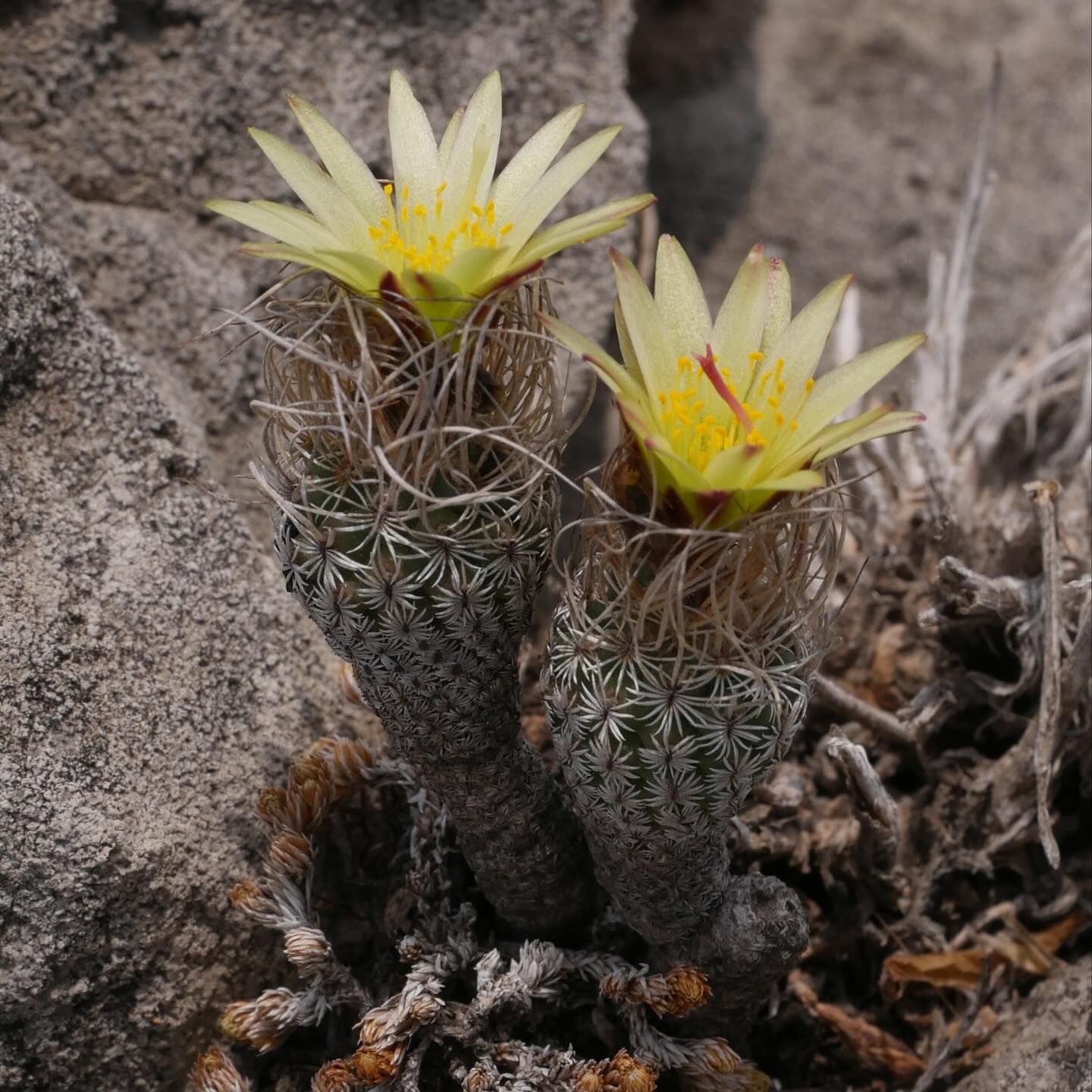
The epithet pseudomacrochele itself encodes the identification problem. Backeberg chose it because the plant resembles T. schmiedickeanus subsp. macrochele (the “big-spine” subspecies) but is not the same plant. In the field, distribution resolves most confusion: subsp. macrochele is a Tamaulipas endemic around La Peditas near Miquihuana, completely separate from the Hidalgo/Querétaro range of the autonym.
In cultivation, where provenance may be unknown, spine count is the fastest character: 6 to 8 per areole on T. pseudomacrochele versus 1 to 4 on subsp. macrochele. The twist of the spines along their length is visible without magnification on the autonym and is not a character of subsp. macrochele, which has curved but not characteristically tortuous spines. Body size provides a supporting character: subsp. macrochele reaches up to 6 cm diameter at maturity, stockier than the autonym’s 3.5 cm maximum. Flower colour provides a secondary character in flower: pale pink with darker mid-stripe on the autonym; white to pale pink with a more white-dominant tone on subsp. macrochele.
Within the genus, T. valdezianus is superficially similar in body size but differs at a glance: the spine system is pectinate and feathery rather than the autonym’s longer, twisted individual spines. The autonym’s sibling subspecies, T. pseudomacrochele subsp. krainzianus, is typically distinguished by its tendency to cluster (the autonym is predominantly solitary), shorter and less conspicuously twisted spines, and larger flowers relative to body size. The two subspecies share the same reserve geography, so wild-origin specimens from the same locality need spine-count and clustering assessment to distinguish.
Frequently asked questions
How do you tell Turbinicarpus pseudomacrochele apart from T. schmiedickeanus subsp. macrochele?
The name pseudomacrochele means “false macrochele,” and the resemblance causes real confusion in cultivation when provenance is unknown. Drag the slider to compare both plants, then use the character table: spine count alone resolves most identifications.


Spine count (6 to 8 versus 1 to 4) is the single fastest and most reliable character regardless of growth stage. The tortuous twist along the spine shaft is visible without magnification on T. pseudomacrochele and is absent in subsp. macrochele.
Is Turbinicarpus pseudomacrochele now called Kadenicarpus on some databases?
Yes. Kew POWO currently accepts Kadenicarpus pseudomacrochele (Backeb.) Doweld as the name for this species, following molecular phylogenetic work, which found that Turbinicarpus sensu lato is polyphyletic and that the pseudomacrochele lineage constitutes a separate monophyletic genus. Some authorities retain Turbinicarpus in the broad sense. Collector literature and trade use Turbinicarpus almost universally. This encyclopedia uses Turbinicarpus pseudomacrochele as the primary binomial and lists Kadenicarpus pseudomacrochele in the synonymy.
How hard is Turbinicarpus pseudomacrochele to grow?
Intermediate in difficulty. The main points of failure are a soil mix that retains too much moisture, a shallow container that constrains the taproot, and watering during cold winter conditions. Plants grown from seed in a highly mineral, limestone-chip-enriched substrate with a deep container and near-complete winter drought perform reliably. The species tolerates brief dry cold well, consistent with its 1,400 to 2,200 m native elevation. Wet cold at or below 5°C is reliably fatal.
Is Turbinicarpus pseudomacrochele CITES-listed?
Yes, on CITES Appendix I. The entire Turbinicarpus genus, including all accepted segregate synonyms (Gymnocactus, Normanbokea, Rapicactus, and per CITES interpretation, Kadenicarpus), is listed on Appendix I. This is the highest CITES tier and prohibits commercial international trade in wild-collected plants. Nursery-propagated plants may be traded with the documentation required under CITES nursery-propagated provisions. Under NOM-059-SEMARNAT-2010, the species also carries category P (en peligro de extinción) under Mexican federal law.
Where does Turbinicarpus pseudomacrochele grow in the wild?
In limestone crevices and calcareous scree in the states of Hidalgo and Querétaro, north-central Mexico. At publication level, the known range covers the Barranca de Metztitlán Biosphere Reserve in Hidalgo and the Sierra Gorda de Querétaro, at elevations of approximately 1,400 to 2,200 m. Precise locality data is withheld from publication due to CITES Appendix I status and documented collection pressure.
How long does Turbinicarpus pseudomacrochele take to flower from seed?
Roughly 3 to 5 years from seed to first flower for well-grown plants under good conditions. This figure represents cultivator consensus extrapolated from genus-level data and comparator species in the genus, including T. pseudopectinatus grower reports and BCSS forum records for the genus broadly. No species-specific peer-reviewed citation exists for this exact figure. Grafted plants flower considerably faster, typically inside 2 years, but produce larger, less characteristically-formed bodies.
Sources & further reading
Backeberg, C., Blätter für Kakteenforschung 1935[3] (basionym Strombocactus pseudomacrochele; page number deferred) · Buxbaum, F. & Backeberg, C., Cactaceae (Berlin) 1937(1): 27 (Turbinicarpus pseudomacrochele comb. nov.) · Mosco, A. (2009). Micro-morphology and anatomy of Turbinicarpus (Cactaceae) spines. Revista Mexicana de Biodiversidad 80(1): 14 · Bruhn, J.G. & Bruhn, C. (1973). Alkaloids and ethnobotany of Mexican peyote cacti and related species. Economic Botany 27(2): 241–251. DOI: 10.1007/BF02872994 · Vázquez-Sánchez, M. et al. (2019). Polyphyly of the iconic cactus genus Turbinicarpus (Cactaceae) and its generic circumscription. Botanical Journal of the Linnean Society 190(4): 405–420. DOI: 10.1093/botlinnean/boz027 · Štárha, R.; Chybidziurová, A.; Lacný, Z. (1999). Alkaloids of the genus Turbinicarpus (Cactaceae). Biochemical Systematics and Ecology 27(8): 839–841. DOI: 10.1016/S0305-1978(99)00019-8 · Kew POWO. Kadenicarpus pseudomacrochele (Backeb.) Doweld. LSID urn:lsid:ipni.org:names:1008390-1. Accessed April 2026 · IUCN Red List. Kadenicarpus pseudomacrochele. Assessment ID 40989. Gómez-Hinostrosa, C.; Sánchez, E.; Guadalupe Martínez, J. (2013). https://www.iucnredlist.org/species/40989/121509203 · ITIS. Turbinicarpus pseudomacrochele ssp. lausseri (Diers & G.Frank) Doweld. TSN 912705. Verified C.A. Butterworth Ph.D. (ITIS Cactaceae Steward) · GBIF dataset “Dinámica poblacional de cactáceas amenazadas.” ID 5fba1aca-44ae-4a4f-a508-6a599d29d1cd · LACGeo / UNESCO MAB. Barranca de Metztitlán Biosphere Reserve profile. https://lacgeo.com/barranca-metztitlan-biosphere-reserve · Desert-Tropicals.com. Turbinicarpus pseudomacrochele ssp. pseudomacrochele. Accessed April 2026 · Sacredcacti.com (Trout’s Notes). Turbinicarpus genus account. Accessed April 2026 · Bihrmann.com. Turbinicarpus pseudomacrochele subspecies. https://bihrmann.com/rikke/subs/tur-pse-sub.asp. Accessed April 2026 · NOM-059-SEMARNAT-2010. Categoria P (en peligro de extinción) for Turbinicarpus taxa. DOF 30 December 2010