
Turbinicarpus pseudomacrochele subsp. krainzianus
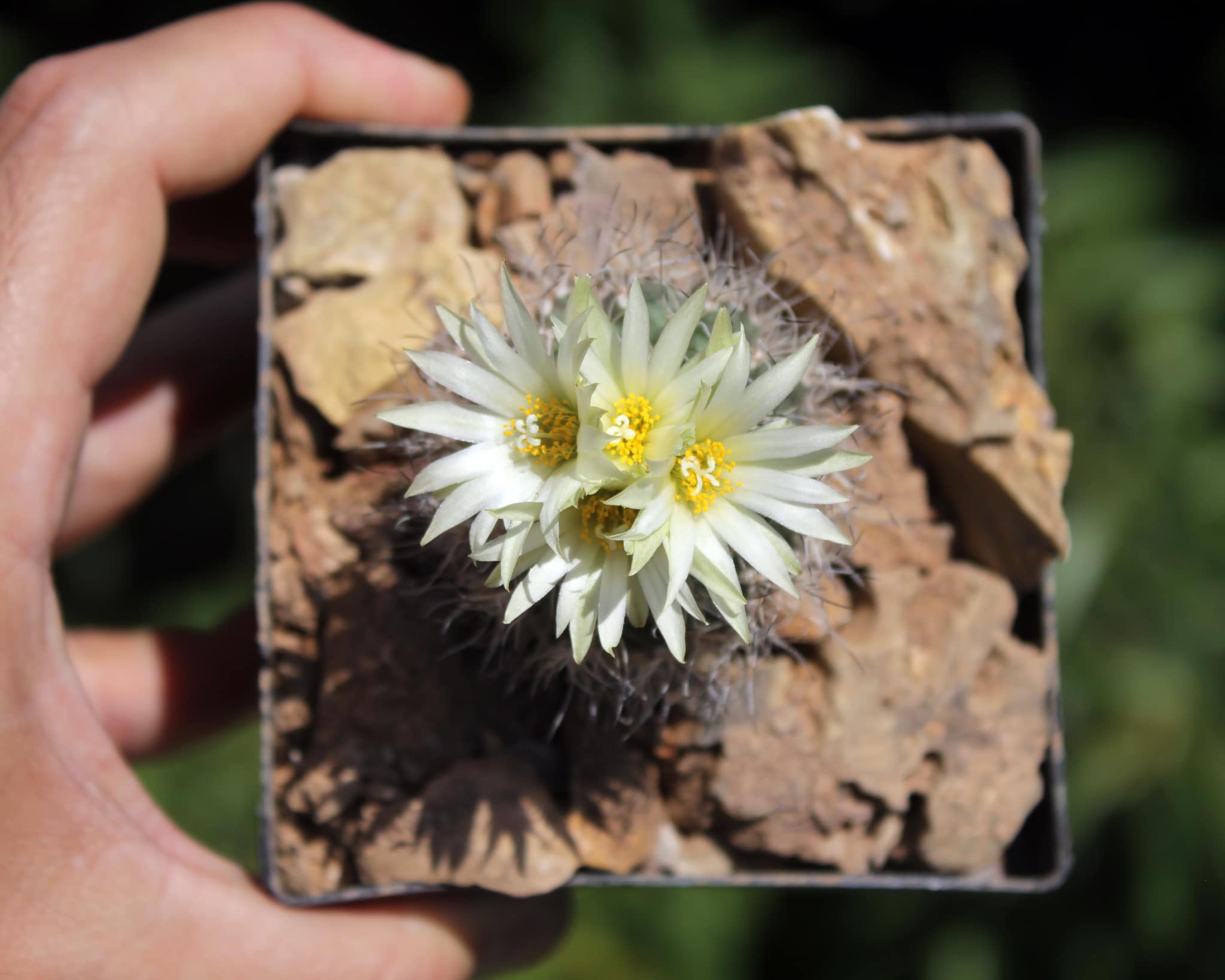
Turbinicarpus pseudomacrochele subsp. krainzianus is the compact, wiry-spined segregate of the T. pseudomacrochele species complex, documented from limestone karst slopes in the Sierra del Doctor massif of eastern Querétaro, Mexico. Gerhart Frank described it in 1960 as Toumeya krainziana, honouring the Swiss botanist Hans Krainz; Backeberg transferred it to Turbinicarpus in 1961. Charles Glass subsequently reduced it to subspecific rank within T. pseudomacrochele, the treatment followed throughout this page.
The subspecies is separated from the autonym by three characters that hold across sources: smaller flowers reaching only 2 cm in diameter in yellowish-cream to greenish-yellow colouring with no pink midstripe, wiry cylindrical spines rather than the flatter papery spines of the autonym, and a narrower, more tapering tubercle apex. Body diameter overlaps between the two subspecies in cultivation, which makes vegetative identification alone unreliable on a non-flowering plant. Turbinicarpus alonsoi from Guanajuato and T. valdezianus with its feathery pectinate spines represent the broader range of spine variation across the genus.
Turbinicarpus pseudomacrochele subsp. krainzianus quick reference
A compact limestone-karst specialist from Sierra del Doctor, Querétaro, with a tuberous tap root and rot-prone crown. Values calibrated for seed grown plants in cultivation, with cultivation essentially identical to the autonym except for the crown-watering caution noted below.
Taxonomy & nomenclature
Gerhart Frank established the taxon in 1960 as Toumeya krainziana G.Frank, published in a short descriptive note. Curt Backeberg transferred it the following year as Turbinicarpus krainzianus (G.Frank) Backeb. in Cactaceae 5: 2890 (1961). Subsequent workers assigned it variously to Neolloydia, Pediocactus, and Strombocactus before Charles Glass reduced it to infraspecific rank as Turbinicarpus pseudomacrochele subsp. krainzianus (G.Frank) Glass, placing it alongside the autonym subsp. pseudomacrochele within the broader species complex. This subspecific combination is retained as the primary binomial throughout the current page.
The 2019 molecular-phylogenetic revision by Vázquez-Sánchez, Sánchez, Terrazas, De La Rosa-Tilapa & Arias (Botanical Journal of the Linnean Society 190: 405-420) demonstrated that Turbinicarpus as then circumscribed was polyphyletic, recovering three well-supported clades recognised as Kadenicarpus, Rapicactus, and Turbinicarpus sensu stricto. Vázquez-Sánchez published the combination Kadenicarpus pseudomacrochele subsp. krainzianus (G.Frank) Vázquez-Sánchez (loc. cit., p. 416, 2019), now the accepted name at Kew POWO. Mexican regional botanical literature and the IUCN 2013 assessment both retain Turbinicarpus pseudomacrochele subsp. krainzianus; this page follows that convention for the primary binomial and cites Kadenicarpus pseudomacrochele subsp. krainzianus in the Synonymy.
Historical synonyms (10)
- Toumeya krainziana G.Frank, 1960 basionym
- Strombocactus pseudomacrochele var. krainzianus (Frank) G.D.Rowley, 1972 homotypic synonym
- Toumeya pseudomacrochele var. krainziana (G.Frank) G.D.Rowley, 1974 homotypic synonym
- Turbinicarpus pseudomacrochele var. krainzianus (G.Frank) Glass & R.A.Foster, 1977 homotypic synonym
- Pediocactus pseudomacrochele var. krainzianus (G.Frank) Halda, 1998 homotypic synonym
- Turbinicarpus krainzianus (G.Frank) Backeb., 1961 heterotypic synonym
- Neolloydia krainziana (G.Frank) A.T.Powell, 1995 heterotypic synonym
- Turbinicarpus pseudomacrochele var. sphacellatus Diers & G.Frank, 1988 nom. inval.
- Kadenicarpus pseudomacrochele var. sphacellatus (Diers & G.Frank) Doweld, 1998 nom. inval.
- Pediocactus pseudomacrochele var. sphacellatus (Diers & G.Frank) Halda, 1998 nom. inval.
Sources: GBIF
Habitat
Full habitat ecology for the T. pseudomacrochele species complex is covered on the parent species page. The subspecies-specific microsite detail: subsp. krainzianus is confirmed from limestone karst slopes of the Sierra del Doctor massif in eastern Querétaro. The massif is a Sierra Madre Oriental calcareous formation ranging from approximately 1,500 to 2,200 m. Plants grow in semi-desert matorral on exposed rock outcrops, with a documented tendency to become partly or completely buried in loose silty pockets during the dry season. This geophytic behaviour, combined with a radial-only juvenile spine stage that pre-dates the characteristic twisted central spines of the adult, likely contributes to undercounting in population surveys. POWO records Querétaro and Hidalgo as the native range; a specific Hidalgo field collection for typical krainzianus was not traced in the literature, and the Hidalgo element on nursery provenance labels has not been matched to a published collection site.
Morphology
The body is solitary to slowly clustering, forming multi-headed clumps up to approximately 15 cm across in cultivation. Individual stems reach 3-4 cm tall. In compact wild plants or single-stem cultivation material the stem diameter runs 8-12 mm; well-grown cultivation specimens typically reach 2-3.5 cm in diameter, with llifle explicitly noting that cultivated individuals exceed the published wild measurements. Body colour is consistently described as dark green across sources. The apex is white-woolly and largely concealed by spines; tubercles are rhomboidal at the base and taper to a pointed apex, approximately 4 mm tall. A tuberous tap root, 3-4 cm long and 5-8 mm wide, anchors the plant in shallow karst pockets.
Six to eight spines per areole reach 12-30 mm, with the uppermost the longest. The key texture character: spines are curved, wiry, and flexible, with a cylindrical cross-section. They are described as non-piercing and bristle-like (llifle). Initial colour is yellowish-brown; mature spines grey with dark tips, and older areoles shed their spines entirely. This contrasts with the autonym’s spines, which growers consistently describe as flatter and more papery in cross-section. Numerical spine length overlaps between the two subspecies (both reach 12-30 mm per llifle), so spine texture under a hand lens, not length, is the reliable vegetative character.
Flowers are diurnal and produced in multiple summer flushes. Diameter reaches up to 2 cm; length similarly up to 2 cm (llifle). Tepals, 12-16 in count, are yellowish-cream to greenish-yellow with no pink midstripe. Style is white, with four white stigma lobes and yellow anthers seated below stigma level. This is the single most reliable identification character against the autonym: no subsp. krainzianus produces a rose-pink or white-with-pink-midstripe flower, and the autonym’s flowers reach up to 3.5 cm diameter. Fruit is spherical to oval, 3-5 mm, green ripening to red, bearing 20-25 black finely-tuberculate seeds approximately 1 mm across. Seedlings pass through a purely radial-spined juvenile stage before developing the characteristic twisted central spines, which can cause collector confusion with other pectinate-spined Turbinicarpus including T. boedekerianus.
Locality detail
POWO records Querétaro and Hidalgo as the native range. Only the Sierra del Doctor massif in eastern Querétaro carries a documented field collection for subsp. krainzianus. The llifle entry for this subspecies notes that distribution is uncertain. A specific Hidalgo field locality could not be traced in the literature reviewed; the Hidalgo element appears on nursery provenance labels citing the two-state formula but without a named collection site. The companion form lausseri is also described from Sierra del Doctor. Until a Hidalgo occurrence with collection data is published, the Sierra del Doctor centroid below is the sole defensible mapped point.
Turbinicarpus pseudomacrochele subsp. krainzianus care and cultivation
Cultivation is essentially identical to the autonym T. pseudomacrochele; the full account of substrate, container, watering regime, and propagation lives on the parent species page. Two subspecies-specific points warrant separate treatment here.
Crown rot vulnerability
Growers consistently flag subsp. krainzianus as particularly prone to crown rot in the first two years after seed germination and following repotting (llifle; Trout’s Notes). The white-woolly apex that covers the growing point traps moisture. Directing watering away from the apex, or watering only from below, is the most effective mitigation. After any root disturbance, keep the substrate completely dry for two to three weeks before resuming a cautious watering schedule.
Substrate and root accommodation
No cultivation source gives a substrate pH target for this taxon. Named growers report the wider genus stalls under alkaline irrigation water and resumes growth under acidified water, target pH roughly 5.0 to 6.0, which is the real, genus-specific pH lever here. The canonical ratio is 35 per cent pumice, 15 per cent lava rock, 5 per cent zeolite, 20 per cent granite grit, 20 per cent limestone chip, and 5 per cent worm castings. Pumice and lava form the drainage backbone; the zeolite buffers pH and paces trace nutrients. Limestone chip at 20 per cent is the site’s bloc-level convention for the Mexican limestone genera; no cultivation source publishes a proportion specific to this taxon. Organic content is kept to 5 per cent; the tuberous tap root demands a pot with sufficient depth to sit without bending, and any mix that holds moisture beyond 24 hours at the root crown is the primary route to loss.
All seven Turbinicarpus species on this site share a 95/5 mineral-organic baseline; no published grower source gives a per-species limestone proportion for the genus, so limestone is carried as bloc-level convention (Doorbar and Quail’s Mexican-limestone-genera practice), not a species-specific finding. T. lophophoroides currently ships a different limestone and silica split with no cultivation source behind the difference; that figure is under review against the genus baseline.
| Species | Pumice | Lava | Zeolite | Granite | Limestone | Silica | Organic |
|---|---|---|---|---|---|---|---|
| T. alonsoi | 35% | 15% | 5% | 20% | 20% | 0% | 5% |
| T. valdezianus | 35% | 15% | 5% | 20% | 20% | 0% | 5% |
| T. boedekerianus | 35% | 15% | 5% | 20% | 20% | 0% | 5% |
| T. lophophoroides | 35% | 15% | 5% | 20% | 10% | 10% | 5% |
| T. pseudomacrochele | 35% | 15% | 5% | 20% | 20% | 0% | 5% |
| T. pseudomacrochele subsp. krainzianus (this page) | 35% | 15% | 5% | 20% | 20% | 0% | 5% |
| T. saueri | 35% | 15% | 5% | 20% | 20% | 0% | 5% |
Comparison
The identification challenge within the pseudomacrochele complex is discussed in the FAQ below, with a drag slider and character table covering the subspecies versus autonym comparison in detail. Outside the complex, vegetative confusion with other small-bodied Turbinicarpus is possible at the juvenile stage, when subsp. krainzianus presents only radial pectinate spines. T. lophophoroides, which loses its spines entirely as an adult, is immediately distinct once past the seedling stage. T. saueri from Tamaulipas runs larger-bodied with long flexible white spines that are conspicuously different in adult form. The compact stem and wiry twisted central spines of adult subsp. krainzianus place it clearly within the pseudomacrochele group; the question is always which member of that group a given plant represents.
The lausseri form from the same Sierra del Doctor massif adds a further complication. Workers who treat lausseri at subspecific rank rather than as a form of krainzianus distinguish it by slightly longer spines and minor flower differences; others sink it into krainzianus entirely, and ITIS records a partial synonymy. On a plant without field provenance data, distinguishing krainzianus from lausseri is not achievable from morphology alone with current published descriptions. The var. minimus form is a different matter: the extremely compact body (under 1.5 cm) and abbreviated spination of minimus are visually distinct from typical krainzianus at any growth stage.
Frequently asked questions
How do you tell T. pseudomacrochele subsp. krainzianus apart from the autonym subsp. pseudomacrochele?
Both subspecies share genus, limestone habitat, and overlapping ranges in Querétaro and Hidalgo. Unlabelled in a collection tray, three characters separate them reliably: flower colour, flower diameter, and spine texture. Body size overlaps enough that vegetative identification alone is insufficient on a non-flowering plant.
For a non-flowering plant, spine texture is the most accessible character: subsp. krainzianus spines are wiry and round in cross-section; autonym spines have a distinctly flattened, semi-papery texture visible under a hand lens. On a flowering plant, no identification question remains: no krainzianus produces a 3 cm white-and-pink flower, and no autonym produces a 2 cm greenish-yellow one.
Is Turbinicarpus pseudomacrochele subsp. krainzianus hard to grow?
Intermediate to advanced difficulty. The subspecies is not technically demanding, but two failure points require attention: the woolly apex traps moisture and rots quickly if water sits at the crown, and the tuberous tap root is sensitive to disturbance. Two to three weeks of complete dryness after any repotting is the single most effective prevention. Outside those windows, cultivation follows the same mineral-substrate, low-water-winter regime as most small-bodied limestone Turbinicarpus. Adequate ventilation is a consistent grower recommendation (llifle, Trout’s Notes).
Is Turbinicarpus krainzianus legal to own?
Legal to own as a seed-propagated or documented cultivated specimen, subject to local laws. Both subspecies of T. pseudomacrochele are listed on CITES Appendix I, the most restrictive trade category, which prohibits commercial trade in wild-collected material. Seed-grown and nursery-propagated specimens are legal under CITES Article VII(4) with artificial-propagation certificates from a registered nursery. Mexico’s federal NOM-059-SEMARNAT lists the species as P (En Peligro de Extinción), prohibiting collection from the wild within Mexico. Private ownership of legally documented specimens is unrestricted in most jurisdictions.
Where does Turbinicarpus krainzianus grow in the wild?
The documented field locality is the Sierra del Doctor massif in eastern Querétaro, Mexico, a limestone karst formation of the Sierra Madre Oriental. The De Herdt 1965 collection, cited in specialist seed provenance lists, places the original material at Sierra del Doctor. POWO records both Querétaro and Hidalgo as the native range; a specific Hidalgo field locality for typical subsp. krainzianus has not been published in the literature reviewed, and llifle notes that distribution is uncertain. Plants grow on exposed calcareous rock outcrops in semi-desert matorral, commonly becoming partly buried in silty soil pockets during the dry season.
What is the accepted name for Turbinicarpus krainzianus today?
Kew POWO (accessed 2026-04-21) lists the accepted name as Kadenicarpus pseudomacrochele subsp. krainzianus (G.Frank) Vázquez-Sánchez, following the 2019 molecular-phylogenetic revision that split the former Turbinicarpus into three genera. Mexican regional botanical literature and the IUCN 2013 assessment both retain Turbinicarpus pseudomacrochele subsp. krainzianus. The collector trade overwhelmingly continues to use either the subspecific binomial under Turbinicarpus or the older species-rank name Turbinicarpus krainzianus.
Sources & further reading
Frank G. (1960). Toumeya krainziana G.Frank, original description. Kakteen und andere Sukkulenten. · Backeberg C. (1961). Turbinicarpus krainzianus (G.Frank) Backeb. in Cactaceae 5: 2890. · Glass C. & Foster R. (1977). Morphological and cultivation notes on Turbinicarpus pseudomacrochele var. krainzianus. · Vázquez-Sánchez M., Sánchez D., Terrazas T., De La Rosa-Tilapa A. & Arias S. (2019). Polyphyly of the iconic cactus genus Turbinicarpus (Cactaceae) and its generic circumscription. Botanical Journal of the Linnean Society 190(4): 405-420. doi:10.1093/botlinnean/boz017 · Gómez-Hinostrosa C., Sánchez E. & Guadalupe Martínez J. (2013). Turbinicarpus pseudomacrochele. The IUCN Red List of Threatened Species 2013. e.T40983A2949357. doi:10.2305/IUCN.UK.2013-1.RLTS.T40983A2949357.en · Kew POWO. Kadenicarpus pseudomacrochele subsp. krainzianus (Gerhart Frank) Vázquez-Sánchez. Plants of the World Online, Royal Botanic Gardens Kew. Accessed 2026-04-21. powo.science.kew.org/taxon/77201706-1 · llifle, Encyclopedia of Living Forms. Turbinicarpus pseudomacrochele subs. krainzianus. Accessed 2026-04-21. llifle.com/Encyclopedia/CACTI/Family/Cactaceae/12808/ · llifle, Encyclopedia of Living Forms. Turbinicarpus pseudomacrochele (autonym). Accessed 2026-04-21. llifle.com/Encyclopedia/CACTI/Family/Cactaceae/12802/ · Trout’s Notes (sacredcacti.com). Turbinicarpus genus notes; stem dimensions citing Glass & Foster 1977. Accessed 2026-04-21. · Mammillaria Society. Kadenicarpus genus page. Accessed 2026-04-21. mammillaria.net/kadenicarpus/ · Hajek-Cactus seed listing. T. pseudomacrochele ssp. krainzianus De Herdt 1965, Sierra del Doctor, Querétaro. Accessed 2026-04-21. · Alvarez et al. (2004). Evaluación del riesgo de extinción de las poblaciones naturales de Turbinicarpus pseudomacrochele (Backeb.) Buxb. & Backeb. (Cactaceae). Cactáceas y Suculentas Mexicanas 49 (UNAM/Instituto de Ecología).