
Ferocactus cylindraceus
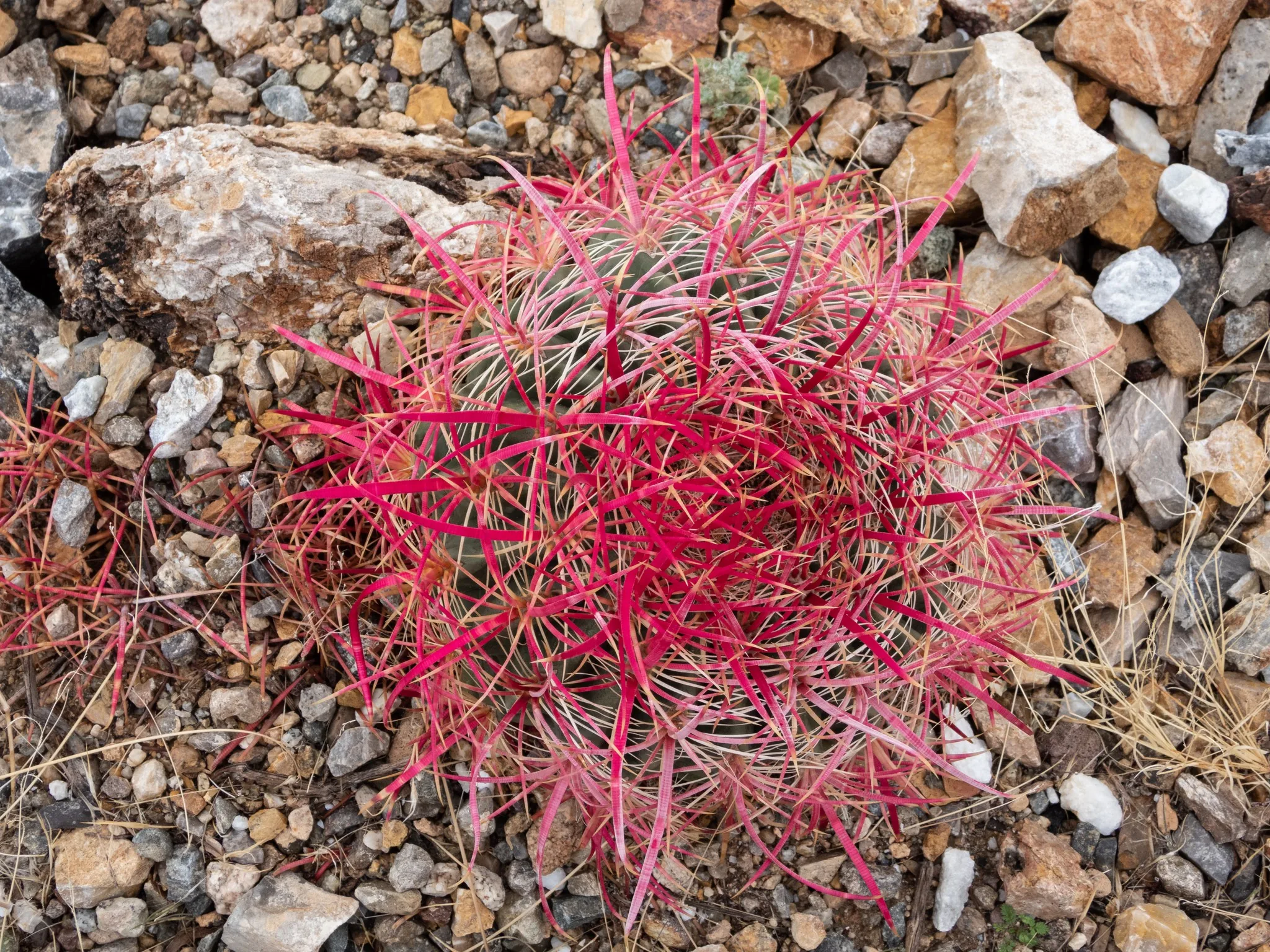
Ferocactus cylindraceus (Engelm.) Orcutt is the dominant barrel cactus of the Mojave and Sonoran deserts, the species most visitors see when they walk the trails at Joshua Tree National Park, Anza-Borrego Desert State Park, or Mojave National Preserve. Stems grow to 3 m tall and 50 cm wide, clothed in 18 to 31 prominent ribs and a dense armour of spines that run from vivid crimson on new growth to buff-grey in age. The plant tolerates elevations from 60 m near the Colorado River corridor to 1,500 m at its upper distributional limit in southern California, and ranges from there northeast into Nevada and far southwest Utah, east through low-elevation Arizona, and south through Baja California into Sonora.
It is called the compass barrel, and the miner’s compass, because popular tradition holds that older plants lean to the south or southwest, making the apex a navigational reference in open desert. That reputation deserves scrutiny: population surveys of F. cylindraceus in the Borrego Desert measured no statistically significant lean in plants at Rainbow Canyon Wash. The archetypical reliably-leaning barrel is Ferocactus wislizeni of Arizona, not cylindraceus. The name traveled west with Anglo settlers and attached to this species by geographic familiarity, not by consistent botanical observation. Some aged cylindraceus do lean, driven by the same differential-growth mechanism as wislizeni; others remain strictly vertical for their entire lifespan. The FAQ below addresses this in detail.
For most of its California range, F. cylindraceus grows without the company of other large barrel cacti; the great columnar bulk of a multi-decade plant rising from a creosote-bush flat, surrounded by white bursage and Joshua trees, is an unshared visual signature. In central and western Arizona the picture changes: overlap with Ferocactus hamatacanthus occurs in collector contexts rather than in the wild, and comparison with F. wislizeni and F. emoryi is necessary for in-situ Arizona identifications.
The species is protected across its US range. Removal from public land is prohibited. In California and Arizona it carries a salvage-restricted designation, meaning removal from private land requires a state permit. International trade is covered by the Cactaceae family-wide CITES Appendix II listing regardless of propagation method. There is no federal Endangered Species Act listing; wild populations across the Mojave and Sonoran deserts remain wide-ranging and substantial.
Ferocactus cylindraceus quick reference
A sun-demanding desert barrel from open gravelly Mojave and Sonoran slopes, growing on decomposed granite bajadas between 60 and 1,500 m elevation. Values calibrated for seed grown plants in cultivation, drawn from habitat data and specialist grower experience.
Taxonomy & nomenclature
The name used on this page is Ferocactus cylindraceus (Engelm.) Orcutt, following Flora of North America, ITIS, the USDA PLANTS Database, iNaturalist, and the US Fish and Wildlife Service. These are the authoritative sources for North American vascular plants, and they treat cylindraceus as the accepted species name. Kew POWO currently disagrees: it follows Govaerts (2001) in sinking F. cylindraceus as a synonym of Ferocactus acanthodes (Lem.) Britton & Rose, with three subspecies under that umbrella. POWO currently sinks F. cylindraceus under F. acanthodes; FNA, ITIS, and US Fish & Wildlife retain F. cylindraceus as the accepted name. We follow FNA on US-range species.
The nomenclatural dispute traces to George Lindsay’s 1955 doctoral thesis (published 1996), which neotypified Echinocactus acanthodes Lem. with the holotype of Echinocactus cylindraceus Engelm., making the two names nomenclaturally equivalent. Since E. acanthodes Lem. (1839) predates E. viridescens var. cylindraceus Engelm. (1852) by thirteen years, strict priority rules would require the epithet acanthodes. POWO follows that argument. FNA explicitly notes the synonymy but retains cylindraceus as the working name because the varieties proposed by Benson (1982) are “not consistently distinguishable” and the species is deeply entrenched in North American botanical literature under cylindraceus. This is not a settled matter; different databases will show different accepted names for the foreseeable future.
The basionym is Echinocactus viridescens var. cylindraceus Engelm., Amer. J. Sci. Arts, ser. 2, 14: 338 (1852). Engelmann later elevated it to Echinocactus cylindraceus in the Pacific Railroad Report (1857 [1856]). Charles Russell Orcutt transferred it to Ferocactus as F. cylindraceus in Cactography 5 (1926).
Infraspecific taxonomy adds another layer of disagreement. FNA treats the species as a single highly variable entity with no formally recognised infraspecific taxa. ITIS and the US Fish and Wildlife Service recognise three subspecies: the nominal subsp. cylindraceus of southeastern California, southwestern Arizona, and Baja California; subsp. lecontei (Engelm.) N.P.Taylor, Leconte’s barrel, which tends toward robust reddish spines and extends through central Arizona into southern Nevada and Utah; and subsp. tortulispinus (H.E.Gates) N.P.Taylor, Baja California plants with prominently twisted golden spines up to 20 cm long. A fourth entity, var. eastwoodiae L.D.Benson, the cliff barrel of coastal southern California bluffs, is recognised by NatureServe with a separate Global Element ID but not by FNA. POWO distributes the same biological variation differently, recognising three subspecies under F. acanthodes: subsp. acanthodes, subsp. lecontei, and subsp. eastwoodiae. No single treatment commands universal adoption.
Historical synonym (1)
- Ferocactus cylindraceus var. cylindraceus , homotypic synonym
Sources: POWO (Kew) · IPNI · GBIF · Wikidata
Habitat
Ferocactus cylindraceus grows on gravelly and rocky terrain across an unusually wide elevational band. Primary substrates are decomposed granite bajadas and alluvial fans below rocky mountain ranges, volcanic gravelly slopes, canyon walls, and cliff bases. The species avoids heavy clay soils and any ground that holds water. Plant communities hosting cylindraceus include Creosote bush scrub (Larrea tridentata) and white bursage (Ambrosia dumosa) at the hottest lower elevations, Joshua tree woodland (Yucca brevifolia) at middle elevations through much of southern California, palo verde and ironwood-saguaro associations at low Arizona elevations, and interior chaparral fringe (manzanita, scrub oak) in the western parts of the range particularly for the cliff-dwelling eastwoodiae form.
Root architecture is shallow: the lateral root system extends to 8–15 cm depth but reaches a total combined length of roughly 182 m (600 feet) for a large mature plant. Roots account for only about 14% of total dry weight, leaving the stem as the dominant storage organ. That shallow, wide-spreading system allows the plant to uptake soil moisture within 24 hours of rainfall, exploiting even small precipitation events that would not penetrate to deeper root zones.
Growth rates diverge sharply by geography. California plants, growing under a single winter-spring rainy season, average 0.5 to 2.0 cm of height gain per year. Arizona plants, which receive both a winter and a monsoon pulse, grow roughly 3.3 cm per year. The tallest documented specimen, in the Borrego Desert, stood 3.15 m. California plants with a single rainy season may live substantially longer than Arizona counterparts; some 10-foot specimens are estimated at 170 years old, though direct lifespan verification for the species is not available. Primary mortality causes are mechanical toppling when height-to-diameter ratio becomes unstable, bighorn sheep herbivory, and small mammal herbivory. Plants can shed up to 81% of their water content without dying, the stem parenchyma contracting and then rehydrating after rain.
Seedling recruitment is tightly coupled to rainfall anomalies. Most successful establishment cohorts coincide with El Niño years that deliver above-average winter precipitation. Nurse plants are essential to seedling survival: Ambrosia dumosa, Ephedra aspera, and Hilaria rigida (big galleta grass) shelter germinating seeds from lethal summer temperatures and desiccation. Grand Canyon population studies showed that feral burro grazing before 1981 eliminated nurse plants and blocked recruitment entirely; ungrazed sites maintained demographic equilibrium. Seedlings die below approximately -9°C (18°F), setting a lower latitude and elevation limit on the species.
For most of its California range, F. cylindraceus is the only large barrel cactus in the plant community, a biogeographic convenience for identification. Overlap with other large Ferocactus species occurs mainly in central and western Arizona, where F. wislizeni and F. emoryi share parts of the range; field identification there requires close attention to rib and spine characters. Neither of those species is covered on this site, but F. wislizeni is the species most commonly confused with cylindraceus in the field and in popular literature.
Morphology
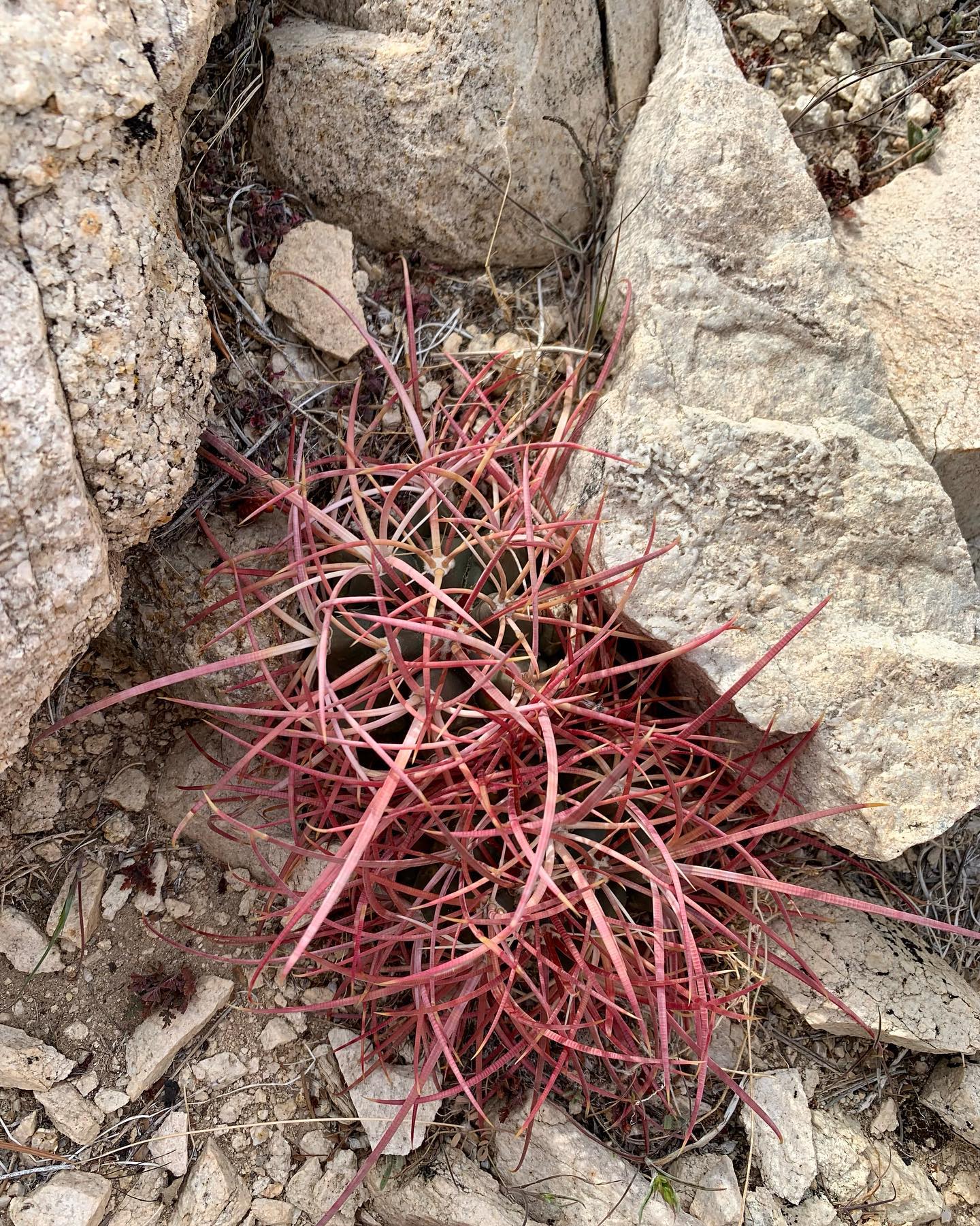
Ferocactus cylindraceus begins its life as a ribbed globe and matures into a cylinder: that shape change, from squat hemisphere to upright column, is itself a useful field-ageing tool. Mature plants typically stand 45 to 150 cm tall and 25 to 40 cm in diameter, with extreme dimensions recorded at 300 cm tall and 50 cm wide. The plant is almost always solitary; branching or clumping is unusual. The stem surface is green but rarely visible; dense spination covers the ribs completely in mature specimens.
Rib count rises as the plant ages. Very young plants show only 5 to 8 ribs; mature specimens carry (18–)21–31 ribs, with approximately half of measured wild plants falling on Fibonacci numbers (5, 8, 13, 21). Each rib is notched immediately above the areole, which bears elongated tomentum of tan or brownish wool. Spine counts range from 12 to 32 per areole across sources; typically 4 central spines and 8 to 28 radials.
The principal central spine is the most watched character for identification purposes. FNA describes it as “one or more curved or slightly twisted, sometimes hooked.” Southwest Desert Flora is more precise: the hook is present but is “hooked only on immature specimens” in adults. This matters when comparing the species to Ferocactus hamatacanthus, which carries a permanently and strongly hooked central spine in adults. The principal central spine reaches up to 12.7 cm on large plants, with tiny ridges visible under close inspection.
Spine colour is variable and diagnostically useful at the subspecies level. New spines emerge pink, crimson, red, or yellow depending on the population; they age to whitish, yellow-grey, or buff over years. FNA gives “whitish, yellow, pink, dull red, or brown.” Plants referable to subsp. lecontei trend toward robust reddish spines; tortulispinus populations show golden, prominently twisted spines up to 20 cm long.
Flowers are funnel-shaped, 3 to 6 cm long and 4 to 6 cm in diameter, borne in a ring near the apex on current-season growth. The exterior is maroon or reddish; the interior is bright yellow, sometimes yellow-orange, with perianth segments showing a red midstripe. The primary bloom period runs April through June, though some populations extend flowering into midsummer. Plants begin flowering when their diameter reaches approximately 15 to 18 cm; from seed in cultivation, this requires roughly 10 years. The primary pollinator is Diadasia rinconis, a cactus-specialist bee responsible for approximately 99% of successful pollination in related Ferocactus populations studied; European honeybees are ineffective pollinators for this species. The flower-eating caterpillar Pseudoschinia elautalis destroys 23 to 29% of flowers and buds in some populations.
Fruit is bright yellow, occasionally reddish, 2.5 to 5 cm long, fleshy when fresh and deeply hollow except for the seed mass. The exterior is scaly; the fruit opens on drying. Seeds are black, numerous, and poppy-seed-sized. The fruit is not fleshy or edible in the way some other barrel-cactus fruits are; this character separates cylindraceus from F. hamatacanthus, whose fruit is juicy and eaten fresh. Indigenous peoples across the range ate the flowers, seeds, and stem pulp of cylindraceus, and fashioned large stems into cooking vessels and spines into needles.
Locality detail
Ferocactus cylindraceus occupies a cross-state range that spans five US states and two Mexican states. In California it holds the entire southeastern desert region, from the Colorado Desert at the lowest and hottest elevations through the Mojave Desert and into the interior. It is the characteristic barrel of every major California desert protected area: Anza-Borrego, Joshua Tree, Mojave National Preserve, and the lower reaches of Death Valley all support strong populations.
Northeast of California the range continues into southern Nevada along the Colorado River drainage, and into far southwestern Utah near the latitude of St. George, approximately 37°N, the northern distributional limit of the species. In Arizona the range is concentrated in low-elevation western portions, particularly the Colorado River corridor; the eastern Arizona boundary is less clear and coincides with the ranges of F. wislizeni and F. emoryi. South of the border, the species continues through Baja California Norte and into Sonora, though the Sonoran boundary with F. emoryi should be treated with caution.
The type locality is the southern San Felipe Hills near San Felipe, San Diego County, California, near the Baja California border. This is a non-sensitive species with wide distribution; the map above uses regional population centroids to represent the major protected-area concentrations rather than precise site coordinates.
Ferocactus cylindraceus care and cultivation
Ferocactus cylindraceus has a longer cultivation history in California and Arizona nurseries than most Mexican Ferocactus, so grower experience is comparatively robust. The species is not difficult once its core needs are met: full sun, extreme drainage, and a reliable winter dry rest. Where it fails in cultivation, the cause is almost always root rot from overwatering or winter cold combined with wet substrate.
Substrate
Wild plants grow in decomposed granite, gravelly sandy slopes, and rocky well-drained soils from the Mojave and Sonoran Deserts into Baja California, across both granitic and limestone terrain. The cultivation substrate must replicate extreme drainage; a waterlogged mix is the primary failure mode. The canonical ratio is 40 per cent pumice, 15 per cent lava rock, 5 per cent zeolite, 30 per cent granite grit, 5 per cent limestone chip, and 5 per cent worm castings. The granite fraction is house convention rather than a copy of the bajada habitat; the limestone chip sits at 5 per cent as house convention too, not a species requirement, and no source establishes the species as a calcicole or a calcifuge. Hard tap water already supplies calcium and bicarbonate at every watering; rainwater and RO water supply neither. The zeolite paces nutrients between waterings; native soils run from pH 6.0 to 7.5, a habitat figure rather than a pot-mix target. No peat, no standard potting mix.
All four Ferocactus species on this site share the genus 90/10 mineral-organic baseline, and the limestone share in every row is house convention rather than a species requirement. Granite weight shifts between species; the glaucescens and hamatacanthus rows match each other closely.
| Species | Pumice | Lava | Zeolite | Granite | Limestone | Silica | Organic |
|---|---|---|---|---|---|---|---|
| F. viridescens | 40% | 15% | 5% | 30% | 0% | 0% | 10% |
| F. cylindraceus (this page) | 40% | 15% | 5% | 30% | 5% | 0% | 5% |
| F. glaucescens | 35% | 15% | 5% | 25% | 15% | 0% | 5% |
| F. hamatacanthus | 35% | 15% | 5% | 25% | 15% | 0% | 5% |
Container choice can be standard terracotta given this species’s tolerance for fast drying between waterings. Roots spread laterally rather than deeply, so medium-depth containers are more useful than tall narrow ones. A wide, medium-depth pot with reliable drainage holes is the standard recommendation. Repot only when root-bound, as the species is sensitive to root disturbance.
Watering and light
Full sun is non-negotiable. Six to eight hours of direct sunlight per day is the minimum for healthy growth and eventual flowering; under insufficient light the plant grows even more slowly than its already-slow pace and may never flower in cultivation. Unlike some Mexican cacti with cliff-face or understory niches, cylindraceus is an exposed-bajada plant that evolved under intense desert sunlight.
Spring through summer: water thoroughly every 2 to 3 weeks, allowing the substrate to dry completely between waterings. Some Nevada growers report satisfactory results with as little as a sprinkle every two weeks during hot summers, demonstrating that the species is forgiving of modest reductions. Reduce watering through autumn. During the winter rest, water once every 6 to 8 weeks if temperatures are above 10°C; keep completely dry when cold. First-year seedlings need more frequent moisture and should not be allowed to desiccate.
Cold hardiness is a topic with two different answer levels. The standard cultivation figure is -7°C (20°F) for a short period when bone-dry; the USDA zone 9a baseline. At the other extreme, Dave’s Garden grower reports document zone-7b survival (approximately -12°C) for established adult plants grown against south-facing walls with gravel mulch in Salt Lake City. That figure applies to fully dry, large, thermally protected specimens and should not be taken as a general growing guide. Seedlings are far less cold-tolerant; population ecology data places the seedling cold floor at approximately -9°C (18°F). For cultivation planning, the -7°C widget value is the practical working minimum; anything colder requires verified winter-dry conditions and established root systems.
Propagation is almost entirely by seed. The species is predominantly solitary, and offsets are rare. Seeds germinate best at 29°C (84°F) with warm summer moisture, typically within 5 to 6 weeks under suitable conditions. The growth timeline from seed to flowering size is roughly 10 years to reach the 15 to 18 cm diameter threshold at which plants first bloom. In-ground Arizona conditions at 3.3 cm per year produce a flowering-size plant in around 5 to 6 years; California container culture at 0.5 to 2.0 cm per year extends that to a decade or more. A dilute low-nitrogen cactus fertilizer applied once or twice during the growing season is sufficient; do not fertilize during dormancy.
Comparison
In the wild, Ferocactus cylindraceus is visually distinctive within its California range because it shares that range with no other large barrel cactus. The identification challenges arise at the edges of the range. In Arizona, plants must be compared against F. wislizeni (fish hook barrel) and F. emoryi (Emory’s barrel), neither of which is covered on this site. In collections worldwide, the most practically important comparison is with Ferocactus hamatacanthus, the Turk’s head or Texas barrel; both species share the curved or hooked central spine character, and both appear regularly in specialist nurseries.
The comparison with Ferocactus viridescens, the San Diego coast barrel, is rarely urgent in practice: viridescens is a compact coastal globose that rarely exceeds 30 to 45 cm tall and grows exclusively in the coastal fog belt of San Diego County and northern Baja California. Size alone resolves most encounters; a plant taller than 50 cm is not viridescens. The two species were confused more often historically than by current collectors, largely because the original Engelmann description of the type locality was imprecise and overlapping geographic ranges were assumed before precise distribution records were available.
The comparison with Ferocactus glaucescens, the Mexican blue barrel, is even less problematic. Glaucescens has a strongly blue-green glaucous body and pale yellow spines that make it immediately distinct from any cylindraceus population, which always presents green-bodied stems under a spine cover that runs pink-red to buff-grey. The two species are geographically non-overlapping in the wild: glaucescens is a Hidalgo limestone endemic; cylindraceus is a Mojave-Sonoran desert plant. Confusion between them in collections is rare.
Frequently asked questions
How do you tell Ferocactus cylindraceus apart from Ferocactus hamatacanthus?
Both Ferocactus cylindraceus and Ferocactus hamatacanthus carry a prominently curved or hooked central spine on younger plants, which is the main driver of confusion between them in specialist nurseries and mixed collections. In the wild they do not overlap: cylindraceus is a Mojave and Sonoran Desert plant; hamatacanthus is a Chihuahuan Desert species of Texas, New Mexico, and northern Mexico. But both appear in collections worldwide, and the hook character requires qualification: in hamatacanthus the hook is permanent and strongly pronounced in adults; in cylindraceus the hook is most obvious on juveniles and typically becomes a curve rather than a sharp hook on large adults. Rib count is the fastest reliable in-hand check. Drag the slider to compare both plants, then use the table.

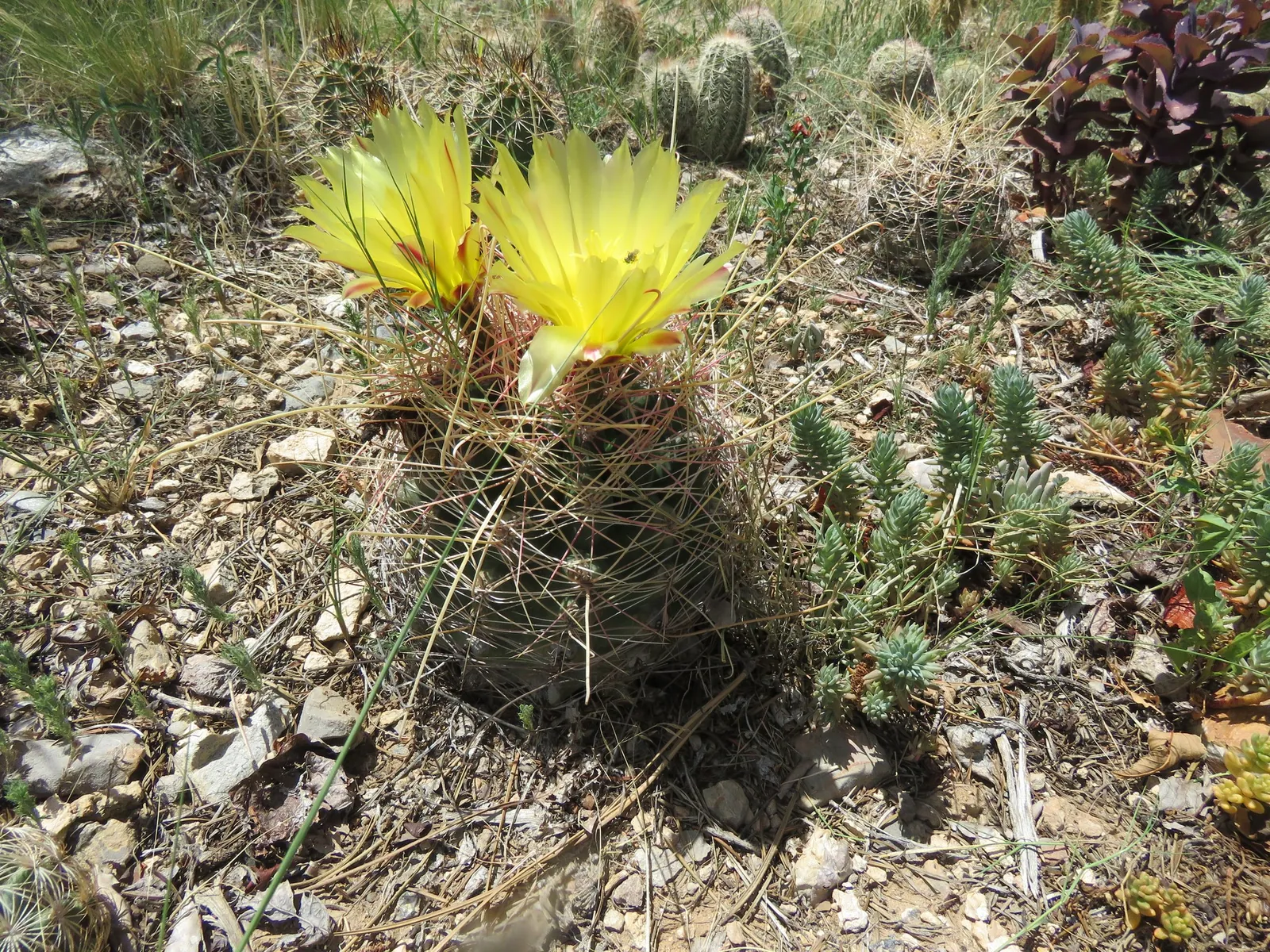
Rib count is the fastest check: 18 or more ribs points to cylindraceus; 13 to 17 points to hamatacanthus. When the plant is small and rib count is still settling, check the central spine in adults: a permanently sharp hook means hamatacanthus. If fruit is present, edibility is definitive: hamatacanthus produces juicy, kiwi-flavoured fruit; cylindraceus fruit is hollow and inedible.
Is the California barrel cactus easy or difficult to grow?
Intermediate. The species has been grown successfully by collectors across the American Southwest, California, and in European greenhouse collections for decades. Its core needs are consistent: a minimum of 6 to 8 hours of direct sunlight, extreme substrate drainage, and a reliable winter dry rest. Where it fails, the cause is almost always overwatering or cold combined with wet substrate. Growth from seed is very slow; expect roughly 10 years to reach flowering size from germination. In-ground conditions in Arizona or the Southwest produce faster results than container culture. For collectors with full-sun outdoor space in a dry climate, this is an accessible and rewarding species; for those without adequate sunlight or winter-dry conditions, it struggles.
How long until a barrel cactus flowers from seed?
Plants begin flowering when their stem diameter reaches approximately 15 to 18 cm. The time to reach that diameter depends heavily on growing conditions. Arizona plants in the ground under two rainy seasons grow roughly 3.3 cm per year and can reach flowering size in 5 to 6 years. California container plants growing at 0.5 to 2.0 cm per year require a decade or more. Seeds germinate best at 29°C (84°F) with warm moisture and typically sprout within 5 to 6 weeks. The primary bloom period runs April through June; plants occasionally extend flowering into midsummer in some populations.
Is it legal to collect or move a barrel cactus in California or Arizona?
Ferocactus cylindraceus is protected across its entire US range. Removal from any public land (national parks, monuments, BLM land, state parks) is prohibited without a federal or state permit; penalties are significant. In both California and Arizona the species carries a salvage-restricted designation, meaning that even removal from private land requires a state salvage permit. International trade (including bringing plants into or out of the US) is covered by the Cactaceae family-level CITES Appendix II listing and requires CITES documentation regardless of whether plants are wild-collected or nursery-propagated. There is no current US Endangered Species Act listing. The practical summary: do not move, collect, or transport this species without verifying applicable state and federal permit requirements first.
Why do some barrel cacti lean south, and does the compass story hold for Ferocactus cylindraceus?
The lean is real, but its association with Ferocactus cylindraceus is contested. The mechanism is differential growth: the shaded north-facing side of the stem elongates faster than the sun-exposed south-facing side, pushing the apex toward the sun over decades. This maximises solar radiation on the growing tip and reproductive zone. The lean is well-documented and reliable in Ferocactus wislizeni of Arizona, which is the original “compass barrel” of botanical literature. For F. cylindraceus, empirical surveys in the Borrego Desert measured no statistically significant lean in plants at Rainbow Canyon Wash; Southwest Desert Flora states explicitly that the species “does not lean southward.” Other sources, including Wikipedia and numerous popular accounts, describe aged cylindraceus specimens leaning toward the southwest. The most defensible summary: the lean is an inconsistent feature of this species, present in some populations and absent in others, and should not be relied upon as a navigational tool. The name “compass barrel” traveled from F. wislizeni to F. cylindraceus by geographic familiarity, not by consistent observation.
Where does the compass barrel cactus grow in the wild?
The Mojave and Sonoran deserts of the southwestern United States and adjacent Mexico. In the US, the range covers the entire southeastern California desert region, southern Nevada, far southwestern Utah, and low-elevation western Arizona along the Colorado River corridor. South of the US border, the species continues through Baja California Norte and into Sonora, Mexico. Major protected populations exist in Joshua Tree National Park, Anza-Borrego Desert State Park, Mojave National Preserve, Death Valley National Park (lower elevations), and the Santa Rosa and San Jacinto Mountains National Monument. Plants occupy gravelly rocky slopes, decomposed granite bajadas, canyon walls, and sandy desert flats with substrate structure, from 60 m near the Colorado River to 1,500 m at the upper elevational limit. The characteristic plant communities are Creosote bush scrub and Joshua tree woodland.
Sources & further reading
Engelmann, G. (1852). Echinocactus viridescens var. cylindraceus. Amer. J. Sci. Arts, ser. 2, 14: 338 · Orcutt, C.R. (1926). Ferocactus cylindraceus (Engelm.) Orcutt. Cactography 5 · Kew POWO, Ferocactus acanthodes (Lem.) Britton & Rose (POWO-accepted name, treating cylindraceus as synonym); and Ferocactus cylindraceus IPNI lsid urn:lsid:ipni.org:names:103619-2 · Flora of North America (FNA), Ferocactus cylindraceus treatment (Benson 1982 varieties noted but not formally recognised; Lindsay 1996 neotypification discussed) · Southwest Desert Flora, Ferocactus cylindraceus, California Barrel Cactus. southwestdesertflora.com · Tchester.org (Tom Chester), Plant Species of the Borrego Desert: Ferocactus cylindraceus. Detailed ecological fact sheet; cites Jordan & Nobel (1981, 1982), Bowers et al. (1995), Robberecht & Nobel (1982) · AmericanSouthwest.net, Ferocactus cylindraceus, California barrel cactus. americansouthwest.net · Anderson, E.F. (2001). The Cactus Family. Timber Press, Portland. pp. 339–340 · US Fish and Wildlife Service, Ferocactus cylindraceus species profile; and Ferocactus cylindraceus ssp. tortulispinus profile. fws.gov · ITIS (Integrated Taxonomic Information System), Ferocactus cylindraceus accepted-name treatment with subspecies cylindraceus, lecontei, tortulispinus · NatureServe Explorer, Ferocactus cylindraceus var. eastwoodiae, Global Element ID ELEMENT_GLOBAL.2.133577; publication: Bradleya 2: 19 (1984) · Bowers, J.E. (1997). Demographic patterns of Ferocactus cylindraceus in relation to substrate age and grazing history. Plant Ecology 133(1): 37–48. DOI: 10.1023/A:1009767621391 · McIntosh, M.E. (2005). Pollination of two species of Ferocactus: interactions between cactus-specialist bees and their host plants. Functional Ecology 19: 1–10. DOI: 10.1111/j.1365-2435.2005.00990.x · Wikispecies, Ferocactus cylindraceus / F. acanthodes; basionym chain, POWO synonymy note, infraspecific treatments · Plantiary.com, California Barrel Cactus Care Guide, Ferocactus cylindraceus · Dave’s Garden Plant Files, Ferocactus cylindraceus; grower cold-hardiness reports including zone-7b Salt Lake City data · Lindsay, G. (1996). The Genus Ferocactus: Systematics and Biogeography. Tireless Termite Press, San Diego. (Lindsay’s 1955 doctoral thesis; neotypification of Echinocactus acanthodes) · AmericanSouthwest.net, Ferocactus hamatacanthus; Q1 comparator cross-check (fruit character, spine flexibility)