
Gymnocalycium mihanovichii
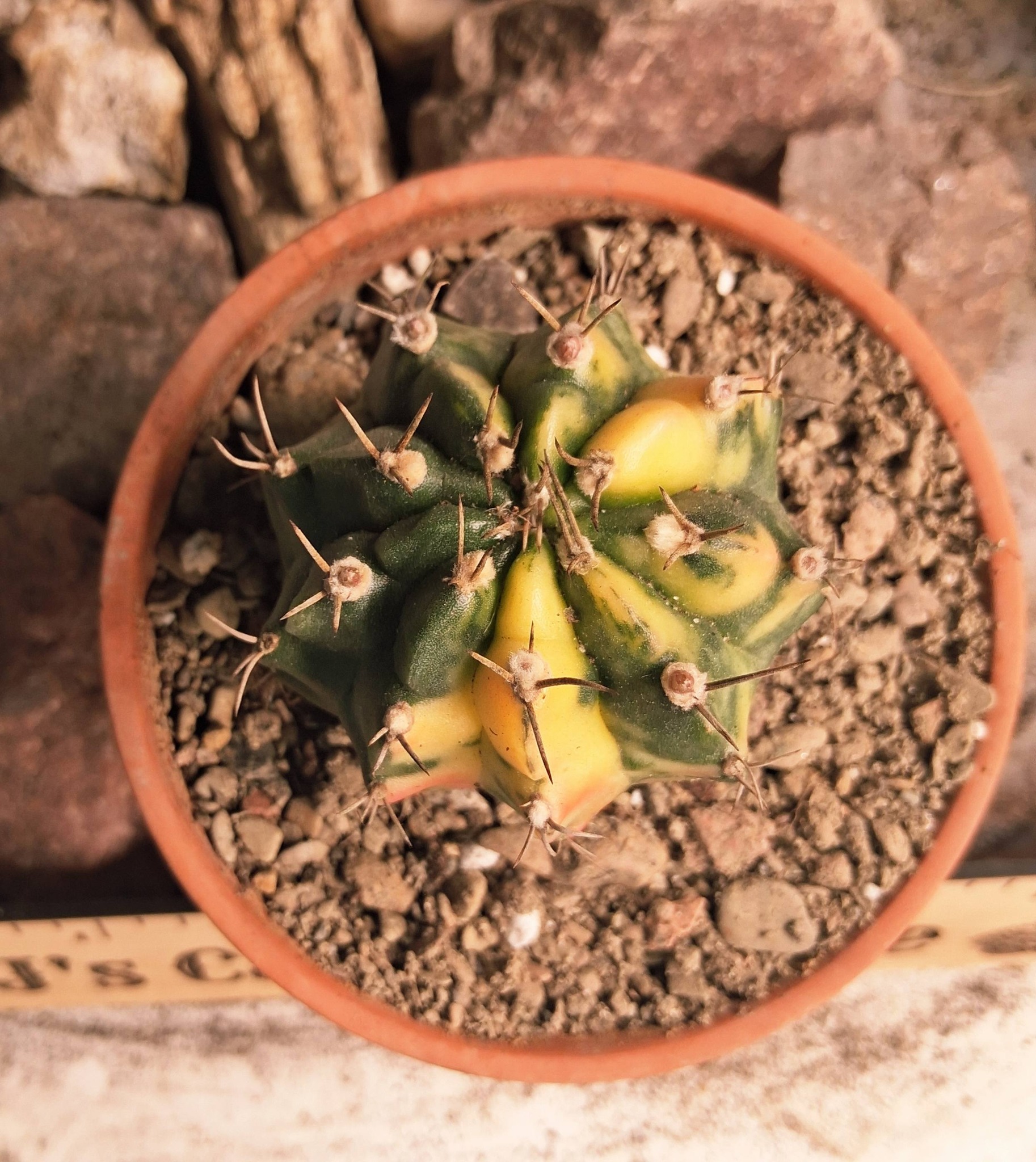
Gymnocalycium mihanovichii is the Paraguayan cactus behind the global moon cactus phenomenon, yet the wild type that spawned the entire Hibotan cultivar industry is a modest, low-growing plant: flat-globose, rarely exceeding 6 cm across, with smooth grey-green skin marked by distinctive horizontal banding across each rib. Alberto Vojtěch Frič collected the type material in Paraguay during his 1903 expedition, and the species was first described as Echinocactus mihanovichii by Frič and Gürke in 1905, honouring Nikola Mihanović (1846–1929), the Croatian-Argentinian shipping magnate who bankrolled Frič’s Paraguayan travels. The transfer to Gymnocalycium was made by Britton and Rose in their 1922 Cactaceae monograph.
Gymnocalycium mihanovichii is the type species of subgenus Muscosemineum, a clade confirmed as monophyletic by Demaio et al. (2011) using plastid DNA. Its native range is confined to Argentina (Chaco and Formosa provinces) and Paraguay (Boquerón and Alto Paraguay departments), across the Gran Chaco dry thorn forest. Secondary horticultural sources occasionally list eastern Bolivia, but this reflects confusion with Gymnocalycium stenopleurum, whose POWO-confirmed range extends into southeastern Bolivia; Bolivia does not appear in the accepted native range for this species. Within the genus, its closest relatives in terms of Chaco distribution are G. stenopleurum to the north and Gymnocalycium horstii, which occurs much further south in subtropical Brazilian highlands.
The Hibotan chapter is brief but worth knowing for context. In 1937, Japanese nurseryman Eiji Watanabe imported 300 seeds of G. mihanovichii var. friedrichii from a German source. From the 1940 seedling crop of roughly 10,000 plants, two reddish mutants were identified as chlorophyll-deficient. Watanabe propagated these by grafting and released the fully red ‘Hibotan’ cultivar commercially in 1948. Full cultivar treatment belongs on the G. mihanovichii f. rubra page; the yellowed and sectored forms are covered under G. mihanovichii f. variegata. The wild-type species discussed here is fully chlorophyllous and grows without grafting.
In cultivation the wild type is less demanding than its commercial offspring. It is a summer grower, wants generous water during the growing season, tolerates partial shade, and asks only for a dry, cool winter rest. The species flowers early, often at 2–3 cm diameter, producing semi-closed pale yellowish flowers that are small and discreet compared to the gaudy grafted cultivars. This is a plant that rewards patience: seed grown specimens develop the characteristic banded-rib coloration and spine character that grafted nursery stock never settles into.
Gymnocalycium mihanovichii quick reference
A flat-globose Gymnocalycium from the Gran Chaco dry thorn forest of Paraguay and northeastern Argentina, growing at low elevation under partial shrub shade in alluvial sandy-clay soils with a strong summer-rain regime. Values calibrated for seed grown plants in cultivation, drawn from habitat ecology and specialist grower experience.
Taxonomy & nomenclature
The basionym Echinocactus mihanovichii was published by Alberto Frič and Max Gürke in Monatsschrift für Kakteenkunde 15: 142 in 1905. Nathaniel Lord Britton and Joseph Nelson Rose transferred it to Gymnocalycium in Cactaceae 3: 153, fig. 159, published 12 October 1922 (IPNI LSID: urn:lsid:ipni.org:names:115434-2). POWO accepts two synonyms under the current species name: the basionym Echinocactus mihanovichii and Gymnocalycium mihanovichii var. filadelfiense Backeb. (published in Kakteenlex.: 170, 1966; heterotypic, not accepted).
Gymnocalycium mihanovichii is the type species of subgenus Muscosemineum Schütz (1968). The molecular phylogeny of Demaio, Barfuss, Kiesling, Till and Chiapella (2011) confirmed subgenus Muscosemineum as monophyletic with high statistical support using plastid DNA, Bayesian inference, and maximum parsimony analyses. Seed characters define the subgenus: globular, approximately 1 mm, light brown dull testa, small hilum, inconspicuous arillus. The tribal placement of Gymnocalycium was revised by Romeiro-Brito, Taylor, Zappi and colleagues (2023) in a target enrichment sequencing study published in Annals of Botany 132(5): 989–1006, which formally established the new subtribe Gymnocalyciinae within tribe Cereeae. This placement was confirmed independently by de Vos et al. (2025) in a phylogenomics analysis of hundreds of nuclear genes (Plant Systematics and Evolution). Older literature (and GBIF, which lags the published phylogenetics) places Gymnocalycium in Trichocereeae; the Cereeae / Gymnocalyciinae classification supersedes this.
The nomenclatural history of var. friedrichii merits careful attention because it generated substantial collector confusion. POWO treats Gymnocalycium mihanovichii var. friedrichii Werderm. as a heterotypic synonym of Gymnocalycium stenopleurum F.Ritter, a geographically distinct northern Paraguayan taxon now accepted as a separate species. World Flora Online inverts this: it treats G. stenopleurum as a synonym of Gymnocalycium friedrichii (Werderm.) Pažout. This is a live authority disagreement with no consensus resolution at time of writing; this page follows POWO. The collector literature (llifle, cactus-art.biz, CactiGuide) historically treated friedrichii as a variety or form of G. mihanovichii, an arrangement that is outdated under both POWO and WFO treatments. Graham Charles (Gymnocalycium in Habitat and Culture, 2009) took a more conservative view, treating var. stenogonum as synonymous with the type species, which compresses the complex further. Plants sold in the trade as ‘var. friedrichii’ or ‘G. friedrichii’ are best treated as G. stenopleurum material pending a revised monograph.
Historical synonyms (4)
- Echinocactus mihanovichii Fric & Gürke, 1905 basionym
- Gymnocalycium mihanovichii var. filadelfiense Backeb., 1966 homotypic synonym
- Gymnocalycium mihanovichii f. nigrum Y.Itô, 1981 homotypic synonym
- Gymnocalycium mihanovichii subsp. albiflorum Pazout, homotypic synonym
Sources: POWO (Kew) · IPNI · GBIF · Wikidata
Habitat
Gymnocalycium mihanovichii grows in the Gran Chaco of western Paraguay and northeastern Argentina, an extensive flat-to-gently-undulating alluvial plain built from Andean sediment over millennia. The species’ native range sits in the Chaco Boreal of Paraguay (Boquerón and Alto Paraguay departments) and the Chaco Austral extending into Formosa and Chaco provinces of Argentina. This is not a rocky-outcrop or highland species; the Chaco is sedimentary alluvial plain, and the substrate is sandy to clay alluvial soil, flat and deep, unlike the granite or limestone substrates typical of many other rare Gymnocalycium.
Plants grow in the understory of dry thorn forest and gallery forest along the Paraguay River corridor, under the canopy of quebracho blanco (Aspidosperma quebracho-blanco), quebracho colorado (Schinopsis spp.), and algarrobo (Neltuma / Prosopis spp.). Individual plants typically occupy the forest floor under shrubs or grasses, receiving direct sunlight only during certain parts of the day; some populations described in specialist literature are in shade for most of the year. This partial-shade microhabitat is the basis for the species’ tolerance of lower light conditions in cultivation compared to exposed hillside cacti.
Climate at the core range (Paraguay River corridor, Boquerón and Alto Paraguay departments) is hot and strongly seasonal. Annual rainfall is 700–900 mm, concentrated in the austral summer (October–March). Summer temperatures regularly exceed 40°C; winters are cool with occasional light frosts at low elevation. Elevation across the range is low: 89 m at Puerto Casado, 150–225 m at Filadelfia and the Argentine Chaco sites. The strong summer-wet, winter-dry seasonality directly informs the cultivation watering rhythm: heavy summer irrigation followed by a completely dry winter rest.
Morphology
The body is flat-globose, broader than tall. A mature specimen reaches approximately 4 cm tall by 5–6 cm diameter; some sources report slightly wider plants under cultivation conditions, but 4–6 cm across is the consistent field figure for the type. Color is grey-green to bluish-grey; plants exposed to stronger light develop a bronzed or brownish-purple cast. The defining visual character is the transverse cross-banding on the ribs: each rib carries alternating darker and lighter horizontal marks running across its face, particularly conspicuous in juveniles and less pronounced as the body matures. This banding pattern is absent in G. stenopleurum and distinguishes G. mihanovichii at a glance from other Paraguayan Gymnocalycium.
Ribs number eight in nearly all plants; all consistent sources agree on this count. The ribs are narrow-edged and slightly notched, lower and wider than in many Gymnocalycium species. Each areole sits above the genus’s characteristic ‘chin’: a small rounded tubercular projection below the areole that is the defining morphological signature of Gymnocalycium (the genus name means ‘naked calyx’, referring to the absence of hairs or scales on the flower tube). Areoles carry grey-white felt and are spaced regularly along each rib.
Spines are 5–6 radial per areole, with a very occasional single central spine in some individuals; the absence of central spines is characteristic of the type and is one of the characters used to separate it from related species with stouter armature. Spines are weak and pliable, slightly curved but not hooked, measuring 0.8–1 cm long. Color is greyish-yellow to pale brown with darker bases; older spines are partly deciduous, shedding with age.
Flowers are the second strong identification character. They are pale greenish-yellow to brownish-yellow, 4–5 cm long, and do not fully open: the petals remain semi-closed, giving the flower a silky, half-furled appearance. This semi-closed habit is a reliable separation from G. stenopleurum, whose purplish-pink flowers open wide. Stamens are light green in two rows; style light green with a yellowish stigma. Bloom season in cultivation is late spring to early summer (May–July in the northern hemisphere); in southern hemisphere habitat, October–December. The plant flowers early relative to its body size, often from 2–3 cm diameter. Fruit is spindle-shaped (clavate), up to 4 cm long and 1 cm diameter, grey-green ripening to red, splitting vertically when mature, revealing small black seeds.
Locality detail
The type material was collected by Alberto Frič during his 1903 Paraguayan expedition; the protologue cites the general Paraguayan Chaco without precise coordinates. Field number LB 5481 (Alfred Lau), labelled ‘Puerto Casado (probably Type locality)’, anchors the core type locality to the Puerto Casado area of Alto Paraguay department, on the Paraguay River at approximately 89 m above sea level. Puerto Casado was renamed Puerto La Victoria in 2012. A second major collection locality, LB 2196, places the species southeast of Filadelfia in Boquerón department, at roughly 220–225 m above sea level in drier Chaco interior.
The Argentine populations of var. stenogonum (now absorbed into the type under POWO) extend the range southwest into Formosa and Chaco provinces, with field number P 242 from Toro Alarachii in the southern Argentine Chaco at approximately 150 m. The northern boundary of the range blends into G. stenopleurum territory around Cerro León and northern Alto Paraguay; plants from the transition zone are taxonomically ambiguous and reflect the live authority disagreement between POWO and World Flora Online on which name has priority for the northern taxon. Coordinates published on this page are town and regional centroids; precise GPS is not available from published sources consulted.
Gymnocalycium mihanovichii care and cultivation
Substrate
Gymnocalycium mihanovichii grows in alluvial sandy-to-clay lowland soil under the Gran Chaco thorn-forest canopy in Paraguay. The canonical cultivation ratio is 40 per cent pumice, 15 per cent lava rock, 5 per cent zeolite, 30 per cent granite grit, no limestone, and 10 per cent worm castings. Pumice, lava, zeolite and granite are a declared house formulation: they set the pot’s own drainage speed and cation-exchange capacity, not a claim about the plant. Limestone and organic are the two components this site certifies against evidence, and no published cultivation source ties either figure to Gymnocalycium mihanovichii specifically, or distinguishes it from its genus-mates: limestone stays at zero as the floor of a genus-wide indeterminate carbonate reading, and organic stays at 10 per cent as the ceiling of the Cactaceae family baseline, both house conventions rather than species findings. Growers on hard tap water should switch to rainwater, which carries almost none of the bicarbonate that hard water adds at every watering. Excellent drainage remains the non-negotiable requirement: roots cannot tolerate waterlogging even briefly. Repot every two years; the fine, webby root system does not require large containers.
All five Gymnocalycium species on this site carry the identical substrate vector. Limestone and organic are house-convention values: no cultivation source found in this site’s research ties either figure to one species over another, so the genus publishes a single formulation across all five pages rather than five separate numbers. Growers on hard tap water should use rainwater or soft water instead of adding limestone to the mix.
| Species | Pumice | Lava | Zeolite | Granite | Limestone | Silica | Organic |
|---|---|---|---|---|---|---|---|
| G. buenekeri | 40% | 15% | 5% | 30% | 0% | 0% | 10% |
| G. horstii | 40% | 15% | 5% | 30% | 0% | 0% | 10% |
| G. mihanovichii (this page) | 40% | 15% | 5% | 30% | 0% | 0% | 10% |
| G. mihanovichii f. variegata | 40% | 15% | 5% | 30% | 0% | 0% | 10% |
| G. mihanovichii f. rubra | 40% | 15% | 5% | 30% | 0% | 0% | 10% |
Watering and light
G. mihanovichii is a summer grower adapted to 700–900 mm of annual summer rain. It is more ‘thirsty’ relative to Atacama or Chihuahuan desert species: in hot summer conditions, water every 2–5 days, allowing the substrate to approach dryness but not desiccate. In cooler or lower-light indoor conditions, watering weekly during active growth is appropriate. Begin tapering in September; from November through February (northern hemisphere) keep the substrate completely dry. llifle records frost resistance to −5°C for fully dry dormant plants in USDA zones 9–10 but this figure applies only when soil moisture is zero; wet cold above 0°C will rot the roots.
In habitat the species grows under shrub and grass canopy, receiving full sun only for part of the day. In cultivation, bright indirect light to nearly full sun both produce good results; 4–6 hours of direct light develops the characteristic bronzing and purple tones of the epidermis and slightly denser spine growth. Intense midday sun in hot climates without acclimatisation risks scorching the grey-green body. The species responds to increased light by shifting from grey-green toward brownish-purple, which many growers find attractive as a display character. Grafting is not needed for the wild type; it is only required for the chlorophyll-free G. mihanovichii f. rubra and the partially depigmented G. mihanovichii f. variegata.
Is a moon cactus real or dyed?
The red, pink, yellow and orange forms sold as moon cactus are natural plant pigments, not dye. A normal cactus looks green because chlorophyll masks everything else. The Hibotan mutants make little or no chlorophyll, so the carotenoid and betalain pigments underneath show through as solid color. Scratch the skin and the color runs all the way through the tissue; a dyed plant shows green under the surface. The purple form is the only one that keeps enough chlorophyll to live without grafting.
Moon cactus lifespan and regrafting
A grafted moon cactus is not a long-lived plant. The graft union usually holds for one to three years before the scion and the rootstock, which grow at different rates, separate at the join and the colored top dies back. The rootstock often outlives the top and keeps pushing offsets. To save a fading plant, cut a healthy offset from the colored scion and graft it onto fresh rootstock; a chlorophyll-free scion cannot root and live on its own, so rooting the cutting alone will not work. Sellers who quote a flat two to five years gloss over how much the rootstock match drives the real number.
Color forms: red, pink, yellow
The original moon cactus is the solid red Hibotan, a chlorophyll-free mutant of this species. Nurseries now graft pink, orange and yellow selections from the same mutant line, plus sectored cream-and-green variegates and the rare near-purple form. The two color forms documented on this site each have a dedicated page; the other colors are the same natural mutant pigment expressed at different intensities.
Comparison
The most important comparison on the bench is with Gymnocalycium stenopleurum, the northern Paraguayan taxon that shares the same subgenus, overlapping range, and similar flat-globose body geometry. The distinction matters practically because plants sold in the trade as ‘var. friedrichii’ or ‘G. friedrichii’ belong to G. stenopleurum under current POWO treatment, and conflating the two species conflates meaningfully distinct plants with different cultivation needs and flower characters. Three characters resolve the confusion without specialist tools: run a fingertip across the skin (smooth versus rough), observe the flower (semi-closed pale yellow versus wide-open purplish-pink), and note the rib count (typically 8 in mihanovichii versus 8–14 in stenopleurum).
Within the taxa covered on this site, the two sister forms of this species are the obvious next comparison. Gymnocalycium mihanovichii f. rubra is the chlorophyll-free red Hibotan mutant: it cannot photosynthesize, must be grafted onto a green rootstock to survive, and is instantly recognisable by its uniform red or orange-red coloration. G. mihanovichii f. variegata shows sectored yellow or cream variegation against green tissue; stable clones with sufficient green sectors can grow without grafting but are slower than the wild type. Neither form is likely to be confused with the wild type in hand.
The Brazilian outgroup siblings in the genus are clearly distinct. Gymnocalycium buenekeri from Rio Grande do Sul has a matte dark-green epidermis (versus the smooth, lighter grey-green of mihanovichii), invariably pink flowers, and five ribs rather than eight. It grows on Cretaceous sandstone at a subtropical latitude with year-round rainfall, an entirely different geological and climatic setting from the flat alluvial Chaco. Gymnocalycium horstii, also from southern Brazil, is substantially larger (up to 15–20 cm diameter), with a high-gloss green body and large satiny pink-white flowers: a full size class above mihanovichii and not a realistic source of identification confusion.
Frequently asked questions
Is a moon cactus a real plant or is it dyed?
A moon cactus is a real, living plant, and its color is natural. The colored top is a chlorophyll-free Gymnocalycium mihanovichii mutant; with the green masking pigment gone, the red, pink, orange or yellow pigment underneath shows through. The color runs through the whole tissue, not just the surface, which is how you tell a true mutant from a painted plant. The top cannot photosynthesize, so it is grafted onto a green rootstock that feeds it.
Can you grow a moon cactus from a cutting?
Not from the colored top alone. The bright scion has no chlorophyll, so a cutting taken from it cannot root and feed itself; it will slowly starve. The only way to propagate the colored part is to graft an offset onto a fresh green rootstock such as Hylocereus or a seedling Gymnocalycium. The green rootstock below can be rooted from a cutting in the normal way, but it will grow as a plain green cactus, not a moon cactus.
How do you tell Gymnocalycium mihanovichii apart from Gymnocalycium stenopleurum?
Gymnocalycium stenopleurum is the taxon most likely to cause bench confusion with G. mihanovichii: the two are sympatric at the northern edge of mihanovichii’s range, share the same subgenus and similar flat-globose body form, and the entire ‘var. friedrichii’ synonym pool belongs to stenopleurum under current POWO treatment. Three characters resolve the identification reliably.


Epidermis texture is the fastest single field character: run a fingertip across the body. G. mihanovichii feels smooth; G. stenopleurum feels rough and tuberculate. When a flower is present, the color and opening habit confirm the identification beyond doubt.
Is Gymnocalycium mihanovichii difficult to grow?
Gymnocalycium mihanovichii is easy to grow. The main requirements are generous summer watering (reflecting its 700–900 mm summer-rain Chaco habitat), a completely dry winter rest, and protection from intense midday sun without acclimatisation. It flowers early at small body sizes and tolerates partial shade, which makes it forgiving in lower-light indoor settings. The most common failure is overwatering during the winter rest, which rots the fine root system quickly in cool, wet conditions.
Does Gymnocalycium mihanovichii need to be grafted?
The wild-type species does not require grafting and grows readily from seed without a rootstock. Seeds germinate in 2–4 weeks under warmth and moderate moisture; growth rate is approximately 1–2 cm per year in early cultivation. The species can also be propagated from offsets when produced. Grafting is required only for the chlorophyll-deficient f. rubra (Hibotan) and is useful for monstrose or crested forms where accelerated growth aids display; the healthy green species performs best when seed grown and develops natural body proportions that grafted nursery stock never settles into.
Is the moon cactus an endangered species?
The wild species is widespread across the Argentine and Paraguayan Chaco; conservation concern is low, and the species is not endangered in the wild. All Cactaceae are covered by CITES Appendix II; artificially propagated specimens can be traded legally with appropriate documentation. The color-mutant Hibotan forms sold commercially as ‘moon cacti’ are exempt from CITES permit requirements per CITES CoP10 Prop. 10.68 (1997), which documented approximately 3.3 million live color-mutant plants in international trade in 1993 alone.
Where does Gymnocalycium mihanovichii grow in the wild?
Gymnocalycium mihanovichii is native to the Gran Chaco, the flat alluvial lowland plain of western Paraguay and northeastern Argentina (Chaco and Formosa provinces). Core populations occur along the Paraguay River corridor at Puerto Casado / Puerto La Victoria in Alto Paraguay department and in the Boquerón interior around Filadelfia, at elevations from about 89 to 500 m above sea level. The habitat is dry thorn forest dominated by quebracho and algarrobo trees, with sandy-to-clay alluvial soil and a strongly seasonal summer-rain climate receiving 700–900 mm of annual rainfall.
When does Gymnocalycium mihanovichii flower?
In cultivation (northern hemisphere), flowering occurs from late spring through early summer, typically May to July. First flowering occurs at 4–5 years from seed, often from as little as 2–3 cm body diameter; few Gymnocalycium bloom this early. The flowers are pale greenish-yellow, 4–5 cm long, and characteristically remain semi-closed with a silky appearance rather than opening wide. In the southern hemisphere wild habitat, bloom season runs October through December.
Sources & further reading
Plants of the World Online. Gymnocalycium mihanovichii (Frič & Gürke) Britton & Rose. LSID urn:lsid:ipni.org:names:115434-2. Royal Botanic Gardens, Kew · Plants of the World Online. Gymnocalycium stenopleurum F.Ritter (synonymy, var. friedrichii treatment). Royal Botanic Gardens, Kew · International Plant Names Index. Gymnocalycium mihanovichii (Frič & Gürke) Britton & Rose. LSID urn:lsid:ipni.org:names:115434-2. Royal Botanic Gardens, Kew · Demaio, P.H., Barfuss, M.H.J., Kiesling, R., Till, W. & Chiapella, J.O. (2011). Molecular phylogeny of Gymnocalycium (Cactaceae). American Journal of Botany 98(11): 1841–1854. DOI: 10.3732/ajb.1100054 · Romeiro-Brito, M., Taylor, N.P., Zappi, D.C., Telhe, M.C., Franco, F.F. & Moraes, E.M. (2023). Unravelling phylogenetic relationships of the tribe Cereeae using target enrichment sequencing. Annals of Botany 132(5): 989–1006. DOI: 10.1093/aob/mcad153 · de Vos, J.M., Eggli, U., Nyffeler, R., Larridon, I. et al. (2025). Phylogenomics and classification of Cactaceae based on hundreds of nuclear genes. Plant Systematics and Evolution. DOI: 10.1007/s00606-025-01948-z · llifle.com. Gymnocalycium mihanovichii (Frič & Gürke) Britton & Rose. Encyclopedia of Living Forms entry 11929. Morphology; cultivation; cold tolerance notes · North Carolina State University Extension. Plant Toolbox: Gymnocalycium mihanovichii (Chin Cactus, Moon Cactus, Plaid Cactus). Morphology; IUCN status; cultivation · Giromagi Cactus and Succulents. Gymnocalycium mihanovichii (Frič & Gürke) Britton & Rose. Morphology; cultivation; cold tolerance · Gymnocalycium Genus Database (gymnocalycium.wordpress.com). Field entries for LB 2196 (Filadelfia, Boquerón) and var. stenogonum P 242 (Formosa, Argentina) · CITES Conference of the Parties, Tenth Meeting (1997). Proposal 10.68: Amendment to Appendix II, Gymnocalycium mihanovichii color mutants. CITES Secretariat. Trade volume data (1993: c. 3.3 million live plants) · University of Arkansas Division of Agriculture, Cooperative Extension Service. ‘Grafted Cactus, Neon Cacti, Moon Cactus, Hibotan Cactus.’ Plant of the Week (2015). Hibotan timeline: 1937 seed import, 1940 season, 1948 release · LAC Geo. ‘The Dry Chaco: A Realm of Resilience.’ lacgeo.com. Chaco ecoregion ecology and vegetation