
Gymnocalycium buenekeri
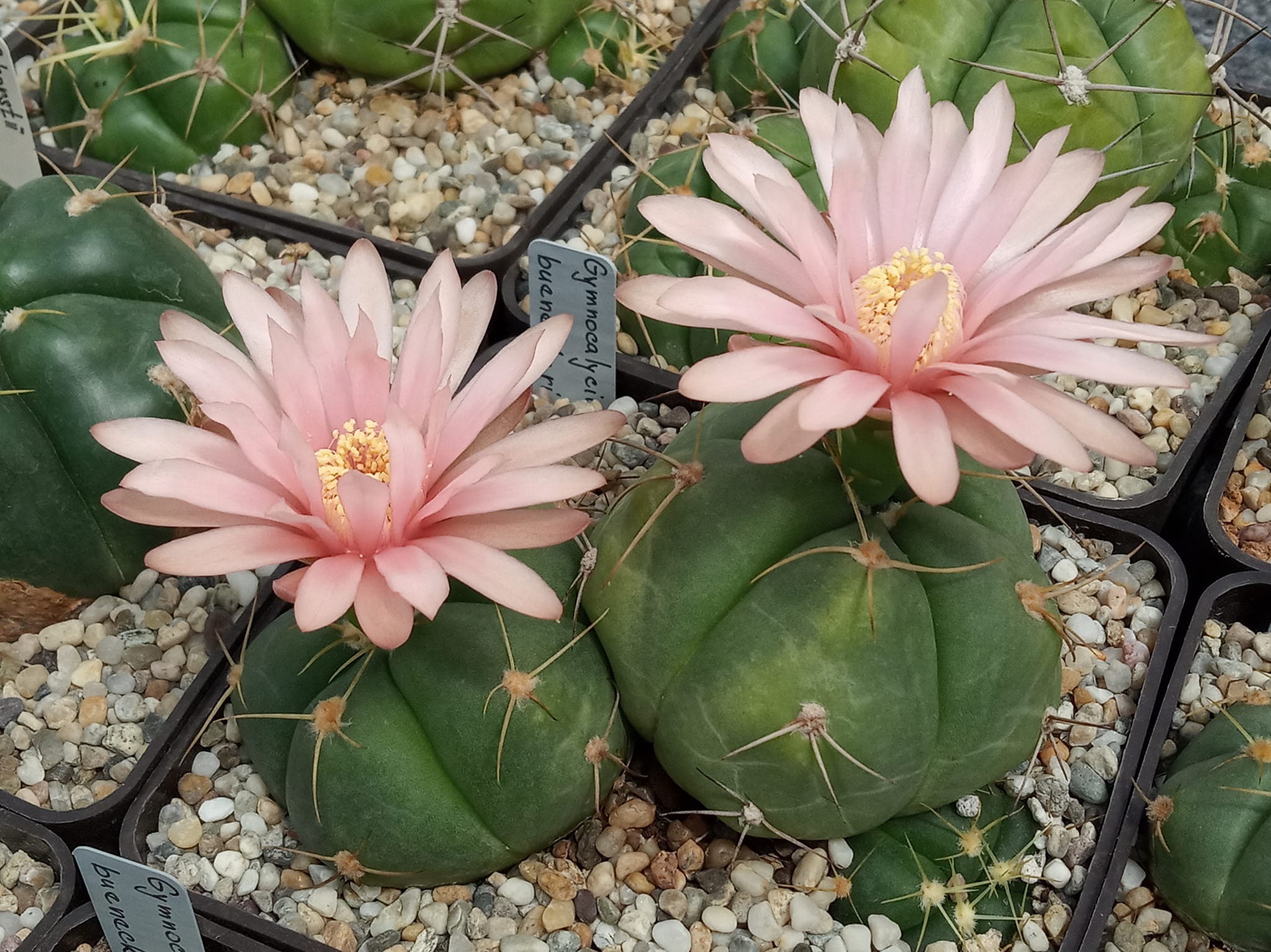
Gymnocalycium buenekeri is a depressed-globular, pink-flowered cactus endemic to sandstone outcrops near São Francisco de Assis in western Rio Grande do Sul, Brazil. Most collectors know it under the species-rank name first published by Dereck Swales in 1979, honouring H. Buenecker, the grower who brought the plant to his attention. Kew POWO and the official Brazilian flora currently place it as Gymnocalycium horstii subsp. buenekeri, but that arrangement remains contested by field researchers who argue the morphological and distributional discontinuity warrants full species status. On this page the name G. buenekeri is used throughout, both because it is the working name in the collector community and because it better reflects the weight of the most recent fieldwork.
The body is depressed-globular, clumping readily, with a matte dark-green to bluish-grey epidermis that distinguishes it at once from its glossy sibling Gymnocalycium horstii. Run a finger across a fresh body: buenekeri feels subtly rough; horstii is smooth as a polished marble. Flowers are invariably pink, ranging from pale peach-pink to rose, with a deeper claret throat. The nearest wild populations of G. horstii subsp. horstii lie approximately 200 km to the east in the Serra Geral highlands, with no intermediate populations detected in any field survey.
The estimated wild population is fewer than 500 plants across three small sites, all on private grazing land near São Francisco de Assis. Illegal collection for the ornamental trade has severely reduced wild numbers; grazing pressure adds a secondary threat. A further biological constraint limits natural recovery: the plants are functionally dioecious, meaning each individual functions as either male or female, and fruit set requires a male-functional plant to transfer pollen to a female-functional plant during the same brief flowering window. Given the low population density across three isolated sites, synchronous cross-pollination is rare. The Prefeitura of São Francisco de Assis has acknowledged the conservation problem and committed to safeguarding the taxon.
In cultivation, the species is considerably less difficult than its wild rarity implies. KuaS-Kettinger describes it as very easy to cultivate; llifle.com notes no cultivation difficulties. The RHS has awarded it the Award of Garden Merit (AGM) and rates it H2, meaning it tolerates a minimum of 1–5°C in container cultivation. When kept dry in winter, established plants survive brief dips to −4°C. Gymnocalycium buenekeri grows without grafting on its natural roots and offsets freely to form attractive clusters.
Gymnocalycium buenekeri quick reference
A flat-globose, clumping Gymnocalycium from subtropical sandstone outcrops in western Rio Grande do Sul at around 200 m, growing under partial shade with moderate seasonal rainfall year-round. Values calibrated for seed grown plants in cultivation, drawn from habitat ecology and specialist grower experience.
Taxonomy & nomenclature
Gymnocalycium buenekeri was first described by Dereck Swales in Cactaceae & Succulent Journal (Great Britain) 40(4): 97, published in 1979 (the research markdown records the year as 1978 per IPNI, reflecting the journal cover date; the effective date is 1979). The epithet honours H. Buenecker, the cactus grower who collected the plant and brought it to Swales’ attention. Kew POWO currently accepts Gymnocalycium horstii subsp. buenekeri (Swales) P.J.Braun & Hofacker, a combination published in Schumannia 3: 188 (2001, formally issued 2002). The Brazilian national flora (REFLORA / JBRJ) and the New Cactus Lexicon both follow the subspecies treatment.
The question of whether buenekeri deserves full species status is a genuine and ongoing dispute among specialists. An informal variety treatment was proposed in 1995; Braun and Hofacker settled on subspecies rank in 2001. The 2012 Brazilian flora checklist reinstated full species status, and the conclusion was argued again in 2013 on the basis of a 2006–2011 field study. The central finding was that all individuals observed near São Francisco de Assis display the consistently matte epidermis, that no intermediate populations exist in the approximately 200 km separating buenekeri and horstii subsp. horstii, and that functional dioecy in buenekeri represents a biologically significant character worth recognising. On those arguments, morphological and distributional discontinuity support full species rank. The genus also shows affinities with Gymnocalycium mihanovichii, a Chaco-origin species that sits in a separate subgeneric lineage, illustrating how broadly diversified Gymnocalycium is across South American biomes.
A 2011 molecular phylogenetic study placed the horstii group within subgenus Macrosemineum, a traditional grouping which the analysis found to be paraphyletic. The subgeneric arrangement in Gymnocalycium is still in flux and the formal rank of buenekeri is likely to be revisited as more molecular data are collected. The New Cactus Lexicon adopted the subspecies treatment at page 129. The synonymy Gymnocalycium horstii var. buenekeri sometimes seen in older trade sources was an intermediate treatment that was never validly published under any author’s name.
Historical synonyms (3)
- Gymnocalycium bueneckeri Swales, 1978 basionym
- Gymnocalycium horstii subsp. buenekeri (Swales) Buining, heterotypic synonym
- Gymnocalycium horstii var. buenekeri Buining, heterotypic synonym
Sources: GBIF
Habitat
Gymnocalycium buenekeri grows on Cretaceous sandstone. This is the geological substrate of the Paráná sedimentary basin, which underlies western Rio Grande do Sul around São Francisco de Assis. The contrast with its sister taxon is biogeographically significant: Gymnocalycium horstii subsp. horstii occupies the eastern Serra Geral highlands, where the underlying rock is basalt and granite formed from Cretaceous volcanic intrusion. The two taxa have evolved in geologically distinct settings separated by approximately 200 km, and no survey has detected intermediate populations in the intervening lowland zone.
Plants occur on rocky outcrops and steep north-facing slopes (in the southern hemisphere, north-facing slopes are sun-exposed and equator-facing). The surrounding vegetation is subtropical campo grassland with shrubs and occasional small palms. Crucially, individual plants grow not in open-rock full exposure but in rock crevices and under the canopy of low shrubs and palm fronds, receiving direct sun only outside the hottest midday hours. This partially shaded microhabitat is the basis for cultivating the species under semi-shade, not in the full desert sun that suits most barrel-form cacti. Elevation is approximately 200 m above sea level, a notably low altitude for a highland-adapted cactus and one that contributes to the mild, humid subtropical climate the plant experiences year-round.
The climate at São Francisco de Assis is subtropical, with approximately 1,600–1,800 mm of annual rainfall distributed across the year, peaking slightly in summer but with no truly dry season. Winters are mild with occasional frosts. This pattern is entirely unlike the strongly seasonal summer-rain or winter-rain deserts where most rare cacti evolved, and it shapes every cultivation recommendation for this species: it is not a bone-dry summer grower, and consistent background moisture is part of its natural condition.
Morphology
The body is depressed-globular to slightly short-cylindrical, remaining fairly flat-topped even in old plants. Mature specimens reach approximately 12–15 cm height and 10–12 cm diameter; the largest field-measured individuals approach 20 cm across. The most immediate visual character is the epidermis texture: matte, dull, non-lustrous, ranging from dark green to mid-green with an occasional bluish-grey cast. KuaS-Kettinger describes this as matt bäulich-gräu bis dunkelgrün: matt bluish-grey to dark green. Touch confirms the identification instantly: the surface feels slightly rough under a fingertip, unlike the smooth polished skin of G. horstii subsp. horstii.
Ribs number five in the great majority of plants. One field count at a documented population found only two plants out of approximately fifty with a rib count other than five. The ribs are broadly rounded with shallow transverse furrows subdividing the rib surface, and each areole sits above the characteristic Gymnocalycium “chin”: a small rounded notch below the areole that is the genus’s most consistent morphological signature. Areoles carry initially dense white wool.
Spines total 3–7 per areole, with five as the most commonly observed count. There are no central spines. Spines are slightly curved, rigid, pale yellow when new, maturing to light brown and eventually grey. They measure up to 3 cm long and spread in a somewhat flattened arrangement against the body rather than projecting outward. The overall effect resembles the spider arrangement of related Gymnocalycium in the horstii group. Observers note the spines appear long relative to body size and more widely spaced than in G. horstii subsp. horstii.
Flowers open to approximately 6 cm long and 8 cm across when fully expanded, making them large relative to the body. Colour is invariably pink: pale peach-pink to rose-pink in the outer tepals, deepening to a claret-pink centre. No white-flowered individuals have been documented for buenekeri; this pink-always character is the second quickest separation from G. horstii subsp. horstii, where cream-white or near-white flowers are the modal expression. Bloom season runs from spring through early autumn, peaking in mid-summer. The plant is functionally dioecious: each individual functions as male or female rather than as a hermaphrodite. Cross-pollination between a male-functional and a female-functional plant is required for fruit set.
Fruit is ovoid, bluish-green to blue-grey, slow to mature (up to six months from pollination), eventually softening and splitting open. Each fruit can contain up to 250 seeds. The plant offsets readily from the base, forming dense clumping clusters in cultivation and in the field.
Locality detail
The entire known range of Gymnocalycium buenekeri fits within a few square kilometres around São Francisco de Assis, a municipality in the western interior of Rio Grande do Sul. The best-documented collection site is 12 km WNW of the town, recorded under the field number WG 23 by Wolfgang Gemmrich and listed by specialist nursery Uhlig Kakteen. A 2011 field survey by Anceschi and Magli confirmed three populations, with one near the Esquina da Silva area and two others within the broader São Francisco de Assis surroundings. All are on private agricultural land used for livestock grazing.
Coordinates published here are regional approximations. For a species with fewer than 500 wild plants and an active illegal collection trade documented in the specialist literature, precise GPS data are deliberately withheld.
Gymnocalycium buenekeri care and cultivation
Substrate
The natural substrate is shallow mineral soil in Cretaceous sandstone crevices, with moderate organic content from leaf litter under the subtropical shrub canopy. The canonical cultivation ratio is 40 per cent pumice, 15 per cent lava rock, 5 per cent zeolite, 30 per cent granite grit, no limestone, and 10 per cent worm castings. Pumice, lava, zeolite and granite are a declared house formulation: they set the pot’s own drainage speed and cation-exchange capacity rather than making a claim about the plant, and granite sits at the high end of its range because this genus carries a high rot exposure that calls for fast-drying hard grit. Limestone and organic are the two components this site certifies against evidence, and no published cultivation source ties either figure to Gymnocalycium buenekeri specifically: limestone stays at zero as the floor of a genus-wide indeterminate carbonate reading, and organic stays at 10 per cent as the ceiling of the Cactaceae family baseline, both house conventions rather than species findings. Growers on hard tap water should switch to rainwater or soft water rather than add limestone to compensate.
All five Gymnocalycium species on this site carry the identical substrate vector. Limestone and organic are house-convention values: no cultivation source found in this site’s research ties either figure to one species over another, so the genus publishes a single formulation across all five pages rather than five separate numbers. Growers on hard tap water should use rainwater or soft water instead of adding limestone to the mix.
| Species | Pumice | Lava | Zeolite | Granite | Limestone | Silica | Organic |
|---|---|---|---|---|---|---|---|
| G. buenekeri (this page) | 40% | 15% | 5% | 30% | 0% | 0% | 10% |
| G. horstii | 40% | 15% | 5% | 30% | 0% | 0% | 10% |
| G. mihanovichii | 40% | 15% | 5% | 30% | 0% | 0% | 10% |
| G. mihanovichii f. variegata | 40% | 15% | 5% | 30% | 0% | 0% | 10% |
| G. mihanovichii f. rubra | 40% | 15% | 5% | 30% | 0% | 0% | 10% |
Watering and light
Water moderately but consistently through the growing season (spring to early autumn). Allow the substrate to approach dryness between waterings but do not allow the plant to desiccate for extended periods. The habitat receives rainfall across all seasons without a truly dry period, so complete summer dryness is not appropriate for this species. Begin tapering water in September; through winter keep the substrate nearly dry, with minimal water only if the plant shows signs of serious shrivelling on warm days.
Semi-shade is the natural condition: plants grow under shrubs and palm fronds on north-facing slopes, not in open exposure. In cultivation, morning sun with afternoon shade, or filtered light through a greenhouse shade cloth, suits the matte epidermis. Intense afternoon summer sun bleaches or scorches the body. In lower-light climates (northern Europe, the UK), full sun is tolerated and produces denser growth; RHS H2 rating confirms the plant can be grown outdoors in mild-frost regions with protection. Established plants in containers should receive high-potassium fertiliser once or twice during the growing season to support root and flower development without excessive vegetative growth.
Grafting onto Echinopsis (Trichocereus) rootstocks can accelerate growth and bring plants to flowering size faster, which is useful specifically for seed production: getting a male-functional and a female-functional plant into bloom simultaneously is the primary obstacle to setting seed in cultivation. Grafting is not necessary for general cultivation; the species grows readily without grafting. Variegated forms sold in the trade are grafted as a necessity due to reduced chlorophyll.
Comparison
The question the field comparison resolves is whether the plant in hand is buenekeri or horstii subsp. horstii. Two characters settle it in seconds: epidermis texture (matte versus glossy) and flower colour (pink versus cream-white). Both are observable without reference material, which is why Anceschi and Magli used epidermal texture as the primary field character in their 2011 population surveys.
A secondary confusion involves Gymnocalycium denudatum, another Rio Grande do Sul species with the same five-spine spider arrangement. G. denudatum spines lie pressed nearly flat against the stem (appressed), whereas buenekeri spines spread and arch slightly away from the body. G. denudatum also produces white flowers and has a glossy green epidermis, placing it firmly with horstii rather than buenekeri on both key characters.
The chlorophyll-deficient forms of Gymnocalycium mihanovichii f. rubra and G. mihanovichii f. variegata are visually distinct and unlikely to be confused with buenekeri; their bright red or yellow-green pigmentation makes them recognisable immediately. The parent species Gymnocalycium mihanovichii from the Paraguayan Chaco is also clearly distinct: it has horizontally banded ribs with characteristic striping and pale greenish-yellow flowers, a body form unlike anything in the horstii group.
Frequently asked questions
How do you tell Gymnocalycium buenekeri apart from Gymnocalycium horstii?
Gymnocalycium horstii subsp. horstii is the plant most likely to be confused with G. buenekeri: they are sister taxa, occupy the same state (Rio Grande do Sul), share the same broad body geometry and five-spine arrangement, and the entire nomenclatural debate questions whether they are even separate taxa. Two characters resolve the confusion immediately.


Epidermal texture is the single most reliable field character. In photographs, look for the light reflection: buenekeri absorbs light; horstii reflects it. If both taxa are in flower, the colour difference removes any remaining doubt.
Is Gymnocalycium buenekeri difficult to cultivate?
Gymnocalycium buenekeri is easy to grow relative to its extreme rarity in the wild. KuaS-Kettinger and llifle.com both note the absence of significant cultivation difficulties, and the RHS AGM status confirms it performs reliably in temperate greenhouse conditions. The main requirements are semi-shade in summer, moderate but consistent watering through the growing season, and dry cool conditions in winter. Overwatering in cold conditions is the most common failure mode.
How is Gymnocalycium buenekeri propagated from seed?
Propagation from seed is possible but complicated by functional dioecy. Each plant functions as either male or female, so producing seed requires two plants that flower simultaneously and happen to be of opposite functional sex. The seed ripening period is long: up to six months from pollination to mature fruit. Seeds germinate readily under standard Gymnocalycium conditions (warmth, moisture, light shade). Given the pollination constraints, collector-to-collector exchanges of seed-grown plants and documented cultivated stock are the primary route to obtaining the species.
Is Gymnocalycium buenekeri legal to own and trade?
Like all Cactaceae except a few spineless genera, Gymnocalycium buenekeri is covered by CITES Appendix II. Trade in wild-collected specimens requires export permits from Brazil and import documentation in the destination country. Nursery-propagated plants with clear captive-origin documentation can be traded legally across borders with CITES paperwork. The illegal collection trade is documented as the primary driver of the species’ wild population decline; sourcing from reputable specialist nurseries with documented seed-grown or cultivated provenance is strongly recommended.
Where does Gymnocalycium buenekeri grow in the wild?
Gymnocalycium buenekeri grows on rocky Cretaceous sandstone outcrops near São Francisco de Assis in western Rio Grande do Sul, Brazil, at approximately 200 m above sea level. It inhabits steep north-facing slopes (sun-exposed in the southern hemisphere) within subtropical campo grassland, growing in rock crevices and under the shade of low shrubs and small palms. The climate is subtropical with around 1,600–1,800 mm of annual rainfall and no true dry season. The species does not occur naturally anywhere outside this area; the nearest populations of its sister taxon lie 200 km to the east.
When does Gymnocalycium buenekeri flower?
Flowering in cultivation occurs reliably from spring through early autumn, peaking in summer. Individual flowers are large relative to the body size, reaching approximately 6 cm long and 8 cm across when fully open, and open over successive days during the flowering window. Plants of 3–5 cm diameter are capable of flowering under warm, well-lit conditions. Because the species is functionally dioecious, flowers on a single plant will not set seed without cross-pollination from a plant of the opposite functional sex.
Sources & further reading
POWO: Plants of the World Online. Gymnocalycium horstii subsp. buenekeri (Swales) P.J.Braun & Hofacker. LSID urn:lsid:ipni.org:names:20006433-1. Royal Botanic Gardens, Kew · IPNI: International Plant Names Index. LSID urn:lsid:ipni.org:names:20006433-1. Royal Botanic Gardens, Kew · REFLORA / Lista da Flora do Brasil 2020. Jardim Botânico do Rio de Janeiro (JBRJ) · Hunt, D. (ed.) (2006). The New Cactus Lexicon (NCL), p. 129. DH Books, Milborne Port · Braun, P.J. & Hofacker, A. (2001). Schumannia 3: 188. Combination of G. horstii subsp. buenekeri · Swales, D. (1979). Gymnocalycium buenekeri. Cactaceae & Succulent Journal (Great Britain) 40(4): 97 · Anceschi, G. & Magli, A. (2013). Conservation assessment and field study: Gymnocalycium buenekeri near São Francisco de Assis, Rio Grande do Sul, Brazil. CR B2ab(ii,iv,v). Via cactusinhabitat.org · Demaio, P.H., Barfuss, M.H.J., Kiesling, R., Till, W. & Chiapella, J.O. (2011). Molecular phylogeny of Gymnocalycium (Cactaceae). American Journal of Botany 98(12). DOI: 10.3732/ajb.1100054 · Kettinger, W. (n.d.). Gymnocalycium horstii ssp. buenekeri. KuaS-Kettinger.de. Specialist morphological and cultivation reference · Royal Horticultural Society. Gymnocalycium horstii subsp. buenekeri. RHS Plant Finder. AGM status; H2 hardiness · llifle.com (n.d.). Gymnocalycium buenekeri. Encyclopedia of Cacti entry 18878. Frost tolerance; cultivation notes · Uhlig Kakteen. Gymnocalycium buenekeri WG 23, Rio Grande do Sul, 12 km WNW von São Francisco de Assis. Field collection provenance listing