
Gymnocalycium mihanovichii f. rubra
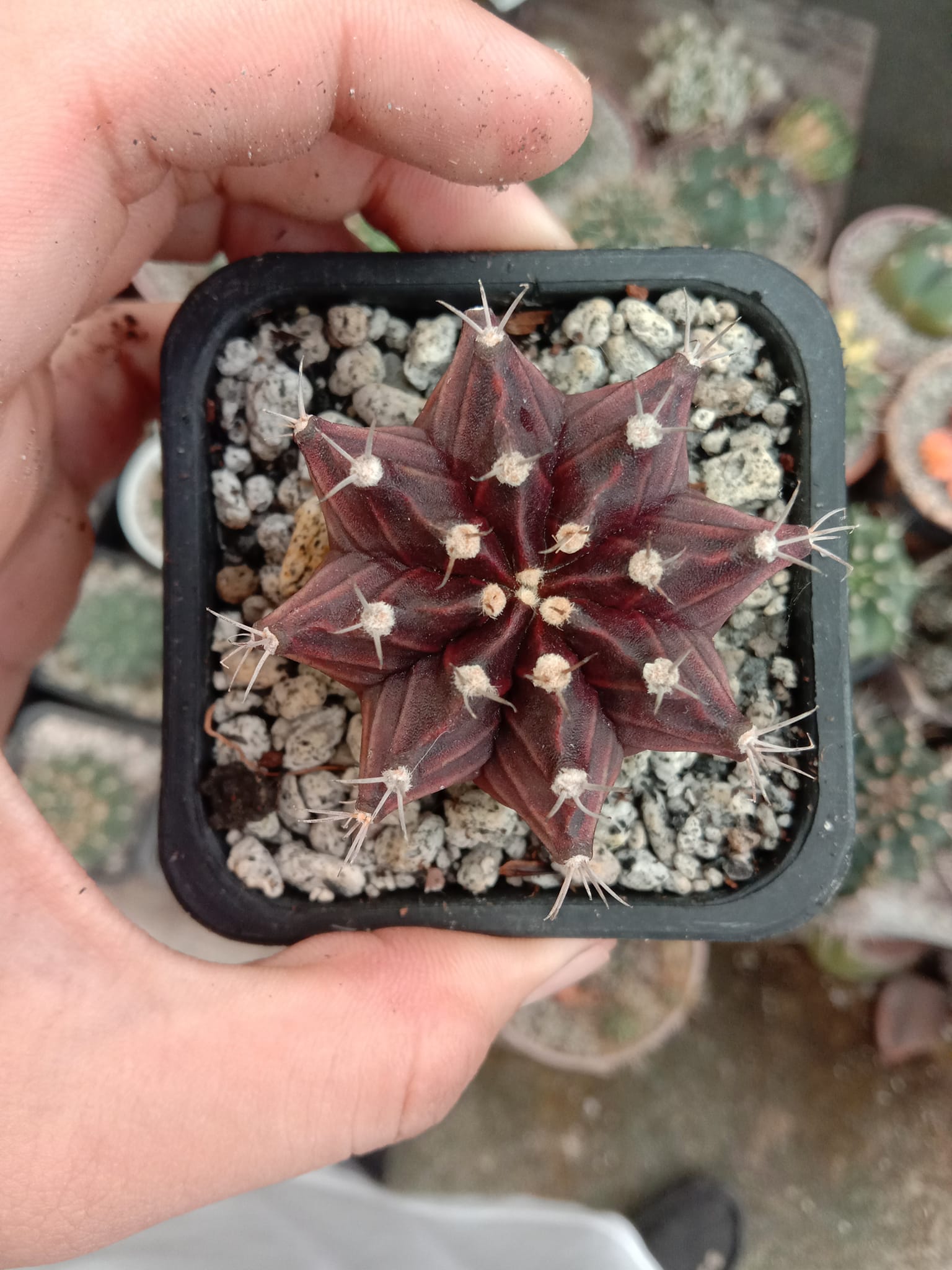
Gymnocalycium mihanovichii f. rubra, sold worldwide as the moon cactus or Hibotan cactus, is the most commercially produced cactus on earth. Its vivid scarlet, orange, yellow, or purple body contains no chlorophyll whatsoever; without a photosynthesising rootstock beneath it the plant dies within days to weeks. Every specimen you see in a garden centre is a graft: a coloured Gymnocalycium mihanovichii scion fused to a green cactus rootstock, typically Hylocereus undatus or Harrisia ‘Jusbertii’. In 1993, approximately 3.3 million live colour-mutant plants moved through international trade in a single year, a figure cited in the CITES CoP10 Proposal 10.68 (1997) that established the dedicated exemption for this trade.
The cultivar was commercially released by Japanese nurseryman Eiji Watanabe in 1948. Watanabe had imported 300 seeds of G. mihanovichii var. friedrichii from Germany in 1937; from roughly 10,000 seedlings raised in 1940, two reddish achlorophyllous mutants were identified. Propagated by grafting through subsequent generations, the fully red ‘Hibotan’ cultivar was stabilised and released commercially eight years after its discovery. By 2011, South Korea had come to dominate global production, accounting for approximately 70 percent of worldwide supply with a wholesale value of roughly US$4 million that year. The Netherlands and Thailand are secondary production centres.
Despite the mass-market ubiquity, the plant has collector significance as the origin story of an entire horticultural industry. The partially chlorophyllous sister form, Gymnocalycium mihanovichii f. variegata (cv. ‘Hibotan Nishiki’), draws more serious collector attention because stable clones with sufficient green sectors can survive ungrafted, and each specimen carries a unique variegation pattern. The fully achlorophyllous f. rubra forms covered here have no capacity for independent life.
This page covers the horticultural form only. Taxonomy, wild habitat, distribution across the Gran Chaco of Paraguay and northeastern Argentina, field morphology, and the parent species IUCN conservation assessment are documented on the G. mihanovichii page.
Gymnocalycium mihanovichii f. rubra quick reference
A grafted combination: achlorophyllous G. mihanovichii f. rubra scion on a green cactus rootstock (typically Hylocereus undatus or Harrisia ‘Jusbertii’). All cultivation values are governed by the rootstock physiology, not by the wild-type parent species habitat.
Taxonomy & nomenclature
The designation “f. rubra” is a horticultural name, not a validly published botanical forma under the International Code of Nomenclature (ICN). No entry for this name appears in IPNI or POWO; the suffix “hort.” (hortorum, meaning “of the gardens”) that accompanies it in specialist databases confirms its status as a nursery designation rather than a code-compliant publication. The formally correct name under the International Code of Nomenclature for Cultivated Plants (ICNCP) is Gymnocalycium mihanovichii cv. ‘Hibotan’, the cultivar released by Eiji Watanabe in 1948.
In commercial and collector practice, however, “f. rubra” has expanded well beyond its literal meaning (Latin: red) to cover the entire group of completely chlorophyll-free mutants regardless of body colour. Red, orange, yellow, and purple/pink achlorophyllous specimens are all sold under “f. rubra” or “moon cactus” in mass retail. By 1983, Ishikawa had documented 16 named colour variations within the fully achlorophyllous class alone. Korean breeding institutions subsequently registered ICNCP-compliant cultivar names for improved commercial lines, including ‘Hongkwang’ (1997, bright red, 9 ribs) and ‘Suhong’ and ‘Hongseong’ (both red). The yellow colour class is sometimes called f. lutea hort. or cv. ‘Hibotan Lutea’; purple and white variants carry no standardised formal names.
One additional nomenclatural note: the most widely traded colour mutants technically derive from G. mihanovichii var. friedrichii seed, which POWO now treats as a synonym of the separate species Gymnocalycium stenopleurum F.Ritter. The CITES annotation (see Conservation box above) acknowledges this ambiguity and applies the exemption broadly to colour mutants sold under the G. mihanovichii trade name regardless of the underlying variety. The parent species taxonomy and the friedrichii/stenopleurum synonymy dispute are covered in full on the G. mihanovichii page.
Historical synonyms (4)
- Echinocactus mihanovichii Fric & Gürke, 1905 basionym
- Gymnocalycium mihanovichii var. filadelfiense Backeb., 1966 homotypic synonym
- Gymnocalycium mihanovichii f. nigrum Y.Itô, 1981 homotypic synonym
- Gymnocalycium mihanovichii subsp. albiflorum Pazout, homotypic synonym
Sources: GBIF
Habitat
Gymnocalycium mihanovichii f. rubra has no wild habitat. This form is an obligate graft of entirely horticultural origin, first produced in Japan in 1940 and commercially released in 1948; it does not occur in nature and has never been recorded outside cultivation. The parent species, Gymnocalycium mihanovichii, grows across the Gran Chaco of Paraguay and northeastern Argentina; its ecology, substrate, climate, and distribution are documented on the G. mihanovichii parent species page.
Morphology
The scion body is globose to slightly flattened, matching the parent species in form: typically 3–6 cm across with 8 ribs, small areoles carrying weak pale radial spines, and the genus’s characteristic ‘chin’ tubercles below each areole. The one departure from the parent species is total: body colour. In wild-type G. mihanovichii, chlorophyll dominates the epidermis visually and produces a grey-green to bluish-green body. In f. rubra mutants, chlorophyll biosynthesis is blocked entirely. With no chlorophyll to mask them, the epidermal pigments are fully unmasked and visible.
Those pigments are betalains. Cacti in family Cactaceae (order Caryophyllales) produce betalain pigments rather than anthocyanins as their primary non-chlorophyll colourants; this is well-established at the family level. Betacyanins (red-violet, nitrogen-containing) produce the red and purple forms; betaxanthins (yellow-orange) produce the yellow and orange forms. The betalain identification for this specific taxon is a family-level inference supported by tissue-localisation research in cactus stems, not a species-confirmed pigment study; no primary paper specific to G. mihanovichii f. rubra pigment chemistry has been published to date.
The grafted profile is visually distinctive: the coloured globose scion sits atop a elongated columnar green rootstock, the two bodies joined at a flat circular graft union. Commercial rootstocks are typically Hylocereus undatus (dragon fruit cactus), with Harrisia ‘Jusbertii’ dominant in Japanese and Korean industrial production. Hylocereus trigonus is also used commercially. In hobby grafting, Myrtillocactus geometrizans is a common choice; Pereskiopsis spp. are used only as transitional propagation stocks to speed early seedling growth, then replaced by a permanent rootstock before the graft is considered finished. Flowers, when they appear on grafted specimens, are the same pale greenish-yellow of the wild type; colour of scion body does not affect flower colour.
Locality detail
Gymnocalycium mihanovichii f. rubra has no distinct wild locality. It is a product of Japanese horticulture, originating from achlorophyllous seedlings selected from a batch grown in Japan in 1940 from imported seed. No wild population exists or has ever been reported. Locality data for the parent species, including the type locality at Puerto Casado (now Puerto La Victoria) in Alto Paraguay, Paraguay, and the full distribution across the Argentine and Paraguayan Gran Chaco, is covered on the G. mihanovichii parent species page, which includes a locality map.
Gymnocalycium mihanovichii f. rubra care and cultivation
Cultivation of f. rubra means cultivation of the grafted combination; the scion itself is metabolically passive. Every care decision is governed by what the rootstock needs, not by what the wild-type G. mihanovichii would tolerate in its Chaco habitat.
Substrate
The substrate ratios below apply to the Hylocereus rootstock, not the scion. f. rubra is an obligate graft: the scion is chlorophyll-free and has no functional root system. All water and nutrient uptake runs through the rootstock. The canonical ratio is 40 per cent pumice, 15 per cent lava rock, 5 per cent zeolite, 30 per cent granite grit, no limestone, and 10 per cent worm castings. This is the same cultivation-first Gymnocalycium vector used across the genus, applied here as an interim placeholder: no Hylocereus, Harrisia or Myrtillocactus rootstock dossier exists yet on this site, so the rootstock does not currently get its own certified mix. The lava rock is the structural drainage aggregate; the zeolite handles cation exchange without adding water-holding mass. Avoid high-organic mixes that retain prolonged moisture in the root zone; Hylocereus roots rot quickly under those conditions.
All five Gymnocalycium species on this site carry the identical substrate vector. Limestone and organic are house-convention values: no cultivation source found in this site’s research ties either figure to one species over another, so the genus publishes a single formulation across all five pages rather than five separate numbers. Growers on hard tap water should use rainwater or soft water instead of adding limestone to the mix.
| Species | Pumice | Lava | Zeolite | Granite | Limestone | Silica | Organic |
|---|---|---|---|---|---|---|---|
| G. buenekeri | 40% | 15% | 5% | 30% | 0% | 0% | 10% |
| G. horstii | 40% | 15% | 5% | 30% | 0% | 0% | 10% |
| G. mihanovichii | 40% | 15% | 5% | 30% | 0% | 0% | 10% |
| G. mihanovichii f. variegata | 40% | 15% | 5% | 30% | 0% | 0% | 10% |
| G. mihanovichii f. rubra (this page) | 40% | 15% | 5% | 30% | 0% | 0% | 10% |
Watering and light
Hylocereus undatus is a tropical epiphytic cactus native to forest margins; it is not a desert plant and prefers partial shade in habitat. This means the grafted combination’s light requirement is dictated by the rootstock preference: 2–4 hours of bright indirect light per day is optimal. Two to three hours of gentle morning sun is tolerated. Avoid intense afternoon direct sun. The scion epidermis lacks the chlorophyll that gives green cacti their natural UV-absorption capacity; direct summer sun bleaches and scorch-patches the coloured body, and the betalain pigments fade irreversibly under high UV. Insufficient light causes the rootstock to etiolate and stretch.
Water the grafted unit by the soak-and-dry approach: allow the top few centimetres of substrate to dry before the next watering. In the growing season (spring through summer), this typically means watering every 2–3 weeks indoors; more frequently outdoors in warm conditions. Keep water away from the graft union crown; moisture pooling at the junction promotes fungal infection and accelerates union failure. In winter, reduce to once per month or less. Hylocereus rootstock is more active year-round than desert cacti but excess moisture in cool winter conditions causes rapid root rot.
Cold tolerance is determined entirely by the rootstock. Hylocereus undatus begins to suffer below 7°C (45°F) and damage is rapid below 5°C. Treat the grafted combination as a houseplant in any climate below USDA zone 10; maintain above 10°C at all times for safe year-round cultivation. Frost is fatal to the whole unit within hours.
Graft union lifespan and re-grafting
The typical lifespan of a moon cactus on a commercial Hylocereus rootstock is 1–3 years under standard retail and houseplant conditions. The limiting mechanism is the growth-rate differential: Hylocereus can extend 20–30 cm per year in warm, moist conditions, while the Gymnocalycium scion grows less than 1 cm per year. Over time, the expanding rootstock tissue creates mechanical stress at the graft union; the vascular connections stretch and eventually fail, causing the scion to detach or the union to develop a callus gap that blocks translocation. Overwatering and cold damage accelerate this timeline.
Re-grafting onto a fresh rootstock resets the clock and is standard practice among collectors who maintain colour-mutant specimens long-term. A clean horizontal cut through the old union, selection of juvenile Hylocereus or Myrtillocactus stock, and firm contact held with rubber bands until the union calluses (typically 1–2 weeks) is the basic procedure. The scion can survive indefinitely under this regime. Plants from specialist growers who re-graft regularly carry more collector interest than retail stock destined to decline within its first two years.
Comparison
The most useful three-way comparison for this taxon is between the green wild type, the partially chlorophyllous f. variegata, and the fully achlorophyllous f. rubra. They represent a spectrum of chlorophyll deficiency: full green (wild type), partial (variegata), none (rubra). The wild type is self-sufficient and grows without grafting. Gymnocalycium mihanovichii f. variegata carries sectored yellow-to-cream variegation against green tissue; stable clones with large enough green sectors can sustain themselves without grafting, though most commercial specimens are grafted for vigour and coloration. f. rubra has no green sectors at all and cannot survive even briefly without a rootstock.
The practical identification question most growers face is telling f. rubra from f. variegata. Both are commonly grafted. Both are sold in specialty nurseries alongside each other. The distinction is immediate: f. rubra has a uniformly coloured body with a single dominant hue (red, orange, yellow, purple, or white) and no green tissue anywhere on the scion. f. variegata has irregular multi-colour sectors, typically with visible green patches mixed with pink, yellow, or orange; no two specimens look identical. A specimen with any green tissue on the scion is f. variegata or a related partially chlorophyllous form; a scion with zero green tissue is f. rubra.
Within the wider genus, the obviously distinct species are worth a brief note for context. Gymnocalycium buenekeri from Rio Grande do Sul, Brazil, has five ribs and invariably pink flowers; its matte dark green epidermis has no chlorophyll deficiency and it grows ungrafted from sandstone outcrops at subtropical latitude. No realistic identification confusion with f. rubra is possible in person; the comparison is only relevant if a label has gone missing.
Frequently asked questions
What is the difference between Gymnocalycium mihanovichii f. rubra and f. variegata (Hibotan Nishiki)?
Gymnocalycium mihanovichii f. variegata is the form most likely to be confused with f. rubra in specialist nurseries: both are forms of the same parent species, both are typically grafted, and both are sold under related common names (moon cactus, Hibotan, Nishiki). The distinction hinges entirely on chlorophyll content and the resulting colour pattern.


The fastest single field character is green tissue on the scion. Any visible green on the scion body identifies f. variegata (or a related partially chlorophyllous form). Zero green tissue anywhere on the scion means f. rubra. No other character is needed.
How long do moon cacti live?
Most commercially sold moon cacti last 1–3 years on their original Hylocereus rootstock. The limiting factor is the growth-rate differential: the rootstock extends 20–30 cm per year while the scion grows less than 1 cm, and over time mechanical stress at the union causes the vascular connection to fail. With attentive care, 4–5 years is achievable. Re-grafting onto a fresh rootstock resets the lifespan entirely, and a scion can persist indefinitely under this regime.
Can a moon cactus survive without grafting?
The fully achlorophyllous scion cannot be rooted or grown without a rootstock under any circumstances. No chlorophyll means no photosynthesis means no metabolic energy; a scion removed from its rootstock dies within days to weeks. The scion can be re-grafted onto a new rootstock. Seeds produced by f. rubra (if it flowers on the rootstock) yield a mix of achlorophyllous and normally chlorophyllous seedlings; achlorophyllous seedlings require grafting from germination and will die otherwise. The partially chlorophyllous sister form, f. variegata, is the only form with any prospect of ungrafted survival.
Is a moon cactus CITES protected? Do I need a permit?
Gymnocalycium mihanovichii is CITES Appendix II, as is the entire family Cactaceae. For commercially sold moon cacti, however, CITES Annotation #608 specifically exempts colour mutants of G. mihanovichii from Convention documentation requirements, provided they are artificially propagated and grafted on one of three approved rootstocks: Harrisia ‘Jusbertii’, Hylocereus trigonus, or Hylocereus undatus. All commercially sold moon cacti are grafted on approved stocks; no CITES permit is required to buy or sell them. The exemption was adopted at CITES CoP10 (1997) through Proposal 10.68, which cited approximately 3.3 million live colour-mutant plants in international trade in 1993 alone as justification for removing the administrative permit burden.
Why is my moon cactus dying or turning brown?
The most common cause of decline, in order of frequency, is overwatering causing rootstock root rot: the base of the rootstock turns soft and black, the scion shrivels, and the whole unit collapses. The second cause is graft union failure due to the growth-rate differential between rootstock and scion: the scion tilts or detaches, and the junction turns brown and dry. Third is sunburn on the scion: pale or brown scorch patches appear on the coloured body after exposure to intense direct sun. Fourth is cold damage: the whole plant softens if exposed to frost or near-freezing temperatures. Mushy base indicates root rot (rootstock killed); dry brown junction indicates graft failure (re-graft onto fresh stock); pale scorch patches indicate too much direct sun.
Sources & further reading
CITES Conference of the Parties, Tenth Meeting (1997). Proposal 10.68: Amendment to Appendix II, Gymnocalycium mihanovichii colour mutants. CITES Annotation #608. Trade volume data (1993: c. 3.3 million live plants) · llifle.com. Gymnocalycium mihanovichii var. friedrichii f. Rubra hort. Entry ID 11967. Taxonomy; nomenclature; horticultural status · llifle.com. Gymnocalycium mihanovichii cv. Hibotan hort. Entry ID 11950. Cultivar history; morphology; cultivation · llifle.com. Gymnocalycium mihanovichii var. friedrichii f. nishikii hort. Entry ID 11948. f. variegata comparison; partial chlorophyll; ungrafted growth capability · Slovenian albino cactus history document (arnes.si). Ishikawa (1983) data: 16 named fully achlorophyllous varieties; Watanabe / Kitoh 1940 breeding history. Attributed to multiple primary sources · Stintzing, F.C. et al. (2012). Tissue localization of betacyanins in cactus stems. Acta Horticulturae Mexicana (Scielo). Cactaceae betalain pigment biology (family-level reference) · University of Arkansas Division of Agriculture, Cooperative Extension Service. ‘Grafted Cactus, Neon Cacti, Moon Cactus, Hibotan Cactus.’ Plant of the Week (2015). UAEX/UADA. Hibotan history; cultivation overview · Gyunggi-do Province Agricultural Research & Extension Services (Korea). Production and Breeding of Cacti for Grafting in Korea (2009). South Korea c. 70% global share; US$4 million wholesale (2011 data) · Lee, Y.B. et al. (1998). Breeding of a new cultivar Gymnocalycium mihanovichii var. friedrichii ‘Hongkwang’ with red color for grafting cactus. EurekaMag abstract · Giromagi Cactus and Succulents. Gymnocalycium mihanovichii f. variegata. f. variegata morphology; ungrafted growth; collector context · CactusGrowGuide. Moon Cactus (Gymnocalycium mihanovichii): A Complete Care Guide. Cultivation; lifespan; light; cold tolerance · CafePlanta. The Lifespan of Moon Cactus: A Comprehensive Guide. Lifespan 1–3 years; re-grafting practice · CactiGuide.com Forum. ‘The right rootstock: Grafting’ thread. Rootstock comparison; Pereskiopsis as transitional propagation stock only