
Gymnocalycium horstii
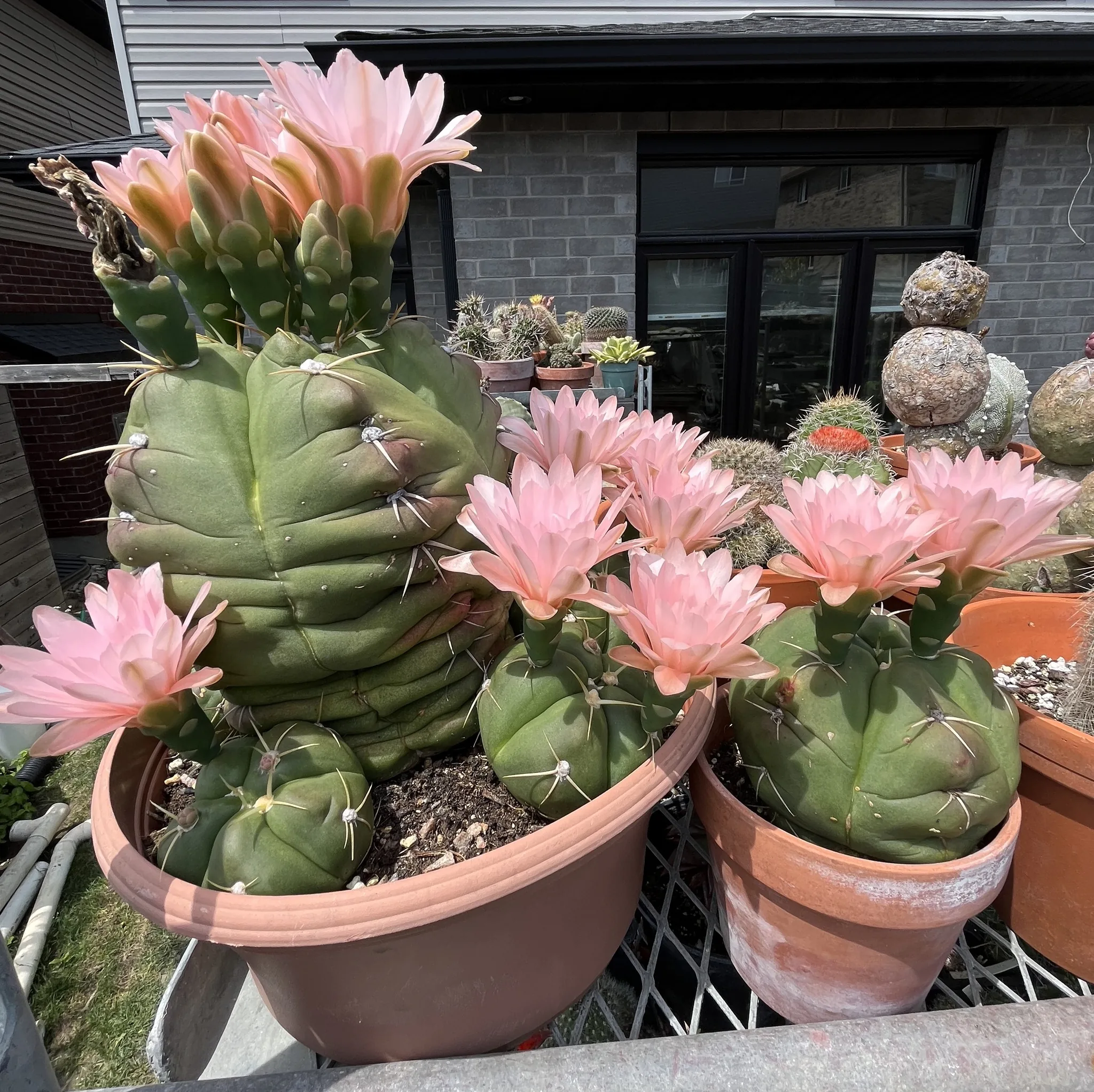
Gymnocalycium horstii Buining is the largest species in its genus by body diameter, routinely reaching 15–20 cm across at maturity and occasionally exceeding 25 cm. First described by Albert Frederik Hendrik Buining in Kakteen und Andere Sukkulenten 21: 162 (1970), the species was named in honour of Leopoldo Horst (1918–1987), a German-born Brazilian cactus collector and commercial exporter active in Rio Grande do Sul. The earliest field-collected material is attributed to Horst himself under number HU 79, from the Caçapava do Sul area.
The wild range is restricted to southern Rio Grande do Sul state, Brazil, where populations grow on rocky sandstone outcrops within pampa grassland in the Camaqua Basin. Some horticultural sources extend the range to Uruguay, eastern Paraguay, and northeastern Argentina, but POWO does not accept these extensions and restricts the native range to Rio Grande do Sul alone. The discrepancy likely reflects label confusion in old cultivation material and is not supported by recent field surveys.
In flower this is an exceptional plant. The funnel-shaped blooms reach 11 cm long and 11 cm across, placing G. horstii at the top of the genus for flower size. The nominate subspecies carries white to pale pink flowers; subsp. buenekeri (and the separately treated Gymnocalycium buenekeri) reliably produces pink flowers. Bloom season in cultivation falls in late spring to early summer, typically May to July in the northern hemisphere.
It is covered by CITES Appendix II, and trade in wild-collected specimens is restricted. Field surveys in the Guaritas corridor have documented sharp declines from collector theft, quarrying, and agricultural conversion. Buy only from documented nursery propagation sources.
Gymnocalycium horstii quick reference
A large globose Gymnocalycium from the pampa grasslands of southern Rio Grande do Sul, Brazil, growing at 100–400 m on rocky sandstone outcrops in filtered light under boulders and scrubby shrubs. Values calibrated for seed grown plants in cultivation, drawn from habitat ecology and specialist grower experience.
Taxonomy & nomenclature
Gymnocalycium horstii Buining was published in Kakteen und Andere Sukkulenten 21: 162 in 1970, with figures 1–6 illustrating the type. The genus name means ‘naked calyx’, referring to the absence of hairs or scales on the flower tube, a character shared across the genus. POWO places the species in subgenus Gymnocalycium, section Denudata under the Schuetz infrageneric system. Molecular phylogenetics placed G. horstii clustering with G. denudatum in plastid-DNA analyses, consistent with the section assignment.
The tribal placement of Gymnocalycium was revised when a 2023 target enrichment sequencing study in Annals of Botany 132(5): 989–1006 formally established the new subtribe Gymnocalyciinae within tribe Cereeae. A 2025 phylogenomics analysis in Plant Systematics and Evolution confirmed this placement independently. Older sources and some current databases (including GBIF) retain the pre-2023 Trichocereeae placement; the Cereeae / Gymnocalyciinae classification is current.
POWO accepts two subspecies: the nominate G. horstii subsp. horstii and G. horstii subsp. buenekeri (Swales) P.J.Braun & Hofacker, published in Schumannia 3: 188 (2001, published 2002). The basionym is Gymnocalycium buenekeri Swales (Cactaceae & Succulent Journal of Great Britain 40: 97, 1978). This subspecies combination is contested. Gymnocalycium buenekeri was argued by Anceschi and Magli to represent a distinct species on morphological and geographic grounds: the two populations are approximately 200 km apart in Rio Grande do Sul with no confirmed intermediates; epidermis texture is consistently different (glossy in nominate horstii, dull in buenekeri); and molecular data shows G. horstii clustering with G. denudatum, not with buenekeri. This site carries G. buenekeri as a separate entry, following the Anceschi and Magli morphological treatment. A synonym listed on Wikispecies, G. horstii subsp. megalanthum Amerh. (named for large flower size), is not accepted in POWO 2026.
Habitat
Gymnocalycium horstii grows within the Brazilian Pampa biome (also known as the South Brazilian Campos or southern subtropical grassland), a temperate grassland system of grasses, scattered shrubs, and occasional small trees covering southern Rio Grande do Sul. This is not an arid desert habitat. The climate at the range centre is temperate subtropical with four distinct seasons: mean annual temperature 17–19°C, annual rainfall 1,100–1,400 mm distributed relatively evenly across the year with a somewhat drier autumn and winter, and occasional winter frosts that rarely drop below −5°C at elevation.
Within this biome the species occupies rocky outcrops, growing in the shelter of boulders and scrubby shrubs rather than on exposed rock faces. The shade-seeking microhabitat is the key cultivation signal: G. horstii is not a full-sun species despite the strong light of the pampa. Plants wedge into crevices or crouch under rocky overhangs, receiving filtered or indirect light for much of the day.
The geology of the Guaritas–Caçapava do Sul area (a UNESCO Global Geopark) is Cambrian-age sedimentary: primarily aeolian sandstones of the Pedra Pintada Alloformation and fluvial sandstones and conglomerates of the Varzinha Alloformation, with interlayered alkaline basalt flows dated to approximately 550 Ma. Soils in rock crevices are thin, mineral-poor, and sharply draining. The species therefore grows on a substrate fundamentally different from the limestone or granite substrates typical of most Mexican rare cacti.
Morphology
The body is globose to depressed-globose, broadly similar in height and diameter. At maturity the body typically measures 15–20 cm across; llifle.com records exceptional specimens reaching 25 cm in diameter. This puts G. horstii at the top of the genus for body size. The surface is deep green and notably high-gloss, appearing almost varnished; this shiny epidermis is the single most reliable field character distinguishing the nominate subspecies from subsp. buenekeri and from G. buenekeri treated as a separate species, both of which carry a dull, matt surface.
Ribs number 5–6, broad and rounded with deep transverse furrows that create the mentoniferous chin-like protrusions characteristic of the genus. Each rib carries 3–5 areoles. Spines are all radial, typically 5 per areole (rarely 6), curved back toward the body and arching outward like spider legs; this spine habit is the origin of the common name ‘Spider Cactus.’ Colour is yellowish-white to pale yellow; length reaches 3 cm. One spine typically points downward while the remainder extend laterally. There are no central spines.
Flowers are funnel-shaped (infundibuliform), white to pale purple-pink in the nominate subspecies; some individuals flower nearly white, others pale rose. The synonym subsp. megalanthum was named for particularly large-flowered individuals, now treated as within normal variation. Flower dimensions reach 11 cm long and 11 cm in diameter, among the largest produced by any Gymnocalycium. Bloom season in cultivation (northern hemisphere) runs May to July. Fruit is ovoid, blue-green. The species is solitary when young and produces offsets slowly with age; young plants remain single-headed for many years, unlike subsp. buenekeri, which clusters more freely.
Locality detail
Three field-collection zones define the known Rio Grande do Sul range. The Caçapava do Sul area, within the Guaritas UNESCO Global Geopark, anchors the type locality via Leopoldo Horst’s HU 79 number, among the first published Horst numbers for this species. Further southeast, field numbers HU 1479 and HU 1481 (collected by Kurt-Ingo Horst) document populations in the Pedras Altas to Herval corridor. The October 2011 survey by Anceschi & Magli covered the Guaritas–Minas de Camaqua–Santana da Boavista corridor and found populations sparse and declining.
Elevation across the range sits at roughly 100–400 m above sea level, consistent with the Guaritas Geopark region, though per-locality elevation data in English-language sources is limited. Llifle.com cites ‘up to 300 m’ for the lower end of the range; other sources suggest populations extend above 300 m on the higher rocky outcrops of the Camaqua Basin. Coordinates on this page are town and regional centroids derived from published locality descriptions; GPS-precise field data is not available from the sources consulted.
Gymnocalycium horstii care and cultivation
Substrate
Gymnocalycium horstii grows in thin, mineral-poor soils in pampa rock crevices in southern Rio Grande do Sul. The canonical cultivation ratio is 40 per cent pumice, 15 per cent lava rock, 5 per cent zeolite, 30 per cent granite grit, no limestone, and 10 per cent worm castings. Pumice, lava, zeolite and granite are a declared house formulation: they set the pot’s own drainage geometry and cation-exchange capacity, not a claim about the plant, and the same aggregate mix is used across the whole genus regardless of which rock a given population happens to sit on. Limestone and organic are the two components this site certifies against evidence, and no published cultivation source ties either figure to Gymnocalycium horstii specifically: limestone stays at zero as the floor of a genus-wide indeterminate carbonate reading, and organic stays at 10 per cent as the ceiling of the Cactaceae family baseline, both house conventions rather than species findings. Growers on hard tap water should switch to rainwater or soft water rather than add limestone to compensate. Repot every two years; the eventual body size demands a substantial container.
All five Gymnocalycium species on this site carry the identical substrate vector. Limestone and organic are house-convention values: no cultivation source found in this site’s research ties either figure to one species over another, so the genus publishes a single formulation across all five pages rather than five separate numbers. Growers on hard tap water should use rainwater or soft water instead of adding limestone to the mix.
| Species | Pumice | Lava | Zeolite | Granite | Limestone | Silica | Organic |
|---|---|---|---|---|---|---|---|
| G. buenekeri | 40% | 15% | 5% | 30% | 0% | 0% | 10% |
| G. horstii (this page) | 40% | 15% | 5% | 30% | 0% | 0% | 10% |
| G. mihanovichii | 40% | 15% | 5% | 30% | 0% | 0% | 10% |
| G. mihanovichii f. variegata | 40% | 15% | 5% | 30% | 0% | 0% | 10% |
| G. mihanovichii f. rubra | 40% | 15% | 5% | 30% | 0% | 0% | 10% |
Watering and light
The pampa climate brings 1,100–1,400 mm of rainfall per year spread relatively evenly across the seasons, with autumn and winter somewhat drier. This is not a desert species and does not thrive under a year-round near-dry regime. In the growing season (spring through early autumn), water generously on a soak-and-dry cycle; approximately every 10–14 days at moderate temperatures is a reasonable starting cadence, shortened in heat, extended in cool or overcast spells. Begin tapering in early autumn as temperatures drop. From October through March (northern hemisphere), keep the substrate near-dry but allow occasional very light watering if temperatures stay above 15°C and the body shows visible shrivelling. Overwatering in cool conditions is the primary cultivation risk; root rot sets in quickly.
In habitat the species shelters under rocks and bushes, receiving filtered or indirect light for much of the day. Bright indirect light to partial shade suits it well in cultivation; morning sun is beneficial. Intense afternoon sun in summer, particularly in hot climates, causes scorch and an undesirable bronzing of the glossy epidermis. The functional cultivation lux range documented by specialists is 40,000–80,000 lux. Etiolation and loss of the compact form result from insufficient light, so do not overcompensate toward shade. Safe minimum temperature is 5°C when the substrate is dry; fully dry dormant plants have been documented surviving brief exposure to −4°C, and one Phoenix grower reports fifteen years of successful ground culture with winter cold-frame protection. These extended cold figures apply only in fully dry conditions; wet cold above 0°C is lethal.
Comparison
Gymnocalycium horstii is most often confused with Gymnocalycium buenekeri, the Rio Grande do Sul sibling that POWO folds into G. horstii as subsp. buenekeri. This site treats it as a separate species, following the Anceschi & Magli morphological argument. Three characters separate the nominate horstii from buenekeri cleanly and without specialist tools. Run a finger across the body: horstii subsp. horstii has a high-gloss, almost varnished epidermis; buenekeri is consistently dull and matt. Count the spines per areole: horstii carries five, buenekeri typically three. Observe the clustering habit: horstii remains solitary for many years; buenekeri offsets relatively freely and forms clusters earlier in life.
The comparison with Gymnocalycium mihanovichii from the Paraguayan Gran Chaco is useful for understanding how different members of the same genus can be in all key characters. G. mihanovichii is a small flat-globose plant, rarely exceeding 6 cm diameter, with a smooth grey-green body carrying distinctive horizontal banding across the ribs and semi-closed pale yellow flowers 4–5 cm long. G. horstii is in a completely different size class (up to 20 cm diameter), with a high-gloss body, five to six broad ribs with no horizontal banding, and funnel flowers more than twice the size. A collector seeing both on a bench without labels would not confuse them.
The chlorophyll-free colour mutants of G. mihanovichii are the Gymnocalycium most widely seen in retail horticulture. The red ‘Hibotan’ form (G. mihanovichii f. rubra) requires grafting to survive and cannot be confused with G. horstii in any form. Collector-grade G. horstii seed grown plants are a different proposition entirely: slow to mature, progressively more impressive in flower: satiny pink-white blooms reaching 11 cm across on a glossy globe that deepens with maturity.
Frequently asked questions
How do you tell Gymnocalycium horstii apart from Gymnocalycium buenekeri?
Gymnocalycium buenekeri is the taxon most likely to arrive at the bench mislabelled as G. horstii, and vice versa. POWO treats buenekeri as a subspecies of horstii, making the question of which plant you have also a nomenclatural one. Seven characters separate them reliably.


Epidermis texture is the single fastest field character: run a finger across the body. G. horstii subsp. horstii is unmistakably glossy; G. buenekeri is consistently matt. When a flower is present, the consistent pink of buenekeri versus the variable white-to-pale-pink of horstii confirms the identification.
Is Gymnocalycium horstii difficult to grow?
Gymnocalycium horstii is relatively forgiving once its two key requirements are met: sharp drainage and a near-dry winter rest. The main cultivation risks are overwatering in cool conditions, which causes rapid root rot, and intense afternoon sun without acclimatisation, which scorches the glossy body. It tolerates partial shade, grows steadily without special intervention, and is not prone to the pest or disease problems that trouble more demanding collectors’ cacti. Patient growers are rewarded with flowers that measure up to 11 cm across, the largest produced by any Gymnocalycium by dimension.
How do you propagate Gymnocalycium horstii?
Seed is the primary propagation method and the most appropriate for collectors seeking plants with natural body proportions. Seeds germinate in 7–14 days at 20–28°C under warmth and moderate moisture; some batches take up to four weeks. Seed viability declines after two to three years, so sow fresh when possible. Mature plants eventually produce offsets that can be separated, allowed to callus for one to two days, and potted into dry mix; water sparingly for the first two weeks after potting. The species is slower to offset than most Gymnocalycium, and young plants remain single-headed for several years.
Is Gymnocalycium horstii legal to buy and own?
Yes, with appropriate documentation for international trade. All Cactaceae are listed on CITES Appendix II, requiring export permits for international commercial trade in wild-collected plants. Nursery-propagated plants sold domestically do not require special permits in most countries. Field surveys have documented active collection pressure on wild populations; the species is covered by CITES Appendix II. Wild-collected plants are illegal to export. Buy only from sources that can document nursery propagation and legal provenance.
Where does Gymnocalycium horstii grow in the wild?
Gymnocalycium horstii grows on rocky sandstone outcrops within pampa grassland in southern Rio Grande do Sul state, Brazil. Populations are concentrated in the Camaqua Basin: the Caçapava do Sul area (within the Guaritas UNESCO Global Geopark), the Pedras Altas to Herval corridor, and the Guaritas–Minas de Camaqua–Santana da Boavista corridor. Plants grow sheltered between boulders and under scrubby shrubs, not on exposed rock faces; field surveys have found populations shrinking due to collector theft, quarrying, and agricultural conversion.
When does Gymnocalycium horstii flower?
In cultivation (northern hemisphere), Gymnocalycium horstii typically flowers May to July. First flowering from seed has been recorded at five to eight years under good conditions, though specific data is limited; anecdotal reports suggest plants can flower at smaller sizes than their eventual mature diameter would suggest. Flowers are funnel-shaped, white to pale pink in the nominate subspecies, reaching 11 cm long and 11 cm across; they rank among the largest produced by any Gymnocalycium and can exceed the diameter of the plant body on younger specimens.
Sources & further reading
Plants of the World Online. Gymnocalycium horstii Buining. LSID urn:lsid:ipni.org:names:115397-2. Royal Botanic Gardens, Kew · Plants of the World Online. Gymnocalycium horstii subsp. buenekeri (Swales) P.J.Braun & Hofacker. Royal Botanic Gardens, Kew · Romeiro-Brito, M., Taylor, N.P., Zappi, D.C., Telhe, M.C., Franco, F.F. & Moraes, E.M. (2023). Unravelling phylogenetic relationships of the tribe Cereeae using target enrichment sequencing. Annals of Botany 132(5): 989–1006. DOI: 10.1093/aob/mcad153 · de Vos, J.M., Eggli, U., Nyffeler, R., Larridon, I. et al. (2025). Phylogenomics and classification of Cactaceae based on hundreds of nuclear genes. Plant Systematics and Evolution. DOI: 10.1007/s00606-025-01948-z · Demaio, P.H., Barfuss, M.H.J., Kiesling, R., Till, W. & Chiapella, J.O. (2011). Molecular phylogeny of Gymnocalycium (Cactaceae). American Journal of Botany 98(12). DOI: 10.3732/ajb.1100054 · Anceschi, G. & Magli, A. (2013). Gymnocalycium horstii field survey and conservation assessment. cactusinhabitat.org. Survey of October 2011; CR B2ab(ii,iv,v) assessment; population decline; threats; G. buenekeri species argument · llifle.com. Gymnocalycium horstii Buining. Encyclopedia of Living Forms entry 18875. Morphology; cultivation; cold tolerance; EOO · Foliage Factory. Gymnocalycium horstii care notes. foliage-factory.com. Light lux range; cold tolerance; cultivation · Kessler’s Cacti. Gymnocalycium horstii Spider Cactus. kesslerscactus.com. Common name; cold hardiness; spine morphology · Mountain Crest Gardens. Gymnocalycium horstii ssp. buenekeri. mountaincrestgardens.com. Subspecies morphology comparison; shiny vs dull epidermis · Dave’s Garden Plant Files. Gymnocalycium horstii. davesgarden.com. 15-year Phoenix cultivation observation; May bloom; biweekly summer watering · Wikipedia contributors. Gymnocalycium horstii. Wikipedia, The Free Encyclopedia. Morphology compilation; IUCN status; subspecies; etymology · GBIF. Gymnocalycium horstii Buining, taxon ID 7282980. gbif.org. Occurrence records; field localities