
Gymnocalycium mihanovichii f. variegata
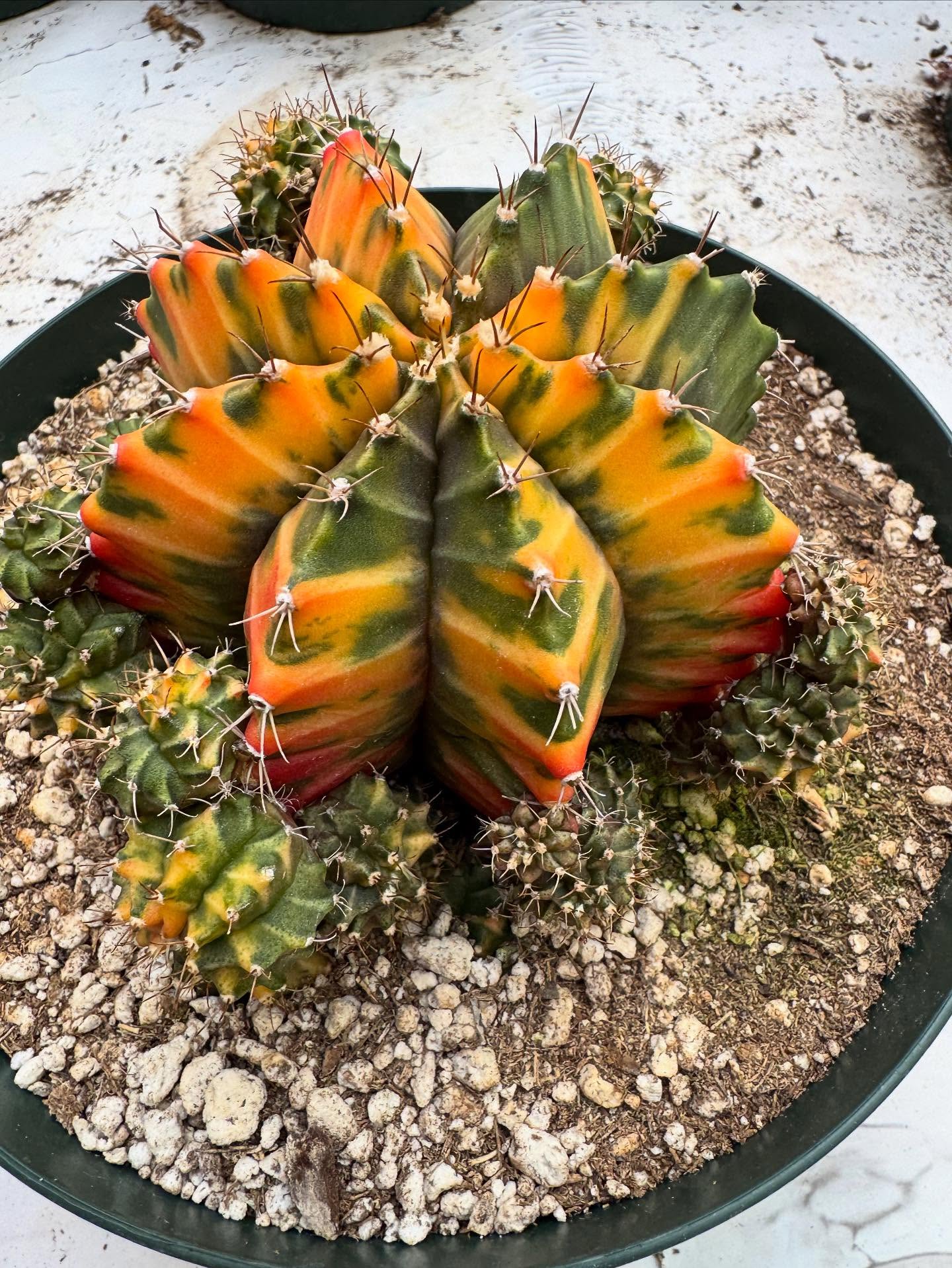
Gymnocalycium mihanovichii f. variegata is the partially de-chlorophylled form of the Paraguayan chin cactus, carrying a chimeral mix of fully chlorophyllic green sectors and chlorophyll-deficient patches that express the underlying carotenoid and anthocyanin pigments as yellow, orange, pink, and red. No two plants are identical; the distribution of coloured and green tissue varies across the body in irregular sectors, streaks, and patches, making each specimen visually unique. The form does not occur in wild populations of the parent species, which is confined to the Gran Chaco of Paraguay and northeastern Argentina; it arises exclusively through nursery selection from seed batches and has been cultivated as a recognised group since at least the early 1950s in Japan.
The critical distinction between f. variegata and its fully de-chlorophylled counterpart, Gymnocalycium mihanovichii f. rubra, is photosynthetic capacity. f. variegata retains active chlorophyll in its green sectors and can sustain itself without grafting when those sectors are sufficiently extensive. f. rubra (the Hibotan of the mass-market moon cactus trade) carries no chlorophyll at all and cannot survive without a rootstock to supply sugars. This difference determines the entire cultivation approach: stable f. variegata clones with dominant green tissue are viable as ungrafted plants; heavily coloured specimens with minimal green may need grafting support.
In the Japanese grower literature, this group was documented as the Nishiki group (‘Nishiki’ meaning brocade), distinct from the Hibotan trade. Ishikawa’s 1983 catalogue recorded ten Nishiki variations, indicating an established parallel selection history by that date. By the early 2000s Thailand had become a significant production centre for ungrafted variegated forms, developing a cultivation tradition that treats f. variegata specifically as an ungrafted plant distinct from the grafted Hibotan commodity. The llifle entry for this group notes directly that ‘those with some chlorophyll are able to grow without grafting and are very beautiful and priced by collectors.’
For parent-species ecology, range, full IUCN assessment, and the history of the Hibotan cultivar programme, see the Gymnocalycium mihanovichii page. This page covers the form: its variegation biology, cultivation adjustments relative to the green type, propagation, and its position within the CITES trade regime.
Gymnocalycium mihanovichii f. variegata quick reference
A chimeral variegated form of the Paraguayan chin cactus, carrying mixed chlorophyllic and chlorophyll-free sectors; slower-growing than the green wild type due to reduced photosynthetic capacity, with heightened light sensitivity in coloured tissue. Values calibrated for seed grown plants in cultivation.
Taxonomy & nomenclature
The parent species, Gymnocalycium mihanovichii (Frič & Gürke) Britton & Rose (1922), is the sole accepted taxon in Kew POWO; no infraspecific names are recognised under it. POWO lists zero formas, varieties, or subspecies for this species, and a search of the International Plant Names Index returns no result for ‘Gymnocalycium mihanovichii variegata.’ The designation f. variegata is a horticultural label used consistently in trade and collector databases to describe partially de-chlorophylled sectored plants, but it has no Code-governed protologue or nominating authority. Using it on this page follows grower convention, not botanical nomenclature.
The horticultural synonym most frequently encountered alongside f. variegata is cv. Nishikii hort., the Japanese grower name for this group. llifle treats cv. Nishikii as explicitly equivalent to f. variegata, noting that Nishiki is the Japanese word for brocade and that the name applies specifically to the partially de-coloured plants that retain chlorophyll. The trade name Hibotan Nishiki is sometimes applied to the same group, particularly to specimens falling between the predominantly green type and the fully chlorophyll-free f. rubra. All three names refer to the same plant category; they are not separate taxa.
The relationship between f. variegata and f. rubra is one of degree, not kind. Both arise from chloroplast biogenesis failures in the meristem; f. variegata is a chimeral sectorial pattern where mutant and wild-type cell lines grow side by side, while f. rubra reflects a complete mutation leaving no functional chloroplasts anywhere in the body. The green wild type, f. variegata, and f. rubra represent a continuum of chlorophyll reduction from full to zero, with the variegata group occupying the intermediate range. None of these designations is a validly published botanical name under the International Code; all three are cultivar-group or horticultural-category labels in common use.
Historical synonyms (4)
- Echinocactus mihanovichii Fric & Gürke, 1905 basionym
- Gymnocalycium mihanovichii var. filadelfiense Backeb., 1966 homotypic synonym
- Gymnocalycium mihanovichii f. nigrum Y.Itô, 1981 homotypic synonym
- Gymnocalycium mihanovichii subsp. albiflorum Pazout, homotypic synonym
Sources: GBIF
Habitat
Gymnocalycium mihanovichii f. variegata has no wild distribution. The parent species grows in the Gran Chaco of Paraguay (Boquerón and Alto Paraguay departments) and northeastern Argentina (Chaco and Formosa provinces), in dry thorn forest on flat alluvial sandy-to-clay soils along the Paraguay River corridor, at elevations from approximately 89 to 500 m above sea level. Full habitat ecology, climate data, and field-collection locality details are on the Gymnocalycium mihanovichii page. Variegated chlorophyll-mutant seedlings arise sporadically from seed batches in cultivation, not from wild populations; chlorophyll deficiency is disadvantageous in natural competition and does not produce viable wild plants.
Morphology
The body dimensions of f. variegata match the parent species: flat-globose, reaching approximately 4 cm tall by 5–6 cm in diameter in typical cultivation. Grafted specimens supplied with rootstock sugars can grow larger and faster, sometimes approaching the dimensions cited for material derived from the ‘var. friedrichii’ parentage (now treated as G. stenopleurum); ungrafted plants of the nominate species parentage stay within the 4–6 cm range. Rib count is eight, matching the parent. Spine character is the same: five to six weak, pliable radials per areole, 0.8–1 cm, greyish-yellow with dark bases, no central spine in most individuals.
The defining character is the variegation itself. The pattern is sectored to blotched: irregular portions of the epidermis lack chlorophyll, allowing the underlying carotenoids (yellows, oranges) and anthocyanins (reds, purples) to dominate visually while the green sectors retain normal chlorophyll. No two plants carry the same distribution; the pattern is individually unique, and bilateral asymmetry across ribs is common. Colour range in the de-chlorophylled sectors includes red, orange, dark purplish, yellow, and cream; some clones are predominantly one colour with occasional green strips, others are nearly half-and-half.
The variegation arises from a sectorial chimera pattern: the chloroplast mutation occurs in the meristem at the cell level, producing adjacent sectors of mutant and wild-type tissue growing side by side. This is a plastid-level or chimeral cell-line division, not a simple dominant-recessive nuclear gene mutation. As a result, the pattern in any given plant is maintained through vegetative growth from that meristem but is not reliably transmitted through the sexual cycle. Seed batches from variegated parents produce offspring across the full spectrum from green to heavily coloured, with most reverting toward the green type. Colour intensity depends on how much de-chlorophylled tissue the plant carries: plants with extensive coloured sectors appear more vivid; plants with minimal variegation lean predominantly green with scattered coloured patches. Flowers, when they occur on ungrafted plants, are the same pale greenish-yellow, semi-closed, silky form as the parent species.
Locality detail
Gymnocalycium mihanovichii f. variegata has no distinct wild locality and no wild distribution to map. The designation refers exclusively to plants of horticultural origin, selected from seed batches in nurseries; the first well-documented selection history for the Nishiki group is Japanese, from approximately the 1950s onward. Modern commercial production is centred in Thailand, where ungrafted variegated plants are grown at scale for export. For distribution of the parent species across the Paraguayan and Argentine Gran Chaco, including field-collection localities and a locality map, see the Gymnocalycium mihanovichii page.
Gymnocalycium mihanovichii f. variegata care and cultivation
Substrate
The substrate ratios below apply to the rootstock in grafted specimens; the chlorophyll-deficient scion has no functional root system of its own when grafted and depends entirely on the rootstock for water and nutrient uptake. Ungrafted specimens with sufficient green tissue use the same cultivation-first vector as the rest of the genus. The canonical ratio for either context is 40 per cent pumice, 15 per cent lava rock, 5 per cent zeolite, 30 per cent granite grit, no limestone, and 10 per cent worm castings. This is the same Gymnocalycium vector used across the genus, applied here as an interim placeholder for the rootstock: no dedicated Hylocereus, Harrisia or Myrtillocactus dossier exists yet on this site. The zeolite buffers pH and paces nutrients between waterings without adding water-holding mass. Irrigate with rainwater where possible; the genus tolerates alkaline tap water poorly. Excellent drainage is non-negotiable for the rootstock; roots rot quickly in standing water at any temperature below the rootstock’s comfort range. Because f. variegata grows more slowly than the green type, repotting every 3 to 4 years is appropriate for ungrafted specimens; grafted units should be assessed for rootstock vigour annually.
All five Gymnocalycium species on this site carry the identical substrate vector. Limestone and organic are house-convention values: no cultivation source found in this site’s research ties either figure to one species over another, so the genus publishes a single formulation across all five pages rather than five separate numbers. Growers on hard tap water should use rainwater or soft water instead of adding limestone to the mix.
| Species | Pumice | Lava | Zeolite | Granite | Limestone | Silica | Organic |
|---|---|---|---|---|---|---|---|
| G. buenekeri | 40% | 15% | 5% | 30% | 0% | 0% | 10% |
| G. horstii | 40% | 15% | 5% | 30% | 0% | 0% | 10% |
| G. mihanovichii | 40% | 15% | 5% | 30% | 0% | 0% | 10% |
| G. mihanovichii f. variegata (this page) | 40% | 15% | 5% | 30% | 0% | 0% | 10% |
| G. mihanovichii f. rubra | 40% | 15% | 5% | 30% | 0% | 0% | 10% |
Watering and light
The seasonal watering rhythm mirrors the parent species: water regularly through the summer growing season, allow the substrate to approach dryness between waterings, begin tapering in autumn, and keep completely dry from November through February in northern hemisphere cultivation. No documented difference in watering frequency separates f. variegata from the green type; the slower growth simply means the plant consumes less water over a given period, but the drying cycle remains the same principle.
Light is where f. variegata diverges most sharply from the green wild type. Chlorophyll-free sectors lack the photochemical protection that functional chlorophyll provides, and they scorch under prolonged direct midday sun before the green tissue shows any comparable damage. The optimal placement is bright filtered light or morning direct sun with shade in the peak hours: east-facing or lightly shaded south/west exposure works well. Inadequate light suppresses colour saturation; the coloured sectors appear washed out in deep shade, so the balance point is bright indirect to filtered direct light. Acclimatise any plant moved from shade to increased light gradually over two to three weeks, watching the coloured sectors first for signs of bleaching.
Cold tolerance for ungrafted plants is the same as the parent: 10°C minimum for routine cultivation, with established dry-dormant plants tolerating brief lower exposure if the substrate is completely dry. Grafted plants are governed by the rootstock: Hylocereus undatus and H. trigonus, the rootstocks most commonly used for the commercial grafted trade, are tropical and do not tolerate frost. A grafted f. variegata must be kept above 10°C to protect the graft union, regardless of what the scion alone could tolerate.
Whether grafting is needed depends on the individual plant. Seed grown plants with substantial green sectors are photosynthetically self-sufficient and are sold as bare-root or ungrafted specimens by specialist nurseries. Plants with near-complete de-chlorophylling, where coloured tissue covers the majority of the body surface, may carry insufficient chlorophyll to sustain independent growth, particularly as seedlings or small offsets; grafting onto Hylocereus undatus or Harrisia ‘Jusbertii’ stabilises these plants and allows growth until a viable offset can be separated. The commercial grafted trade applies the same Hylocereus-graft technique used for f. rubra, but serious collectors distinguish grafted-for-speed from ungrafted-for-quality: ungrafted specimens develop the flat-globose body proportions and natural spine character that grafted stock accelerates past.
Propagation by offset is the most reliable method for preserving a clone’s variegation pattern. When a plant produces a basal offset, the offset inherits the same chimeral cell lines as the parent and typically carries the same colour distribution. Allow offsets to dry for several days before placing in substrate; an offset must carry enough green tissue to develop roots independently. Heavily coloured offsets with minimal green may fail to root and are candidates for grafting rather than rooting. The species produces offsets sparingly; offset availability in cultivation is limited compared to more clustering species. Seed propagation is commercially practised but produces unpredictable results: offspring range from fully green to heavily variegated, with many reverting toward the green type.
Comparison
The most important comparison is with f. rubra, the fully de-chlorophylled form. Gymnocalycium mihanovichii f. rubra is the Hibotan moon cactus of the mass-market nursery trade: completely chlorophyll-free, uniformly coloured across the entire body surface, incapable of photosynthesis, and an obligate graft that dies within weeks if removed from its rootstock. f. variegata always shows green sectors; this is the single fastest field character. A body with any visible green tissue is f. variegata or the green wild type; a body with no green at all is f. rubra.
Against the green wild type, the separation takes a single observation. A uniformly grey-green to brownish-green body with no coloured sectors is the unmodified species; the presence of any yellow, orange, or red patches defines the form. The parent species page covers the wild-type cultivation approach and morphology in full.
Within the broader genus, the two Brazilian species covered on this site are clearly distinct from any f. variegata regardless of how coloured the individual plant happens to be. Gymnocalycium buenekeri from Rio Grande do Sul is a uniformly dark matte green body with five ribs and invariably pink flowers; no sectored colour variation is involved. Collector interest in variegated forms is concentrated on the mihanovichii complex; the rib geometry and flower colour of buenekeri and G. horstii leave no room for confusion with any f. variegata clone.
Frequently asked questions
How do you tell Gymnocalycium mihanovichii f. variegata apart from Gymnocalycium mihanovichii f. rubra?
Both f. variegata and f. rubra are forms of the same parent species arising from the same chlorophyll-mutation mechanism. The difference is degree: f. variegata is a chimeral partial mutation; f. rubra is a complete one. The distinction determines whether grafting is required.


The single most reliable field character is whether the plant shows any visible green tissue. f. variegata always has green sectors; f. rubra never shows green. No magnification needed: the presence or absence of green tissue resolves the identification on sight.
Is Gymnocalycium mihanovichii f. variegata easy to grow?
Ungrafted plants with sufficient green sectors are easy to grow. The requirements differ from the parent species mainly in light: chlorophyll-free sectors scorch under prolonged direct sun, so bright filtered or morning direct light is better than full midday exposure. Watering and substrate follow the same summer-wet, winter-dry pattern as the parent. The slower growth rate means less frequent repotting and a longer wait to reach flowering size, but the cultivation inputs themselves are not demanding.
How do you propagate variegated Gymnocalycium mihanovichii?
Offset separation is the primary method for preserving a clone’s specific variegation pattern. When a plant produces a basal offset, the offset inherits the same chimeral cell lines as the parent and typically carries the same colour distribution. Allow offsets to dry for several days before rooting in substrate; offsets must carry enough green tissue to generate roots independently. Heavily coloured offsets with minimal green sectors may fail to root and are better grafted.
Seed propagation produces unpredictable offspring: offspring from variegated parents range from fully green to highly variegated, with many reverting toward the green type. This reflects the chimeral nature of the mutation; the mutant cell line does not pass reliably through the sexual cycle. Multiple specialist nurseries practice seed propagation commercially and select the most variegated seedlings for further distribution.
Is it legal to buy Gymnocalycium mihanovichii f. variegata?
Yes, without restriction beyond standard Cactaceae rules. All Cactaceae are listed under CITES Appendix II, and artificially propagated nursery plants in the horticultural trade are freely available in most countries. CITES Annotation #608, agreed at CoP10 (1997), exempts colour-mutant forms of this species grafted on Harrisia ‘Jusbertii’, Hylocereus trigonus, or H. undatus from the Convention’s provisions. Ungrafted f. variegata plants are not covered by that annotation and fall under the standard Appendix II regime, which does not require individual import or export permits for personal quantities of artificially propagated specimens in most importing countries.
Does the variegated moon cactus occur in nature?
No. Gymnocalycium mihanovichii f. variegata is exclusively a cultivation selection and does not occur in wild populations of the parent species. Chlorophyll deficiency is a disadvantage in natural competition; variegated seedlings that arise spontaneously in the wild do not survive to maturity. The parent species, Gymnocalycium mihanovichii, grows in the Gran Chaco of Paraguay and northeastern Argentina as a fully chlorophyllic green plant.
Does Gymnocalycium mihanovichii f. variegata flower?
Yes, ungrafted plants with sufficient green tissue do flower in cultivation. The flowers are the same pale greenish-yellow, semi-closed, silky form as the parent species, blooming in spring (March through May in the northern hemisphere). Grafted plants may be slower to flower because Hylocereus rootstock growth can outpace the scion; some grafted retail stock does not flower under typical home conditions. Ungrafted plants with a good balance of green and coloured sectors generally flower reliably once they reach the same small body size at which the parent species produces its first blooms.
Sources & further reading
Plants of the World Online. Gymnocalycium mihanovichii (Frič & Gürke) Britton & Rose. LSID urn:lsid:ipni.org:names:115434-2. Royal Botanic Gardens, Kew. Zero infraspecific taxa recognised; no f. variegata accepted · llifle.com. Gymnocalycium mihanovichii (Frič & Gürke) Britton & Rose. Encyclopedia of Living Forms entry 11929. cv. Nishikii hort. defined; graft propagation note · llifle.com. Gymnocalycium mihanovichii var. friedrichii f. nishikii. Encyclopedia of Living Forms entry 11948. Nishiki/variegata character; ungrafted viability · llifle.com. Gymnocalycium mihanovichii var. friedrichii f. Rubra / cv. Hibotan. Encyclopedia of Living Forms entry 11967. f. rubra obligate graft; completely chlorophyll-free; Watanabe origin; Ishikawa 1983 catalogue reference · Giromagi Cactus and Succulents. Gymnocalycium mihanovichii f. variegata. Morphology; cultivation; slow growth; spring flowers; not found in wild; offset propagation · Farbio.com. ‘Made by humans: colorful cacti.’ Ungrafted viability of f. variegata; chlorophyll-sector distinction from fully coloured forms · Baldwin, D.L. ‘Hidden Gymnos: My Thai Succulent Mystery.’ DebraLeeBaldwin.com. Documentation of Thai-origin ungrafted variegated G. mihanovichii growing ungrafted; flowers and offsets in cultivation · Supanantananont, P. (2019). Variegated Gymnocalycium Hybrids Cultivation in Thailand. Cactus and Succulent Journal (USA), 91(2): 144–146. DOI: 10.2985/015.091.0207. Thailand as production centre for ungrafted variegated forms · CITES Conference of the Parties, Tenth Meeting (1997). Proposal 10.68: Amendment to Appendix II, Gymnocalycium mihanovichii colour mutants. CITES Secretariat. Annotation #608 exact text; grafted colour mutants on Harrisia/Hylocereus exempt from Convention provisions · Jomo Studio. Gymnocalycium Mihanovichii Variegata: Care Guide and Pro Tips. jomostudio.com. Light sensitivity of coloured sectors; temperature guidance · Romeiro-Brito, M., Taylor, N.P., Zappi, D.C., Telhe, M.C., Franco, F.F. & Moraes, E.M. (2023). Unravelling phylogenetic relationships of the tribe Cereeae using target enrichment sequencing. Annals of Botany 132(5): 989–1006. DOI: 10.1093/aob/mcad153. Tribe Cereeae / subtribe Gymnocalyciinae placement