
Pseudolithos migiurtinus
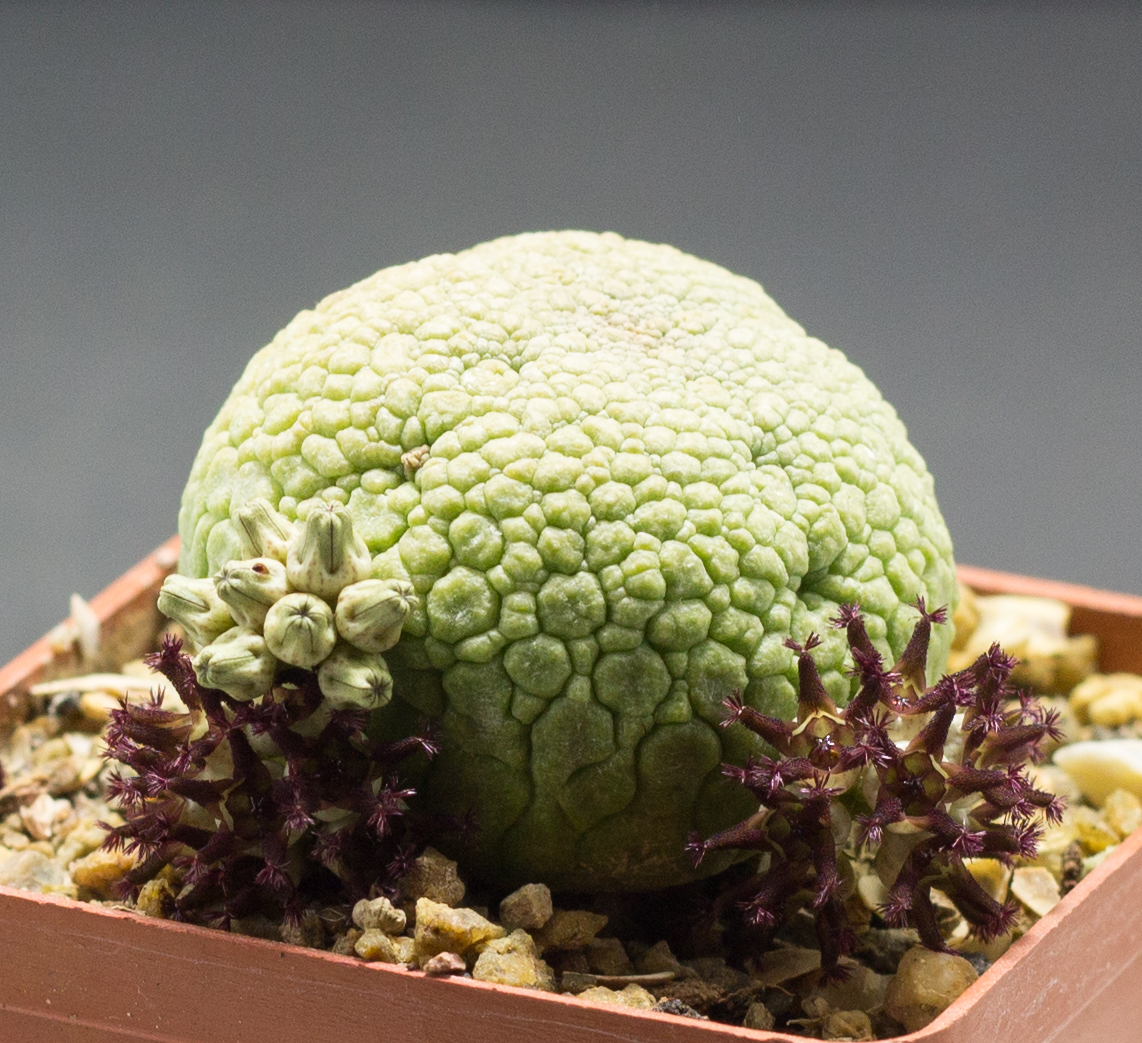
Although Pseudolithos migiurtinus belongs to the milkweed family rather than Cactaceae, its stone-mimicking habit and extreme drought adaptation place it squarely in the rare-succulent collector world. The rounded, tessellated body sits directly on the substrate in the open rocky deserts of northeastern Somalia, where its olive-grey-green to reddish-brown surface renders it effectively invisible against the surrounding grit until an observer is nearly on top of it.
This is the type species of the genus and the species that anchors the entire Pseudolithos cluster. The three siblings on this site compare themselves against it: Pseudolithos cubiformis differs in its sharply cube-shaped body; Pseudolithos caput-viperae branches into multi-headed nodule colonies at adult size; and Pseudolithos mccoyi produces elongated quadrangular stems from the Dhofar coast. P. migiurtinus stays single-stemmed, rounded, and broadly oval.
In cultivation, it is the most forgiving species in the genus. While P. caput-viperae and P. mccoyi are typically grown grafted in northern hemisphere collections, P. migiurtinus grows well ungrafted with careful watering. The flowers are small, dark-red to maroon, laterally positioned at the base of the stem, and emit a carrion scent that draws fly pollinators. Seed pods, when they form, hold 15 to 20 comose seeds each.
Chiovenda described the plant in 1937 as Whitesloanea migiurtina from herbarium material collected in the Migiurtinia region of northeastern Somalia during Italian colonial-era expeditions. The name migiurtinus refers to Migiurtinia, the colonial-period name for the coastal region now known as Puntland and the Bari Region. Bally transferred the species to the newly erected genus Pseudolithos in 1975.
Pseudolithos migiurtinus quick reference
A stone-mimicking stapeliad from the rocky desert of NE Somalia, growing in open gritty substrate in full sun exposure with a bimodal tropical rainfall regime. Values calibrated for seed grown plants in cultivation, drawn from specialist grower experience and habitat data.
Taxonomy & nomenclature
The accepted name is Pseudolithos migiurtinus (Chiov.) P.R.O.Bally, currently placed in family Apocynaceae, subfamily Asclepiadoideae, tribe Ceropegieae, subtribe Stapeliinae. The basionym is Whitesloanea migiurtina Chiovenda, published in Malpighia 34: 542 (1937). Bally transferred the species to the newly erected genus Pseudolithos in 1975, published in National Cactus and Succulent Journal 30(2): 31.
The type species of the genus Pseudolithos is P. sphaericus P.R.O.Bally, now treated as a synonym of P. migiurtinus. Because the type species name is a synonym of P. migiurtinus, this species represents the type species concept of the genus.
Other synonyms include Lithocaulon sphaericum P.R.O.Bally (1959, an invalid genus name; Lithocaulon Bally is a junior homonym of the fossil alga Lithocaulon Meneghini 1857) and Pseudolithos eylensis P.R.O.Bally (1975), now treated under P. migiurtinus by POWO. The eylensis synonym represents a larger-bodied variant from near Eyl (Eil) on the Bari coast; it is not treated as a separate taxon here.
A 2017 phylogenetic revision proposed absorbing Pseudolithos into an expanded Ceropegia, which would make this species Ceropegia migiurtina (Chiov.) Bruyns. POWO does not follow that treatment as of 2026; the site follows POWO and retains Pseudolithos as a distinct genus.
Molecular phylogenetic work placed Pseudolithos as monophyletic within the stapelioid Ceropegieae, with Caralluma as its closest relative and Echidnopsis and Rhytidocaulon as sister genera. The same study transferred P. mccoyi to Anomalluma on molecular grounds, though POWO continues to list it under Pseudolithos. The genus name means “false stone” in Greek (pseudo = false, lithos = stone); the species epithet migiurtinus records the original Migiurtinia collection locality.
Historical synonyms (4)
- White-sloanea migiurtina Chiov., 1937 basionym
- Lithocaulon sphaericum P.R.O.Bally, 1959 heterotypic synonym
- Pseudolithos sphaericus (P.R.O.Bally) P.R.O.Bally, 1965 heterotypic synonym
- Pseudolithos harardheranus Dioli, 2002 heterotypic synonym
Sources: POWO (Kew) · IPNI · GBIF · Wikidata
Habitat
Pseudolithos migiurtinus grows in open, gritty rocky desert in the Bari Region of northeastern Somalia. The substrate is characteristically mineral-only: loose grit and rocky ground with very low organic content, consistent with the limestone and gypsum outcrops typical of the Cal Madow and broader Bari Region geology. The plant sits directly at ground level on flat or gently sloped terrain in full sun, with no cliff-face or overhang association.
The stone-mimicry strategy is the single most ecologically distinctive character of the species. The tessellated grey-green to reddish-brown body closely matches the surrounding grit in both colour and texture, rendering the plant invisible against the substrate from any distance beyond arm’s reach. The genus name encodes this directly. This camouflage, combined with a fly-pollinated carrion flower that completes its reproductive cycle without attracting herbivores, is a highly effective adaptive strategy in a sparsely vegetated, heavily grazed landscape.
The broader ecoregion is Somali montane xeric woodlands and Acacia-Commiphora bushlands, with associated vegetation including Acacia spp., Commiphora spp. (myrrh, frankincense), Boswellia spp., Euphorbia spp., and Aloidendron eminens. No species-level plant community has been documented for the immediate P. migiurtinus microhabitat. Inland habitat is preferred; the species is not reported from fog-collecting coastal cliff environments despite coastal proximity in parts of the Bari Region.
The climate is tropical arid to semi-arid, with mean annual rainfall below 200 mm in the lowlands. Somalia has a bimodal rainfall pattern: the Gu rains (March to July) and Deyr rains (September to November), separated by two dry seasons (Jilaal and Hagaa). Growth in cultivation is summer-active, consistent with warm-season activation. Elevation is not documented in the accessible literature for this species; the Bari Region spans sea level to approximately 2,400 m at Mount Shimbiris, with most shrubland habitats below 500 m.
Morphology
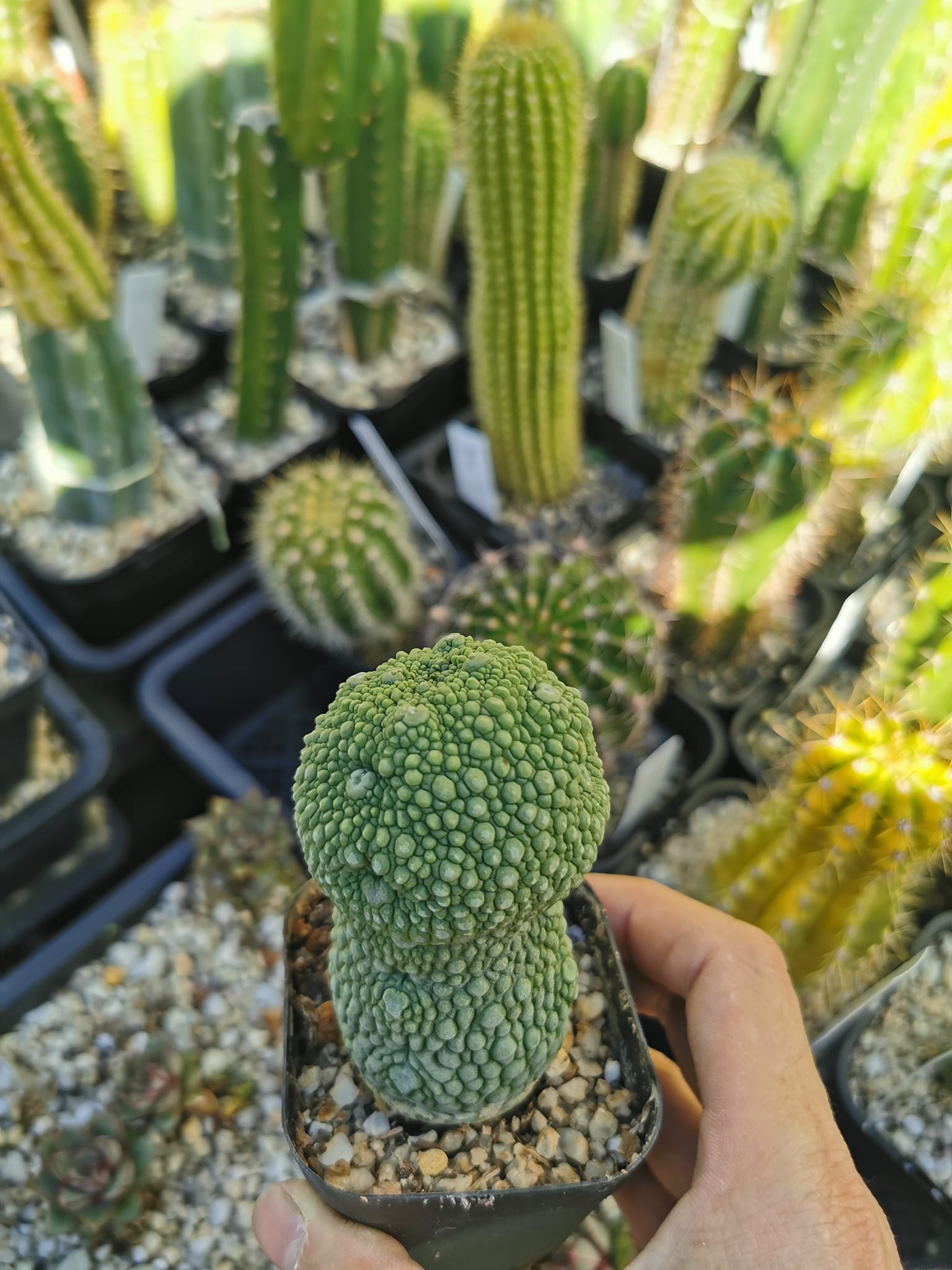
The body is usually solitary and single-stemmed, oval to sub-globose in overall form. Some plants show a sub-quadrangular cross-section; shape is variable enough that POWO describes the habit as “succulent subshrub.” Height reaches up to 8 cm, diameter up to 6 cm. Very old specimens rarely produce a second stem. The Eyl locality variant, formerly described as Pseudolithos eylensis and now treated as a synonym of this species, is an exception: plants from near the town of Eyl in the Bari Region reach up to 12 cm in diameter and 15 cm tall, markedly above the 8 cm height typical of the species.
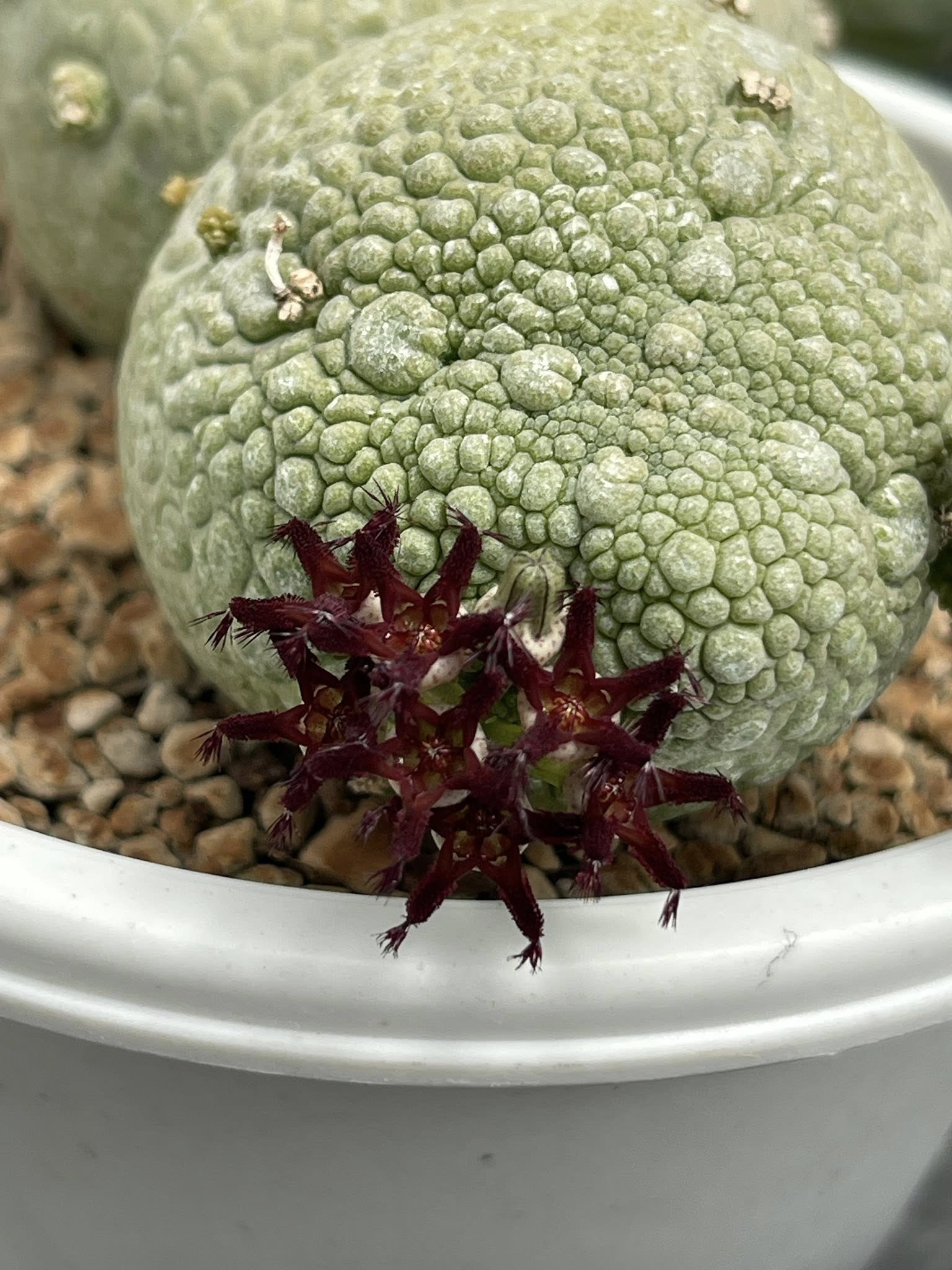
The entire surface is covered with low, rounded knobbly tubercles forming an irregular polygonal tessellation. The tubercles are raised only slightly above the body plane, giving a texture described across specialist sources as knobbly or rough rather than spiny or ridged. There are no spines, no ribs, and no distinct areoles in the cactus sense. The body colour varies with light exposure from light green in shade, through olive-grey-green in partial sun, to reddish-brown under full sun, making it a near-perfect chromatic match for the surrounding grit under any growing condition.
Flowers emerge laterally at the base of the stem rather than apically. Because the plant sits directly on the ground in the wild, “lateral” is effectively synonymous with “at ground level.” Individual corollas measure 5 to 7 mm across. The tube is white to pale green; the lobes are dark red to maroon with short tufted hairs. Flowers appear in small clusters, primarily in late summer, though year-round flowering is possible under warm greenhouse conditions. The smell is often described as rotting meat; it targets the same carrion-fly vectors that service other stapeliads.
Pollinated flowers produce paired follicles up to 8 cm long, each containing approximately 15 to 20 seeds. The seeds are small, dark brown, and comose, bearing the tuft of hairs universal in Asclepiadoideae that carries them on wind currents. The root system is fibrous; unlike some stapeliads, this species does not form a large tuberous storage root.
Locality detail
The native range of Pseudolithos migiurtinus is Somalia, specifically the northeastern corner historically called Migiurtinia and corresponding broadly to the modern Bari Region and Puntland administration. All specialist sources agree on this “NE Somalia” characterisation; one Wikipedia article listing “South and Central Somalia” appears to be erroneous for this species.
The 1937 Chiovenda protologue gives only “Migiurtinia” as the collection locality. No GPS coordinates, municipality, or field-number record for the type collection has been identified in any source reviewed; the original collector is also undocumented. The neotype is the holotype of Lithocaulon sphaericum Bally, collected near the town of Eyl (Eil) on the Bari coast, at approximately 7.97°N, 49.82°E. No published population count or range-area figure exists. Somalia’s civil instability since 1991 has made systematic field surveys essentially impossible, and population trends are unknown. The regional centroid above places the marker at the centre of the Bari Region; no finer resolution is appropriate or available.
Pseudolithos migiurtinus care and cultivation
Among the four Pseudolithos species on this site, P. migiurtinus has the best documented cultivation record. It is consistently described as the easiest starting point in the genus and the species most growers encounter first. The critical variable is not substrate or light but watering discipline: both overwatering and underwatering cause rot, and the transition from healthy plant to irretrievable mush can take only days. Good ventilation is essential.
Get the airflow right and the rest follows.
Substrate
Pseudolithos migiurtinus needs a substrate that drains fast enough to protect the stem base. The recipe is 45 per cent pumice (4 to 5 mm grain size) as the primary aggregate, 8 per cent lava rock, 10 per cent zeolite for cation exchange, 20 per cent granite grit, 10 per cent coarse silica, and 7 per cent worm castings. That organic share comes from grower-practice evidence at the arid stapeliad and caudiciform group level; no source publishes a figure naming P. migiurtinus alone, and the site’s four Pseudolithos species now carry the same organic share rather than an invented split. Limestone chip is not included: no source recommends limestone, dolomite, or oyster grit for this genus. Keep pots small; underpotting prevents residual moisture from pooling after watering.
All four Pseudolithos species on this site share one substrate vector. No published source distinguishes one Pseudolithos species from another on substrate composition, so the same recipe applies across the genus rather than a figure invented per species. Limestone stays at 0 percent because no source at any tier recommends limestone, dolomite, or oyster grit for this genus. The organic share is set from grower-practice evidence at the arid stapeliad and caudiciform group level, not from any single Pseudolithos-only source.
| Species | Pumice | Lava | Zeolite | Granite | Limestone | Silica | Organic |
|---|---|---|---|---|---|---|---|
| P. cubiformis | 45% | 8% | 10% | 20% | 0% | 10% | 7% |
| P. migiurtinus (this page) | 45% | 8% | 10% | 20% | 0% | 10% | 7% |
| P. caput-viperae | 45% | 8% | 10% | 20% | 0% | 10% | 7% |
| P. mccoyi | 45% | 8% | 10% | 20% | 0% | 10% | 7% |
Watering and light
During the active growth season (spring through summer), water regularly when the substrate has fully dried, roughly every 7 to 14 days in warm conditions. The requirement for regular summer moisture is non-negotiable: plants that are kept too dry during hot weather deflate and lose shape. In autumn reduce frequency. Winter rest should be dry or nearly so; if temperatures are maintained above 10°C, light watering once a month can be given, but bone-dry is safer when conditions are cool.
Light requirements reflect the open, sun-exposed rocky-desert habitat. Strong, bright light is appropriate, but protection from the most intense midday sun at peak summer reduces stress. The consensus across specialist sources ranges from “full sun” (Singapore NParks) to “sheltered from full sun” (llifle) to “away from excessive strong sunlight” (specialist grower, Bangkok). Practical target: maximum light short of the harshest afternoon direct sun in midsummer. Good ventilation is at least as important as light level; stagnant air in a closed greenhouse accelerates rot risk.
Cold tolerance
The safe practical minimum is 10°C, consistent across llifle, Giromagi, and specialist grower documentation. Brief dry exposure down to 5°C is reported as survivable for established plants, and some BCSS-adjacent forum growers manage plants at 8°C with careful moisture management. The principle is consistent: cold plus moisture kills; cold plus bone-dry substrate is tolerated. Bottom heat in winter benefits cultivation in northern hemisphere greenhouses.
Propagation
Seed is the standard propagation route. Surface-sow on a mineral mix, keep slightly moist at warm temperatures, and germination can occur within days under tropical conditions or within a few weeks in temperate greenhouses. Seedlings are ready for pricking out after about six months; flowering can occur within one to three years, which is notably faster than the decade-scale timelines associated with comparable rare cacti. Fly pollination is required in the wild; in cultivation, hand pollination or open greenhouse access for flies produces seed. Grafting is not normally required: P. migiurtinus grows well ungrafted with careful watering. This distinguishes it from P. caput-viperae and P. mccoyi, which are typically grafted onto Ceropegia linearis in northern hemisphere cultivation. Emergency rerooting by cutting above a rot line is possible but not a standard practice.
Comparison
As the type species of the genus, P. migiurtinus is the reference point against which all three siblings are measured. The body geometry is the fastest orientation: P. migiurtinus is consistently oval to sub-globose with a rounded cross-section; P. cubiformis is distinctly cube-shaped with a sub-quadrangular cross-section and enlarged shield-like facets running along four cardinal edges. On any photograph, the geometry difference is unambiguous.
The comparison with P. caput-viperae is most relevant at the seedling stage. Its seedlings are reported to be essentially identical to young P. migiurtinus in appearance, which creates a labelling risk in seed-raised batches. At adult size, however, the two are unmistakable: P. caput-viperae branches after approximately one year into a multi-headed colony of nodules 15 to 40 mm tall, while P. migiurtinus remains single-stemmed and reaches up to 8 cm tall.
Pseudolithos mccoyi is the least likely confusion risk: it produces elongated, cylindrical to quadrangular branching stems from the Dhofar coast of Oman and southern Yemen, a range and a body form so distinct from the rounded Somali stone mimic that overlap is unlikely outside an unlabelled seed tray. At the genus level, the tessellated surface texture is the shared character that ties all four species together; within that, body geometry is the most immediately photographable diagnostic.
Frequently asked questions
How do you tell Pseudolithos migiurtinus apart from Pseudolithos cubiformis?
Pseudolithos cubiformis is the species most likely to be confused with P. migiurtinus in a mixed collection. Both are solitary, single-stemmed, tessellated stone mimics from NE Somalia widely grown together by specialists. Drag the slider to compare body geometry, then read the character table.


Body geometry is the fastest check: a plant with a distinct cube or sub-quadrangular cross-section and enlarged shield facets along four edges is cubiformis. A plant with a rounded, oval to sub-globose body and uniformly low knobbly tubercles is migiurtinus. This character is visible in any photograph and resolves the identification without magnification.
Is Pseudolithos migiurtinus difficult to grow?
Intermediate by stapeliad standards and notably easier than its congeners in the genus. P. migiurtinus grows ungrafted without requiring a rootstock, which is not true of P. caput-viperae or P. mccoyi in most northern-hemisphere collections. The central challenge is watering: both too much and too little cause rot, and the warning signs arrive very quickly. Plants need regular water during hot summer days but must dry out fully between waterings and require very good ventilation. Given the right mineral substrate, strong light, and airflow, the species rewards consistent care with steady growth and can reach flowering size from seed within one to three years.
Does Pseudolithos migiurtinus need a CITES permit?
Pseudolithos migiurtinus is not listed under CITES Appendix I, II, or III. Apocynaceae stapeliads fall outside the Cactaceae family-level Appendix II listing that covers most rare cacti, and no genus- or species-level CITES listing for Pseudolithos has been found in any source reviewed. Nursery-propagated plants can be traded and transported across borders in most CITES-signatory countries without CITES documentation. This is a meaningful distinction for collectors who regularly deal with CITES-II cacti and are accustomed to permit requirements. Buyers should still verify current regulations in their jurisdiction, as domestic wildlife law may apply independently of CITES.
Where does Pseudolithos migiurtinus grow in the wild?
In the open rocky desert of the Bari Region in northeastern Somalia, the coastal territory historically called Migiurtinia and now part of the Puntland administration. The plant grows at ground level on flat or gently sloped gritty terrain in full sun, in mineral-only substrate of limestone and gypsum grit. Associated ecoregion vegetation includes Acacia, Commiphora, Boswellia, and Euphorbia species. No precise locality coordinates have been published; Somalia’s civil instability since 1991 has made systematic field surveys essentially impossible, and no population count exists.
How quickly does Pseudolithos migiurtinus reach flowering size from seed?
Faster than most rare succulents of comparable collector status. Under warm conditions, germination can occur within days of sowing, and specialist growers report that seedlings are ready for pricking out after about six months. Flowering can follow within one to three years from seed, based on specialist grower observations in tropical climates. This is substantially faster than the decade-scale timelines for comparable rare cacti such as Aztekium or many Ariocarpus. Hand pollination is required in enclosed collections; plants in open greenhouses where flies have access may set seed spontaneously. Each follicle holds approximately 15 to 20 seeds, so a single pollinated flower can produce a meaningful seed batch.
Why does Pseudolithos migiurtinus rot so easily?
Two failure modes operate independently and produce the same result. Overwatering saturates the fibrous root zone and invites fungal attack at the stem base; the stem softens and the plant can turn to liquid within days without visible warning. Underwatering during active growth causes the body to deflate and the surface tissue to break down in a different but equally rapid sequence. The solution is not moderation but precision: water thoroughly when the substrate is fully dry, then ensure the mix dries completely before the next watering. Equally important is airflow. Stagnant humid air around the plant dramatically raises the rot risk even when the substrate is dry. Keeping pots small (underpotting) reduces the volume of moisture held in the mix and shortens the dry-down period between waterings, which is why specialist growers consistently recommend it.
Sources & further reading
Chiovenda, E. (1937). Whitesloanea migiurtina sp. nov. Malpighia: rassegna mensile di botanica 34: 542 · Bally, P.R.O. (1965). Genus Pseudolithos P.R.O.Bally nov. gen. Candollea 20: 41 · Bally, P.R.O. (1975). Pseudolithos migiurtinus (Chiov.) P.R.O.Bally comb. nov. National Cactus and Succulent Journal 30(2): 31 · Thulin, M. (2006). Flora of Somalia (via Kew POWO synonymy for P. sphaericus under P. migiurtinus) · Kew POWO. Pseudolithos migiurtinus (Chiov.) P.R.O.Bally. IPNI lsid urn:lsid:ipni.org:names:100737-1 · Meve, U. and Liede, S. (2002). A molecular phylogeny and generic rearrangement of the stapelioid Ceropegieae (Apocynaceae-Asclepiadoideae). Plant Systematics and Evolution 234: 171–209 · Bruyns, P.V., Klak, C. and Hanacek, P. (2017). A revised, phylogenetically-based concept of Ceropegia (Apocynaceae). South African Journal of Botany 112: 399–436 · llifle.com Encyclopedia of Living Forms, Pseudolithos migiurtinus entry ID 12758 · llifle.com Encyclopedia of Living Forms, Pseudolithos eylensis entry ID 17907 · NParks Flora & Fauna Web (Singapore), Pseudolithos migiurtinus ID 5446 · Henry Shaw Cactus and Succulent Society (2009). Pseudolithos: plant of the month · Asclepiad Exhibition. Notes on Pseudolithos and Quaqua · Giromagi Cactus and Succulents, Pseudolithos migiurtinus species page · pijaya-plant.blogspot.com. Pseudolithos migiurtinus (cultivation, germination notes, Bangkok) · Wikipedia: Somali montane xeric woodlands (ecoregion, geology, flora context)