
Epithelantha micromeris
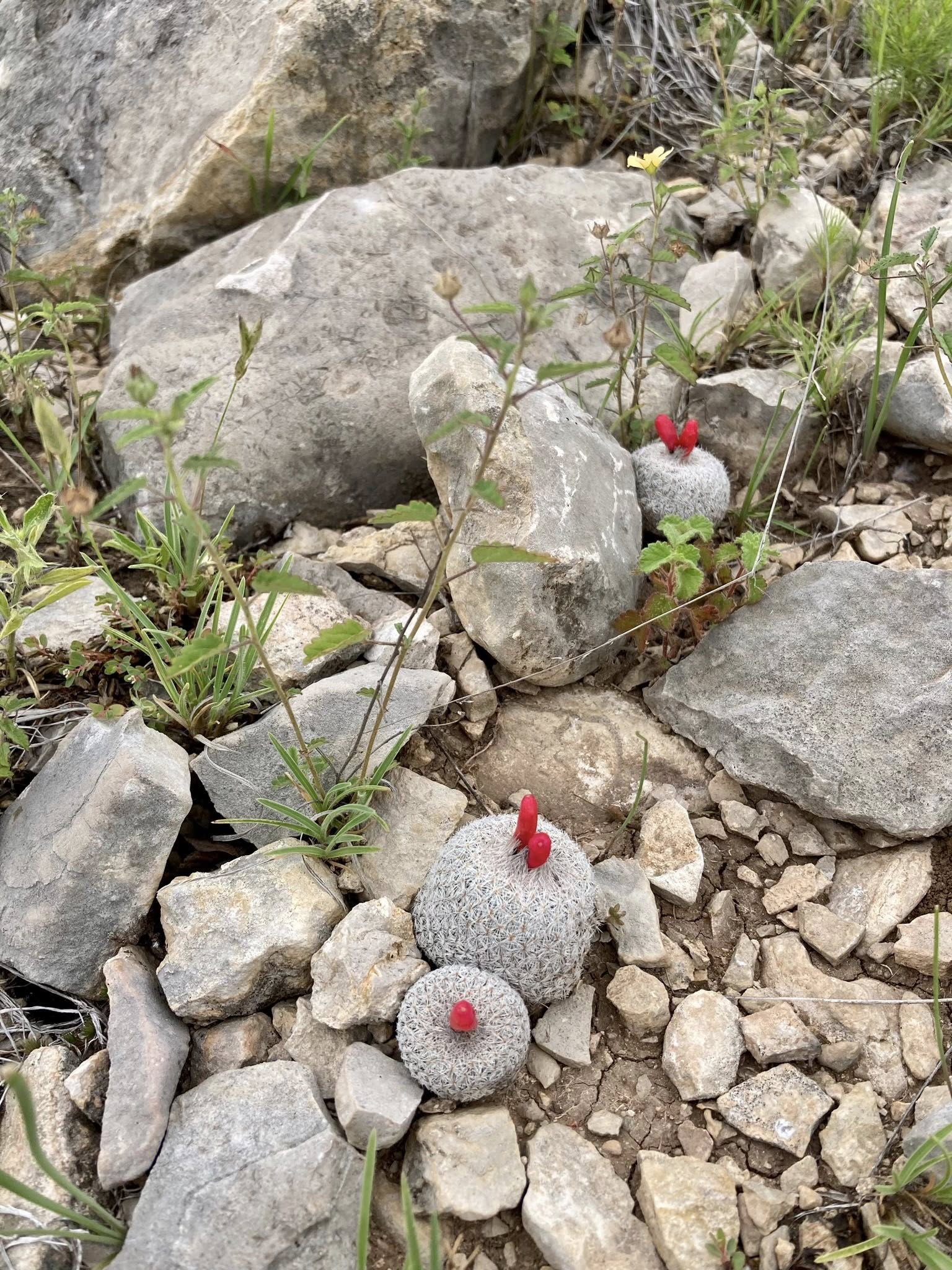
Epithelantha micromeris (Engelm.) F.A.C.Weber ex Britton & Rose is the type species of Epithelantha and the nomenclatural anchor for a genus of ten species accepted by Kew POWO. George Engelmann published the basionym Mammillaria micromeris in 1856 from material collected by Charles Wright on the U.S. and Mexican Boundary Survey, with a type locality of “western Texas, on the upper Pecos and on the Limpia.” Britton and Rose validated both the genus and this combination in The Cactaceae vol. 3 in 1922. The species has the widest range and the highest collector recognition in the genus.
For most of the twentieth century E. micromeris was treated as a broadly circumscribed species absorbing every other taxon in the genus at varietal or subspecific rank. Molecular and morphometric work by Aquino and colleagues, culminating in their 2019 Systematic Botany paper, resolved Epithelantha as a monophyletic group sister to Turbinicarpus and recognised ten species. Epithelantha bokei, Epithelantha greggii, and Epithelantha pachyrhiza were all elevated from infraspecific rank to species level under that treatment. The E. micromeris sensu stricto cultivated today is therefore narrower than what the pre-2010 trade sold under that name.
Among the five Epithelantha taxa on this site, E. micromeris is the most widely distributed and the easiest to source from documented nursery stock. It is also the only autogamous member of the group: a single isolated plant sets seed without a partner clone, which gives it a meaningful propagation advantage over the self-sterile Epithelantha cryptica and over E. bokei, which requires cross-pollination to fruit. That self-fertility is both a practical cultivation benefit and a key morphological signal worth noting at the bench.
The diagnostic character separating E. micromeris from its closest look-alike is spine colour. The pectinate radials on a healthy plant develop pinkish to brownish tips toward the apex, in contrast to the pure chalk-white of E. bokei and the duller ashy-grey of E. greggii. The coral-red elongated berry, held for weeks on the apical crown, is the genus-wide signature and is especially conspicuous on this species. Both features resolve most field and bench identifications quickly.
Epithelantha micromeris quick reference
A Chihuahuan Desert calciphile growing on limestone hills and gravels between 500 and 1,800 m across Trans-Pecos Texas and seven Mexican states. Values calibrated for seed grown plants in cultivation, drawn from species-specific habitat data and grower consensus for E. micromeris rather than genus-level extrapolation.
Taxonomy & nomenclature
The accepted name is Epithelantha micromeris (Engelm.) F.A.C.Weber ex Britton & Rose. The basionym is Mammillaria micromeris Engelm., described in the Proceedings of the American Academy of Arts and Sciences 3: 260 (1856) as part of Engelmann’s Synopsis of the Cactaceae of the Territory of the United States and Adjacent Regions. Type material was collected by Charles Wright on the U.S. and Mexican Boundary Survey under William H. Emory; the protologue type locality is “western Texas, on the upper Pecos and on the Limpia,” placing the type collections in the trans-Pecos limestone country between the Pecos River and Limpia Creek in the Davis Mountains area. Some secondary databases shorthand the locality as “Doña Ana, New Mexico”; this is a database artefact and not the Engelmann citation as printed.
Frédéric A. C. Weber recognised Epithelantha informally in Bois’ Dictionnaire d’Horticulture (1898) but did not validly publish the genus. Britton and Rose validated both genus and species in The Cactaceae vol. 3, pp. 92–93 (1922), and the binomial is therefore correctly cited as “(Engelm.) F.A.C.Weber ex Britton & Rose.” E. micromeris is the type species of the genus and the nomenclatural anchor for all ten POWO-accepted Epithelantha.
For most of the twentieth century the species was treated as a polymorphic aggregate containing every other taxon now recognised in the genus, with subordinate names ranking variously as variety or subspecies. The molecular and morphometric work published in Systematic Botany in 2019 and Ecology and Evolution in 2021 recovered Epithelantha as a monophyletic group sister to Turbinicarpus and elevated the historical infraspecific taxa to species rank. POWO follows that treatment. The contemporary E. micromeris sensu stricto is narrower than pre-2010 collector usage. Principal synonyms include Cactus micromeris (Engelm.) Kuntze (1891), Cephalomamillaria micromeris (Engelm.) Frič (1925), and Epithelantha petri Halda & Horáček (2000).
Historical synonyms (12)
- Mammillaria leucodictia Link, 1848 basionym
- Mammillaria micromeris Engelm., 1856 homotypic synonym
- Cactus micromeris (Engelm.) Kuntze, 1891 homotypic synonym
- Echinocactus micromeris F.A.C.Weber, 1898 homotypic synonym
- Cephalomamillaria micromeris (Engelm.) Fric, 1925 homotypic synonym
- Epithelantha micromeris var. typica Croizat, 1943 homotypic synonym
- Epithelantha micromeris var. caespitosa Y.Itô, 1981 homotypic synonym
- Cactus leucodasys Kuntze, 1891 heterotypic synonym
- Cactus leucodictius (Link ex Otto & Dietr.) Kuntze, 1891 heterotypic synonym
- Epithelantha petri Halda & Horácek, 2000 heterotypic synonym
- Epithelantha unguispina subsp. huastecana D.Donati & Zanov., 2010 heterotypic synonym
- Epithelantha spinosior subsp. huastecana (D.Donati & Zanov.) Lodé, 2020 heterotypic synonym
Sources: POWO (Kew) · IPNI · GBIF · Wikidata
Habitat
Epithelantha micromeris has the widest geographic range of any Epithelantha and is the only species whose range extends substantially north of the U.S.-Mexico border. The U.S. distribution covers southeast Arizona (Cochise and Santa Cruz Counties), south-central New Mexico (Hidalgo, Doña Ana, Eddy and Otero Counties), and far west Texas through the Trans-Pecos and Big Bend country. From there the range continues south into the Chihuahuan Desert across seven Mexican states: Chihuahua, Coahuila, Durango, Nuevo León, San Luis Potosí, Tamaulipas, and Zacatecas. Kew POWO summarises the Mexican portion as “Mexico Northeast,” but the published Mexican literature extends the documented range into Durango, Tamaulipas, and Zacatecas in addition to the core northeastern states; the fuller seven-state range is used here.
The species is a Chihuahuan Desert obligate restricted almost entirely to limestone hills, ledges, gravel pavements, and crevices on sedimentary calcareous substrate. It occasionally appears on igneous rocks but is far more abundant on Cretaceous limestone. Reported elevation spans roughly 500–1,800 m (1,640–5,900 ft), with the bulk of populations in the 900–1,500 m belt. Vegetation associates include desert grassland, Chihuahuan thorn scrub, creosote-tarbush flats, and pinyon-juniper-oak transition at the upper elevation limit. The substrate pH at population level is broadly 7.5–8.2, derived from limestone parent rock.
Climate follows the Chihuahuan Desert monsoon-driven pattern: summer rainfall arrives July through September and triggers the main growth flush; winters are cold and dry. Lower-elevation Mexican populations rarely experience extended freezes; Trans-Pecos Texas populations at higher elevation are exposed to genuine winter cold, with event-level lows reaching −12°C in Brewster County. The species is the cold hardiest in the genus, consistent with its Trans-Pecos and New Mexico presence at latitudes none of the Mexican endemics reach.
Morphology
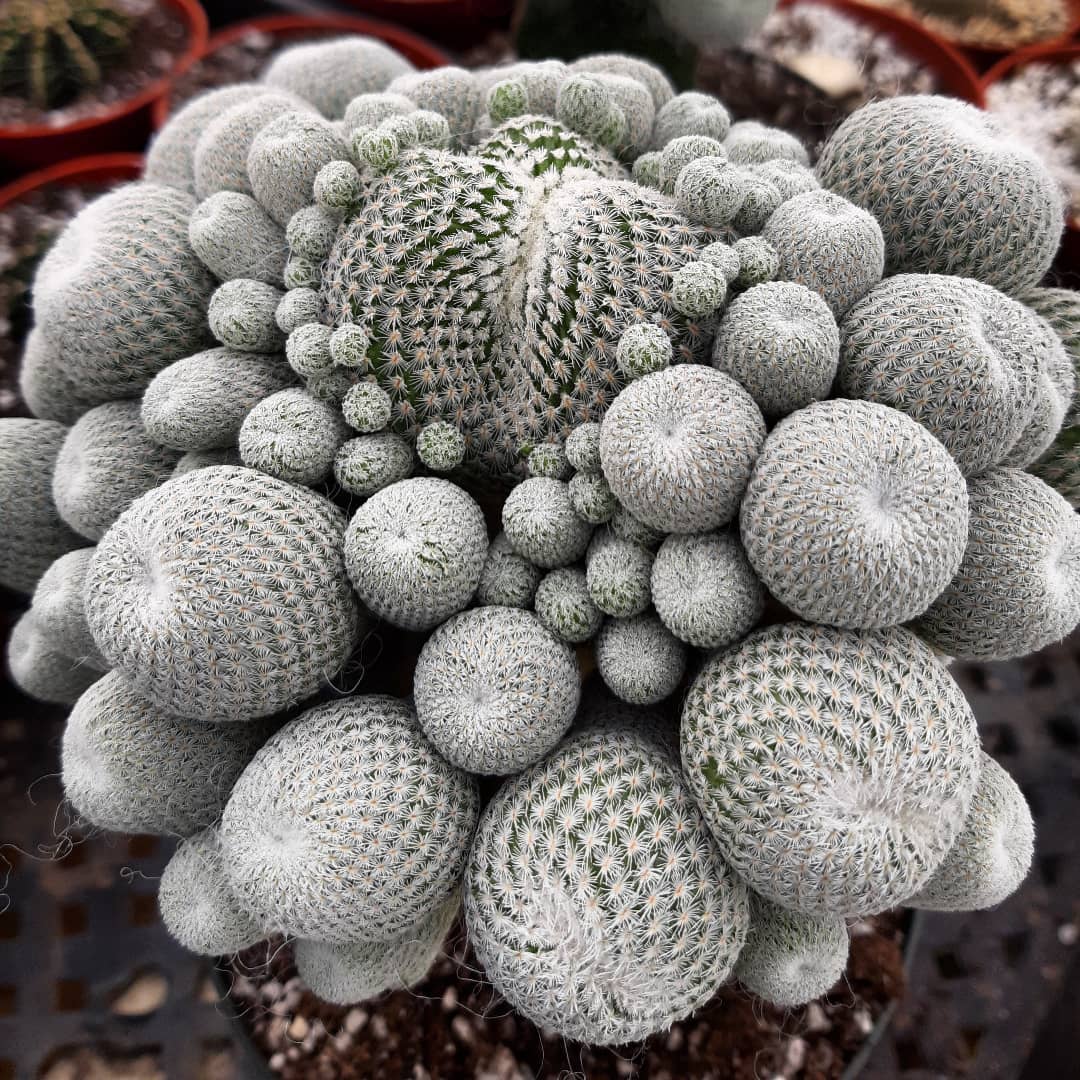
Bodies are among the smallest in the family. Mature plants are simple to sparsely clustering, depressed-globose to globose, with stems 1–5 cm tall (occasionally to 6 cm in cultivation) and 2–4 cm in diameter. The apex carries a tuft of dense felted areolar hair that conceals the flowers when in bud. Tubercles are tightly spiralled in approximately 5-8-13 parastichies but are completely hidden by the spination on a healthy plant.
Spines are the diagnostic feature. Each areole carries 20–35 (rarely to 40) tightly appressed pectinate radial spines, 2–5 mm long, arranged in a flat plane against the stem so the body reads as a smooth grey-white sphere. On mature plants, particularly toward the apex, the spines develop a pinkish to brownish tinge at their tips. This contrasts directly with the pure ivory white of E. bokei and the duller ashy-grey of the much larger E. greggii. Apical spines are slightly longer, stand erect, and are usually shed cleanly each season rather than persisting as a tangled cap.
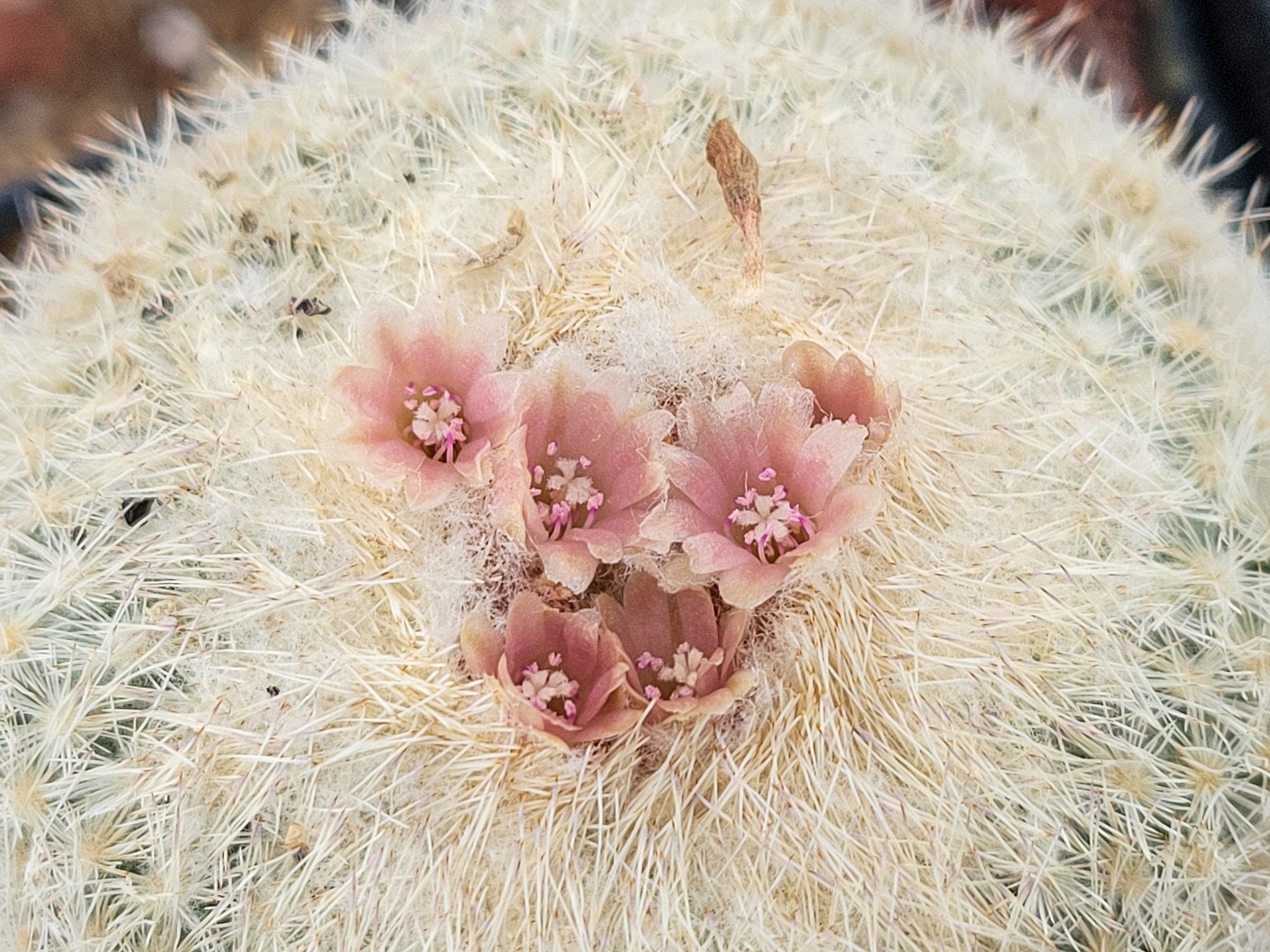
Flowers open at the apex in a tight ring of 1–3 buds at a time: 2–9 mm long, 3–5 mm across, pale pink to pinkish-white, barely emerging from the apical wool. Flowering peaks February to April in habitat, with a secondary flush following monsoon rains in summer. The plant is autogamous: a single isolated specimen sets seed without a partner, which is unusual in the genus and distinguishes it from the self-sterile E. cryptica and the cross-pollination-dependent E. bokei. The fruit is the genus signature: a slender club-shaped to narrowly cylindric berry, 3–20 mm long and 2–5 mm wide, bright coral-red, naked, slightly fleshy, and persistent on the apex for weeks through summer. Seeds are black, 1 mm, and 5–15 per fruit.
Locality detail
The type locality from Engelmann’s 1856 protologue is “western Texas, on the upper Pecos and on the Limpia,” referring to the Pecos River drainage and Limpia Creek in the Davis Mountains region of trans-Pecos Texas. Type material collected by Charles Wright during the U.S. and Mexican Boundary Survey is held at the Missouri Botanical Garden (MO). Some secondary databases record the type locality as “Doña Ana, New Mexico”; this abbreviates a broader collecting itinerary and does not reflect the text of the protologue.
The map above marks state-level centroids rather than population coordinates. The species is documented across a large area with numerous subpopulations; the IUCN assessment confirms extent of occurrence well above the threatened-category threshold. The US range covers three states: Southeast Arizona, south-central New Mexico (Hidalgo, Doña Ana, Eddy, Otero counties), and the Trans-Pecos region of Texas. The Mexican range covers seven states. Kew POWO describes the Mexican range as “Mexico Northeast,” but the published Mexican literature places the species in Durango, Tamaulipas, and Zacatecas as well as the four core northeastern states; all seven are mapped here.
Epithelantha micromeris care and cultivation
Epithelantha micromeris is slow and unforgiving of overwatering, but uncomplicated to keep alive on the right substrate. The species tolerates collector cultivation well, flowers reliably when the winter rest is respected, and produces seed without a partner plant. The two failure modes that account for almost all losses are root rot from winter moisture and etiolation from insufficient light. Both are avoidable.
Substrate
The substrate must be aggressively mineral. In the wild, this species grows on Cretaceous limestone and Chihuahuan Desert-derived calcareous gravels. In cultivation, the house mix targets pH 7.5–8.2. A 90% inorganic / 10% organic mix built from pumice, lava, crushed limestone, granite grit, zeolite, silica, and a small fraction of worm castings is the house working mix. The limestone fraction (crushed horticultural limestone or oyster grit) is grower convention for the genus, not a proven requirement of this species. Whether that share suits your plants depends heavily on your water: hard tap water already supplies calcium and bicarbonate at every watering, while rainwater and RO water supply neither. The specific breakdown is 35% pumice, 15% lava, 15% crushed limestone, 10% zeolite, 10% granite grit, 5% silica, and 10% worm castings.
All five Epithelantha species on this site share a 90/10 inorganic-to-organic baseline; limestone and silica percentages shift with each species’s calcareous dependence in the wild.
| Species | Pumice | Lava | Zeolite | Granite | Limestone | Silica | Organic |
|---|---|---|---|---|---|---|---|
| E. bokei | 40% | 10% | 15% | 0% | 25% | 0% | 10% |
| E. micromeris (this page) | 35% | 15% | 10% | 10% | 15% | 5% | 10% |
| E. greggii | 35% | 20% | 10% | 10% | 15% | 0% | 10% |
| E. pachyrhiza | 30% | 20% | 10% | 10% | 25% | 0% | 5% |
| E. cryptica | 40% | 15% | 10% | 10% | 20% | 0% | 5% |
Watering and light
Cease watering from November through March. The substrate must be bone dry at the pot base through this period; winter moisture combined with cool temperatures collapses the root system without visible above-ground symptoms until the plant is already beyond recovery. Resume in late March or April with a single thorough soak, then allow complete drying over 12–16 days before the next cycle. From May through September, water when the top 4–5 cm is fully dry. Water from below or at the base, never from above; the fine apical spination traps moisture and the apical wool dries slowly, raising rot risk at the apex if overhead watering is used repeatedly.
Light should be full sun. The pinkish apical spine tipping that identifies the species and separates it from E. bokei requires strong UV to develop and hold. Plants kept in shade produce pale, elongated apical growth that loses the compact sphere form and obscures the diagnostic colour. A south-facing position under glass or outdoors in dry climates is the minimum; full outdoor summer growing is strongly preferred at temperate latitudes.
Propagation from seed
Self-fertility is the propagation advantage that makes this species more tractable from seed than most of its congeners. A single mature plant produces viable seed without a second individual. Seeds germinate at 25–28°C in 10–21 days. Move seedlings into full light and open air early to develop compact adult spination. First flowering on a well-grown plant with proper winter rest arrives at four to six years. Offsets, where they form, root after a one-week callus.
Comparison
Epithelantha bokei is the closest look-alike. E. bokei is smaller, more sharply concave at the apex, and covered in the most uniform pure-white pectinate spines in the genus; the surface reads as if the plant has been dipped in chalk. E. micromeris is taller-bodied, less tidy, and frequently shows pink to brown tipped apical spines. The cultivation difference is significant: E. bokei is self-incompatible and requires a second genetically distinct clone to set seed. E. micromeris is autogamous. Mature E. bokei almost always develops annual constriction rings in the stem tissue; mature E. micromeris rarely does.
Epithelantha greggii is the largest accepted Epithelantha, with bodies easily three times the diameter of E. micromeris, an ashy-grey rather than pinkish-white spine cast, and a flat-topped apex. It is endemic to the Saltillo region of Coahuila. The size difference alone resolves any field confusion at a glance.
Epithelantha pachyrhiza has a tiny aerial body sitting on a swollen turnip-shaped taproot. The above-ground stem can look superficially like a small E. micromeris, but lifting the plant exposes the diagnostic enlarged root that makes E. pachyrhiza immediately recognisable. Mammillaria lasiacantha, particularly its small denudate forms, shares the white pectinate look at a distance. The split is obvious on the flowering plant: Mammillaria produces flowers from the axils of older tubercles lower on the plant, while Epithelantha flowers exclusively from the woolly apex. Fruit shape is equally diagnostic: the Mammillaria berry is club-shaped and ripens slowly to red; the Epithelantha berry is slender, bright coral, and persistent.
Frequently asked questions
Is Epithelantha micromeris hard to grow?
Intermediate. The species is not fragile, but it punishes two specific errors without warning. First, overwatering during the cool season collapses the root system before any above-ground symptom appears; the substrate must be bone dry from November through March. Second, insufficient light produces elongated apical growth that loses the compact sphere form and the pink spine tipping that makes the plant worth growing. On the right limestone-heavy substrate with full sun and a respected winter rest, the species is rewarding and long-lived.
Can Epithelantha micromeris be grown from seed?
Yes, and this species has a propagation advantage over most of its genus: it is autogamous, meaning a single isolated plant sets viable seed without a pollinator partner or a second specimen. Seeds germinate at 25–28°C in 10–21 days. Move seedlings into full light and open air early to develop compact adult spination; excessive humidity delays spine development and invites damping-off. First flowering on a well-grown plant with proper winter rest arrives at four to six years from seed. The seed grown target is worth the wait: grafted plants gain speed but never settle into the flat-globose habit of the full-term plant.
Is Epithelantha micromeris legal to own?
Yes, with documentation. The species is listed under CITES Appendix II through the family-level Cactaceae listing, which permits international commercial trade with proper export permits from the country of origin. In Mexico it is additionally protected under NOM-059-SEMARNAT-2010 as “Sujeta a protección especial.” Domestic trade in nursery-propagated material within a single country does not require CITES documentation. Documented nursery-propagated stock is both the legally defensible and ethically correct source; wild-collected material from Mexico or Texas is not legally tradeable without CITES documentation, which is not issued for wild-collected stock under the standard Appendix II regime.
Where does button cactus grow in the wild?
Across the Chihuahuan Desert from Trans-Pecos Texas and adjacent U.S. states south into seven Mexican states. The U.S. range covers southeast Arizona, south-central New Mexico, and far west Texas through Big Bend country. In Mexico the documented range extends across Chihuahua, Coahuila, Durango, Nuevo León, San Luis Potosí, Tamaulipas, and Zacatecas. Populations grow almost entirely on Cretaceous limestone hills, ledges, and gravels, between 500 and 1,800 m elevation. The species is present in multiple protected areas, including Big Bend National Park and Cuatrociénegas.
When does Epithelantha micromeris flower?
February through April is the primary flush in habitat, with a secondary flush following summer monsoon rains. In cultivation at temperate latitudes, flowering typically occurs March through May after the winter rest break. Flowers are pale pink to pinkish-white, 2–9 mm long, and open at the apex in rings of 1–3 buds at a time, barely emerging from the dense apical wool. The flower is not the main visual event; the coral-red elongated berry that follows is the genus signature and persists conspicuously on the crown for weeks through summer.
Sources & further reading
Engelmann, G. (1856). Synopsis of the Cactaceae of the Territory of the United States and Adjacent Regions. Proceedings of the American Academy of Arts and Sciences 3: 259–314. (Protologue of Mammillaria micromeris, p. 260.) · Britton, N.L. & Rose, J.N. (1922). The Cactaceae: Descriptions and Illustrations of Plants of the Cactus Family, vol. 3, pp. 92–93. Carnegie Institution of Washington. (Validation of genus Epithelantha and combination E. micromeris.) · Aquino, D., Cervantes, A., Gernandt, D.S. & Arias, S. (2019). Species Delimitation and Phylogeny of Epithelantha (Cactaceae). Systematic Botany 44(3): 600–616. · Aquino, D., Gernandt, D.S. & Arias, S. (2021). The importance of environmental conditions in maintaining lineage identity in Epithelantha (Cactaceae). Ecology and Evolution 11(8): 3596–3611. · Plants of the World Online (POWO). Epithelantha micromeris (Engelm.) F.A.C.Weber ex Britton & Rose. Royal Botanic Gardens, Kew. powo.science.kew.org · IUCN Red List of Threatened Species (2017). Epithelantha micromeris assessment. Category: Least Concern. iucnredlist.org/species/152537/121478420 · Anderson, E.F. (2001). The Cactus Family. Timber Press, Portland. Epithelantha treatment, pp. 274–276. · Hunt, D., Taylor, N. & Charles, G. (eds.) (2013). The New Cactus Lexicon, 2nd edition. dh books, Milborne Port. Epithelantha micromeris entry. · Powell, A.M. & Weedin, J.F. (2004). Cacti of the Trans-Pecos and Adjacent Areas. Texas Tech University Press, Lubbock. · Hernández, H.M. & Gómez-Hinostrosa, C. (2015). Mapping the Cacti of Mexico, Part II. dh books / Cactus Conservation Initiative. (Mexican range and protected-area coverage.) · Flora of North America Editorial Committee (2003+). Flora of North America North of Mexico, vol. 4. Epithelantha micromeris treatment. · CONABIO / SEMARNAT. NOM-059-SEMARNAT-2010 protected species list and 2019 revision. Comisión Nacional para el Conocimiento y Uso de la Biodiversidad, Mexico. · Pérez-Molphe-Balch, E. et al. (2012). Micropropagación de Epithelantha micromeris (Engelm.) F.A.C. Weber ex Britt. & Rose. Revista Mexicana de Ciencias Agrícolas 3(6). scielo.org.mx · Henry Shaw Cactus and Succulent Society (2018). Plant of the Month: Epithelantha. hscactus.org · CITES Appendix II Cactaceae blanket listing. cites.org