
Epithelantha pachyrhiza
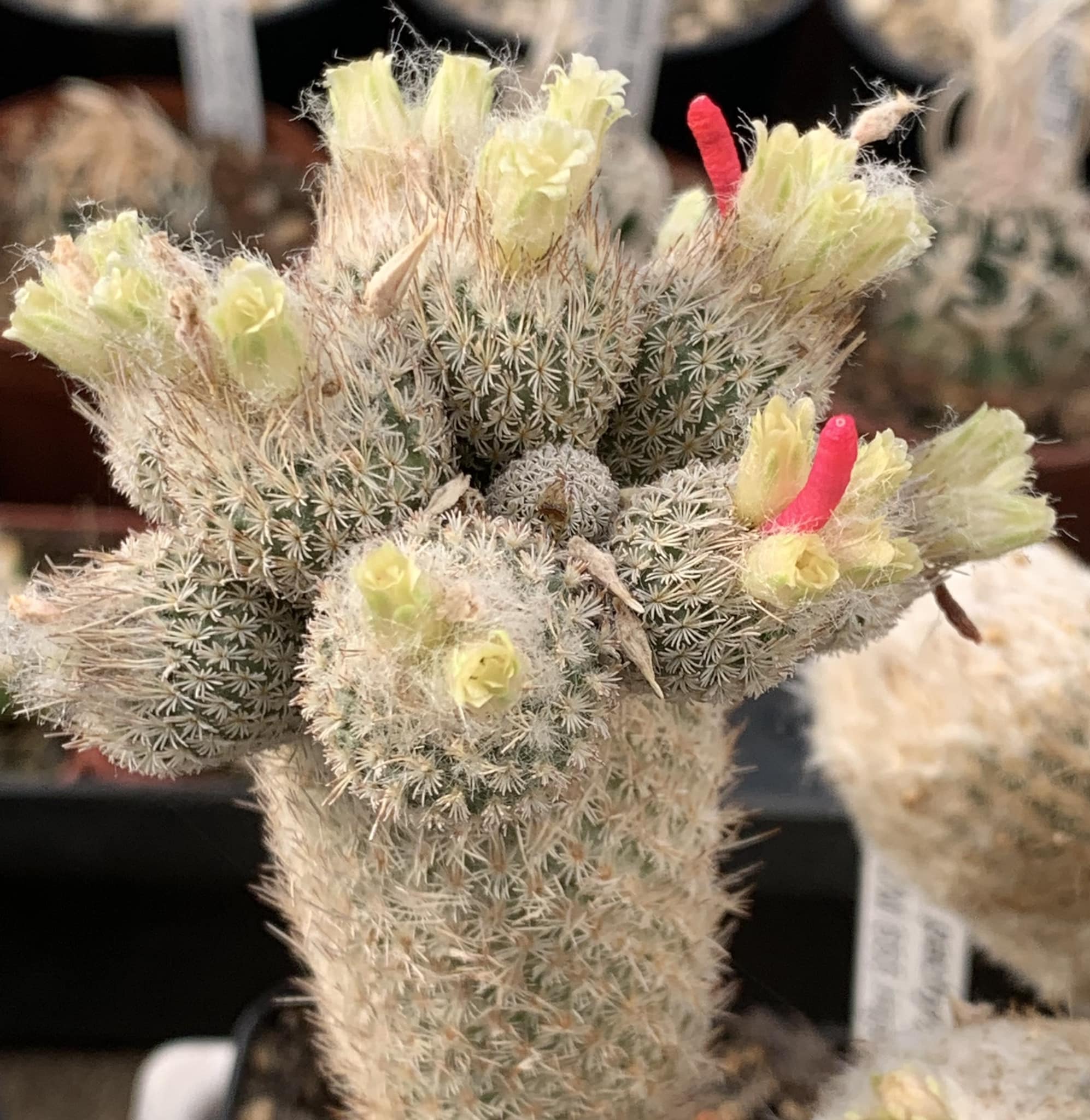
Epithelantha pachyrhiza (W.T.Marshall) Backeb. is a small, taproot-bearing button cactus restricted to the southern limestone country of Coahuila state in northeast Mexico. William Taylor Marshall first described the plant in 1944 as a variety of the widespread Epithelantha micromeris, publishing the basionym Epithelantha micromeris var. pachyrhiza in Cactus and Succulent Journal (Los Angeles) 16: 161. Curt Backeberg raised it to species rank ten years later, in Cactus (Paris) 39: 31 (1954). The epithet is descriptive Greek: pachys (thick, stout) plus rhiza (root), which names the swollen napiform taproot that makes this species immediately recognisable to any grower who has lifted one from its pot.
Two rank treatments currently coexist in the literature. Kew POWO, IPNI, and the 2019 chloroplast phylogeny by Donati and Zanovello in Systematic Botany 44(3) all accept E. pachyrhiza at species rank. The older treatment by N.P. Taylor in Cactaceae Consensus Initiatives 5: 13 (1998), followed by Anderson’s The Cactus Family (2001) and most European nurseries, retains E. micromeris subsp. pachyrhiza. This site follows POWO and the Donati-Zanovello molecular arrangement; plants sold under either name in trade refer to the same taxon. The two infraspecific names erected by Donati and Zanovello in 2010, subsp. elongata and subsp. parvula, are listed as POWO synonyms: the 2019 phylogeny did not recover either as a strongly supported clade, and most curators now lump both under the nominate.
Within the Epithelantha genus as circumscribed by POWO, E. pachyrhiza is the only member with a consistently swollen, fleshy taproot. The type species Epithelantha micromeris and the Big Bend endemic Epithelantha bokei both carry fibrous root systems; the taproot of pachyrhiza is the single most reliable vegetative character separating the taxon from every other species in the genus. Closely related in range but morphologically distinct, Epithelantha greggii is the larger-bodied Saltillo endemic with ashy-grey rougher spination and also lacks the diagnostic taproot.
Collector interest in E. pachyrhiza is almost entirely driven by that underground architecture. The exposed-root presentation, where successive repottings gradually lift the swollen tuber above the substrate level until it stands like a bonsai’s nebari, is a practised horticultural art confined to this species and a handful of other taproot-bearing cacti. Specimens with fully exposed, well-hardened taproots command significant prices on the specialist market. Plants grown from seed develop the architecture cleanly from the start; grafted stock on Pereskiopsis or Hylocereus never forms the taproot at all, which makes provenance the first question any serious buyer asks.
Epithelantha pachyrhiza quick reference
A button cactus of the Coahuilan highlands, growing on calcareous bedrock and cliff crevices between 1,400 and 2,300 m. Values calibrated for seed grown plants in cultivation, drawn from habitat data and grower accounts specific to E. pachyrhiza. The taproot architecture demands a deep container; these values assume a pot at least 12–15 cm deep.
Taxonomy & nomenclature
The accepted name is Epithelantha pachyrhiza (W.T.Marshall) Backeb., the basionym being Epithelantha micromeris var. pachyrhiza W.T.Marshall, published in Cactus and Succulent Journal (Los Angeles) 16: 161, fig. 150 (1944). Marshall’s description was the first formal recognition of the swollen-root Coahuilan button cactus as taxonomically distinct from the widespread E. micromeris sensu stricto. Curt Backeberg effected the rank elevation to species in Cactus (Paris) 39: 31 (1954), citing the magnitude of the taproot divergence as justifying species recognition.
The nomenclatural history since Backeberg is contested. N.P. Taylor reduced the taxon back to subspecific rank as Epithelantha micromeris subsp. pachyrhiza (W.T.Marshall) N.P.Taylor in Cactaceae Consensus Initiatives 5: 13 (1998). Anderson’s The Cactus Family (2001) and most subsequent cultivation literature followed Taylor’s arrangement. The 2019 cpDNA phylogeny by Donati and Zanovello, sampling four chloroplast regions (petL-psbE, psbA-trnH, trnL-F, trnQ-rps16), recovered E. pachyrhiza as a strongly supported clade distinct from the E. micromeris lineage. POWO adopted the species-rank treatment following that phylogenetic work, and this site follows POWO. Growers who source material from European nurseries will encounter the subspecific label; both names refer to the same plants.
Donati and Zanovello also erected two infraspecific taxa in 2010: Epithelantha pachyrhiza subsp. elongata (Backeb.) D.Donati & Zanov. (based on Backeberg’s 1954 E. micromeris var. elongata) and subsp. parvula D.Donati & Zanov. Their 2019 phylogeny did not recover either subspecies as a statistically supported clade, and POWO treats both as synonyms of E. pachyrhiza sensu stricto. Mesa Garden and some collector lists continue to offer material under the subspecific labels; morphological variability in body elongation and root proportions is real but clinal rather than discrete enough to sustain formal rank.
Historical synonyms (7)
- Epithelantha pachyrhiza var. elongata Backeb., 1954 homotypic synonym
- Epithelantha pachyrhiza subsp. elongata (Backeb.) D.Donati & Zanov., 2010 homotypic synonym
- Epithelantha pachyrhiza subsp. parvula D.Donati & Zanov., 2010 homotypic synonym
- Epithelantha micromeris var. pachyrhiza W.T.Marshall, 1944 heterotypic synonym
- Epithelantha micromeris var. elongata Backeb., 1954 heterotypic synonym
- Epithelantha micromeris f. elongata (Backeb.) Bravo, 1980 heterotypic synonym
- Epithelantha micromeris subsp. pachyrhiza (W.T.Marshall) N.P.Taylor, 1998 heterotypic synonym
Sources: GBIF
Habitat
Epithelantha pachyrhiza is a Coahuilan microendemic with no confirmed populations outside a compact area around Saltillo, the state capital of Coahuila in northeast Mexico. The type locality, given by Marshall as the country southwest of Saltillo toward the Carneros Pass, lies approximately 29 km south of the city. Confirmed populations also cluster at Higueras, Coahuila, the source of the widely circulated field-collected lot SB325 collected by Steven Brack, and at Ramón Arispe on the eastern side of Saltillo. The species does not cross into neighbouring Nuevo León, Zacatecas, or Durango, and no populations have been confirmed beyond the southern Coahuilan limestone belt. Its congener Epithelantha cryptica Donati & Zanov. (2011) is known from a single nearby Coahuilan locality and also lacks the taproot, suggesting that the pachyrhiza root architecture is geographically as well as morphologically isolated within the genus.
Elevation across the documented range runs from 1,400 m to 2,300 m, with most records in the 1,800 to 2,200 m band on the Sierra Madre Oriental foothills above Saltillo. The habitat is steep calcareous cliffs, gravelly limestone scree slopes, and bedding-plane crevices where wind-blown soil and leaf litter accumulate in pockets. Associated vegetation includes Juniperus flaccida, J. deppeana, rosette agaves, small-bodied turbinicarpi, and occasional Pinus at the upper margin. The microhabitat is more shaded and seasonally more humid than the open Chihuahuan Desert flats occupied by E. micromeris sensu stricto; that ecological contrast aligns with the morphological one and reinforces the argument for species-level separation.
Substrate is uniformly calcareous. Parent rock is limestone throughout the documented range, with soil pH in the 7.5 to 8.2 range at the crevice sites where plants are wedged. The plants grow with their taproots plunging vertically into deep cracks or between rock laminations, with only the small aerial body protruding above the stone surface. In wider gravel sites the taproot may be compact and turnip-shaped; on steeper cliff faces where the root follows a narrow vertical crack, it elongates markedly into a parsnip form. Both growth geometries occur within the same locality depending on the physical character of the available substrate crack.
Morphology
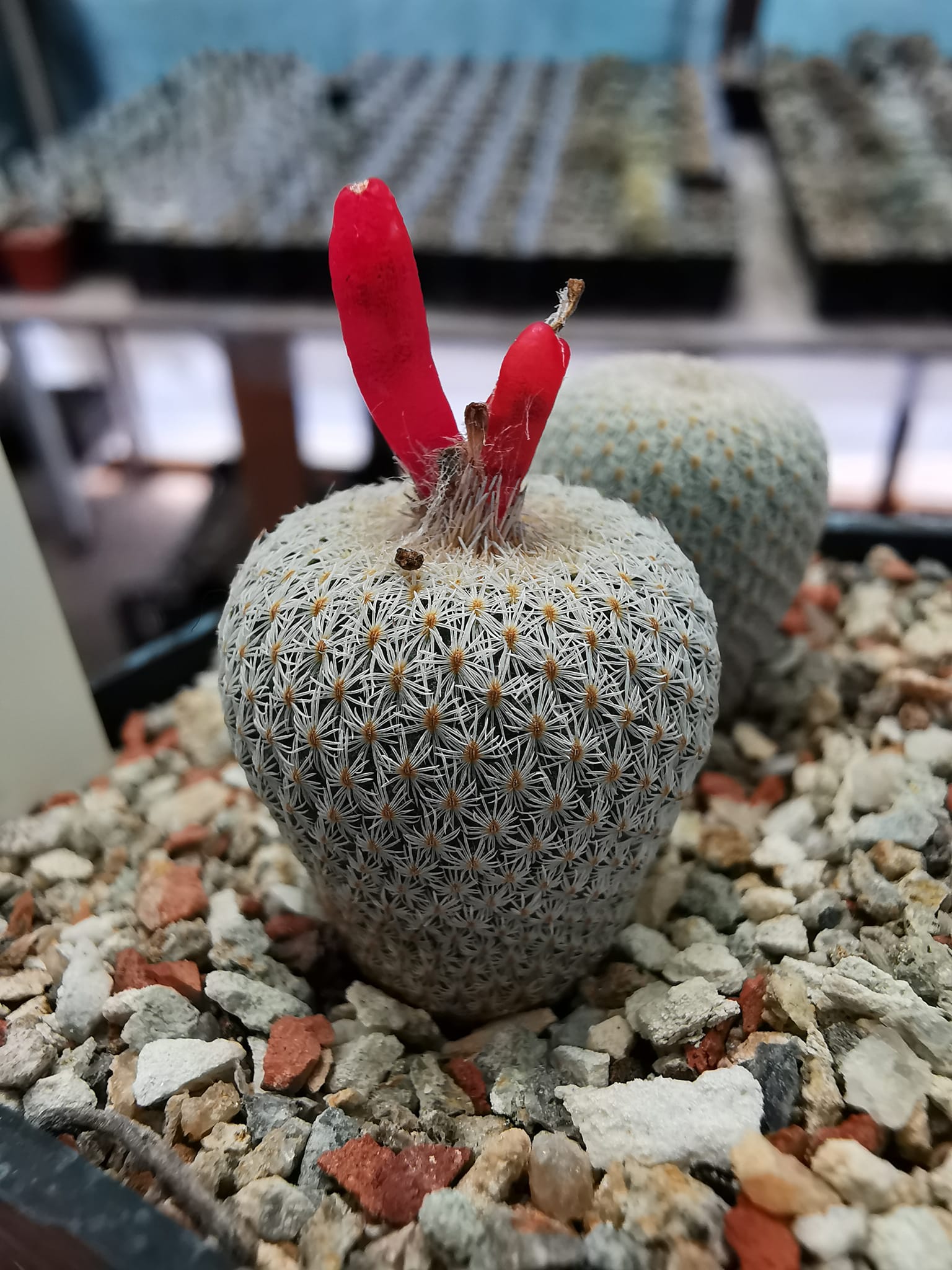
The aerial body is small, depressed-globose to short-cylindrical, 2 to 4 cm in diameter and seldom more than 4 cm above the surface in habitat plants. With age the body elongates slowly and may reach 8 to 10 cm of total visible stem in undisturbed cultivated specimens, though the exposed portion in habitat almost never exceeds 5 cm because seasonal contraction pulls the plant tight to the substrate during dry periods. Tubercles are minute, conical, packed in low spirals, and crowned with closely-set areoles each carrying 16 to 24 short radial spines. The radials are 1 to 2 mm long, slightly flattened, white to pale orange-tan or bluish-tan, pectinate, and arranged in a single layer. Centrals are absent or vestigial. Spine cover is partial: portions of the green epidermis remain visible between areoles, a feature that separates pachyrhiza from E. micromeris sensu stricto and from E. bokei, where the body is almost entirely concealed under dense fine spines.
Below the aerial body lies the structure that defines the species. The taproot begins at a narrow, slightly constricted neck and swells into a fleshy, napiform to carrot-shaped tuber, typically 3 to 8 cm long and 1.5 to 4 cm wide at its broadest point, tapering to a fine apex. The root tissue is firm and pale, with a corky outer skin in mature plants. The constricted neck between body and root reliably identifies pachyrhiza in cultivation, where it is exposed by careful repotting and serves as the showpiece of the species. Habitat plants growing in steep cliff crevices develop a markedly elongated, parsnip-shaped root following the crack geometry; plants in flatter gravel sites develop the more compact turnip shape. Both forms occur within the same population.
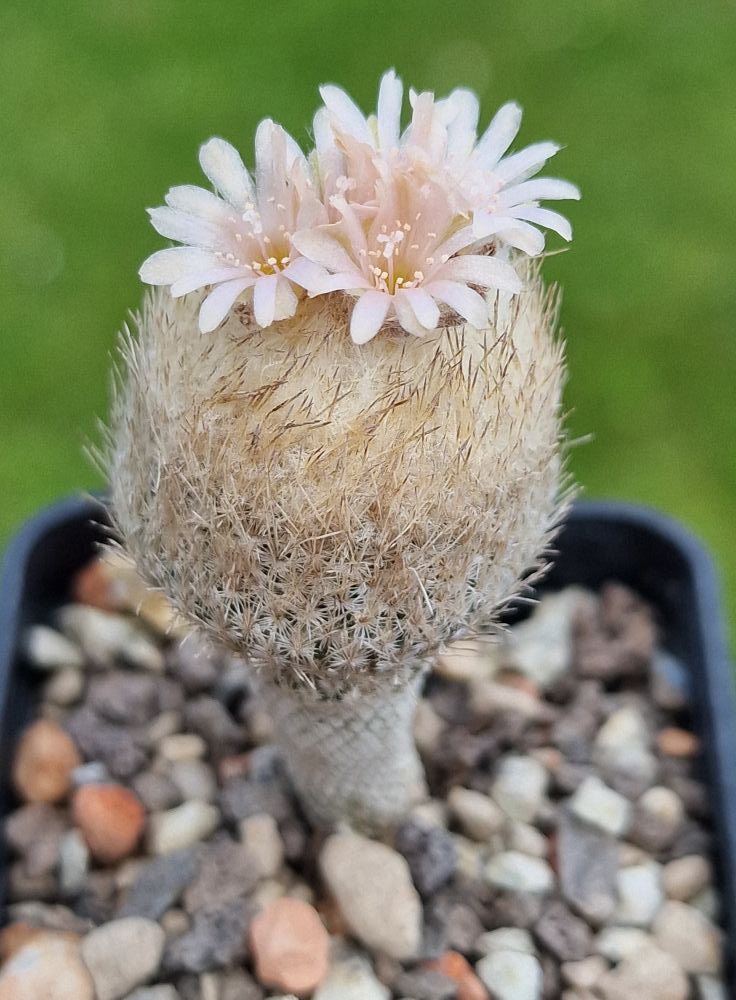
Flowers are produced from the woolly apex during late spring and early summer. They are small, 8 to 12 mm across, bell-shaped to narrowly funnelform, pinkish-white to pale rose, with perianth segments that barely clear the apical wool. The species is reported as self-incompatible, requiring cross-pollination for viable seed, in contrast to the self-fertile E. micromeris. Fruits are slender, club-shaped to elongate-cylindrical, 8 to 15 mm long, bright pink to coral-red at maturity, emerging from beneath the apical wool several months after flowering. Seeds are minute, black, 0.7 to 1.0 mm long, with a punctate testa.
Locality detail
All confirmed populations of Epithelantha pachyrhiza fall within a compact area of southern Coahuila, centred on the Saltillo metropolitan area and its immediate surroundings. The type locality is the limestone country southwest of Saltillo toward the Carneros Pass, described by Marshall in 1944 as approximately 18 miles (29 km) south of the city. Populations at Higueras, associated with Steven Brack’s SB325 collection lot, and at Ramón Arispe on the eastern side of Saltillo are the other named localities in the literature. The total area of occupancy is on the order of a few tens of square kilometres, all within a single Mexican state.
The map above marks town-level centroids rather than precise GPS coordinates. Exact population localities for CITES Appendix II species are withheld on this site to reduce the risk of targeted poaching, consistent with IUCN guidance on sensitive-species locality data. The Higueras provenance is already public through the SB325 field number and is presented here at the town level, which is the precision published in the literature.
Epithelantha pachyrhiza care and cultivation
Cultivating Epithelantha pachyrhiza well requires two non-negotiable decisions before the first potting: the right container depth and a fast-draining mineral substrate. Every other variable is secondary. Get those two wrong and the plant will decline slowly; get them right and the species is undemanding.
Substrate
A deep container is a non-negotiable requirement for the taproot. A 95% inorganic / 5% organic working recipe: 30% pumice (3–6 mm), 20% lava rock, 25% crushed limestone chip (3–6 mm horticultural limestone), 10% zeolite, 10% granite grit, and 5% worm castings as the sole organic component, targeting a house pH of 7.5–8.2. The crushed limestone fraction is grower convention for the genus, not a proven requirement of this species. Whether that share suits your plants depends heavily on your water: hard tap water already supplies calcium and bicarbonate at every watering, while rainwater and RO water supply neither. Avoid akadama, peat, bark fines, and coir; all four retain moisture at the root zone for longer than the plant tolerates.
All five Epithelantha species on this site share a calcareous inorganic baseline; E. pachyrhiza ties for the highest limestone fraction and for the lowest organic component among the five. Those limestone shares are house convention, not species requirements.
| Species | Pumice | Lava | Zeolite | Granite | Limestone | Silica | Organic |
|---|---|---|---|---|---|---|---|
| E. bokei | 40% | 10% | 15% | 0% | 25% | 0% | 10% |
| E. micromeris | 35% | 15% | 10% | 10% | 15% | 5% | 10% |
| E. greggii | 35% | 20% | 10% | 10% | 15% | 0% | 10% |
| E. pachyrhiza (this page) | 30% | 20% | 10% | 10% | 25% | 0% | 5% |
| E. cryptica | 40% | 15% | 10% | 10% | 20% | 0% | 5% |
Container
Container choice is not optional. The taproot demands vertical space; a standard shallow cactus pan forces it to coil back on itself, which is the most common cause of slow decline in cultivated material. Use a pot at least 12 to 15 cm deep, sized so the taproot has room to extend without touching the base. Long-tom pots, deep square plastic, and tall cylindrical clay all work. Squat azalea pots do not. Repot every two to three years in early spring, taking the opportunity to inspect the root for rot and to refresh the surface gravel mulch. Each repotting is also the window for gradually exposing more of the taproot if the display-root technique is the goal.
Watering and light
Water sparingly from late spring through early autumn: a thorough soak followed by a complete drydown of two to three weeks between waterings. In winter the plant must be kept completely dry and cool; 5 to 10°C is ideal. Cold-wet coincidence at any temperature above freezing collapses the root faster than frost exposure. The species tolerates brief excursions to −7°C in a bone-dry substrate; wet cold at −2°C is more dangerous than dry cold at −7°C. Full sun in spring and autumn produces the densest spine cover and the most compact body. At midsummer and low latitudes, 30 to 40% shade between 11:00 and 15:00 prevents body discolouration and browning of the apical wool. Fertilise with a quarter-strength low-nitrogen feed once in late spring and once in midsummer; nothing further is needed.
Comparison
The species most routinely confused with E. pachyrhiza in the trade is the type species Epithelantha micromeris (Engelm.) F.A.C.Weber ex Britton & Rose. Distinguishing the two is simple once the plant is out of its pot: micromeris has a fibrous root system without a swollen tuber and a body almost completely concealed under dense, fine, white spines, while pachyrhiza has the diagnostic napiform taproot and visibly green epidermis between spine clusters. In habitat the two are also separated by elevation and substrate: micromeris occupies open Chihuahuan Desert flats from west Texas south into Coahuila, while pachyrhiza is confined to higher, more humid limestone crevices around Saltillo.
Epithelantha bokei L.D.Benson, the ping-pong-ball cactus, is the second taxon that generates confusion. It shares the small white-spined button habit but lacks the swollen taproot, has a smoother and more concave apex, and the spines are so fine and tightly appressed that the body looks polished. E. bokei is confined to the Big Bend country of west Texas and adjacent Coahuila and Chihuahua. Plants sold as E. bokei in cultivation are sometimes E. pachyrhiza with the root hidden in the pot; a careful repotting inspection is the only reliable way to settle the identification.
Epithelantha micromeris subsp. unguispina (Boed.) N.P.Taylor is occasionally lumped with pachyrhiza in older trade lists. The taxa are not synonymous: subsp. unguispina has a fibrous root, longer black-tipped central spines (4 to 5 mm, occasionally to 20 mm, downward-curved), pink flowers, and occurs near Monterrey, Nuevo León, south into San Luis Potosí. The downward-hooked black spines are diagnostic and exclude pachyrhiza on the first inspection. The recently described Epithelantha cryptica Donati & Zanov. (2011), known only from a single Coahuilan locality, also resembles pachyrhiza in body size but has a fibrous root, a chalky white spine cover, and a strongly contractile habit that pulls the body almost flush with the substrate during dry periods. The absent taproot is the simplest exclusion criterion.
Frequently asked questions
Is Epithelantha pachyrhiza hard to grow?
Intermediate, with two non-negotiable requirements. The substrate must be fast-draining and mineral, and the container must be deep enough for the taproot, at least 12 to 15 cm. The crushed limestone in the house mix is grower convention, not a species requirement; hard tap water already supplies calcium and bicarbonate at every watering, while rainwater and RO water supply neither. A strict dry winter rest from November through February is the third requirement: cold wet soil at any temperature above freezing collapses the root faster than frost exposure. Outside those three disciplines the species is undemanding. The taproot exposure display technique requires patience across multiple repotting cycles, but patience is not the same as technical difficulty.
Can Epithelantha pachyrhiza be grown from seed?
Yes, and seed grown plants are the only route to the full taproot architecture. Seed germinates on a sterile mineral mix at 20 to 25°C, typically at 40 to 60% on fresh seed. Growth is slow; a seed grown plant takes 6 to 10 years to reach flowering size, which is why grafted material on Pereskiopsis or Hylocereus dominates the commercial trade and flowers within 18 months. Grafted plants never form the diagnostic taproot: the rootstock’s vascular system overrides the genetic programme for tuber formation. Serious collectors prefer seed grown stock for that reason. The taproot is the whole horticultural story of the species, which matters more than principle alone.
Is Epithelantha pachyrhiza legal to own?
Yes, with documentation. All Cactaceae fall under CITES Appendix II, which permits international commercial trade with proper export permits from the country of origin. E. pachyrhiza is endemic to Mexico; CITES documentation is required for any international transaction. Mexican federal law (NOM-059-SEMARNAT-2010) does not currently list the species, but the conservation status of small-range Coahuilan endemics is under active review. Within a single country, domestic trade in nursery-propagated material does not require CITES permits. The legally and ethically defensible source is documented seed grown nursery stock; wild-collected plants cannot be legally traded internationally without CITES documentation, which is not issued for wild-collected Cactaceae under the standard regime.
Where does Epithelantha pachyrhiza grow in the wild?
Strictly in southern Coahuila state, northeast Mexico: a microendemic confined to limestone crevices, calcareous cliffs, and gravelly scree slopes around the Saltillo metropolitan area. Named localities include the Carneros Pass type area approximately 29 km south of Saltillo, the Higueras locality (Steven Brack SB325), and Ramón Arispe on the eastern side of Saltillo. Elevation runs from 1,400 m to 2,300 m, with most records in the 1,800 to 2,200 m band on the Sierra Madre Oriental foothills. The total area of occupancy is on the order of a few tens of square kilometres within a single Mexican state; no populations are confirmed across the state line into Nuevo León, Zacatecas, or Durango.
When does Epithelantha pachyrhiza flower?
Late spring to early summer: May and June at most cultivation latitudes, with the timing controlled largely by temperature accumulation after the winter rest. Flowers are small, 8 to 12 mm across, bell-shaped to narrowly funnelform, and pinkish-white to pale rose; they emerge from the woolly apex and barely clear the apical felt. The species is self-incompatible and requires cross-pollination from a separate plant to set viable seed, in contrast to the self-fertile E. micromeris. Fruits are elongated, club-shaped, 8 to 15 mm long, and mature to bright coral-red; they emerge from beneath the apical wool several months after flowering and persist on the plant until the following season.
Sources & further reading
Marshall, W.T. (1944). A new variety of Epithelantha micromeris. Cactus and Succulent Journal (Los Angeles) 16: 161, fig. 150. (Original protologue of var. pachyrhiza) · Backeberg, C. (1954). Epithelantha pachyrhiza (W.T.Marshall) Backeb. Cactus (Paris) 39: 31. (Rank elevation to species) · Taylor, N.P. (1998). New combinations in Epithelantha. Cactaceae Consensus Initiatives 5: 13. (Reduction to E. micromeris subsp. pachyrhiza) · Anderson, E.F. (2001). The Cactus Family. Timber Press, Portland. pp. 280–282 · Donati, D. (2011). Epithelantha F.A.C. Weber ex Britton & Rose: revision of the genus. Privately published, Bologna · Donati, D. & Zanovello, C. (2019). Species Delimitation and Phylogeny of Epithelantha (Cactaceae). Systematic Botany 44(3): 540–558. doi:10.1600/036364419X15620113920635 · POWO (2026). Epithelantha pachyrhiza (W.T.Marshall) Backeb. Plants of the World Online. Royal Botanic Gardens, Kew. urn:lsid:ipni.org:names:132973-1 · IPNI (2026). Epithelantha pachyrhiza (W.T.Marshall) Backeb. International Plant Names Index. ipni.org/n/132973-1 · IUCN (2017). Epithelantha micromeris. IUCN Red List of Threatened Species. Fitz Maurice, B. & Fitz Maurice, W.A. (Assessors). Least Concern; assessment predates POWO acceptance of E. pachyrhiza at species rank · Henry Shaw Cactus and Succulent Society (2018). Plant of the Month: Epithelantha. hscactus.org · llifle, Encyclopedia of Living Forms (2026). Epithelantha micromeris subs. pachyrhiza (W.T.Marshall) N.P.Taylor. llifle.com · cactus-art.biz (2026). Epithelantha pachyrhiza SB325 Higueras, Coahuila, Mexico. cactus-art.biz · CITES (2026). Appendix II blanket listing for Cactaceae; Epithelantha species entries. cites.org