
Epithelantha cryptica
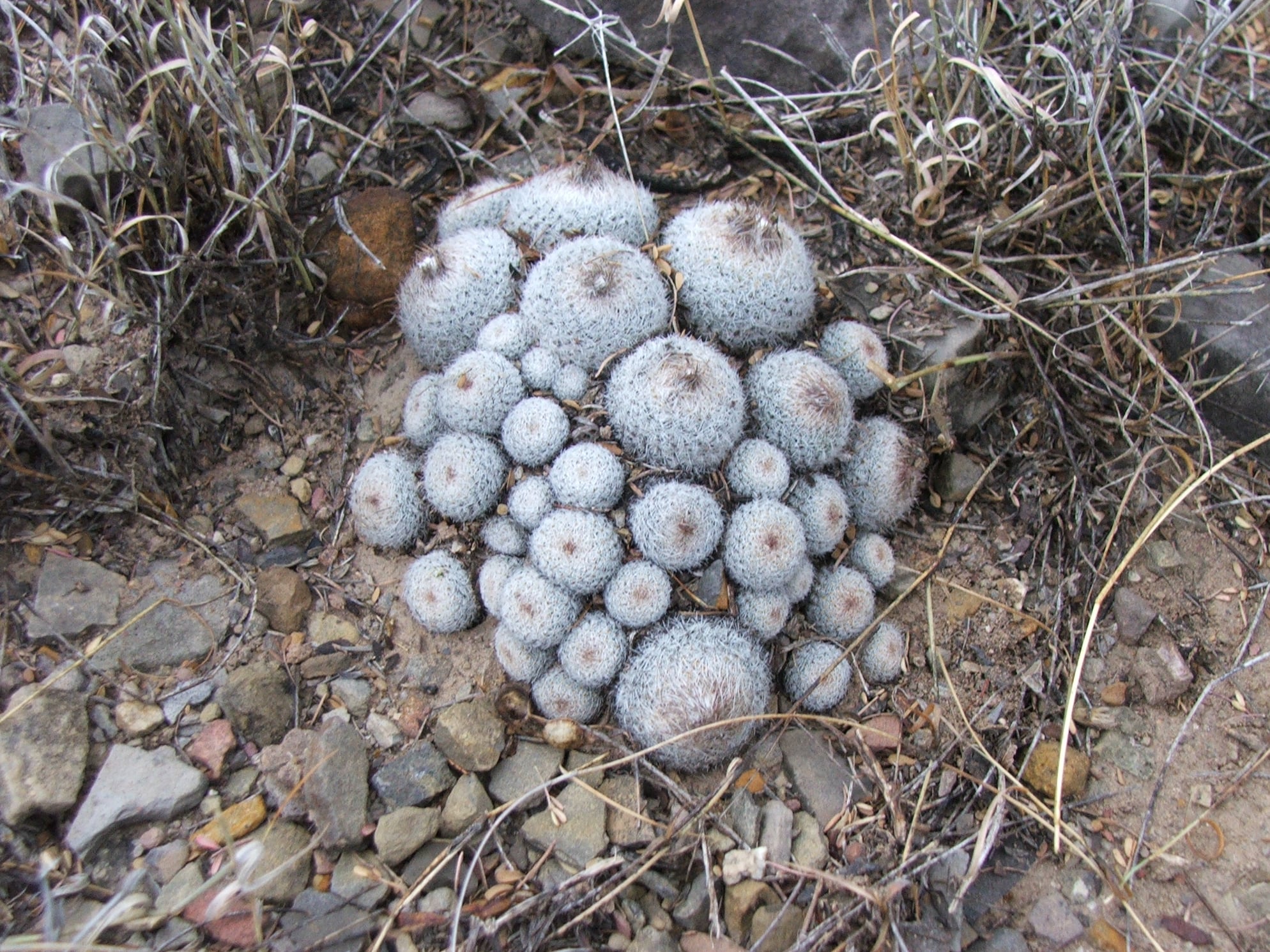
Epithelantha cryptica D.Donati & Zanov. is a button cactus described in 2011 from a single Coahuilan limestone ridge. The epithet derives from the Greek kryptikos, meaning hidden, and names the plant’s defining characteristic: the apex barely clears the surrounding gravel, so from a metre away the plant reads as a pale dust-rosette rather than a cactus. The protologue was published in Davide Donati and Carlo Zanovello’s monograph on the genus, issued through the Cactus Trentino Südtirol Society.
Kew POWO accepts E. cryptica at species rank within a ten-species genus. The Donati and Zanovello monograph that described the species recognised seven species; subsequent work raised the accepted count to ten. E. cryptica is not disputed as a good species in any of these treatments. Its nearest relative on morphology and ecology is Epithelantha micromeris, the wide-ranging type species of the genus; the two are separable by habit, habitat, and climate niche, though not by chloroplast sequence alone.
The type locality is La Muralla, Municipio Castaños, a Cretaceous limestone ridge complex in the central Coahuilan Chihuahuan Desert. GBIF records and iNaturalist observations cluster tightly around that ridge. Among the genus, only E. cryptica is known exclusively from this microsite; the other four Epithelantha covered on this site span ranges from the Trans-Pecos to the broader Coahuilan desert. Epithelantha greggii, the largest-bodied accepted species, grows in the Saltillo region a short distance south, and the two share the same Cretaceous limestone substrate.
In the collector trade, legitimately-sourced E. cryptica is among the hardest Epithelantha to obtain. Specialist European nurseries with direct connections to the Donati and Zanovello circle list seed grown plants periodically. One additional constraint on supply sets this species apart from its siblings: E. cryptica is self-sterile. A single clone produces flowers but no viable seed without a second genetically distinct plant flowering in synchrony. Collectors growing single specimens will not see seed regardless of how well the plant blooms.
Epithelantha cryptica quick reference
A Coahuilan limestone microendemic at 1000–1300 m, seated flush with Cretaceous gravel in Chihuahuan desertscrub. Values calibrated for seed grown plants in cultivation, drawn from habitat data and specialist grower consensus for E. cryptica specifically, not genus-level extrapolation.
Taxonomy & nomenclature
The accepted name is Epithelantha cryptica D.Donati & Zanov. The protologue appeared in the 2011 monograph Epithelantha by Davide Donati and Carlo Zanovello, published through the Cactus Trentino Südtirol Society, at page 55. POWO and IPNI record 2011 as the formal nomenclatural date. Several derivative treatments cite 2010, reflecting when fieldwork and pre-publication announcements circulated; the printed monograph date governs.
The genus Epithelantha was described by F.A.C. Weber and validated by Britton and Rose. POWO presently accepts ten species; the Donati and Zanovello monograph in which E. cryptica appeared recognised seven. The Aquino et al. (2019) revision in Systematic Botany tested the genus with four chloroplast regions and recovered ten species, including cryptica, with no proposal to sink the new Coahuilan taxon. The most recent phylogeny supports monophyly for Epithelantha with Turbinicarpus as the sister group.
The diagnostic separation between E. cryptica and Epithelantha micromeris was the central problem the 2011 protologue addressed. The Donati and Zanovello revision used body habit, tubercle proportions, and seed-coat micromorphology to draw the boundary. The 2019 chloroplast phylogeny found that sequence data alone cannot resolve the two; they appear as sisters in the tree but without meaningful node support separating them. The 2021 ecology paper closed the gap by showing that the two taxa occupy non-overlapping climatic niches even where geographic proximity suggests possible contact. Environmental filtering maintains lineage identity where molecular markers cannot detect it.
Hunt’s New Cactus Lexicon (2nd ed. 2013) does not include E. cryptica. The omission reflects the Lexicon’s caution about microendemics described in specialist-society publications after the Lexicon’s own manuscript cutoff. No synonyms are accepted under the current POWO treatment.
Habitat
Epithelantha cryptica is endemic to Coahuila, Mexico. The holotype habitat is gentle hillslopes and ridges on Cretaceous limestone gravel at La Muralla, in the central Coahuilan Chihuahuan Desert north of Saltillo and east of the Sierra de la Madera massif. GBIF records and iNaturalist observations cluster tightly within the Castaños corridor. The protologue treats the species as known from a single locality and notes it is reasonably expected on adjacent ridges with the same geology, but no systematic survey beyond La Muralla has been published.
Elevation at the type locality is approximately 1100 m; working elevation range for the page is 1000–1300 m, consistent with the ridge topography of the Castaños area. The substrate is Cretaceous limestone gravel with organic-influenced soil, pH approximately 7.6. Plants occupy shallow crevices nearly flush with the surrounding gravel, with only the spine-covered apex visible from above. The flush-to-substrate habit buffers the apex against direct insolation, against small mammal browsing, and against the larger temperature swings experienced a few centimetres above the gravel.
Vegetation at La Muralla is Chihuahuan desertscrub: a low shrub layer of Larrea, Acacia, and Parthenium with a substantial cactus component. Documented sympatric cacti include Epithelantha greggii subsp. greggii, Echinocereus pectinatus, E. enneacanthus, Coryphantha macromeris, Sclerocactus scheeri, and Echinomastus mariposensis. The cohabitation of two Epithelantha species at the same locality without intergrading was part of the evidence that motivated the Donati and Zanovello split.
Morphology
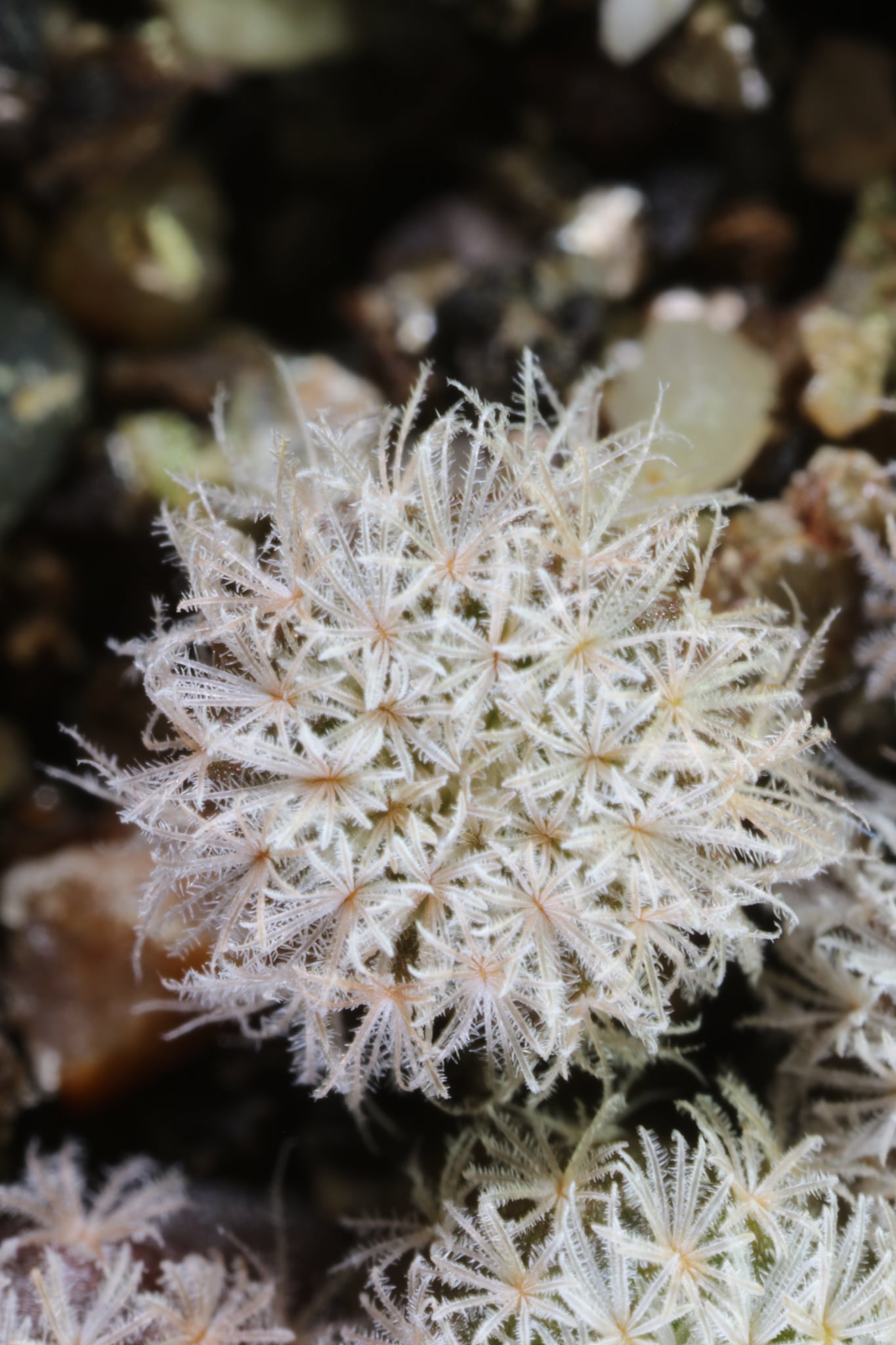
Mature plants form low clusters reaching about 4 cm tall and 5 cm in overall diameter. Individual stems are globose to depressed-globose, typically 1.5–2.5 cm across, seated below the level of the surrounding gravel so that only the spine-covered apex is visible from directly above. The body is invisible under the spination.
Each areole carries 20 to 90 white to ashy-grey spines in 1–5 series. All spines are slender, terete, and soft to the touch, pressed close to the stem. At the apex the spines stiffen slightly and stand more erect. The protologue separates E. cryptica from Epithelantha micromeris on tubercle proportions and seed-coat micromorphology rather than spine counts alone; the two are most reliably distinguished by habit and habitat context.
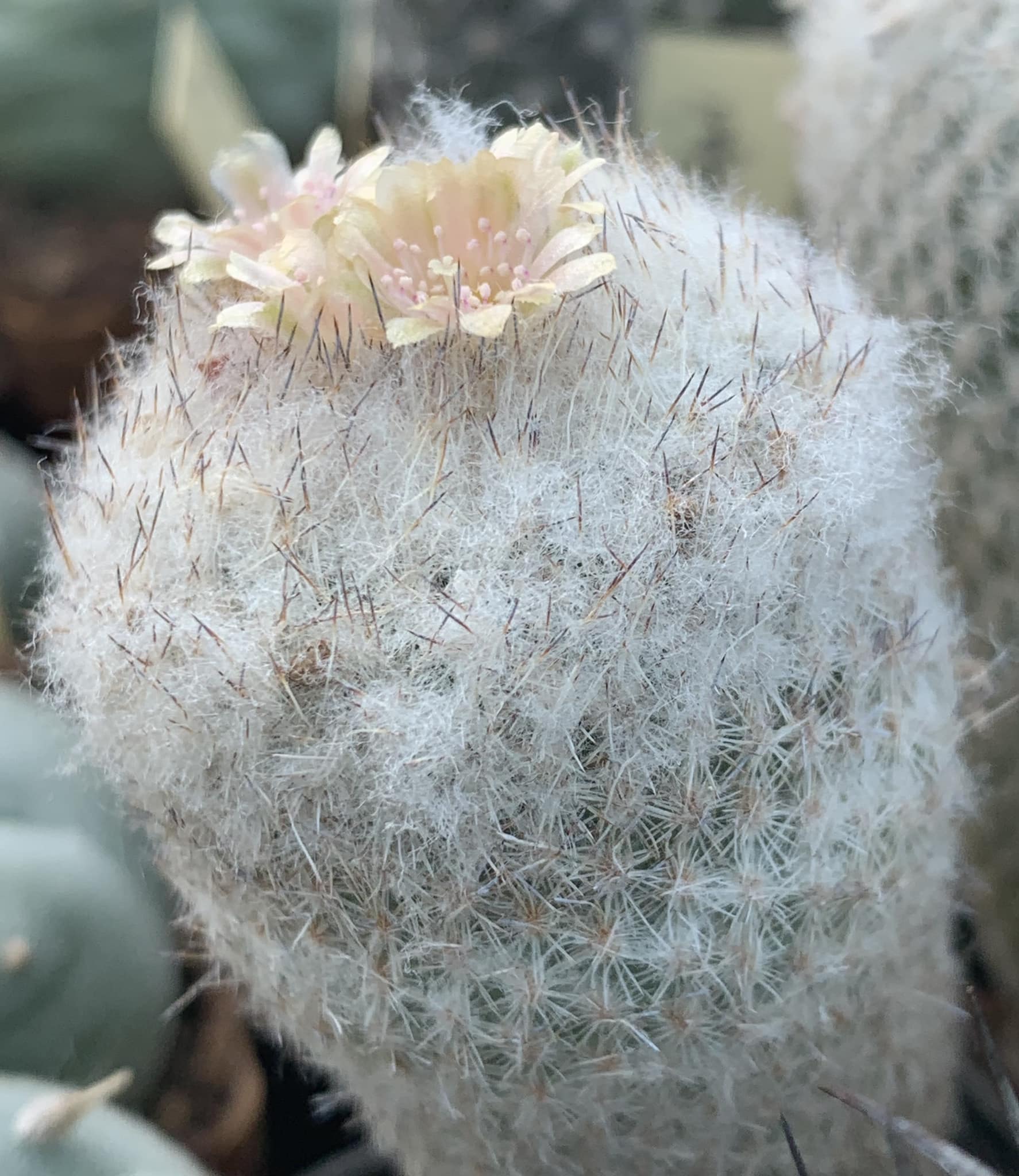
Flowers are funnelform, small (a few millimetres long), and pink to pale-pink. The genus is reported predominantly self-sterile; E. micromeris is the known exception, being autogamous. E. cryptica is self-sterile. A single-clone plant will flower and may form fruit, but that fruit will be empty. Cross-pollination from a second genetically distinct plant is required for viable seed. No pollinator study specific to E. cryptica has been published; genus-level inference points to small bees as probable vectors, consistent with the small pink flowers, but the identity of the visiting insects at La Muralla is not documented.
Fruits are bright red, narrowly cylindric, weakly succulent and quickly drying, 3–20 mm long. Seeds are blackish, glossy, obliquely hemispheric, just over a millimetre across.
Locality detail
The holotype was collected in Municipio Castaños, Coahuila, at La Muralla, at approximately 1100 m elevation. The JSTOR Global Plants record carries this string verbatim. La Muralla is a limestone ridge complex in the central Coahuilan Chihuahuan Desert.
POWO records E. cryptica as endemic to Coahuila. GBIF records and iNaturalist observations cluster around the type locality. The protologue notes the species as known from a single locality at the time of description; subsequent field reports remain within the Castaños corridor. The full geographic extent of the species has not been formally surveyed, and no range polygon beyond the type locality has been published. The map marker above reflects the published municipality-level locality; no coordinate redaction is warranted at this scale.
Epithelantha cryptica care and cultivation
Epithelantha cryptica sits at the strict end of the genus’s cultivation range. The plant is small, very slow, and collapse-prone when overwatered or held wet through winter. Losses show up weeks after the error, not immediately; by the time the apex softens, root rot is well advanced.
Substrate
40% pumice, 15% lava rock, 10% zeolite, 10% granite grit, 20% crushed limestone chips (3–6 mm horticultural limestone), and 5% worm castings (95/5 inorganic-to-organic). The limestone fraction and pumice share follow house convention rather than documented habitat evidence; target pH is 7.6. Pot shallow and tight; a 6–8 cm clay pot is enough for a flowering-size plant.
All five Epithelantha species on this site share a calcareous inorganic baseline; E. cryptica runs the leanest organic fraction (5%) of the five, matching its slow-growing flush-to-substrate habit.
| Species | Pumice | Lava | Zeolite | Granite | Limestone | Silica | Organic |
|---|---|---|---|---|---|---|---|
| E. bokei | 40% | 10% | 15% | 0% | 25% | 0% | 10% |
| E. micromeris | 35% | 15% | 10% | 10% | 15% | 5% | 10% |
| E. greggii | 35% | 20% | 10% | 10% | 15% | 0% | 10% |
| E. pachyrhiza | 30% | 20% | 10% | 10% | 25% | 0% | 5% |
| E. cryptica (this page) | 40% | 15% | 10% | 10% | 20% | 0% | 5% |
Watering and light
Water to runoff during active growth (April through September in the northern hemisphere), with the substrate drying completely between waterings. Reduce to one light watering per month from October. Stop entirely from December through February if night minima drop below 5°C. Cold and wet together is the principal failure mode.
Plants seated below substrate level in habitat receive filtered light, not direct overhead exposure. Under glass, an east or south-east aspect with light shading from June to August keeps the apex tight without scorching. The species does not require the full midday summer sun that the larger-bodied Epithelantha species tolerate.
Cold tolerance and propagation
The dry cold floor is −5°C, the softest in the Epithelantha launch. Habitat winter minima at 1100 m in central Coahuila drop to freezing on still clear nights; the plant survives by sitting in a substrate-buffered microsite. Replicate that with overwintering dryness, not additional heat.
Propagation from seed requires two genetically distinct clones: E. cryptica is self-sterile. A single flowering plant will not set viable seed regardless of how reliably it blooms. Collectors holding one clone should source a second from a different nursery batch before expecting any seed output. Grafting produces faster growth but the resulting plant loses the flush-to-substrate habit that defines the species. Seed grown plants are slow, reaching flowering at roughly ten years from seed at 1–1.5 cm diameter, and worth the wait.
Comparison
The closest comparison for E. cryptica is Epithelantha micromeris, the wide-ranging type species. Morphologically the two are similar enough that populations from the Castaños area sat under E. micromeris sensu lato before the 2011 revision. The diagnostic separation comes from three sources: the protologue identifies tubercle geometry and seed-coat sculpture as the primary morphological boundary; the growth habit differentiates them in the field (cryptica sits flush with the substrate, micromeris sits above it); and the 2021 ecology paper quantifies non-overlapping climatic niches, with micromeris occupying colder and drier Chihuahuan Desert conditions and cryptica occupying a warmer and slightly wetter Coahuilan thermal envelope. Chloroplast data alone will not resolve the two.
One character separates the two decisively for cultivation purposes: E. micromeris is autogamous; E. cryptica is self-sterile. A collector with a single micromeris clone can harvest seed from a lone flowering plant. A collector with a single cryptica clone cannot, regardless of flower production.
Epithelantha bokei, the chalk-white Trans-Pecos miniature, shares the densely appressed pectinate spination but differs from cryptica on range, size, and cold tolerance. bokei occurs in Brewster County, Texas and adjacent Coahuila; cryptica is known only from La Muralla. Epithelantha pachyrhiza, the Coahuilan taproot dwarf, is distinctive below the soil surface rather than above it; its aerial body is a tiny button sitting at substrate level, but the underground swollen taproot is the diagnostic feature, not the low-emergence habit. At the species level, pachyrhiza and cryptica are both Coahuilan microendemics; their ecological comparison is the most useful one for a collector deciding between the two.
Frequently asked questions
Is Epithelantha cryptica hard to grow?
Advanced. The species is small, very slow, and collapse-prone when overwatered or kept damp through winter. The principal failure mode is cold combined with moisture: the substrate must be bone dry from December through February. Beyond winter dryness, the self-sterility constraint (two distinct clones required for seed) makes this the most demanding species in the Epithelantha launch. A grower who has mastered E. micromeris successfully can attempt cryptica; it is not a starting-point species.
Can Epithelantha cryptica be grown from seed?
Yes, but two genetically distinct clones are required. E. cryptica is self-sterile: a single plant will form flowers, but the resulting fruit will be empty without pollen from a second unrelated individual. Collectors holding one clone must source a second from a different nursery batch or provenance before expecting viable seed. Time from seed to flowering is roughly ten years at 1–1.5 cm body diameter under good cultivation with a respected winter rest. Grafting produces faster results but eliminates the flush-to-substrate habit that defines the species.
Is Epithelantha cryptica legal to own?
Yes, with documentation. E. cryptica falls under the CITES Appendix II blanket listing for Cactaceae, which permits international commercial trade with an export permit from the country of origin and an import permit where the receiving country requires one. No species-specific IUCN assessment exists, and there is no separate Mexican NOM-059-SEMARNAT listing for cryptica at time of writing. Domestically, nursery-propagated material within a single country does not require CITES permits. Documented seed grown nursery stock is the legally and ethically defensible source.
Where does Epithelantha cryptica grow in the wild?
La Muralla, Municipio Castaños, Coahuila, Mexico, at approximately 1000–1300 m elevation on Cretaceous limestone gravel ridges. The protologue treats the species as known from this single locality and expects it on adjacent ridges with identical geology; no formal survey beyond La Muralla has been published. The full geographic extent of the species is not known. GBIF records and iNaturalist observations all cluster within the Castaños corridor, consistent with a hyper-localised Coahuilan microendemic.
When does Epithelantha cryptica flower?
Flowering follows the genus pattern: spring through early summer in cultivation, broadly April through June at northern hemisphere latitudes. Individual flowers are funnelform, a few millimetres long, pale pink. No pollinator study specific to E. cryptica exists; the probable vector at genus level is small bees, consistent with the small pale flowers, but visiting insects at the La Muralla population have not been documented. The fruit is bright red, narrowly cylindric, and quickly drying.
Sources & further reading
Donati, D. & Zanovello, C. (2011). Epithelantha. Cactus Trentino Südtirol Society. [Protologue, p. 55] · Aquino, D., Cervantes, R.C., Gernandt, D.S. & Arias, S. (2019). Species delimitation and phylogeny of Epithelantha (Cactaceae). Systematic Botany 44(3): 600–615 · Aquino, D., Moreno-Letelier, A., González-Botello, M.A. & Arias, S. (2021). The importance of environmental conditions in maintaining lineage identity in Epithelantha (Cactaceae). Ecology and Evolution 11(9): 4520–4531 · Kew POWO. Epithelantha cryptica D.Donati & Zanov. powo.science.kew.org · IPNI. Epithelantha cryptica D.Donati & Zanov. ipni.org · GBIF. Epithelantha cryptica occurrence dataset. gbif.org · JSTOR Global Plants. Epithelantha cryptica holotype image and type-locality label. plants.jstor.org · Catarino Morales, B. (2014). Epithelantha of Coahuila, part 1. Xerophilia 3(1)/issue 8: 31–40 · CITES Appendix II Cactaceae blanket listing. cites.org