
Strombocactus disciformis
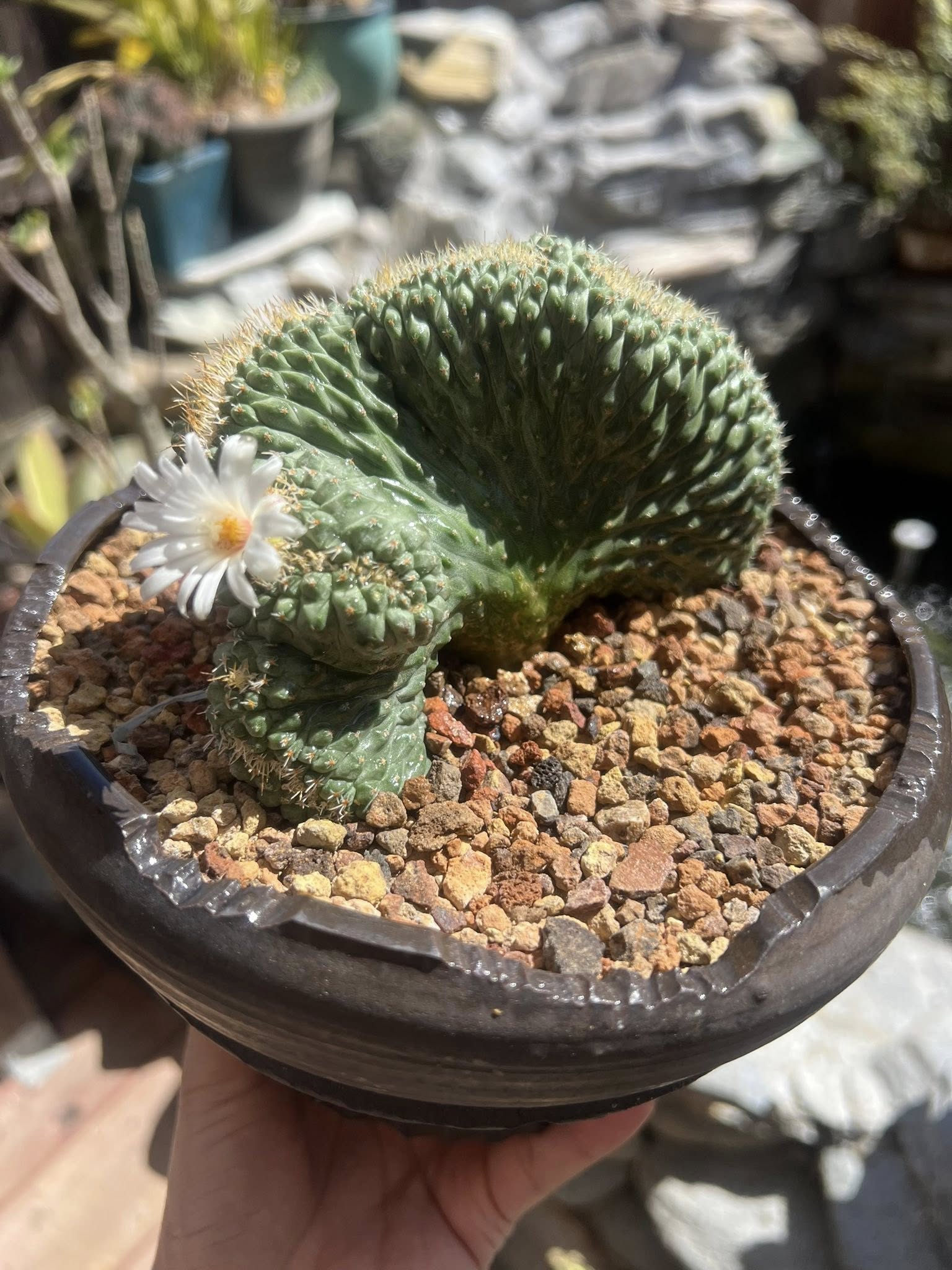
Strombocactus disciformis (DC.) Britton & Rose is the disc cactus of the Moctezuma Canyon, a flattened-disc lithophyte that roots itself into near-vertical limestone and calcareous-shale cliff faces across Hidalgo, Querétaro, and the Sierra Gorda of Guanajuato between 1,000 and 1,600 m elevation. Candolle described the species as Mammillaria disciformis in 1828 from material collected in Hidalgo by the Irish botanist Thomas Coulter; Britton and Rose erected the monotypic genus Strombocactus in The Cactaceae volume 3 (1922), taking the genus name from the Greek strombos (spinning top) and the Latin epithet disciformis (disc-shaped) as a direct description of the plant’s most obvious feature.
The most striking structural character is a 13:8 Fibonacci spiral of imbricate rhomboid tubercles covering the entire body surface. This golden-ratio geometry is the genus-level diagnostic that sets Strombocactus apart from the other tubercled, ribless cacti of central Mexico. Two POWO-accepted subspecies exist: subsp. disciformis across Hidalgo and Querétaro, bearing cream to pale-yellow flowers with a magenta midvein on the outer tepals, and subsp. esperanzae Glass & S.Arias (1996), restricted to a single canyon system in Mun. Xichú, Guanajuato, distinguished solely by its deep magenta flowers.
The genus contains one other accepted species, Strombocactus corregidorae Arias & E.Sánchez (2010), described from Infiernillo Canyon in the Moctezuma River corridor on the Querétaro-Hidalgo border. At 18-23 cm tall with yellow flowers and darker spination, S. corregidorae is the larger and morphologically more robust sister species, though both occupy the same limestone canyon-wall niche.
Strombocactus disciformis is among the most legally restricted cacti in cultivation. IUCN assessed it as Vulnerable in 2013, citing a range limited to approximately 10 localities and documented population decline through illegal overcollection. The entire genus carries CITES Appendix I status, and the species is listed as Amenazada (A) under Mexico’s NOM-059-SEMARNAT-2010. Slow growth is the cultivation reality: 8-10 years from seed to first flower when grown on their roots, with plants reaching only 1 mm diameter at year two.
Strombocactus disciformis quick reference
A calcareous-shale lithophyte of near-vertical canyon walls in the Moctezuma River corridor at 1,000-1,600 m. Values calibrated for seed grown plants in cultivation, drawn from habitat data and specialist grower consensus rather than genus-level extrapolation.
Taxonomy & nomenclature
The accepted name is Strombocactus disciformis (DC.) Britton & Rose, published in The Cactaceae 3: 106 (1922), IPNI LSID urn:lsid:ipni.org:names:246156-2. The basionym is Mammillaria disciformis DC., Mém. Mus. Hist. Nat. 17: 113 (1828), published by Augustin Pyramus de Candolle from material collected in Hidalgo by Thomas Coulter. Britton and Rose erected Strombocactus as a monotypic genus to accommodate the species, drawing the name from the Greek strombos (spinning top) in reference to the body shape.
The species has cycled through five genera over nearly two centuries. K. Schumann placed it in Echinocactus (1898); Kuntze in Cactus (1891); W. T. Marshall in Ariocarpus (1947); and Halda in Pediocactus (1998). Halda also described Strombocactus disciformis subsp. jarmilae in 1997 from northern Querétaro, which POWO now subsumes under subsp. disciformis; older collector literature still uses the trinomial. All five genus combinations are treated as synonyms of the accepted name on this site, following POWO as the taxonomic authority.
POWO accepts two subspecies. Subsp. disciformis is the nominate form across Hidalgo and Querétaro. Subsp. esperanzae Glass & S.Arias, Brit. Cact. Succ. J. 14(4): 202 (1996), is restricted to a single canyon system in Mun. Xichú, Sierra Gorda, Guanajuato; the epithet honours Sra. Esperanza Benavides de Vasquez, who guided collectors to flowering plants. The only consistent diagnostic character between the two subspecies is flower colour: cream to pale yellow with a magenta midvein in subsp. disciformis versus deep magenta to bright pink in subsp. esperanzae.
A molecular phylogenetic study by Bárcenas, Hernández, Hernández-Ledesma and Montoya Gómez (Phytotaxa 512, 2021) recovered Strombocactus as paraphyletic using plastid markers (matK, psbA-trnH, atpB-rbcL), finding S. corregidorae sister to a clade containing Ariocarpus + Turbinicarpus + S. disciformis. The authors erected Chichimecactus for the corregidorae lineage; POWO does not accept the new genus and continues to list Strombocactus corregidorae as the accepted name. This site follows POWO.
Historical synonym (1)
- Echinocactus helianthodiscus Lem., heterotypic synonym
Sources: POWO (Kew) · IPNI · GBIF · Wikidata
Habitat
Strombocactus disciformis grows on near-vertical and occasionally overhanging limestone and calcareous-shale canyon walls in the Moctezuma River corridor of central Mexico. Plant bodies root into narrow horizontal cracks and small ledges where fine clay and silt have accumulated on the cliff face, with only the flattened crown projecting above the rock surface. South- and southwest-facing walls receive intense afternoon insolation; the half-sunken habit and the dense apical wool moderate the heat load on the growing centre. The geological substrate is Cretaceous limestone and calcareous shales (lutitas calcáreas), with some populations on gypsum-bearing strata; substrate pH runs approximately 7.5-8.2.
Distribution across both subspecies covers three Mexican states. Subsp. disciformis occupies Hidalgo (Barranca de Tolimán, Ixmiquilpan, Moctezuma River canyon, Zimapán area) and Querétaro (intermountain valleys of Tolimán, Cadereyta and Peñamiller, Río Extorax basin). Subsp. esperanzae is restricted to a single canyon in Mun. Xichú, Sierra Gorda, Guanajuato. Together the two subspecies are known from approximately 10 localities. Elevation across the range runs 1,000-1,600 m, with most documented populations at 1,200-1,500 m. Four-state distribution claims (Nuevo León, San Luis Potosí, Tamaulipas, Veracruz) appearing in some databases contradict POWO and the Arias & Sánchez 2010 type-locality work and are rejected here.
Climate is semi-arid subtropical with a summer-rain regime: annual precipitation 400-700 mm, concentrated June-September during the North American monsoon, followed by a long dry winter with brief humid periods in October. Summer highs reach 28-32°C in canyon bottoms; winter cold fronts occasionally push canyon-floor temperatures to 0-2°C. Vegetation community is matorral xerófilo with co-occurring Agave, Hechtia, Mammillaria, Coryphantha, Echinocereus, and Turbinicarpus on accessible ledges below; the cliff faces themselves carry essentially no shading vegetation, leaving Strombocactus fully exposed on the rock.
Morphology
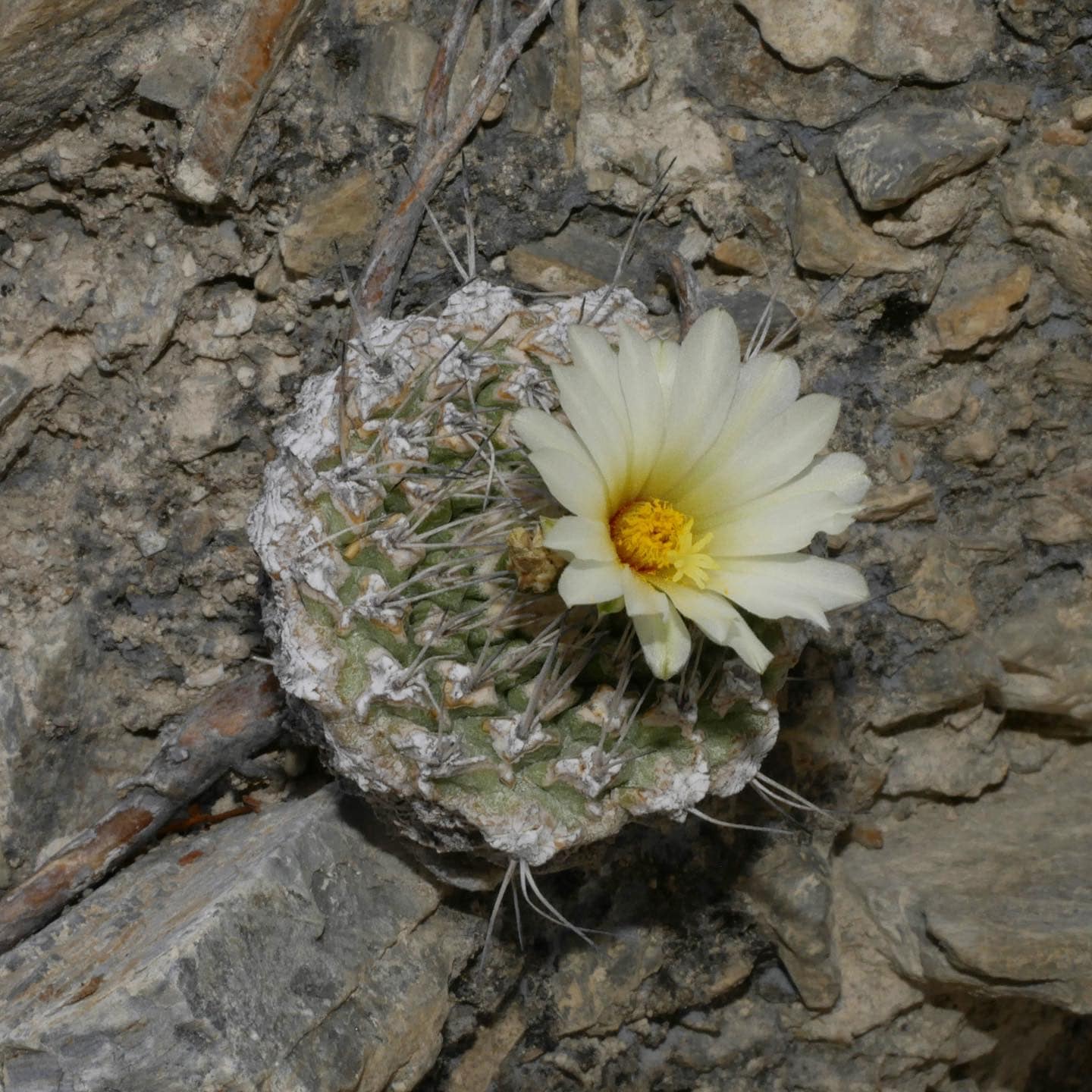
The diagnostic feature is the 13:8 Fibonacci spiral of imbricate rhomboid tubercles covering the entire body surface. Counting the two interlocking parastichy series across the crown yields 13 spirals running one direction and 8 running the other, the nearest Fibonacci approximation to the golden ratio, and the exact arrangement that separates Strombocactus from every visually similar Mexican cactus genus. Each tubercle is 1-1.8 cm high, hard, and closely pressed to its neighbours, with no intervening ribs or grooves. The body is solitary or rarely multi-headed, flattened-disc to broadly depressed-globular with a depressed woolly apex.
Body dimensions in habitat: 3-9 cm diameter, 2-5 cm tall. The plant presents only the discoid crown above the rock surface; the lower body and the napiform (turnip-like) taproot are embedded in the cliff-face crack fill. Colour is blue-green to greyish-green, sometimes with a purplish or reddish flush under strong light; older specimens develop brown corky patches at the collar. Exceptional cultivated specimens reach 10 cm or more in diameter with great age, and the body becomes more globose in the absence of the natural rock constraint. Areoles sit at each tubercle tip in white wool; apical areoles carry the densest wool, forming the characteristic crown pom-pom. Spines: 1-5 per areole, typically 4-5 erect; 1.2-2 cm long; dark grey at the tips, paler grey toward the base; soft to weakly pungent. Older areoles shed their spines, leaving the lower body naked and revealing the grey-green tubercle surfaces.
Flowers emerge apically from the woolly growing centre. Subsp. disciformis: 2.5-3.5 cm long and broad; inner tepals white to yellowish-white; outer tepals carry a magenta midvein on the abaxial surface; stigma white to yellowish, 8-10 lobed; filaments white to reddish; anthers yellow. Nectar concentration has been measured at 22.09 ± 7.42 °Brix in the annular nectary of subsp. disciformis, consistent with bee-pollinated flowers. Flowers open mid-morning and close late afternoon, with individual blooms lasting 1-3 days. Subsp. esperanzae flowers deep magenta to bright pink, the only consistent diagnostic separating the two subspecies. Fruit: small dehiscent berry, approximately 7 mm, pinkish to greenish-brown, dehiscing longitudinally at maturity. Seeds: 0.5 mm, black, tuberculated testa, pyriform.
Locality detail
The type locality of Strombocactus disciformis, as fixed by Britton and Rose in 1922, is Mineral del Monte (also called Real del Monte), Hidalgo. It rests on Thomas Coulter’s 1828 collection, described in the protologue as barrancas de Lomo de Toro, en las minas de Zimapán, Hidalgo. Joseph Nelson Rose collected additional Querétaro material in 1905, establishing the broader distribution at the time of the 1922 combination.
The map displays three regional centroids rather than population-level coordinates. Strombocactus disciformis holds CITES Appendix I status and an IUCN Vulnerable assessment driven in part by illegal overcollection; publishing sharp GPS points for any locality would facilitate poaching. Regional centroids convey the three-state distribution range without exposing individual populations to targeting. Collectors and researchers requiring precise locality data should consult the Arias & Sánchez 2010 primary literature and IUCN assessment documentation through their institutional access.
Strombocactus disciformis care and cultivation
Strombocactus disciformis sits at the advanced end of the difficulty range. The challenges are not complicated: a mineral-dominant alkaline substrate, a strict dry winter, and the patience to grow a 1 mm seedling for 8-10 years without shortcuts. None of those requirements is forgiving of compromise.
Substrate
The species grows in calcareous-shale and limestone canyon-wall crevices at pH 7.5-8.2, with near-zero organic content in the natural substrate fill. The cultivation target is a free-draining, mineral-dominant mix with explicit calcium-buffering capacity and a silica fraction, set by house convention rather than by that habitat fill. The locked 7-component mix: 40% pumice (primary drainage aggregate), 15% lava rock (mid-mix structural fraction, heavier weighting toward pot base), 10% zeolite clinoptilolite (cation exchange, pH buffering at the alkaline end), 10% granite grit (slow-release minerals and structure), 12% crushed limestone (house convention for the genus, not a species requirement), 8% coarse silica 1-3 mm (inside the 5-10% silica band the site also holds for Aztekium), and 5% worm castings (the 90/10 Cactaceae baseline shifted to 95/5 as house convention; no cultivation source publishes an organic share for the genus, and 5% supplies trace nitrogen for greenhouse growth without inviting rot). House target pH: 7.5-8.2 alkaline, not a measured species preference. A 5 mm surface layer of crushed limestone or oyster grit stabilises the collar and reduces moss growth. The grower’s water is the largest uncontrolled variable in whether the limestone share suits a collection: hard tap water already supplies calcium and bicarbonate at every watering, while rainwater and RO water supply neither.
Both Strombocactus species on this site occupy the same limestone canyon-wall niche, but that habitat does not set the pot mix. Substrate ratios are calibrated identically at 95/5 inorganic-to-organic, with an elevated limestone fraction held as house convention for the genus rather than as a species requirement. How well that share suits a collection depends mostly on the grower’s water.
| Species | Pumice | Lava | Zeolite | Granite | Limestone | Silica | Organic |
|---|---|---|---|---|---|---|---|
| S. disciformis (this page) | 40% | 15% | 10% | 10% | 12% | 8% | 5% |
| S. corregidorae | 40% | 15% | 10% | 10% | 12% | 8% | 5% |
Watering and light
Bone dry from November through February. The napiform taproot holds enough water reserve to carry the plant through four months without any input; any moisture during this window combined with temperatures below 5°C invites rot at the neck. The first spring watering waits until daytime temperatures consistently exceed 18°C: one thorough soak, then allow complete drying. From March through May, one watering per month is typical; June through August increases to every 2-3 weeks during peak growing weather. September and October taper back to once monthly. Rainwater is preferred; tap water is acceptable since the species naturally grows in alkaline conditions, unlike Brazilian or epiphytic cacti that require acidified water.
Light: bright direct sun in temperate greenhouses year-round. The half-sunken canyon-wall habit means the exposed crown tolerates intense afternoon insolation; only 20-30% shade cloth through the hottest summer afternoons in subtropical climates prevents apical scorch on specimens recently moved outdoors. Acclimate gradually from shade-cloth growing to unfiltered sun over 3-4 weeks in spring. A south-facing greenhouse bench or south-facing windowsill works well year-round at temperate-zone latitudes.
Growth rate and propagation
The growth timeline from seed is the defining cultivation fact for this species. Seedlings reach 1 mm diameter at year two, 2 cm at 6-8 years, and first flower at approximately 8-10 years when grown ungrafted. Some robust material flowers at 7 years; 12-15 years is not unusual. Grafting onto Pereskiopsis for early seedling acceleration compresses the schedule to 2-4 years to flower, but grafted plants tend toward globose or elongated bodies that lack the flat-disc habit of habitat material, and most serious collectors consider grafted specimens a temporary propagation tool rather than a display goal. Degrafted plants rarely recover the proportions of a true seed-grown specimen of equivalent age.
Germination rates from fresh seed are low: commonly cited below 10% without stratification. Sow on a sterile, mineral-heavy surface mix in spring, bottom-water, and maintain 22-28°C; seedlings are visible in 7-21 days on well-sourced material. The 0.5 mm seed size means no vegetative propagation is practical; offsetting is rare in nature and in cultivation. Half-strength low-nitrogen cactus fertilizer applied once in late spring and once in mid-summer is sufficient; growers who skip fertilization entirely report no measurable difference at the growth rates involved.
Comparison
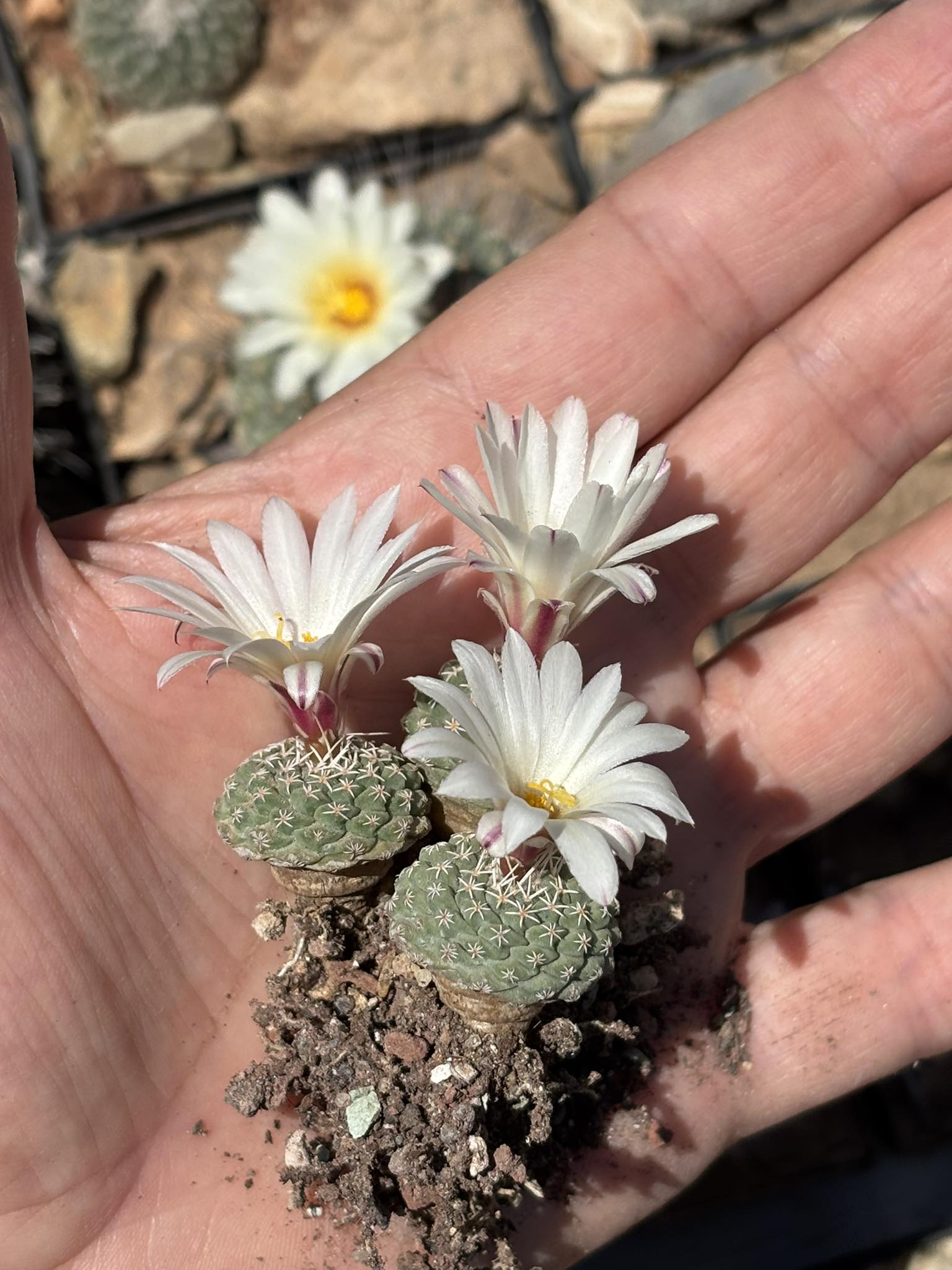
The only other member of the genus, Strombocactus corregidorae, occupies the same Moctezuma Canyon limestone-wall niche but differs sharply in dimensions. S. corregidorae reaches 18-23 cm tall with a more elongate-globose body compared to the 2-5 cm discoid profile of S. disciformis in habitat. Spines are more robust (2-3.5 cm, 2-3 per areole, dark greyish) and flowers are yellow, not cream with a magenta midvein. Both species share the 13:8 spiral tubercle geometry, though the difference in body size makes field separation unambiguous in mature plants. S. corregidorae has been proposed for the new genus Chichimecactus by Bárcenas et al. (2021) on molecular grounds; this site follows POWO in retaining the Strombocactus name.
The morphological analogue from a different canyon system is Aztekium ritteri, the other major gypsum-cliff lithophyte of Mexico (Nuevo León). Both are tiny grey-green canyon-wall plants with woolly apical areoles, but the body organisation differs completely: A. ritteri has 9-11 true ribs with transverse corrugations and secondary “false ribs”; S. disciformis has no ribs, only the 13:8 Fibonacci spiral of tubercles. Spine count and size also differ: Aztekium carries 1-3 soft spines of 3-4 mm; Strombocactus carries 4-5 erect spines of 1.2-2 cm that calcify and fall with age. Flowers: A. ritteri produces sub-10 mm white to pale pink blooms; S. disciformis flowers are 2.5-3.5 cm.
A practical field ID challenge in the Hidalgo-Querétaro canyon corridor is separation from Turbinicarpus pseudomacrochele, a small Querétaro-Hidalgo cliff cactus that shares overlapping range and white-ish flowers. The papery, contorted spines of T. pseudomacrochele (3-5 cm, twisted) are immediately diagnostic against the short, erect, eventually caducous spines of Strombocactus. Tubercle geometry differs sharply: Turbinicarpus has weakly defined tubercles without the tight imbricate spiral pattern of S. disciformis. Confusion risk is low to moderate in juvenile plants but minimal once spination has developed.
Frequently asked questions
Is Strombocactus disciformis hard to grow?
Advanced. The hardest single requirement is patience: 8-10 years from seed to first flower when grown ungrafted, with plants measuring only 1 mm diameter at year two. The substrate must be a mineral-dominant, alkaline mix with a limestone fraction; generic cactus soil will not sustain the species long-term. Winter watering is the death mode: the substrate must be completely dry from November through February, and any moisture combined with temperatures below 5°C causes crown rot. None of these requirements is complicated, but none is flexible.
Can Strombocactus disciformis be grown from seed?
Yes, and it is the only acceptable cultivation path for serious collectors. Germination rates from fresh seed are low, commonly below 10%, and seedlings develop with extreme slowness: 1 mm at year two, 2 cm at 6-8 years, flowering at roughly 8-10 years. Grafting onto Pereskiopsis compresses the timeline to 2-4 years to flower but produces globose or elongated bodies that lose the characteristic flat-disc habit. Degrafted plants rarely recover the proportions of a true seed-grown specimen. Sow in spring on a sterile mineral mix at 22-28°C; germination in 7-21 days on well-sourced seed.
Is Strombocactus disciformis legal to own?
Yes, with the correct documentation. The entire genus Strombocactus carries CITES Appendix I status, which prohibits international commercial trade in wild-collected specimens; any import or export requires individual permits from both the exporting and importing country’s CITES management authority. Under Mexico’s NOM-059-SEMARNAT-2010, the species is classified Amenazada (Threatened, category A); collection or transport of wild material within Mexico requires federal permits. The IUCN assesses the species as Vulnerable, citing illegal overcollection as the primary documented threat. Seed-grown nursery stock from CITES-permitted European or US specialist suppliers, with a CITES certificate of captive propagation, is the only legally clean acquisition path for collectors outside Mexico.
Where does Strombocactus disciformis grow in the wild?
On near-vertical limestone and calcareous-shale canyon walls in the Moctezuma River corridor of central Mexico, across three states. Subsp. disciformis occurs in Hidalgo (the Zimapán area and Moctezuma Canyon) and Querétaro (Tolimán, Cadereyta, Peñamiller valleys). Subsp. esperanzae is restricted to a single canyon in Mun. Xichú, Sierra Gorda, Guanajuato. Elevation: 1,000-1,600 m, most populations at 1,200-1,500 m. Approximately 10 localities are documented across both subspecies. Four-state distribution claims extending to Nuevo León, San Luis Potosí, Tamaulipas, and Veracruz contradict Kew POWO and the primary type-locality research and are not credible.
When does Strombocactus disciformis flower?
Late spring to mid-summer in habitat, typically May through July. In temperate-zone cultivation, flowers appear spring through early autumn when growing conditions are met. Individual flowers open mid-morning and close late afternoon, with each bloom lasting 1-3 days. Subsp. disciformis produces cream to pale-yellow flowers 2.5-3.5 cm across, with the outer tepals carrying a distinctive magenta midvein on the abaxial surface. Subsp. esperanzae flowers deep magenta to bright pink. Pollination is by small native bees; the flowers are infundibuliform (funnel-shaped) and diurnal, with a nectar concentration of 22.09 ± 7.42 °Brix. The species is partially self-fertile but cross-pollination produces higher seed set.
Sources & further reading
Candolle, A.P. de (1828). Mammillaria disciformis. Mém. Mus. Hist. Nat. 17: 113. · Britton, N.L. & Rose, J.N. (1922). Strombocactus disciformis (DC.) Britton & Rose. The Cactaceae 3: 106. · International Plant Names Index (IPNI). Strombocactus disciformis (DC.) Britton & Rose, record urn:lsid:ipni.org:names:246156-2. ipni.org · Plants of the World Online (Kew POWO). Strombocactus disciformis (DC.) Britton & Rose. powo.science.kew.org. Accepted name, basionym, synonyms, distribution, accepted subspecies. · Glass, C.E. & Arias, S. (1996). Strombocactus disciformis subsp. esperanzae. Brit. Cact. Succ. J. 14(4): 202. · Arias, S. & Sánchez-Martínez, E. (2010). Una especie nueva de Strombocactus (Cactaceae) del río Moctezuma, Querétaro, México. Revista Mexicana de Biodiversidad 81: 619-624. · Bárcenas, R.T., Hernández, H.M., Hernández-Ledesma, P. & Montoya Gómez, L.M. (2021). Chichimecactus (Cactoideae, Cactaceae), a new genus based on molecular characterisation of highly endangered Strombocactus species. Phytotaxa 512(3): 155-168. · Gómez-Hinostrosa, C., Sánchez, E., Martínez, G. & Bárcenas, R.T. (2013). Strombocactus disciformis. IUCN Red List of Threatened Species 2013-1, e.T152318A623148. Category Vulnerable, criteria v3.1. iucnredlist.org/species/152318 · Olmos-Lau, V.R. & Mandujano, M.C. (2016). An open door for illegal trade: online sale of Strombocactus disciformis (Cactaceae). Nature Conservation 15: 1-9. · Vazquez-Sanchez, M. et al. The structure of nectaries in the genus Strombocactus (Cactaceae). Botanical Sciences, article 2077. botanicalsciences.com.mx · llifle.com Encyclopedia of Living Forms. Strombocactus disciformis, records 2103, 12841 (subsp. esperanzae), 2110 (subsp. jarmilae). llifle.com · Henry Shaw Cactus and Succulent Society (2012). Strombocactus (Plant of the Month). hscactus.org