
Thelocactus rinconensis
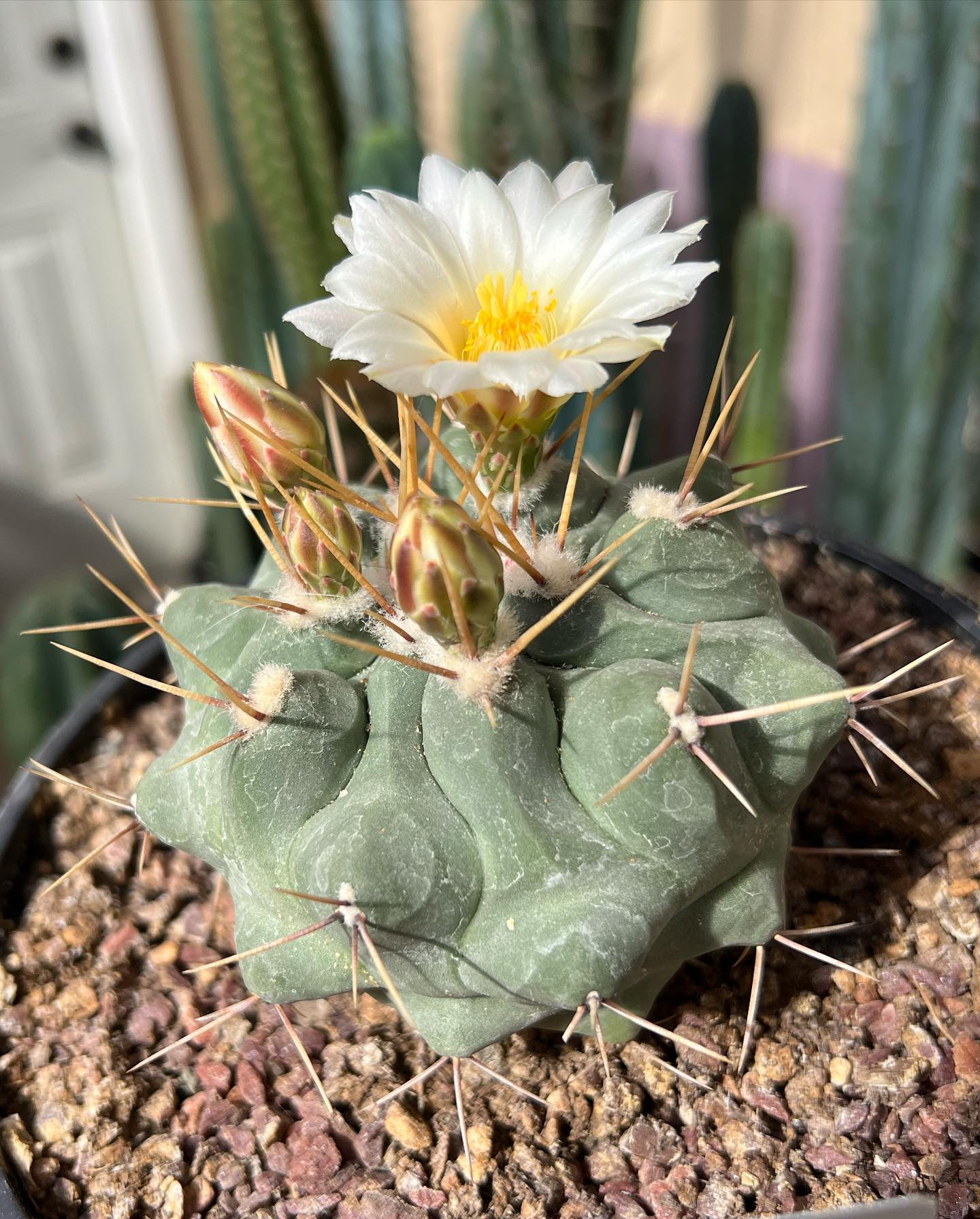
Thelocactus rinconensis (Poselg.) Britton & Rose is a flat-domed Chihuahuan Desert cactus endemic to Coahuila and Nuevo León, Mexico, with the most complex infraspecific structure in the genus. Heinrich Poselger visited La Rinconada, Coahuila, in 1851 and initially referred his collections to Echinocactus lophothele Salm-Dyck; on further study he published a distinct species, Echinocactus rinconensis, in the Allgemeine Gartenzeitung 23: 18 in 1855. Britton and Rose transferred the species to Thelocactus in Cactaceae 4: 7 (1923). The name rinconensis derives from La Rinconada, the type locality area northeast of Saltillo.
Six infraspecific taxa are documented in specialist literature. Kew POWO accepts subsp. nidulans (Quehl) Bravo, the bird’s nest form with dense shredding radials; subsp. phymatothelos (Poselg.) Glass, from Arteaga Canyon south of Saltillo at approximately 1,900 m; subsp. freudenbergeri (R.Haas) Mosco & Zanov., the most geographically restricted, from Grutas de Garcia, Nuevo León; and subsp. hintonii Lüthy, described 1997 from Cienega del Toro, Municipality of Galeana, Nuevo León. Two further subspecies, subsp. icamolensis Halda & Kupcák from near Icamole, Nuevo León, and subsp. palomaensis Pavlíček & Zatloukal from northern Sierra Paila, Coahuila, are accepted by Wikispecies and specialist literature; their current POWO disposition was not fully confirmed during research and is noted in the Taxonomy section below. The subspecies diversity drives a deep sub-collecting niche within a single species name.
Within the six Thelocactus on this site, T. rinconensis pairs most naturally with Thelocactus hexaedrophorus in the flat-domed grey-green segment of the genus. Both are glaucous, both are sparse-spined relative to Thelocactus bicolor, and both carry pale flowers rather than magenta. The collector reaching for one almost always considers the other, and distinguishing them reliably requires attention to rib count and tubercle geometry rather than body colour alone.
Thelocactus rinconensis holds an RHS Award of Garden Merit, confirming reliable performance in temperate cultivation. Seed grown plants require five to nine years to reach first flower, longer than T. bicolor’s three to five years, making it a meaningful cultivation commitment; the flat low-domed body and the long central spines projecting from an otherwise sparse areole provide a distinctive sculptural quality throughout that time. The subspecies complex adds collecting depth: a dedicated collector can assemble all six subspecies with notably different spine and flower characters from the single accepted species.
Thelocactus rinconensis quick reference
A Chihuahuan Desert species, growing on limestone hills and canyon slopes at 1,200 to 1,900 m in Coahuila and Nuevo León, Mexico. Values calibrated for seed grown plants in cultivation, drawn from species-specific habitat data and specialist grower sources.
Taxonomy & nomenclature
The accepted name is Thelocactus rinconensis (Poselg.) Britton & Rose, with the basionym Echinocactus rinconensis Poselger published in the Allgemeine Gartenzeitung 23: 18 in 1855. Poselger visited La Rinconada, Coahuila, in 1851 and initially assigned his collections to Echinocactus lophothele Salm-Dyck (1850), an older combination. After further study he revised his view and published a distinct species in 1855, taking the epithet from the locality name. Britton and Rose transferred the species to Thelocactus in Cactaceae 4: 7 (1923), published 24 December 1923. The species lacks a preserved original collection; Edward F. Anderson designated a neotype in 1972, deposited as US 3050276, from approximately 20 km northeast of Saltillo, Coahuila, representing the type locality area.
A significant nomenclatural split in the literature concerns the relationship of T. rinconensis to Thelocactus lophothele (Salm-Dyck) Britton & Rose. The Matuszewski 2011 monograph on the genus Thelocactus treats T. lophothele as the accepted species name and reduces rinconensis to a subspecies, the opposite of the POWO treatment. Kew POWO accepts T. rinconensis as the species name and places T. lophothele in synonymy as a heterotypic synonym based on Echinocactus lophothele Salm-Dyck (1850). This page follows POWO. Collectors searching the Matuszewski treatment or older European catalog listings under T. lophothele will find the same biological entity.
Six infraspecific taxa are documented. Subsp. nidulans (Quehl) Bravo, with the basionym Echinocactus nidulans Quehl (1911), is the bird’s nest form from Saltillo and Parras, Coahuila; it carries 5 to 11 radial spines giving the dense nest appearance for which it is named and is listed as Threatened under NOM-059-SEMARNAT-2010. Subsp. phymatothelos (Poselg.) Glass, with basionym Echinocactus phymatothelos Poselger (1886), is restricted to Arteaga Canyon south of Saltillo at approximately 1,900 m. Subsp. freudenbergeri (R.Haas) Mosco & Zanov., transferred 1999, is the most geographically restricted, from a single locality at Grutas de Garcia, Nuevo León, and has acicular radials (4 to 6, 15 to 40 mm) and magenta flowers. Subsp. hintonii Lüthy, described in Kakteen und andere Sukkulenten 48(2): 39 (1997) from Cienega del Toro, Municipality of Galeana, Nuevo León at 1,610 m, also has magenta flowers; its boundary with subsp. freudenbergeri is not fully resolved in accessible specialist literature. Two further subspecies, subsp. icamolensis Halda & Kupcák (Kaktusy, 2001) from near Icamole, Nuevo León, and subsp. palomaensis Pavlíček & Zatloukal from northern Sierra Paila, Coahuila, are accepted in Wikispecies and the specialist thelocactus.cactus-mall.net genus resource; their current POWO disposition was not fully confirmed in the research pass and should be verified against the live POWO infraspecific list.
Historical synonyms (12)
- Echinocactus lophothele Salm-Dyck, 1850 basionym
- Echinocactus rinconensis Poselg., 1855 homotypic synonym
- Thelocactus rinconensis var. nidulans (Quehl) Glass & R.A.Foster, 1977 homotypic synonym
- Thelocactus rinconensis var. phymatothele (Poselg. ex Rümpler) Glass & R.A.Foster, 1977 homotypic synonym
- Thelocactus rinconensis var. phymatothelos (Poselg.) Glass & R.A.Foster, 1977 homotypic synonym
- Thelocactus rinconensis var. freudenbergeri R.Haas, 1992 homotypic synonym
- Thelocactus rinconensis subsp. hintonii Lüthy, 1997 homotypic synonym
- Thelocactus rinconensis subsp. nidulans (Quehl) C.E.Glass, 1998 homotypic synonym
- Thelocactus rinconensis subsp. phymatothelos (Poselg. ex Rümpler) C.E.Glass, 1998 homotypic synonym
- Thelocactus rinconensis subsp. freudenbergeri (R.Haas) Mosco & Zanov., 1999 homotypic synonym
- Thelocactus rinconensis subsp. icamolensis Halda & Kupcák, 2000 homotypic synonym
- Thelocactus rinconensis subsp. palomaensis Pavlícek & Zatloukal, 2004 homotypic synonym
Sources: POWO (Kew) · IPNI · GBIF · Wikidata
Habitat
Thelocactus rinconensis is endemic to northeastern Mexico, confined to Coahuila and Nuevo León. This is the tightest geographic footprint of any multi-subspecies Thelocactus on the site, with the entire species complex fitting within a roughly 200 km corridor centred on the Saltillo region. The nominate subspecies and subsp. nidulans are both Coahuilan; subsp. freudenbergeri and subsp. hintonii are Nuevo León endemics, the latter at Galeana Municipality; subsp. icamolensis occurs northwest of Monterrey; the subspecies collectively span from the Parras area west to the Sierra Paila border and south to the Nuevo León highlands near Grutas de Garcia. Elevation across the complex runs from approximately 1,200 to 1,900 m, with a wider reported range of 600 to 2,000 m in some sources.
The habitat throughout is matorral xerófilo on calcareous substrate. All subspecies are documented exclusively from limestone hills, canyon slopes, and rocky calcareous outcrops; no siliceous substrate exceptions are recorded in the literature, distinguishing this species from Thelocactus bicolor, where subsp. flavidispinus grows on novaculite in Texas. Subsp. phymatothelos grows on the slopes of Arteaga Canyon south of Saltillo alongside Neolloydia conoidea, a useful co-occurring species for habitat verification. The llifle cultivation notes record that the Saltillo-area habitats are subject to overgrazing by goats, a consistent threat to limestone-scrubland cacti across the Chihuahuan Desert core.
Rainfall across the Coahuila and Nuevo León range follows the Chihuahuan Desert summer monsoon: approximately 300 to 450 mm annually, concentrated June through September. Winters are cold and essentially dry. The summer-rain pattern maps directly onto the cultivation watering calendar: active growth in the monsoon window, complete dryness through the cold season.
Morphology
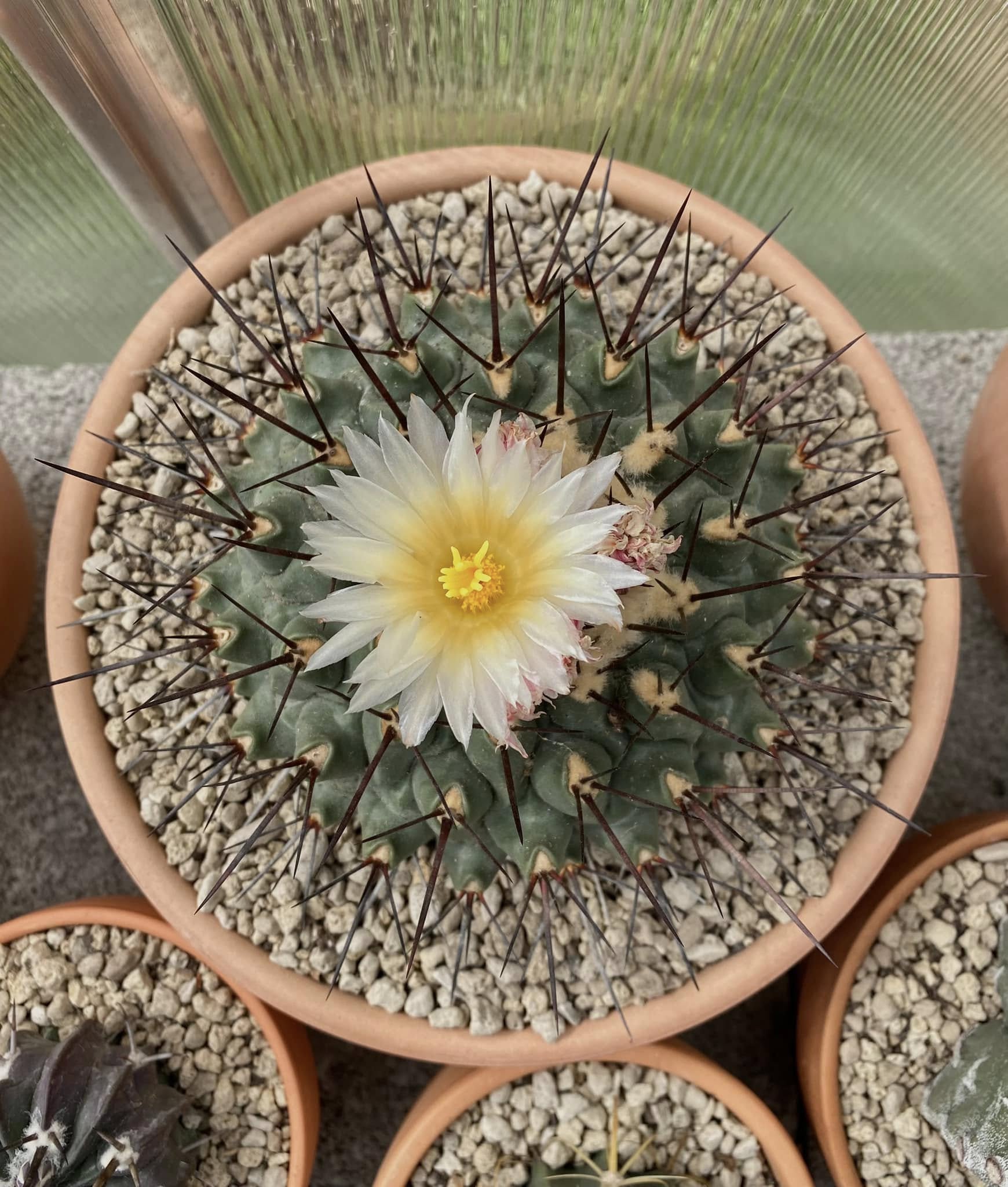
The stem is solitary, rarely branching, and distinctly low-domed to depressed-globose, always wider than tall. Mature cultivated specimens of the nominate subspecies typically reach 6 to 12 cm in height and 12 to 20 cm in diameter; the RHS notes an ultimate height of 10 cm. The profile is flat relative to the other Chihuahuan Desert Thelocactus on this site. The epidermis is light glaucous-grey to grey-green, occasionally acquiring a purple tinge under cold stress or intense UV. Ribs number 20 to 31, arranged around the stem and divided into angled, conical tubercles. Areoles are circular to elliptical, white-woolly, spaced approximately 20 to 25 mm apart along the rib faces.
Spination of the nominate subspecies is notably sparse relative to most cacti of comparable body size. Central spines number 3 to 4, measuring 60 to 80 mm in length, acicular to subulate, ochre to grey-brown in colour, straight or very slightly curved. Radial spines number 0 to 5; many nominate populations in the wild produce plants with no radials at all, a character that immediately distinguishes them from Thelocactus macdowellii, which carries 15 to 25 dense white radials. Subsp. nidulans has the most spination in the complex: 5 to 11 radials (5 to 30 mm, silvery and shredding) plus 3 to 4 centrals to 80 mm, producing the nest-like appearance. Subsp. freudenbergeri carries acicular radials 4 to 6 (15 to 40 mm), more than the nominate but less than nidulans.
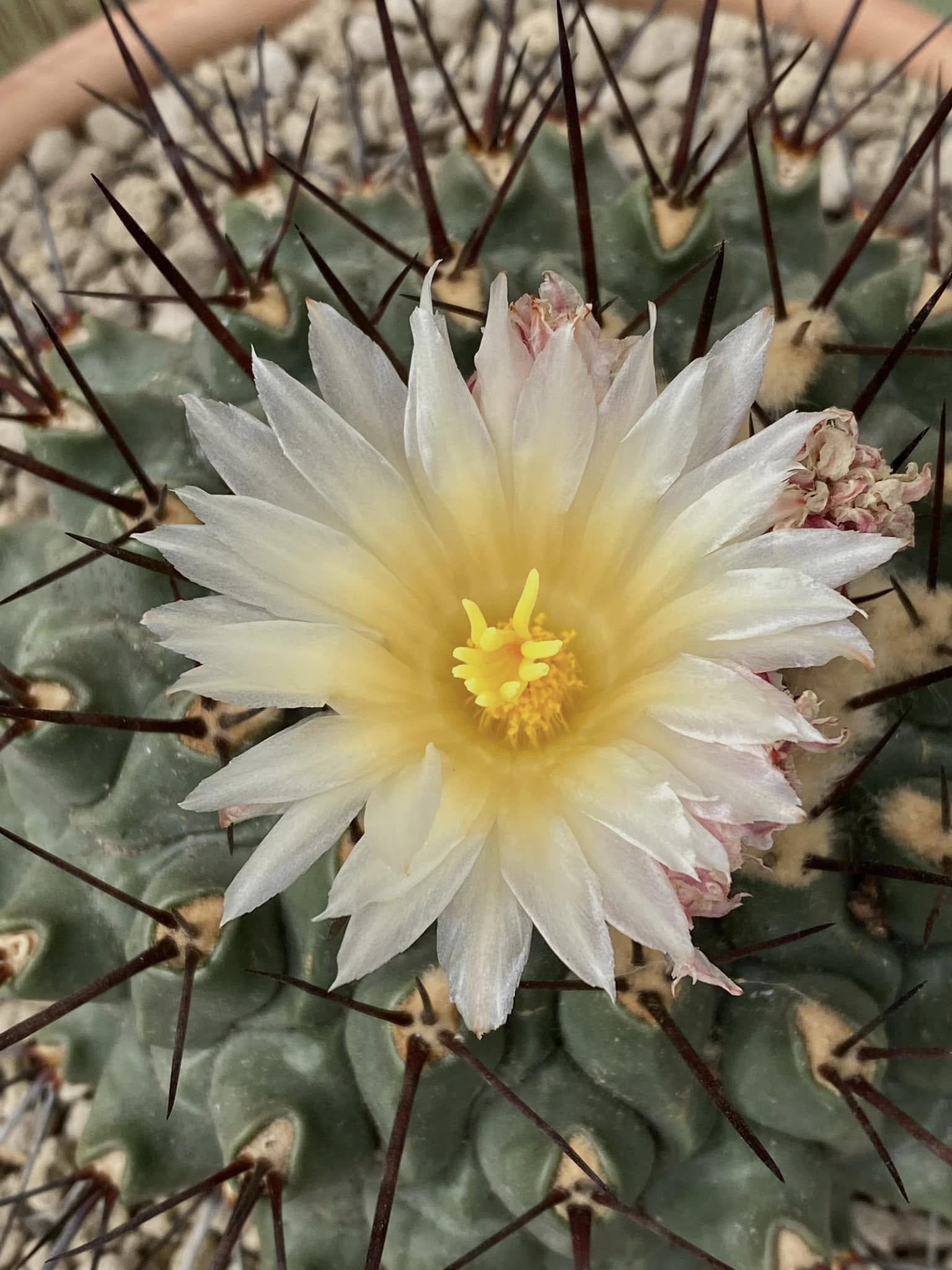
Flowers of the nominate subspecies are 30 to 50 mm wide, funnel-shaped, white to pale pink or pale yellowish with a pinkish flush toward the centre; the flower colour is markedly paler than T. bicolor’s vivid magenta, a useful field character. The magenta flowers occurring in subsp. freudenbergeri, hintonii, and icamolensis are subspecies-level characters, not nominate. Flowering runs from mid-March through mid-September, with an early spring peak; the RHS describes the season simply as “spring.” Seed grown plants from the nominate typically reach first flower at five to nine years from germination, longer than T. bicolor’s three to five years. Fruit is spherical to oblong, 7 to 9 mm diameter, greenish or yellowish at maturity. Seeds are 1.7 to 2 mm long, with a verrucose testa surface.
Locality detail
The type locality is La Rinconada, Coahuila, the area visited by Poselger in 1851 from which the specific epithet is drawn. No preserved Poselger collection exists. Edward F. Anderson designated a neotype in 1972: specimen US 3050276, collected approximately 20 km northeast of Saltillo, Coahuila, on 22 July 1972, confirming that the nominate subspecies is the Saltillo-area entity and establishing a formal type-specimen anchor for the name. The Saltillo region is also where subsp. nidulans and subsp. phymatothelos occur, making the Saltillo-Arteaga corridor the area of highest subspecific density in the species complex.
The map shows the major documented localities across both states. Subsp. freudenbergeri at Grutas de Garcia, Nuevo León, is the most geographically restricted entity in the complex, known from a single locality; its proximity to the subsp. hintonii locality at Galeana Municipality means both Nuevo León subspecies occur within the same mountain system and may form a continuum. Subsp. icamolensis near Icamole sits northwest of Monterrey and represents the northernmost documented point in the species. The palomaensis taxon from northern Sierra Paila extends the Coahuilan range westward toward the Coahuila-Chihuahua border area, though its POWO status requires confirmation.
Thelocactus rinconensis care and cultivation
Thelocactus rinconensis carries the RHS Award of Garden Merit, reflecting reliable behaviour in temperate cultivation conditions. Specialist cultivation sources describe the species as requiring “mineral well-permeable substratum with little organic matter” and flag that excess organic content causes elongation, losing the characteristic flat-domed body form the species is collected for. The cultivation target is a compact, wide, low-growing plant with the long centrals projecting above a clean glaucous body. Excess watering or excess organic substrate produces a taller, looser plant that no longer reads as this species.
Substrate
The substrate recipe is 35 per cent pumice, 15 per cent lava rock, 10 per cent zeolite, 10 per cent granite grit, 15 per cent crushed limestone (3 to 6 mm horticultural grade or oyster grit), 5 per cent coarse silica grit, and 10 per cent worm castings. This delivers a 90 per cent inorganic, 10 per cent organic ratio with a substantial limestone fraction, which is house convention for the genus, not a requirement of this species. Hard tap water already supplies calcium and bicarbonate at every watering; rainwater and RO water supply neither. The pH target of 7.0 to 8.0 is an in-house default, not a documented standard for this genus. Unlike Thelocactus bicolor subsp. flavidispinus, which grows on non-calcareous novaculite in Texas, every documented population of T. rinconensis is on limestone. That habitat record does not set the pot mix, and the same recipe applies uniformly across the subspecies.
Substrate ratios across the Thelocactus species on this site. Most carry elevated limestone fractions by house convention. T. rinconensis matches the baseline shared with T. bicolor and T. hexaedrophorus. (this page)
| Species | Pumice | Lava | Zeolite | Granite | Limestone | Silica | Organic |
|---|---|---|---|---|---|---|---|
| T. bicolor | 35% | 15% | 10% | 10% | 15% | 5% | 10% |
| T. hexaedrophorus | 35% | 15% | 10% | 10% | 15% | 5% | 10% |
| T. rinconensis (this page) | 35% | 15% | 10% | 10% | 15% | 5% | 10% |
| T. macdowellii | 35% | 10% | 10% | 10% | 20% | 5% | 10% |
| T. setispinus | 35% | 15% | 10% | 10% | 8% | 10% | 12% |
| T. tepelmemensis | 30% | 10% | 10% | 5% | 25% | 10% | 10% |
Watering and light
Watering tracks the Chihuahuan summer monsoon pattern native to Coahuila and Nuevo León. Resume carefully in March as temperatures rise; the first watering after winter should be light. From June through September, water thoroughly when the substrate is fully dry, every 10 to 14 days at warm temperatures (28°C and above) or less frequently in cooler conditions. Llifle advises “sparse irrigation from March to October” as a conservative summary. Taper from October; keep the plant bone-dry from November through February. Winter moisture combined with cool temperatures causes root rot. First spring watering should wait until overnight temperatures are consistently above 5°C.
Light requirements differ slightly from T. bicolor. Multiple specialist sources including llifle and Giromagi recommend some summer shading: morning sun with afternoon protection above 35°C enhances body coloration and reduces sunscorch on the glaucous epidermis. Full sun is appropriate in winter and early spring to firm the body and initiate bud set. In temperate glass house conditions, full sun year-round is generally safe; outdoor cultivation in continental-summer climates benefits from midday shade in the hottest weeks. Repot every two to three years in spring, using a wide shallow container that matches the flat body form and fibrous root system.
Comparison
The closest confusion risk in the genus is Thelocactus hexaedrophorus. Both are low-domed, grey-green, tuberculate Thelocactus with limestone habitats and pale flowers; a collector seeing an unlabelled flat grey plant in a specialist collection might reasonably reach for either name. The reliable diagnostic is rib and tubercle geometry. T. rinconensis has 20 to 31 ribs divided into conical, angled tubercles. T. hexaedrophorus has only 8 to 13 ribs, breaking into the near-hexagonal six-sided faces that give it its name. This difference is plainly visible on any reasonably grown specimen: hexaedrophorus looks architectural and geometric; rinconensis shows many more ribs with less-defined polygonal faces. Spination adds a secondary check: the nominate T. rinconensis carries 3 to 4 prominent centrals 60 to 80 mm long with few or no radials; T. hexaedrophorus frequently has 0 central spines and short radials under 25 mm, leaving the body geometry entirely exposed. Distribution differs: T. rinconensis is confined to Coahuila and Nuevo León, while T. hexaedrophorus extends across at least ten Mexican states.
Thelocactus macdowellii sometimes enters the comparison because it also occurs in Coahuila and Nuevo León. T. macdowellii is immediately distinguishable: its body carries 15 to 25 dense white to straw-coloured spines per areole over 30 or more strongly tuberculate ribs, producing a white snowball appearance at odds with the spare, long-spined silhouette of T. rinconensis. Flower colour confirms the separation: T. macdowellii flowers magenta; the nominate T. rinconensis flowers white to pale pink. The only point of surface similarity is shared geography in the Saltillo corridor.
Within the rinconensis subspecies complex itself, the practical distinctions for collectors centre on spine density and flower colour. Subsp. nidulans is the most distinctive: the dense shredding radials that give the bird’s nest appearance immediately separate it from the nearly spine-free nominate. Subsp. freudenbergeri and hintonii carry magenta flowers, contrasting with the nominate’s pale white to pink. Among the other Thelocactus on this site, Thelocactus setispinus is ruled out instantly by its cylindric body, single hooked central spine, and yellow flowers.
Frequently asked questions
Is Thelocactus rinconensis hard to grow?
Intermediate. The Royal Horticultural Society’s Award of Garden Merit signals reliable performance under temperate conditions, and specialist sources describe it as a manageable cultivation target. The single most important variable is a completely dry winter rest from November through February; wet-cold conditions cause root rot. The wide shallow container the flat-domed body requires also matters: a deep pot that stays damp longer than two to three days after watering creates unnecessary rot risk. Light summer shading in hot climates helps maintain the glaucous body colour. Seed grown plants require patience; five to nine years to first flower is the research-supported range.
Can Thelocactus rinconensis be grown from seed?
Yes, and seed grown plants are the cultivation target. The species germinates under standard top-sown conditions at 21 to 27°C substrate temperature in spring. Time to first flower is five to nine years from germination, longer than most Chihuahuan Desert Thelocactus, and reflects the species’ slow flat-domed growth habit. Grafted plants accelerate flowering to roughly 18 months but produce proportionally taller, looser bodies that lose the characteristic flat profile. Seed grown plants maintain proper body dimensions and develop the root system suited to the wide shallow pot the species ultimately requires.
Is Thelocactus rinconensis legal to own?
Yes, with documentation. T. rinconensis falls under the CITES Appendix II blanket listing for Cactaceae, so international commercial trade requires export permits from Mexico. The legal profile carries a subspecies complication: subsp. nidulans is listed as Threatened (Category A) under Mexico’s NOM-059-SEMARNAT-2010, adding a layer of federal protection for that subspecies within Mexico beyond what CITES Appendix II requires. This does not restrict legal ownership of nursery-propagated stock outside Mexico, but it does mean that specifically labelled subsp. nidulans material should carry clear propagation documentation to avoid ambiguity. Nursery-propagated seed-grown stock with documented provenance is the legally defensible source for all subspecies worldwide.
Where does Thelocactus rinconensis grow in the wild?
Exclusively in northeastern Mexico, confined to Coahuila and Nuevo León. The type locality is La Rinconada, Coahuila, northeast of Saltillo, and the Saltillo region holds the highest subspecific density: nominate, subsp. nidulans, and subsp. phymatothelos all occur in or near this corridor. Nuevo León holds subsp. freudenbergeri at Grutas de Garcia (single locality), subsp. hintonii at Galeana Municipality (1,610 m), and subsp. icamolensis northwest of Monterrey. The species grows on limestone hills and canyon slopes in xerophytic scrub at 1,200 to 1,900 m elevation.
When does Thelocactus rinconensis flower?
From mid-March through mid-September, with the strongest flush in spring. Flowers of the nominate subspecies are 30 to 50 mm wide, funnel-shaped, white to pale pink or pale yellowish with a pinkish centre flush. This pale colour is a key field distinction from the vivid magenta flowers of Thelocactus bicolor. Subsp. freudenbergeri and hintonii produce magenta flowers (50 to 60 mm), so flower colour alone is not sufficient to identify all subspecies. No specific published pollinator study has been located; the large open funnel flowers in the Chihuahuan Desert context are consistent with bee pollination.
Sources & further reading
Poselger, H. (1855). Echinocactus rinconensis Poselg. Allgemeine Gartenzeitung 23: 18. Basionym. · Britton, N.L. & Rose, J.N. (1923). Thelocactus rinconensis comb. nov. Cactaceae 4: 7. Published 24 December 1923. · Kew POWO. Thelocactus rinconensis (Poselg.) Britton & Rose. IPNI lsid urn:lsid:ipni.org:names:138864-1. powo.science.kew.org · IUCN Red List. Thelocactus rinconensis. Category: Least Concern (assessment year 2013). iucnredlist.org · Royal Horticultural Society. Thelocactus rinconensis. Award of Garden Merit; hardiness H2 (1–5°C); spring-blooming. rhs.org.uk · llifle, Encyclopedia of Living Forms. Thelocactus rinconensis (Poselg.) Britton & Rose. llifle.com · llifle. Thelocactus rinconensis subs. phymatothelos. llifle.com · llifle. Thelocactus rinconensis subs. freudenbergeri. llifle.com · llifle. Thelocactus rinconensis subs. hintonii. llifle.com · The Genus Thelocactus. Thelocactus rinconensis ssp. rinconensis; ssp. nidulans (NOM-059 Threatened confirmed). thelocactus.cactus-mall.net · Wikispecies. Thelocactus rinconensis. Complete synonym list and subspecies enumeration including icamolensis and palomaensis. species.wikimedia.org · Giromagi Cactus and Succulents. Thelocactus rinconensis. giromagicactusandsucculents.com · Arizona Arboretum Plant Database. Thelocactus rinconensis. Elevation 1,200–1,900 m; time to flower 5–9 years. apps.cals.arizona.edu · Dave’s Garden (PlantFiles). Thelocactus rinconensis. Flower colour range; cold hardiness USDA 9a; grower reports. davesgarden.com · Lüthy, J.M. (1997). Thelocactus rinconensis subsp. hintonii Lüthy descr. nov. Kakteen und andere Sukkulenten 48(2): 39. · Wikipedia. Thelocactus rinconensis; Thelocactus hexaedrophorus. en.wikipedia.org · Anderson, E.F. (2001). The Cactus Family. Timber Press, Portland.