
Thelocactus tepelmemensis
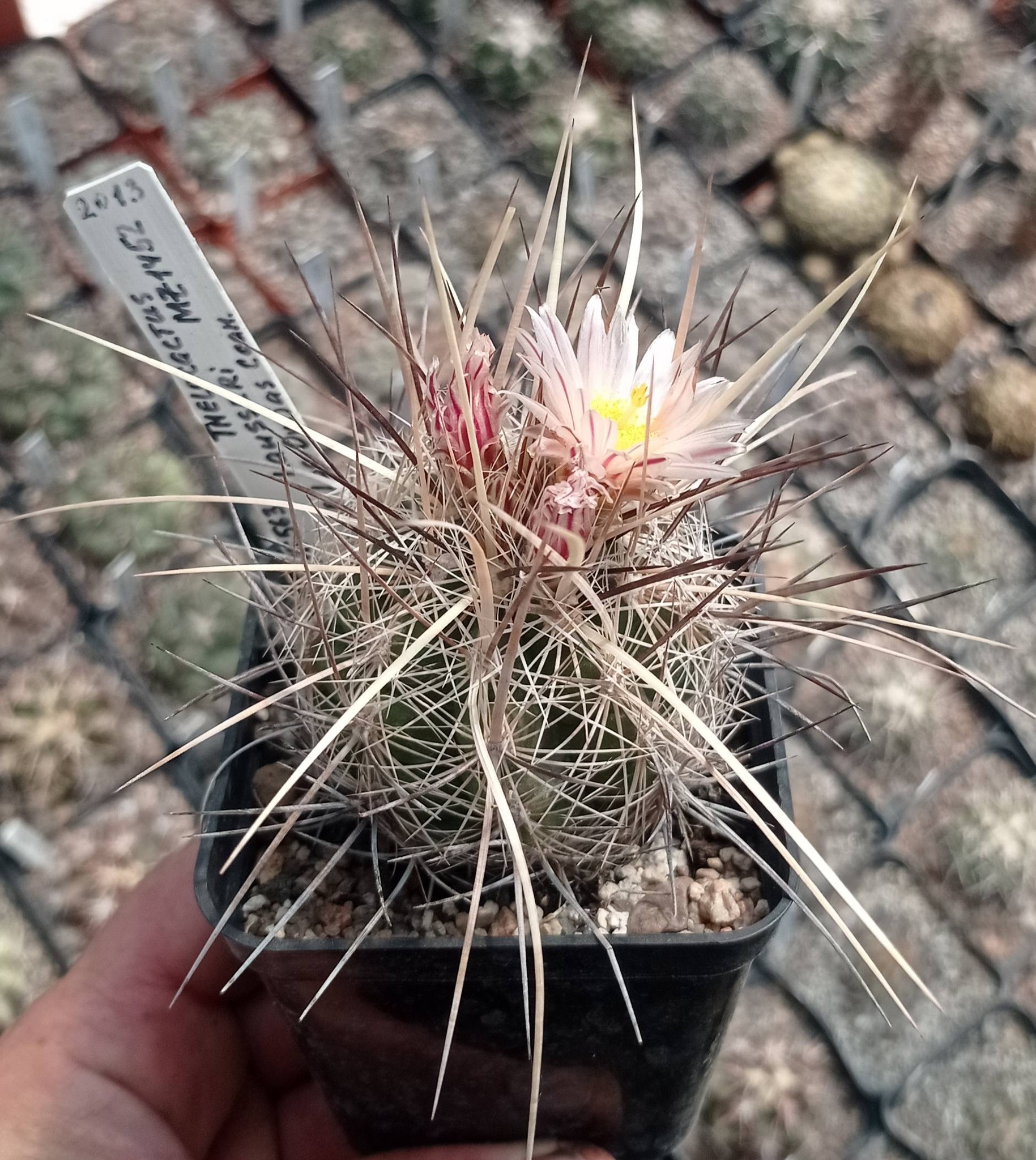
Thelocactus tepelmemensis T.J.Davis, H.M.Hern., G.D.Starr & Gómez-Hin. was published in Phytotaxa 361(1): 115–122 in 2018, making it the newest accepted species in the genus and the last to be added to the six Thelocactus covered on this site. The four describing authors include Héctor M. Hernández and Carlos Gómez-Hinostrosa, the co-authors of Mapping the Cacti of Mexico, whose regional authority on the Tehuacán-Cuicat-lán Valley floor underpins the habitat description and conservation framing in the protologue. The holotype, H.M. Hernández et al. 4128, is deposited at MEXU (Instituto de Biología, UNAM, Mexico City) as specimen 1471315; isotypes are held at the Desert Botanical Garden Herbarium (DES) and a second MEXU accession (1471316).
T. tepelmemensis is the southernmost record in the genus, one of only two Thelocactus species documented outside the Chihuahuan Desert Region proper; the other is Thelocactus bicolor, which reaches south Texas. All other accepted Thelocactus species are Chihuahuan Desert natives. The species grows in a single narrow river canyon near the community of Tepelmeme Villa de Morelos in northwestern Oaxaca, within the Tehuacán-Cuicat-lán Biosphere Reserve, designated a UNESCO World Heritage Site in July 2018, the same year the species was described.
The protologue identifies T. leucacanthus (Zucc. ex Pfeiff.) Britton & Rose as the morphologically closest known species, based on shared ribbed stem architecture and overlapping spine counts. T. leucacanthus does not appear in this site’s current Thelocactus build; the most useful comparative species from the genus hub is Thelocactus hexaedrophorus, with which it shares a broadly globose form and moderate spination. The diagnostic characters that separate them are treated in the Comparison section. Among the cultivated Thelocactus, T. tepelmemensis is the rarest, least studied, and most recently described, with only one recorded iNaturalist observation and no dedicated cultivation literature as of 2026.
Within the canyon at Tepelmeme, the species grows on steep to vertical limestone rock faces alongside a plant community typical of the Tehuacán-Cuicat-lán lower-canyon flora: columnar cacti including Pilosocereus chrysacanthus, Cephalocereus columna-trajani, and Escontria chiotilla; globular cacti including Mammillaria carnea and Mammillaria albilanata; and shrubs including Agave titanota and Fouquieria purpusii.
Thelocactus tepelmemensis quick reference
A lithophyte of a single narrow Oaxacan canyon, growing on vertical limestone cliff faces at 1,420–1,460 m with afternoon shade from canyon walls. Values other than the soil mix derived from habitat research and sister-species analogy; the soil mix is house convention, and no published cultivation data exists for this species. Values calibrated for seed grown plants in cultivation.
Taxonomy & nomenclature
The accepted name is Thelocactus tepelmemensis T.J.Davis, H.M.Hern., G.D.Starr & Gómez-Hin., published in Phytotaxa 361(1): 115–122 (2018) with the DOI 10.11646/phytotaxa.361.1.10. The four authors are Tristan J. Davis, Héctor M. Hernández, Greg D. Starr, and Carlos Gómez-Hinostrosa. Kew POWO accepts the name with no synonyms listed; no synonymisations or combination changes have been published in accessible literature since the 2018 description. The GBIF taxon key is 10732812. This is the youngest accepted species in Thelocactus and carries no published infraspecific taxa.
The species epithet is derived from Tepelmeme Villa de Morelos, the municipality in northwestern Oaxaca nearest the type locality. The tribe placement is Cacteae (subfamily Cactoideae), the same Chihuahuan Desert tribe as all other Thelocactus. The protologue places the species closest to T. leucacanthus (Zucc. ex Pfeiff.) Britton & Rose on morphological grounds, sharing a ribbed stem architecture and overlapping spine counts, but differing in flower colour (red-purple versus yellow or magenta in T. leucacanthus), fruit shape (ovoid versus globose), rib orientation (consistently vertical versus sometimes twisted), and seed micropyle structure (conjunct versus disjunct). The T. tepelmemensis seed micropyle lying inside the hilum border is identified as a key diagnostic seed character for the species in the protologue.
Thelocactus tepelmemensis represents the southernmost documented record in the genus, in the Tehuacán-Cuicat-lán biogeographic province rather than the Chihuahuan Desert Region that all other accepted Thelocactus occupy. Its occurrence in the same canyon system as Mammillaria carnea, M. albilanata, and several columnar cacti characteristic of the reserve’s xerophytic scrub positions it within a distinct biogeographic context from the Chihuahuan Desert species in the genus, a relationship the describing authors specifically highlight in the protologue discussion.
Habitat
Thelocactus tepelmemensis is known from a single narrow river canyon near Tepelmeme Villa de Morelos in the municipality of Tepelmeme, northwestern Oaxaca. The canyon falls within the Tehuacán-Cuicat-lán Biosphere Reserve, a protected area that hosts 86 cactus species and 21 endemics and received UNESCO World Heritage status in July 2018, the same month the protologue appeared. The species grows on steep to vertical limestone rock faces within the canyon at 1,420 to 1,460 m elevation, an unusually narrow altitudinal band of 40 m that reflects the confined canyon microhabitat rather than any wide altitudinal tolerance.
The protologue explicitly states that the plants grow on limestone rock faces “protected from direct afternoon sun,” a detail that immediately separates this species from the sun-baked open slopes occupied by T. hexaedrophorus and T. bicolor. The canyon aspect provides morning to midday light and cuts off the afternoon sun, producing a bright but not fully exposed microclimate consistent with a northeast- or east-facing wall. The substrate is fractured limestone cliff with negligible soil accumulation in rock crevices and ledges; the plants are essentially lithophytic, anchored in calcium-rich mineral fissures with no organic horizon.
The associated plant community is characteristic of the lower-canyon xerophytic scrub of the Tehuacán-Cuicat-lán Valley: columnar cacti including Pilosocereus chrysacanthus, Cephalocereus columna-trajani, and Escontria chiotilla as the canopy layer, with Mammillaria carnea and M. albilanata as globular co-occurring cacti; Opuntia pubescens and O. decumbens; Agave titanota; and Fouquieria purpusii and Cnidoscolus multilobus as non-cactus scrub components. Rainfall at this elevation in northwestern Oaxaca is estimated at 300 to 500 mm annually, concentrated in the summer months from June to September. The canyon walls and their thermal mass buffer the microhabitat from the most extreme temperature swings recorded at the nearby town, which sits approximately 600 m higher in elevation.
Morphology
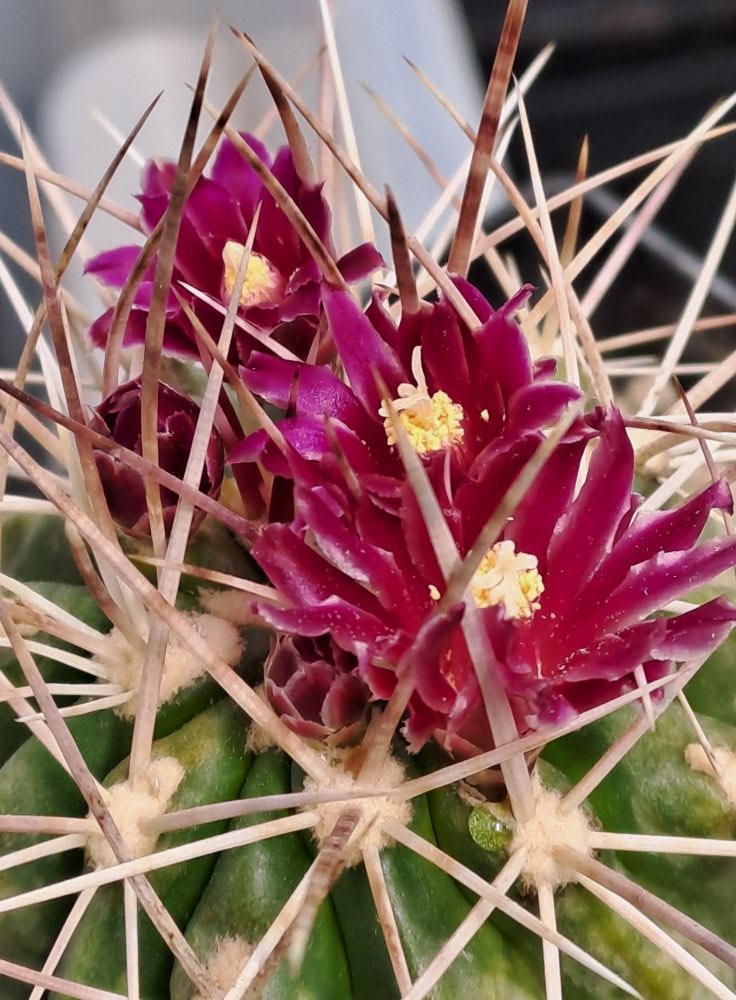
The stem is solitary or caespitose (clustering via lateral stems), globose to elongate, 14 cm tall in the modal range and up to 30.5 cm in the largest recorded caespitose individuals, with a diameter of approximately 10.5 cm. The epidermis is green, with no glaucous or waxy bloom; this is one of two visual characters that immediately distinguish the species from Thelocactus hexaedrophorus, which is distinctly blue-grey and pruinose. The apex is rounded. Both solitary and clustering growth forms occur in the single known population.
Ribs number (11 to) 13 and are consistently vertical. The vertical rib orientation is a stated diagnostic character in the protologue: in T. leucacanthus, the morphologically closest species identified in the original description, ribs may be twisted or spiral. The ribs of T. tepelmemensis do not dissolve into hexagonal tubercles, unlike those of T. hexaedrophorus; they are distinct, relatively undivided low ribs with rounded summits. Each areole carries (6 to) 8 to 9 spines, 10 to 26 (to 42) mm long, poorly differentiated into radial and central; one spine is typically positioned centrally, 1 to 4.2 cm long, tan with a red tip, but the distinction from radials is not sharp. Three small glands at the areole are rarely present.
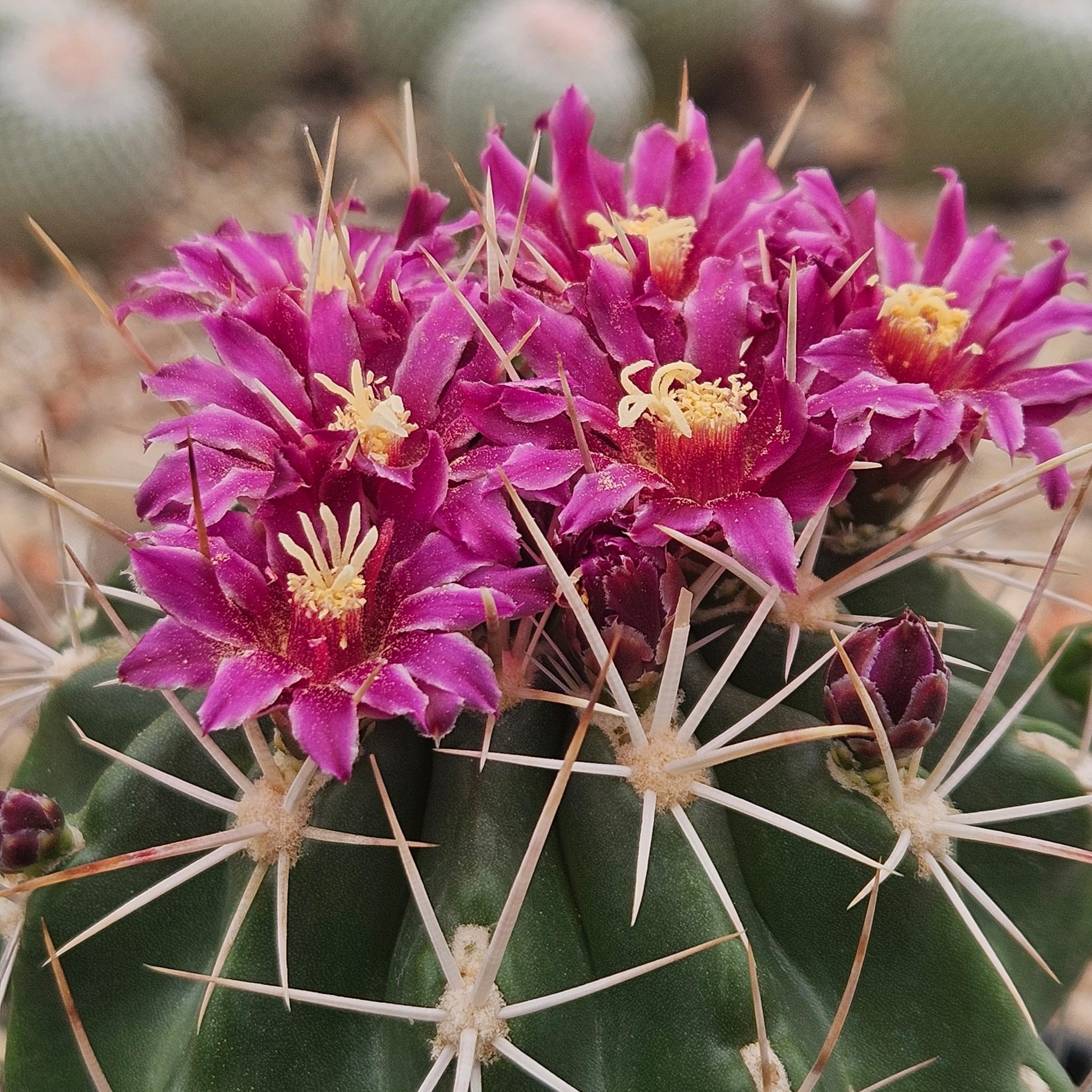
Flowers are funnel-shaped, 13 to 23 mm long, red-purple at anthesis. This flower size is the single most striking diagnostic at the genus level: most Thelocactus flowers measure 25 to 100 mm; the cactus-mall.net genus identification key places T. tepelmemensis at “flowers 10 to 15 mm diameter” versus T. leucacanthus at “flowers 35 to 90 mm diameter.” The flowers are intensely coloured and thumbnail-sized, appearing from the apex. The fruit is ovoid, reddish-purple, approximately 10 by 5 mm, with persistent perianth; the ovoid fruit shape is noted as diagnostic in the protologue, as most Thelocactus fruits are globose to sub-globose. Seeds measure 1.06 to 1.21 by 0.78 to 1.00 mm with a finely verrucose testa. The seed micropyle is conjunct, lying inside the hilum border, a character identified as diagnostic for the species against the disjunct micropyle of most other Thelocactus.
Locality detail
The entire known range of Thelocactus tepelmemensis is a single narrow river canyon near Tepelmeme Villa de Morelos, in the municipality of Tepelmeme, northwestern Oaxaca. The town itself sits at approximately 2,058 m elevation; the canyon type locality is below the town at 1,420 to 1,460 m, consistent with a canyon running significantly below the surrounding plateau. The Tehuacán-Cuicat-lán Biosphere Reserve encompasses the locality, providing federal protection under Mexican environmental law. The reserve’s July 2018 UNESCO World Heritage inscription, coinciding with the species’ description, adds an international conservation layer to its single known site.
The precise GPS coordinates of the type locality are not published in accessible sources; the full protologue PDF (behind the Phytotaxa subscription paywall) likely contains them. Collector coordinates for the holotype are held at MEXU (Mexico City) and DES (Phoenix, Arizona). The Leaflet map below uses a regional centroid for the Tepelmeme area as a conservation measure consistent with this site’s policy on sensitive recently-described species. The biogeographic context of the site is the Tehuacán-Cuicat-lán Valley, which hosts 86 cactus species and 45 of Mexico’s 70 columnar cactus species within a 490,000-hectare protected area.
Thelocactus tepelmemensis care and cultivation
Thelocactus tepelmemensis is effectively uncultivated territory. The species was described in 2018, has only one recorded iNaturalist observation, and appears in no specialist nursery listings or grower diaries consulted for this page. Every cultivation value below is derived from habitat research and analogy with the morphologically closest described species; all values should be treated as provisional working hypotheses until cultivation experience in the community accumulates.
Substrate
The habitat is limestone cliff face: fractured calcareous rock with mineral dust in crevices and no organic horizon. This is the most extreme limestone microhabitat recorded for any Thelocactus. The house substrate recipe is 30 per cent pumice, 10 per cent lava rock, 10 per cent zeolite, 5 per cent granite grit, 25 per cent crushed limestone (the highest limestone fraction in the genus on this site), 10 per cent coarse silica grit, and 10 per cent worm castings. This is a 90 per cent inorganic, 10 per cent organic mix. The 25 per cent limestone fraction and the 5 per cent granite fraction are house convention, not species requirements. Hard tap water already supplies calcium and bicarbonate at every watering; rainwater and RO water supply neither. The 10 per cent organic is the standard house baseline, and the pumice fraction sits below the 35 per cent used for the Chihuahuan Desert siblings as a house choice. All values are house derivations and are not sourced from published cultivation data.
Substrate ratios across the six Thelocactus species on this site. T. tepelmemensis carries the highest limestone fraction in the genus at 25%, a house convention rather than a species requirement. All values are house derivations; no published cultivation data exists for this species.
| Species | Pumice | Lava | Zeolite | Granite | Limestone | Silica | Organic |
|---|---|---|---|---|---|---|---|
| T. bicolor | 35% | 15% | 10% | 10% | 15% | 5% | 10% |
| T. hexaedrophorus | 35% | 15% | 10% | 10% | 15% | 5% | 10% |
| T. rinconensis | 35% | 15% | 10% | 10% | 15% | 5% | 10% |
| T. macdowellii | 35% | 10% | 10% | 10% | 20% | 5% | 10% |
| T. setispinus | 35% | 15% | 10% | 10% | 8% | 10% | 12% |
| T. tepelmemensis (this page) | 30% | 10% | 10% | 5% | 25% | 10% | 10% |
Watering and light
Watering should follow the Tehuacán-Cuicat-lán summer rainfall pattern. Resume watering cautiously in May as temperatures rise above 12 to 15°C. From May through September, water when the substrate is fully dry at the pot base. The canyon microhabitat receives slightly more ambient humidity than the open desert slopes occupied by most Chihuahuan Desert Thelocactus, so a watering interval of every 10 to 14 days in peak summer is a reasonable starting estimate rather than the every-7-days baseline used for siblings from exposed slopes. Taper from October; allow the substrate to dry completely before temperatures drop below 10°C. Keep completely dry from November through February. No grower experience documents the species’ rot sensitivity at the root; err on the side of dryness in winter given the general genus pattern.
Light is the critical departure from all other Thelocactus on this site. The protologue’s statement that the plants grow on rock faces “protected from direct afternoon sun” is specific and actionable. This species should receive bright morning to midday light, with the intense afternoon sun blocked or filtered. An east-facing position under glass, or a south-facing position with dappled shade through midday in hot climates, approximates the canyon wall exposure. Under temperate northern-European greenhouse conditions, a bright but not the sunniest position is appropriate. This is a direct reversal of the advice for T. hexaedrophorus and T. bicolor, both of which are full-sun species from exposed hillsides.
Cold tolerance is estimated at a minimum of 8 to 10°C in cultivation. At approximately 17.8°N latitude in a protected canyon, the type locality experiences minimal frost risk; the thermal mass of the canyon walls further buffers against any cold events. This is meaningfully less cold-hardy than the Chihuahuan Desert siblings, which tolerate brief exposure to 0°C or lower when completely dry. Keep above 10°C in cultivation to be safe. No published cold tolerance data exists for this species.
Comparison
The protologue identifies T. leucacanthus (Zucc. ex Pfeiff.) Britton & Rose as the morphologically closest known species, based on shared ribbed stem architecture and overlapping spine counts. T. leucacanthus is a Hidalgo and Querétaro species not included in the current Thelocactus build on this site. The key characters separating the two are flower size and colour (13 to 23 mm red-purple for T. tepelmemensis versus 35 to 90 mm yellow or magenta for T. leucacanthus), fruit shape (ovoid versus globose), and rib orientation (consistently vertical in T. tepelmemensis; sometimes twisted in T. leucacanthus). The flower size difference alone resolves any identification question between the two.
Among the six Thelocactus on this site, the most useful comparison is with Thelocactus hexaedrophorus. Both species are broadly globose, moderately spined, and compact relative to the taller bicolor or the wide disc-shaped rinconensis. The differences are definitive. T. hexaedrophorus has a blue-grey glaucous epidermis; T. tepelmemensis has a plain green stem with no waxy bloom. T. hexaedrophorus has 8 to 13 ribs breaking into near-hexagonal tubercles; T. tepelmemensis has 13 consistently vertical ribs without hexagonal faceting. The flower contrast is impossible to miss: T. hexaedrophorus produces white to pale pink flowers 5 to 10 cm wide; T. tepelmemensis produces red-purple flowers 13 to 23 mm long, roughly one quarter the diameter. Growth habit also differs: T. hexaedrophorus is always depressed-globose (wider than tall); T. tepelmemensis can be elongate, potentially taller than wide in clustering individuals.
Thelocactus rinconensis is distinguishable from T. tepelmemensis by its very flat disc-like form (12 to 20 cm wide, 6 to 8 cm tall), 20 to 25 ribs, and 3 to 4 prominent central spines 6 to 8 cm long that radiate visibly from each areole. The spination of T. rinconensis dominates the plant’s silhouette; that of T. tepelmemensis is subdued, with poorly differentiated spines leaving the ribs visible. Thelocactus bicolor requires no close inspection: its bicoloured red-and-ochre spination, taller ovoidal body, and vivid 5 to 9 cm magenta flowers make it immediately distinct. Thelocactus setispinus is ruled out by its elongate cylindric body and single prominent hooked central spine.
Frequently asked questions
Is Thelocactus tepelmemensis hard to grow?
Advanced. The species is effectively uncultivated: described in 2018, with only one known iNaturalist observation and no grower diary or specialist nursery data published as of 2026. All cultivation guidance is derived from habitat analogy with sister species. The most important constraint is light: unlike other Thelocactus, the protologue explicitly records the plants growing on cliff faces protected from afternoon sun, meaning full-sun treatment used for Chihuahuan Desert relatives will likely cause stress. Growers working with this species are in experimental territory with no community experience to fall back on.
Can Thelocactus tepelmemensis be grown from seed?
In principle yes, by analogy with the genus. No published germination data exists for this species. Genus-level practice points to germination at 21 to 26°C, with sporadic timing common in Cacteae tribe species. Seed availability is extremely limited; what circulates in the specialist trade will have come from botanical garden material or collector exchanges. Seed grown plants are the appropriate cultivation goal because no propagated stock has yet established through the commercial trade channels that would allow degrafted or grafted material to appear.
Is Thelocactus tepelmemensis legal to own?
Yes, with documented provenance. CITES Appendix II covers all Cactaceae, so any international commercial trade requires export permits from Mexico. The Tehuacán-Cuicat-lán Biosphere Reserve provides additional habitat protection under Mexican federal law; wild collection within the reserve is prohibited. NOM-059-SEMARNAT-2010 predates the species’ 2018 description and had not formally assessed it at publication. Nursery-propagated stock with documented botanical-garden or seed-trade provenance is the only legally defensible path for acquisition outside Mexico.
Where does Thelocactus tepelmemensis grow in the wild?
A single known location: a narrow river canyon near Tepelmeme Villa de Morelos in northwestern Oaxaca, Mexico, within the Tehuacán-Cuicat-lán Biosphere Reserve. The plants grow on steep to vertical limestone cliff faces at 1,420 to 1,460 m elevation, shielded from direct afternoon sun by the canyon walls. This is the southernmost documented record in the genus Thelocactus, in the Tehuacán-Cuicat-lán biogeographic province rather than the Chihuahuan Desert Region where all other accepted species occur.
When does Thelocactus tepelmemensis flower?
The flower season is not precisely documented in published literature. By analogy with the genus and the subtropical highland climate of northwestern Oaxaca, flowering likely occurs from spring through mid-summer, triggered by warm temperatures and the onset of summer rainfall. The flowers are small (13 to 23 mm long) and red-purple, funnel-shaped from the apex; they are the most visually distinctive character of the species and are roughly one quarter the diameter of most other Thelocactus flowers. No specific pollinator has been documented in the protologue or any subsequent study.
Sources & further reading
Davis, T.J., Hernández, H.M., Starr, G.D. & Gómez-Hinostrosa, C. (2018). A distinctive new species of Thelocactus (Cactaceae) from Oaxaca, Mexico. Phytotaxa 361(1): 115–122. DOI: 10.11646/phytotaxa.361.1.10. · Kew POWO. Thelocactus tepelmemensis T.J.Davis, H.M.Hern., G.D.Starr & Gómez-Hin. GBIF taxon key 10732812. powo.science.kew.org · GBIF. Thelocactus tepelmemensis occurrence data. gbif.org/species/10732812 · Wikipedia contributors. Thelocactus tepelmemensis. en.wikipedia.org/wiki/Thelocactus_tepelmemensis · Novataxa. Thelocactus tepelmemensis protologue summary. novataxa.blogspot.com (2018). Confirmed authors, holotype repository, spine and seed measurements. · cactus-mall.net. Thelocactus species identification key. thelocactus.cactus-mall.net. Flower diameter diagnostic placing T. tepelmemensis at 10–15 mm versus T. leucacanthus at 35–90 mm. · Botanical Sciences (2019). Specific habitat requirements and niche conservatism for nine species of the Mexican genus Thelocactus. Botanical Sciences 97(1). scielo.org.mx · Hernández, H.M. & Gómez-Hinostrosa, C. (2011, 2015). Mapping the Cacti of Mexico, Parts I and II. Succulent Plant Research vol. 7 and 8. DH Books. · UNESCO World Heritage Centre. Tehuacán-Cuicat-lán Valley: originary habitat of Mesoamerica. whc.unesco.org/en/list/534/ Inscribed 2018; 86 cactus species; 21 endemic; limestone karst topography. · Wikipedia contributors. Tehuacán-Cuicat-lán Biosphere Reserve. en.wikipedia.org. Reserve context: 45 of Mexico’s 70 columnar cactus species; karst limestone topography. · iNaturalist. Thelocactus tepelmemensis. inaturalist.org/taxa/746070. One recorded observation; confirms minimal cultivation presence. · Anderson, E.F. (2001). The Cactus Family. Timber Press, Portland.