
Cochemiea setispina
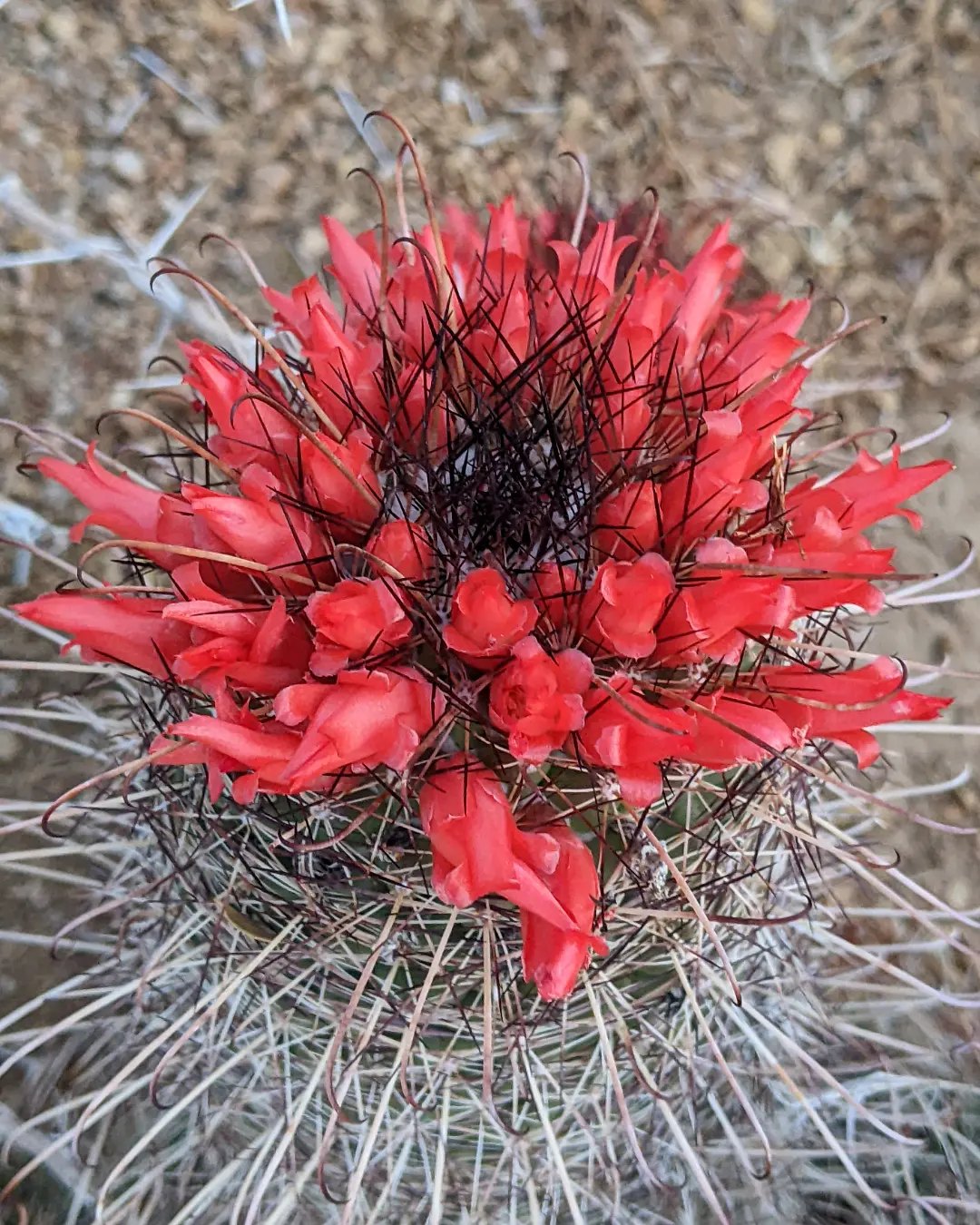
Cochemiea setispina (J.M.Coult.) Walton is one of the two original pre-revision Cochemiea species, alongside Cochemiea poselgeri, that anchored the genus before Breslin, Wojciechowski & Majure’s 2021 molecular revision expanded it from four coastal Baja shrubs to roughly 36 species. The name traces to John Merle Coulter, who described the basionym Cactus setispinus in Contributions from the U.S. National Herbarium 3(2): 106 (1894), based on material from the interior mountain ranges of central Baja California. Katherine Brandegee transferred the species to Mammillaria in 1897; Frederick Arthur Walton elevated the genus Cochemiea in 1899 and placed the species there under the combination that Kew POWO accepts today.
The epithet is Latin for bristly-spined, and no name in the encyclopedia describes its bearer more directly. Each areole carries 10–12 slender white radial spines up to 34 mm long, spreading widely from the center and giving the plant a soft, densely white appearance that reads as almost furry at a distance. The contrast with C. poselgeri’s sparse brown radials is immediate and unmistakable. This is a compact interior granite mountain species; it clusters into tight clumps no taller than 30 cm, occupying rocky slopes in the Sierra de San Borja, Sierra La Asamblea, and adjacent ranges of central Baja California at elevations from valley floor to 400 m.
C. setispina sits in the Cochemiea s.s. five-taxon core clade with C. poselgeri, C. halei, C. maritima, and C. pondii. All five share the zygomorphic red hummingbird-pollinated flowers that originally distinguished the genus from Mammillaria, and all five trace a Pacific Coast Baja California origin at approximately 5–4 million years ago. In cultivation the spring bloom (March–April) is the standout event: flowers reach 5–6 cm in length, disproportionately large for the plant’s stem diameter, a scarlet zygomorphic tube identical in pollination syndrome to C. poselgeri but produced four to five months earlier in the calendar year.
The species sits on CITES Appendix II through the whole-family Cactaceae listing. Its narrow range across interior Baja granite ranges and collection pressure for the ornamental trade create real vulnerability for wild populations; nursery-propagated, seed-documented stock is the only defensible collector source. Conservation status details are in the box below.
Cochemiea setispina quick reference
An interior granite-slope endemic from the central Baja California Peninsula, occupying rocky slopes in the Sierra de San Borja and adjacent ranges at 0–400 m on non-calcareous igneous substrates with a bimodal semi-arid climate. Values calibrated for seed grown plants in cultivation, drawn from habitat data and specialist grower sources.
Taxonomy & nomenclature
The accepted name is Cochemiea setispina (J.M.Coult.) Walton. The basionym Cactus setispinus Engelm. ex J.M.Coult. was published in Contributions from the U.S. National Herbarium 3(2): 106 (1894). The Engelmann qualifier in the basionym author citation indicates that George Engelmann supplied unpublished notes that Coulter drew on for the formal description; Kew POWO credits the accepted combination to (J.M.Coult.) Walton without the Engelmann qualifier. The species epithet derives from Latin seta (bristle) and -spinus (spined), describing the dense bristly white radial spines that visually define the plant.
Katherine Brandegee transferred the species to Mammillaria as Mammillaria setispina (J.M.Coult.) K.Brandegee in Erythea 5: 117 (1897). In the same year that Frederick Arthur Walton elevated Cochemiea to genus rank, he placed C. setispina there in Cactus Journal (London) 2: 51 (1899), establishing the currently accepted combination. D.R. Hunt reduced the species to a subspecies of C. pondii in Mammillaria Postscripts 6: 5 (1997) as Mammillaria pondii subsp. setispina; U. Guzman transferred the same combination to Cochemiea in Cactaceae Systematics Initiatives 16: 16 (2003). Both subspecific combinations are listed in some specialist databases as primary names for the species. Kew POWO, following the Breslin et al. (2021, 2022) molecular phylogenies, accepts Cochemiea setispina as a full species distinct from C. pondii, and that treatment is used here.
Cochemiea setispina belongs to the Cochemiea s.s. five-taxon core clade documented by Breslin, Wojciechowski & Majure (2022, American Journal of Botany 109(10): 1472–1487). The five members of this clade are C. halei, C. maritima, C. pondii, Cochemiea poselgeri, and C. setispina. All five share the zygomorphic scarlet tubular flowers and hummingbird pollination that originally distinguished the pre-revision Cochemiea from Mammillaria, and all five trace a common Pacific Coast Baja California origin at approximately 5–4 Ma. The remaining ~31 species of the expanded genus, including the other five taxa covered on this site, belong to derived clades with entirely different flower forms and pollinator syndromes.
Historical synonyms (5)
- Cactus roseanus J.M.Coult., 1894 basionym
- Cactus setispinus J.M.Coult., 1894 homotypic synonym
- Mammillaria setispina (J.M.Coult.) Engelm., homotypic synonym
- Mammillaria pondii subsp. setispina (J.M.Coult.) D.R.Hunt, 1997 heterotypic synonym
- Cochemiea pondii subsp. setispina (J.M.Coult.) U.Guzmán, 2003 heterotypic synonym
Sources: POWO (Kew) · IPNI · GBIF · Wikidata
Habitat
Cochemiea setispina is an interior granite-slope endemic of the central Baja California Peninsula. The documented range spans both Baja states: in Baja California (the northern state), the species occurs in the Sierra de San Borja, Sierra La Asamblea, and on Isla Angel de la Guarda in the Gulf of California; in Baja California Sur (the southern state), it occupies the Sierra de San Francisco and Sierra de Guadalupe. The type locality is San Borja, at the San Borja Mission area in the interior of central Baja California. Kew POWO recognises the range as “Mexico (C. Baja California)” indicating central Baja California Peninsula spanning both states.
Elevation is 0–400 m above sea level. This is a relatively low-elevation interior mountain species; the upper bound of 400 m is consistent across multiple independent sources and represents rocky terrain in the interior granite ranges rather than any subalpine zone. The habitat is described uniformly as slopes of granite mountains in the Baja California Desert ecoregion (WWF Deserts & Xeric Shrublands biome). The substrate at documented localities is coarse, gravelly, and non-calcareous: granite, gneiss, trachyte, porphyry, and sandstone conglomerate. No limestone or calcareous rock association has been documented.
The interior mountain climate differs from the coastal conditions occupied by Cochemiea poselgeri. Annual rainfall in the interior ranges is estimated at 100–250 mm with a bimodal pattern: sparse Mediterranean-type winter rains (November–March) and a summer pulse from Gulf of California tropical moisture (July–September). The interior position provides less Pacific maritime fog influence than the coastal lowlands, but higher thermal amplitude: hotter days, cooler nights at equivalent latitudes. Full sun reaches the granite slopes unobstructed. Associated cacti at documented localities include Echinocereus ferreirianus, Echinocereus brandegeei, Mammillaria dioica, and Ferocactus peninsulae, a community adapted to exposed arid granite slopes.
Morphology
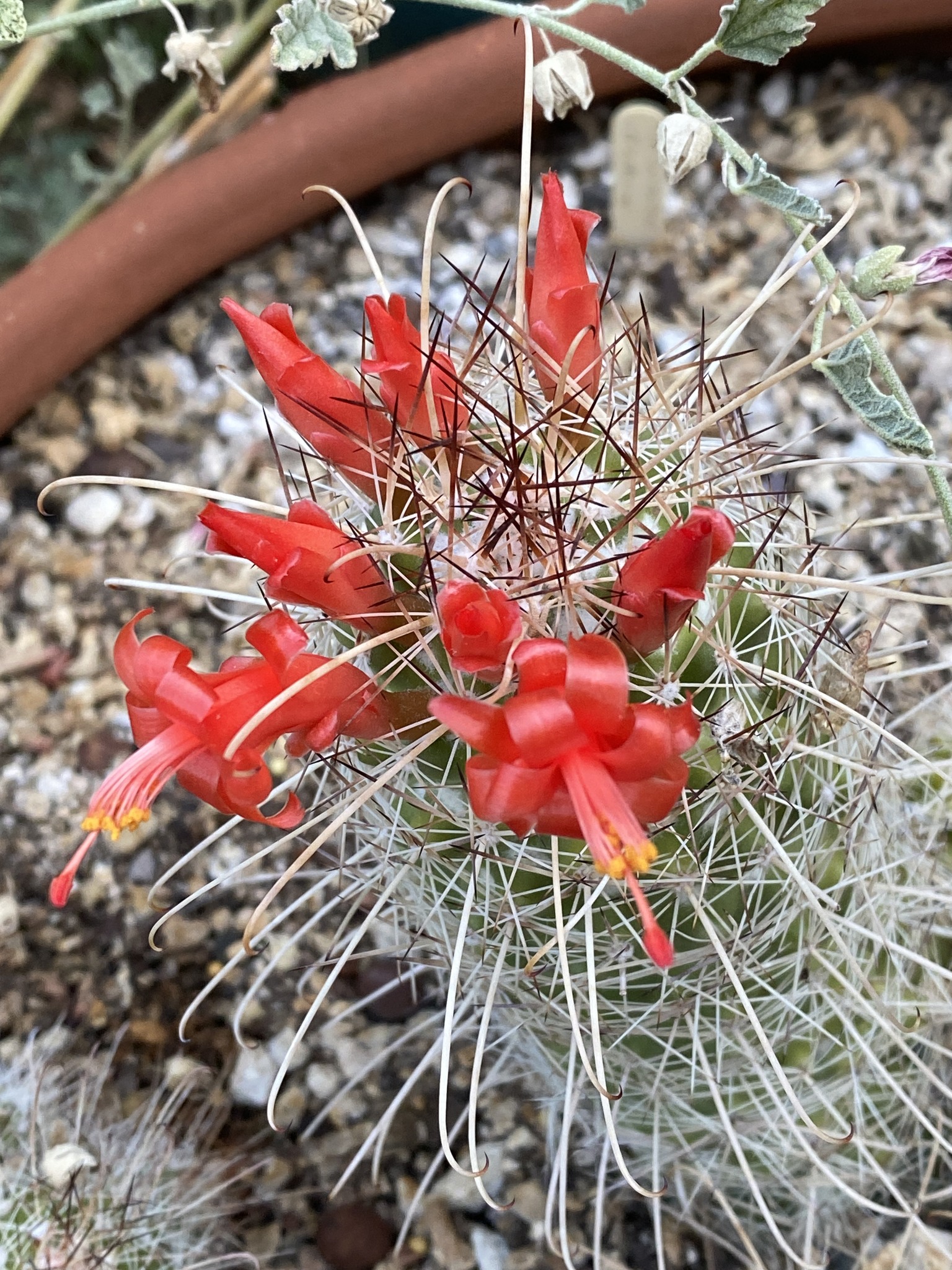
Cochemiea setispina forms compact clusters of cylindrical gray-green stems, initially solitary, later developing into small irregular clumps. Stems reach 30 cm in length and 3–6 cm in diameter, erect to slightly prostrate in open exposures. The stout diameter relative to the stem length makes this a compact, chunky plant in comparison to the sprawling, slender-stemmed C. poselgeri, which reaches 200 cm in length at only 4 cm across. Tubercles are conical with woolly axillae.
Spination is the plant’s defining character. Each areole carries 10–12 radial spines, white with black or dark tips, 10–34 mm long, slender and flexible, spreading widely outward from the areole to produce the dense white bristly coverage that earns the name setispina. Central spines number 1–4; the upper centrals are straight, while the lowest central is the longest (2–5 cm) and hooked at the tip. The presence of multiple central spines distinguishes this species from C. poselgeri, which carries only a single shorter hooked central. The overall effect of the dense white radials is a plant that reads as white or silver-white at any viewing distance, a character shared by no other taxon in the expanded genus covered on this site.
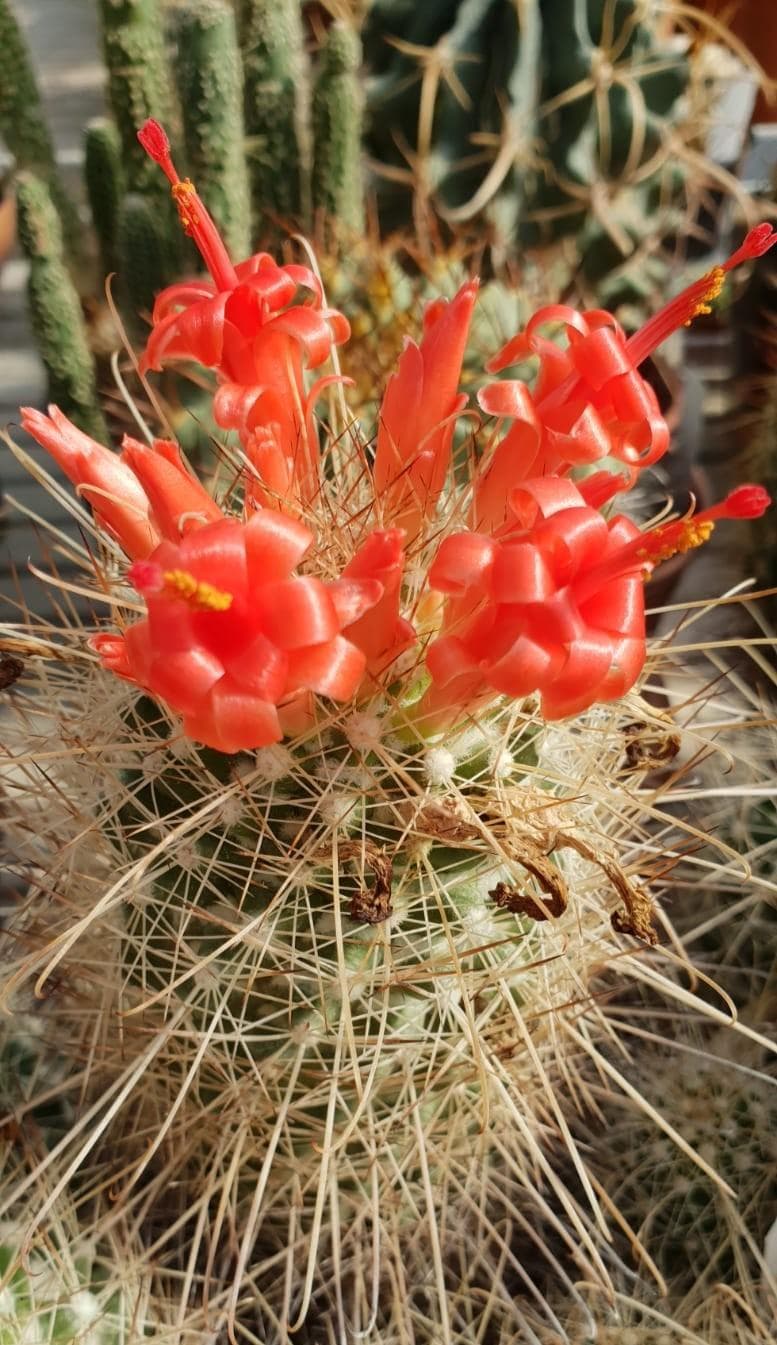
Flowers are scarlet red, zygomorphic (bilaterally symmetrical), and large relative to the plant’s stem diameter: 5–6 cm long and 2 cm wide, with a long tubular hypanthium, flaring segments, and reflexed perianth tips that expose the stamens and elongated style. This is the hummingbird-pollination syndrome characteristic of the pre-revision Cochemiea s.s. clade. Flowering is in spring, March–April, with an occasional secondary flush in autumn. The spring-blooming phenology is phenologically distinct from C. poselgeri’s August–September late-summer bloom and tracks the spring onset of moisture in the interior mountain ranges. Fruit is obovoid, scarlet, 2–3 cm long. Seeds are black and pitted.
Locality detail
The type locality is San Borja, the area around the historic San Borja Mission in the interior of central Baja California. Coulter’s 1894 description records the species from this locality, which falls within the Sierra de San Borja granite range. The four map points above represent the four named mountain ranges in the documented distribution. These are regional centroids rather than population-level coordinates; precise GPS coordinates for individual populations are not published in the primary literature available for this page.
The species does not overlap geographically with Cochemiea poselgeri in documented ranges. C. poselgeri occupies the coastal and semi-coastal lowlands of southern Baja California Sur from around San Ignacio south to the Cape Region, while C. setispina is an interior mountain-range species tied to granite slopes at central and more northerly latitudes of the peninsula. Isla Angel de la Guarda, a large Gulf of California island east of the Sierra La Asamblea population, is a documented occurrence for C. setispina and is not represented on the map as a separate point.
Cochemiea setispina care and cultivation
Cochemiea setispina is a species that rewards precision over quantity in cultivation. The two non-negotiables are a fast-draining mineral substrate and a complete winter dry rest. Get those right and the plant grows steadily, clusters over time, and flowers reliably in spring. The dense white bristly spination provides natural sun protection at the granite-slope UV levels the species evolved under, so full sun is an asset, not a risk.
Substrate
The native habitat is granite mountain slopes with mixed coarse igneous and metamorphic substrate: granite, gneiss, trachyte, porphyry, and sandstone conglomerate. No cultivation source reports this species needing lime or being harmed by it, so limestone is left out as the house default, not because the plant is known to dislike it. The recommended substrate is 40% pumice, 15% lava rock (scoria), 10% zeolite (clinoptilolite 4–6 mm), 20% granite grit, 5% horticultural silica grit (1–3 mm), and 10% worm castings; limestone is 0% throughout. The total is 90% inorganic and 10% organic, matching the standard Cactaceae baseline. Granite is elevated to 20% (versus 15% in C. poselgeri) as a house choice for coarse drainage grit, not to mirror the granite scree of the habitat. Silica is correspondingly lower at 5% because the elevated granite already provides angular mineral grit drainage. Zeolite at 10% buffers pH toward neutral; a slightly acidic outcome (pH 6.5–7.0) is a house target rather than a documented species preference. In hot dry climates, bump organic to 15% (reducing pumice to 35%) to retain moisture against rapid drying during the spring growing season. In cool humid climates, reduce organic to 5–8% (raising pumice to 42–45%) to reduce rot risk.
All seven Cochemiea species on this site grow across a range from granite-only slopes to Durango limestone. C. guelzowiana and C. theresae carry 20% limestone and C. albicans sits at 10%, as house convention rather than a species requirement; the remaining four Baja species carry 0% limestone. C. setispina is one of those four.
| Species | Pumice | Lava | Zeolite | Granite | Limestone | Silica | Organic |
|---|---|---|---|---|---|---|---|
| C. poselgeri | 40% | 15% | 10% | 15% | 0% | 10% | 10% |
| C. setispina (this page) | 40% | 15% | 10% | 20% | 0% | 5% | 10% |
| C. guelzowiana | 35% | 15% | 10% | 10% | 20% | 5% | 5% |
| C. saboae | 45% | 15% | 10% | 15% | 0% | 10% | 5% |
| C. theresae | 32% | 12% | 10% | 12% | 20% | 6% | 8% |
| C. blossfeldiana | 40% | 10% | 10% | 20% | 0% | 10% | 10% |
| C. albicans | 40% | 10% | 10% | 15% | 10% | 10% | 5% |
Watering and light
The interior mountain climate has a bimodal rainfall pattern with sparse Mediterranean winter rains (November–March) and a summer Gulf moisture pulse (July–September). The spring-blooming phenology indicates that active growth and flower development begin with the late-winter moisture onset. In cultivation: withhold water entirely November through January, allowing the substrate to dry fully and the stems to shrivel slightly over winter (this stress promotes spring flowering). Resume with minimal water every 3–4 weeks in February–March to break dormancy before the bloom. Through the spring growing season (April–June), water every 2–3 weeks allowing the substrate to dry completely between waterings. Continue regular watering through summer (July–September, every 2–3 weeks) through the secondary Gulf moisture period. Reduce in October and transition to dormancy. The species is described as especially sensitive to overwatering; always water to runoff, then withhold completely until the substrate is dry throughout. Never water during cold wet weather.
Full sun is required. Maximum sun exposure is needed for full growth potential and reliable flowering. The granite-slope habitat provides unobstructed sun at low elevation in a semi-arid interior climate, and the dense white spination evolved in part as UV protection. In cultivation, acclimate young unacclimated plants gradually, but established specimens tolerate full sun without shade. Good ventilation around the plant is important for this interior semi-arid species, which lacks the Pacific maritime moisture buffer that moderates conditions for coastal C. poselgeri.
Cold tolerance and propagation
No specialist grower source provides a confirmed minimum temperature for C. setispina. From the interior Baja elevation range (0–400 m) and the habitat at similar latitudes, winter temperatures rarely drop below 0–2°C; brief exposure to 0°C dry may be tolerated. The safe recommended minimum for any sustained exposure is 5°C. Wet cold at any temperature is a serious rot risk. Repot every 2–3 years in spring before first watering, when roots are at their driest.
Seed grown plants develop the characteristic dense white spination and compact cluster form that defines the species; grafted plants may grow with aberrant elongated habit that obscures the compact identity. Sow in spring at 21–27°C in a well-draining mineral mix with minimal organic; germination typically occurs in 7–14 days. Seedlings are slow-growing. Mature clusters produce offsets that can be separated. Plants are self-sterile at the genus level; two genetically distinct individuals are required for seed set.
Comparison
The only realistic confusion candidate for C. setispina within this genus’s encyclopedia coverage is Cochemiea poselgeri, the other pre-revision Cochemiea s.s. member. Both species share the zygomorphic scarlet hummingbird-pollinated flowers that originally defined the old genus, both are Baja California Peninsula endemics, and both carry hooked central spines. Any collector who knows the pre-revision Cochemiea concept will encounter these two as “true Cochemiea” and will want to know how to tell them apart.
The separation is clear on multiple characters. Stem habit is the fastest: C. setispina reaches 30 cm in compact clusters; C. poselgeri reaches 200 cm in sprawling decumbent colonies that drape off cliff faces. The spine cover is equally diagnostic: C. setispina carries 10–12 long white bristly radials (up to 34 mm) giving a dense white appearance; C. poselgeri has fewer, shorter, darker brown-tipped radials (up to 8, approximately 10 mm). The central spine complement differs too: C. setispina carries 1–4 centrals (the lowest hooked, up to 5 cm); C. poselgeri has a single shorter hooked central (1.5–2 cm). The flowers of C. setispina (5–6 cm) are significantly larger than those of C. poselgeri (~3 cm). The two species do not overlap geographically in documented ranges: C. setispina occupies interior granite mountain ranges of central Baja at 0–400 m; C. poselgeri occupies the coastal and semi-coastal lowlands of southern Baja California Sur from San Ignacio to the Cape Region. In cultivation, flowering season provides the most reliable calendar character: C. setispina blooms March–April (spring); C. poselgeri blooms August–September (late summer).
The five other taxa covered in this genus present no realistic confusion risk with C. setispina. Cochemiea blossfeldiana has bicoloured pink-and-white actinomorphic flowers and northern Baja range, nothing like the white-spined spring-blooming interior mountain species. Cochemiea albicans has stiff white spines rather than flexible bristly radials, and actinomorphic pink-white flowers. The mainland miniatures Cochemiea guelzowiana, C. saboae, and C. theresae are radically different in scale, range, and flower colour from the interior Baja granite-slope species.
Frequently asked questions
Is Cochemiea setispina hard to grow?
Intermediate. The species has two firm requirements: a fast-draining mineral substrate and a dry winter dormancy with no watering from November through January. Both are easy to provide but easy to get wrong. Overwatering during cold months is the main cause of losses; the species is described as especially sensitive to overwatering. Given full sun, the correct mineral substrate, and a dry winter rest, it grows steadily and clusters reliably over time.
Can Cochemiea setispina be grown from seed?
Yes. Sow in spring at 21–27°C in a well-draining mineral mix with minimal organic; germination typically occurs in 7–14 days. Seedlings are slow-growing; the compact clumping habit and dense white spination take several years to develop from a compact juvenile. Seed grown plants are the collector target because grafted plants may develop an aberrant elongated habit that obscures the compact, densely white-spined character. The species is self-sterile at the genus level; two genetically distinct individuals are needed for seed set and fruit production.
Is Cochemiea setispina legal to own?
Yes, with documentation. All Cactaceae are listed on CITES Appendix II under the whole-family listing (annotation #4 since 1977), which permits international trade with CITES export and import permits from the appropriate national authorities. Cochemiea setispina is not separately listed on CITES Appendix I and carries no additional protection beyond the family listing. Nursery-propagated specimens with documented seed-grown provenance are the legally defensible collector source; wild-collected plants from Mexico require CITES documentation not routinely issued for wild specimens.
Where does Cochemiea setispina grow in the wild?
In the interior granite mountain ranges of the central Baja California Peninsula, Mexico: the Sierra de San Borja and Sierra La Asamblea in Baja California (northern state), and the Sierra de San Francisco and Sierra de Guadalupe in Baja California Sur. Isla Angel de la Guarda, a large Gulf of California island east of the Sierra La Asamblea, is also a documented occurrence. The type locality is San Borja (the San Borja Mission area) in interior central Baja California. Elevation is 0–400 m on granite mountain slopes in the Baja California Desert ecoregion.
When does Cochemiea setispina flower?
Spring, primarily March through April, with an occasional secondary flush in autumn. The spring bloom is phenologically linked to the late-winter moisture onset in the interior Baja mountain ranges and is notably earlier than Cochemiea poselgeri’s late-summer (August–September) bloom. Flowers are scarlet red, 5–6 cm long and 2 cm wide, zygomorphic and tubular with reflexed perianth tips. They appear in a ring near the growing tip of each stem. Plants are self-sterile; hummingbird cross-pollination from a genetically distinct individual is required for fruit and seed production.
Sources & further reading
Coulter, J.M. (1894). Cactus setispinus sp. nov. Contributions from the U.S. National Herbarium 3(2): 106 · Brandegee, K. (1897). Mammillaria setispina comb. nov. Erythea 5: 117 · Walton, F.A. (1899). Cochemiea. Cactus Journal (London) 2: 51 [elevation to Cochemiea and current accepted combination] · Britton, N.L. & Rose, J.N. (1923). Cactaceae 4. Carnegie Institution, Washington · Anderson, E.F. (2001). The Cactus Family. Timber Press, Portland. p. 167 · Hunt, D.R. (1997). Mammillaria Postscripts 6: 5 [subspecific combination Mammillaria pondii subsp. setispina; superseded by Breslin et al. 2021] · Kew POWO. Cochemiea setispina (J.M.Coult.) Walton. powo.science.kew.org/taxon/urn:lsid:ipni.org:names:62443-2 · Breslin, P.B., Wojciechowski, M.F. & Majure, L.C. (2021). Molecular phylogeny of the Mammilloid clade (Cactaceae) resolves the monophyly of Mammillaria. Taxon 70(2): 308–323 · Breslin, P.B., Wojciechowski, M.F. & Majure, L.C. (2022). Remarkably rapid, recent diversification of Cochemiea and Mammillaria in the Baja California, Mexico region. American Journal of Botany 109(10): 1472–1487 · llifle, Encyclopedia of Living Forms. Cochemiea setispina. llifle.com/Encyclopedia/CACTI/Family/Cactaceae/9645 · Giromagi Cactus and Succulents. Cochemiea pondii subs. setispina. giromagicactusandsucculents.com/cochemiea-pondii-subs-setispina · Wikipedia. Cochemiea setispina. en.wikipedia.org/wiki/Cochemiea_setispina [secondary synthesis; distribution details cross-verified to primary sources] · Florafinder. Cochemiea setispina. florafinder.org/Species/Cochemiea_setispina.php