
Cochemiea blossfeldiana
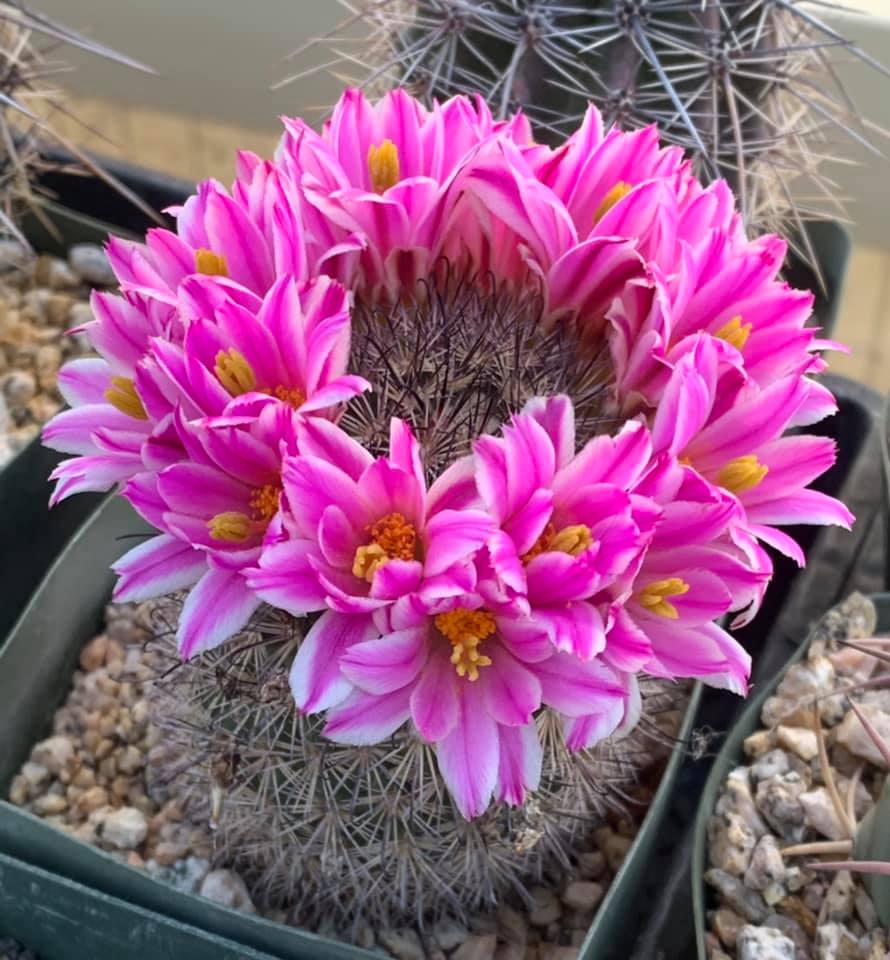
Cochemiea blossfeldiana (Boed.) P.B.Breslin & Majure is a compact globose cactus restricted to the Pacific coast fog belt of north-central Baja California and two offshore islands: Guadalupe Island, roughly 260 km west of the peninsula, and Cedros Island, approximately 90 km offshore near Punta Baja. Friedrich Boedeker described the basionym Mammillaria blossfeldiana in Monatsschrift der Deutschen Kakteen-Gesellschaft 3: 209 (1931), naming it for Robert Blossfeld, a German gardener who played a role in its introduction to European cultivation. Breslin, Wojciechowski & Majure transferred it to Cochemiea in Taxon 70: 319 (2021) as part of the molecular revision that expanded the genus from four Baja shrubs to roughly 36 species.
Two subspecies are accepted under Kew POWO. The nominate subsp. blossfeldiana occupies the north-central Baja California Pacific coast and both offshore islands. Subsp. rectispina (E.Y.Dawson) P.B.Breslin & Majure is an island endemic on Isla Magdalena, further south in Baja California Sur, with divergence confirmed by molecular clock analysis in the Breslin et al. 2022 American Journal of Botany phylogeny. Mammillaria shurliana H.E.Gates (1956), sometimes described from taller-bodied Punta Baja material, is not accepted as a named taxon under POWO and is pooled into species-level synonymy.
The plant sits in the ex-Mammillaria and ex-Bartschella portion of the expanded Cochemiea, not in the pre-revision Cochemiea s.s. five-taxon core that shares the hummingbird pollination syndrome and scarlet zygomorphic flowers of Cochemiea poselgeri and Cochemiea setispina. The bicolour funnel-shaped flowers of C. blossfeldiana are actinomorphic (radially symmetrical) and insect-pollinated, a floral architecture shared with the other non-Cochemiea s.s. members of the expanded genus, including the mainland miniatures C. saboae and C. theresae.
The restricted Pacific coastal range, assessed under the former name Mammillaria blossfeldiana, has an estimated extent of occurrence near 8,000 km², and the accessible coastal localities are within reach of human activity and collection pressure. All Cactaceae sit on CITES Appendix II, making documented nursery-propagated provenance the only legally defensible collector source.
Cochemiea blossfeldiana quick reference
A compact coastal desert endemic from the Pacific fog belt of north-central Baja California, growing on decomposing granite coastal plains and slopes at 0–150 m under intense sun moderated by regular California Current fog. Values calibrated for seed grown plants in cultivation, drawn from habitat data and specialist grower sources.
Taxonomy & nomenclature
The accepted name is Cochemiea blossfeldiana (Boed.) P.B.Breslin & Majure. Friedrich Boedeker published the basionym Mammillaria blossfeldiana in Monatsschrift der Deutschen Kakteen-Gesellschaft 3: 209 (1931), describing the species from plants that Robert Blossfeld introduced to European cultivation. Boedeker’s 1931 protologue cites “Lower California” as the origin; no precise type locality or coordinates appear in the protologue, and no subsequent lectotypification designating a sharper collection site has been published. The new combination in Cochemiea was established by Breslin, Wojciechowski & Majure in Taxon 70(2): 319 (2021) as part of the molecular phylogenetic revision demonstrating non-monophyly of Mammillaria as broadly circumscribed.
The synonymy reflects the species’ long history in Mammillaria and brief residence in two segregate genera. Kew POWO lists six species-level synonyms: Mammillaria blossfeldiana Boed. (homotypic basionym, 1931), Bartschella blossfeldiana (Boed.) Doweld (2001), Chilita blossfeldiana (Boed.) Buxb. (1954), Ebnerella blossfeldiana (Boed.) Buxb. (1951), Mammillaria goodridgei var. blossfeldiana (Boed.) Neutel., and Neomammillaria blossfeldiana (Boed.) H.E.Gates (1933). The Bartschella placement (Doweld 2001) was a brief segregate-genus experiment; Bartschella as a whole was absorbed into Cochemiea by Breslin et al. 2021. Mammillaria shurliana H.E.Gates (1956), described from taller-bodied material from Punta Baja, is pooled into species-level synonymy under POWO and is not accepted at subspecific rank.
Two subspecies are currently accepted. Subsp. blossfeldiana occupies the north-central Baja California Pacific coast plus Guadalupe and Cedros Islands. Subsp. rectispina (E.Y.Dawson) P.B.Breslin & Majure, based on the earlier Mammillaria goodridgei var. rectispina E.Y.Dawson, is confined to Isla Magdalena in Baja California Sur, with molecular clock divergence from the nominate subspecies estimated at roughly half a million years or older under the BEAST analysis in Breslin et al. (2022 American Journal of Botany). The epithet “rectispina” refers to the straighter central spines of island populations versus the hook of the nominate. Within the expanded Cochemiea, C. blossfeldiana is placed in the ex-Mammillaria and ex-Bartschella portion of the genus rather than in the pre-revision Cochemiea s.s. five-taxon core (C. halei, C. maritima, C. pondii, C. poselgeri, C. setispina) that retains the hummingbird-pollination syndrome and zygomorphic flowers.
Habitat
Cochemiea blossfeldiana is a strictly coastal and low-elevation species, confined to the Pacific-facing margin of north-central Baja California from roughly 29–30°N latitude. Documented mainland localities include Santa Rosalillita, Punta Baja, Boca Marrón, Punta María, and the Mezquital area, all within Ensenada Municipality, Baja California state. Elevation across the entire range is 0–150 m; this is not a montane species and there are no credible high-altitude records. The estimated extent of occurrence is approximately 8,000 km², including the two offshore island populations.
The native substrate is decomposing granite and gravelly coastal plains and slopes. The Peninsular Ranges granitic basement rock dominates the Pacific escarpment of north-central Baja California; the natural habitat is chemically distinct from the limestone karst terranes of the Sierra Madre Oriental where many allied species occur. The granitic habitat does not make this species a calcifuge, and no cultivation source establishes it as one. There is no calcicole evidence for this species in the available literature.
The Pacific coast fog belt of north-central Baja California is driven by the California Current, a cold equatorward current that generates regular low-stratus cloud and coastal fog along this stretch of coast. Guadalupe Island, 260 km offshore, is an oceanic island with frequent fog year-round from the same current system. Cedros Island receives heavy fog and cloud on its northern and western sectors, particularly in spring and summer, providing condensation moisture during the long dry season between winter rains and any irregular late-summer tropical influence. Annual rainfall at Santa Rosalillita and Punta Baja is extremely low, in the range of 50–150 mm, with most arriving in winter (November–March). The fog supplement is the primary moisture source during the dry months. Populations on coastal flats are documented growing barely above the surface in dry periods, a partial-burial strategy against extreme solar radiation at ground level.
Associated vegetation on the coastal plains and slopes includes cardón (Pachycereus pringlei), Stenocereus spp., boojum (Fouquieria columnaris), elephant tree (Bursera microphylla), Jatropha cinerea, and the xerophytic coastal scrub typical of the Lower Sonoran Desert zone grading into the Baja California Desert.
Morphology
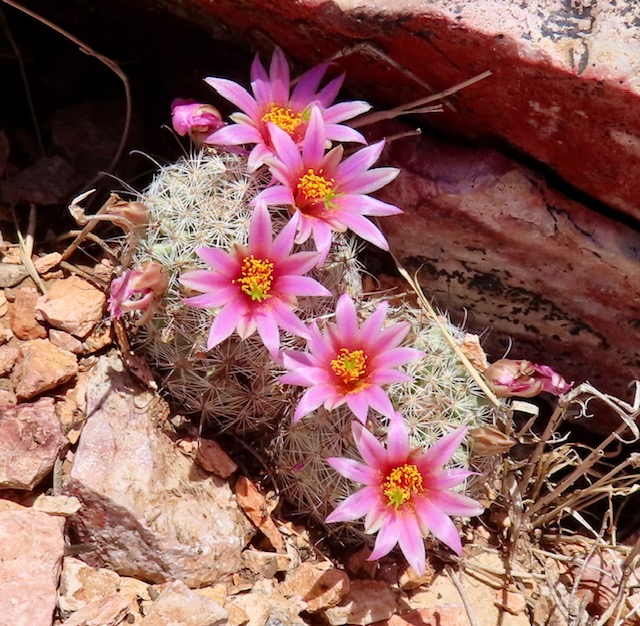
Cochemiea blossfeldiana is a compact, typically solitary species. The body is globose to shortly cylindrical, grey-green, with no milky sap. Mature plants in cultivation typically reach 5 cm in height and 3–4 cm in diameter; wild specimens may approach 10 cm in height at large sizes, but the compact 5 cm form is the standard presentation. The species rarely branches or forms small offsets with age; the solitary single body is the normal growth form. Tubercles are short and conical, 3–5 mm long with quadrangular bases; axils are nearly bare or with sparse wool.
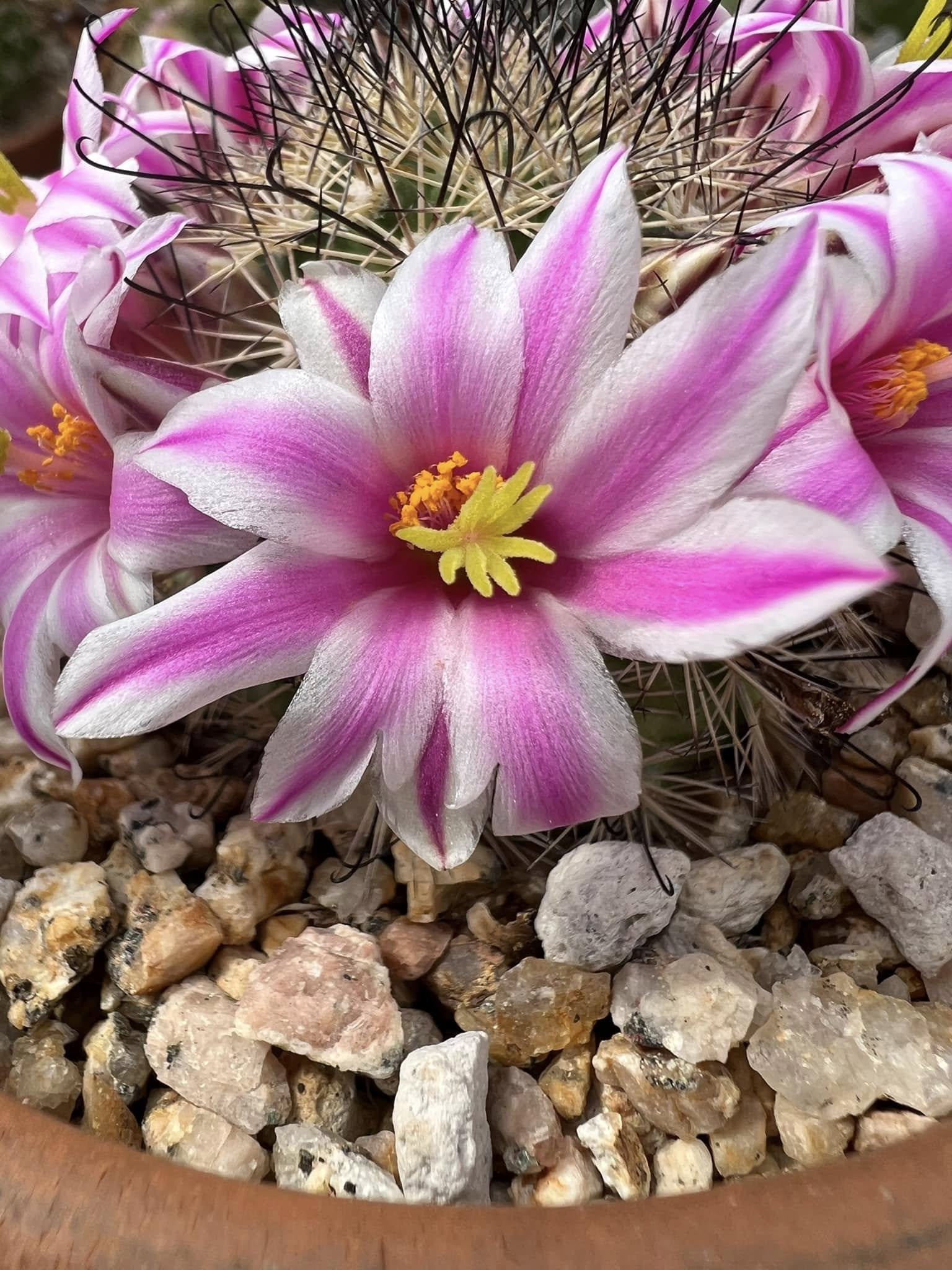
The spination is the primary identification character. Each areole carries 3–4 central spines approximately 8–12 mm long. The lowermost central spine is the diagnostic feature: dark brown to black, erect, and hooked outward. The upper 2–3 centrals are straight, acicular, and paler. The radial spines number 11–20 (typically 15–20), white-cream to yellowish with darker tips, 4–7 mm long. The contrast between the dark hooked central and the pale cream-yellow radials is visible at arm’s length and is the fastest vegetative identification character for the species. This spine palette distinguishes C. blossfeldiana immediately from Cochemiea albicans, which has white radials (14–21) and white centrals with only brown tips.
The flowers are the ornamental highlight. They are broadly funnel-shaped (infundibuliform), actinomorphic, and 20–40 mm in diameter. The bicolour ringed pattern is the diagnostic visual signature of the species: white inner petal segments carry a vivid rose-carmine to crimson midrib stripe; outer segments are deep pink to brownish-red with cream margins. The overall impression is a ring of white petals striped boldly in pink-to-crimson, produced around the crown of the stem in a whorled cluster. Flowers appear from March through July, with peak production in spring (April–May) as winter rainfall moisture is still available in the substrate. The actinomorphic symmetry and accessible nectar are consistent with insect pollination; no published pollinator study has been conducted for this species. Fruit is club-shaped, 14–20 mm long, orange-red to scarlet. Seeds are black and minutely pitted.
Locality detail
The range of Cochemiea blossfeldiana is geographically compact: a coastal strip of north-central Baja California roughly 100 km long between Santa Rosalillita and the Punta María area, plus two Pacific offshore islands and the southern Isla Magdalena population of subsp. rectispina. The mainland localities are all within Ensenada Municipality, Baja California state, in a zone where the granitic Peninsular Ranges meet the Pacific coast at low elevation.
The map above marks the principal documented localities with two marker colours: rose-red for subsp. blossfeldiana populations (mainland coast, Guadalupe Island, Cedros Island) and steel blue for the Isla Magdalena subsp. rectispina population. Guadalupe Island, 260 km offshore, is an isolated oceanic island with a distinct flora; the cactus population there contributes to the island biogeographic picture examined in the Breslin et al. 2022 American Journal of Botany phylogeny. Population coordinates follow published locality descriptions and regional centroids rather than precise GPS points, appropriate for a CITES-listed taxon with a restricted range.
Cochemiea blossfeldiana care and cultivation
Cochemiea blossfeldiana rewards collectors who commit to the two requirements its coastal Baja origin demands: full sun and a completely dry winter dormancy. The species grew up on granitic coastal plains and cliff faces where annual rainfall is measured in tens of millimetres and fog provides the seasonal moisture bridge. Given correct conditions it grows steadily, stays compact and in character, and flowers reliably from March through July with the bicolour pink-and-white blooms that make it a standout in any Cochemiea collection.
Substrate
The native substrate is decomposing granite and gravelly coastal plains. That geology describes where the wild plants grow; it does not set the pot mix. The recommended 7-component ratio for C. blossfeldiana is 40% pumice (primary drainage aggregate), 10% lava rock (scoria), 10% zeolite (clinoptilolite 4–6 mm, cation exchange and pH buffering toward neutral), 20% granite grit (elevated above the genus baseline), 0% limestone, 10% horticultural silica grit (1–3 mm), and 10% worm castings. Total: 90% inorganic, 10% organic. The 90/10 baseline reflects the standard Cactaceae starting point. In cool humid climates (UK, Pacific Northwest), reduce organic to 5% and increase pumice to 45% to lower rot risk during cool damp winters.
All seven Cochemiea species on this site span a wide substrate range. C. guelzowiana and C. theresae carry the most limestone (20%); the Baja coastal species carry none; C. albicans sits at 10%. C. blossfeldiana carries granite elevated to 20%, with limestone at 0%. No cultivation source establishes any Cochemiea species as needing lime or avoiding it. Hard tap water already supplies calcium and bicarbonate, while rainwater and RO water supply neither.
| Species | Pumice | Lava | Zeolite | Granite | Limestone | Silica | Organic |
|---|---|---|---|---|---|---|---|
| C. poselgeri | 40% | 15% | 10% | 15% | 0% | 10% | 10% |
| C. setispina | 40% | 15% | 10% | 20% | 0% | 5% | 10% |
| C. guelzowiana | 35% | 15% | 10% | 10% | 20% | 5% | 5% |
| C. saboae | 45% | 15% | 10% | 15% | 0% | 10% | 5% |
| C. theresae | 32% | 12% | 10% | 12% | 20% | 6% | 8% |
| C. blossfeldiana (this page) | 40% | 10% | 10% | 20% | 0% | 10% | 10% |
| C. albicans | 40% | 10% | 10% | 15% | 10% | 10% | 5% |
Watering and light
The native climate delivers most rainfall in winter (November–March), followed by a long dry spring and summer with fog as the primary moisture input, and potential irregular late-summer tropical storm moisture. Plants in the wild have been documented partially burying the body against the substrate during prolonged dry periods. In cultivation: withhold water completely from November through January to enforce a dry dormancy. Resume with minimal watering every 3–4 weeks in February and March to wake roots before flowering. Water every 2–3 weeks from April through June, allowing the substrate to dry completely between waterings; this is the peak flowering window. Reduce to every 3–4 weeks through summer and dry down from October. Always water to runoff, then withhold until the substrate is completely dry throughout. llifle rates this species as especially sensitive to overwatering; the root neck is the primary rot site under wet-cool conditions.
Full sun is the baseline for flowering success. The native habitat on coastal plains and cliff faces receives intense radiation; the dense spination is adapted to it. Fewer than 6 hours of direct sun per day suppresses flowering and produces elongated, off-character growth. In very hot climates exceeding 40°C, some midday shade on young unacclimated plants reduces sunburn risk; established plants in coastal California or Mediterranean climates tolerate full sun without protection.
Cold tolerance and propagation
The California Current moderates temperatures at the Baja Pacific coast localities, and hard inland freezes are not a natural feature of this species’ habitat. Mountain Crest Gardens rates it at USDA Zone 10+ (minimum approximately −1°C briefly); the recommended safe minimum for sustained exposure is 5°C. Any moisture in the substrate below 5°C sharply increases crown rot risk. In cool climates, bring in before first frost. Repot every 2–3 years in spring before the first watering of the season, when roots are at their driest.
Seed grown is the collector route for natural body proportions; grafted plants on fast-growing rootstocks produce oversized, off-character bodies that lose the compact form that makes this species distinctive. Seeds germinate at 21–27°C in a lightly moistened mineral-dominant seedling mix within 7–14 days. Seedlings grow slowly. The tight globose body and characteristic spine contrast develop over several years from germination.
Comparison
The most likely confusion candidate for Cochemiea blossfeldiana is Cochemiea albicans, the only other compact-bodied Baja endemic ex-Mammillaria in the expanded genus with overlapping or adjacent geographic range. Both are actinomorphic-flowered species from the Pacific slope of Baja California, both absorbed into Cochemiea by Breslin et al. 2021 from Mammillaria or the former Bartschella; both carry hooked or near-hooked central spines and produce flowers in broadly similar bicolour pink-and-white colour schemes at first glance. The confusion risk is real at the juvenile stage before flowers are present, particularly in mixed collection settings.
Spine colour is the fastest vegetative separation. C. blossfeldiana has cream-yellow to yellowish radial spines (11–20) and a single dark brown-to-black hooked lower central; the spine palette reads as a dark centre against a cream-buff surround. C. albicans has pure white radial spines (14–21) and white centrals with brown tips only at the tip; the spine palette reads as uniformly white, with the plant body almost entirely concealed by the dense pale spination in mature specimens. This vegetative character holds at any stage of the plant’s development and does not require waiting for flowers.
When flowers are present the contrast is unambiguous. C. blossfeldiana produces vivid bicolour flowers: white petals with a bold rose-carmine to crimson midrib stripe, a colour contrast saturated enough to read as pink-and-white in photographs. C. albicans produces white-to-light-pink flowers with a softer pink central stripe and less overall colour contrast. The flowers of C. blossfeldiana are also larger (20–40 mm diameter) and showier than the approximately 20 mm flowers of C. albicans. Body size provides a secondary separation for mature plants: C. blossfeldiana is typically solitary and reaches 5–10 cm; C. albicans branches basally to form clusters and reaches up to 20 cm in height. Habitat offers a further check: C. blossfeldiana grows on granitic coastal substrate; C. albicans occupies more calcareous ground in central Baja.
Frequently asked questions
Is Cochemiea blossfeldiana hard to grow?
Intermediate. The species asks for full sun, a completely dry winter dormancy from November through January, and a limestone-free granitic substrate; given those three it grows and flowers without particular difficulty. The hardest aspect is the winter rest: any moisture at the root neck during cool temperatures causes rapid crown rot. In cultivation, root rot from overwatering in winter and inadequate light suppressing flowers account for most losses. The compact solitary body means there are no offsets to propagate if the plant is lost.
Can Cochemiea blossfeldiana be grown from seed?
Yes. Seed germinates at 21–27°C in a lightly moistened mineral-dominant seedling mix, typically within 7–14 days. Seedlings are slow-growing and take several years to develop the tight globose form and characteristic bicolour spine contrast. Seed grown plants are the collector target; grafting accelerates early growth but produces oversized, off-character bodies that lose the compact proportions that define the species. The species does not offset reliably, so seed is the primary propagation route.
Is Cochemiea blossfeldiana legal to own?
Yes, with documented provenance. All Cactaceae are listed on CITES Appendix II under the whole-family listing (annotation #4 since 1977), which permits international trade with CITES export and import permits. The species is also protected under Mexican federal wildlife law as a native endemic cactus. Nursery-propagated specimens with documented seed-grown provenance are the legally defensible collector source. Wild-collected plants from Mexico require CITES documentation that is not routinely issued for wild specimens, and the Near Threatened IUCN status makes wild collection counter to conservation practice.
Where does Cochemiea blossfeldiana grow in the wild?
On the Pacific coast of north-central Baja California, Mexico, at documented localities including Santa Rosalillita, Punta Baja, Boca Marrón, and Punta María, all within Ensenada Municipality, Baja California state. Additionally on Guadalupe Island (approximately 260 km offshore) and Cedros Island (approximately 90 km offshore), both under the California Current Pacific fog belt. Elevation is 0–150 m. Habitat is decomposing granite and gravelly coastal plains and slopes in the Lower Sonoran Desert zone. A separate island subspecies (subsp. rectispina) grows on Isla Magdalena in Baja California Sur.
When does Cochemiea blossfeldiana flower?
March through July, with peak production in spring (April–May) when winter rainfall moisture is still present in the substrate and temperatures are rising. Flowers are broadly funnel-shaped, actinomorphic, 20–40 mm in diameter, white with a vivid rose-carmine to crimson midrib stripe on each petal. They appear in a ring around the crown of the stem. No published pollinator study exists for this species; the actinomorphic funnel flower form with accessible nectar is consistent with insect rather than hummingbird pollination, distinguishing it from the zygomorphic red-tubular flowers of Cochemiea poselgeri and C. setispina.
Sources & further reading
Boedeker, F. (1931). Mammillaria blossfeldiana sp. nov. Monatsschrift der Deutschen Kakteen-Gesellschaft 3: 209 · Britton, N.L. & Rose, J.N. (1923). Cactaceae, vol. 4. Carnegie Institution, Washington · Kew POWO. Cochemiea blossfeldiana (Boed.) P.B.Breslin & Majure. powo.science.kew.org/taxon/urn:lsid:ipni.org:names:77217847-1 · Kew POWO. Mammillaria blossfeldiana Boed. (basionym). powo.science.kew.org/taxon/urn:lsid:ipni.org:names:150670-2 · Breslin, P.B., Wojciechowski, M.F. & Majure, L.C. (2021). Molecular phylogeny of the Mammilloid clade (Cactaceae) resolves the monophyly of Mammillaria. Taxon 70(2): 308–323 · Breslin, P.B., Wojciechowski, M.F. & Majure, L.C. (2022). Remarkably rapid, recent diversification of Cochemiea and Mammillaria in the Baja California, Mexico region. American Journal of Botany 109(10): 1472–1487 · IUCN Red List. Mammillaria blossfeldiana Boed. (assessed under former name). Status: Near Threatened. Assessment year: 2012. EOO approximately 8,000 km². iucnredlist.org · llifle, Encyclopedia of Living Forms. Mammillaria blossfeldiana. llifle.com/Encyclopedia/CACTI/Family/Cactaceae/5369 · Wikispecies. Cochemiea blossfeldiana. species.wikimedia.org/wiki/Cochemiea_blossfeldiana · Wikipedia. Cochemiea blossfeldiana. en.wikipedia.org/wiki/Cochemiea_blossfeldiana · Mountain Crest Gardens. Mammillaria blossfeldiana care page. mountaincrestgardens.com/mammillaria-blossfeldiana · Mammillaria Society Forum. Mammillaria shurliana thread (grower notes on Punta Baja populations, WM 5620). mammillaria.forumotion.net/t1513-mammillaria-shurliana