
Cochemiea saboae
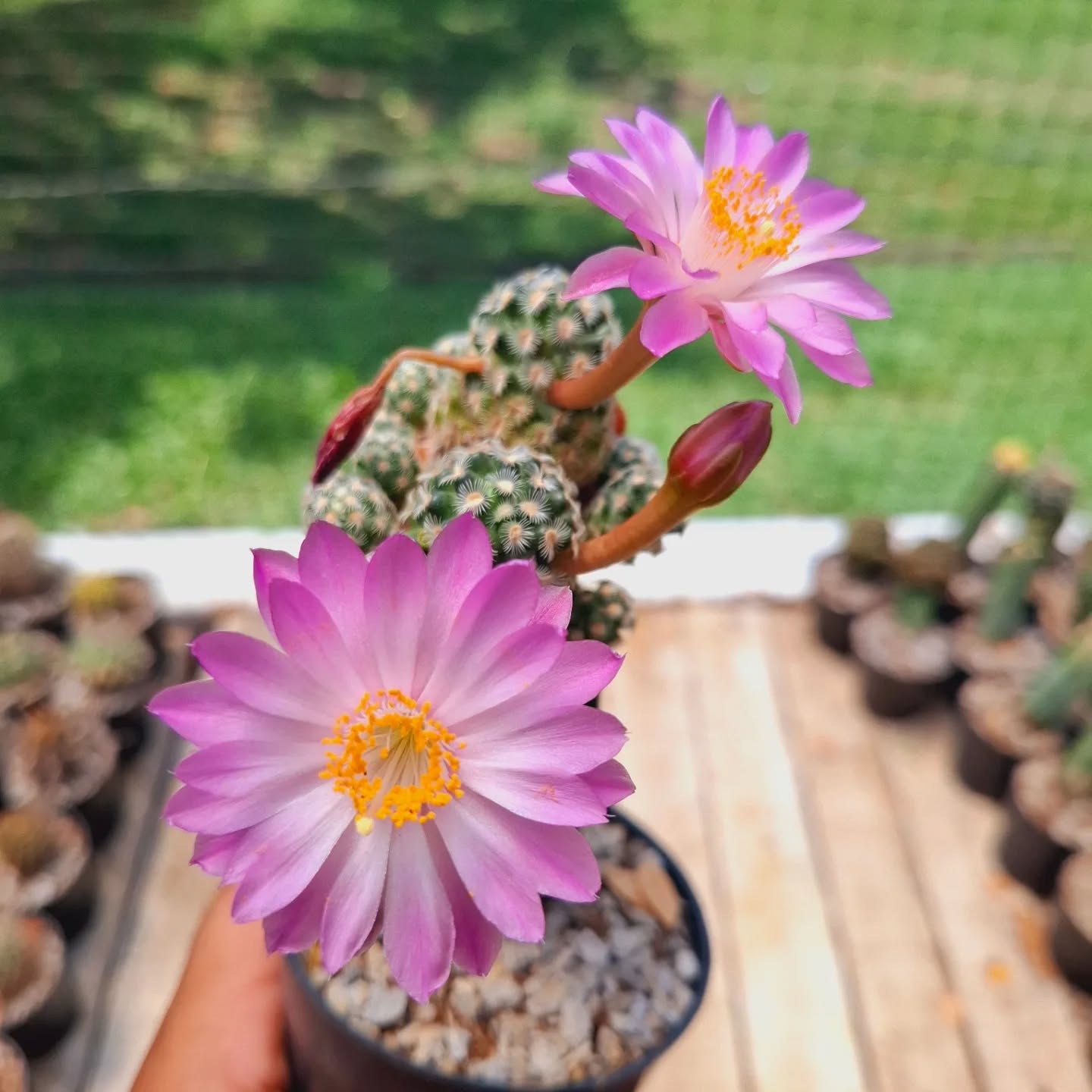
Cochemiea saboae (Glass) Doweld is a miniature clumping cactus from the volcanic highlands of Chihuahua and Sonora that carries some of the most disproportionately large flowers in the expanded genus. Charles Edward Glass described the basionym Mammillaria saboae in Cactaceas y Suculentas Mexicanas 11: 55 (1966), naming it in honour of American collector Kathryn Sabo. Alexander Doweld transferred it to Cochemiea in Sukkulenty 3: 39 (2000), two decades before Breslin, Wojciechowski & Majure’s 2021 molecular revision (Taxon 70: 308–323) confirmed and greatly expanded the genus. Kew POWO accepts three subspecies: the nominate subsp. saboae from western Chihuahua, subsp. haudeana (A.B.Lau & K.Wagner) Doweld from the Yecora area of southeastern Sonora, and subsp. goldii (Glass & R.A.Foster) Doweld from the Nacozari region of northeastern Sonora.
The body of C. saboae reaches 1–3.5 cm in diameter and 1–4 cm in height, egg-shaped and densely clothed in 17–45 fine white radial spines depending on subspecies. Central spines are absent. A plant under 2 cm tall can carry a funnelform pink to dark lilac-pink flower 4–6.5 cm across, a ratio that few cacti anywhere approach. The flower dwarfs the body at full aperture. Subsp. goldii is solitary; the other two subspecies clump freely into low mats and cushions that can pull entirely below the soil surface during the dry season, a disappearing act that makes wild-population censusing notoriously difficult.
All three subspecies grow on volcanic substrates at Sierra Madre Occidental elevations of 1,070–2,200 m. The habitat is volcanic tuff or volcanic rocky scree in the ecotone between Madrean pine-oak woodland and upper Chihuahuan grassland, with a summer monsoonal rainfall regime and cold, dry winters. The tuberous root is a significant water-storage organ; it makes the plant extremely rot-prone in cultivation and is the primary driver of the difficulty rating. Cryptocarpic fruit biology, in which seeds are retained inside the body until the plant disintegrates, further limits population recovery from collection pressure. Cochemiea theresae, the closest visual comparator in this genus, shares the tuberous taproot and the outsized funnelform flowers but grows on limestone in Durango and Zacatecas, not volcanic rock in Chihuahua and Sonora.
Intense collector demand across all three subspecies, particularly for documented seed-grown stock of subsp. haudeana and subsp. goldii, has driven both legitimate cultivation and documented collection pressure on wild populations. Grafted plants are widely available and reach flowering faster, but lose the compact natural body character that defines the collector goal. Seed grown plants, never grafted, remain the benchmark.
Cochemiea saboae quick reference
A high-elevation volcanic-substrate miniature from the Sierra Madre Occidental of Chihuahua and Sonora, with a tuberous root system that demands complete winter dryness and fast-draining mineral substrate. Values calibrated for seed grown plants in cultivation, drawn from habitat data and specialist grower experience.
Taxonomy & nomenclature
The accepted name is Cochemiea saboae (Glass) Doweld. The basionym Mammillaria saboae Glass was published in Cactáceas y Suculentas Mexicanas 11: 55 (1966) by Charles Edward Glass, who named the species after American cactus collector Kathryn Sabo. Alexander Doweld made the transfer to Cochemiea in Sukkulenty 3: 39 (2000). Kew POWO accepts the Doweld (2000) combination as the current name. Breslin, Wojciechowski & Majure’s 2021 molecular revision (Taxon 70: 308–323) confirmed the placement within the expanded Cochemiea but did not publish a new combination for this species, as Doweld’s 2000 combination was already available. The species is still sold in the trade under Mammillaria saboae.
Kew POWO accepts three subspecies. Subsp. saboae is the nominate, from western Chihuahua. Subsp. haudeana (A.B.Lau & K.Wagner) Doweld is from the Yecora area of southeastern Sonora, with Alfred Lau’s field number L777 documenting the Yecora locality at 2,000 m elevation. Subsp. goldii (Glass & R.A.Foster) Doweld, whose basionym Mammillaria goldii Glass & R.A.Foster was published in the Cactus and Succulent Journal (Los Angeles) 40: 149–151 (1968), is from volcanic tuff a few miles north of Nacozari de García, Sonora, at approximately 1,070 m, and is the only solitary-stemmed subspecies. Mammillaria saboae subsp. roczekii W.Rischer & Wolfg.Krüger (2003), described from Canatlán, Durango, is treated by POWO as a synonym of the nominate subspecies.
Within the expanded Cochemiea, C. saboae belongs to the group of former Mammillaria miniatures that Doweld transferred on morphological grounds before the 2021 molecular confirmation. The funnelform, radially symmetric flowers of this species and its closest relative Cochemiea theresae are entirely distinct from the zygomorphic tubular hummingbird-pollinated flowers of the pre-revision Cochemiea s.s. core (C. poselgeri, C. setispina), reflecting the polyphyletic origin of the expanded genus concept. The genus name Cochemiea traces to Frederick Arthur Walton’s 1899 elevation of Brandegee’s 1897 subgenus, now applied across a much broader species concept.
Habitat
Cochemiea saboae inhabits the Sierra Madre Occidental highlands of Chihuahua and Sonora at elevations between 1,070 m (subsp. goldii type locality near Nacozari) and approximately 2,200 m (subsp. saboae and subsp. haudeana localities in western Chihuahua and the Yecora area). The substrate across all three subspecies is consistently volcanic: tuff, scoria, basalt, or rhyolite-derived rocky scree, all within the Sierra Madre Occidental volcanic belt. The glass and Foster (1968) protologue for subsp. goldii describes the type locality explicitly as grayish-white volcanic tuff in full sun with individual plants sheltered under small rocks. No calcareous or limestone substrate association has been documented for any population of any subspecies.
The broader ecological setting is the ecotone between Madrean pine-oak woodland (with Pinus engelmannii, Quercus hypoleucoides, and Q. chihuahuensis on slopes) and upper Chihuahuan grassland on plateau surfaces. The Yecora area of southeastern Sonora, where subsp. haudeana occurs, is the transition zone of this ecoregion at approximately 1,500–2,000 m. Plants grow in rock crevices and at the edges of small rock outcrops, rooting into minimal gritty volcanic-derived mineral substrate. Associated cacti at the Yecora locality include Echinocereus polyacanthus and other volcanic-slope specialists.
The climate across the range is summer-monsoonal: annual precipitation at the Yecora station runs 700–900 mm, heavily concentrated in July through September, with a pronounced dry season from October through May. High-elevation localities of subsp. saboae and haudeana experience cold dry winters with occasional frost and snow. The subsp. goldii locality near Nacozari at 1,070 m is warmer and drier. During the dry season, all three subspecies are documented contracting considerably, with clumping plants of subsp. saboae and haudeana able to pull entirely below the soil surface, a behaviour that makes wild-population censusing unreliable and contributes to conservation assessment uncertainty.
Morphology
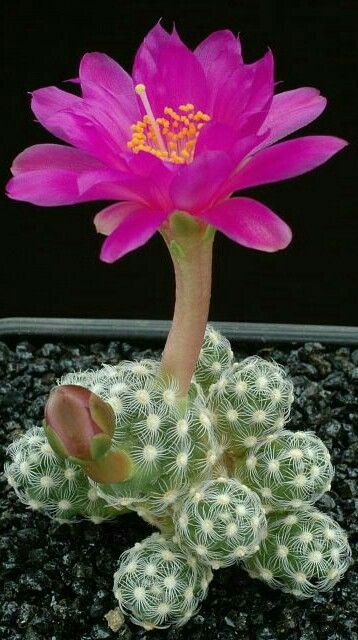
Cochemiea saboae is a miniature cactus with a growth habit that varies by subspecies. Subsp. saboae and subsp. haudeana clump freely into low cushion mats; subsp. goldii remains solitary throughout its life, a diagnostic character for that subspecies. Individual stems are egg-shaped (ovoid) to subglobose, 1–3.5 cm in diameter and 1–4 cm tall, with the body typically green and the tubercles small, slightly rounded, and smooth. Axillae are naked: bare, with no wool, bristles, or latex. The absence of milky juice in the axillae is a diagnostic character separating the Cochemiea clade from the milky-sapped main Mammillaria lineage.
Spine counts vary by subspecies. Subsp. saboae carries 17–25 radial spines per areole; subsp. haudeana 18–27; subsp. goldii 34–45, the densest of the three. All radials are glassy white with a yellow base, fine and comb-like in arrangement, up to 2–6 mm long. Central spines are absent in all subspecies. The dense fine radials and naked axillae give the plant a soft, feathery appearance at arm’s length; up close, the individual spine geometry is smooth and glassy, not plumose. The root system is thick and fleshy, tuberous, a significant water-storage organ adapted to the seasonally dry habitat.
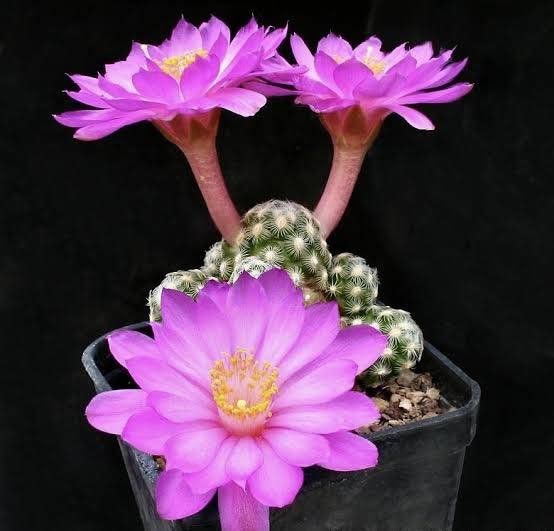
The flowers are the defining feature of the species and the source of its collector appeal. Funnelform and radially symmetric (not zygomorphic), they open in spring, primarily April through May in cultivation. Flower length or diameter reaches 4–6.5 cm, with subsp. haudeana flowers documented at dark lilac-pink to pinkish magenta, 4–6.5 cm; subsp. goldii flowers pink, 4–5 cm; subsp. saboae pink, sometimes pale. A stem under 2 cm tall carrying a flower of 4 cm or more is common. This body-to-flower ratio is more extreme than that of Cochemiea guelzowiana, which has a much larger body to match its similarly large flowers. Fruit is cryptocarpic: retained inside the plant body and released only when the stem disintegrates. Seeds are black.
Locality detail
The three subspecies of Cochemiea saboae occupy non-overlapping areas within the Sierra Madre Occidental volcanic belt. The nominate subsp. saboae is documented from western Chihuahua, with field collection records at El Terrero, El Manzano, and Cuesta de los Peyotes at approximately 2,100–2,200 m. Subsp. haudeana centres on the Yecora area of southeastern Sonora at 1,500–2,000 m, with Alfred Lau field number L777 providing the primary documented locality. Subsp. goldii is known from the specific type locality a few miles north of Nacozari de García, Sonora, on the road to Agua Prieta, at approximately 1,070 m on grayish-white volcanic tuff.
Map markers represent regional centroids rather than precise population GPS coordinates. Published collection data for the nominate subspecies and subsp. haudeana uses locality names rather than GPS points; the subsp. goldii type description gives road-distance directions from Nacozari rather than coordinates. For a species subject to documented collection pressure across all three subspecies, using regional centroids rather than precise population points is standard practice. The holotype of subsp. goldii is deposited at Pomona College herbarium, Claremont, California, with duplicates at Mexican and Smithsonian Institution herbaria.
Cochemiea saboae care and cultivation
Cochemiea saboae is an advanced cultivation challenge. The tuberous root is exceptionally rot-prone; the plant requires a complete winter dormancy with zero moisture from November through March; and the tiny body gives little visual warning before root failure progresses to the point of no recovery. Multiple independent grower sources describe the species as “extremely prone to rot” despite its apparent simplicity. Grafting onto vigorous rootstock bypasses the root rot risk entirely and is widely practised, but grafted plants lose the compact natural body proportions and tuberous root architecture that define the collector target. Seed grown plants on the tuberous root remain the benchmark for serious growers.
Substrate
The native substrate is volcanic tuff and volcanic rocky scree with minimal soil development: near-pure mineral, non-calcareous, fast-draining. The recommended mix is 45% pumice, 15% lava rock (scoria), 10% zeolite (clinoptilolite 4–6 mm), 15% granite grit, 10% horticultural silica grit (1–3 mm), and 5% worm castings, with limestone at 0% throughout. Pumice at 45% is the highest fraction among Cochemiea species on this site, reflecting the extreme drainage demand of the tuberous root. Limestone is excluded entirely as house practice; no source records either a lime requirement or a lime aversion for this species. The substrate is positively documented as volcanic and non-calcareous across all three subspecies type localities, in contrast to the limestone habitats of congeners C. theresae and C. guelzowiana, but that habitat contrast is not what sets the pot mix. In humid climates (UK, Pacific Northwest), reduce organic to 0–3% and bump pumice to 48–50%; the rot risk at high ambient humidity with any organic fraction is severe for this species specifically.
All seven Cochemiea species on this site grow across a wide substrate range from zero-limestone volcanic rock to Durango limestone-habitat terrain. C. guelzowiana and C. theresae carry 20% limestone as a house convention; the Baja coastal and granite-slope species carry 0% limestone; C. saboae is the most pumice-dominant at 45%, by house formulation.
| Species | Pumice | Lava | Zeolite | Granite | Limestone | Silica | Organic |
|---|---|---|---|---|---|---|---|
| C. poselgeri | 40% | 15% | 10% | 15% | 0% | 10% | 10% |
| C. setispina | 40% | 15% | 10% | 20% | 0% | 5% | 10% |
| C. guelzowiana | 35% | 15% | 10% | 10% | 20% | 5% | 5% |
| C. saboae (this page) | 45% | 15% | 10% | 15% | 0% | 10% | 5% |
| C. theresae | 32% | 12% | 10% | 12% | 20% | 6% | 8% |
| C. blossfeldiana | 40% | 10% | 10% | 20% | 0% | 10% | 10% |
| C. albicans | 40% | 10% | 10% | 15% | 10% | 10% | 5% |
Watering and light
The natural climate has a pronounced summer monsoonal pulse (July–September) and a long dry season (October–June). Plants pull below the soil surface during the dry season in habitat, a clear indicator of the winter dormancy requirement. In cultivation: complete dormancy November through March with zero watering. One light watering in April to wake the root system as temperatures rise. Every 3–4 weeks May–June as the growing season begins and flowering occurs. Every 2–3 weeks July–September to coincide with the monsoon pulse. Reduce in October with one or two final waterings before complete dry-down. Water to runoff each time, then withhold until the substrate is bone dry throughout, including the bottom of the pot. Never mist or splash the crown; the root neck is the primary rot site.
Bright light is required for reliable flowering. The subsp. goldii type collection was in full sun, with plants using rock shadows as midday shade refugia; subsp. haudeana growers report best results with full morning sun and afternoon shade in hot climates. The rule of thumb is maximum available bright light with afternoon shade protection when temperatures exceed 35°C, and a minimum of 4–5 hours direct sun for flowering. Underpotting in the smallest diameter shallow pot that accommodates the tuberous root prevents moisture accumulation at unused substrate edges, which is the most common cause of root neck rot in cultivation.
Cold tolerance and propagation
Brief cold tolerance to −4 to −5°C is documented for completely dry plants by specialist growers; USDA zone 9b–11 applies for outdoor cultivation. The recommended safe minimum for any sustained cold exposure is 5°C. Any moisture combined with temperatures below 5°C substantially increases rot risk. High-elevation populations of subsp. saboae and haudeana (2,100–2,200 m) experience hard frosts under snow cover in winter, but the plants are dormant and the substrate is effectively dry; do not interpret this cold tolerance as wet-cold hardiness in cultivation.
Seed germination at 21–25°C in a near-mineral mix yields results in 14–21 days. Seedlings are very slow-growing; 5–8 years from sowing to first flower on the tuberous root is typical. The cryptocarpic fruit biology means seeds in habitat are released only through plant death; commercial seed comes from cultivated plants by careful fruit extraction. Repot every 2–3 years in spring before the first watering to inspect the tuberous root and refresh the substrate.
Comparison
The species most likely to be confused with Cochemiea saboae in a collection is Cochemiea theresae. Both are extreme miniatures with body diameter under 4 cm, no central spines, only fine white radial spines, outsized funnelform flowers that dwarf the body, and a tuberous taproot that demands identical cultivation rigour. Both are cryptocarpic, both are notoriously rot-prone in cultivation, and both are among the most coveted miniatures in the expanded genus. Older taxonomic literature actually placed C. theresae as a variety of Mammillaria saboae (Rowley 1979), underscoring their morphological proximity. The confusion is genuine and affects collectors new to the former Mammillaria miniature complex.
Eight characters reliably separate them. Growth form: C. saboae subsp. saboae and subsp. haudeana clump freely, while C. theresae is typically solitary. Substrate: C. saboae grows on volcanic tuff and scree (non-calcareous, no limestone association confirmed); C. theresae grows in moss patches over limestone rock formations in Durango. Spine texture: C. saboae spines are smooth and glassy; C. theresae spines are distinctly plumose (pinnate, feathery), visible under a loupe and often distinguishable by touch. IUCN status: C. saboae Least Concern across its multi-state range; C. theresae Critically Endangered as assessed in 2013, with fewer than 250 mature individuals at the Coneto Mountains type locality. Geography: C. saboae is from Chihuahua and Sonora; C. theresae is from Durango and Zacatecas. Subspecies: C. saboae has three accepted subspecies; C. theresae is a single taxon. Flower size: C. saboae reaches 6.5 cm; C. theresae tops out around 4.5 cm. The CITES status difference carries conservation weight in trade: C. theresae from an uncertified source should be treated as a serious concern.
The remaining five taxa in this genus present no realistic confusion with C. saboae. Cochemiea guelzowiana has a body 7–10 cm wide with hooked central spines and up to 80 radials, an order of magnitude larger than C. saboae. Cochemiea blossfeldiana is a Baja endemic with hooked centrals and bicoloured pink-and-white flowers. Cochemiea albicans is a larger white-spined Baja island species. The pre-revision Baja s.s. clade, C. poselgeri and C. setispina, are shrubs with zygomorphic scarlet hummingbird-pollinated flowers on stems 30–200 cm long. None of these are a realistic comparison for a 2 cm clumping miniature from a Sonoran volcanic highland.
Frequently asked questions
Is Cochemiea saboae hard to grow?
Advanced. The species demands a completely dry winter dormancy from November through March; any moisture during this period causes the tuberous root to rot rapidly. The single hardest aspect is resisting the urge to water a tiny plant that looks as though it might need moisture. Grafting bypasses the root rot risk and is widely practised, but grafted plants lose the compact body character and tuberous root architecture of seed grown specimens, which are the collector target.
Can Cochemiea saboae be grown from seed?
Yes, though slowly. Seeds germinate at 21–25°C in a near-mineral mix in 14–21 days. Seedlings grow very slowly; 5–8 years from sowing to first flower is typical on the tuberous root. Seed grown plants are the collector target because grafting suppresses the compact natural body and removes the tuberous root architecture. Cryptocarpic fruit biology means legitimate seed comes from cultivated plants via manual extraction; field-collected seed is not commercially available.
Is Cochemiea saboae legal to own?
Yes, with documentation. All Cactaceae are listed on CITES Appendix II under the whole-family listing (annotation #4 since 1977), allowing international trade with the appropriate CITES export and import permits. Subsp. goldii additionally carries Amenazada (A) status under Mexico’s NOM-059-SEMARNAT-2010, tightening domestic Mexican protections for that subspecies. Nursery-propagated specimens with documented seed provenance are the legally defensible collector source. Wild-collected plants from Mexico require CITES documentation not routinely issued for wild specimens.
Where does Cochemiea saboae grow in the wild?
On volcanic tuff, scoria, and rocky scree in the Sierra Madre Occidental highlands of Chihuahua and Sonora, Mexico, at 1,070–2,200 m elevation. The three subspecies occupy non-overlapping areas: subsp. saboae in western Chihuahua, subsp. haudeana near Yecora in southeastern Sonora, and subsp. goldii near Nacozari in northeastern Sonora. Habitat is volcanic rock outcrops in the transition zone between Madrean pine-oak woodland and upper Chihuahuan grassland. Plants can pull entirely below the soil surface during the dry season, making population censusing difficult.
When does Cochemiea saboae flower?
Primarily April through May in cultivation at temperate latitudes. Flowers are funnelform and radially symmetric, pink to dark lilac-pink or magenta depending on subspecies: subsp. haudeana produces dark lilac-pink to pinkish magenta flowers 4–6.5 cm across; subsp. goldii pink flowers 4–5 cm; subsp. saboae pink, sometimes pale. A stem under 2 cm tall commonly carries a flower wider than its own diameter. Adequate bright light and the appropriate moisture trigger in spring are required for reliable flowering; plants in insufficient light or given no spring watering cue will not bloom.
Sources & further reading
Glass, C.E. (1966). Mammillaria saboae sp. nov. Cactáceas y Suculentas Mexicanas 11: 55 · Glass, C.E. & Foster, R.A. (1968). Mammillaria goldii: a new species. Cactus and Succulent Journal (Los Angeles) 40: 149–151 · Doweld, A.B. (2000). Cochemiea saboae comb. nov. Sukkulenty 3(1–2): 39 · Kew POWO. Cochemiea saboae (Glass) Doweld. powo.science.kew.org/taxon/urn:lsid:ipni.org:names:151628-2 (accepted name from basionym record) · Kew POWO. Cochemiea saboae subsp. haudeana (A.B.Lau & K.Wagner) Doweld. powo.science.kew.org/taxon/urn:lsid:ipni.org:names:1092774-2 · Breslin, P.B., Wojciechowski, M.F. & Majure, L.C. (2021). Molecular phylogeny of the Mammilloid clade (Cactaceae) resolves the monophyly of Mammillaria. Taxon 70(2): 308–323 · llifle, Encyclopedia of Living Forms. Cochemiea saboae subsp. haudeana. llifle.net/Encyclopedia/CACTI/Family/Cactaceae/9672 · llifle, Encyclopedia of Living Forms. Cochemiea saboae subsp. goldii. llifle.com/Encyclopedia/CACTI/Family/Cactaceae/9667 · Planet Desert. Mammillaria saboae haudeana (cultivation notes). planetdesert.com · Desert-Tropicals. Mammillaria saboae ssp. haudeana. desert-tropicals.com/Plants/Cactaceae/Mammillaria_haudeana.html · Henry Shaw Cactus and Succulent Society (2009). Mammillaria saboae-haudeana (Plant of the Month). hscactus.org/resources/plants-of-the-month · Wikipedia. Cochemiea saboae. en.wikipedia.org/wiki/Cochemiea_saboae