
Ariocarpus agavoides
| Family | Cactaceae |
| Named by | Castañeda (1941) as Neogomesia |
| Transferred by | E.F. Anderson (1962) |
| Native range | Tamaulipas & San Luis Potosí, Mexico |
| Elevation | 1,070–1,900 m |
| Stem diameter | 3–8 cm; subglobose |
| Tubercles | 2–7 cm long; spine-tipped |
| Flowers | Magenta; 3.5–5 cm across |
| Fruit | Pinkish-red to reddish-purple |
| IUCN status | Endangered |
| CITES | Appendix I |
Tamaulipas Living Rock · Magueyito
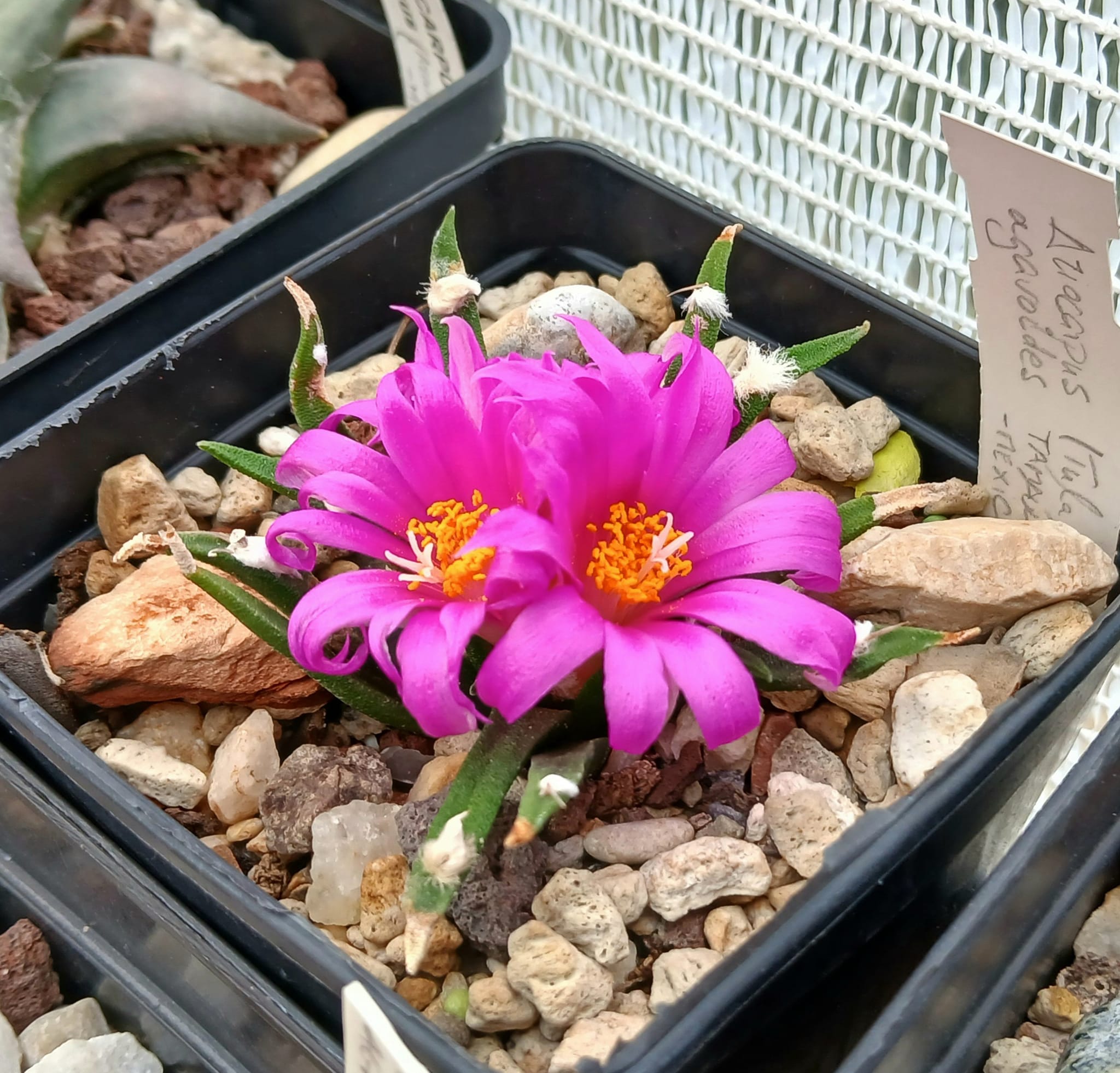
Ariocarpus agavoides is the odd one out. Every other species in the genus has abandoned spines entirely in the adult form, a defining character of Ariocarpus that separates it from almost all other ribbed and tubercled cacti in its range. Ariocarpus agavoides kept them. The short, whitish spines that persist at the tips of its dark green tubercles make this species look less like a cactus and more like a small succulent from a different family altogether. The resemblance to a miniature Agave is close enough that Marcelino Castañeda, who first described it in 1941, chose the species name agavoides for exactly that reason. It is also close enough that he placed it in its own genus, Neogomesia, rather than in Ariocarpus, convinced the spined areoles and unusual tubercle placement warranted full generic separation.
That separation did not hold. Edward Anderson, in his 1962 revision of the genus, demonstrated that Neogomesia fell squarely within Ariocarpus on every structural character except the spine retention, and that the areole placement, while unusual, was not outside the range of variation seen across the genus. The transfer to Ariocarpus has been accepted by every subsequent treatment. But Castañeda’s instinct was not entirely wrong: Ariocarpus agavoides is distinctive, and the combination of characters it carries, the spines, the dark green colour, the curious areole placement halfway along the tubercle surface, the vivid magenta flowers, makes it instantly recognisable among the Cactaceae.
Contents
Taxonomy & Nomenclature
Marcelino Castañeda described this species in 1941 in the Cactus and Succulent Journal (Los Angeles), placing it in a new monotypic genus he named Neogomesia. The genus name honoured Marte Gómez, a Mexican politician and amateur botanist, and the species epithet agavoides (from the Greek -oides, resembling, and the genus Agave) captured the plant’s most striking visual character. Castañeda’s rationale for the new genus rested primarily on the areole morphology: the areoles of Neogomesia are round pads positioned partway along the upper surface of each tubercle rather than at or near the tip, a placement he considered sufficiently different from the grooved or apical areoles of Ariocarpus to justify generic separation.
Edward Frederick Anderson, working through his comprehensive revision of Ariocarpus and its allies, transferred the species to Ariocarpus in 1962, publishing the combination Ariocarpus agavoides (Castañeda) E.F. Anderson in the American Journal of Botany. Anderson’s argument was that the areole position, while unusual, was not categorically different from the variation already documented across Ariocarpus, and that all other structural characters, the geophytic habit, the tuberculate stem, the taproot, the flower morphology, placed the species firmly within the genus. That transfer is universally accepted. Kew’s Plants of the World Online and the IUCN both list the species under Ariocarpus.
The synonymy includes the basionym Neogomesia agavoides Castañeda, as well as Ariocarpus kotschoubeyanus subsp. agavoides (Castañeda) Halda, a combination published in 1998 that subordinated the species within Ariocarpus kotschoubeyanus. That subordination has not been widely followed. Two infraspecific taxa have been described from disjunct populations: subsp. sanluisensis (Sotomayor, Arredondo, Sánchez Barra & Martínez-Mendéz, 2003) from the San Luis Potosí populations, and subsp. pulcher (Halda & Horá?ek, 2003). Their status remains debated; Kew treats both as synonyms of the type.
Common names are sparse. Magueyito (little agave) is the local Spanish name in the Tula region, a direct reference to the plant’s visual resemblance. Tamaulipas Living Rock Cactus is the English common name used in conservation literature. In local use around Tula, the mucilaginous sap from the roots has traditionally been used as a glue for repairing pottery, and the sweet-tasting tubercles are occasionally eaten or added to salads.
Historical synonyms (5)
- Neogomesia agavoides Castañeda, 1941 basionym
- Ariocarpus agavoides subsp. pulcher Halda & Horácek, 2003 homotypic synonym
- Ariocarpus kotschoubeyanus subsp. agavoides (Castañeda) Halda, 1998 heterotypic synonym
- Ariocarpus agavioides subsp. pulcher Halda & Horácek, 2003 heterotypic synonym
- Ariocarpus agavioides subsp. sanluisensis Sotom., Arred., Sánchez Barra & Mart.Mend., 2003 heterotypic synonym
Sources: POWO (Kew) · IPNI · GBIF · Wikidata
Habitat & Native Range
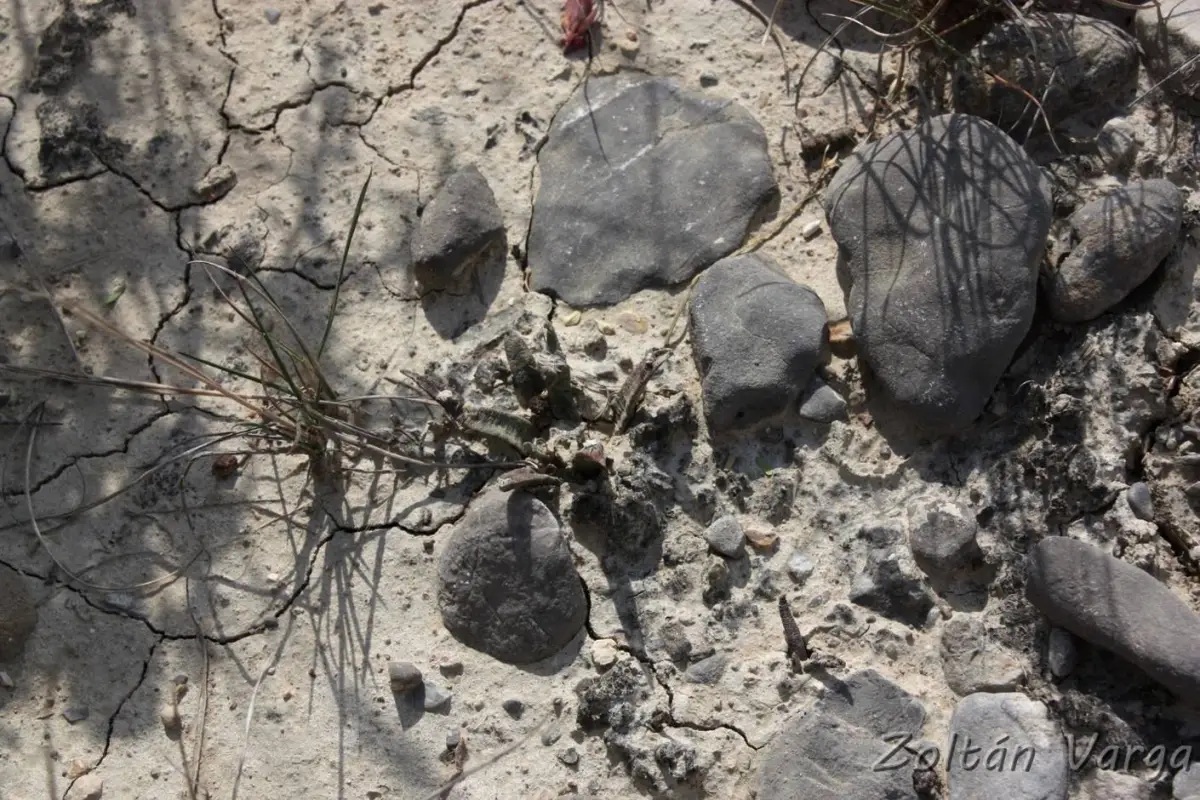
Ariocarpus agavoides occurs in two disjunct population areas separated by roughly 100 kilometres of Sierra Madre Oriental terrain. The type locality and historically documented core range centres on the town of Tula in southern Tamaulipas, where the species grows on rocky limestone hills at elevations of approximately 1,070 to 1,200 metres. A second, more recently discovered population cluster occurs further west in San Luis Potosí, in the municipalities of Guadalcázar and Francisco I. Madero, where material designated subsp. sanluisensis has been documented. The San Luis Potosí plants share the same general morphology as the Tamaulipas type but some individuals show more consistent spine development.
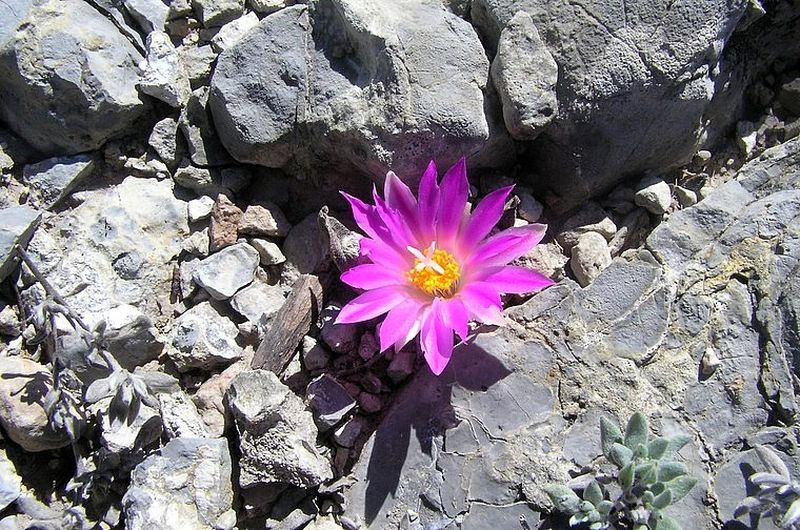
The substrate at both localities is calcareous: rocky limestone in the Tamaulipas hills, and similar limestone-derived substrates in the San Luis Potosí sites. The plant grows wedged into crevices and gaps in the rock, its taproot threading downward while the rosette of tubercles sits at or just below the soil surface. The camouflage is effective. The dark green body, when coated with dust and partially retracted during dry periods, blends with the surrounding rock and soil to a degree that makes field detection difficult without experience.
The plant community around the Tula locality includes Mammillaria candida, which Alfred Lau documented growing alongside Ariocarpus agavoides during his 1974 collection trip. The broader landscape is dry shrubland typical of the western flanks of the Sierra Madre Oriental, with scattered Agave, Opuntia, and xerophytic scrub. The resemblance of Ariocarpus agavoides to a small Agave, noted by one observer as comparable to Agave albopilosa, is particularly apt in this context: the two genera share habitat in the same general mountain system, separated by perhaps 100 miles.
The geographic gap between the Tamaulipas and San Luis Potosí populations raises questions about the species’ historical range. Whether these two clusters represent the remnants of a formerly continuous distribution fragmented by climate change or habitat loss, or whether they evolved independently from a common ancestor, is not resolved in the current literature. What is clear is that both populations are small, geographically restricted, and under pressure from the same combination of threats: illegal collection for the cactus trade, habitat degradation from livestock grazing, and the slow reproductive pace of the species itself.
Morphology
The body of Ariocarpus agavoides is subglobose, flattened, and mostly subterranean. The above-ground portion forms a rosette of stiff, dark green to greenish-brown tubercles radiating from a central growing point. Total stem diameter reaches 3 to 8 centimetres, with the stem itself up to 6 centimetres tall before the rosette of tubercles. The bulk of the plant is the fleshy taproot and underground stem, which together account for most of the total mass.
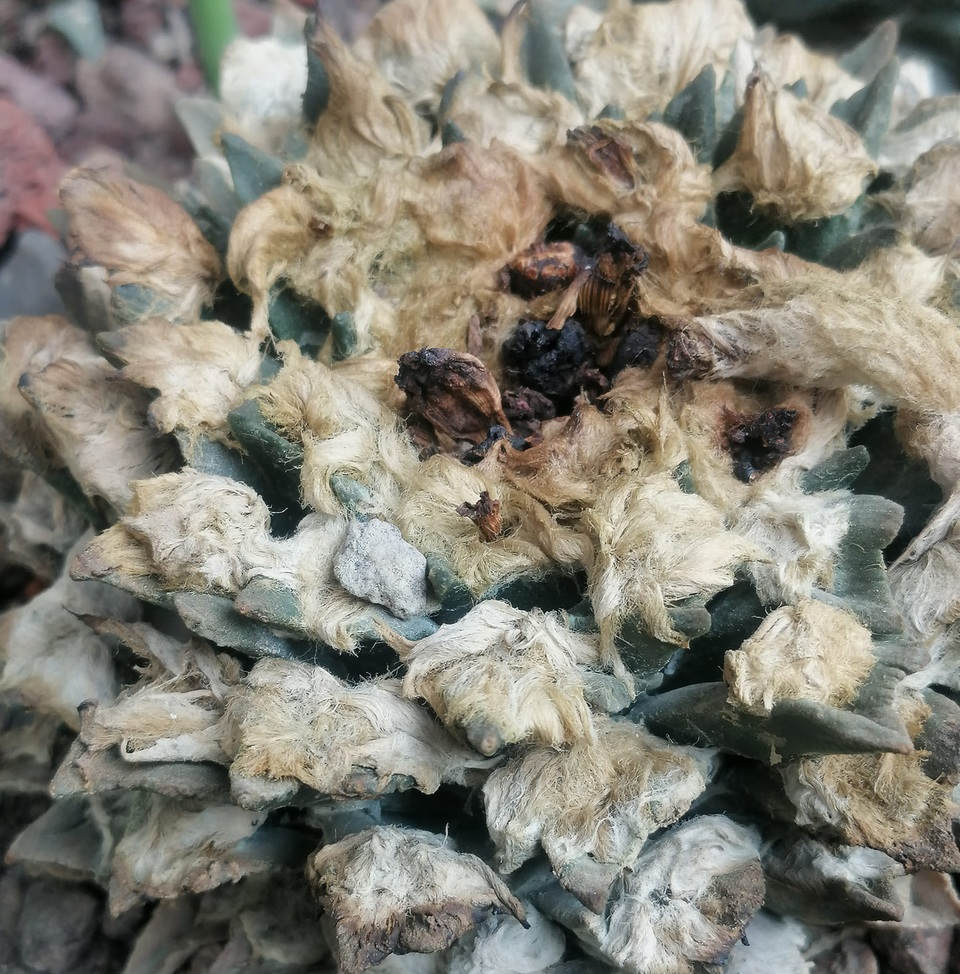
The tubercles are the most distinctive feature. They are elongated, divergent, 2 to 7 centimetres long and 5 to 10 millimetres wide, with acute tips and a flattened upper (adaxial) surface. They project outward from the stem base at wide angles, giving the plant its characteristic agave-like rosette profile. The texture is smooth to slightly roughened, without the deep fissuring of Ariocarpus fissuratus or the verrucose surface of Ariocarpus bravoanus. In habitat, the tubercles are often described as flaccid or slightly flexible, though cultivated plants grown in stronger light tend to produce stiffer, more rigid growth.
The areoles are positioned in a way that is unique within the genus. Rather than sitting in a groove along the full length of the tubercle (as in the Roseocactus subgenus) or at the very tip, they appear as round woolly pads approximately halfway along the upper surface, set back from the tubercle apex by about a centimetre. Each areole is up to 5 millimetres in diameter and carries a tuft of white to cream wool. From these areoles, in many individuals, emerge one to two short whitish spines up to about 7 to 10 millimetres long. The spines are not present on every plant or every tubercle; some individuals are completely spineless, while others bear spines on most or all tubercles. The San Luis Potosí populations (subsp. sanluisensis) tend to show more consistent spine development than some Tamaulipas plants, though this is a tendency rather than an absolute rule.
Below ground, the taproot follows the standard Ariocarpus pattern: large, fleshy, fusiform, serving as the primary water and nutrient reserve. The root accounts for the majority of the plant’s total mass and allows the species to survive extended drought by retracting the crown toward the soil surface and living off stored reserves until conditions improve.
Locality Diversity Across the Range
The documented localities for Ariocarpus agavoides fall into two distinct geographic clusters. The Tamaulipas populations, centred on the town of Tula, represent the type locality and the majority of collector-circulated material. The San Luis Potosí populations, discovered more recently and described as subsp. sanluisensis, extend the known range of the species significantly to the west. Between these two clusters lies a gap of roughly 100 kilometres of mountainous terrain with no confirmed intermediate populations. The localities documented below are drawn from published field collection records and represent the range of confirmed provenance data available for cultivated material.
Documented Ariocarpus agavoides localities by region
Tamaulipas, Mexico
- Tula (type locality) SB 370
- Tula (LAU 1013, 1,900 m)
- Tula (EFA 1186 / 1616 / 1736, 1,219 m)
- Tula (CS 79.6, 1,195 m)
- Hill near Tula (WTH 47)
- South of Tula / Road to La Providencia (PH 572.1, 1,070 m)
- South of Lucio Vásquez (RS 1308)
San Luis Potosí, Mexico
- El Jaujal (PHA 1904, subsp. sanluisensis)
- Mun. Guadalcázar
- Fco. I. Madero (MZ 1430)
Described Forms
- subsp. sanluisensis (Sotomayor et al. 2003)
- subsp. pulcher (Halda & Horá?ek 2003)
Locality names reflect documented collector provenance designations and field collection records. Collector codes reference original field numbers from published sources. The two geographic clusters (Tamaulipas and San Luis Potosí) are separated by approximately 100 kilometres of mountainous terrain with no confirmed intermediate populations.
Flowering & Fruit
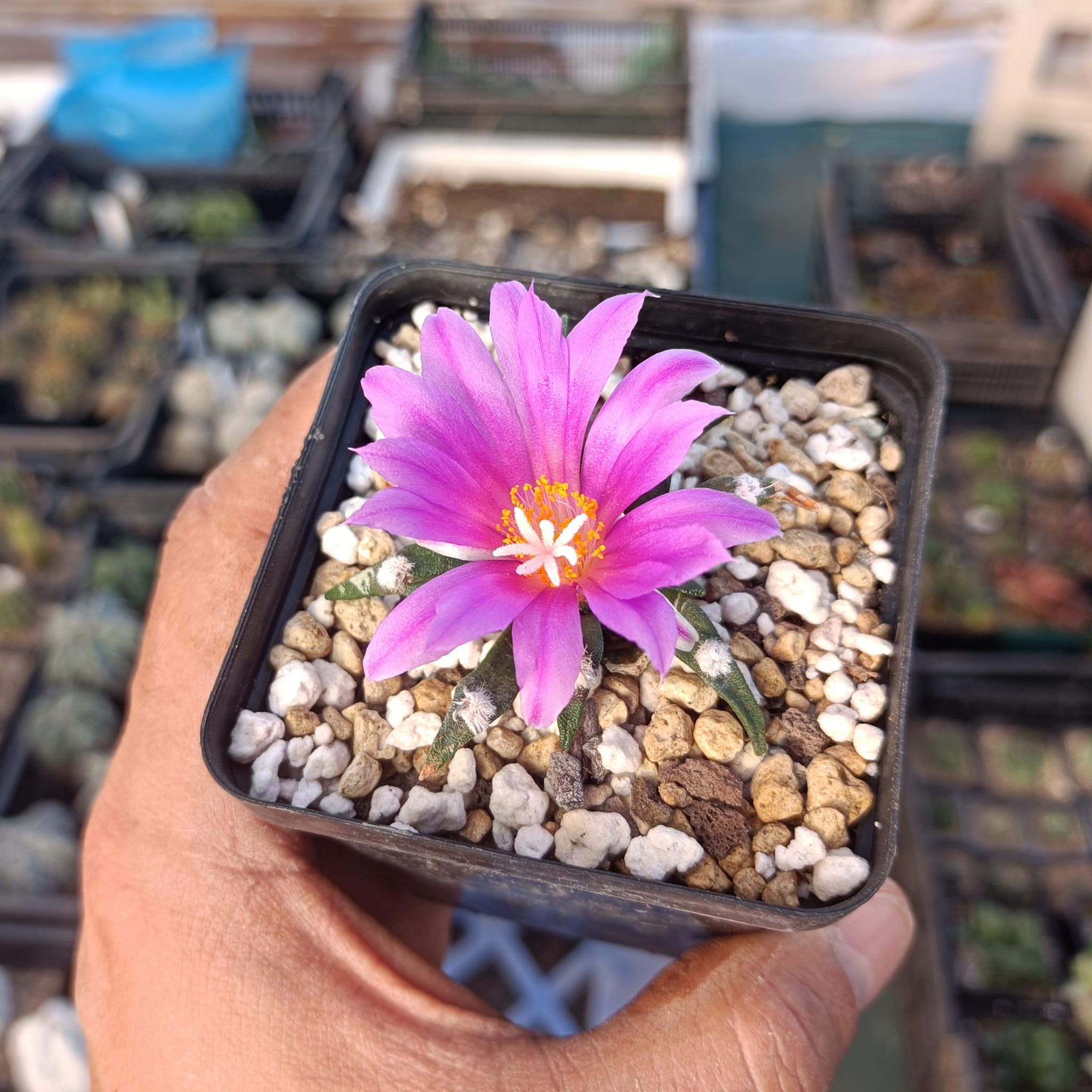
Ariocarpus agavoides produces vivid magenta flowers that are disproportionately large relative to the small, dark body beneath them. Flower diameter ranges from 3.5 to 5 centimetres. The outer perianth segments carry greenish-white margins, while the inner segments are a deeper, more saturated magenta. The pistils are deep yellow and the stamens white, creating a colour contrast at the flower centre that adds to the overall visual impact. These are among the most intensely coloured flowers in the genus, comparable to the deep magenta of Ariocarpus kotschoubeyanus and significantly more saturated than the pale pink of Ariocarpus fissuratus or the white of Ariocarpus retusus.
Flowering occurs in autumn, typically October through November, and plants can reach flowering maturity in as few as five to eight years from seed under good conditions. This is relatively fast for an Ariocarpus. Individual flowers last two to four days, opening during daylight and closing at night. Established plants may produce several flowers in sequence over the flowering season.
The fruit is globose, pinkish-red to reddish-purple when fresh, turning brown as it dries. Fruit length reaches up to 2.2 centimetres. Seeds are black and small, consistent with the genus. Fruit development is slow, ripening over several weeks after pollination. The fruit often remains partially buried in the central wool of the crown, and growers working with this species sometimes need to excavate the ripe fruit carefully to harvest seed.
From Seedling to Specimen
Compared to several other Ariocarpus species, Ariocarpus agavoides is a slightly faster grower. The timeline to flowering maturity of five to eight years from seed is noticeably shorter than the ten to twenty years required for some of the larger species like Ariocarpus retusus or Ariocarpus fissuratus. This relative speed does not make it fast by any normal horticultural standard, but it does make it a rewarding member of the genus for growers working from seed.
Germination from fresh seed is reliable under standard conditions: a sealed propagator over bottom heat at 25 to 35 degrees Celsius produces sprouts within five to ten days. Young seedlings are small, round, and green, showing the tiny rudimentary spines that most Ariocarpus carry in their juvenile phase. Unlike the other species, where these spines vanish entirely within the first year or two, Ariocarpus agavoides seedlings retain and develop their spines as they mature, a visible sign of the species identity from an early stage.
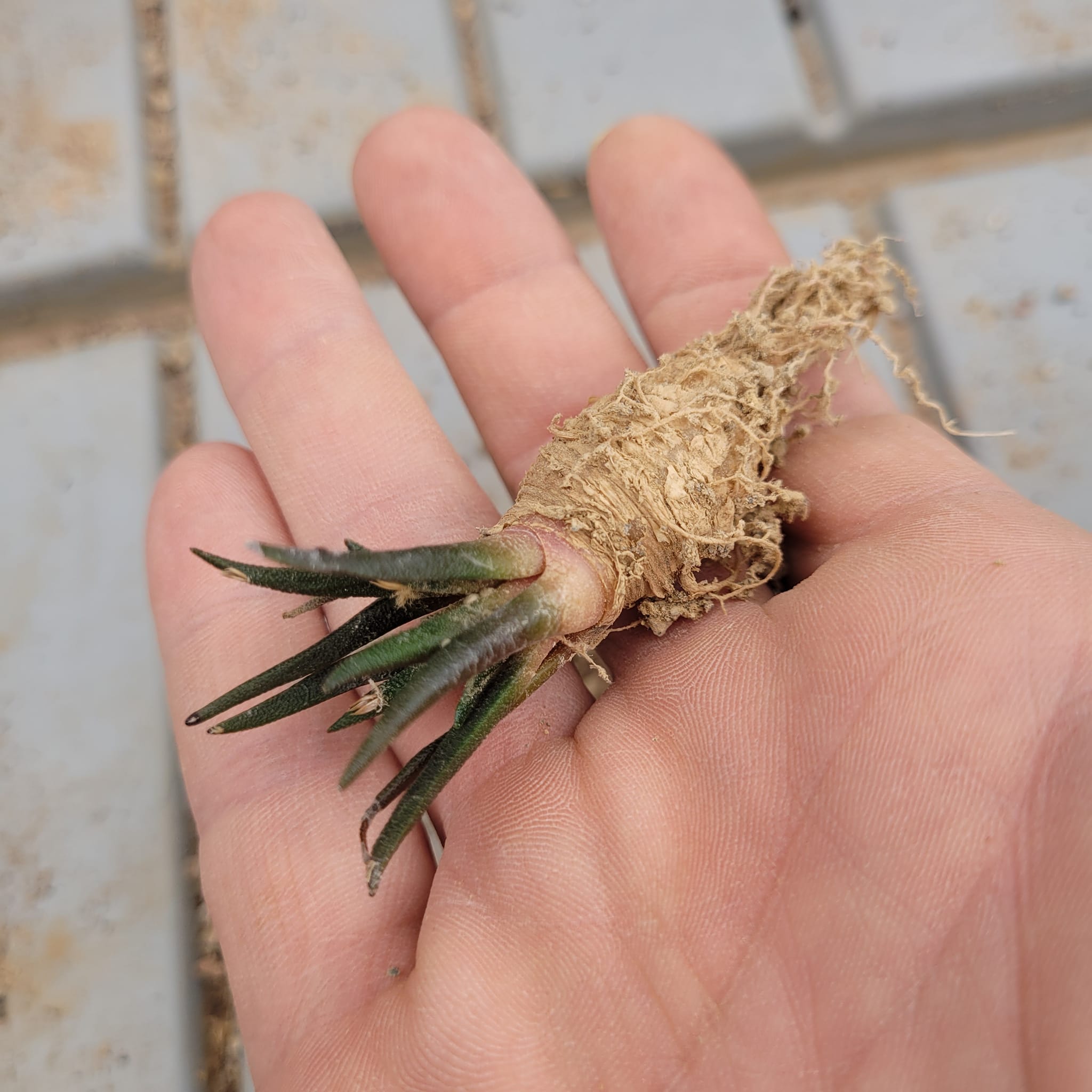
Grafting onto Pereskiopsis rootstock is practised for this species and accelerates growth significantly, bringing plants to flowering size in three to five years. The trade-off is the same as for all grafted Ariocarpus: the body grows upright and enlarged rather than flat and compact, and the character of an seed-grown specimen is not replicated. For growers building a long-term collection, seed-grown from seed remains the standard. A mature seed-grown Ariocarpus agavoides, five to eight centimetres across with its dark green spined rosette and a flowering history measured in years, is a different object entirely from a grafted plant of the same age.
Ariocarpus agavoides care and cultivation
Substrate
A mineral-dominant substrate built for fast pot drainage. In habitat this species grows over calcareous hills north of Ciudad Victoria in Tamaulipas, but a pot is a different system, so the recipe below is a cultivation formulation, not an attempt to recreate that ground. The canonical ratio is 43 per cent pumice, 15 per cent lava rock, 5 per cent zeolite, 20 per cent granite grit, 12 per cent limestone chip, and 5 per cent worm castings. The zeolite buffers pH around 7.0 to 8.0 and paces nutrients through the watering cycle; the lava is the structural drainage aggregate; the limestone chip is a genus-wide house convention rather than an agavoides-specific finding, and growers on hard tap water should reduce or omit it since the water itself already supplies calcium. Drainage is the overriding constraint: the taproot will not tolerate waterlogged conditions, and the mix must dry completely between waterings.
All eleven Ariocarpus pages on this site share one uniform mineral formulation; no cultivation source anywhere in the genus supports a different mineral share for any taxon, gypsum-hill locality included. The limestone chip sits at 12 per cent, a house convention drawn from published grower recipes (one of which runs as high as 20 per cent) rather than a per-species measurement, and growers on hard tap water should reduce or omit it since the water itself already supplies calcium.
| Species | Pumice | Lava | Zeolite | Granite | Limestone | Silica | Organic |
|---|---|---|---|---|---|---|---|
| A. fissuratus | 43% | 15% | 5% | 20% | 12% | 0% | 5% |
| A. fissuratus subsp. lloydii | 43% | 15% | 5% | 20% | 12% | 0% | 5% |
| A. retusus | 43% | 15% | 5% | 20% | 12% | 0% | 5% |
| A. retusus subsp. furfuraceus | 43% | 15% | 5% | 20% | 12% | 0% | 5% |
| A. retusus f. cristata | 43% | 15% | 5% | 20% | 12% | 0% | 5% |
| A. kotschoubeyanus | 43% | 15% | 5% | 20% | 12% | 0% | 5% |
| A. scaphirostris | 43% | 15% | 5% | 20% | 12% | 0% | 5% |
| A. agavoides (this page) | 43% | 15% | 5% | 20% | 12% | 0% | 5% |
| A. bravoanus | 43% | 15% | 5% | 20% | 12% | 0% | 5% |
| A. bravoanus subsp. hintonii | 43% | 15% | 5% | 20% | 12% | 0% | 5% |
| A. trigonus | 43% | 15% | 5% | 20% | 12% | 0% | 5% |
Containers and watering
Deep pots with a height-to-diameter ratio of at least 1.5 to 1 accommodate the taproot. Plastic or ceramic pots are preferable for the additional evaporation they provide. Water thoroughly during the growing season (late spring through early autumn), allowing the substrate to dry completely between waterings. Stop watering entirely from early autumn through late spring. The winter dry period is essential and reflects the natural rainfall pattern of the species’ habitat.
Light and temperature
Full sun for mature, acclimatised plants. Direct light produces the tightest rosette form and the darkest green colouration. New arrivals or plants recently moved from shade should be introduced to full sun gradually over several weeks to avoid bleaching. Cold tolerance is reasonable for a species from 1,000 to 1,900 metre elevations: established plants with dry roots tolerate brief drops to around minus 4 degrees Celsius. USDA zones 9b through 11b are viable for year-round outdoor culture in sheltered, well-drained positions.
Seed grown vs. grafted or degrafted
Both approaches serve a purpose. Grafted plants reach flowering size faster and are useful for seed production. seed-grown plants develop the correct flat profile, dark colouration, and proportionally accurate tubercles. The two are complementary. Many specialist growers maintain grafted stock for seed and seed-grown specimens for the collection bench.
Frequently asked questions
How difficult is Ariocarpus agavoides to grow?
How is Ariocarpus agavoides propagated from seed?
Is Ariocarpus agavoides legal to own?
Where does Ariocarpus agavoides grow in the wild?
When does Ariocarpus agavoides flower?
Related Taxa in the Genus
Ariocarpus fissuratusThe living rock. Most widely grown species in the genus, ranging from central Mexico into Texas. Heavily fissured grey-green tubercles and a thick woolly crown.Ariocarpus fissuratus subsp. lloydiiDistinct tubercle character and a convex, smoothly textured body from Coahuila and Zacatecas. Occasionally available in the specialist trade.Ariocarpus retususThe largest species in the genus, reaching 20 centimetres across. Most variable Ariocarpus and the natural starting point for collectors.Ariocarpus retusus subsp. furfuraceusWoolly, papillose tubercle surfaces distinguish it from the type. Preferred by many collectors for its refined texture.Ariocarpus retusus f. cristataThe cristate form. Exceptionally rare. Seed-grown specimens are almost never seen in collections.Ariocarpus kotschoubeyanusThe smallest Ariocarpus, rarely exceeding 4 centimetres. Magenta flowers on a tiny flat body. Requires perfect drainage.Ariocarpus scaphirostrisSingle population in Nuevo León. Boat-shaped tubercles unique in the genus. Another single-valley specialist like Ariocarpus agavoides.Ariocarpus bravoanusRecently separated from Ariocarpus kotschoubeyanus. Dark green ascending tubercles with a verrucose surface. Includes subsp. hintonii.Ariocarpus bravoanus subsp. hintoniiDistinct form with a restricted range within Nuevo León. Intermediate between bravoanus and the fissuratus group.Ariocarpus trigonusThe only yellow-flowered Ariocarpus. Triangular upward-pointing tubercles and a sprawling wide-bodied growth habit.
Sources & References
Castañeda, M. (1941). Neogomesia agavoides. Cact. Succ. J. (Los Angeles) 13: 99. · Anderson, E.F. (1962). A revision of Ariocarpus (Cactaceae). I. The status of the proposed genus Roseocactus. Amer. J. Bot. 49: 615. · Anderson, E.F. & Fitz Maurice, W.A. (1997). Ariocarpus revisited. Haseltonia 5: 1–20. · Anderson, E.F. (2001). The Cactus Family. Timber Press. · Sotomayor, M., Arredondo, A., Sánchez Barra, R. & Martínez-Mendéz, M. (2003). Ariocarpus agavoides subsp. sanluisensis. Brit. Cactus Succ. J. 21: 100. · Halda, J.J. & Horá?ek, P. (2003). Ariocarpus agavoides subsp. pulcher. Acta Mus. Richnov., Sect. Nat. 10: 149. · Halda, J.J. (1998). Ariocarpus kotschoubeyanus subsp. agavoides. Acta Mus. Richnov., Sect. Nat. 5: 35. · Gómez-Hinostrosa, C. et al. (2013). Ariocarpus agavoides. IUCN Red List of Threatened Species. · Hernández, H.M. & Gómez-Hinostrosa, C. (2011). Mapping the cacti of Mexico. Succulent Plant Research 7: 1–128. · Royal Botanic Gardens, Kew. Plants of the World Online. Ariocarpus agavoides (Castañeda) E.F.Anderson. Retrieved 2026.